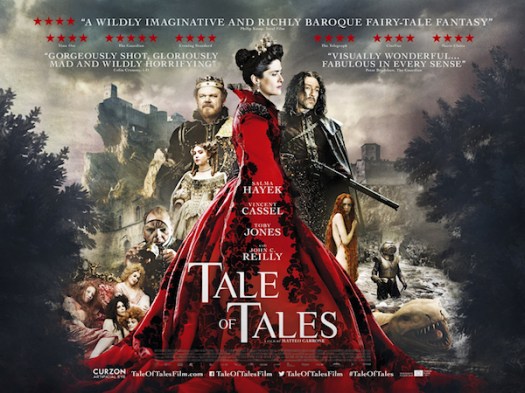
Logan (2017)

2017 #30
James Mangold | 137 mins | cinema | 2.35:1 | USA / English & Spanish | 15 / R

This review contains major spoilers.

Logan

Little Miss Sunshine meets Hell or High Water via Midnight Special, with more superpowers and (probably) fewer Oscar nominations, in the film some people are calling the best superhero movie since The Dark Knight.

In the not-so-distant future, the man once known as Wolverine, Logan (Hugh Jackman), is living / hiding on the US-Mexico border, his once formidable powers diminished by age. He works as a limo driver to afford meds for an ailing Professor Charles Xavier (Patrick Stewart), whose psychic powers have become dangerous as his brain falters with age. When a woman recognises Logan and asks for his help, the disillusioned former X-Man fobs her off. But soon dark forces and a mysterious girl (Dafne Keen), not to mention his innate moral code, will force his claw-wielding hand…

While Marvel Studios harp on about how they mix other genres into their superhero movies, with such-and-such a film being superheroes-cum-political-thriller, or this-and-that film being superheroes-cum-heist-movie, and so on, everything they produce is really merely colouring within the lines of the superhero picture, they’re just using different crayons to do it. Logan not only uses different crayons, but it’s colouring a whole new picture, too. It’s not the first superhero movie to operate at a remove from the standard big-budget tropes of the genre, but it is perhaps the first from a major franchise to dare to step so far outside the norm. As I intimated at the start, the feel of the piece is more indie neo-Western road movie than CGI-driven superhero spectacular, though to imply it stints on expensive action thrills would be disingenuous. It still cost $97 million, after all, and so works at ways to retain the favour of a blockbuster-seeking crowd. Nonetheless, the overall impression is of a refreshing change for the subgenre, with a more distinctive feel than any of those aforementioned Marvel movies.
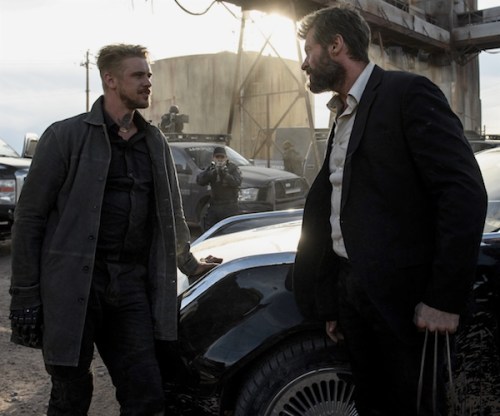
Wolverine vs Robotic Hand Man

That doesn’t mean it’s perfect, sadly. Functionally speaking, Logan barely has a villain. There are some ill-intentioned and dangerous people after X-23, so our heroes have to run away from them — that’s all the role they have to play. Heading up the hunt is Pierce (Boyd Holbrook), a henchman figure who’s de facto lead villain purely because he gets the most screen time. Unfortunately, he has more personality in his defining attribute, a CGI robotic arm, than in the rest of his characterisation combined. The theoretical Big Bad is Dr Zander Rice (Richard E. Grant), an evil scientist who we’re told developed some kind of virus that all but wiped out mutantkind, but now seems incapable of tracking down a group of preteens. He’s not on screen enough to make any kind of meaningful impression. On the bright side, on my “how badly miscast is Richard E. Grant” scale (which ranges from “very badly” to “not that bad, I suppose”) this errs towards the positive end, precisely because of that lack of screen time. Lastly there’s younger, fitter Wolverine clone X-24 (also Jackman), who’s at least intentionally devoid of personality — he’s been bred without it so he’ll be the perfect biddable killing machine. Obviously he’s ripe for some sort of thematic commentary — on ageing; on morality; on heroism; on, frankly, anything — but it never comes.

With the villainous side of the equation so unbalanced, we’re left primarily with our heroes. Fortunately, they do take up the slack, mainly through a pair of fantastic performances from Jackman and Stewart. Wolverine is undoubtedly the defining role of Jackman’s career, a part he’s played on and off for 17 years across seven movies (as a lead, plus a couple more cameos). Here he’s the most human he’s ever been. In many ways Logan was always one of the most relatable X-Men, one of our points of entry into their world and taking the piss out of them and the situation when it was called for. He was still primarily a likeable character in a fantastical world though, whereas here he feels more like a real person, struggling with the physical detriments of ageing and (less explicitly) the metaphysical quandaries of what it was all for. As he puts his time with the character to bed, Jackman gets to deliver his most nuanced and affecting turn in the role. Neatly, it mirrors where it all began for this version of the character: protecting a young mutant girl struggling to come to terms with her dangerous powers in a world that’s out to get her.

Professor X-piring

Stewart is every bit as good as a man defined by his mental prowess whose mind is failing. Originally cast to play a statesman-like role in the series, here Stewart gets to have a bit more fun, to be a bit more cheeky, but also to tap into a bit more depth of emotion, as Charles struggles with whatever it was he did to land him in hiding in Mexico (I think there was some dialogue that explained it but, frankly, I missed it in the mumbly sound mix. I’ll catch that on Blu-ray, then).

Of course, they both die. Normally that’d be shocking in a major studio blockbuster, but it’s quite clear Logan is playing by different rules, and in those rules the old good guys die. Heck, nearly everyone dies, but the only deaths that matter are Charles’ and Logan’s. What’s at least a bit interesting is how they die. For Professor X, it’s almost ignominious, — in a bed, not even his own, stabbed by X-24 for virtually no reason, then later fading away in the back of a truck. It’s not a grand heroic self-sacrifice while trying to save the world, the kind of death you’d expect for a character of his stature (and more or less the kind he got in The Last Stand, the first time they killed him off). It’s a great life come to a meaningless end. Well, Logan’s that kind of movie — it has no reverence for such things, just as life itself does not. Conversely, the death of Wolverine / Logan / James Howlett (who is he, in the end?) is a sacrifice, the selfish man of the movie’s opening giving himself up to save some kids; or, in grander terms, to save the future. Ah, but he was never really selfish, was he? It was an act. An affection brought by the hard years. He was always a good guy at heart. Always an X-Man, as the neat final shot emphasises.
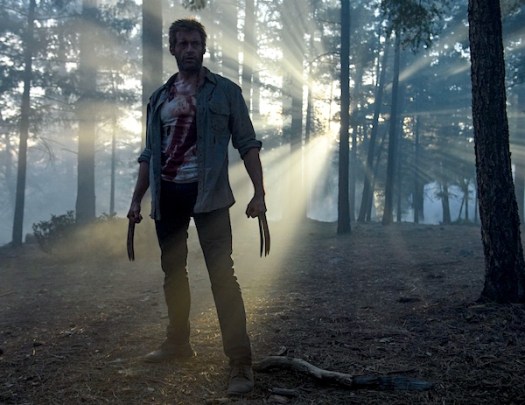
Wolverine: The Last Stand

So there is some thematic meat to tuck into here, even with the apparent dead-end (pun not intended) of the X-24 subplot. Couple that with the many uncommon-to-the-genre plot and tonal points and you have a movie that does merit consideration as one of the finer superhero films. However, the perception some espouse of this being brave or bold moviemaking is not inherent to the film. If this were an original story starring new characters, especially if they didn’t have superpowers, it wouldn’t make it a bad film, but nor would it be perceived as being so original or revolutionary. What is uncommon or remarkable is making that kind of movie with a well-known character, and in particular one who’s familiar from leading CGI-fuelled PG-13 summer spectacles.

Is that alone enough to confer greatness? Logan’s consistency of style and tone render it easily the best Wolvie solo movie (as much as I liked The Wolverine on the whole, its climax was horrible), but for this X-fan it’s not enough to usurp the top-draw traditional superheroics to be found in the three or four genre classics produced by the main series. Perhaps time and re-viewing will increase Logan in my estimation, however, because it is a very strong film indeed.

4 out of 5

100 Films @ 10: Short Films

For the final in my series of ten top tens (yes, we’ve reached the end already / finally (delete as appropriate)), I’ve decided to take a look at one of the less-discussed aspects of the film world: shorts.

In the past ten years I’ve watched and reviewed just 51 short films, but as I’ve never ranked them before it seemed overdue that I create some kind of quality-sorted list. Here, then, are my ten favourite short films that I watched in the last decade.

10
Pixels

Don’t worry, there’s no Adam Sandler in sight — this Pixels is the three-minute short that went down so well online someone bought the rights and turned it into a feature. A fun idea, it works better as a narrative-less couple of minutes than it did forced into the shape of a blockbuster.

9
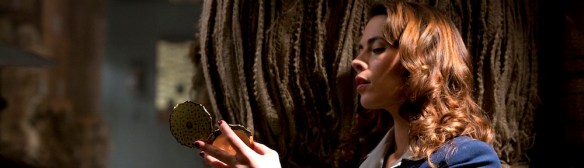
Marvel One-Shot: Agent Carter

Easily the best of Marvel’s now-defunct series of short films, Agent Carter was so good — exciting, characterful, funny — that it was later expanded into a two-season TV series (which I still haven’t watched. Oops.)
8
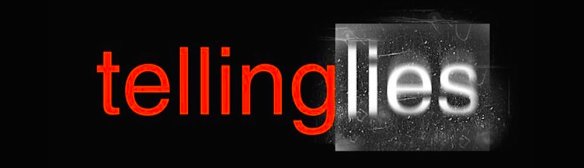
Telling Lies

A simple idea, very well executed: as we listen to a series of phone conversations, the speakers’ dialogue appears on screen… except instead of transcribing their exact words, it reveals their true thoughts. At only a few minutes long Telling Lies doesn’t outstay its welcome, instead maintaining the basic idea well and crafting a neat and amusing little story with it.

7
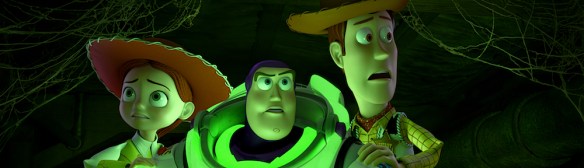
Toy Story of Terror!

Having managed to beat the odds and create three great Toy Story movies, Pixar seemed foolish trying to extend it further as a franchise. Toy Story of Terror justifies that decision, however, with a story, style, and message that would’ve been strong enough to be a whole feature (with some expansions, of course) but plays equally well in just 20 minutes.

6
Wallace and Gromit in A Matter of Loaf and Death

As with #7, this was a seasonal special for old animated favourites that would’ve worked just as well (perhaps even better) expanded out to a full feature. A Matter of Loaf and Death is the first Wallace & Gromit film since the very first not to win an Oscar, but it’s every bit as good as its forebears — I can’t think of much higher praise than that.

5
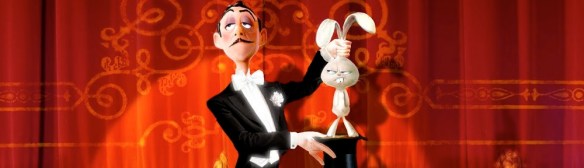
Presto

The Pixar short that accompanied WALL-E, Presto is a perfectly-executed piece of near-silent slapstick tomfoolery. Surprisingly, this also lost out on an Oscar. Its director went on to co-direct last year’s Storks, which… didn’t go down so well.

4
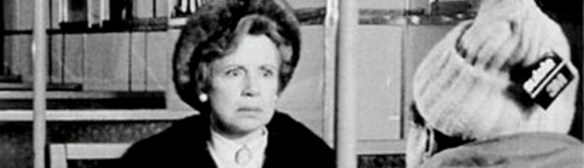
The Lunch Date

Winner of the short Palme d’Or and an Oscar, The Lunch Date is a clever little tale with a well-disguised twist. I imagine if it was made today people would talk about its social relevance, which is a little depressing nearly 30 years on, but there you go. The first work by director Adam Davidson, he’s since gone on to helm episodes of shows like Six Feet Under, Lost, Deadwood, Dexter, Rome, True Blood, Fringe, Fear the Walking Dead, and many, many more.

3
The Present

As with most of the best shorts, The Present presents a simple but effective idea quickly and with a strong emotional hit. A cute tale of a boy and his dog, it also has a message about positivity and overcoming adversity. No Oscar here, but its director has since worked for Disney on Zootropolis and Moana, as well as on The Secret Life of Pets and Revolting Rhymes.

2
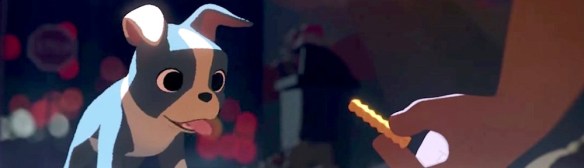
Feast

Another lovely short, also told economically and without dialogue, about a friendly little dog who helps out his owner. Yeah, I’m a sucker for cute dogs. But Oscar-winner Feast is also beautifully animated: nicely stylised and executed as essentially one long montage, proving again that exceptional filmmaking can create an emotional experience in the briefest of times.

1
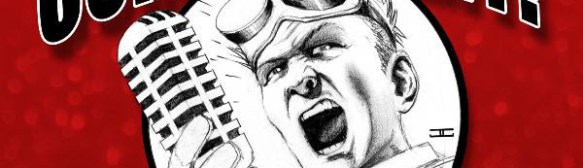
Commentary! The Musical

Unlike the previous films on this list, it’s the very opposite of silent — it is, in many ways, all about sound. There’s also no big emotional hit and no sniff of awards recognition either. So why does Commentary! The Musical top my list? Because it so impressively made. It’s the commentary track on Dr. Horrible’s Sing-Along Blog, but rather than just the production team chatting about how they made the show, it’s sung through. And it’s not just a collection of new songs played over the original production — it’s frequently scene specific, sometimes even shot specific. It’s an incredible feat of writing and planning; not only that, but it’s hilariously funny too.

Tomorrow: birthday day.

100 Films @ 10: Basil Rathbone Sherlock Holmes Films

Yesterday I ranked the film series that have been a part of 100 Films down the years. The Sherlock Holmes films starring Basil Rathbone as the Great Detective and Nigel Bruce as his trusty sidekick Dr Watson may only have placed 6th on that list, but they have been a regular presence on my blog for most of its life as I slowly worked my way through all 14, from The Hound of the Baskervilles in Year 2 to Dressed to Kill as the record-breaking #200 in Year 9.

It seemed only fitting to include the series in my tenth birthday celebrations, therefore, so for today’s top ten I’ve gone back over all my reviews (and memories) and used them as a guide to rank my ten favourite instalments.

10
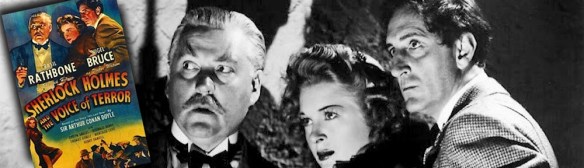
Sherlock Holmes and the Voice of Terror

“The basic concept is a nice idea for a war-set spy-thriller, but not really for a Sherlock Holmes mystery. […] The consensus seems to be against me, but by the end I was quite enjoying Voice of Terror. It may be a Sherlock Holmes film in name only, but taken instead as a cheap spy thriller it makes for passable entertainment.” Full review.

9
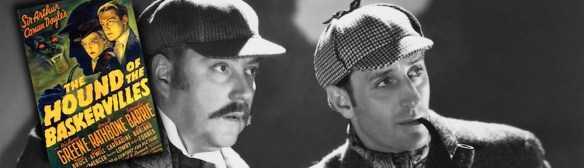
The Hound of the Baskervilles

“One of the novel’s strong points is its occasional Gothic styling, and this is something the film version does very well. Dartmoor looks fantastic, like something Tim Burton would have created were he working in the ’30s. It’s clearly a set, but it’s dramatic and moody and completely effective.” Full review.

8
Terror by Night

“a contained, almost claustrophobic version of a Holmes tale. There are definite pros to this: it’s effectively a locked room mystery, with an element of howdunnit closely tied to the whodunnit. […] That it’s one of the series’ lesser instalments but still so enjoyable is simply testament to their overall quality.” Full review.

7
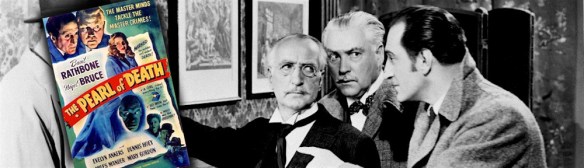
The Pearl of Death

“Holmes first rescues the priceless Borgia Pearl, but then quite spectacularly loses it. The notion of Holmes being doubted, of having to prove himself to reassert his reputation, is a good one — one recently borrowed by avowed Rathbone fans Moffat & Gatiss for their modern-day Sherlock, in fact.” Full review.

6
Sherlock Holmes and the Secret Weapon

“The name’s Holmes, Sherlock Holmes, as Universal’s loose adaptations of Britain’s Greatest Detective deliver a low-key proto-Bond, 22 years before Goldfinger applied the same tricks to Britain’s Greatest Spy. […] As with Voice of Terror, I enjoyed a lot of Secret Weapon in spite of its distinct un-Holmes-ness — it’s another pacey, exciting World War Two spy thriller.” Full review.

5
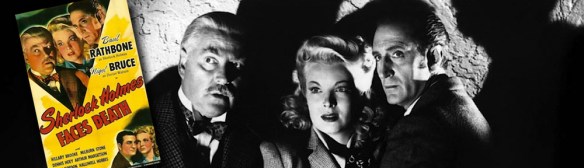
Sherlock Holmes Faces Death

Faces Death leaves behind the proto-Bond WW2 spying of the last three films (“it can almost be viewed as the starting point of a completely new Holmes series” asserts one review I’ve read) to involve Holmes in a genuine detective mystery […] packed with proper deduction, which is excellent.” Full review.

4
The Adventures of Sherlock Holmes

“There’s rain-lashed, fog-drenched Victorian London streets! Brutal murders by foul foreigners! Dastardly plots against the crown! Galloping carriages! Romantic subplots! A smattering of comedy! A song-and-dance number! (No, really, there is.) And a final shoot out… in the Tower of London! You can’t escape the joyous feeling that this was designed as pure entertainment, literally including something for everyone.” Full review.

3
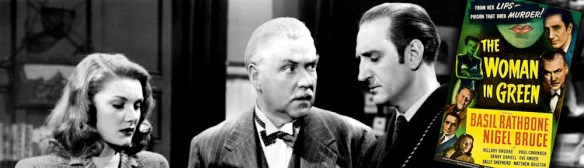
The Woman in Green

“Starting with a particularly vile series of murders that mask an even more detestable scheme and genuine peril for our hero, I can imagine some fans would find The Woman in Green to be too big a step outside the Rathbone Holmes comfort zone. For me, however, these elements mark it out as one of the series’ best instalments.” Full review.

2
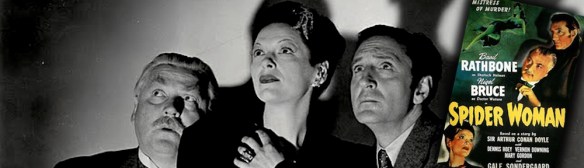
The Spider Woman

“Screenwriter Bertram Millhauser skillfully mixes elements from various Conan Doyle tales [including] The Sign of Four, The Final Problem, The Adventure of the Empty House, The Adventure of the Devil’s Foot and The Adventure of the Speckled Band. […] Several of these borrowed elements — the faked death and The Woman — lead to some delicious scenes, such as when Holmes reveals he’s alive to Dr Watson, offering one of those occasions where Bruce’s comedic rendition of the role actually works.” Full review.

1
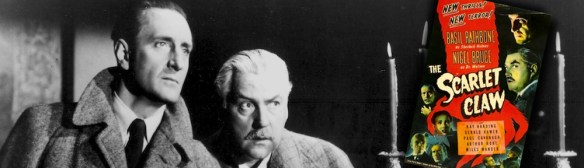
The Scarlet Claw

“[Roy William Neill’s] direction is incredibly atmospheric, from a wonderful mist-covered opening scene, replete with an incessantly tolling bell, to regular instances of shadow-drenched photography afterwards; not to mention various pleasing camera angles and moves. The story — in which townsfolk believe a mythical beast has returned to murder its residents — presents a well-constructed mystery all round, though as it moves into the second half some of its twists become all too guessable. [Such] little niggles may stop the film from being perfect but, like the similarities to The Hound of the Baskervilles, while they’re certainly there, they’re easy to overlook in the name of a rollicking good horror-mystery-adventure.” Full review.

Tomorrow: as seen on TV.

100 Films @ 10: Most-Played Soundtracks

For today’s top ten I’ve opened up iTunes, sorted all my songs by play count, and seen which are my most-listened-to cues from film & TV soundtracks. I’m not a great musical connoisseur, really, so because of that and this just being a statistical most-played list, expect lots of exciting action music — especially as this includes plays from when I wrote a blockbuster-style screenplay for one of my university dissertations, so I listened to an awful lot of that kinda stuff then.

Couple of other points: These are all score cues rather than songs that are on soundtracks, because, well, that’s what I chose to do. However, I have included trailer music, but only when it was composed especially for the trailer — nothing from those generic “music for trailers”-type albums. Finally, I’ve ditched repeats from the same album, because I thought this would basically be the track list for Pirates of the Caribbean otherwise. Turns out that wouldn’t’ve been the case, and instead it removed a track from, of all things, Torchwood.

10
Suite from X2

from X-Men 2

I’ve written before of my fondness for John Ottman’s X-Men theme. As this was the only version of it for years, I listened to it plenty. I guess it’ll be supplanted by the version from X-Men: Apocalypse eventually, because the tracks on that album are less ‘cluttered’ with other bits of the score. (As the confusion about X2’s title continues, let me note this: the UK soundtrack album is called X-Men 2 and this track on it is called Suite from X2; the US soundtrack album is called X2 and this track on it is called Suite from X-Men 2.)

9
Wheel of Fortune

from Pirates of the Caribbean: Dead Man’s Chest

From the second Pirates movie, this is the cue from the big sword fight climax — which, as you may remember, includes a runaway water wheel, hence the title. For all his production-line type methods, Hans Zimmer can deliver a very effective action cue.

8
Closing Credits: “Bolero”

from Moulin Rouge

As with much of the music in Baz Luhrmann’s musical, this is a track that suggests a lot of drama, even if it ‘only’ plays over the end credits. I can’t really explain why I like it so much, but I do. For whatever reason I listened to it every day on my way to work when I interned for a summer in New York, which (a) didn’t do its play count any harm, and (b) means I always associate it with riding the Subway, weirdly. As to who wrote it, I’ve got it down as being by the film’s composer, Craig Armstrong, but Wikipedia says Steve Sharples and Allmusic says Simon Standage, so I dunno.

7
This is Gallifrey: Our Childhood, Our Home

from Doctor Who: Series 3

Murray Gold has been composing all of Doctor Who’s music for over a decade now, which is quite an achievement, especially for a show that so regularly changes its style — week to week, in many respects. My favourite piece of his work is probably his theme for the 11th Doctor, created for series five, but I’ve most listened to this elegiac piece for the Doctor’s home planet from the series three finale.

6
Mind Heist

from the Inception trailer

Braaaam! Christopher Nolan’s film is perhaps most famous for defining trailer music for the next… well, it’s still kinda ongoing, isn’t it? Yet that recognisable cue used in the trailers isn’t actually from the film itself. Heck, it’s not even by the film’s composer, Hans Zimmer (him again!) The story behind it is a mite more complicated, but Zack Hemsey was one of the main people involved in the final trailer, and it was he who put out a track with his version of that work, so here it is.

5
The James Bond Theme

from the Casino Royale trailer

Monty Norman’s James Bond Theme has been re-worked countless times down the years, but this version struck me as soon as I first heard it for one key reason: voices. The final part of the track has the familiar tune accompanied by a choir, I believe for the first time, and it sounds fantastic. It was created by trailer music outfit Pfeifer Broz. Music specifically for the Casino Royale trailer, so you won’t find it on the soundtrack CD, but, of course, it’s still out there to be found…

4
Can You Dig It (Iron Man 3 Main Titles)

from Iron Man 3

Despite their continued success, there are criticisms regularly raised against Marvel’s shared universe movies. One is the weak villains. Another is the painfully generic music. That’s precisely why Brian Tyler’s title theme from the third Iron Man stands out so: it accompanies the ’70s-action-show-style credit sequence with a ’70s-action-show-style reworking of the film’s main theme (which I also quite like, but is much more standard “modern blockbuster music” in sound).

3
Drink Up Me Hearties

from Pirates of the Caribbean: At World’s End

More Zimmer Pirates. This is the final cue, accompanying the end credits of the film, and as such is something of a summation of the series’ music. It’s kind of the epitome of modern blockbuster scores, for good or ill.

2
The Chase

from Torchwood

More Murray Gold, here composing with his Doctor Who orchestrator, Ben Foster. This ticks many of the boxes I mentioned at the start: an action cue from my screenwriting playlist. Gold’s Whoniverse music has most often been in the style of modern blockbuster movies, because that’s the feel the show has gone for, but by distilling the essence of that style he has on occasion produced tracks that exceed its big-budget counterparts for effectiveness. This is one such occasion: as fast-paced action tracks go, this is often one of the fastest and actioniest.

1
He’s a Pirate

from Pirates of the Caribbean: The Curse of the Black Pearl

The creation of Pirates of the Caribbean’s soundtrack is a notorious clusterfuck of composers literally competing against each other to produce something for the Disney movie. Reports vary on what exactly went on, but I believe the long and the short of it is Klaus Badelt wrote the most music that was actually used and so got the credit on the CD. Presumably Hans Zimmer didn’t think the film would be all that big and didn’t care — he certainly took the credit for the sequels’ scores, though. Anyway, this recognisable main theme actually has its roots in another Zimmer score, Drop Zone, as you can hear here. Shocking self-plagiarism, ain’t it? Still, this improved version is the one everyone knows now, and it’s wound up my most-played soundtrack track.

Tomorrow: never-ending stories.

In a Valley of Violence (2016)

2017 #20
Ti West | 104 mins | download (HD) | 2.35:1 | USA / English | 15 / R

In a Valley of Violence

The spirit of the Spaghetti Western is alive and well in writer-director Ti West’s shoot ’em up; though where they once took inspiration from samurai movies, now Mr West has his sights set on modern-day gun-fu movies — specifically, here he retrofits John Wick into a familiar Old West narrative.

On his way to Mexico with just his horse and dog Abby for company, drifter Paul (Ethan Hawke) passes through an almost-deserted town, where he ends up in a fight with wannabe-tough-guy Gilly (James Ransone). It turns out Gilly is the son of the local Marshal (John Travolta), but he considers the matter settled and lets Paul move on, ordering his son to leave it be. A shamed Gilly has a different opinion, however, leading his gang of friends to assault Paul in the dead of night. But as is the way with halfwit villains, they leave our hero alive, ready for him to ride back into town and exact his vengeance.

If you come to movies looking for an original storyline, you’ll be disappointed here — as I say, it’s basically John Wick in the West (if you’ve seen that Keanu Reeves actioner, you’ll already know the outcome of Gilly’s revenge on Paul). The devil is in the details, however, and in that respect In a Valley of Violence is rather enjoyable. Perhaps the biggest mark in its favour is its sense of humour. It’s not a comedy by any means, but Gilly’s gang are borderline incompetent in a way that’s increasingly laughable.

Do you know what they call a Quarter Pounder with cheese in the West?

Travolta gets in on the act as a man who seems very much in control of his own little kingdom, but when things truly kick off he’s somewhat caught in the middle. Thankfully he’s not just the bullying villainous type, instead getting a nicely balanced reaction to events: he knows Gilly’s done wrong, but stands by him because he’s his son; but when Paul’s pushing comes to shoving… well, familial loyalty only gets you so far.

As Paul, Hawke finds some degree of complexity in the (anti-)hero, but this isn’t exactly a movie built for psychological complexity. Taissa Farmiga is positioned as the love interest, but thankfully isn’t entirely reduced to such a thankless role. As her sister, Karen Gillan reminds us that, while she may be best known for brightly-coloured sci-fi on screens both big and small, her roots are in comedy. But the biggest star is, of course, the dog. You can’t help getting attached, even when you know you’re watching John Wick of the West.

The dog's the star

The film offers many stylistic nods to remind us of its Spaghetti inspiration, like the starkly animated title sequence, or Jeff Grace’s Morricone-riffing score, which some criticise for its obviousness but I thought was fun. It even comes through in the film’s structure, with a slow-burn first half that reminded me of Leone’s attitude to action. Some complain of the pace there, or lack of it, but I rather liked that. It partly functions as a deliberate delaying of gratification: the main reason we’re here is for the bloody vengeance we know will eventually be coming, but West carefully sets the scene and gradually puts characters in place early on so that the second half can more fully concentrate on the violence. The wit is kept alive even then, with more than one of the deaths provoking at least some laughter.

The more I write about it, the more I wonder if this film is something of an acquired taste. It’s not out-and-out comical enough to be classed as a comedy, but action die-hards may feel the lighter elements undermine the violent thrills they seek. I thought it worked, but experience has taught me that I’m more accepting than most of such tonal mash-ups.

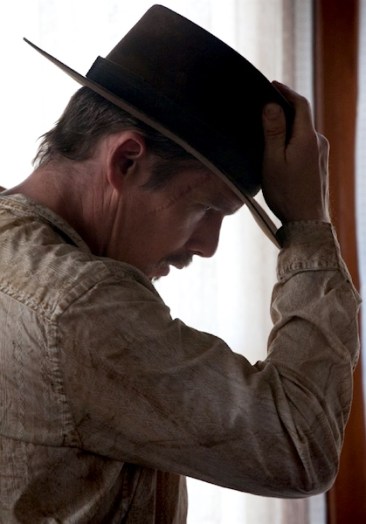
Cool cowboy

Despite the plot similarities, In a Valley of Violence isn’t going to challenge John Wick for ultra-choreographed action satisfaction, but it has many aspects to recommend it for those who like a chuckle alongside their bloodshed.

4 out of 5

In a Valley of Violence is released direct to DVD & Blu-ray in the UK on 6th March.
John Wick: Chapter 2 is in UK cinemas from today.

Love & Friendship (2016)

2016 #173
Whit Stillman | 94 mins | streaming (HD) | 1.78:1 | Ireland, France & Netherlands / English | U / PG

Love & Friendship

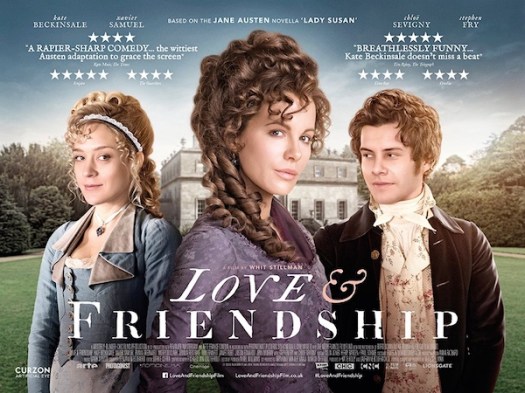
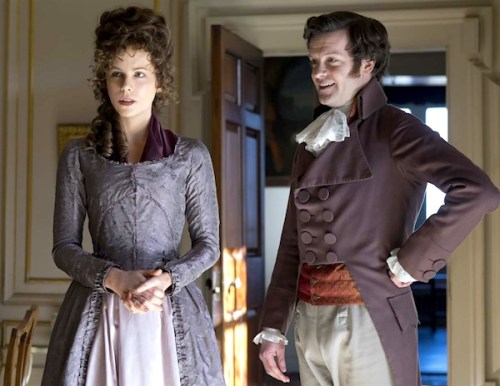
Adapted from Jane Austen’s early novella Lady Susan, writer-director Whit Stillman’s arch comedy concerns one Lady Susan Vernon (Kate Beckinsale), a widow with a certain reputation in polite society, which she endeavours to hide from while engaging in matchmaking machinations for both herself and her daughter.

That’s the vague version, anyway. The details of the plot are occasionally a mite too intricate to follow, especially as explanations tend to come after the fact, if they do at all. However, for those prepared to go along with it, the reward is a film that is at times hilariously funny.

Stillman’s writing and direction are both a little mannered, which will surely turn off some viewers, but the real stars are, indeed, the stars. Kate Beckinsale is phenomenal — funny, dry, biting, witty, but also conveying that Susan is making it all up as she goes, despite pretending to be in control. The other standout is Tom Bennett as the dimwitted Sir James Martin. His knowledge of the commandments and opinion of peas are particularly delightful.

Kate Beckinsale & Tom Bennett

Love & Friendship may be something of an acquired taste thanks to its stylistic affectations, but couple that with its wry sense of humour and it makes a likeable change from the heritage ambitions of most Austen adaptations. Perhaps, too, that makes it the Jane Austen film for people who don’t normally like Jane Austen films.

4 out of 5

Mad Max: Fury Road – Black & Chrome Edition (2015/2016)

2017 #19a
George Miller | 120 mins | Blu-ray | 2.40:1 | Australia & USA / English | 15 / R

Mad Max: Fury Road - Black & Chrome Edition

During post-production on Mad Max 2, aka The Road Warrior, director George Miller had a chance to watch composer Brian May (not that one) at work. As was standard practice, May was working with a ‘slash dupe’ copy of the film — a cheaply-produced duplicate print, which has the defining characteristic of being in black and white. Miller was instantly smitten, believing this was the best-looking version of his film. 30-something years later, during post-production on the fourth Max movie, Fury Road, Miller had the film’s colourist convert some scenes into black and white, and he once again discovered his preferred version. Only this time he mentioned it publicly and promised it would be released, which is more or less how, about 18 months after the film’s theatrical release, we ended up getting the so-called Black & Chrome Edition on Blu-ray. It finally makes its way to UK shores today… though only in a Zavvi-exclusive Steelbook edition, which has both already sold out and was dispatched to purchasers (like me!) last week. So, uh, so much for that.

Let’s start by getting some people’s obvious complaint out of the way: “Why do you need to buy it again? Why not just turn down the colour on your TV?” Well, you could, and you’d get an approximation of the effect; but if you have an appreciation for the fine details of film photography and colouring, that doesn’t cut it. The Black & Chrome version isn’t just the existing colour turned off — other things have been tweaked to heighten the experience, most obviously the contrast. Here’s a video that handily compares a selection of shots from the colour version, the Black & Chrome version, and the colour version simply desaturated:

If you’re thinking “but the two black & white ones look the same!” then maybe this isn’t for you. And that’s OK — it’s an alternate version, after all.

In his introduction (the only new special feature on the Blu-ray), Miller admits that at times you lose some information by not having the colour; however, at other times it looks even better, and he reiterates that he thinks this is the best version of the movie overall. Somewhat famously, the theatrical version of Fury Road has hyper-saturated colours as a reaction against the usual post-apocalypse movie look of heavy desaturation. It’s somewhat ironic, then, that Miller’s preferred version is the opposite extreme — but can you imagine any studio exec agreeing to release a $150 million black & white movie?

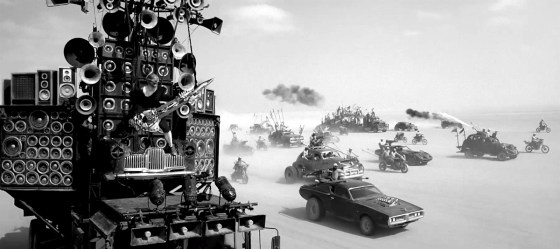
Also in that introduction, Miller expands on the appeal of the desaturated version: “Something about black and white, the way it distills it, makes it a little bit more abstract, something about losing some of the information of colour, makes it somehow more iconic.” He’s got a point. The starkness of the imagery really heightens the effectiveness of some shots and sequences. Indeed, taking a look at some parts of the colour version afterwards, it all felt so ‘busy’ thanks to the additional visual information. You may remember that, a few years ago, Steven Soderbergh shared a black and white version of Raiders of the Lost Ark, the point being to highlight the shot composition and editing, easier to focus on with the distraction of colour removed. And he’s right. Not in the sense that this feels like watching an assignment for film school, but in the sense that the point of the framing and focus is emphasised further without colour.

Black and Doof

And it does look beautiful. Cinematographer John Seale is clearly a master of lighting, something that’s only more apparent without colour. Indeed, Soderbergh said the same thing of Douglas Slocombe’s work on Raiders: “his stark, high-contrast lighting style was eye-popping regardless of medium.” Most of the movie looks like it’s been etched from silver — or, of course, chrome. The greys and whites are metallic, the blacks deep points of contrast. It looks gorgeous. It’s let down slightly by the nighttime scenes, however. They weren’t so hot in the colour version either, having been clearly shot in daytime and aggressively graded blue. Presumably that finished version was used for this, because rather than the stark imagery of the rest of the film, the nighttime stuff is kind of murky, the blacks kind of blue-ish, and it’s far less pleasing. (If you want to see for yourself, compare this screenshot to the others here.) Fortunately, that doesn’t make up much of the film.

Separate to the colour issue, Miller has expressed the influence of silent movies over Fury Road, including cutting the film without its soundtrack to make sure that it worked on a purely visual level. When he first promised the black and white edition would be released, he also said there’d be an isolated score option, to give the viewer the option of seeing the most stripped-back version possible. Sadly, that hasn’t happened. (He also promised a commentary and additional special features, which aren’t there either.) At times I tried to imagine how it would work in relative silence, and aside from a couple of places where you might want an intertitle or two, and the pre-climax scene where Max explains the new plan to Furiosa, it’d get by fine. So thoroughly committed is Fury Road to visual storytelling that even many of the dialogue scenes don’t actually need their dialogue — think about the early bit where Hux and Slit argue about who’s going to drive, for example. Sure, the dialogue makes explicit that Hux is normally the driver and Slit is taking his steering wheel because Hux is semi-incapacitated, but their body language conveys the gist of their disagreement clearly. It’s a shame Warners didn’t go the whole hog and let us have the option to experience the film with just the score, or score and effects, because I think it would’ve been equally interesting.

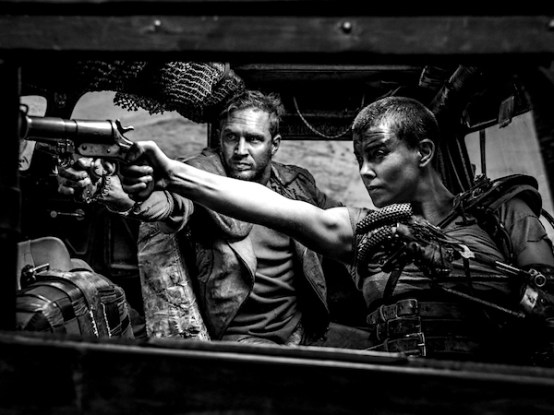
Furiouser and Furiosa

Obviously Fury Road: Black & Chrome is always going to be a curiosity for the dedicated fan rather than the primary way of viewing the film. Next time I watch it I imagine I’ll go back to the full colour version… but that’s mainly because I’ve only seen that version once anyway, so I want to re-experience the full impact of its wild colourfulness. However, for appreciating the quality of the photography, and for emphasising the legendary iconicity of Max and Furiosa’s story, I think Black & Chrome may well be the way to go.

5 out of 5

Mad Max: Fury Road – Black & Chrome Edition is theoretically released on UK Blu-ray today. It’s also available to own digitally from Amazon, iTunes (as an extra on the regular edition), and presumably other retailers (if they still exist) too.

Steven Soderbergh’s variation of Raiders of the Lost Ark will probably be reviewed at a later date, because I really want to watch that now.

The Maltese Falcon (1941)

2016 #142
John Huston | 96 mins | DVD | 1.33:1 | USA / English | PG

The Maltese Falcon

Humphrey Bogart is private dick and consummate bullshitter Sam Spade in this (re-)adaptation of Dashiell Hammett’s novel, considered the first major film noir.

The twisty plot of murder and thievery is enlivened by duplicitous performances from femme fatale Mary Astor, an effeminate Peter Lorre, the always welcome Elisha Cook Jr., and the humungous presence of Sydney Greenstreet, making his film debut at 60 and stealing every scene.

It’s also the directorial debut of John Huston, whose work alongside cinematographer Arthur Edeson is the greatest star: the low-key lighting and dramatic angles are (like the rest of the film) archetypal noir.

4 out of 5

The Maltese Falcon was viewed as part of my What Do You Mean You Haven’t Seen…? 2016 project, which you can read more about here.

Tale of Tales (2015)

aka Il racconto dei racconti

2016 #148
Matteo Garrone | 134 mins | streaming (HD) | 2.35:1 | Italy, France & UK / English | 15 / R

Tale of Tales

Based on 17th Century Italian fairytales by Giambattista Basile, Tale of Tales relates three interlocking stories of dark fantasy. If there’s one thing that really connects them, it’s thematic: essentially, “be careful what you wish for”; or maybe “be grateful for what you’ve got”. There are primary characters in each tale who go to disgustingly extraordinary lengths to achieve what they desire — eating a sea-monster’s heart raw, breeding a giant flea, self-flaying — and it rarely turns out for the best.

If you can stomach the contents, there’s a quality cast, and the locations, production design, and cinematography are simply gorgeous.

4 out of 5

Me and Earl and the Dying Girl (2015)

2016 #137
Alfonso Gomez-Rejon | 101 mins | streaming (HD) | 2.35:1 | USA / English | 12 / PG-13

Me and Earl and the Dying Girl

This is a film about a high school student who makes movie parodies for fun, who befriends a dying girl. It won the Audience Award at Sundance. I’m not sure there’s any other knowledge you need to judge if you’ll like this movie or not. Except normally that’d have me thinking “oh God, here we go,” but I liked it enough to put it in my Top 20 of last year.

So, I admit, I went into the film feeling pretty cynical about it. I was expecting to find a movie tailor-made to be an indie cinephile’s dream comedy-drama. There are elements of that about it, but I must also admit I ended up being won round and affected by the film, to the point of feeling quite emotional and often a little teary for, ooh, most of the second half. Was I just manipulated into feeling that way? Well, that question is a fallacy. All film is emotionally manipulative, because it has been constructed to achieve a purpose, and the people who complain about feeling manipulated by sappy dialogue or heavy-handed music or whatever have just seen behind the curtain, as it were. For these reasons it kind of annoys me when critics or ‘film fans’ get annoyed about a film being “manipulative”, but maybe that’s a rant for another time.

Me and Earl and the Criterion Collection

Anyway, as I was saying, I kind of didn’t want to like Me and Earl and the Dying Girl because I didn’t want to fall into the obvious trap of “this movie totally gets me because I love Criterion editions too!” But I thought it worked in spite of those pandering affectations. Or maybe I just couldn’t resist them on a subconscious level? In some respects it doesn’t matter how it achieved it: the film wanted to make me feel a certain way, and I did feel that way — success.

Perhaps another reason it worked for me was the positioning of Greg (the titular “Me”) as a high school “Everyman”, not affiliated with any of the school’s multitudinous social groups. I don’t think I’ve seen that in a film before. What movies (and TV) have taught us about American high schools is that they are chocka with rigid cliques, and everyone belongs in one group or another. Is that true? I have no idea — but as far as movies (and TV) are concerned, yes it is. I don’t think it’s the case out in the rest of the world (well, at least not in the UK); not so rigidly and antagonistically as it’s depicted as being in US high schools, anyway. Nonetheless, I could identify with Greg’s status as someone able to drift around groups being generally well-liked but also almost entirely unnoticed, which perhaps helped me buy into him and his emotional journey a little more, thereby explaining the film’s ultra-effective emotional manipulation effect.

The Dying Girl

A lot of what works lies in the performances. As “the dying girl”, Rachel, Olivia Cooke is fantastic. She’s got the showy role, but manages to play it with subtlety. Instead of the usual indie movie Manic Pixie Dream Girl, the lead character / narrator is the Quirky one and she’s a cynical girl who undercuts him, which is kinda fun. Nonetheless, as the film’s “Me”, Greg, Thomas Mann has a less obviously showcasing part, but the way he handles it — especially as the film moves away from the “he’s a Quirky film fan who’s uncomfortable in high school just like you” aspect — is essential to how the film’s relationships and emotions function.

Nowhere is this better exemplified than in a two-hander between the pair: achieved in a single static shot that lasts five minutes, they don’t look at each other while they argue and their friendship struggles. It’s a frankly stunning scene from all involved: kudos to Jesse Andrews (who wrote both the original novel and the screenplay) for the plausible and complex dialogue; kudos to Alfonso Gomez-Rejon for the confident blocking of both actors and camera; kudos to both of the actors for their layered, emotive, but not grandiose, performances.

Several supporting cast members are also worthy of note: Jon Bernthal as a cool teacher; Molly Shannon as Rachel’s mom; and Nick Offerman for once again perfectly judging the level of funny his character needed to hit to be comic relief but also stay tonally consistent with the rest of the film.

Fake Criterions

A final stray thought before I wrap up this rather bitty review: I’ve read a few comments that make a point of mentioning this is not like all those other “teen death” movies, or that if you’re sick of all those then this one’s still good, and so on. I’m kind of aware these “teen death” movies exist and that there’ve been a few, but I’ve never bothered to watch one (because, frankly, they’ve all sounded rubbish), so I am immune to any overkill other viewers may experience. But if there’s a lesson here (and I’m not saying there is) it would be that you don’t have to watch every high-profile film that comes out (unless you’re a critic and being paid to do it).

4 out of 5

Me and Earl and the Dying Girl placed 14th on my list of The 20 Best Films I Saw For the First Time in 2016, which can be read in full here.