What Do You Mean You Haven’t Seen These Films Noirs?

My name for Blindspot before someone else created Blindspot, “What Do You Mean You Haven’t Seen…?” (WDYMYHS for short) works in the same way: 12 films I should have seen but haven’t, watched one a month throughout the year. (And these, too, contribute to my 100 Films in a Year Challenge.) To differentiate the pair, I now use Blindspot to focus on Great Movies™ I should have seen, whereas WDYMYHS takes a particular ‘theme’ each year. Last year, it was 1986. This year, it’s film noir.

If you’re getting déjà vu, it’s because in 2022 film noir was the theme of my Challenge’s ‘Genre’ category. Why the jump from Genre to WDYMYHS? What makes that different? Well, when it was just a genre I was free to watch any noirs, and so I tended towards ones that were short or to hand, to facilitate easy viewing. That meant I didn’t make significant headway into the many highly-acclaimed noirs I’ve not seen. So, this year’s selection redresses the balance by being a list of some of the most important noirs I’ve never seen.

First, the 12 films I’ve chosen, in alphabetical order. Afterwards, I’ll write a little about how and why I decided these are “important” noirs.


Ace in the Hole

Ace in the Hole

The Asphalt Jungle

The Asphalt Jungle

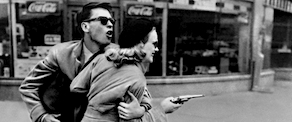
Gun Crazy

Gun Crazy

In a Lonely Place

In a Lonely Place

The Killers

The Killers

Mildred Pierce

Night and the City

Night and the City

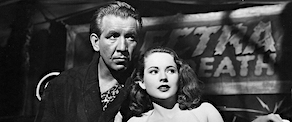
Nightmare Alley

Nightmare Alley

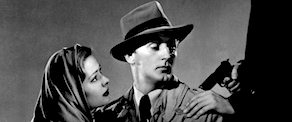
Out of the Past

Out of the Past

Scarlet Street

Scarlet Street

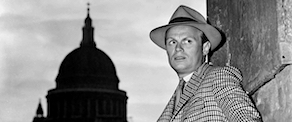
Shadow of a Doubt

Shadow of a Doubt

Sweet Smell of Success

Sweet Smell of Success


Normally it’s Blindspot’s selection process that gets very technical while WDYMYHS is a bit more intuitive, but this year it’s the latter that has used various lists in an attempt to define its 12 films. Not that I got insanely technical with it — no need for Excel spreadsheets and formulae here. Instead, I cross-referenced a handful of key lists, and that got me results I was happy enough with.

First, long-time readers of this blog may remember me referencing the book Pocket Essentials: Film Noir at one time or another in the past. It was the first book I bought after my interest in noir was piqued; a small, slim volume that’s mostly made up of a massive list of noir films. It’s still my go-to reference after watching a noir — to see if it’s in there, and see if there’s a rating (you can’t blame the book’s sole author for not having seen them all). Indeed, even though I now own some large and beautiful noir-related books (Taschen’s Film Noir: 100 All-Time Favorites immediately comes to mind, a book I really should spend more time with), Pocket Essentials is the only book I’ve referred to in forming this list. Before beginning that exhaustive list of every noir they could manage, the book highlights seven key titles for analysis. I’ve seen six of them, meaning the seventh — Alfred Hitchcock’s Shadow of a Doubt — went straight into my WDYMYHS selection.

For the remaining 11, I looked to four lists. First up was TSPDT’s 100 Essential Noirs. (On TSPDT’s site, these 100 have been subsumed into the ongoing 1,000 Noir Films project. You can find lists of just the initial 100 on iCheckMovies and Letterboxd.) With a whopping 72 films I’d never seen (thus proving my point that there are many “essential” noirs I still need to see), I made it a requirement that a film had to be on this list to be included.

The next two lists, which I considered equally, were IMDb’s Film-Noir Top 50 and the top 25 noirs of the ‘Czar of Noir’, Eddie Muller. Although both those lists are ranked, I ignored that in favour of which films were on both lists. Despite not having seen 30 films on the IMDb list and 20 on Muller’s, there were, as it turned out, just nine overlaps. They included the #1 film on Muller’s list, In a Lonely Place, but not my highest-ranked unseen film on IMDb’s, 6th placed White Heat; nor, indeed, the film ranked 2nd by Muller, Criss Cross. Funny stuff like that happens when you use multiple lists, which is part of why I do it so often.

Anyway, adding those nine got me to ten. This is where the fourth and final list came in — though it wasn’t a list as such, more using other opinions as a decider. Going back to the 100 Essential Noirs, I sorted it by the ratings of Letterboxd users, and included the top two that weren’t already in. Those were Ace in the Hole (the 2nd highest that I hadn’t seen on both IMDb’s list and by Letterboxd ratings, but not on Muller’s list) and Mildred Pierce. The aforementioned White Heat missed out by one place.

Or maybe it didn’t. Well, I mean, it did; but I also mean, maybe it will still end up included. I say that because, while normally Blindspot and WDYMYHS wouldn’t qualify for wildcards in my 100 Films Challenge (they’re lists of 12 films taking up 12 slots — there aren’t any to be wildcards), this year there sort of are spare films. In the case of Blindspot 2023, because it’s entirely based around the Sight & Sound poll, films from the rest of the list are allowed as wildcards. For WDYMYHS, as being on the 100 Essential Noirs was an entry requirement, I think the rest of that list should be eligible for wildcards. That’s quite a lot of possibilities (60, to be precise), but I probably won’t actually get round to any of them, so hey, why not?


2022 | Week 35

When I revived 2007’s weekly(-ish) review compilation format at the start of 2022, the main objective was to write shorter reviews (not necessarily as short as the couple-of-sentences-per-film I wrote back in 2007, but not worrying about trying to do full write-ups for everything), which would help enable me to stay more up-to-date. Well, the former has only been partially successful, and that means the latter has slipped, too: here we are, rapidly heading towards the end of December, and I’m only just posting reviews of films I watched at the end of August / start of September. I’m certainly not going to have 2022 finished before 2023 begins.

Hey-ho, there’s nothing to be done about it — other than remind myself I was intending to be more concise and more on top of things, and continue to try to push myself in that direction. In the meantime, on we go, with…

  • Mona Lisa (1986)
  • Mirror (1975), aka Zerkalo
  • Clerks (1995)
  • Persuasion (2022)
  • He Walked by Night (1948)


    Mona Lisa

    (1986)

    Neil Jordan | 104 mins | Blu-ray | 1.85:1 | UK / English | 15 / R

    Mona Lisa

    Neo-noir filtered through a British sensibility — which means you get a character study merely garnished with genre thrills, especially when the character in question is played by Bob Hoskins, adding depth and complexity to your could-be-straightforward protagonist.

    Said protagonist is George, a recently-released minor gangster looking for work. He’s an interesting mix of a character: streetwise but also kinda naïve; racist and judgemental, but without really meaning it. It’s like he’s just reciting stuff he’s heard from everyone else, rather than it being stuff he really believes. Well, isn’t that true of so many with horrendous opinions? These days they just get them from YouTube. George’s prejudices are somewhat challenged when he’s assigned to drive around a high-class call girl, Simone, who happens to be black. Although Hoskins took most of the plaudits (including an Oscar nomination and BAFTA win), as Simone, Cathy Tyson breathes an equal amount of life into a character that, similarly, in lesser hands could’ve just been a plot-driving mystery. (She was also nominated for a BAFTA, incidentally.)

    The film’s style is an interesting mishmash, in that it has an element of British grit and groundedness — especially being shot on grainy film, all on location in London, in a world of everyday gangsters and prostitutes — but with fantastical and/or genre flourishes — George’s friend Thomas creates weird art stuff and engages in literary discussions; nighttime London is shot to look like a vision of Hell; and then there’s all the noir stuff in the construction of the story. There’s a version of this film that fully gives in to that genre, but the comedy and ‘fantasy’ dilutes the neo-noir aspects, making the film more unique, and distinctly British.

    The fact Arrow initially released Mona Lisa as the de facto lesser half of a double-bill with earlier Hoskins-starring gangster flick The Long Good Friday does it something of a disservice (though it’s also is the primary reason I had it in my collection to prompt me to watch it, so swings and roundabouts). This is a film more than worthy of standing on its own; and one that, while not poorly regarded or completely forgotten, merits a wider rediscovery.

    4 out of 5

    Mona Lisa is the 53rd film in my 100 Films in a Year Challenge 2022. It was viewed as part of “What Do You Mean You Haven’t Seen…?” 2022. It placed 11th on my list of The Best Films I Saw in 2022.


    Mirror

    (1975)

    aka Zerkalo

    Andrei Tarkovsky | 107 mins | digital (HD) | 1.37:1 | Soviet Union / Russian | U

    Mirror

    Andrei Tarkovsky’s poetic evocation of memory and mid-20th-century Soviet history. If that sounds a bit Arty, just wait ’til you hear Criterion’s blurb, which says it’s “as much a poem composed in images, or a hypnagogic hallucination, as it is a work of cinema.” Oh dear, sounds like Hard Work, right? Well, it is.

    Calling it “visual poetry” might sound like pretentiousness, but it really isn’t — Mirror definitely plays more like that than a traditional narrative film. And, just like most poetry, I didn’t really get it. I must confess that I was tuning out by the end; partly due to tiredness, which is my own fault; but partly that the film gave me nothing to really latch on to; no (clear) narrative or character or anything for me to focus on to keep my wavering attention in the right place. On the bright side, it avoided being a total disaster in my eyes by having some nice-looking bits, and individual scenes or sequences that kinda work. But I absolutely do not “get it” as a whole cohesive piece of art.

    Clearly, this kind of thing works for some people — Sight & Sound’s most recent poll ranked it 31st, and the director’s poll (which I would normally argue errs slightly more mainstream) went even better and placed it 8th. Each to their own. Based on his work that I’ve seen so far, I just don’t think Tarkovsky’s for me.

    2 out of 5

    Mirror is the 54th film in my 100 Films in a Year Challenge 2022. It was viewed as part of Blindspot 2022.


    Clerks

    (1994)

    Kevin Smith | 88 mins | DVD | 1.85:1 | USA / English | 15 / R

    Clerks

    There’s no escaping the fact that Clerks is very much a product of its time, both in itself as a work of art, and in how it became a breakout success. (Can you imagine a film like this launching a career like Kevin Smith had (for a bit) if it was made today? Best you could hope for now is being seen by half-a-dozen festival-goers before the director gets tapped to be Kevin Feige’s puppet on some Marvel content.) That said, for all its ’90s-time-capsule-ness, it holds up pretty well as a piece of entertainment. By which I mean, I laughed multiple times and was never bored.

    The story, such as it is, concerns a pair of convenience store workers hanging out for a day, and the various little dramas and incidents that occur to and around them. Serving as both writer and director, Smith quite cleverly turns bugs into features. No budget? Make that the whole aesthetic, with grainy 16mm photography and an everyday setting in which ‘nothing’ happens. Non-pro actors? Have everyone deliver all their lines mile-a-minute, thus making the whole thing feel kinda heightened and stylised, to the point where you can’t be sure if most of the cast can’t act or it was all a deliberate choice. This is further fed by Smith often letting scenes play out in long takes with no cuts — if these guys can remember all their lines to do a whole scene in a oner, they must be pretty professional, right?

    Impressively for a first-timer behind the camera, Smith doesn’t go overboard with directorial flourishes. There’s the occasional shot or sequence with some extra pizzazz to keep up the visual interest, but he seems to know that less is more; that this is the kind of film that plays best in medium shots. This might sound like basic stuff, but evidence shows that first-time filmmakers with something to prove are regularly tempted to go all-out and make something that feels Directed. That might be nice for a showreel, but for an actual film, restraint goes a long way.

    Technique aside, the content just works. These characters are likeable enough to hang out with for 90 minutes, because that’s effectively all we’re doing. But there’s enough variety in their conversations and situations, and enough genuinely funny lines and moments, that it works and is enjoyable, rather than being a dull or directionless slice-of-life piece.

    4 out of 5

    Clerks is the 55th film in my 100 Films in a Year Challenge 2022.


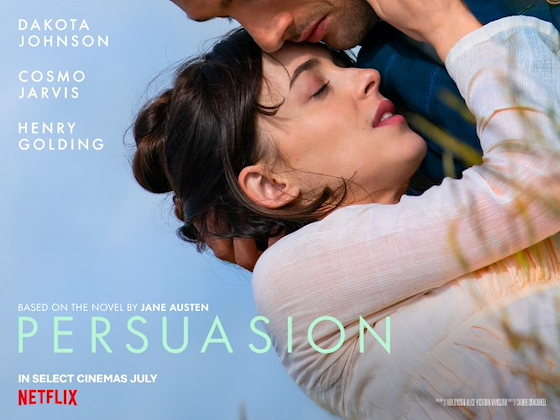
    Persuasion

    (2022)

    Carrie Cracknell | 108 mins | digital (UHD) | 2.00:1 | USA / English | PG / PG

    Persuasion

    Jane Austen adaptations appear to be perennially popular, so it was probably only a matter of time before Netflix attempted one. Here, they’ve retained the original setting but given proceedings a modern-ish wash, apparently influenced by their hit series Bridgerton style (I’ve never seen Bridgerton, so this is based on the trailers and that others have made the same comparison). The result? A trailer that met with a great deal of displeasure from Austen fans, not keen on the apparent irreverence to the source material. I’ve never read Austen, either, so I’ll leave exact comparisons to the more knowledgeable.

    That said, I can’t say the trailer fully won me over, but I thought I’d allow the film its chance. And it’s not terrible — there are lots of nice scenes and moments to be found. Unfortunately, they’re undercut by the bits everyone talked about from the trailer: the clearly-Fleabag-inspired gurns to camera; the banal and misplaced modern-style dialogue. The really sad thing is that there aren’t actually very many of those bits — the ones that were widely cited as “examples” are nearly all of them, in fact — and so there is nearly a very nice film here.

    Dedicated fans of Austen’s original work, and those who prefer their period dramas played straight and faithful, will likely still find those moments off-putting. If you’re prepared to overlook the missteps, this Persuasion is largely likeable.

    3 out of 5

    Persuasion is the 56th film in my 100 Films in a Year Challenge 2022.


    He Walked by Night

    (1948)

    Alfred Werker | 79 mins | digital (HD) | 4:3 | USA / English | PG

    He Walked by Night

    “A film that started as a humble low-budget offering from a second-tier studio, but wound up being one of the most influential films of its era” is how ‘Czar of Noir’ Eddie Muller describes He Walked by Night in his introduction for TCM’s Noir Alley strand. That’s partly because it inspired the radio series Dragnet, which was immensely significant in the development of police procedural series, a genre that remains a bread-and-butter staple of TV entertainment to this day. But also because it was shot by cinematographer John Alton — “the greatest noir stylist of all time”, says Muller, and here he produced “one of the most dramatically photographed film noirs ever”. There’s debate over whether the film was actually helmed by its credited director, Alfred Werker, or if Anthony Mann actually did most of the work. “It doesn’t really matter,” says Muller, “because the picture’s held together by the stunning visual style of its singular cinematographer”.

    Well, I can’t disagree. This is a gorgeously shot film, and a concise exemplar of all we know of film noir style — primarily, abundant shadows. But it’s not just the imagery that makes it work. There are multiple tense suspense sequences, often making great use of silence — this is a film not afraid to be quiet when it’s effective — climaxing with an incredibly atmospheric chase and shootout in the LA storm drain system. We spend a lot of time with the villain, Roy Martin — the film is definitely a howcatchem; no whodunit mystery here — who’s superbly played by Richard Basehart. Coming back to the point about silence, Martin is a loner, so he doesn’t get much dialogue a lot of the time, but Basehart still effectively conveys how smart and cunning he is. Also worthy of note is Whit Bissell as an electronics dealer who unwittingly sold on ‘inventions’ that Martin had in fact stolen. The poor guy is clearly innocent and been duped, but he ends up between a rock and a hard place when the police aren’t sure they believe that.

    The overall style of He Walked by Night is intensely procedural and serious about it, but it still finds room for glimpses of character, both from the cops and the criminals; and there’s humour, too. That helps give it a bit of light and shade, and also genuine reality — you’ll find humorousness everywhere in real life, however serious events may be.

    4 out of 5

    He Walked by Night is the 57th film in my 100 Films in a Year Challenge 2022.


  • 2022 | Week 34

    Skipping week 33 (when I didn’t watch anything), here are all the films I watched in week 34 — which, if anyone’s interested, was back in August. Somehow, I don’t think I’m going to get caught up on my 2022 reviews before the end of the year…

  • The Winter Guest (1997)
  • Repeat Performance (1947)
  • Carousel (1956)


    The Winter Guest

    (1997)

    Alan Rickman | 105 mins | digital (SD) | 16:9 | UK & USA / English | 15 / R

    The Winter Guest

    The writing and directing debut of actor Alan Rickman, The Winter Guest follows four loosely-connected pairs of characters through a day in their lives, all confined to a small Scottish seaside town where the stark winter has turned the sea to ice. It’s the kind of film where nothing happens: the characters hang out with each other and talk, basically, with their issues ranging from bereavement to stereotypical teenage sex obsession (one boy played by a young Sean Biggerstaff wants… a bigger staff, wink wink. Sorry, the pun was too tempting to avoid).

    The confined setting and characters means the end result feels theatrical in both style and content — it’s basically just a series of two-handers, with quite mannered dialogue. And yet its staging isn’t so limited, because Rickman and cinematographer Seamus McGarvey do an excellent of of evoking the chilly surroundings (most of the film is set outside), giving the scenery a painterly feel. That’s probably in part due to using digital matte paintings to convey the frozen ocean, but it extends to the beaches and town buildings, too. Or it could just be an unintended side effect of the smoothing conferred by watching in digitally compressed SD; but as it’s just about my favourite aspect of the film, let’s assume it was intentional and skilfully done.

    3 out of 5


    Repeat Performance

    (1947)

    Alfred Werker | 93 mins | Blu-ray | 1.37:1 | USA / English

    Repeat Performance

    On the eve of 1947, actress Sheila Page (Joan Leslie) shoots dead her husband (original Saint Louis Hayward). She flees, ending up at the home of her producer (second Falcon Tom Conway) in the early hours of New Year’s Day… 1946. Given the chance to re-live the past year, can she make things right?

    Repeat Performance gets classified as film noir, but I feel like it’s one of those films that sits on the periphery of what qualifies for the genre. The opening — in which a woman shoots dead her husband, in New York City at night — yes, very noir. But what unfurls over the next 90 minutes is more of a backstage romantic melodrama by way of Twilight Zone-style fantasy. But that’s the thing with noir: as a movement that wasn’t recognised and codified as a genre until after it was over, what ‘counts’ can be a very broad church.

    Here, the odd combination of styles makes for an unusual and mostly entertaining film. My only real gripe is that we’re given very little idea what went on in the ‘original’ 1946, so it’s hard to tell how much effort Sheila is actually making to change it, or to follow how successful she’s being. This kind of perspective is perhaps the benefit of a further 75 years of development and refinement in the field of fantastical storytelling — Repeat Performance isn’t a Fantasy film in the true genre sense, more a Thriller with a neat inciting twist, a la Sliding Doors (my go-to example of a Fantasy film that doesn’t care it’s a Fantasy film!)

    The plot is bolstered by strong or likeable performances across the board. Some of the lead cast may be better known for starring in B-movie schedule-fillers, but this is proof if proof were needed that to interpret that as a sign of limited skill on their part would be an incorrect conclusion. Which is a rather torturous way of saying “Hayward and Conway were quite good actors, actually”. Hayward is particularly good here, getting to show off his range from loving husband to psychopathic abuser, plus a few other stages in between. Conway is more at the likeable end of the spectrum as Sheila’s kindly producer, while Richard Basehart’s performance (in his movie debut) as queer-coded poet William Williams (in the original novel, the character is a transvestite) was so impressive that the producers gave him more scenes with Leslie and bumped up his billing.

    4 out of 5

    Repeat Performance is the 52nd film in my 100 Films in a Year Challenge 2022.


    Carousel

    (1956)

    Henry King | 123 mins | digital (HD) | 2.55:1 | USA / English | U

    Carousel

    Carousel is a spectacularly odd entry in the Rodgers & Hammerstein canon of musicals. Based on a play called Liliom (which was previously filmed by Frank Borzage in 1930 and Fritz Lang in 1934), it tells the story of a carnival barker (Gordon MacRae) who’s been dead 15 years, but in flashback we learn of how he fell in love and married, and how he died, and why he now gets a chance to go back for a day to make amends. That almost makes the film sound focused. As it plays out, the storyline has a weirdly aimless quality, not helped by songs that are mostly mediocre or bizarre. That’s before we get to the horrendously outdated views on domestic violence, or the fact that it’s not actually got very much to do with the titular fairground attraction.

    The darker material and themes could work in the right setting, but here they clash with the sunny seaside photography and stereotypically cheerful musical numbers. I mean, this is a story about a physically abusive husband and wannabe small-time crook, who can’t even change his ways when the afterlife gives him a second chance, and we have songs about the beauty of summer and the joys of a clambake (the latter may haunt your memories…)

    A strange film, and not in the good way. At least it’s made me curious to see the Borzage and Lang versions — perhaps as a straight drama it will be more obvious why this has merited adaptation so many times.

    2 out of 5


  • 2022 | Weeks 29–32

    2022 may be rushing headlong towards its final stretch (only one month ’til Christmas, people!), but my reviews are lagging behind somewhat: this update takes us all the way back to July and August.

    That said, there’s quite a long spread covered here, because I only watched one film in each of these weeks: 45 Years in week 29, The Bucket List in week 30, previously-reviewed Prey in week 31, and Tintin and the Lake of Sharks in week 32. That’s definitely not the right way to go about watching 100 films in a year, but there we go.

  • 45 Years (2015)
  • The Bucket List (2007)
  • Tintin and the Lake of Sharks (1972), aka Tintin et le lac aux requins


    45 Years

    (2015)

    Andrew Haigh | 95 mins | digital (HD) | 1.85:1 | UK / English | 15 / R

    45 Years

    Charlotte Rampling and Tom Courtenay star as a couple preparing for their 45th wedding anniversary party, when their comfy relationship is rocked by news that brings to the surface events from his past.

    What could have been a histrionic drama about the nature of trust in a relationship instead takes its cue from the characters’ advanced age, and so is a more understated consideration of the same. The length and passage of time is relevant, too: if something happened a long time ago but you only just learnt about it, does that change how you react to the news? Should it? And is the real revelation not the news itself, but the realisation that, even if you’ve lived closely with another person for decades, you can never be truly sure you know them. Another person’s true self is fundamentally unknowable, for any one of us.

    All of which might sound a bit highfalutin, but 45 Years is the kind of film that revels in ambiguity, with characters who never let on their true feelings — in that sense, it feels like a deliberate Acting Showcase for Rampling — and a vague ending, all of which invites you to draw your own conclusions. The final moment feels pointed, but the openness of what went before means it’s up to you what it means. There’s something truthful about that, but also something frustrating.

    4 out of 5


    The Bucket List

    (2007)

    Rob Reiner | 97 mins | digital (HD) | 16:9 | USA / English | 12 / PG-13

    The Bucket List

    I may have written before (but not recently, so let’s do it again) about how Rob Reiner’s directorial career baffles me. He had an incredible run in the ’80s and ’90s — almost back to back he helmed This Is Spinal Tap, Stand By Me, The Princess Bride, When Harry Met Sally, Misery, and A Few Good Men — but then his career suddenly nosedives into a bunch of stuff you’ve mostly never even heard of. What happened? Is there some “John Landis on Twilight Zone“-style ‘secret’ I’m unaware of?

    One of the very few exceptions in his later career (which certainly didn’t lead to that being revived) was this, a breakout hit 15 years ago (yes, it’s 15 years old) of the kind they don’t make so much anymore: a mainstream comedy-drama aimed at adults. It’s about two old men (pure star power in Jack Nicholson and Morgan Freeman) with only months left to live, who decide to spend their final days going on a tour of… green screen studios and kinda-low-res stock footage, apparently. I guess you didn’t get location filming on the kind of budget a film like this was made for even back in 2007.

    Cheap production values aside, it has an insistent sentimentality — undercut with just a big enough dose of snark to stop it becoming too saccharine — that, unsurprisingly, played well with general audiences but, equally unsurprisingly, doesn’t seem to be to the taste of many cinephiles (just look at the middling-to-low scores on Letterboxd, especially of the most-liked reviews, and contrast with its sturdy 7.4 score on IMDb). While I wouldn’t go quite as harsh as many of my fellow Letterboxd users, I do think it’s not that good — it’s broadly likeable, a generally pleasant way to pass 90 minutes, rather than in any way exceptional.

    3 out of 5


    Tintin and the Lake of Sharks

    (1972)

    aka Tintin et le lac aux requins / The Adventures of Tintin: The Mystery of Shark Lake

    Raymond Leblanc | 74 mins | DVD | 4:3 | Belgium & France / English | U

    Tintin and the Lake of Sharks

    Having adapted several of Hergé’s Tintin books for TV and film, Belgian animation outfit Belvision for some reason opted to create an original story for their second big-screen outing with the character (it was later retrofitted into book form, using frames from the film as the illustrations). Written not by Hergé but his friend, fellow Belgian comics creator Greg (aka Michel Regnier), Lake of Sharks feels like exactly what it is: an imitation of a Tintin adventure rather than the real deal.

    Events start out in a typically Tintin fashion, with some crooks after an invention of Professor Calculus’s; but later things take a turn for the Bondian, including an elaborate underwater lair that owes a debt to the imagination of Ken Adam. Eventually it all gets a bit silly, with stuff like an ever-expanding bouncy 3D photocopier, or the villain’s elaborate “you will die in one hour” execution method for Tintin. That kind of adventure serial writing has been so widely mocked at this point (the Austin Powers movies took aim at it 25 years ago; others may have done so before then) that it’s hard to remember there was ever a time when it was still played with a straight face.

    The animation is mostly of a slightly higher quality than Belvision’s previous efforts, but the quality of the designs is variable. The regular cast feel faithfully copied from Hergé, and most other characters are in the right style; but there are a couple of major child characters who look out of place, along with their pet dog. It’s a bit like when you were a kid and mixed action figures from different ranges into the same game: yeah, they’re all still plastic figurines (or, in the case of the film, hand-drawn 2D characters), but stylistically they don’t line up.

    The English dub is an American effort, and far from ideal. None of the voices are great, but most suffice once you get used to them. The exception is Captain Haddock, who is egregiously bad throughout. That said, we’re also subjected to the kids singing a song about a donkey that is unspeakably awful. Couldn’t they have cast actors who could sing? At least that would’ve taken the edge off it.

    3 out of 5

    Tintin and the Lake of Sharks is the 50th film in my 100 Films in a Year Challenge 2022.


  • The 100 Films Guide to Scream

    I don’t always do anything to mark Halloween on this blog… but when I do, this is the kind of thing I do: complete coverage of the Scream movies (so far).

    That means all-new “100 Films Guide To”s for the original film, its two sequels, and the 2011 legacy sequel, plus my brand-new review of this year’s, er, new legacy sequel. You know, the film that should’ve been called 5cream, but wasn’t.


    Scream (2022)

    Matt Bettinelli-Olpin & Tyler Gillett | 114 mins | Blu-ray (UHD) | 2.39:1 | USA / English | 18 / R

    Scream (2022)

    Nowadays, reviving horror franchises with reboots or continuations that just use the same title as the original film are all the rage — witness The Thing, Halloween, and Candyman; you might also include Evil Dead, Blair Witch, The Predator, and Texas Chainsaw Massacre. (And it’s not just limited to horror movies: Shaft is a sequel to Shaft, which was a sequel to Shaft.) And where there’s a trend in horror movies, the Scream series must follow, to both emulate and roast the genre’s new status quo. Fortunately, there’s more than merely “we could call a new Scream film ‘Scream’” to the movie’s satirical targets.

    Set about ten years after the last film, the fifth Scream (I get that the recycled title is a meta-gag too, but I still think it’s a shame they missed the chance to go with 5cream, or Screams / Scream5) introduces us to a new cast of characters. That’s what every Scream film has had to do (that’s the thing with slashers — most of your cast gets killed off each time), but here we’re in ‘requel’ mode. For those who don’t know, ‘requel’ is a portmanteau of “reboot” and “sequel”, i.e. a film that’s both a reboot (in the sense it’s a new story you can jump onboard with) and a sequel (in that it’s still in continuity with the previous films). “Legacy sequel” is a similar thing — a belated sequel, in continuity, with the original cast, now older — but Scream already targeted that kind of follow-up last time out. What being a ‘requel’ means for this film is we meet all the new characters before the legacy ones are gradually introduced the plot.

    A plot summary is barely necessary: someone in a Ghostface mask is murdering people. Who is it? What’s their motive? That’s the plot of all the Scream films — of course it is, that’s how horror franchises work. The devil is in the details, but that can make the details spoilers. There are some neat reveals, and twists on the franchise’s formula, that I’m not going to spoil here because that would ruin the fun. If you’re a fan of the series, the less you know going in, the better. For example, there’s one reveal — which doesn’t come until we’re already in the final act — that was, apparently, blown in the trailer, even after the filmmakers worked hard to keep it secret until the right moment in the film itself. (That’s according to the audio commentary — I haven’t watched the trailer to see if it blatantly blew it or if fans just worked it out from the footage shown.)

    Ghostface Mk.V

    Scream being Scream, it gets to both have its cake and eat it by pointing out the laughable clichés and ridiculous tropes of other horror films, then doing them anyway. Some people dislike this approach — “pointing out that what you’re doing is a cliché doesn’t stop it from being a cliché” — but, personally, I think it’s part of the charm of these films. They don’t do the thing and then have someone go “that was so cliché!”, they tell you “wouldn’t it be clichéd if this happened?” and then it does. Too subtle a difference for some, I guess, but it works for me. One thing the previous films have a habit of doing — and it continues in this one — is laying out the entire plot for you, even telling you who the villain is, but you don’t notice because you’re busy playing whodunnit and stringing the mystery together. Of course, they also lay out red herrings, so it’s always easier to spot the “they gave it all away” moments with hindsight.

    Whether or not you’re on board with that “point out what it’s going to do then do it” approach will probably dictate how much enjoyment you can get out of a film like Scream. The best bits are the ones that are self-aware, either because characters are expressly discussing the plot or because the filmmakers are playing with our expectations. In the case of the latter, this film has a really neat sequence in which you know for certain the killer is going to jump out at some point, but the character on screen is, as ever, oblivious to this fact, so merrily goes around opening doors, thus blocking our lines of sight, or wandering past open doorways, which are then held in shot for just a moment too long… It’s a gag that builds in hilarity the longer it goes on, and directors Bettinelli-Olpin & Gillett milk it magnificently.

    As for the former, this film has an especially neat exchange about “fan fiction”. Without Wes Craven in the director’s chair and/or Kevin Williamson at the typewriter, this film could definitely be dismissed as just “fan fiction” — that’s the gag, really. But, in terms of quality, there’s “fan fiction” and there’s “fans who have become professionals picking up the baton and continuing a franchise perfectly”. If this film is either, I’d argue it’s the latter. Which is a slightly convoluted way of saying Scream (5) nails the tone, style, and — perhaps most importantly — meta humour that makes a Scream film a Scream film.

    4 out of 5

    Scream is the 69th film in my 100 Films in a Year Challenge 2022.

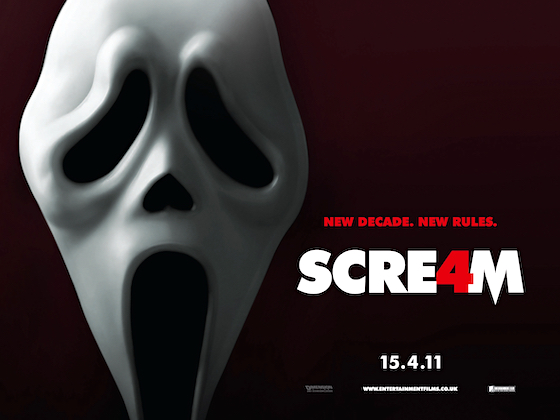
    Scre4m (2011)

    The 100 Films Guide to…

    Scre4m

    New Decade. New Rules.

    Also Known As: Scream 4. Not in the film itself, though. Nor on any of its marketing. But most places on the internet? Apparently. Quite why certain online movie databases are so resistant to listing the film by its proper title, I don’t know.

    Country: USA
    Language: English
    Runtime: 111 minutes
    BBFC: 15
    MPAA: R

    Original Release: 13th April 2011 (Belgium, Egypt & France)
    US & UK Release: 15th April 2011
    Budget: $40 million
    Worldwide Gross: $95.99 million

    Stars
    Neve Campbell (Scream (1996), Scream (2022))
    Courtney Cox (Scream 2, Scream (2022))
    David Arquette (Scream 3, Scream (2022))
    Emma Roberts (Wild Child, We’re the Millers)
    Hayden Panettiere (I Love You, Beth Cooper, Scream 6)

    Director
    Wes Craven (Wes Craven’s New Nightmare, Scream)

    Screenwriter
    Kevin Williamson (Scream, I Know What You Did Last Summer)

    The Story
    Ten years since the last Ghostface killings, and the tragic events have faded into festivity for the teens of Woodsboro, who now celebrate the anniversary of the first killings. But this year is a special one, because Sidney Prescott is back in town, and someone has donned the mask to go on a new killing spree…

    Our Heroes
    Sidney Prescott, perennial survivor of multiple Ghostface killers, must face one again as she returns to her hometown for the first time in years to promote her new book. Dewey — now Sheriff — and Gale — now his wife — are back, too, along with an array of fresh faces ready for the slaughter.

    Our Villain
    After a decade away, Ghostface is back! Except, as always, it’s a new killer (or killers) behind the famous mask. They’re still stalking Sidney, her friends and her family, but who is it and what’s their motive this time?

    Best Supporting Character
    Each new Scream film has introduced fresh faces (the films have a habit of killing off most of the supporting cast each time round, funnily enough, so you kinda have to), but the “whole new generation” angle of Scre4m makes it feel like there are even more this time round. While many are clear mirrors of characters from the first film (deliberately so), perhaps the one that manages to stand out the most in her own right is Hayden Panettiere’s Kirby, sassy best friend to Sidney’s cousin Jill. Yeah, she’s he new version of Rose McGowan’s Tatum, but, unlike some of the other characters, she doesn’t just feel like a 2011-painted carbon copy of the original. Plus, (major spoiler alert!) there’s a reason that, despite this film leaving her for dead, she’s set to reappear in Scream 6.

    Memorable Quote
    The Voice: “It’s time for your last-chance question. Name the remake of the groundbreaking horror movie in which the vill—”
    Kirby: “Halloween, Texas Chainsaw, Dawn of the Dead, The Hills Have Eyes, Amityville Horror, Last House on the Left, Friday the 13th, A Nightmare on Elm Street, My Bloody Valentine, When a Stranger Calls, Prom Night, Black Christmas, House of Wax, The Fog, Piranha. It’s one of those, right?”

    Memorable Scene
    The film begins with two teen girls at home choosing a movie to watch, when a mysterious caller with a gravelly voice threatens their lives. What happens next would be a spoiler… but, from the very start, Scre4m sets out its stall as a movie that, in true franchise tradition, is going to play with the rules and expectations of movies.

    Previously on…
    After a hugely successful and acclaimed first film, Scream did what so many popular movies have done in the past few decades: got turned into a trilogy. Really, it’s only fitting that it got in early on the 2010s trend of “reviving a once-popular but thought-finished film series”.

    Next time…
    And now it’s getting in on the “just keep making more films forever” trend that once used to be more-or-less limited to James Bond and shitty horror sequels but nowadays is the defining feature of the entirety of Hollywood. First there was a new film simply titled Scream (the fact it’s not called 5cream or Scream5 is a sin), and next is… a second/sixth film that no one seems quite sure what the final title will be. I guess we’ll find out when it’s released next March.

    Awards
    2 Scream Awards nominations (Horror Actress (Neve Campbell), Best Cameo (Anna Paquin & Kristen Bell))

    Elsewhere on 100 Films…
    I originally reviewed Scre4m after I first watched it back in 2012, when I felt the film was “kind of old school. It fits better in the era of the original trilogy and/or earlier horror films than with the development of the genre in the intervening decade.” I went on to suggest it “plays best to those who saw the first three at the right age, i.e. mid-to-late teens or so. I shouldn’t think it would engage a new audience all that much, especially ones versed in the gorier Saw and Final Destination franchises. But for those of us with fond memories (to one degree or another) of the first three films, it’s kind of a nice little revisit.”

    Verdict

    The original Scream trilogy was the defining horror franchise of the ’90s, so reviving it over a decade after its last instalment seemed like the usual Hollywood BS of revisiting any recognisable IP. But with the original last, screenwriter, and director all returning, the film actually did what Scream has always done: be part scary movie, and part commentary on the horror genre landscape. And this time it throws in some social commentary for good measure, with some slightly-ahead-of-its-time satire of social media celebrities. It’s only become more pertinent with the stratospheric rise of YouTubers in the additional decade since the film came out.

    One criticism I’ve seen levelled at Scre4m a few times is that it takes on remakes when it isn’t a remake itself. Well, that wouldn’t work, would it? For the characters to know they’re in a ‘remake’, they’d have to know there was an original — which by default would mean it’s not a remake but a continuation. In fact, the film does address this: it points out that we’re back in the original town, with killers who are following the pattern of the original movie (in-universe, that’s Stab, which seems to be a pretty faithful telling of the ‘real-life’ events shown in Scream). Most of the new characters are analogous to ones from the first film, too. So, Scre4m is, in fact, a remake… while also not being one, obviously.

    All in all, the eleven years between Scream 3 and Scre4m gave the filmmakers enough fresh material to chew on to make the film a more-than-worthwhile addition to the franchise. For my money, the fresh perspectives make it easily the series’ best film since the first.

    Scream 3 (2000)

    The 100 Films Guide to…

    Scream 3

    The most terrifying scream
    is always the last.

    Country: USA
    Language: English
    Runtime: 117 minutes
    BBFC: 18
    MPAA: R

    Original Release: 4th February 2000 (USA & Canada)
    UK Release: 28th April 2000
    Budget: $40 million
    Worldwide Gross: $161.8 million

    Stars
    Neve Campbell (Three to Tango, The Company)
    David Arquette (Ravenous, Ready to Rumble)
    Courtney Cox Arquette (Commandments, Zoom)
    Liev Schreiber (Sphere, X-Men Origins: Wolverine)

    Director
    Wes Craven (The Last House on the Left, My Soul to Take)

    Screenwriter
    Ehren Kruger (Arlington Road, The Ring)

    The Story
    As production gets underway on Stab 3 — the latest in the series of horror movies based on the Woodsboro killings — someone wearing a Ghostface costume starts killing the cast. But really, they want to know one thing: the whereabouts of perpetual murder-target Sidney Prescott…

    Our Heroes
    With Sidney in hiding at a remote location known only to a handful of people, the initial investigation into the new killings falls to the other survivors of the previous films: Dewey, now working as a consultant-cum-security on Stab 3, and his former love interest, intrepid reporter Gale Weathers.

    Our Villain
    The Ghostface killer is back, now terrorising Hollywood — but who’s behind the mask this time? As with the first two films, this technically counts as a whodunnit, though well done if you guess anywhere near the correct conclusion — it’s hardly Christie-level…

    Best Supporting Character
    Mark Kincaid (Patrick Dempsey) is the Hollywood homicide detective investigating the murders. As someone who grew up around the movie biz, he’s as au fait with the rules of cinema as most of the characters have had to become — but does that mean he fits right in, or has all the knowledge necessary to be the new Ghostface?

    Memorable Quote
    “Is this simply another sequel? Well, if it is, same rules apply. But here’s the critical thing: if you find yourself dealing with an unexpected backstory and a preponderance of exposition, then the sequel rules do not apply. Because you are not dealing with a sequel, you are dealing with the concluding chapter of a trilogy.” — Randy

    Memorable Scene
    Looking for someone, Sidney wanders into the abandoned Stab 3 soundstage — to be confronted by a perfect full-size replica of her childhood home. As she wanders inside, remembering the terrifying events that occurred there, she begins to suspect the killer is also lurking. Cue a clever re-staging of one of the first film’s most memorable scenes, as the new killer chases Sidney around her old home.

    Making of
    Neve Campbell was busy shooting a TV series and another film during the production of Scream 3, meaning her availability was limited to just 20 days on set. That’s why Dewey, Gale, and the new supporting cast get so much more screentime now, with Sidney mostly by herself. But whoever was in charge of scheduling around Campbell’s availability actually did a pretty good job maximising her presence, spreading her appearances throughout the film, with a few key interactions with the rest of the cast. If you didn’t know the behind-the-scenes story, you might not even realise what they had to do.

    Previously on…
    The first Scream garnered much acclaim for its amusing deconstruction of slasher movies. Naturally, Scream 2 applied the same modus operandi to sequels.

    Next time…
    Scream 3 was supposedly the end of the series… but if there’s one thing popular horror movie franchises do, it’s keep coming back. So, a little over a decade later, the series was revived with Scre4m in 2011. Then it was turned into an unrelated TV series that ran for two seasons in 2015 and 2016. Then that was rebooted as Scream: Resurrection in 2019. Then the original movie continuity was returned to earlier this year, in the confusingly-titled Scream. That’s getting a sequel next year. Goodness knows what they’re gonna call it.

    Awards
    2 MTV Movie Award nominations (Female Performance (Neve Campbell), Comedic Performance (Parker Posey))
    1 Fangoria Chainsaw Award (Supporting Actress (Parker Posey))

    Verdict

    The Scream movies were always noteworthy for the metatextual way in which they addressed and engaged with the tropes and clichés of slasher movies, but actually setting this one in Hollywood on the set of a slasher movie based on the events of the previous movies is perhaps taking the whole self-awareness thing one step too far. It pushes its luck even further with some cameos that are kinda fun, but also kinda too silly (Jay and Silent Bob?! So the Scream movies are canonically set in the View Askewniverse…) Plus, the attempt to retcon in a series-overarching motive for the killer, in aid of making it a true trilogy rather than just “another Scream movie”, is as forced and unsatisfying as it sounds.

    All of which said, the film still has effective moments and individual sequences, and a smattering of entertaining gags that are still on the money. Even if it remains the least of the Scream films, but it’s far from the disaster it’s often been painted as.

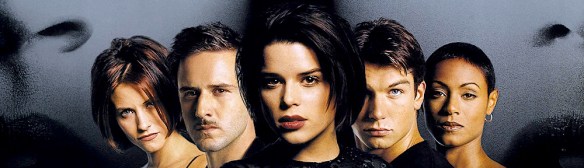
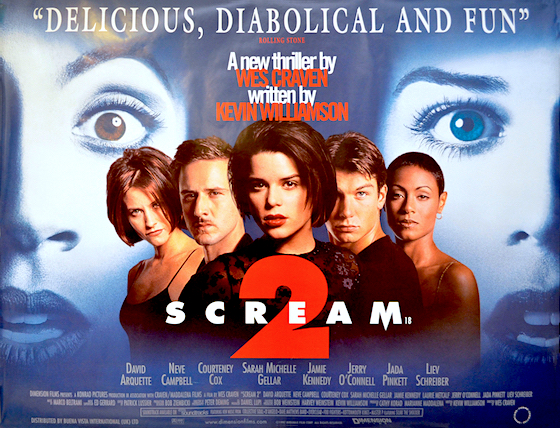
    Scream 2 (1997)

    The 100 Films Guide to…

    Scream 2

    Someone has taken their love of
    sequels one step too far.

    Country: USA
    Language: English
    Runtime: 120 minutes
    BBFC: 18
    MPAA: R

    Original Release: 12th December 1997 (USA & Canada)
    UK Release: 1st May 1998
    Budget: $24 million
    Worldwide Gross: $172.4 million

    Stars
    Neve Campbell (54, Skyscraper)
    Courtney Cox (Masters of the Universe, Bedtime Stories)
    David Arquette (Wild Bill, Eight Legged Freaks)
    Jamie Kennedy (Romeo + Juliet, Son of the Mask)

    Director
    Wes Craven (The Hills Have Eyes, Cursed)

    Screenwriter
    Kevin Williamson (Teaching Mrs. Tingle, Cursed)

    The Story
    Sidney is now at college, but when a movie is released based on the Woodsboro murders, a new killer dons the Ghostface mask and begins targeting her fellow students.

    Our Heroes
    The sequel natural reunites the survivors of the first film (spoilers!) — target Sidney Prescott, police officer Dewey Riley, reporter Gale Weathers, and film nerd Randy Meeks — while adding a host of new victims / suspects. It’s full of faces that were TV-famous at the time and/or have gone on to be better known since: Jada Pinkett Smith, Omar Epps, Liev Schreiber, Sarah Michelle Gellar, Joshua Jackson, Timothy Olyphant, Jerry O’Connell, Laurie Metcalf…

    Our Villain
    Ghostface — but unlike other slasher franchises with supernatural villains, this is just a mask, worn by different killer(s) in each film. Who is it this time? Well, that’d be a spoiler — the Scream movies are effectively murder mysteries. Not particularly good murder mysteries (they don’t function in that Christie-esque way of laying out suspects and clues so we can have a fair guess at whodunnit), but they’re technically murder mysteries nonetheless.

    Best Supporting Character
    Some of the new characters give their best shot at being memorable, but sorry, it’s Randy again (see this category in the first Scream). That said, there is a nice little cameo from the ever-excellent David Warner.

    Memorable Quote
    Randy: “The way I see it, someone’s out to make a sequel. You know, cash in on all the movie murder hoopla. So it’s our job to observe the rules of the sequel. Number one: the body count is always bigger. Number two: the death scenes are always much more elaborate. More blood, more gore. Carnage candy. Your core audience just expects it. And number three: if you want your sequel to become a franchise, never, ever—”

    Memorable Scene
    Sidney and her roommate Hallie are being escorted to safety in the back of a police car when Ghostface appears out of nowhere, hijacks the car, and crashes it into roadworks. With the car’s back doors locked, the girls’ only chance of escape is by climbing into the front seat and out the driver’s window — right past the unconscious serial killer…

    Previously on…
    The original Scream was such a hit that this sequel was in production just six months later, and eventually released less than a year after the first.

    Next time…
    As the horror franchise of the ’90s, naturally Scream has continued into the ’00s and beyond: Scream 3 wrapped up the trilogy in 2000, before the series was revisited with Scream 4 (actually titled Scre4m) in 2011, and then revived earlier this year in a film simply titled Scream. That’s getting a sequel next year, which obviously poses titling issues. There have also been a couple of TV incarnations, both entirely unrelated in story terms: Scream: The TV Series ran for two seasons in 2015 and 2016, and Scream: Resurrection (or season 3, if you prefer) in 2019.

    Awards
    1 MTV Movie Award (Female Performance (Neve Campbell) — she beat Kate Winslet in Titanic!)
    3 Fangoria Chainsaw Awards (Wide-Release Film, Supporting Actress (Courtney Cox), Screenplay)
    2 Fangoria Chainsaw Award nominations (Actress (Neve Campbell), Supporting Actor (Liev Schreiber))
    3 Saturn Award nominations (Horror Film, Actress (Neve Campbell), Supporting Actress (Courtney Cox))

    Verdict

    Where the first Scream was a forensic deconstruction of the slasher genre, the second is more of a vague gesture in the general direction of sequel tropes — less focused, less insightful, less funny. But, crucially, it’s still quite entertaining. There are abundant references for movie buffs to enjoy (primarily to other sequels and, er, other Friends cast members), while Wes Craven’s ever-skilful thrill sequences ensure the tension doesn’t slack too much. There are even a few jump scares for the more susceptible. It’s not a genre-(re)defining classic like the first movie, but it’s still a solid scary movie.

    Scream (1996)

    The 100 Films Guide to…

    Scream

    Someone has taken their love of
    scary movies one step too far.

    Country: USA
    Language: English
    Runtime: 111 minutes
    BBFC: 18
    MPAA: R

    Original Release: 20th December 1996 (USA)
    UK Release: 2nd May 1997
    Budget: $14 million
    Worldwide Gross: $173 million

    Stars
    Neve Campbell (The Craft, Wild Things)
    David Arquette (Buffy the Vampire Slayer, Never Been Kissed)
    Courtney Cox (Ace Ventura: Pet Detective, 3000 Miles to Graceland)
    Drew Barrymore (Firestarter, 50 First Dates)

    Director
    Wes Craven (A Nightmare on Elm Street, Red Eye)

    Screenwriter
    Kevin Williamson (I Know What You Did Last Summer, The Faculty)

    The Story
    In the quiet town of Woodsboro, a mysterious man in a mask starts murdering teenagers, first taunting them with horror movie trivia questions.

    Our Hero
    Sidney Prescott is an ordinary high school girl… apart from the fact her mother was murdered a year ago, and it was her eyewitness testimony that saw a man sentenced to death. Now, a serial killer seems to be targeting her — could the events be connected?

    Our Villain
    A slasher movie has to have a distinctive-looking, nicknamed serial killer at its centre, and here it’s Ghostface — although he’s actually only called that once in the film itself. His costume is a generic Halloween outfit bought from any old store, and is technically called Father Death. Why didn’t that name stick instead? Probably because it’s a bit shit.

    Best Supporting Character
    The film has severable memorable supporting turns, but perhaps the key one is nerd and video store employee Randy (Jamie Kennedy). He knows all the rules of horror films, and when it turns out his friends don’t, he helpfully gives them an explainer — which also works for any audience members who maybe aren’t so au fait with the genre either.

    Memorable Quote
    “No, please don’t kill me, Mr. Ghostface, I wanna be in the sequel!” — Tatum

    Memorable Scene
    The opening scene: everyday teenage girl Casey (played by Movie Star™ Drew Barrymore) is preparing to watch a movie when she gets a phone call. It seems like a wrong number, but the man keeps calling back. At first their chat is a bit flirty, but then it begins to get a bit weird, and soon… well, if you haven’t seen it, I wouldn’t want to spoil it for you.

    Making of
    The movie’s climax takes place at a house party the kids are having to take their mind off the killings, or something. But you wouldn’t guess it was the climax to start with, because it begins a little over halfway through the film — the ‘scene’ altogether lasts 42 minutes. It was shot across a gruelling 21 days of night shoots. After it was finally done, the crew had T-shirts made saying “I Survived Scene 118”.

    Next time…
    Two direct sequels followed in 1997 and 2000. More recently, the franchise has been subjected to the usual rounds of revivals: it took on parodying the ‘legacy sequel’ with a continuation in 2011, then did the same again with another one in 2022. A sequel to that is on the way next year. In between, there was a spin-off TV series that lasted three seasons. Season 1 and 2 were a reboot, unconnected to the movies; then it rebooted itself for season 3, still with no connection to the movies.

    Awards
    1 MTV Movie Award (Movie)
    1 MTV Movie Award nomination (Female Performance (Neve Campbell))
    4 Fangoria Chainsaw Awards (Wide-Release Film, Actress (Neve Campbell), Supporting Actress (Drew Barrymore), Screenplay)
    1 Fangoria Chainsaw Award nomination (Supporting Actor (Skeet Ulrich))
    3 Saturn Awards (Horror Film, Actress (Neve Campbell), Writer)
    3 Saturn nominations (Director, Supporting Actor (Skeet Ulrich), Supporting Actress (Drew Barrymore))

    Verdict

    By the mid-’90s the once-popular horror genre was languishing in a mire of endless sequels to the same old titles — but then Scream came along and gave it a much-needed kick up the rear end. Originally titled Scary Movie (in some ways, a more apt title), Scream is a horror movie that knows it’s a horror movie — a kind of self-awareness, often (arguably mistakenly) referred to as post-modernism, that was ever so popular in the ’90s. But it worked for a reason: it treated the audience with respect. It said, “you know the rules, so let’s not pretend.” And that facilitates two things: by acknowledging the rules, it can play with them to make you laugh; and it can break them to surprise you. Thus Scream is simultaneously a spoof of the slasher genre and a genuine entry in it. It’s potentially a tricky tightrope to walk (several major directors were rejected because they thought the film was just a comedy), but Wes Craven nails the tone so perfectly that he makes it look easy. So what might have been a last-hurrah commentary on what had already been instead turned out to be the beginning of a new wave; one which has helped fuel the genre for over 25 years since.