Star Trek (2009)

2009 #24
J.J. Abrams | 127 mins | cinema | 12A / PG-13
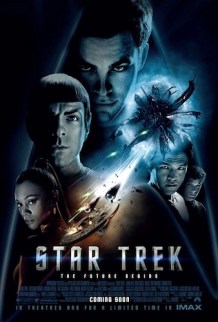
It’s Star Trek, Jim, but not as we know it.

Sorry, but as someone who isn’t actually much of a Trek fan I couldn’t resist that. I’ll try not to include any more. In which case, it’s set phasers to thrill (sorry) as the crew of the Starship Enterprise boldly go (sorry) back to the big screen, hoping to relaunch the ailing franchise to live longer and prosper (sorry). The crew look younger than ever and there’s a heavier dose of action to boot — why, it sounds like it might almost be fun! In which case, beam me up Scotty! (Done now.)

“Fun” is certainly the buzz-word for this incarnation of Trek: it’s all action, special effects and spectacle, without a single scene of uniformed elderly people sat debating ethics. Though some ethical issues circle the plot, they provide character motivation (or excuse) rather than any kind of debate. While the average blockbuster crowd won’t mind this — and nor will critics, apparently — the universal praise this reboot has received may become somewhat baffling. Clearly claims that it’s “great science fiction” are misattributed — it’s great action-adventure in a sci-fi setting. Perhaps an easy confusion to make, but an irritating one nonetheless.

But I digress. The emphasis is very much on spectacle throughout, with wide shots of future cities, starships, alien planets and battles, all shining and designed to be as awe-inspiring as possible. No element of the film remains untouched by this desire: the Good Guys and Bad Guys are clearly delineated — no shades of grey in this gleaming white Universe; the jokes are all entirely upfront, almost to the point of slapstick; everyone’s very young and pretty; and the majority of female characters (there aren’t many) are gratuitously in their underwear at some point too. It all makes for a huge contrast to the dark-as-we-can blockbusters that have been doing the rounds for the last few years (and will be as much as ever this summer) — it makes Iron Man look serious. This is completely appropriate for Trek as originally conceived: the original series was Kennedy-era optimism, all about equality, exploration and peace; perhaps then this is the first film of Obama-era optimism — lots of young people defeating overwhelming terrorist odds.

With all its bright, optimistic youthfulness, it has the feel of a PG-rated family-friendly blockbuster, which might lead one to wonder about the meaningfulness of the “12” certificate now that it has an “A” attached. The answer undoubtedly lies in the action sequences (not the underwear — there’s nothing worse than Princess Leia’s bikini, and that’s rated U. Not that it would be today.) It’s unfortunate that the opening U.S.S. Kelvin sequence is the film’s best, though the rest don’t suffer by comparison. While nothing else is as individually memorable — though parachuting onto the drill tries very hard to be — it’s all of a good enough quality and, crucially, moves by fast enough that you likely won’t notice.

There’s a plot too, believe it or not. It’s actually quite complex, but is pushed along in big chunks of exposition and those breezy action scenes, meaning most won’t notice the strain writers Roberto Orci and Alex Kurtzman are under to make it all work. Sadly they didn’t quite pull it off: there are some glaring plot holes, the worst being a huge blob of coincidence fuelled by convenience halfway through that barely makes any sense. This icy planet — or The Planet of Convenience, as I feel it should be called — features the giant red monster seen so prominently in the trailer. It will come as no surprise that it’s designed by the bloke who came up with Cloverfield’s beasty, not only because it looks almost as foul but because Abrams resolutely keeps the same crew around him at every level. But it’s an irritant to those looking for a cohesive story, starring in an unnecessary action sequence that stinks of both “oh, and a big nasty monster would be cool” and “no one will buy this coincidence, let’s hide it in an action sequence with a distractingly ugly monster!”

The plot does impress in one regard however: it is incredibly entrenched in the intricacies of Star Trek continuity and history, yet all this manages to slip by amiably and accessibly. It’s so at pains to explain why this new-look Trek is completely different from canon yet absolutely a part of it that it runs round the houses tying things together and explaining away inconsistencies that only knowledgeable Trekkies will care about. This is impressive because, in spite of it, it feels like a Fresh New Trek. Perhaps this is why the fans have embraced a film that looks like a multiplex-pleasing reboot: they feel catered for with Spock Prime (as the credits would have it), the complexities of time travel and the references back to the other Trek universe, offering up a whole load of new things to integrate into already-bursting continuity manuals, meaning the lighter action-adventure stuff is permissible too.

Technically speaking, the film is a mixed bag. The design work, for example, is great. While the Romulan ship is your typical Big Bad Semi-Organic Alien Vessel, seen a lot in every space opera TV series of the ’90s, the Enterprise is clean and bright and rather different. After years of Alien-inspired grime throughout sci-fi — even attempted in Star Trek with the submarine-like vessel at the heart of prequel series Enterprise — the new-look USS Enterprise is all bright white and vibrant colours. It’s custom made for plastic toy playsets in fact; or, to be slightly nicer, “these are the voyages of the Apple iEnterprise.”

On the other hand, the cinematography is frequently irritating. While many of the CG shots present a graceful view of the space spectacle, most of the time they need to put the damn camera down. It doesn’t need to be jiggling about all over the place during dialogue scenes — Kirk and Pike in the bar post-fight is an especially irritating example — and it would be nice to see what’s going on in the action scenes. Of course, they manage to provide a nice clear shot when the ladies are in their undies. Cynical? Never. DoP Daniel Mindel has confessed that he tried to get in as many lens flares as possible, and you can tell — it comes across like it was shot by someone who’s only ever worked on digital, then upon switching to film accidentally created a lens flare, thought it was pretty, and decided the film would be better if there was one at literally every opportunity. It wouldn’t.
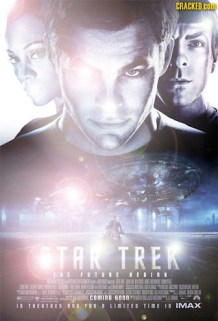
The cast and handling of multiple characters are both less problematic. The way the young crew is brought together is more than a tad contrived, but with seven major characters to compile in a Very Young Crew origin story it’s not an easy task. Certainly, this way is much more exciting than if they were simply assigned the job at an appropriate age and bonded on their first mission — which would undoubtedly have been the plot of Old Trek’s origin movie. The focus is clearly on Kirk and Spock; mainly the former, but his character arc is little more than a standard genius-rebel-comes-good one, whereas Spock’s battle between two cultures and within himself allows Zachary Quinto a lot more to do. Chris Pine makes a good Dashing Hero, balancing the heroic action and broad humour with aplomb, but it’s Quinto whose acting chops come the closest to getting a test. Wisely, neither chooses to copy their original counterpart, which allows them to breathe as characters rather than impersonations.

Most of the leads follow the same strategy to good effect; while Anton Yelchin (as Chekov) and Karl Urban (as Dr ‘Bones’ McCoy) come closer to doing impressions than anyone else, they still make good their own versions. Winona Ryder is a piece of odd casting though, aging up for a tiny role as Spock’s mother. At least Jennifer Morrison’s equally tiny mothering role can be put down to the fact that, while she’s very recognisable to any House fans, she’s playing her own age and isn’t a movie star. Ryder is. Or, perhaps, was.

Unsurprisingly, Simon Pegg’s incarnation of Scotty is an awful a lot of fun. There’s nothing like enough of him, and a sequel will only benefit from an increased Scotty presence from the very start. Though Pegg gets the lion’s share of the best comedic bits — possibly due to his experience and talent in the field — he only turns up to add lightness at the point everyone else begins to get Very Serious About The Plot. Before that there are plenty of jokes flying around, including several that actually require memory — a rare thing in a film focused on spectacle — paying off earlier gags you didn’t expect would receive a payoff. The level to which the film is internally referential and interconnected is again to Orci and Kurtzman’s credit. As noted, the humour brings a nice lightness to proceedings, something missing from the darker-than-dark treatment most franchises offer these days.

The final scene is a bit of a cheesy moment, one of those “aww look the whole gang’s together and they’re all friends” bits — for an American film that relies on optimism, it’s something that they managed to have only one. But it does hold the promise of more adventures to come, and based on the critical and box office success of this outing we’re sure to get them. The need to introduce so many characters here both drives the plot forward and restrains it — the former provides a lot of material, including all the stuff tying it to main Trek continuity, while the latter means any independent narrative is primarily a facilitator for the rest. Hopefully a sequel will suggest the latter is true and it’s not a reliance on the former that has provided this entry’s quality. Or, to put it plainly, “next time they better come up with a good plot”.

For an independent viewer, the over-zealous critical reception is Star Trek’s biggest problem: while it is certainly satisfying in some areas it’s also lacking in others, but it seems most of the world’s critics are closet Trekkies, able to seize upon an above-average film and hail it as the Second Coming. It will come as no surprise when I say it isn’t. I’ve never really got on with Star Trek and its solar system of spin-offs — which, I admit, may be Doctor Who-fan bloody-mindedness — but this I enjoyed, a little in spite of myself and the disproportionate adulation it’s received elsewhere. Rebooting a franchise in a way that appeases fans and pulls in new viewers is no easy task, but it seems safe to say that Abrams has done almost as good a job as Russell T Davies, even if only one of them remembered to hide some brains among the entertainment.

This new incarnation of Trek is bright, light and fun in the face of insurmountable odds — both from the threat in the film and from public perception. Despite the claims, it is not the Second Coming, but it is very good at what it does. In all these respects, it really is just like Obama-era optimism. Does it mean Abrams can relaunch the ailing Trek franchise? Why, yes he CAAAAAAAAAAAAN.

(Really done now.)

4 out of 5

Star Trek placed 7th on my list of The Ten Best Films I Saw For the First Time in 2009, which can be read in full here.
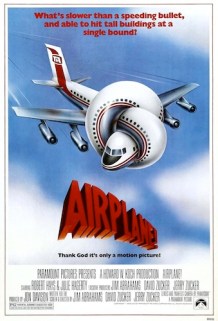
Airplane! (1980)

2009 #21
Jim Abrahams, David Zucker & Jerry Zucker | 84 mins | DVD | PG / PG

Airplane! is not… well, many things. But what it is is a comedy, and, as I’ve said before, if a comedy makes me laugh that’s good enough — it’s its job and, unless there’s more advertised, there’s no good reason to expect or desire more. So is it funny? Yes. But…
The main problem with watching Airplane! for the first time now is that it occasionally suffers from its own popularity. Many jokes are too well known to seem original in context, and while some retain their humour others look tired. The ungenerous would mark it down for this, but that seems unfair considering it’s only the film’s fault in the sense that it was so good everyone’s copied it. However, age is a problem in other ways: cultural references always date, and some jokes here depend on those; some depend on being American too, meaning they passed by with an uncomfortable awareness that I was watching a joke but had no idea why it should make me laugh.

Airplane! combats these almost-faults in two ways: one, it is irrepressibly silly, which in this case is a very good thing; and two, it has an incredibly high joke rate. Combined, these mean it can coast over some of the problems. Even when it slows for a minute or two while running through a gag you don’t get, there’s an overriding silliness that can raise a chuckle and an awareness that there’ll be another along promptly enough.

There’s a good mix of gags too. As well as visual and out-there humour there’s a pleasing use of moderately intelligent wordplay — you’d be hard pushed to find that in a modern populist comedy film. Considering the BBFC’s PG rating there’s also a surprising number of gags that are adults (or, really, teenagers+) only. Even more surprising is that a film with jokes about blow jobs, suicide and cocaine, and which briefly features a pair of bare breasts, only received a PG from the MPAA.

This model of comedy — the silly spoof, as it were — is still in use today in the depressingly endless series of …Movie movies (like this weak example). But where they’re just crude, Airplane! is witty; where they’re just random, Airplane! is irreverent; and where they’re just derivative, Airplane! was original. It may have aged a little, but it’s still funny, and that’s good enough.

4 out of 5

X-Men Origins: Wolverine (2009)

2009 #23
Gavin Hood | 107 mins | cinema | 12A / PG-13

X-Men is a Great Big Action Movie Franchise — you know, the kind that sprawl on through increasingly lengthy films with the constant risk of diminishing quality. Well, at a relatively brisk 107 minutes, this fourth entry in the X-series is actually the second longest. Shocking I know. But while it counterintuitively conforms to the first rule, it fortunately doesn’t to the second, despite what others may say.
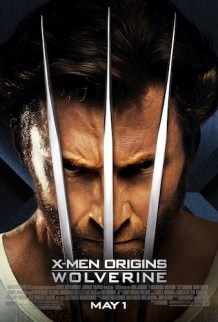
Wolverine, to put it simply — much as the film would — entertains. In this respect it may lack the depth of X-Men or X2, both of which played with subtexts of social exclusion and derision evoking especially the historical treatment of Jews and homosexuals; but, taken as a straightforward action-adventure movie about people with extraordinary abilities fighting each other, it more than satisfies. To this end the action sequences are mostly very good. Only one suffers notably from dark cinematography and choppy editing, both common faults these days, while others manage to exhibit the odd bout of originality — the climax atop a nuclear power station is brilliant, making good use of the characters’ superpowers while also delivering on the ol’ punching-and-kicking front. Some have criticised the action for being physically ludicrous, but perhaps they should be reminded that they’re watching a film about people with superpowers. With that in mind, Wolverine never goes beyond what’s plausible for the world that’s been created across all four films.

In fact, lack of subtext aside, this isn’t as distant from the other X-Men films as the single-character focus and prequel status may suggest. It’s mutant-packed, with numerous cameos from characters familiar to comics fans; it begins with the activities of a superhero team, ends with the rescue of a bunch of mutant kids, and the main plot revolves around some humans doing Bad Things to mutants — just like the first three. The most obvious difference is that Wolverine is now very much the central character, but even that isn’t a great change: he was in the first two, however much they tried to convince us otherwise, only neutered in the third because they knew this prequel was on the way. (For me, the abandonment of Wolverine’s backstory was The Last Stand’s biggest fault, the primary thing that made it feel truly separate from the first two films where it was the central — and unresolved — subplot.)

Elsewhere, the vaguely Watchmen-like opening titles are quite neat, conveying backstory and building up the Wolverine/Sabretooth relationship in an attractive fashion, while also slightly distancing this film from the rest of the series by being in a very different style. While the dialogue is rarely more than efficient, there is the odd good one-liner, my particular favourite being when a grossly overweight character mishears Wolverine’s trademark “bub” as “Blob”, a neat use of one familiar element to create another. Even with these moments, almost all the actors are above the script, especially Ryan Reynolds considering how briefly he appears. All do good work nonetheless, the standouts including Dominic Monaghan, whose character is so different from the violence-centric rest that you wish there was more of him, and Liev Schreiber, who is absolutely fine at what he has to do but would benefit from a few more dramatic scenes to get stuck into. Some of his scenes with Wolverine feel very much like a pair of good actors attempting to transcend the material they’re working from.

Around these weaker parts, Hugh Jackman unquestionably carries the film, and is occasionally granted more to do than just fight people. He even gets to attempt something we’ve not seen from Wolverine before: happiness. Even knowing where it’s all going to end — and there is sometimes a sense that we’re just being told a story we’ve either heard before or worked out for ourselves — there are bits like this that help flesh it out, that show us elements of Logan we might not have bothered to consider otherwise. There’s still the odd instance of box-ticking though, as the few pieces we know from the trilogy are strung together by this film’s plot. They’re not too awkwardly slotted in, but there is an awareness that someone was joining up dots.

While this can be ignored, the same can’t always be said for Wolverine’s noticeably silly hairstyle — one particularly bouffanty moment during the climax even provoked laughter from the audience I saw it with. Intriguingly, Jackman is the second of three Aussies with bloody silly hair this summer, following Russell Crowe’s L’Oréal locks in State of Play and preceding Eric Bana’s Picard pate in Star Trek. I’m sure there must be some deeper meaning to these bad barnets…

Unfortunately, a dodgy ’do isn’t the worst of Wolverine’s problems. There’s some very poor CGI, as if the effects guys thought claws were easy so didn’t worry about them too much. Clearly, this isn’t so. The much-criticised de-aging of another recognisable character is also weak, but, for my money, no weaker than what we saw in The Last Stand. Gambit is miscast and underused, and I’m told Deadpool is the latter also. Not being familiar with the character I had no real problem with his treatment here, but perhaps this is why fanboys dislike the film and some others won’t mind it: if you know what these two characters can be or are meant to be, their sidelining might feel like a betrayal; but if you don’t know them, there’s little wrong with them.

The biggest sin for others is that, at times, Wolverine merrily rolls out clichés. One might argue that it’s set in the ’70s and conforming to some kind of ’70s movie schtick, but that would be a pretty thin argument considering it’s not in evidence anywhere else. Personally, I was amused how some of these lines or moments are sped past, as if everyone involved knew they were shooting a bad cliché but felt they had to leave it in.

This year is surprisingly light on superhero movies, with only Watchmen and now Wolverine to satiate that particular fanbase. Of course, last year was exceptionally packed with them, and as the build to Marvel’s massive Avengers team-up kicks off next summer we’ve got a heavy few years ahead. A bit of a break is nice then, and while Watchmen dealt with the more intellectual front of superheroes (or, if you disliked it, tried to), Wolverine caters to the other side with its unashamed action-adventure entertainment. In fact, by being Actually Quite Good when almost everyone is laying into it, Wolverine manages to become the most underrated film of the year so far.

4 out of 5

Big Nothing (2006)

2009 #12
Jean-Baptiste Andrea | 82 mins | TV | 15 / R

Big NothingBig Nothing was co-funded by the Isle of Man and Welsh film boards; it’s therefore unsurprising that it was filmed in those locations; and there’s a bunch of British actors in it… but they’re all playing Yanks and it’s set in Oregon.
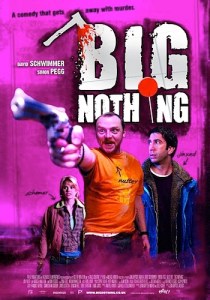
And it’s as schizophrenic as this would suggest. Across its running time — and mostly in the opening half-hour — Big Nothing jumps wildly from mundane comedy to confidence scam thriller to black comedy to geeky spoof. Early on there’s a nice bit referencing The Matrix, for example; a brief moment which feels like it belongs in another film — as do many others. This flitting around makes for a showy opening, Andrea’s direction screaming “look what I can do!” in a way few films have since Guy Ritchie showed off everything he could do in Lock, Stock. It might help Andrea’s showreel, but the downside for viewers is it makes for taxing viewing and a sense that the film lacks its own identity. In short, it’s trying far too hard.

It does settle down however, improving immensely once it gets on with telling its (still loopy) story and stops trying to impress with flashy tricks. It becomes a lot funnier and a lot more enjoyable, slowly fulfilling any hopes the viewer may’ve had.

But it can’t keep it up, despite the brief running time. A long time before the credits roll it degenerates into a grab-bag of random incidents and twists strung together until the made-up-as-it-goes-along script hits something approaching a produceable page count. On the one hand this randomness at least makes it feel different, but on the other it pushes it too far — the array of twists don’t feel like natural occurrences, just plot points that are completely unforeseeable due to being equally nonsensical.

For a good stretch in the middle Big Nothing does more or less what you want it to, leaving the showy opening and desperate series of endings as unfortunate asides to a watchable film struggling to reach feature length.

3 out of 5

Cut (2009)

2009 #20a
Joe Wright | 2 mins | streaming

CutIs Cut an advert or is it a film?

On one hand, websites featuring it always refer to it as a “short film”; it stars film star Keira Knightley; is directed by BAFTA-winner Joe Wright; tells a story in a film (as opposed to advert) style; and is a whole two minutes long.

On the other, it’s paid for by Women’s Aid to front a campaign to raise awareness of domestic violence; it ends with a message to this effect, also featuring no title card or credits; it’s not listed on IMDb; it’s been shown for free among adverts in cinemas and online; it would’ve appeared on TV too if Clearcast hadn’t banned it for being “too violent”; and it’s only two minutes long.

It’s an advert, isn’t it? But it shouldn’t’ve been blocked from TV, which has incensed me enough to pretend it’s a film for the purposes of my little corner of the Internet.

Or half pretend, because purely as a film it isn’t great. It’s well shot by Wright, but some of the dialogue is too on-the-nose to convince and it’s actually slightly padded near the start — so slightly that in anything longer it wouldn’t be noticeable, but when something’s only 125 seconds, every one counts. On the other hand, it tells its story economically, using single shots to establish a lot of detail about characters, their lifestyles and their relationships, aided by Knightley playing a version of herself. In this the length and depth of story chosen are well-balanced.

When the violence comes, it’s moderately brutal. And here’s the rub — it’s arguably not brutal enough to cover the horrid reality of what some people have to suffer. It’s been made suitable to be shown on TV in a slot where people will see it — which, for its aims as an awareness advert, is completely appropriate. In the wake of Clearcast’s stupid ban I was expecting something more severe, which counterintuitively means the violence is more shocking for what it isn’t. Maybe whoever makes the decisions at Clearcast should watch Hostel: Part II before any appeal — or, to be honest, the 12A-rated Dark Knight might suffice.

With a brief running time and an important message to put across, Cut is a 5-out-of-5 advert, if only for the amount of talk and awareness it’s achieved. But I said I was trying to judge it as a film, so I’ll be a little tighter:

4 out of 5

Cut is available to stream for free on YouTube. More information about the campaign’s impact can be found on Wikipedia.

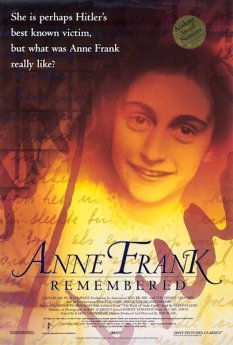
Anne Frank Remembered (1995)

2009 #4
Jon Blair | 117 mins | TV | E / PG

Anne Frank RememberedAnne Frank’s is arguably the best-known individual story of the Holocaust, perhaps because the diary of a 13-year-old girl in hiding from the Nazis — and, sadly, eventually captured by them — makes a perfect gateway for young people into learning about those atrocities.

In this Oscar-winning documentary, Jon Blair exposes the ‘untold story’ of Anne Frank. He adds to her words with the perspective of her friends, other people who knew her, and relatives of her companions in the annex. In covering these views the film presents alternate interpretations of many people Anne wrote about — for example, Fritz Pfeffer (renamed Albert Dussel in the published diary) is very disliked by Anne, but here is painted in a very different light by his son. The film also reflects on Anne herself, and what it uncovers is not always positive. Such an honest approach could be contentious, but its attempt to uncover the truth — rather than paint a false saintly picture — is admirable.

The film’s second half describes what happened after the diary ends, an often ignored part of the tale — even the BBC’s recent, excellent adaptation ended with the residents of the annex being escorted out, and I think many believe this is where the story ends. In reality there were seven months between the discovery of the annex and Anne’s death, and while only Otto Frank survived the concentration camps, many of the others came heartbreakingly close: Peter van Pels died just three days before his camp was liberated, while Pfeffer was marched away by the deserting SS as the Soviets neared, dying with so many others on that path. Here the film touches on much of what life was like in the camps, adding to its detail of how life was for those in hiding. There are undoubtedly other texts that do this more thoroughly, but by focusing on one family and using just a handful of interviewees, the events are made to feel incredibly personal in a way that some documentaries’ more factual approach fails to.

What happened to the diary after the war is also briefly covered: how the book came to light, the impact it had when published, allegations it was a hoax (due to differences between translations, and fictional events created for the 1955 play and subsequent film adaptation), as well as the positive effect it’s had beyond that, including comments from the likes of Nelson Mandela.

With its honest and extended investigation of the events covered in Anne Frank’s diary, plus its consideration of broader facts of the Holocaust, Anne Frank Remembered adds significantly to the original text. In doing so it becomes an essential companion piece to one of the most famous and important documents of the Second World War.

5 out of 5

Runaway Train (1985)

2009 #11
Andrei Konchalovsky | 106 mins | TV | 15 / R

This review contains major spoilers.

Runaway TrainRunaway Train bagged itself three Oscar nominations and one for the Palme d’Or back in 1986, which rather begs the question, how?
On the awards-worthy side, it’s based on an Akira Kurosawa script and features grittier-than-average direction and performances. On the other, the majority of its story and supporting characters feel closer to other ’80s actioners like Lethal Weapon or Die Hard. The focus on a high concept (the title says it all), emphasis on exciting action sequences, the way the plot is structured, the faintly pantomime villains, comical supporting characters, and occasional slips into fantasy (one character was welded into his cell, the state the prison has degraded to, the whole concept of the runaway train and its computer control centre) — none of these elements suggest your typical Oscar nominee, but instead a half-forgotten minor action flick.

The lead characters and their performances, by Jon Voight and Eric Roberts, are above average for the genre — this is where two of the Oscar nods come from — but they’re not notably superior to other outstanding examples (see Bruce Willis and Alan Rickman in Die Hard). Praising the acting can only cover the two leads, at best, because the villains and supporting roles are as one-dimensional and clichéd as you’d expect from the genre. The other Oscar nomination was for editing, one that’s more obviously deserved. Visually, the sequences of the train smashing through the countryside are fairly impressive. Perhaps the camerawork deserved a nod in this respect too, as it lends the film a gritty real-world feel that may be explain some’s distraction from the otherwise familiar values. It can’t mask them all though — for example, the occasionally brutal violence is still denied any real-world punch thanks to the fantastical sheen created by some plot points.

The notable exception to most of this is the ending, where Voight’s anti-hero stands atop a train engine we — and he — know to be doomed, his prison warden nemesis handcuffed inside, and rides it out of sight into the fog. It’s a classy finale that flirts with the downbeat ending, though doesn’t quite succumb to it because we also know the young sidekick and girl have survived. Nonetheless, there’s pleasingly no postscript, simply fading to black after the engine disappears into the mist. The titular train, one might theorise, is like some mythic beast — it arrives through snow-mist, leaves devastation in its wake, and then disappears back into it. But that might be getting a bit too pretentious…

In focusing on these lofty pretensions (which may have been forced on it by nominations and some reviews), one can become distracted from the fact that, taken as a straight-up high-concept action-adventure, Runaway Train has an awful lot going for it. And if you want to get pretentious about it, well, it might just support that too.

As a final aside: one of the film’s most memorable moments, in retrospect, is down to an accident of fate. Near the end a character looks at a space shuttle on TV and muses, “with all this high technology, why couldn’t we stop it?” Just 11 days after Runaway Train’s US release, Space Shuttle Challenger disintegrated 73 seconds after launch, killing its seven crew members. For anyone aware of this correlation, it’s an incredibly poignant moment.

4 out of 5

Though the Radio Times review I’ve linked to says Runaway Train is an 18, it was reclassified in 2008. [It has since been updated.]

State of Play (2009)

2009 #20
Kevin Macdonald | 127 mins | cinema | 12A / PG-13

This review contains minor spoilers.

State of PlayState of Play is one of my favourite TV series of all time, a densely plotted thriller that packs every minute of its six-hour length with clues, characters, twists, revelations, humour and moments of sheer brilliance. It introduced me to James McAvoy and Marc Warren, both of whom are now leading men to one degree or another (and their appearance together in Wanted gave me a bizarre frisson of fanboy delight that’s unusual outside the realm of sci-fi/fantasy), and Bill Nighy, who was surely known before but has since gone on to even more. And that’s to ignore the fantastic performances of John Simm and David Morrissey, two of our finest actors, carrying Paul Abbott’s beautifully convulted plot through all its intricate twists to an inevitable but powerful conclusion.

Much imitated, though the imitators have either fallen short (The State Within) or been flat-out dismal (The Last Enemy), it therefore seems inevitable that State of Play has followed in the footsteps of Traffik and headed for the US big screen. In the process, it squishes six hours down to two and replaces the Simm/Morrissey dynamic with the filmfan-pleasing reunion of Brad Pitt as brilliant-but-troubled reporter Cal McAffrey and Edward Norton as wunderkind politician Stephen Collins. Y’know, in their hands, it might just work!

Except Pitt walked and Norton followed, hastily replaced by the unwaveringly grumpy Russell Crowe as Cal and the offensively inoffensive Ben Affleck as Collins. Oh dear, it’s not off to a good start…

Fortunately, State of Play: The Movie quickly turns out to be a good case for not judging a book by its cover — or, literally, a film by its cast. To be blunt, none are as good as in the original, but that’s the nature of the beast here — even a Pitt/Norton pairing would have struggled to achieve in two hours what Simm/Morrissey could in six. Helen Mirren fares best as editor Cameron, the Nighy role, though doesn’t have the screentime to make it her own. Crowe, Affleck and Rachel McAdams (in a beefed-up role as young reporter Della Frye) are all above average, but none come really close to the originators. Jason Bateman’s appearance as Dominic Foy is probably more than decent — certainly, other reviewers clearly unfamiliar with the original have hailed him as Best Supporting Oscar-worthy — but is as nothing compared to Warren’s creepy wimp in the series. When Collins breaks his cool and attacks Foy, the Affleck/Bateman version packs none of the punch of the Morrissey/Warren original.

But the real focus of this screen-to-bigger-screen translation is that complex six-hour story, condensed from 340 minutes to just 127. This three-fold reduction has been well handled by a trio of screenwriters, and perhaps their most noteworthy achievement is crafting a film that feels entirely like its own entity without sacrificing anything significant from the primary conspiracy plot. The relocation to the politics of Washington is unobtrusive, apparently not encountering issues like the Law & Order: UK writers did in converting across justice systems; as is the focus of Collins’ investigation, switched here from an oil giant to an arms contractor. Both quickly help give the film its own identity, while the latter also makes some plot points more straightforward — with such a shortened running time and so much plot to cram in, this is completely forgivable and works seamlessly. Unsurprisingly some of the depth and nuance of the six-hour version is lost in such an abbreviation, the adaptors choosing to cut characters (Cameron’s son, as played by McAvoy on TV, is a glaring omission for fans) and subplots (Collins’ wife barely features, but again only by comparison) rather than significantly abridge or rush the main narrative. It moves fast, but in a pleasant way — this is not an under-plotted or ponderous thriller.

In all this talk of the plot, original writer Abbott should not be forgotten. While the film’s writers have naturally changed things substantially, much of it is surprisingly cosmetic: the essential cut and thrust of the main conspiracy plot remains, and that’s all from Abbott’s brain. Some of the series’ most memorable moments are intact too, though naturally they don’t quite stand up to comparison — the already-mentioned Collins/Foy beating, for example. Others are sadly lost entirely — my favourite bit of the whole series is when Cameron stops the presses to publish the best opening half-dozen pages of a newspaper ever (so good you would never see something so bold in reality), but that’s nowhere to be seen here. Equally humour is light on the ground, but a few intended laughs do stick through. Their number is quite well-balanced, and all pleasantly natural — aside from a few of Cameron’s one-liners there are no enforced “comedy scenes”, just amusing lines and moments that would be equally unobtrusive in real life.

Macdonald adds his own flourishes to the tale beyond the relocation and business focus. Aside from a slightly unusual obsession with shots of helicopters over the city, his most significant addition is a thematic strand on the potential demise of the newspaper in the face of TV and the Internet. As the story breaks, the explosion of news snippets — from TV, blogs, YouTube — are wonderfully handled, indicating the countless ways we consume news today — and how quickly a lie can spread once someone’s reported it as fact. Sadly these montages fall by the wayside as Cal and Della get deeper into uncovering the complex truth, the movie no longer having the time to indulge them. It’s a shame, because continuing this through every plot twist would’ve helped raise the film’s quality and individuality that little bit extra. Instead, some of the mood and tone they served to create slips a little as the story moves on.

Some reviews have criticised the ending, many going so far as to say it loses all its quality in the last 10 minutes with a dodgy final revelation. This worried me going in, but in fact it remains true to the series’ plot throughout. Perhaps some reviewers need reminding that they’re watching a thriller — you can’t really end with someone confirming what we’ve known for the past half hour, you need a twist. The one that State of Play provides is possibly surprising (I say “possibly” because there will always be those ready to cry “I knew it all along!”) and makes more than enough sense to justify itself. It doesn’t undermine what’s gone before in the slightest; in fact, if anything, it makes it that bit more plausible (unless you really believe huge 24-esque conspiracies are plausible) and casts new light on everything that we’ve seen. Just like the TV series did. It’s not going to be remembered as one of the great twists of all time, but it’s fit for purpose.

For me, the biggest misstep was an incredibly trivial one: the closing credits sequence. Shot in a bright style with relatively jolly music, it totally jars with the increasingly dark thriller just witnessed. The basic conceit of it — the printing of a paper — ties perfectly to the “death of the paper” theme, but its execution is lacking. Of course, when the credits sequence is the only major flaw in a movie (well, aside from the odd spot of clichéd dialogue, and a few moments when Crowe’s hair seems to be auditioning for a L’Oréal advert), you can’t complain too much.

As a fan of the original series, my thoughts ultimately come back to that. It’s a comparison the movie version would always have suffered under, and it’s to the credit of all involved that they’ve managed to create something that exists independently. Even to someone who loves the TV series, watching the film doesn’t feel like a highlights reel or awkward plot summary — it’s the best abridgment one could hope for, uncompromising in not dumbing down the plot, and still managing to add significant elements all of its own. If you remove the TV series from the equation, State of Play stands by itself as an above-average, intelligent and compelling thriller.

Just like the original series, it’s exactly the sort of thing I wish they made more of. Perhaps, if we’re lucky, Abbott will be inspired to revive State of Play 2

4 out of 5

The Birds (1963)

2009 #6a
Alfred Hitchcock | 114 mins | DVD | 15 / PG-13

The BirdsI first saw The Birds on TV so long ago that I can’t even remember how long ago it was. Only two parts of it have stuck with me since: the justly famous scene with the climbing frame (ooh it’s brilliant), and a dead Dan Fawcett with his eyes pecked out (ooh it’s chilling).
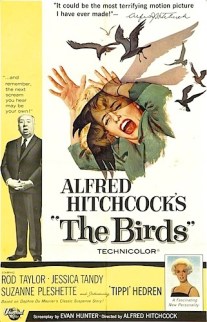
If that didn’t give it away (and as if you didn’t already know), The Birds is a horror film. A horror film of the proper kind too — the kind that scares you, rather than making you jump at regularly-spaced committee-decided intervals. It’s the kind that slow burns its way to the horror — we meet the characters, see their relationships, arrive at the right location… There are hints at what might be coming, but they idle past in the background, almost unnoticed… but gradually increasing.

This isn’t time wasting; it isn’t really character development either, despite how some of it may seem (more on that in a bit). It’s how Hitchcock builds suspense — we know it’s coming, we just don’t know when — and likely contributes to some sex-related subtext too. (I haven’t just pulled that out of thin air, incidentally. There’s the odd moment where that subtext almost breaks through into the text, though Hitchcock quickly reels it back in.)

The second half is where all this time spent delaying and manoeuvring pays off. The titular demented avians attack, and attack again, a near relentless series of assaults and set pieces that allow Hitchcock to show off his apparently endless array of shooting and editing tricks. These aren’t just spectacular action sequences — though there are some, of a fashion — but sequences of unnerving horror. And it’s all achieved without a single note of music — no slowly rising throb in the background to tell us we should be getting scared, no dramatic thud to make us jump, no piercing musical shrieks as the birds attack — yet some sections are almost unbearably tense, built entirely with camera angles and masterful editing.

If there’s a weak note it’s the romantic subplot. While it initially drives the film, it’s largely abandoned later on, becoming no more than an excuse to move characters into place for the birds’ attack. In fact, Hitchcock seems to just get tired of it, allowing the film to jump abruptly from will-they-won’t-they to cuddling and kissing — and it’s not even like a first kiss. Intriguingly, a deleted scene included on the DVD (which has been lost, only surviving through a script segment and production photographs) seems to provide the ‘missing link’ in the central relationship. However, it also offered an explanation for the birds’ attacks (albeit a jokey one), something Hitchcock was keen to avoid, which likely explains its removal.

But that’s mostly beside the point. The Birds is a tension-based horror movie, and every sequence of tension is perfectly staged. This is where Hitchcock is really in his element, and all of the preamble is worth enduring just for the chance to see the master let loose. Dan Fawcett’s lack of eyes has probably stuck with me as much thanks to Hitchcock’s impeccably paced build up as to the gruesomeness of the actual image; and the birds amassing on the climbing frame outside the school is an absolutely perfect sequence, a moment of pure cinema.

5 out of 5

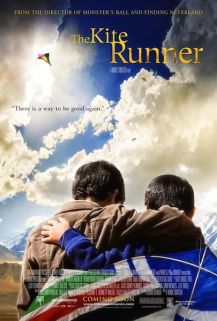
The Kite Runner (2007)

2009 #3
Marc Forster | 123 mins | DVD | 12 / PG-13

The Kite RunnerCan no one tell a story from the beginning any more? I blame How To Write books and courses, insisting that films must begin with certain types of incident to hook the audience, even if this isn’t the first event chronologically. Do they think the audience has no patience? Especially in a film, where you’re only committing about two hours of your time (as opposed to however long it takes to read a novel) and even the most lazy viewer is likely to stick it out for at least 15 minutes.

The Kite Runner is just the latest film to do this (and by that I mean “latest I’ve seen”, as I’m sure dozens have done exactly the same thing since), beginning two thirds of the way through with a scene that makes little sense… until, inevitably, the story flashes back to the start and leads us through to that inconspicuous scene, finally giving it some meaning. Really, it’s little more than a cheap tease; a promise to the audience that what follows is actually going somewhere, however pointless it may seem. It’s perhaps the only trick that makes me inclined against a film (or indeed any work of fiction) right from the off.

Perhaps the structure is lifted directly from the source novel. The film certainly has an unusual feel in this sense, like the text has only been half converted for the screen. Not every film should — or does — conform to the structural rules of those How To Write books, but there’s something about the way events progress here that feels more novelistic than filmic. Arguably this is also true of the story itself, which seems to be more about its themes than its characters: bravery, cowardice, and the difference between the two; friendship, and the lengths (or not) it will go to; truth and lies, and what underhand things people — especially children — will do to cover up their own shortcomings and failings.

In this respect it feels like it’s part biography (though it’s fiction) and part moral fable. By the end, we’re presumably meant to leave with the feeling that some justice has been done at last. But while one boy has been saved from the horrors of his captors — and even then, almost too late — there are hundreds left behind with the still-active villain. In this respect it’s undoubtedly true to life, but it belies an attempt at an uplifting and redemptive ending.

In assessing The Kite Runner it feels like I may have missed something and am being unduly harsh, but sadly it failed to engage me. While I long continued to ponder some of the issues it raised for me (always a positive), I’m not certain they were the ones the filmmakers intended.

3 out of 5

This review was written over three months after seeing the film, based entirely on notes made at the time and my rather poor memory. Apologies if it is therefore a bit unfocussed or, God forbid, inaccurate in the odd minor fact.