
Clint Eastwood | 125 mins | TV | 12 / PG-13
 Million Dollar Baby currently places 143rd on the IMDb Top 250; it’s on the 2010 iteration of They Shoot Pictures, Don’t They?’s fairly definitive list of critics’ greatest movies ever (albeit down in the 900s); it was Empire’s 13th best film of 2005 (no doubt lowered by being almost a year old when the list would’ve been decided); and, most notably, it won the 2005 Best Picture Oscar. But it’s also about boxing, a subject I couldn’t care less about, and indeed I don’t think I’ve ever seen a boxing-centric film before. Unfortunately, Million Dollar Baby did nothing to allay my suspicions that I wouldn’t care less about those either.
Despite this, and its adaptation from a book of boxing tales, the boxing is used by Eastwood (and screenwriter/was-going-to-be-director Paul Haggis) as a means to an end: this is really about Frankie (Eastwood’s boxing coach character) and Meg (Hilary Swank, apparently on Oscar-winning form), how they interact, change each other, what their relationship means to them. Unfortunately, my total disinterest in boxing prevents any significant engagement with their story and holds back my care for their characters. The training and fighting sequences don’t help, and even the film’s anti-boxing stance doesn’t do anything to change my opinion.
Dramatically, Million Dollar Baby takes off once Meg’s paralysed and the boxing’s done with. Undoubtedly this is built on the foundation of the preceding 90 minutes — how the characters and their relationships have been built up, what we’ve seen them go through, etc —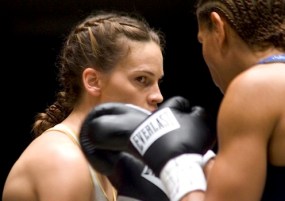 and it goes some way to make up for all the tedium that’s gone before. That it’s a grim and downbeat finale, however, serves an anti-boxing message I already get but does nothing to redeem the tale.
Eastwood is a skilled actor and director and the film is competently made, and at times it’s even more than that, but it’s far from his best work in either field. The same can be said of Morgan Freeman, essentially recapping his Shawshank role as the wise old best friend/narrator; and also of Haggis — whatever your opinion of Crash, the one-liners he added to Casino Royale alone best any moment here. The same may again be true of Hilary Swank, but I can’t remember her in enough else to say. Certainly her character is the film’s saving grace, incessantly likeable throughout and eliciting a smidgen of genuine emotion once all that boxing malarky is finally out of the way. And it’s a good thing she is so likeable, because if her personality was anything less than perfect the tragic ending would elicit thoughts along the lines of “well, if you’re going to go boxing, that’s what you’re gonna get” (rather than the intended sympathy) from viewers like me.
I’m not sure if it’s deliberate or not but, as I say, it’s an incredibly anti-boxing movie. No good character’s life isn’t in some way ruined by the ‘sport’: Meg is paralysed and ultimately loses her life, not to mention realising how awful her family are; Morgan Freeman’s lost the sight in one eye and is reduced to cleaning up a run-down gym; ‘Danger’ gets beat-up; 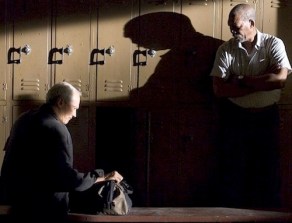 and Frankie’s lost his daughter, gets screwed over by his protégé, and ultimately loses Meg too. In no way is this a cheery depiction of boxing.
It’s funny, really: give me Jackie Chan, or Jet Li, or Tony Jaa, or some Western star’s stunt double, kicking seven shades of whathaveyou out of each other and it’s a brilliant, fun experience; but two people beating the hell out of each other for real in a ring holds not even the slightest semblance of interest or enjoyment for me. Maybe it’s the choreography of filmic violence that makes it more interesting, or maybe I’m just hypocritical — I don’t know, but I still don’t care. Some day I’ll see the likes of Rocky and Raging Bull, and maybe they’ll stand a better chance, but I’m no longer counting on it.
I’m giving Million Dollar Baby four stars out of respect for the skill of the filmmakers and for what it achieves during the final half hour (and in smatterings throughout), but it flies ever so close to a three.

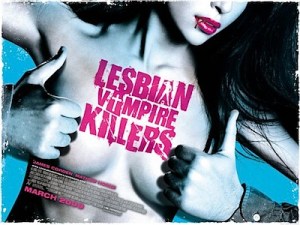 Pre-release hype pegged Lesbian Vampire Killers as the next
 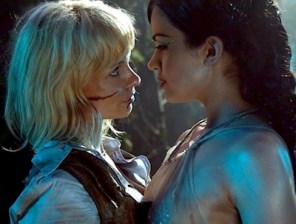 Unfortunately, even with corrected expectations, the film fails to deliver on its twin promises of raunch and horror. Aside from a couple of brief surgically-enhanced medieval boobs, a flash of knickers and the odd girl-on-girl kiss, the film’s sexy content is non-existent. Said Nuts audience would certainly get more from their weekly wank mag; this is mostly 12A-level. The horror, meanwhile, is reduced to well-signposted jump scares — and even then few enough to count on one hand — and the odd bit of comical decapitation/melting with holy water/axes in the head. To be fair, this is meant to be more comedy than horror, and in this sense a few such moments succeed passably.
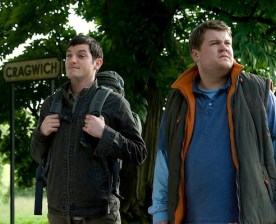 Indeed, consistency is not the film’s strong point. Everyone makes a big fuss about the vampires and how hard they are to kill, yet every one is dispatched with ease, the level of threat never allowed to even attempt an increase before there’s white goo splurting everywhere (that’s what happens when they die, incidentally, not someone’s reaction to the lesbianism). The climax is a mere extension of this, substituting a rising scale of action for running around avoiding the easy killing bit. Any good will amassed in the middle — and there may be a tiny bit — is dismissed in boredom.
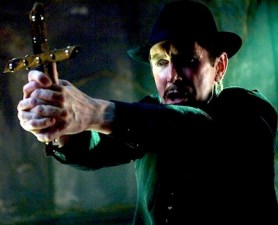 shot for the lowest-common-denominator lad’s-mag-buying audience, though quite what they made of the classic horror reference points that do remain is anyone’s guess. If we’re talking about expectations (and, clearly, I am), Lesbian Vampire Killers did somewhat defy mine — though as I was expecting it to be one of the worst comedies I’d ever seen, that might not be saying much.
 What About Bob is a comedy about mental health. As such, it feels primed for misunderstanding and inappropriateness. And it is indeed a little worrying early on: Bill Murray’s performance is, from the off, superbly believable, but it’s undercut by bad ‘this is a comedy’ music that suggests we’re meant to laugh at his impairments rather than feel sympathy. And maybe that’s what the screenplay, direction and performance were actually aiming at, but, personally, I don’t find laughing at the mentally disabled all that funny, even in a film nearly 20 years old. At one point, people clap as Bob gets off a bus he struggled to even get on — perhaps this is meant to indicate “thank God he got off!”, but I choose to take it as them celebrating his achievement, because, if not, it’s just attacking the disabled again.
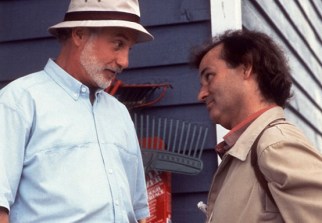 The film hinges entirely on Murray and Dreyfuss, and both are excellent in their respective roles. Murray portrays Bob’s mental health struggles early on in a way that would garner wider praise for accuracy if this were a drama, showing the potential he’s only unleashed in more recent years to play straight roles. But he’s equally good as the film becomes a clear-cut comedy: Bob doesn’t suddenly become a caricature, but is revealed as a good-natured, child-like, fun-loving person who, perhaps, just needs some care and love from others to help his conditions. Dreyfuss, meanwhile, is slickly believable as the uncaring fame-minded therapist, whose true nature — and problems — begin to unravel the more he’s confronted with Bob.
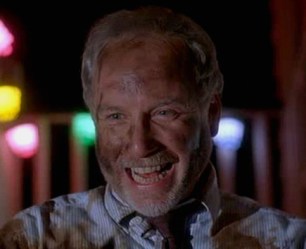 more about you as a person than it does about the film, the characters or the performances. It seems starkly obvious to me that Bob is the ‘good guy’, a nice but troubled chap who just wants to get by and have a good time, while Dr Marvin is a control freak with a raft of suppressed problems that are gradually unveiled throughout the film until they ultimately overwhelm him. He’s not a bad chap per se, but he is in the wrong.
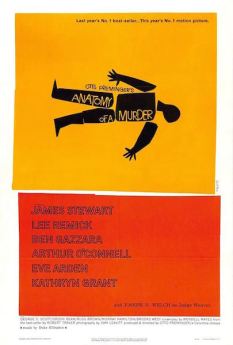 Anatomy of a Murder is a courtroom drama, adapted from a novel by a real-life defence attorney (“defense attorney”, I suppose), who in turn based his fiction on a real case. This background not only adds to the veracity of what we see, but likely explains the film’s style and structure.
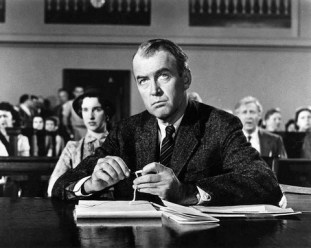 A lot of this support is down to Stewart’s performance — it feels wrong to be cheering the defence counsel of a murderer, even if he had a justifiable motive (which, remember, he may not have) — but we’d probably cheer Stewart on if he was the murderer. His Biegler is always in control, from investigation to courtroom, even when by rights he should be completely out of it. He manipulates the judge, the prosecution, the jury and the crowd to perfection; the viewer sits by his side — we know he’s playing them so we can revel in it — but, in turn, he manipulates us too, tempting us to his team — to laugh at his jokes, to support his case, to loathe the prosecution, even though they might be right. It’s a stellar lead performance.
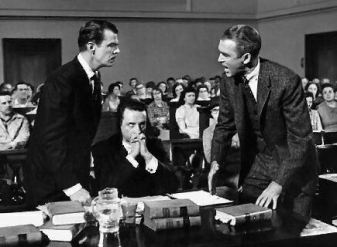 I could just as well go on to praise Ben Gazzara, Arthur O’Connell, Eve Arden, Brooks West, even the smaller roles occupied by Kathryn Grant, Orson Bean, Murray Hamilton and others. Some criticise Joseph N. Welch’s judge, and it’s perhaps true that his performance is a little less refined than the others, but as a slightly eccentric judge he comes off fine. And to round things off, there’s an incredibly cute dog. Mayes’ screenplay is a gift to them all, finding room for character even within the ceaselessly procedural structure, using small dashes of dialogue or passing moments to reveal and deepen each one.
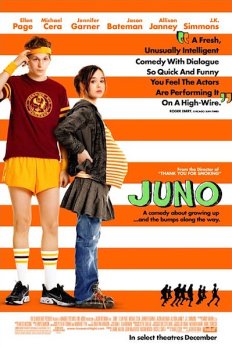 Juno followed in the footsteps of films like
  I always assumed this was British, probably because it stars Billy Connolly and has a suitably quirky premise — one can see it fitting in with the school of British comedy that’s brought us
  His Girl Friday is an acknowledged classic — 19th on the
  There are times when one feels under-qualified to review a film in a way that gives it its due. This happens particularly frequently when one’s blog covers first-time viewings of films that are often classics/significant/beloved/etc. My appreciation for Exiled has been increased by two other, more qualified, reviews: one from
  Denzel Washington and Tony Scott have now served as star and director (respectively, as if you didn’t know) on four films, with
  First, a little note on that aka: technically — and, I believe, legally — no such title is attached to this project. However, the initial idea was developed by Koontz and, after he left the project, adapted into his Dean Koontz’s Frankenstein series of novels. Despite the ‘creative disagreement’ (or whatever they chose to call it) that led him to walk away, the film retains significant similarities to the first book. More on these in a moment.
 100Films.co.uk