
Hideo Nakata | 94 mins | TV | 1.85:1 | UK / English | 15 / R
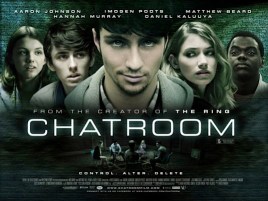 Chatroom is born of — or, at least, partly formed around — trying to find a viable way of depicting the world of online chatrooms on film. Putting on film this world it As It Really Is — people sat at a computer typing at each other — might work well enough for a single scene in Closer, say, but who would want an entire feature of people sat before a glowing screen, fingers tapping, while we have to read all the ‘dialogue’? Chatroom is one possible solution.
I don’t imagine it was the film’s sole goal — presumably presenting the online world in a filmic (or, as it originated as a play, stage-friendly) way was a necessary aside for wanting to set a story in that world. Sadly, the actual tale being told isn’t up to all that much.
To take those two ideas that way round, then, Japanese horror director Hideo Nakata (Ring, Ring 2, The Ring 2) presents the world of chatrooms as a corridor of literal rooms, which — if you’re going for the metaphorical route — is possibly the best way to express online chatrooms on screen. Once in the rooms, people talk — as you would online, except with your voice instead of your fingers. The genuine intimacy and friendship that develops between the characters  in this environment is also truthful. There have been many reviews that are completely dismissive of this facet of the film, leaving me to wonder if they were written by people who haven’t used or experienced such things. It’s a shame, then, that the film’s degeneration into a thriller hides the arguably-worthwhile potential to explain to such people what that online world can be like for people/kids using it.
For all the understanding of the online world, the liberal use of tech occasionally gets in the way. Apparently lead-character William is an expert at hacking, Photoshopping, and all kinds of other computer jiggery-pokery… when the plot wants him to be. There’s nothing to suggest he isn’t capable of all that, and yet it doesn’t quite gel that he is. It seems to be aiming it at an audience ignorant of how computers work, in that William is defined as “a character who is good with computers”, which therefore translates as “a character who can Do Anything with a computer”. It doesn’t hang together.
Like, in many respects, the plot. This is why I wonder which came first, story or concept, because while the latter is fully realised, the former is scrappier. Early subplots don’t really go anywhere, like the story’s searching around for where it wants to explore. The final act collapses into an aimless runaround as it attempts to tack on some kind of exciting thriller-esque climax.  Despite a strong-ish start, perhaps the whole second half of the film is a wobbly mess; not directionless exactly, because by then it does know broadly where it’s going, but it doesn’t do much to suggest to the viewer that it has a real goal in mind. Character motivations and relationships feel as if they’ve not been fully thought out, or at least not fully brought together on screen. Some threads take inexplicable jumps; others aren’t adequately explained or justified. Occasionally it’s Nakata’s direction that overdoes things, for instance laying the soppy “this bit is emotional” music on thick when Matthew Beard’s performance could easily carry a particular sequence.
The cast is populated by young up-and-comers, some of whom have very much up-and-come since. As the initially enigmatic William, Aaron Johnson (Nowhere Boy, Kick-Ass) isn’t bad, though he’s done no favours by the role. There’s the makings of an interesting character here, but it doesn’t coalesce into something recognisable as a real human being. Imogen Poots (28 Weeks Later, Centurion, etc etc) and Hannah Murray (the original Skins cast) discarded in supporting roles. Daniel Kaluuya (also original-flavour Skins, plus Black Mirror episode two) fares marginally better, though again his character and storyline is woefully underdeveloped.
 The aforementioned Matthew Beard, perhaps the least recognisable cast member (his CV shows lots of stuff, just nothing with a significant part for him), gets the best of it. His character is the closest to having a believable arc, to even having credible motivations and actions. The scene-with-too-much-music should hopefully ensure he wins some better roles in the future, though, as that link shows, there’s nothing much yet.
Chatroom is an experiment in presenting an intrinsically unfilmic world in a way that works on screen. It does a fair job of that, though it feels too idiosyncratic to become The Way It’s Done. Sadly, the story it’s married to isn’t as competent. While something like that bears telling — especially as we see increasing reports of online abuse and the establishment struggling with how to police and prosecute it — this isn’t the ideal form. If cinema is (at times, of course) meant to reflect the world we live in, this is very much the world a massive (and ever-growing) number of people now live in. Hopefully Chatroom won’t put someone off trying again sometime.

This review is part of the 100 Films Advent Calendar 2012. Read more here.
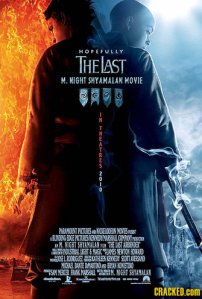 Consensus holds that the work of once-acclaimed director M. Night Shyamalan has managed a near-perfect trajectory of decreasing returns. I’m not talking about box office — I have no idea (or much interest) in how that’s gone for him — but quality, starting with supernatural chiller
 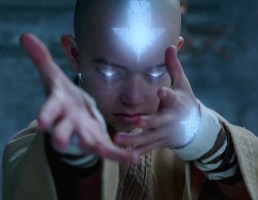 Chunks of it seem to be missing, conveyed through clunky voiceover rather than on-screen action. The first rule of screenwriting — literally, the first — is Show Don’t Tell, but Shyamalan does exactly the opposite.
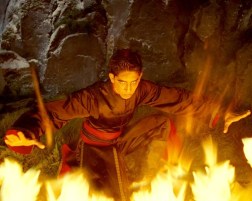 I wouldn’t call myself a Shyamalan apologist, but I think he has at times suffered harshly at the hands of critics and audiences disappointed that he’s never re-reached the heights of The Sixth Sense (though, personally, I prefer
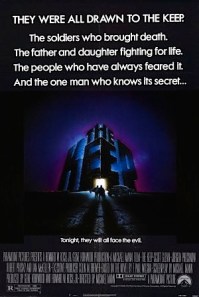 Michael Mann is arguably best known for his modern, urban, slick, intricate crime thrillers — films like
 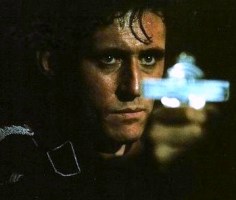 Should we long for a Director’s Cut, then? Maybe that would be an improvement, but I’m not convinced it would be good per se. You see, the film doesn’t just stick to giving us Nazis vs Whatever The Keep Contains, oh no. First the SS turn up, led by a Properly Evil Nazi, played straight by Gabriel Byrne. Escalation, great. Then there’s Ian McKellen as a professor drafted in to make sense of the keep’s mysteries. Also great — even the Good Nazi is going to have to die, right? Who better to root for than a saved-from-a-concentration-camp Jewish professor.
 There are plus points, but they all come with a commensurate downside. The creature is well-realised at first, with some nice animated effects that are more effective than much of the over-cooked CGI spectacle we’d get today. The more we see of him, however, the less power he holds — he ends up essentially a very tall man. OK, it’s a bit better than that makes it sound, but the mysterious billowing smoke was spookier. The film on the whole is nicely shot, with some real standout moments of cinematography. But slow-mo and a smoke machine both get overused by the end, lending many of the visuals a tacky ’80s edge.
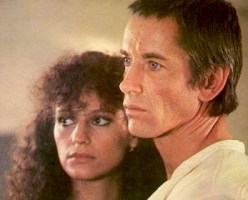 One thing the film never manages to be is remotely scary. It’s not aiming for cheap jump- or gore-based shocks (although there is a little goriness, it’s quite light; triply so by today’s standards), but it doesn’t manage any significant senses of dread or creepiness. As noted, early on it seems to be heading in the right direction — even the secluded mountain village, nestled in a harsh landscape but with greener-than-green grass and garishly painted houses, and towered over by the foreboding slab of stone that is the titular structure, is an uncanny start — but it never makes good on the promise.
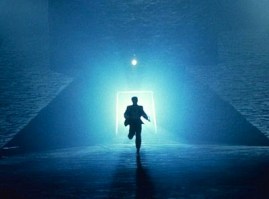 I would love to join their ranks, because there are numerous exciting ideas and moments of quality filmmaking to be found here; but I won’t be, because there’s too much muddled dross packed in around them. The result is that quite-rare thing: a decidedly mediocre film that I’m actually glad I’ve seen. But, unless someone wants to hire me for that remake, never again.
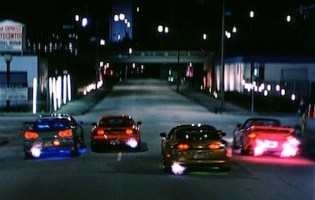
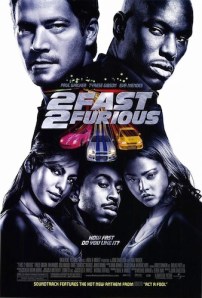 I never thought I’d watch, and certainly not enjoy, the Fast and the Furious series, but a few years ago (after the second film hit cinemas, I think — which would be almost a decade!)
  It’s worth noting it was directed by John Singleton, who started out with the acclaimed social drama
 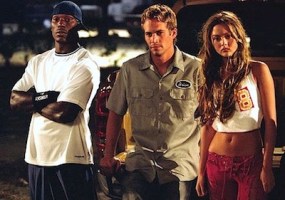 Ultimately, 2 Fast 2 Furious is like cheap fast food: you know it’s made of trash, high in fat and sugar, liable to rot something in your head — and just really bad for you fullstop… yet it’s an enjoyable guilty pleasure once in a while. If you don’t identify with that feeling then you’re a better man than me, and you’ll probably never like this film.
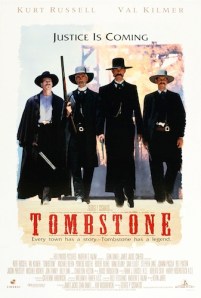 The story of the OK Corral is one I know by name only; I haven’t even seen the
  That may be down to historical accuracy. There’s a distinct feeling of veracity to proceedings, and as I understand it a concerted effort was made in that regard. The Movies perhaps shouldn’t worry about sticking too closely to fact (if you want an accurate lesson, read a textbook), but when they can manage to be both factually accurate and entertaining, it’s all the better. Cosmatos & co appear to balance this well.
 Mainstream US superhero comics underwent something of a revolution — or an evolution, if you prefer — in the ’80s, moving from simplistic good vs evil tales-of-the-week to deeper, thematic- and character-driven stories that in some cases took months or even years to relate in full. It’s a change that’s still felt today (some would contend that they’ve been stuck for decades in a rut these developments ultimately led to). It’s generally considered that there were three works at the forefront of this wave of more adult-orientated comics, all of which still rotationally top Best Graphic Novel Ever polls today: Alan Moore and Dave Gibson’s
  Like Year One before it, the team behind these direct-to-DVD DC animated movies have taken a reverent route to bringing DKR to the screen. It’s in two parts because the original story is too long to faithfully adapt in their limited-length movies (it’ll work out at about two-and-a-half hours all told, which isn’t commercially viable for a direct-to-disc animation), but that also works out OK from a storytelling point of view: this first half ends with a major threat wrapped up and a great cliffhanger to kick off the second half. Those with less appreciation for the economics of film production have slated DC/Warner for splitting the film in two like this, but in some ways it works to its benefit artistically as well as commercially.
 Stylistically, the film retains Miller’s designs, albeit a bit smartened up to work consistently as animation. Some will bemoan that homogenising but others may delight in it — Miller’s art is generally a bit on the scruffy side, I think. Is it an appropriate mark of respect that they’ve translated it so literally from page to screen, or would it have been more interesting for the filmmakers to have taken Miller’s plot and situated it in a world drawn from their own designs? I’m not going to argue that they could have improved on Miller’s work, but it might have been interesting to see the story given a spin in a different artistic style.
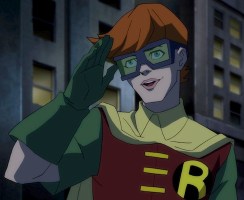 Voice work — the other major addition of an animated re-telling, of course — ranges from solid to very good. I wasn’t convinced by the casting of former RoboCop Peter Weller as Bruce Wayne/Batman, but he’s pretty darn good, carrying exactly the right kind of aged gruffness. It’s unique, I think, to see an active Batman this old on screen — sure, Nolan forwarded things eight years for Rises, but he’s still played by a relatively young and fit Christian Bale, whereas this Batman is grey, in his mid 50s and looking even older. I don’t recall a significant weak link in the rest of the cast, with
 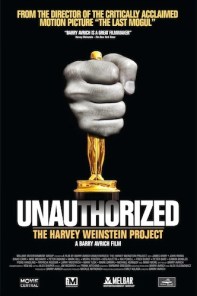 The documentary that Weinstein reportedly tried to stop existing, including discouraging people from participating in interviews. Either he needn’t have worried or really is a complete megalomaniac, because while there is a certain warts-and-all aspect to Avrich’s cinematic biography, it can’t help but admire all that Weinstein has achieved.
 Even for those who were following film culture through this era, and in spite of Harvey’s apparent efforts, there are numerous interviewees who were there — former Miramax employees, for instance — to offer insight. Thanks to archive footage we get even more opinions, including a fair few comments from Harvey himself. How much of this was available at the time, I obviously don’t know. Even if it is mostly recap, it’s a concise and well-constructed one.
 Bill Cunningham is 80. He lives in a small rent-controlled apartment in New York City that is filled with filing cabinets. His bed is little more than a mattress on some boxes. Each day, he dresses in the same distinctively simple blue smock and sets out on his bicycle. He eats at the same places each day; simple cheap food, cheap coffee. He doesn’t have a partner or kids; he may never have had a romantic relationship. He doesn’t watch TV or listen to music. It sounds like some kind of life of poverty or religious devotion. It’s neither, although you could make an argument for the latter, because all Bill does all day is photograph what people wear.
 Bill is, technically, a fashion and society photographer. His real passion, however, is clothes. Real clothes. The clothes people actually wear and how they wear them. His newspaper column — a collection of photos from the streets — is essential reading as far up the chain as Anna Wintour. He doesn’t set trends, he observes them. Exposes them, you might say, because in the past he’s used his work to call fashion designers on where they’ve copied (consciously or not) the work of another from years before, and that has sparked arguments.
 What he actually is, more than a “fashion photographer”, is a documentarian, recording how people choose to present themselves to the world, both as individuals and how that translates en masse. Fashion may seem like a meaningless, arbitrary, frivolous thing to afford such time to, and I’d have no argument against Fashion being called exactly that. But fashion — the actual clothes we wear in our actual lives — is something a good many people spend a good amount of time obsessing over; it’s how they choose to represent themselves in the world, how they indicate what they’re like as a person, how they show which groups or types of people they align with. We all do it, even if it’s not a conscious choice. Surely that’s worth recording?
 But that’s all an aside, probably because it’s so well done. What might be worth picking up on is that there’s no specific story. There are stories in there — like how Carnegie Hall is kicking out its handful of 80- and 90-something resident artists to make way for more office space — but the film doesn’t have an overarching tale. It’s a portrait; one of a fascinating, unusual, but likeable, and certainly unique, individual.
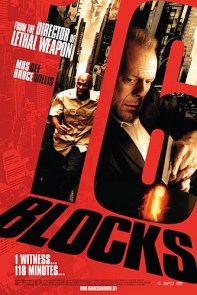 A Bruce Willis action movie? You know what you’re in for here, don’t you? Well, not quite. 16 Blocks casts Willis as less John McClane and more John McCane: old, fat, drunk, limping. He’s a copper still, but the kind of detective whose primary duties are being left to watch over an apartment full of bodies until uniform can show up.
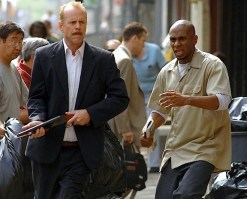 For me, it really lost its way just over an hour in, when our heroes (spoilers!) end up in a hostage situation on a bus. It’s not bad, but it feels like writer Richard Wenk (who’s gone on to co-write heights of culture like
 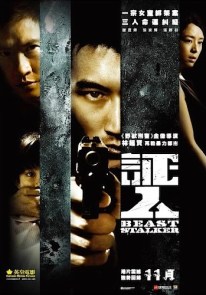 While in pursuit of an accused murderer, a cop (Nicholas Tse) accidentally kills the daughter of said murderer’s prosecutor (Jingchu Zhang). Three months later, just days before his trial, the accused has the prosecutor’s other daughter kidnapped, to persuade her to destroy the evidence proving his guilt. Despite having spent the intervening time in reclusive self doubt, the cop sets out to rescue the kidnapped little girl.
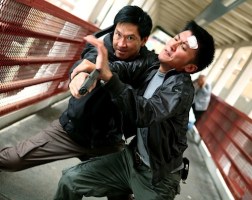 making them a little perfunctory — the real meat actually lies in the plot’s twists and turns. This is more one for fans of thrillers than beat-’em-ups.
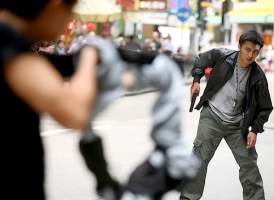 The top performance comes from Nick Cheung as a for-hire kidnapper with the Bondian trait of being blinded in one eye while the other only has black-and-white vision. He gets added complexity thanks to an invalided wife he tenderly cares for — he’s only in this life of crime to pay off his debts and medical bills, y’know. Cheung’s largely silent turn manages a fine balance of menace and sympathy. He won a couple of HK awards for it,
  A brief couple of scenes with a bullied colleague play out nicely, though unfortunately they contrast with a painfully written bit in which another colleague tells Tse’s character what people think of him. “They said you were horrible, but I like working for you,” she tells him (I paraphrase), for no discernible reason. It doesn’t even matter that we’re told that, because we’ve already seen it. I just don’t get it.
 100Films.co.uk