Stay (2005)

2008 #68
Marc Forster | 95 mins | DVD | 18 / R
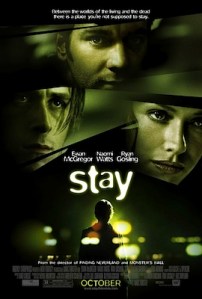
StayI’m sure some viewers didn’t bother to stay until the end of Stay, baffled by an increasingly bizarre plot — which, at times, seems to be doing its best to stay still too — and put off by apparently pointless scenes. If only they had stayed, they could’ve discovered that they had indeed wasted an hour and a half of their lives on a story with a deceptively unoriginal conclusion.

The main problem with Stay is that it thinks it’s cleverer than it is. At its heart is a mystery, or set of mysteries, which the conclusion of can be too easily guessed right from the start. That’s not to say you can piece it together from the clues given, but you can certainly guess at it. This is because much of the film, and its clues, are apparently meaningless. Either there’s supposed to be some deeper, unrevealed significance to things like never-ending staircases and a blind man’s vision being restored, or it’s all there just to look significant and help hide/complicate the final revelation. The climax is consequently disappointing: it’s too obvious, it doesn’t bother to tie everything in, nor does it seem to allow room for the viewer to retrospectively tie things up. To rub salt in the wound, a brief epilogue is twee, one of those ideas that might sound like a neat tweak on what we’ve seen but should actually have been cut.

There are some positives, mostly in the direction. Forster has proved himself excellent with visuals — look at the fantasy scenes in Finding Neverland or the HUD-like graphics in Stranger Than Fiction — and there’s plenty to add to that list. The intriguing scene transitions are the stand-out. While they may initially seem pointlessly flashy, the ending, however flat it may be, does suggest they were done for a reason. Throughout, the film is well shot and well edited, but, perhaps, too well — or, rather, ‘too obviously’. By deliberately ignoring several standard editing rules (I won’t reveal which here), the film-literate viewer may find that too much is given away too early on.

Clearly someone liked Stay, as writer David Benioff sold the screenplay for $1.5 million, and it would be nice to agree with that buyer — there’s a good cast, a good director, some good ideas — but ultimately it’s 85 minutes that seem retrospectively pointless when the final ten do so little with them. There’s no final “oh, that’s what it was about!” twist, just “well, I’d guessed that much” coupled with “and I’ve seen that before”. Some qualities (Forster’s visuals, the likable cast) almost earned it an extra star, but the ending took it back off them.

2 out of 5

Agatha (1979)

2008 #62
Michael Apted | 100 mins | TV | PG / PG

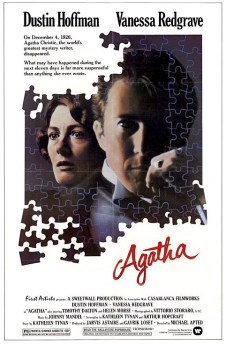
AgathaThere are no giant wasps in sight as Vanessa Redgrave’s Agatha Christie goes missing for eleven days in December 1926, and Dustin Hoffman’s journalist tries to track her down. While the frame of the story is true, the reasons behind Christie’s disappearance, and what occurred during it, aren’t known — which makes it fertile ground for speculation. Sadly, a fantastical plot about jewel thieves and shapeshifting aliens is much more exciting than the down-to-earth mystery we’re offered here.

It’s easy to see the attraction of Christie’s disappearance: it’s a real-life mystery about arguably the greatest mystery author ever, with enough unusual events surrounding it to make it extra suspicious and a long enough gap for something significant to have happened. But while the idea is initially exciting, when it comes to retelling it there isn’t a great deal there — the facts of her disappearance are just the ‘before & after’, amounting to little more than an abandoned car, an assumed name and some amnesia. Unless one invents something to fill those missing days, there’s little to tell (she went to a hotel and forgot what happened, essentially) — so, of course, this film fills in the gap. With a murder mystery, naturally. Sort of, anyway.

To be honest, I found it a tad confusing for the most part. While the initial setup is well handled, showing what drives Christie to run away (consciously or not) and the beginning of the police search, it begins to flounder once the plot slides into its fully fictional phase. Hoffman’s journalist, who had been hoping to interview Christie, manages to stumble across her at the hotel, where he pretends not to know who she is, while she… has health treatments… It’s only at the conclusion, when Christie’s plan begins to come together, that one realises there was a plan at all. It’s a shame the revelation comes so late because it’s actually not that bad a plot, and makes for quite a neat and almost plausible (providing you can accept Christie as a potential murderess (sort of)) explanation for everything.

The performances do nothing to raise the film. Redgrave is lumbered with little to do, mostly wandering around looking dazed. Her performance is decent but the material she has is lacking. Hoffman, on the other hand, is just flat, while Timothy Dalton’s sneering Colonel Christie sadly barely features. On a more technical level, the police investigation subplot is disappointingly forgotten halfway through, and everything is shot with too little light. Sometimes the latter is effective, such as during a train journey where occasional flashes of light illuminate Christie’s uncomfortably blank face, but at other times it merely obscures events. (It’s possible this is just the print, of course.)

Christie’s disappearance remains a fascinating mystery, though in all likelihood the true causes were either very internal or mental health related — not the easiest thing to depict in a movie, especially when your audience is likely expecting a thriller. Agatha has a game stab at weaving an interesting tale into the gaps in the facts, but by the end I was wondering if a straightforward biopic mightn’t have been a better idea.

3 out of 5

The Adventures of Sherlock Holmes (1939)

2008 #39
Alfred Werker | 79 mins | DVD | PG

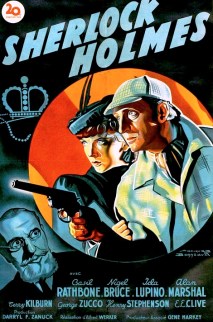
The Adventures of Sherlock HolmesNever mind waiting two or three years for a sequel these days — after the 1939 Hound of the Baskervilles was a box office success, Fox had a sequel out just five months later! I reviewed that first Rathbone/Bruce film back in February, promising an irregular series reviewing the further thirteen pictures the pair starred in. Well, I’ve finally got round to watching the second, and while I was a tad harsh on the first I found myself enjoying this one more.

The Adventures of Sherlock Holmes pits the titular detective against his arch-nemesis, Moriarty, in what’s really speaking a relatively weak plot — most depressing of all is how easily Moriarty’s plan to distract Holmes almost succeeds. But never mind that! There’s rain-lashed, fog-drenched Victorian London streets! Brutal murders by foul foreigners! Dastardly plots against the crown! Galloping carriages! Romantic subplots! A smattering of comedy! A song-and-dance number! (No, really, there is.) And a final shoot out… in the Tower of London! You can’t escape the joyous feeling that this was designed as pure entertainment, literally including something for everyone.

Bruce’s Watson may bumble about too much for the purists (me included, more often than not), the murder plot lacks proper explanation (the production notes on Optimum’s DVD pleasingly expand on this), Rathbone’s characterisation of Holmes may be a touch too friendly… but by then I’m just nitpicking. This sequel is atmospherically, entertainingly and excitingly executed, and that’s plenty good enough for me.

4 out of 5

L.A. Confidential (1997)

2008 #26
Curtis Hanson | 132 mins | DVD | 18 / R

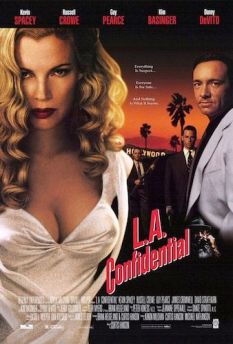
L.A. ConfidentialOnce again I’m watching an adaptation shortly after plowing through the source novel, a situation that has so far proved awkward for giving films a fair assessment. L.A. Confidential is an especially tricky one: how does a 480-page, densely written, intricately plotted crime novel, spanning seven years and “no fewer than four and perhaps as many as a dozen major crimes”, translate into a two-and-a-quarter-hour film? With more than a few surprises, as it turns out, because the apparently minor changes near the film’s start turn out to be the proverbial pebble in a pond: their ripples spread so far that, by the second half, not even a reader who can remember the many details of the novel’s complex plot will know for sure what’s coming.

This isn’t necessarily a bad thing. If screenwriters Hanson and Brian Helgeland had tried to squeeze in everything the movie would have been rushed even at three hours. Instead they’ve excised several unnecessary subplots and trimmed others to the bare minimum. Most impressively, they’ve picked apart several of the multitudinous plot threads and completely restructured them. It’s an incredible feat of adaptation. The downside is that some great strands are lost. Ed Exley’s father plays a huge role in the novel but is completely absent here; Inez Soto, the victim of a brutal gang rape, is reduced from a key supporting character to a couple of lines. Another connected loss is some characterisation. Jack Vincennes and Exley lose the most, though Bud White’s development is tied too closely to the main storyline. That said, the characters are still mostly there, painted quickly and precisely; they may lack some of the depth and complexity the novel can offer, but that’s an almost unavoidable difference between a film and a long, well-written novel. To make a good film such sacrifices are necessary — even though it’s been simplified, the novel’s complex plot is still a long way from becoming straightforward.

What impressed me most about L.A. Confidential is that, despite spending huge chunks of the film pondering what they’d cut and changed, I still enjoyed it immensely. Even while distracted with thoughts of the novel, its differences and its relative merits, I could still enjoy the fantastic filmmaking. The casting is perfect, especially Spacey, Pearce and Crowe (perhaps the last most of all, considering his penchant for real life violence). For once it really is as if the roles were written for them, making it easy to forget that Pearce and Crowe were virtually unknown at the time. They’re supported by a cracking screenplay (which I think I’ve praised plenty already) and beautiful direction, which manages to evoke the period without being shot like a period film — Hanson has stated that he aimed to make it period-accurate but shoot it like a modern thriller, and he’s succeeded. There may be one or two imperfections (the music felt a little repetitive to me, for example), but they’re slight and it seems churlish to pick on them in any depth.

I look forward to watching L.A. Confidential again without the novel hanging over my head. I’ve made my comparisons now, and my memory’s weak enough that, by the time I get round to watching it again (perhaps when the long-rumoured special edition re-release turns up), I’ll have forgotten enough of the novel’s specifics to not be bothered by them. I expect I’ll enjoy it even more then. It’s an excellent achievement, both as an adaptation and a film in its own right. You can’t say fairer than that.

5 out of 5

The Baskerville Curse (1983)

2008 #25
Eddy Graham | 67 mins | DVD | U / G

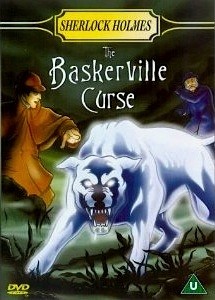
The Baskerville CursePeter O’Toole is Sherlock Holmes (well, his voice) once again in this animated Conan Doyle adaptation from the ’80s (see also my reviews of two others, The Sign of Four and A Study in Scarlet). Of course, this is an adaptation of that perennially popular Holmes story, The Hound of the Baskervilles, and as such O’Toole barely features. A shame, as he’s the only half decent thing in this mess.

As I’ve previously expressed, The Hound of the Baskervilles is not my favourite Holmes story, though it has its moments and there have been some enjoyable screen versions. Unfortunately, this pointlessly renamed offering retains all of the original’s faults but loses most of the best bits, despite wasting time on train journeys, telegram writing and pointless flashbacks to things we saw just minutes earlier. The animation is poor, even for a production of this level, with dire character design and a total lack of atmosphere (it opens with jolly music over views of primary-coloured countryside!) There are further flaws, but there’s no point wasting any more time going through them. I can only hope that the final entry in this series, The Valley of Fear, will be closer in quality to the other two instalments.

In retrospect, I’m certain I underrated the 1939 adaptation of The Hound of the Baskervilles. I’m equally certain that I shall have no such regrets over this lame attempt.

1 out of 5

The Baskerville Curse featured on my list of The Five Worst Films I Saw in 2008, which can be read in full here.

Rebecca (1940)

2008 #10
Alfred Hitchcock | 125 mins | download | PG

This review could be seen to contain some spoilers.

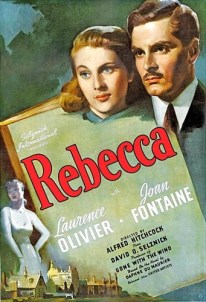
RebeccaI must confess that I don’t think I’ve come to Rebecca under the best circumstances for judging it as a film in its own right. As with last week’s Great Expectations, Rebecca is on my current University module, which means I arrive at it having just read both Daphne du Maurier’s original novel and, the afternoon before viewing, a detailed and very interesting account of the film’s genesis and production from Hitchcock and Selznick: The Rich and Strange Collaboration of Alfred Hitchcock and David O. Selznick in Hollywood (nothing like a snappy title, eh?) by Leonard J. Leff. Such reading conspires to lead me into direct comparisons with the novel (which, as with most adaptations, are ultimately unfavourable due to things having to be cut), as well as a preoccupation with what was going on during production.
But, trying to put such distracting things aside, Rebecca has a great many good points. The cast, for one thing, are perfect. There were serious doubts about Joan Fontaine as the lead, but she is spot-on as the shy, almost childish, Mrs de Winter. Laurence Olivier is equally effective as Maxim, and Judith Anderson’s Mrs Danvers is suitably scary, if significantly younger than I imagined. The production’s technical aspects are also highly admirable: while the early Monte Carlo scenes may be nothing especially exciting, the plot whizzes past and we soon find ourselves at the infamous Manderley, all large halls, fog-filled grounds, dramatic lighting and big camera moves. Especially of note is Maxim’s confession — a long chunk of dialogue in the novel, it would have been all too easy to just use a flashback, but Hitchcock instead employs a camera move across the empty room to suggest the narrated action.

Further comparisons with the novel are inevitable, of course. The film skips nothing of importance, condensing events effectively so that the plot moves at a decent pace. Some events, such as the fancy dress ball and following ship wreck, are even made more dramatic by combining them. Some choices are thoroughly bizarre though: the novel is well known for its first person narrative, something the film attempts to retain by featuring Mrs de Winter in every scene… until the end when, in a deviation from the novel, she remains at Manderley while we follow Maxim and co. to London for some final twists. This does lead to a dramatic reunion upon Maxim’s return to Manderley, but I’m not convinced such a brief moment was worth the modifications.

As expected, viewing in such close proximity to the novel also forces comparisons that aren’t especially warranted — for example, the film loses much of the characterisation of Mrs de Winter by unsurprisingly finding no way to adapt her frequent flights of fancy and imagination. But then, one can always read the novel for those things (and I’d recommend it — get past the famous but dull opening and it often rattles along), and so, judged purely on its own merits, there is a considerable amount to recommend in Rebecca.

5 out of 5

The Hound of the Baskervilles (1939)

2008 #9
Sidney Lanfield | 77 mins | DVD | PG

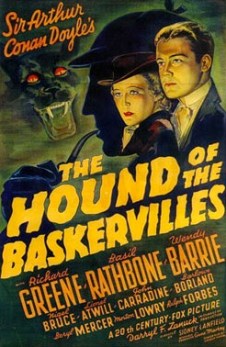
The Hound of the BaskervillesArguably the definitive screen interpretation of Sherlock Holmes and Dr Watson, played by Basil Rathbone and Nigel Bruce, appear for the very first time here, in what would become the first in a series of 14 pictures starring the pair. (Incidentally, this will be the first in an irregular set of reviews of that series. I have the rather lovely Optimum box set, you see, and so shall slowly work my way through it. Though as I’ve already owned it for several years and only just started watching it (as with so many DVDs), I have no idea how long it will be before I finish.)

I’ll start by laying my cards on the table: The Hound of the Baskervilles is a vastly overrated Holmes tale, and one that has been unduly adapted at least 15 other times (that from a quick search of IMDb). As far as I can tell its popularity is primarily due to the circumstances around its original publication (it was the first Holmes story in nearly a decade, following his death in The Final Problem). Holmes is absent for much of the story, which plods along fairly uneventfully (or, at least, inconsequentially) until a slightly dubious climax involving a centuries-old portrait. Naturally, all of these flaws carry over into any faithful adaptation, and this certainly is one.

One of the novel’s strong points is its occasional Gothic styling, and this is something the film version does very well. Dartmoor looks fantastic, like something Tim Burton would have created were he working in the ’30s. It’s clearly a set, but it’s dramatic and moody and completely effective. After the dull and poorly-designed interior scenes in London, it’s fantastic when the film finally moves down into Devon and things… well, don’t exactly get going, but at least there’s something to look at! As with the novel the plot meanders by, diverted by an escaped convict and an entirely pointless (in this version at least) seance, until that painting-based resolution. All is not lost, however, as a particularly vicious-seeming attack by the hound livens things up considerably.

Rathbone is underused as Holmes, which is a shame as he immediately makes the part his own. Bruce isn’t as bungling and comedic as he would later become, though the signs are already beginning to show. And the infamous final line — “Oh Watson, the needle!” — is actually a huge anticlimax if you haven’t seen it before, an entirely pointless, meaningless and misplaced addition.

I feel like I’ve come down a little harshly on Hound of the Baskervilles, mainly thanks to a general unfavourable opinion of the source material. There are many better Holmes stories, often ignored thanks to the fame of this particular one. The following 13 films may be even less faithful adaptations than this, but I’m looking forward to their fun and frivolity, which will hopefully top Baskervilles. The moor really is fantastic though.

3 out of 5

The Mirror Crack’d (1980)

2008 #5
Guy Hamilton | 105 mins | TV | PG

The Mirror Crack'dA star-studded cast and the director of Battle of Britain, Goldfinger and three other Bond films can’t raise this adaptation of an Agatha Christie Miss Marple mystery far above the level of an ’80s TV movie.

There are some good lines, and it’s a Christie so obviously the fundamental story is good, but the direction is flat and lacks suspense, half the cast phone in their performances, and Angela Lansbury, lumbered with a sprained ankle and premature aging, seems to be in a dry run for Murder, She Wrote. The lack of involvement by the main character is something I always find problematic with Marple stories, even when the actress involved has the necessary twinkle. Edward Fox is her match as the detective who actually does most of the detecting for once (but is still robbed of the final revelation, of course).

The best bit, which I’ll just take a moment to highlight, is the opening. It’s a black & white murder mystery, the scene of the final revelation… and the print burns up just before the killer is revealed. The film cuts to a village hall, where the film was being screened and the projector’s just died. Miss Marple proceeds to explain what will happen to everyone, based on what she’s deduced from the film so far. A man at the back who’s seen it confirms she’s right. Much better than my summary makes it sound, this is by far the film’s highlight, one of the few whole scenes that rises above the pervading flaws.

Despite a few commendable elements, this is a good tale that’s not told as well as it could be.

2 out of 5

Piglet’s Big Movie (2003)

2007 #129
Francis Glebas | 72 mins | TV | U / G

Piglet's Big MovieI used to enjoy the Disney Winnie the Pooh series when I was younger. I also used to love the original books by A.A. Milne. In fact, I still enjoy the books — they’re witty, knowingly written, and often sweet. Sadly, Disney’s interpretation seems to have faired less well.

In this case it’s largely down to the first half, where the mostly original storyline and weak & randomly inserted songs simply aren’t up to scratch. However, things improve massively with a couple of fairly straight adaptations of Milne’s original tales.

Mildly amusing at times and with a positive (if predictable) message about friendship and self-worth, this would undoubtedly entertain young children — which, to be fair, is its intended audience. While it initially seems to fall far short for older audiences, it turns out to be not all bad.

3 out of 5

Manhattan Murder Mystery (1993)

2007 #124
Woody Allen | 103 mins | DVD | PG / PG

Manhattan Murder MysteryWoody Allen mixes a bit of the thriller into his usual relationship-based comedy/drama style, with effective results. The combination produces an engaging thriller with the usual character-focused drama woven around it, and a decent dash of comedy too. The first half hour or so is a tad slow, but the pace picks up as the story rattles into the second half.

Murder Mystery has been criticised as lightweight — the comedy stops the thriller being too serious, the thriller stops the drama being the focus, and they both prevent the comedy from overpowering — but Allen has dealt with these elements in isolation elsewhere, so it’s refreshing to see him do more than merely repeat himself.

This is an underrated gem in Allen’s relatively vast body of work.

4 out of 5