2014 #25
Danny Boyle | 101 mins | Blu-ray | 2.35:1 | UK & France / English | 15 / R
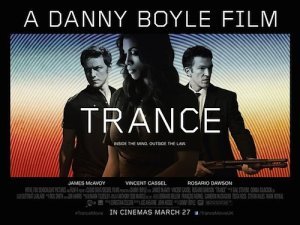 Ambiguous endings used to be anathema to film audiences. They wanted things tied up in a pretty little bow, thank you very much; all the conflicts resolved and all their questions answered. Then the likes of Mulholland Drive and Donnie Darko came along and made vague join-the-dots-yourself endings fashionable — to the point where I’ve read several reviews of Trance that criticise it for having a final act that answers too many questions and clears things up too thoroughly. There’s no pleasing the masses, is there.
In fairness, people perhaps had a right to expect a head-scratcher. The plot description sounds like one: following an art heist, the guy who took and hid the painting (James McAvoy) has amnesia, so his gang’s leader (Vincent Cassel) takes him to a hypnotherapist (Rosario Dawson) to try to dig its location out of his subconscious. Cue a mindbending blend of what’s real and what’s hypnotically induced, right? Kinda like an art house Inception. Mix that with the fact this is an indie-scaled production (though it’s released by 20th Century Fox and Pathe), from a director known to push boundaries, with a choppily-edited self-consciously-confusing trailer, and the bizarre “this isn’t for you, multiplex-goer” poster, and you can see why people expected something that was left-field to the bitter end.
 In the Blu-ray’s special features, Boyle comments that “it’s more classical than you might expect.” He’s talking specifically about the cinematography (and he’s right, but more on that later), but he could equally be talking about the entire movie. Though it has a storyline that blurs the line between what’s actually happening and what’s happening inside a character’s head (or is that characters’ heads?), the overall tone and style — particularly of the climax — is actually quite Hollywood. It’s Hollywood jazzed up with storytelling trickery, a quirky score, dashes of extreme gore and surprising nudity (that it’s not an 18 is somewhat surprising); but underneath all that it’s not a million miles away from your run-of-the-mill thriller.
That said, there’s nothing wrong with taking something standard and dressing it up all fancy-like. The film I often cite as my favourite ever, Se7en, is actually a bog standard police thriller when stripped to its storyline’s base elements, but the skill applied to it by filmmakers like David Fincher, Andrew Kevin Walker and Darius Khondji — not to mention the cast! — puts it on another level.
Trance is a tricksier film than that, though. Perhaps it doesn’t need to be, but that’s assuming you only want a film to be about its story. Here, it’s also about the games that are played in telling the story. As Dawson tries to access McAvoy’s memories through a kind of guided meditation, the film switches between the real world, the ‘dream’ world, and the character’s memories at will. Boyle and cinematographer Anthony Dod Mantle made a conscious decision not to denote these different states in any way — 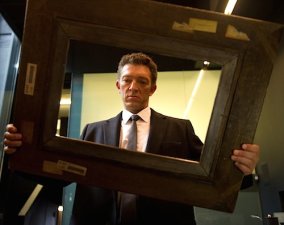 there’s no switching to black and white for dreams, for instance; nothing to definitively tell you which state you’re in. And this is a good thing, because when you need to know you can tell, and the rest of the time… well, the film’s playing with you. That’s the point. What is real and what is a scenario McAvoy’s being talked through? Are these memories what happened or the product of an addled mind?
It’s a complex experience that demands your brain power to navigate it successfully. Even when answers come, there are bits you might need to retrospectively piece together for yourself. There’s nothing wrong with a mystery film that answers its own mysteries, and I don’t think Trance disappoints in what those revelations are. Are they predictable? Everything’s predictable, if you predicted the right thing. Do you have to re-watch it to make sense of everything, or confirm it all for yourself? Not especially — it’s not The Sixth Sense, but I imagine there’d be value in watching it again knowing what every character is really up to.
That’s a credit to the actors as well as the filmmakers, incidentally. McAvoy and Dawson in particular give strong performances. The screenplay plays with our affections and opinions of them (and the other characters — no disrespect to third lead Cassel, who is also very good), but there’s a consistency to their portrayals, and an array of subtleties that are only properly revealed once we know everything, that is testament to a well-considered approach to the entire performance, as opposed to simply playing scenes in the way they seem to the first-time viewer.
 Dod Mantle’s cinematography is also strikingly handsome. As noted, the film’s buzz had me expecting something akin to late-career Tony Scott, all jumpy and weirdly saturated and fragmented. Instead, as Boyle said, it’s actually very classical, but with a great eye. There are a number of shots which would look fabulous framed and hung on the wall, not least of the street outside Dawson’s flat at night, a restaurant next to intersecting train lines, and aerial photography of red-lit nighttime motorway junctions, looking like some kind of Rorschach test-esque psychiatrist’s tool.
By asking you to keep up through a plot and storytelling style that is deliberately twisty and confusing, but then giving you some pretty clear answers at the end, Trance seems to have pissed off a lot of people. Not so me. It’s an entertaining thrill ride and an intriguing psychological mystery wrapped up in one, provided you take it on its own terms.
Trance comes to Sky Movies Premiere from today at 9:35am and 9pm, and is also freshly available on demand through Sky Movies and Now TV.

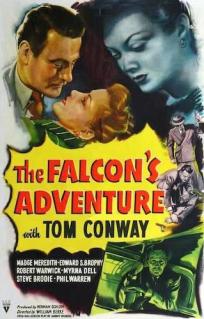 The final Falcon film to star Tom Conway (three more were made a few years later, but there seems to be debate about whether that was the same character) sees our avian-monikered detective planning to take a fishing holiday… until he can’t resist saving a damsel in distress and gets dragged in to a plot involving kidnap, theft, and murder. I think I saw someone jaywalking too, so it’s a veritable hotbed of criminality.
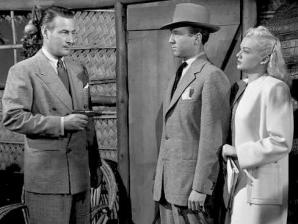 The Falcon’s Adventure is a terribly generic title for a film that isn’t the series’ very best, but is a solid upper-end instalment. They’re mostly quite formulaic films, naturally, but Adventure gets the mix right with some good sequences and gags. As the last film it doesn’t represent much of a conclusion, but then they didn’t really go in for big “series finales” back then, did they.
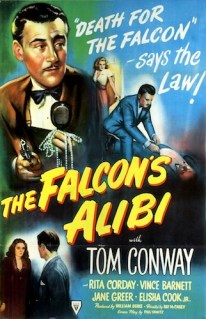 Once again smitten by a pretty lady, the Falcon finds himself co-opted into guarding a wealthy woman’s jewellery. But when said jewels are promptly stolen, and murders ensue, our charming hero is implicated. Who would do such a dastardly thing? And what’s going on with the DJ in the roof of the hotel?
 Among the rest of the cast, Vince Barnett becomes the fourth actor to play the Falcon’s sidekick, Goldie; and Jean Brooks and Rita Corday each appear in their fifth Falcon films! Brooks was previously in
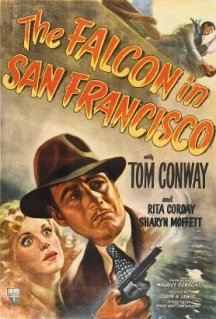 The Falcon is often dragged into adventures by beautiful women he can’t resist, but here it’s a female of a different kind — a little girl. After her nanny is murdered on the train to San Francisco, the Falcon offers to take her safely home… only to get arrested for his troubles, and then be picked up by a mysterious woman and her heavies and given a good beating. What the blazes?!
 At least there’s some comic relief thanks to the return of the Falcon’s sidekick Goldie, who’s been absent since
  The writer-director of
 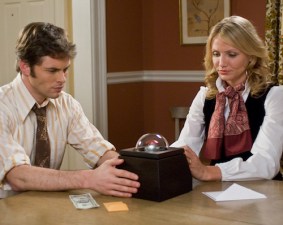 What a nice tribute to his supportive parents and their devotion to one another, eh? At the start, perhaps, but by the end of the film you may be wondering what the writer-director’s subconscious wants to do to his ma and pa…
 What could function well as an indie-level thriller is further undermined by abundant, therefore costly, CGI. Whether that’s Langella’s facial disfigurement (what could’ve been make-up is actually a complex array of tracking dots, green face-paint, motion-control cameras, and so on; all used merely to place him in simple dialogue scenes), or wide shots of ’70s Virginia, with a computer-adjusted skyline, computer-animated cars, and computer-painted snow. It’s not that the effects work is poor (though don’t look too closely at those cars), but that it screams “this must be special effects!” when you don’t want such distractions.
 The Box should have been a film we all discussed for years to come, its “what would you do”-ness providing an
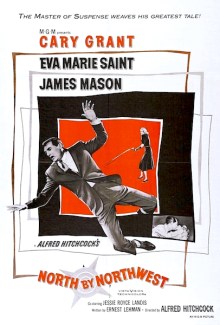 Alfred Hitchcock is famous for a good many movies — I wager most people would jump to
 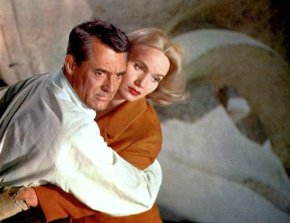 Grant is as wonderful as ever, a perfect ‘everyman’ to guide us through the crazy turns of events, but also finding the appropriate level of humorous edge where it exists. Eva Marie Saint is a textbook ‘Hitchcock Blonde’, attractive but duplicitous — women, eh? James Mason makes for an excellent English-accented villain — today it may be a terrible cliché to use Brits as villains in Hollywood movies, but we’re so damn good at it. That said, Martin Landau makes for a deliciously creepy henchman, so there’s no monopoly. There’s also Leo G. Carroll, who to me will always be best known from
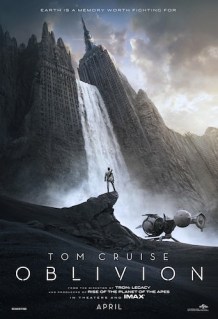 As Oblivion informs us in a hefty chunk of voiceover exposition at the start, the year is 2077, several decades on from a war with aliens that we won but left the Earth in ruins. Humanity fled to a colony on Titan, but the last party to depart remain in orbit aboard a giant space station. Waiting to join them are Tom Cruise and Andrea Riseborough, the last humans on Earth, serving the final few weeks of their mission to watch over the drones that guard giant water-collecting machines, sucking up the oceans for the benefit of the new colony.
 Also, as with many a tale desperate to surprise its audience thus, there are holes in the story and its logic (for a good summary of some of the major sticking points, check out
  I like a good action sequence, and some of the ones Kosinski presents have their moments, but I also found I could have done without most of them. To a degree they seemed to have been slotted in so it could look like an Action Movie in the trailers, the aim (as ever) being to pull in the punters, thereby justifying the budget needed to create such a slick SF world.
 With the aforementioned plot issues, not to mention an ending that some will find too twee (I saw the broad strokes of the epilogue coming from quite a way out, so can’t say I was surprised), Oblivion is not quite all it could have been. But it gets considerably closer than I expected — it’s undoubtedly an A for effort — and that, bolstered by faultless technical aspects, makes for an all-round enjoyable experience.



 After leaving his New York base to investigate some
 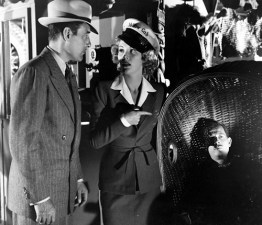 Stand-out sequences include a bit where the police detectives move through a crowd of suspects, all relaxing near the pool on a location shoot, while outlining each one’s possible motivations, essentially to their face. It’s a simple sequence, not exactly high on drama or humour, but there’s a pleasant structural touch to it. Or the finale: the Falcon is, as ever, drawn into the case by a mysterious woman… but by the end he has four of them grouped around him!
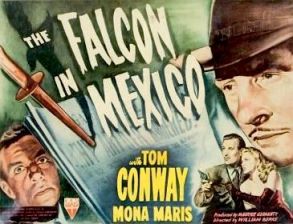 “In our peaceful country, life is very seldom in danger,” states one character halfway through The Falcon in Mexico, just one of many instances that might make you think the film was co-funded by the Mexican tourist board. Oh sure, there’s the usual array of thefts and murders that you’d expect from a Falcon adventure, but they’re mostly committed by Americans. No, the film on the whole is very keen on the place, and the quality of its police, and even ends with a shot of a poster proclaiming “Visit Mexico!”
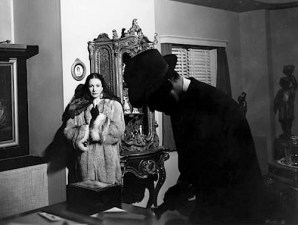 What I did make out was grandly far-fetched — more so than normal, I mean. Considering the tone and style of the series, it’s kind of OK that most of the plot’s explanations are not even close to plausible in the real world. On the bright side, it does make for another genuine mystery (I should stop praising the series for this now, all the films do it).
 100Films.co.uk