Son of Paleface (1952)

2009 #2
Frank Tashlin | 91 mins | DVD | PG

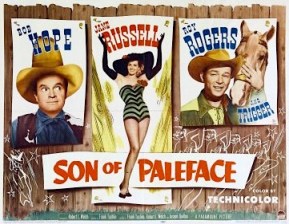
Son of PalefaceA sequel to 1948’s The Paleface only in the sense that it features Bob Hope in a Western setting, this time playing the son of his character from the first film.

Much of it is only gently funny and likely to try the patience of an unforgiving audience, despite the addition of “King of the Cowboys” Roy Rogers to returning stars Hope and Jane Russell. Between them the three manage to deliver some songs too, but the only memorable one is a reiteration of Buttons and Bows from the first film.

Things improve as the film goes on though. It slowly morphs into a live-action cartoon, in the process becoming a lot funnier and, in recreating the style of cartoons, technically impressive too. That the comedy is genuinely entertaining when Son of Paleface finally reaches these sections makes it a shame it takes so much time — and viewer persistence — to get there.

3 out of 5

White Christmas (1954)

2008 #97
Michael Curtiz | 115 mins | DVD | U

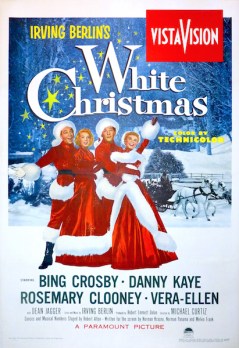
White ChristmasWhite Christmas is surprisingly un-Christmassy. Yes, it’s set at the right time of year, and the plot concerns itself with do-gooding and charity and other such vaguely seasonal themes; but, crucially, there’s a distinct absence of snow (until the very end) and little else actually inspires much Christmas feeling.

The plot winds its way to a moving finale, but, baring a few memorable numbers — Sisters, for example; and, particularly, a rendition of it by the male leads — most of the path there is quite average. One wonders how much of its renown is actually based on the titular song.

3 out of 5

White Christmas is on Film4 today, Monday 24th November 2014, at 12:50pm.

Chicago (2002)

2008 #96
Rob Marshall | 108 mins | DVD | 12 / PG-13

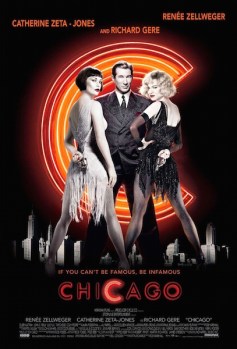
ChicagoI remember being distinctly unimpressed when Chicago took the Best Picture Oscar in 2003, especially as the alternatives included Gangs of New York and The Two Towers — not to mention Road to Perdition, an excellent film that was massively undervalued during award season.

In its favour are a number of memorable songs, all performed with impressive routines. On the downside, they’re all quite stagey in their choreography, though this suits the daydream-fantasy style in which they come about. In fact, the ability of film to make clear the distinction between ‘real life’ and fantasy means the film is far easier to follow than the stage version.

The story is passable enough, serving as a roadmap between the songs and offering the occasional bit of commentary/criticism on celebrity culture — it may be set in the ’20s and have been written in the ’70s, but the characters’ underhand tactics to keep their story on the front pages are as pertinent now as ever.

Five years on, Chicago isn’t as poor as expected — it manages to be consistently entertaining — but nor is it superior to the alternatives. For a current comparison, it’s only marginally better than if Mamma Mia were to trot round winning Best Picture gongs this year.

4 out of 5

The Blues Brothers (1980)

2008 #99
John Landis | 142 mins | DVD | 15 / R

The Blues BrothersCult comedy musical, with a more-than-healthy dose of the surreal, about two brothers on a mission from God, here watched in the extended DVD version (full details at IMDb). Maybe this is why it takes a while to get going — the first hour or so could do with a kick up the proverbial — and has a tendency to sprawl like an unruly first draft.

On the other hand, its insistence at being random, crazy, and incessantly silly throughout is beautifully anarchic. There’s an array of fabulous cameos — Ray Charles! Aretha Franklin! and Carrie Fisher, feeding the anarchy with her ludicrous attempts to kill one of the titular pair. While there were fewer songs than I’d expected, they’re all classics rewarded with infectiously fun performances. Then there’s the climactic car chase, which surely challenges many more serious examples for pure excitement value.

And any film which sees Neo-Nazis jump into a river to avoid being run over has to be good.

4 out of 5

The Blues Brothers is on ITV4 tonight, Friday 26th September 2014, at 11:35pm.

(Originally posted on 24th January 2009.)

Swing Time (1936)

2008 #100
George Stevens | 99 mins | TV | U

Swing TimeSwing Time is, I’m told, widely hailed as the greatest of the Fred Astaire/Ginger Rogers pictures. The plot isn’t especially captivating, one of the stock variations on “boy meets girl” that still serve romcoms to this day, but that’s not the main reason these films are so loved.

That, of course, is the song and (especially) dance numbers. I can’t say I recall any of the songs now, but the dances are suitably impressive. Particularly memorable is an early number where, after Astaire accidentally gets Rogers’ dance teacher character fired, he shows the proprietor how much she’s taught him in the last ten minutes, winning her job back. Trust me, that makes far more sense on screen than in that pathetic explanation. Elsewhere, Astaire blacks up for a dance to Bojangles of Harlem. These days one might wonder why he had to black up, or consider the concept faintly racist, but clearly it was acceptable for the time and in no way detracts from the skill on display.

One interesting note is some story similarities to Sideways — yes, Sideways, the recent Oscar-winning indie comedy about love and wine tasting. Whether Swing Time had any influence on that (made almost 70 years later), or it’s just a huge coincidence, I don’t know, but there are several reminiscent moments throughout the engaged-man-and-buddy-find-love-in-far-off-location-(then-accidentally-let-truth-slip) plot.

I haven’t seen enough Astaire/Rogers films to declare whether this is their best or not, though personally I preferred Top Hat. In the same way the plot of some action films doesn’t matter one iota so long as the fights are good, so the story here is irrelevant beside the quality of the dancing — and that, at least, is exemplary.

4 out of 5

(Originally posted on 9th January 2009.)

The Many Adventures of Winnie the Pooh (1977)

2008 #92
John Lounsbery & Wolfgang Reitherman | 71 mins | DVD | U / G

The Many Adventures of Winnie the PoohHaving finished 2007 with Piglet’s Big Movie, it feels somewhat appropriate to round off 2008 (almost) with Disney’s first Winnie-the-Pooh feature.

The Many Adventures… is actually compiled from three shorts made in 1966, 1968 and 1974, with some new linking material. I don’t know if these shorts were produced with any great expense, but there’s occasional evidence of what looks like cheap animation. It’s not that it’s not smooth or fluid, but rather the attentive viewer will often spot sketch marks around some lines, or flashes of other bits not properly erased. Perhaps it was deliberate, considering the sketchy style of the backgrounds, designed to evoke the original illustrations, but I sometimes found it distracting.

This is one relatively minor flaw in an otherwise brilliant adaptation, however. The film faithfully adapts several of the original stories, acknowledging its sources by frequently showing the action as illustrations within a copy of the book. This fourth-wall-breaking move may irritate some, but personally I loved seeing Pooh and co have to leap from page to page, or tipping the book sideways to free Tigger from a tree. Such moves seem tonally in keeping with A.A. Milne’s original stories and, even though some tales are abridged and some good ones left out, that spirit is always retained.

The characterisation is also spot on, producing an array of cute and loveable creations, none more so than Pooh himself. The gopher is an unnecessary addition, though the running joke about him not being in the book is very nicely done. And one can’t fail to mention the excellent songs, now as linked to the world of Pooh as anything from the original books — especially Tigger’s little tune, surely familiar to anyone who was a child in the last 30 years.

If some later Disney ventures have lost sight of the correct spirit for Pooh’s adventures, at least this original is a great adaptation. Bouncy, trouncy, flouncy, and, above all, fun fun fun fun fun.

5 out of 5

Enchanted (2007)

2008 #80
Kevin Lima | 103 mins | DVD | PG / PG

EnchantedYou’ve probably heard about Enchanted: it’s the one that starts out as a traditionally animated Disney film, before The Normal Girl Who Will Marry A Prince is thrown into a Magic Portal by The Evil Stepmother and finds herself in present-day New York. It’s one of those concepts so good it just makes you think, “why haven’t they thought of that before?”

Thankfully, they pull it off. It’s very funny, riffing on many recognisable elements from Disney’s considerable library of classics, and manages to produce a number of catchy songs of its own. Amy Adams is brilliant in the lead role, managing to be infectiously sweet rather than sickeningly sugary, while Susan Sarandon has a whale of a time in her boundlessly camp (though disappointingly small) role. The rest of the cast are good too, especially a wonderfully vacant James Marsden as The Prince.

The plot is ultimately predictable, but no more than you’d expect considering the target audience — certainly, kids will likely go through all the requisite emotions, and it would probably be more disappointing if they did try anything truly shocking. Still, it’s crammed with more than enough fun invention and new ideas to make up for any unsurprising plot beats.

Quite simply, Enchanted is a fantastic concept, beautifully executed. A veritable success.

4 out of 5

Mamma Mia! (2008)

2008 #81
Phyllida Lloyd | 104 mins | DVD | PG / PG-13
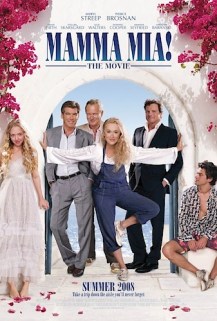
Mamma Mia!If you listen to the critics, no one liked Mamma Mia. If you listen to the public, everyone loved it. It’s the highest grossing British film of all time at the UK box office — at last count, just over £400,000 away from being the highest ever* — and was still playing on the big screen at hundreds of locations the weekend before its DVD release.

Mamma Mia! is the first feature from director Lloyd, who also directed the original stage production — and sometimes both facts show. She doesn’t always quite know what to do with the camera, the choreography is often aimed at a theoretical audience rather than the camera position (a pet peeve of mine), some shots are over-simplistic, others over-done, and there’s a bit of “point and shoot” too, missing opportunities that would be obvious to more experienced film directors. It’s never atrociously directed — at the very least, the scenery looks stunning, and is put to much good use — but it does the job and little more.

The songs themselves don’t need discussion (everyone knows what they think of Abba) but it’s worth mentioning how they’re choreographed and how they come about in story terms. Some have been brilliantly staged (Mamma Mia itself, but especially Does Your Mother Know), though others are flat and awkward (The Winner Takes It All doesn’t win anything as far as I’m concerned). Equally, some emerge naturally from the story (Chiquitita, Money Money Money), while others feel shoehorned in (again, The Winner Takes It All). For others still they seem to have just given up forcing them into the plot, leaving them to be performed by a musical act: Super Trouper, which at least is vaguely appropriate to the juncture it appears; and Waterloo, which is tacked on during the end credits, though at least is amusingly done.

The majority of the cast were clearly chosen for acting skills rather than singing ability, not that it’s done the film many favours. Pierce Brosnan was unfairly singled out by critics for poor vocals, but he’s no worse than several others. On the other hand, Julie Walters is as much of a riot as you’d expect, right from her first line, and earns the lion’s share of the laughs. For any bored male viewers, there’s always Amanda Seyfried, with her often bouncy pair of friends — played by newcomers Rachel McDowall and Ashley Lilley (why, what did you think I meant?) Every cast member is clearly having a ball, so much so that some forget to do more than read lines aloud; but it’s occasionally infectious, the frequency of infection being directly proportional to how susceptible the viewer is to this genre of music and this genre of film.

It may go without saying, but the more you like Abba the more you’ll like Mamma Mia. Conversely, the more you hate them the more you’ll hate it. (Extra stars can be added or subtracted at the end depending on which side of the fence you fall.) It’s therefore easy to see why audiences — especially British audiences — have lapped it up, while the critics have been fairly damning. On the other hand, the often clichéd first-draft-level script and occasionally ungainly first-readthrough-level performances don’t help things any. Luckily it very rarely takes itself too seriously, and consequently is often hilariously funny. Though it attempts both, it clearly works best when being a camp and cheesy comedy rather than a serious romance/family drama. One especially weak note, in my opinion, is the subplot awarded to Colin Firth’s character, who turns gay almost out of nowhere. It’s not a bad idea for a subplot, especially in a film based on Abba music (not that I’m applying any stereotypes here), but it’s poorly executed.

Mamma Mia! never aimed to please the critics, or even your regular movie-goer. Instead it sets its sights firmly on Women Of A Certain Age who can remember Abba from first time round, and students who perhaps listen to them in a more ironic way nowadays. In that sense, it’s clearly an unmitigated success. As camp as a row of tents, disliked by critics, loved by audiences: Mamma Mia! is everything you’d expect from Abba.

3 out of 5

* In the interests of fully-correct information, I feel I should point out that Mamma Mia! has now [December 28th, 2008] overtaken Titanic at the UK box office. (BBC News) ^
Road to Singapore (1940)

2008 #61
Victor Schertzinger | 85 mins | VHS | U

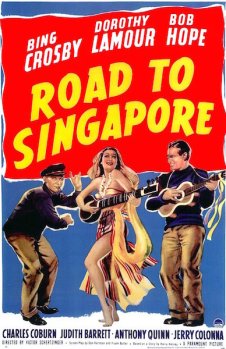
Road to SingaporeBob Hope and Bing Crosby star as a pair of young(ish) playboy sailors who run away from responsibility and family expectations in this comedy that launched the perennially popular Road to… series, which would spawn six sequels over the next 22 years.

Rather than a “comedy”, Road to Singapore might best be described as a “variety film” — it offers a mix of comedy, excitement, romance and song, a selection of entertainment that is more often provided by a few hours of TV these days. While it’s predominately light-hearted, the overall air is still more serious than that of the one other Road to… film I’ve seen, Road to Morocco: the plot seems to have been the film’s starting point, rather than an afterthought to connect the appropriate set pieces, and a couple of fight scenes are not wholly comedic in their choreography.

Unfortunately, in spite of this, there’s nothing here that’s as memorable as in Morocco. Bob and Bing are a great double act, undoubtedly carrying the film, but while it starts well enough it loses it as it goes on — even at a brief 85 minutes, it begins to drag early in the second half. It’s also worth noting that much of it is incredibly dated now, peppered with things like blacked-up natives (and our heroes blacking up to fit in) and the “good little housewife” routine. This is more an observation than a criticism — it’s very much a film of its time.

It might also be worth noting that, while I found Singapore reasonably entertaining, the friend I was watching with — who has enjoyed several other entries in the series, but had yet to see this — found it lacking. The score, however, is solely my own.

3 out of 5

The Wizard of Oz (1939)

2008 #60
Victor Fleming | 98 mins | DVD | U / G

The Wizard of OzThe Wizard of Oz is one of those films whose reputation unavoidably precedes it. Considering it’s nearly 70 years old now, that’s a reputation long in the making.

The biggest problem with this is that, coming to it for the first time as an adult, one knows just about everything that’s going to happen. There are still some gaps to fill for the uninitiated — it takes a surprisingly long time to get to Oz, and a surprisingly quick time from there to the Wizard — but it mostly feels oddly disconcerting: it’s such a well-known tale, even to those of us who hadn’t seen it, that having it played out in full, complete with bits one didn’t know about, is strange. That’s not really anything to do with the film, of course, just my personal impression.

My other observations amount to little more than “the second half is surprisingly light on musical numbers” and “the transition from sepia to full colour is still highly effective and glorious to watch” — as the (very interesting) restoration featurette on the DVD details, it literally looks better now than it ever has before. Beyond that, I had the sense that the film would exert a greater sense of wonder over the very young. That’s appropriate enough, but it means that, coming to it a tad later in life, it’s not a film I’m ever likely to really love.

4 out of 5