The 100-Week Roundup V

Like last time, these five films are connected not only by when I watched them (July 2018), but also by a shared star rating.

Incidentally, it’s about to be a busy time for these 100-week roundups — there should be one every week for the next few weeks to keep up with my backlog. (As time goes on, such frequency may become commonplace.)

In this week’s roundup…

  • Muppet Treasure Island (1996)
  • Blade of the Immortal (2017)
  • Cash on Demand (1961)
  • Free Enterprise (1998)
  • Iron Monkey (1993)


    Muppet Treasure Island
    (1996)

    2018 #147
    Brian Henson | 96 mins | TV | 1.85:1 | USA / English | U / G

    Muppet Treasure Island

    Following the success of The Muppet Christmas Carol, the little felt fellas turned their attention to another classic of Victorian English literature, Robert Louis Stevenson’s piratical adventure Treasure Island. For my money, the result is even better — it’s so good that it made me want to finally read the novel, or at least watch a ‘proper’ adaptation. (Two years later, I’ve done neither. Typical.)

    Why Muppet Treasure Island doesn’t attract the same level of love that’s reserved for their Christmas Carol is beyond me, because it’s really a lot of fun. I’m predisposed to enjoy piratical movies, for whatever reason, so perhaps it appeals to me more than average; but even allowing for such bias, I think this is one of the more enjoyable Muppet movies — if I were to rank them, it would be a toss up between this and the 2011 reboot for first place.

    The best bit is definitely the songs, which are properly good. It helps when you’ve got the likes of Tim Curry to sing them, of course. They’re not all the kind of outright comedy numbers you’d expect, either: the opener, Shiver Me Timbers, is quite dark, in fact. They’re supported by a score by Hans Zimmer, which with hindsight sounds like a dry run for Pirates of the Caribbean. There are seven songs in all, and only one that I didn’t really like, which I’d regard as a good hit rate for a musical.

    To top it off, the film ends with a Muppet sword fight. Really, what more could you want?

    4 out of 5

    Muppet Treasure Island placed 17th on my list of The Best Films I Saw in 2018.

    Blade of the Immortal
    (2017)

    aka Mugen no jûnin

    2018 #148
    Takashi Miike | 142 mins | Blu-ray | 2.35:1 | Japan, UK & South Korea / Japanese | 18 / R

    Blade of the Immortal

    Billed as the 100th film directed by Takashi Miike (which it isn’t, but hey), Blade of the Immortal is actually the first one I’ve seen by the (in)famous director. Based on a manga series, it’s about a samurai who’s rendered immortal to serve penance for his crimes, and the young woman who engages him as a bodyguard to avenge her murdered family.

    It’s a bit episodic at first, as our (anti)hero battles through the villains’ top swordsmen one by one, but that means there’s a regular feed of action sequences between the two bookends that are highlighted in the promotion: how he fights 100 men at the beginning, and 300 men for the climax. That last half-hour is an epic flurry of violence, by the end of which rivers of blood flow — literally.

    Aside from the combat, dramatically and thematically a lot of it is about the difference between good and bad, hero and villain; how, really, there’s not so much difference after all — sometimes it’s just a matter of perspective. It could’ve gone for a more streamlined, straightforward revenge narrative, but it throws many characters into the mix with attendant thematic points, which do lend more texture. Or, if you don’t fancy thinking about that stuff, there’s just a lot of really good fight scenes.

    4 out of 5

    Cash on Demand
    (1961)

    2018 #154
    Quentin Lawrence | 77 mins | TV | 4:3 | UK / English | PG

    Cash on Demand

    This Brit-noir came to my attention thanks to the ghost of 82’s review after Indicator included it in one of their Hammer sets (though I caught it on TV). It’s basically a real-time single location thriller (so right up my street) starring Peter Cushing as a bank manager faced with a clever robber — far from a showy heist, this is a calm, almost sedentary robbery… which ultimately gives way to a furious bevy of twists and counter-twists in the film’s closing minutes.

    It’s led by an excellent performance from Cushing, who convinces entirely as an uptight jobsworth brought low by the stress he must endure, which reveals his true character. The film’s focus is on the ringer he goes through thanks to the heist, rather than on clever details of the heist itself — certain plot points are never explained, but it doesn’t matter because this isn’t about the robbery, it’s about how the robbery affects Cushing. To that end, he’s also nicely contrasted with André Morell as the affable thief, particularly as the pair spend much of the film in extended two-handers. Quentin Lawrence’s direction is unflashy but effective, allowing their performances to shine. It’s almost televisual, though with more setups than anything studio-bound of that era would’ve allowed. No surprise, then, that he only directed a handful of films, mostly plying his trade in ’60s and ’70s TV series.

    I do wonder if we could have spent more time with the rest of the bank’s staff, who remain unaware a robbery is taking place. As it stands, they’re all established at the beginning, but then mostly pushed aside until near the end, when they conduct their own investigation for all of two scenes. What if that was expanded into a proper B-plot through the movie? I think it could make the film even better by adding the potential for even more tension. Perhaps it could withstand an expanded remake…

    4 out of 5

    Free Enterprise
    (1998)

    2018 #158
    Robert Meyer Burnett | 109 mins | streaming | 4:3 | USA / English | 15 / R

    Free Enterprise

    Relationship/sex comedy meets geek reference-athon in this ’90s indie that plays like Swingers meets Clerks (he says never having seen Clerks, so that’s just an assumption of what it’s like).

    It slots into what seems like a very ’90s subgenre: the “young film-loving people trying to break into Hollywood” thing. I’m sure there are lots of societal and industrial reasons why there were so many movies in that vein produced in the ’90s. It also comes with the era’s schtick of dialogue loaded to the nines with pop culture references. It’s perhaps an overfamiliar style now, but here it’s at least quite witty and well performed.

    Indeed, this is so a ’90s indie all-round — you know, like the early Tarantinos, and everyone who copied his dialogue’s voice, that kind of thing. If that’s not your bag, you’ll hate Free Enterprise. But if you enjoy that style of film, and if you love geek culture too, well, this was made for you. Literally, I should think. It certainly felt made for me, and I’m not even a Trekkie. To laypeople, it might just look like “Swingers with geek references”, or conversely (to use that old stereotype of geeks), “my life but with sex”.

    So, to give it a 4-star rating feels like a very personal reaction — I think you’ve got to hit the right confluence of interests to get the maximum enjoyment out of this movie. But if you do, it’s really rather good.

    4 out of 5

    Iron Monkey
    (1993)

    aka Siu nin Wong Fei Hung chi: Tit ma lau

    2018 #160
    Yuen Woo-ping | 90 mins | Blu-ray | 1.85:1 | Hong Kong / Cantonese | 12 / PG-13

    Iron Monkey

    Back around the time I was first getting interested in Asian action cinema — when the Hong Kong Legends DVD label was doing sterling work bringing so many titles to the UK market in extras-packed editions — Iron Monkey was fêted as an absolute modern classic. I think it was one of the first to get a two-disc special edition from HKL too, as if to emphasise its importance. But I never got round to watching it, and so now it perhaps came overburdened with expectation. I found it to be a mix of impressively choreographed action, goofy humour, and a rather slight plot.

    The fights are definitely the star; without those, it’s no great shakes. But then, what do you come to this kind of movie for? It’s definitely one I need to revisit and reassess. (And as it’s been two years now, maybe it’s about time I did…)

    4 out of 5

  • Rocketman (2019)

    2020 #3
    Dexter Fletcher | 121 mins | streaming (HD) | 2.39:1 | UK, USA & Canada / English | 15 / R

    Rocketman

    The director and star of Eddie the Eagle reunite for another biopic of a bespectacled British icon… though I’m not sure how favourable global music megastar Elton John would consider that comparison.

    Both films concern a regular lad from a working-class background who dreams of something bigger — in Eddie’s case, Olympic glory; in Elton’s, music stardom. But that’s more or less where the films diverge, because whereas Eddie’s ski jumping adventure was rendered as a family-friendly comedy, Elton’s seduction by sex and drugs and rock and roll is altogether more adult. But it’s also a world away from grim and gritty seriousness, because director Dexter Fletcher regularly injects flights of fancy and fantasy. Elton may end up in a very dark place (before inevitable salvation, natch), but it’s a helluva lot of fun getting there.

    In my review of the year before’s big musical biopic, Bohemian Rhapsody — which Fletcher ended up guiding through a third of its shoot and post-production after credited helmsman Bryan Singer was fired — I wondered which director was responsible for that film’s “occasional bold directorial flourishes”. On the evidence of Rocketman, I’d guess they were Fletcher’s idea. His staging and camerawork are often highly imaginative here, really cutting loose during the musical numbers. (Fletcher’s next job is taking over the Sherlock Holmes films from Guy Ritchie, a task that certainly requires the kind of visual panache he’s demonstrated here.)

    Piano man

    Indeed, this isn’t just “a film about music”, but a proper musical. It isn’t just a simplistic jukebox musical either, nor a standard musician biopic where the character performs some of their hits. Well, it is both of those — it’s a jukebox musical because all the songs are from Elton’s back catalogue (plus one new one so it could vie for the Oscar, of course), and the character of Elton John does perform some of his hits in recording studios and on concert stages. But it’s also more than that in the way it’s executed. Other characters break into song from time to time too, and there are clever reimaginings of several recognisable tracks. This is a restlessly imaginative movie.

    Egerton is superb in the lead role, crafting Elton as a much more nuanced figure than he’s sometimes regarded; a truly rounded individual with a considered interior life. One might argue the whole drugs storyline is somewhat predictable or even rote, with some surprising mirrors of the much-criticised Bo Rhap (“surprising” because where that film was roundly criticised for its clichés this has received a much more generous critical response)… but if that’s the true story, that’s the true story, right? Egerton certainly negotiates it with believability. Much praise for the film has focused on his performance, leading to significant awards nominations (like at BAFTA) and wins (a Golden Globe), but there are several great supporting players too, not least Jamie Bell as Elton’s lifelong songwriter and true friend, Bernie Taupin.

    The cumulative effect is a movie that is highly enjoyable but not without depth; that offers toe-tapping entertainment and filmmaking thrills in its musical numbers, while also digging into its subject’s troubles and their causes. Like an eagle, or a rocket, it doesn’t just fly, it soars.

    5 out of 5

    Rocketman is on Sky Cinema from today. It placed 10th on my list of The Best Films I Saw in 2020.

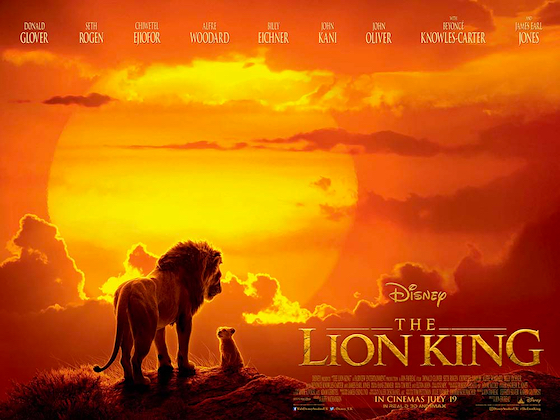
    The Lion King (2019)

    2019 #103
    Jon Favreau | 118 mins | cinema | 1.85:1 | USA / English | PG / PG

    The Lion King

    The Lion King might be the best Disney film. It’s that or Beauty and the Beast. (I’m sure many classicists would plump for something older, but sorry, I’m a ’90s kid.) (Also, by “Disney film” I mean their animated output. Obviously Disney release tonnes of other stuff, and have for a long time, but by “Disney film” we really mean the animations, don’t we? Not “any film that happens to be released by Disney”. I do, anyway. Especially in this context.)

    Sorry, let me start again: The Lion King might be the best Disney film. So when they started down this road of live-action remakes of their beloved classics, it was inevitable their attention would turn to it. Of course, you can’t really do a live-action version of a film whose characters are all lions and hyenas and warthogs and stuff — not without going down the puppetry/costumes route of the stage version, anyhow, which apparently is gangbusters in the flesh (I’ve never seen it; that’s changing in August, Coronavirus permitting) but I can’t envisage working for the mass moviegoing audience. So instead they did the obvious thing and went for photo-real CGI. Heck, most “live-action” blockbusters nowadays are 50%+ CGI anyway, especially Disney ones (they didn’t even design the Avengers’ costumes for Endgame until post-production, ffs). But, at the end of the day, “photo-real CGI” is just another kind of animation. So what Disney have done is remake the animated Lion King in the totally different form of… animation.

    Yeah, you probably knew all that already, and maybe had similar rants in your own mind / reviews / Twitter feeds / in Wendy’s / shouted at tea, Sue (delete as culturally appropriate). But it remains a relevant perspective on this film, because it indicates the essential question one keeps coming back to when watching it:

    Why does this exist?

    The cub who would be king

    Obviously, the simple and true answer is “to make money”. These Disney live-action remakes have been financial successes, otherwise they wouldn’t keep doing them. The more popular the original animated movie, the more successful the remake. The Lion King is one of the most popular of them all, ergo it was a safe bet to be a big hit. The biggest risk was that “why bother?” question — audiences might’ve felt it was pointless and stayed away — but that didn’t happen: it made $1.656 billion worldwide, making it the 7th highest-grossing film of all time. The original film is down at a lowly 47th. If you were the kind of person who thought box office numbers were the be-all and end-all, you might conclude that this film is even better than the already-classic original. It is not. That it did well at the box office is no surprise — I think there’s a massive curiosity factor involved in these remakes (how faithful will they be; what will they have added or taken away; how will this familiar tale look and feel in a new medium) — but that would only get it so far, and most of it would come from opening weekend. Something obviously worked for audiences, because they must’ve kept coming back.

    Well, I can’t explain that one for you. On my first viewing, I didn’t think it was a particularly good film. I rewatched it last night, this time in 3D, and enjoyed it a little more second time round. In part that was because it has really good 3D. Indeed, the praise I’d read for that version was the only reason I was tempted to give the film a second look, and it didn’t disappoint in that department. Whatever you make of the rest of the movie, the photo-real CGI is undeniably a phenomenal technical achievement, and it’s only improved by the life-like dimensionality brought by 3D. With a screen-filling 1.78:1 aspect ratio, it really is like looking through a window. Beyond that, though, I liked the film itself a little more. That’s probably down to expectations — not that I was expecting great things on my first viewing, but knowing exactly what was coming, being fully aware of all the disappointments in store, mitigated them somewhat, and so I was able to enjoy the bits it did well.

    Be prepared for disappointment

    Nonetheless, I think the best way to sum up the experience is to say it’s like a cover song from a TV talent show: a reasonable approximation of the original, although clearly not as good, with unnecessarily added riffs and tricks as the cover artist struggles in vain to “make it their own” while not fundamentally deviating from what made the original so beloved. The trailers made it look like a shot-for-shot remake (possibly deliberately), but director Jon Favreau insisted it wasn’t. He’s right, but it might be better if he had been slavishly faithful, because when he strikes out in a different direction it undermines some of the best bits of the original. At least two songs are rendered as damp squibs by less-imaginative staging, while Can You Feel the Love Tonight is for some reason staged in the afternoon. But even more poorly handled is Be Prepared. It’s perhaps the greatest villain’s song in the Disney canon. You might’ve thought it was impossible to ruin a song so inherently fantastic. I certainly did. Sadly, Favreau has proven us wrong.

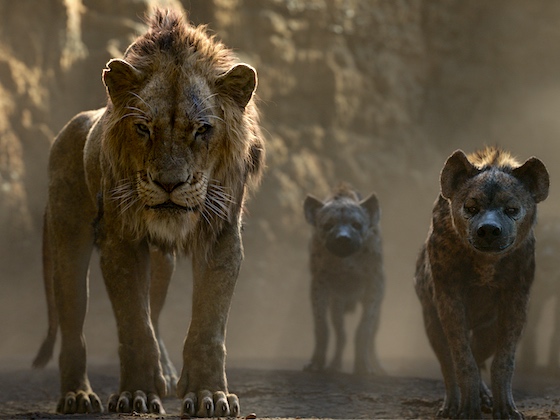
    The voice cast are uniformly adequate, with a couple of standouts. The major one is Chiwetel Ejiofor, who gives a suitably menacing and conniving performance as the treacherous Scar. It’s at least the equal of the original, which considering that was performed by villain par excellence Jeremy Irons is saying something. (Be Prepared is obviously a black mark against this interpretation, but it’s not Ejiofor’s fault he was lumbered with an underpowered rewrite.) James Earl Jones reprises his commanding performance as Mufasa from the original movie. Actually, I don’t know whether he performed it anew or they just recycled his original recordings. You assume the former, but the film is so faithful that the latter may have sufficed. Elsewise, it’s the comedy parts that are given room to shine, with a nice double act from Billy Eichner and Seth Rogen as Timon and Pumbaa, and John Oliver nabbing the lion’s share of the best lines as Zazu (pun very much intended).

    The box office king

    This remake has enough residual quality leftover from the original film to tip the scales into the “didn’t hate it” category. More critical viewers may not be so kind — indeed, they haven’t been. Conversely, those who are less demanding may find the result reasonably likeable (I first saw it with my mum, who thought it was a pleasant couple of hours at the cinema). Still, even with all the technical prowess on show, it can’t replicate either the magic or the majesty of the original animation.

    3 out of 5

    The not-live-action live-action Lion King is on Sky Cinema from today.

    Sholay (1975)

    2018 #200
    Ramesh Sippy | 205 mins | DVD | 4:3 | India / Hindi | PG

    Sholay

    For many Western readers (and the stats say most of mine are, though India is in 3rd of all countries for 2019 so far), there’s every chance you’ll’ve only heard of Sholay (if you’ve heard of it at all) as “one of those Indian films that’s on the IMDb Top 250 nowadays”. But in Indian culture it’s a much bigger deal, a huge and longstanding success; like Star Wars or something is to us, I guess, only without the reams of sequels and spinoffs and merchandise and theme parks. Instead, it’s enjoyed remarkable success of its own: it topped the Indian box office for 19 years, was the first film in India to celebrate a Silver Jubilee at over 100 cinemas, and eventually set a record of 60 Golden Jubilees across India. From a British perspective, in 2002 it topped the BFI’s “top ten Indian films of all time” poll, and in 2004 it was voted the “Greatest Indian Movie” in a Sky poll of 1 million British Indians. I first heard about it years ago in that context, and my desire to see it was only exacerbated when it made it onto IMDb’s list. All of which is why I chose it to be my second-ever #200.

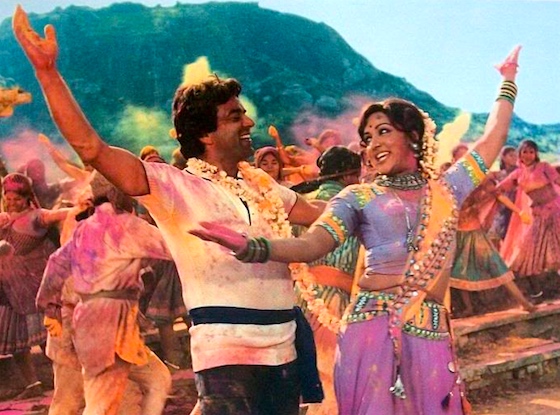
    It’s a tricky film to sum up, because it offers a massive mash-up of tones and genres in a way we’re not accustomed to from Western cinema. There are whole sequences (not just fleeting moments) of broad slapstick humour, epic action, heartfelt romance, brutal violence, colourful musical numbers, intense tragedy, plus backstory that’s filled in via regular, lengthy flashbacks. It wouldn’t be a stretch to say its primary genre was Action, or Comedy, or Musical, or Western — it’s all of those things, by turn; sometimes at the same time. Apparently it’s a defining example of the “masala film”. Masala is, of course, a mix of spices in Indian cuisine, and the films that take that name blend genres together, typically (according to Wikipedia) action, comedy, romance, and melodrama, plus musical numbers.

    Who doesn't enjoy a colourful sing-song?

    That sounds like a recipe for disaster, but what’s perhaps most remarkable about Sholay is that it pulls them off. Thanks to engaging characters and relationships, powerful and humorous performances, quality filmmaking (there’s some strikingly effective camerawork and editing in the big scenes), it all flows. You can see why it became such a success: there’s something for everyone. And you can see why it struggles to transcend the culture it originates from, because when Western movies ever even vaguely attempt this kind of range of tones, there are trolls aplenty waiting to rip them apart for the perceived fault of being tonally inconsistent.

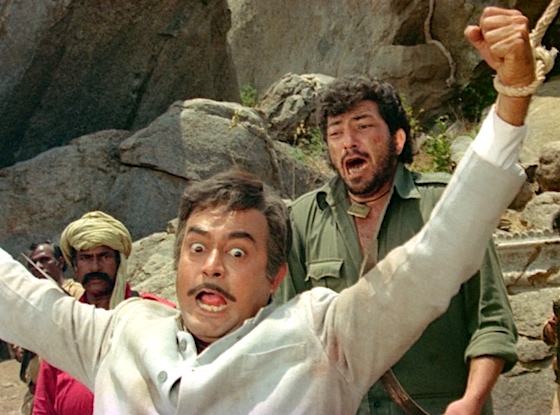
    The heroes are Veeru (Dharmendra) and Jai (Amitabh Bachchan), a pair of crooks with hearts of gold, who are recruited by a retired policeman who once arrested them, Baldev Singh (Sanjeev Kumar), to capture a wanted outlaw, Gabbar (Amjad Khan), who’s terrorising Singh’s village, and who he has a personal history with. The way that storyline plays out is highly reminiscent of Spaghetti Westerns and the samurai movies that inspired some of them — anyone who’s seen the likes of A Fistful of Dollars, Seven Samurai, or Once Upon a Time in the West (or any of the other films that have riffed on / ripped from them) is going to see a lot of reflections here. I don’t mean that to be a criticism — after all, Dollars was an unendorsed remake of Yojimbo, and Seven Samurai was remade as classic Hollywood Western The Magnificent Seven, so there’s strong pedigree among these movies for reworking each other to excellent effect.

    I'm not sure that's safe...

    Sholay certainly adds its own stuff to the mix. I mean, those other films I’ve mentioned don’t have musical numbers or slapstick comedy (not much of it, anyway). Lest you think this plays as a spoof, Singh eventually unveils a tragic backstory (and a neat twist to his character), and Gabbar is a properly despicable, nasty villain. Plus, like most of the best bad guys, he’s not just evil for evil’s sake — he’s motivated to subjugate this particular village for a reason — but he’s still a properly nasty piece of work, excessively and inventively cruel. Rather than a spoof, then, the different genres come into play via an array of plots and asides. At times it does feel like a selection of unconnected subplots to bulk out the running time (and, as you may’ve noticed, it does have a long running time), but most of them come together in the end. Your tolerance for those that don’t (a lengthy comedic aside in a prison, for example) is another matter.

    Musical numbers are another thing that put some people off. There are only five though, and they don’t actually drive the plot that much — I was kind of forced to assess their impact, because for some reason my DVD copy didn’t bother to subtitle the songs, leading me to search out translations online so I could get the gist. Still, when they fill several minutes of screen time each, it is nice to at least have an idea what’s being said sung!

    In the West, Sholay has been hard to find at times (personally, it was years ago that I managed to source an out-of-print DVD by a label you’ve never heard of from an Amazon Marketplace seller), but as of this week it’s available on Amazon Prime Video in the UK (either as part of a subscription or to rent and buy individually), and in HD to boot! Based on the running time it’s the shorter widescreen theatrical version; there’s also a longer, open matte 4:3 “director’s cut”, which is what I watched. There’s info on the differences between the two cuts here, but the mostly it’s a couple of bits of violence that were censored. The biggest change, though, is the ending. No spoilers, but I think the original version is better — it included one of my favourite parts of the entire film, in fact. The revised version was at the insistence of India’s censor board, and includes a heavy-handed moral lecture — it’s not just less good in itself, it also feels overtly censor-mandated. Oh well.

    Vicious villainy

    On the bright side, the 4:3 version isn’t great to watch compositionally. The makers wanted to produce an epic 70mm widescreen kinda movie, but didn’t have the tech to do it properly, so they shot it in full frame 4:3 on 35mm and then had it cropped and blown up in London. Watching in 4:3, it’s obvious that it was always intended to be cropped to widescreen: there’s loads of dead space above everyone’s heads, things like that. That said, every once in a while there’s a shot that seems to be perfectly framed. Maybe they look just as nice cropped, I don’t know. To further muddy the waters about different versions, five years ago Sholay was converted to 3D. Despite the film’s enduring popularity, it didn’t come close to making its money back (the conversion cost US$3.5 million, but the 3D release only grossed US$1.4 million). In the West the studio would seek to recoup more of that with home media, but apparently Blu-ray isn’t popular or successful in India, so the chance of getting a 3D BD is basically nonexistent. But, as I said, it’s on Amazon in HD now, so at least there’s that. (Hopefully it has subtitles for the songs…)

    Whichever version you watch, Sholay is best described as “an experience”. Perhaps lots of Bollywood movies are like this (after all, with huge success comes huge influence, and I’m sure many have tried to emulate it), but I’m not familiar with them so this was all new to me. That epic running time makes it feel like an event to watch, and the winding plot and variety of tones it encompasses make it feel like a whole buffet of entertainment, as opposed to the just one meal that most films offer. I guess, like any food that is foreign to an individual, it comes as an acquired taste, but it’s one I enjoyed immensely. It would also be entirely accurate and fair to roll out a somewhat clichéd sentiment: if you only watch one Bollywood film, this is the one to watch.

    5 out of 5

    As mentioned, Sholay is available on Amazon Prime Video now.

    It placed 25th on my list of The 26 Best Films I Saw For the First Time in 2018.

    Teen Titans Go! To the Movies (2018)

    2018 #246
    Aaron Horvath & Peter Rida Michail | 84 mins | streaming (HD) | 16:9 | USA / English | PG / PG

    Teen Titans Go! To the Movies

    I don’t think I’d even heard of the Teen Titans Go! animated series until promotion for this big screen version started. Best I could tell, a lot of entitled fanboys hate it — it’s too childish and comical, whereas they’d prefer the ‘grown-up’ seriousness of cancelled animated series Teen Titans — and consequently weren’t at all impressed by it getting the honour of film adaptation. Whatever — I thought the trailer looked funny, and, fortunately, the end product lives up to it.

    The Teen Titans are a superhero team made up of erstwhile Batman sidekick Robin, half-robot Cyborg (who, in other iterations, is a member of a certain major-league superhero team), shapeshifter Beast Boy, half-demon sorceress Raven, and alien princess Starfire. After they’re criticised for not having their own movie, the Titans set out to get one made. First step: get an arch-nemesis, for which they target Slade Wilson, aka Deathstroke.

    Although ostensibly a children’s series, and therefore presumably a children’s movie, Teen Titans Go is actually full of gags and references aimed at older viewers, without resorting to cheap double entendres or the like designed to fly over kids’ heads, but instead focusing on the wider universe of superhero movies — it has less respect for the fourth wall than a Deadpool movie. It’s often genuinely witty, and burns through plot and jokes at a joyously fast pace (possibly a legacy of its short TV episodes). It also might be the first time I’ve ever seen a fart gag and thought, “that’s actually quite funny and kinda clever (for a fart gag).” That’s a special kind of achievement in itself.

    4 out of 5

    Teen Titans Go! To the Movies is available on Sky Cinema as of this weekend.

    It placed 23rd on my list of The 26 Best Films I Saw For the First Time in 2018.

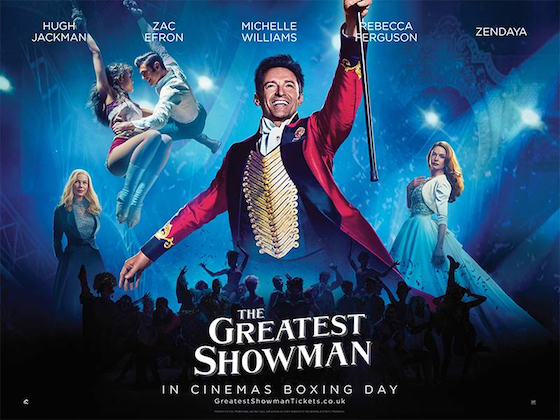
    The Greatest Showman (2017)

    2018 #237
    Michael Gracey | 105 mins | streaming (UHD) | 2.39:1 | USA / English | PG / PG

    The Greatest Showman

    There’s nothing inherently festive about The Greatest Showman (if it has even one scene set around Christmas, I can’t immediately recall it), yet it was initially released on Boxing Day last year and now kicks off December’s premieres on Sky Cinema, and somehow the association feels entirely fitting. I guess it’s something to do with the tone and style of the film itself: a big, cheesy, schmaltzy, cheery musical — just the kind of thing many people like to wallow in during the big, cheesy, schmaltzy, cheery end-of-year festival. It’s almost a John Lewis advert in feature film form, only with upbeat original songs instead of whispery female covers of old hits.

    Inspired very, very, very loosely by a true story, the eponymous gentleman is P.T. Barnum (Hugh Jackman), a man of low station in mid-19th century America who, via a cunning fraud, manages to buy a building that he turns into a museum of curiosities. With attendance poor, he adds a floor show featuring acrobatics and freaks. It’s slated by the critics, but curious audiences flock en masse. Barnum is suddenly a massive success — but at what cost to his personal life?

    Well, virtually none, because there’s barely any jeopardy to be found here (apart from a little forced something to push it into a third act). But jeopardy is not the point of The Greatest Showman, which is all about being a crowd-pleasing good time — like the show-within-the-show, it was poorly received by critics but a huge word-of-mouth success: it never made it to #1 at the US box office, but nonetheless stayed in the top ten for 11 weeks and earned $434 million worldwide; its soundtrack album was such a hit that they’ve already released another album of cover versions. It’s a phenomenon, basically, and I do think the lack of worry or tension in the story is a contributing factor, especially in these troubling times. That kind of lightweightness doesn’t please the critically-minded, but it doesn’t bother those simply after a good time. And why should it?

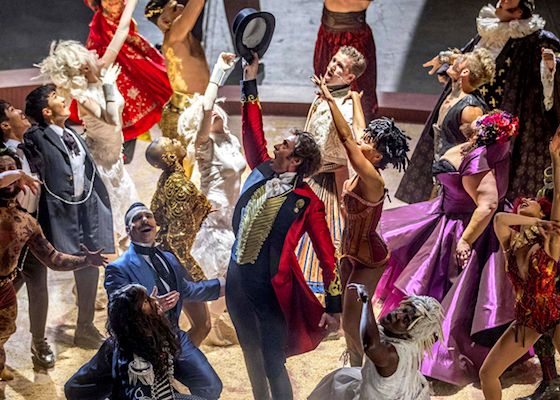
    The greatest show

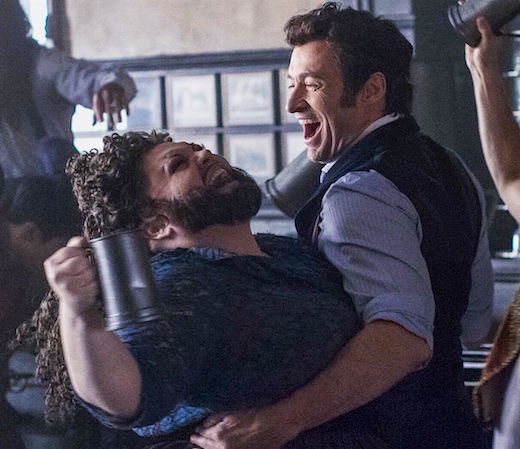
    It’s a Musical through and through, the movie equivalent of a broad stage-grin and jazz hands. The numbers are of a different ilk to traditional Broadway style, but not misplaced — it’s modern chart-pop style songs and music video choreography, wrapped up in a big showy old-school musical vibe. I know everyone’s latched onto This Is Me as the film’s anthem, and Rewrite the Stars earned a single release because it’s a pop love song sung by kid-friendly Zac Efron and Zendaya, but the one number that really works for me is opener/closer The Greatest Show (it’s even better on the soundtrack, because it isn’t awkwardly sliced in two with the rest of the movie shoved in between, as it is on screen). If that song doesn’t end up being co-opted for opening ceremonies and things like that, it’ll be kind of a shame. And if I was to point to a runner-up favourite, I’d go for The Other Side purely for how it’s staged: a barroom duet between Jackman and Efron with impressive drinkography. And talking of the songs, the Honest Trailer contains some excellent spoofs of them.

    Still probably best known as surly superhero Wolverine, Jackman was an established musical theatre star before his big-screen breakthrough, so this stuff is very much within his skill set — indeed, as his recently-announced world tour could attest, this show of song and dance may be more in his comfort zone than the superhero shenanigans. Either way, that he’s so effortlessly consummate at both proves he’s a performer of underestimated range. Less remarkable as allrounders are former Disney brats Efron (as a bored rich kid roped into Barnum’s enterprise) and Zendaya (whose qualifier for a freakshow seems to be that she’s somewhat dark skinned), but they’re perfectly adequate for their poppy against-all-odds romantic subplot. Less at home is Michelle Williams — not that she’s bad, but seeing her smiling and happy is weird

    Drinkography

    Altogether, I can see why The Greatest Showman was unpopular with critics but a huge hit with audiences — it’s a proper crowd-pleaser; a big, cheesy, easy extravaganza, similar to its pop-style music. That’s not the sort of thing critics are enamoured of, but it is the kind of thing that tickles the fancy of the masses. On the whole, it didn’t appeal to me — there were things it could’ve done better without betraying what it was aiming for, I think, like that total lack of risk in the plot, but also things I was never going to like, such as the music style — but it did have its moments.

    3 out of 5

    The Greatest Showman will be available on Sky Cinema from midnight tonight.

    Review Roundup

    Hello, dear readers! I’ve been away for most of the past week, hence the shortage of posts, but I’m back now, so here’s a random ragtag roundup of reviews to kick things off again.

    In today’s roundup:

  • That’s Entertainment! (1974)
  • ’71 (2014)
  • Guardians (2017)


    That’s Entertainment!
    (1974)

    2017 #80
    Jack Haley Jr. | 124 mins | TV | 1.33:1 + 1.78:1 + 2.35:1 + 2.55:1 | USA / English | U / G

    That's Entertainment!

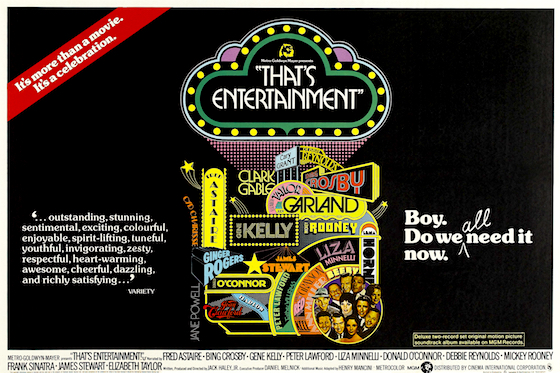
    Greatest hits compilations always seem to be a popular product in the music biz, and that’s essentially what this is, but for movies. An array of famous faces appear on screen to help provide a scattershot history of the MGM musical, but really it’s an excuse to play some fantastic clips from old hits. This may be the kind of programming that TV has taken on and made its own in the decades since, but when the quality of the material is this high, it feels like more than just schedule filler.

    Thanks to many eras being covered it has more aspect ratio changes than a Christopher Nolan movie, though that’s actually quite effective at demarcating the old-school spectacle from the linking chatter. There’s also some “you wouldn’t get that today” commentary, like Frank Sinatra talking about a line of chubby chorus girls (who don’t even look that large!), or various bits and pieces criticising the studio’s history, like how all the films had the same plot.

    It was originally promoted with the tagline “boy, do we need it now”, a reaction to the gritty style of filmmaking that was popular in Hollywood at the time, as well as all the real-life problems of the era (it was released the same year as Nixon resigned because of Watergate). MGM needed it too: the studio was in decline, releasing just five films in 1974. The whole thing carries a somewhat bittersweet air, as ageing stars reflect on past glories from the decrepit environs of MGM’s rundown backlot.

    Nonetheless, it creates a marvellous tribute to a golden era. And I guess it must’ve done alright, because it spawned two sequels, a spin-off, and MGM are still going (more or less) today.

    4 out of 5

    ’71
    (2014)

    2017 #95
    Yann Demange | 99 mins | streaming (HD) | 2.35:1 | UK / English | 15 / R

    ’71

    Set in Belfast in (you guessed it) 1971, ’71 is a thriller that sees an Army recruit become separated from his unit during a riot at the height of the Troubles, leaving him trying to survive the night “behind enemy lines”.

    The film’s best stuff is early on: a brewing riot as police perform a door-to-door search; a tense foot chase through the backstreets; a single-take bombing and its aftermath. The immediacy of all this is well-conveyed, suitably tense and exciting, but also plausible. Then the film decides it needs some sort of plot to bring itself to a close, and so it kicks off some IRA infighting and British Army skullduggery. The added complications don’t exactly bring it off the rails — it’s still a fine and tense thriller — but it lacks that extra oomph that the hair-raising sequences of the first half deliver.

    Still, it’s a promising big screen debut for director Yann Demange, who was reportedly among the frontrunners to helm Bond 25 before that got diverted into Danny Boyle and John Hodge’s idea. His second feature, another period movie, this time a crime drama, White Boy Rick, is out later this year.

    4 out of 5

    Guardians
    (2017)

    aka Zashchitniki

    2017 #122
    Sarik Andreasyan | 89 mins | streaming (HD) | 2.35:1 | Russia / Russian | 12

    Guardians

    You may remember this film from when its trailer went viral a couple of years ago: it’s the “Russian answer to The Avengers” that featured a machine-gun-wielding bear. Naturally, that kind of attention assured it got an international release eventually (I paid to rent it, then it later popped up on Prime Video. You never know how these things are going to go, do you?)

    It’s about a bunch of old Soviet superheroes being reactivated to stop a villain. If that sounds vague, well, I can’t remember the details. Frankly, they don’t matter — Guardians is the kind of film a 6-year-old would write after a diet of Saturday morning cartoons, with the same attention to character development and plot structure you’d expect from such an endeavour. The story is semi-nonsensical: the villain’s plan is never clear (beyond “rule the world”); it flits about between subplots; characters appear and disappear from locations… There’s a litany of “things that don’t quite make sense” — too many to remember without making obsessive notes while rewatching, which I have no intention of doing.

    But if you can ignore all that — or, even better, laugh at it — then it’s fairly watchable, in a brain-off entirely-undemanding so-bad-it’s-good kind of way. There’s some decent CGI (given its budget), some half-decent action, and it’s mercifully brief at under 90 minutes.

    2 out of 5

  • Review Roundup

    This may look like a pretty random selection for a review roundup… and it is. But they do have two things in common: I watched them all in 2017, and I gave them all 3 stars.

    Yeah, not much, is it?

    Anyway, in today’s roundup:

  • The Girl on the Train (2016)
  • Lions for Lambs (2007)
  • Tea for Two (1950)


    The Girl on the Train
    (2016)

    2017 #113
    Tate Taylor | 112 mins | streaming (HD) | 1.85:1 | USA / English | 15 / R

    The Girl on the Train

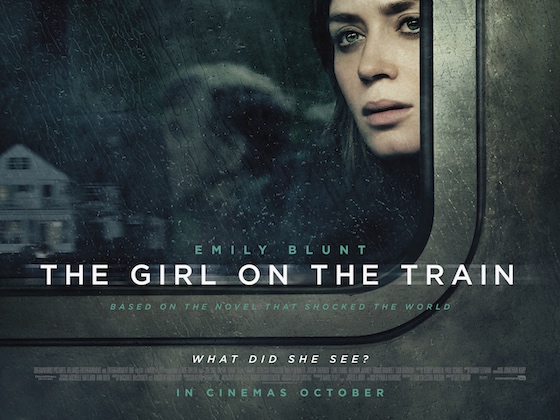
    Based on a bestselling novel, The Girl on the Train stars Emily Blunt as Rachel, an alcoholic divorcee whose commuter train passes her old home every day. She tortures herself by observing her ex (Justin Theroux), his new wife (Rebecca Ferguson) and their child, as well as her former neighbours Scott (Luke Evans) and Megan (Haley Bennett), who she imagines living a perfect life. But after Rachel sees something that shatters the image she’s created, she wakes up from a black out, with mysterious injuries, and to the news that Megan has gone missing…

    The whole story unfurls with a good deal of histrionics and a questionable level of psychological realism, but as a straightforward potboiler it has some degree of entertainment value. In fact, if it had been made with a little more panache then it may even have been seen as a throwback to the kind of melodramas they produced in the ’40s and ’50s. Because it doesn’t seem to have that level of self-awareness, I guess it’s just the modern-day equivalent.

    3 out of 5

    Lions for Lambs
    (2007)

    2017 #121
    Robert Redford | 92 mins | streaming (HD) | 2.35:1 | USA / English | 15 / R

    Lions for Lambs

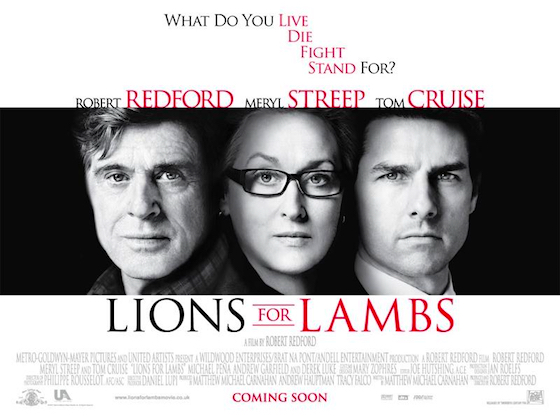
    The US intervention in the Middle East is obviously one of the most significant geopolitical events of our age, but how many films have really got to grips with it? Some, like The Hurt Locker, have given a sense of its impact to those on the ground. Lions for Lambs tried to take a more intellectual standpoint, with three interconnected storylines: a young and ambitious US senator (Tom Cruise) details a new military strategy to an experienced and sceptical journalist (Meryl Streep); a college professor (Robert Redford) tries to engage a talented but apathetic student (Andrew Garfield); and two soldiers become stranded in Afghanistan (Michael Peña and Derek Luke), providing a link between the other two stories.

    Screenwriter Matthew Michael Carnahan originally conceived the work as a play, before realising the Afghanistan section needed the scale of a movie. Nonetheless, his original conception shows through: the film is very talky and stagey, and the other two storylines could certainly be performed on stage with no changes necessary. You can also tell it’s driven by disillusionment in the US’s actions, and it has everyone in its critical sights: the government, the media, the education system… It feels more like a polemic than a movie, lecturing the viewer; although, like everyone else, it doesn’t seem to offer any firm answers.

    Streep and Cruise both give excellent performances. I suppose being a smarmy senator isn’t much of a stretch for the latter, but Streep’s turn as an insecure journalist is the highlight of the film. You need acting of that calibre to keep you invested in a movie like this, and it almost works, but ultimately the film has too little to say.

    3 out of 5

    Tea for Two
    (1950)

    2017 #162
    David Butler | 94 mins | DVD | 4:3 | USA / English | U

    Tea for Two

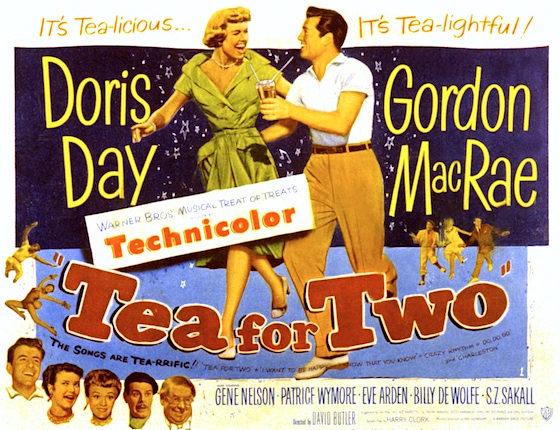
    Musical comedy starring Doris Day (radiant as ever) and Gordon MacRae (given little to do as her love interest).

    The songs are largely forgettable, with a couple of sweet exceptions, but at least there are other things to recommend it, like some impressive dancing from Gene Nelson, particularly during a routine on a flight of stairs. There’s a solid helping of amusing one-liners too, most of them claimed by Eve Arden as Day’s wry assistant Pauline, the rest by S.Z. Sakall as her embattled uncle. Said uncle is, by turns, a bumbling old codger and an underhanded schemer who uses tricks to try to ruin his niece’s happiness just so he can win a bet. Best not to dwell on that too much…

    The same goes for the rushed ending, in which our heroine is in financial ruin, so her assistant basically whores herself out to a rich lawyer so they can still put on the show. Hurrah! And talking of things not to dwell on, there’s also the title, which has absolutely nothing to do with the story (other than it being probably the best song). Conversely, the name of the play it’s based on — No, No, Nanette — is bang on. Ah well.

    Nonetheless, Tea for Two is all-round likeable entertainment; the kind of movie you put on for a pleasantly gentle Sunday afternoon.

    3 out of 5

  • Muppet Review Roundup

    In today’s roundup:

  • The Muppets Take Manhattan (1984)
  • Muppets from Space (1999)


    The Muppets Take Manhattan
    (1984)

    2018 #48
    Frank Oz | 90 mins | streaming (HD) | 16:9 | USA / English | U / G

    The Muppets Take Manhattan

    Apparently (so I read somewhere) at the time this was intended to be the end of the Muppets — the performers were fed up and wanted to move on to other things, and they conceived this third movie as a capstone on the whole affair. That seems inconceivable now — I mean, just how much Muppet stuff has followed it? To date, five more movies, at least two TV series I can immediately think of, plus other specials, countless guest appearances, a theme park attraction…

    I think that tiredness shows through in the finished product. Or maybe it’s just the changing attitudes — they’d just made The Dark Crystal, which maybe indicates they had a hankering for more serious fare. Supposedly the first draft was dismissed by director Frank Oz as being “way too over jokey”, which is surely a terrible criticism of a Muppet screenplay, but Jim Henson encouraged him to tinker with it to emphasise the characters and their relationships. This was partly in response to The Great Muppet Caper, a particularly wacky effort that hadn’t done well at the box office, so they were toning it down.

    Well, I regard the Muppets as primarily comedy characters, and so it’s no wonder this one seems to miss the mark. There’s some occasional funny stuff, the odd good skit, but mostly Take Manhattan just kinda plods along. Personally I thought Caper was a bit of a poor sequel, but this is less good again. It straight up lacks some of the things that make the Muppets so memorable — there isn’t a single fourth wall break, for instance. There’s all together too much focus on plot, even though it’s a very thin one, and the gang spend most of the movie split up, meaning it lacks their camaraderie. So much for focusing on the relationships!

    Muppets in Manhattan

    There are still celebrity cameos, at least, though I feel they’ve aged particularly poorly. Well, there’s Joan Rivers (even if her younger self is always unrecognisable to those of us who mainly knew her in later made-of-plastic years), Elliot Gould, and Liza Minelli, so it’s not all bad. Other than that, the credits explicitly name who the cameos are, but I didn’t even recognise half the names. In fact, the best one is some other Henson puppets: the cast of Sesame Street! Though the presence of puppets isn’t always welcome: a furious Miss Piggy rollerskating after a mugger, filmed in wide shots that I can only assume feature a human in a Miss Piggy suit, is the stuff of nightmares.

    Nonetheless, I shall give The Muppets Take Manhattan a 3 — just. That’s the same as I gave Muppet Caper, which is a shame (that film was more of a 3.5 whereas this is a 2.5), but it’s not so bad that I can give it an outright 2. It’s middling. It’s fans-only, I guess. Some bits work, some bits are good, but overall it’s not quite there as a Muppet movie.

    3 out of 5

    Muppets from Space
    (1999)

    2018 #75
    Tim Hill | 85 mins | streaming (HD) | 16:9 | USA / English | U / G

    Muppets from Space

    I’m afraid things aren’t going to pick up here: Muppets from Space is the lowest rated Muppet movie on IMDb. Personally, it would not be my pick for the worst film starring our felty friends… but it’s not that great, either.

    Hailing from the same era that gave us the likes of Independence Day (which gets directly spoofed), Men in Black (some of them show up), and The Phantom Menace (no references that I could detect, but they came out the same year, so…), you can see why the Muppet movie makers would’ve been inspired to move into the sci-fi realm. The plot concerns finally explaining just what Gonzo is, which is not only unnecessary but feels kind of against the spirit of the thing — no one knows what he is, there’s only one of him, that’s kind of the joke. Well, not after this film…

    Related to that, there’s almost a good thematic thing about belonging, and who your real family is or can be, but it’s only loosely nodded at early on before sort of popping up right at the end, without enough building blocks in between to really make it work as a payoff. But we don’t come to the Muppets for the themes, we come for the gags, and in that respect From Space is… fine. Well, I mean, it’s not really all that funny… or interesting… It just kind of toddles along until an underwhelming ending (it would’ve been better if (spoilers!) it turned out the aliens weren’t Gonzo’s people, thereby leaving what he is a mystery). And there’s a Dawson’s Creek cameo, because they were filming in the studio next door, which obviously feels terribly dated now, but that’s how these things always go I guess.

    So, I didn’t actively dislike it in the way I did Muppets Most Wanted (that’s why I’m giving it a 3 rather than a 2), but that might be the kindest thing I can say about it. Like Muppets Take Manhattan, it sits firmly in the middle of the field — not expressly unlikeable, if you enjoy the Muppets, but with nothing to elevate it.

    3 out of 5

  • La La Land (2016)

    2018 #10
    Damien Chazelle | 128 mins | streaming (HD) | 2.55:1 | USA & Hong Kong / English | 12 / PG-13

    La La Land

    Oscar statue2017 Academy Awards
    14 nominations — 6 wins

    Won: Best Picture, Best Actress, Best Director, Best Cinematography, Best Score, Best Song (City of Stars), Best Production Design.
    Nominated: Best Picture, Best Actor, Best Original Screenplay, Best Editing, Best Costume Design, Best Sound Mixing, Best Sound Editing, Best Song (Audition (The Fools Who Dream)).

    Yes, I am very, very, exceptionally late to the party here. For example: whenever I watch a film I log it on Letterboxd, then have a scan through the ratings my ‘friends’ have given it, whether that’s just one other person or a few dozen. This had by far the highest number of ‘friends’ who’d already seen it that I’ve ever encountered. And it was on Letterboxd that I first encountered La La Land, in fact, when it started screening at festivals in the latter half of 2016 and everyone was raving about it. It was a must-see long before the Oscar buzz started to build, and obviously that only intensified the film’s reputation. It’s a lot of anticipation to heap upon one movie. Fortunately, La La Land can bear it.

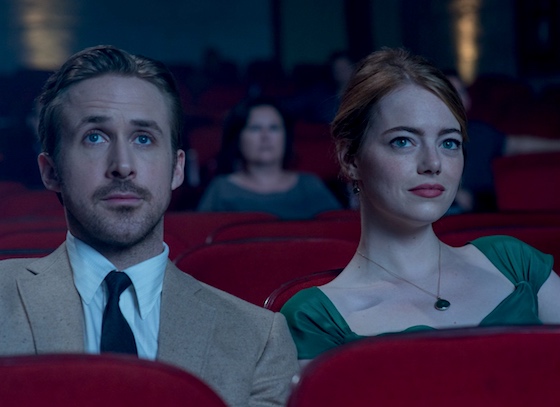
    For anyone who’s even later to it than me, it’s the story of aspiring actress Mia (Emma Stone) and aspiring jazz musician Sebastian (Ryan Gosling), who encounter each other randomly, initially hate each other, but fall in love. Don’t worry, I haven’t spoilt the ending — there’s more story beyond that typical romance plotline. And much of it is told through the mediums of song and dance.

    Watching the best picture...

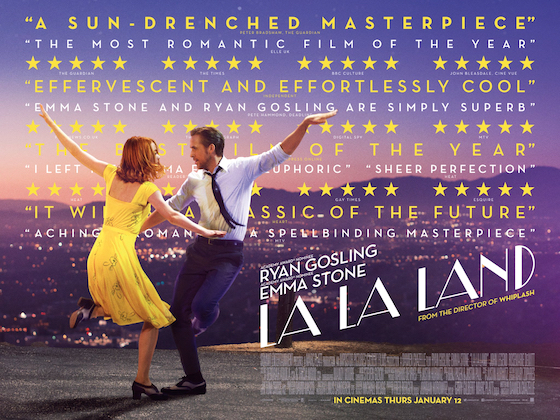
    La La Land isn’t “kind of a musical”, or “I suppose you could call it a musical”, or “a film with songs, a bit like a musical” — it is a Musical. And while the leads can’t really sing, that doesn’t stop there being some beltingly good numbers in it — though, for my money, the best either (a) don’t involve the leads at all, or (b) don’t involve singing. Coincidentally, two of those are the set pieces that bookend the film. The opener is a colourful stunner, a bright and breezy singalongathon on a gridlocked freeway, made even more enjoyable by being realised in a (faked) single-take. Related thought: I feel like we need to bring back done-for-real oners — people are faking them too easily and too often nowadays. Though, saying that, another particularly joyful sequence is the dance routine that adorns the poster. Its success lies in part with Gosling and Stone’s well-performed moves, but also, like the opening number, with how well shot it is. I assumed it was done on a set with some CGI’d backgrounds and probably some invisible cuts, but no, it was achieved on location, the shoot squeezed into the real ‘magic hour’ — actually a half-hour window — and is, I believe, a genuine single take.

    Now, the other bookend is (obviously) the ending. Well, I think they actually label it an epilogue, because its events occur after the main story; but an epilogue is an addendum, isn’t it?, and I reckon this final sequence is as vital as any other part of the film. It’s how the story really ends, and it’s an all-timer of a finale. That comes both from the tone it takes (no spoilers here, but see my Letterboxd comment) but also the sequence itself, a stunning marriage of visuals, soundtrack, and meaning — and I say this as someone who (for a pertinent example) disliked An American in Paris specifically because of its extended ballet bit at the end. Damien Chazelle well earned his Best Director Oscar.

    Finale

    Speaking of which, I must mention what went down at the Oscars. Well, not so much the snafu itself (though that made for great telly), but the ultimate result. I think there can be little doubt that Moonlight is a more significant film for our times, for all kinds of reasons, and it’s certainly a quality work of filmmaking in its own right, but La La Land is a more purely enjoyable cinematic experience, with just enough grit in the mix to stop it being too sappy. I don’t resent Moonlight its victory, but I’d’ve voted for this.

    5 out of 5

    The 2018 Academy Awards are handed out tonight from 1am GMT.

    La La Land placed 4th on my list of The 26 Best Films I Saw For the First Time in 2018.