
David Robert Mitchell | 100 mins | Blu-ray | 2.35:1 | USA / English | 15 / R
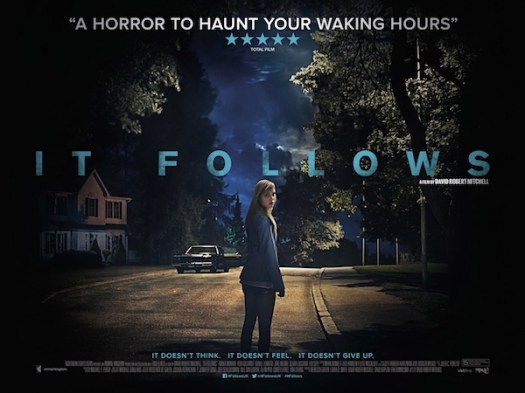
It’s always fun when you come across a divisive movie — “which camp are you in?” It Follows is one of those (naturally — I wouldn’t’ve mentioned it otherwise). Some say it’s an instant horror classic, others that it’s slow, boring, unscary, and can’t even follow its own rules. I’m not qualified enough as a horror viewer to claim the former, but nor do I hold with the latter.
If you’ve not already seen it, it’s based around an original horror concept — that, at least, has been near-enough universally praised. After teenager Jay (The Guest’s Maika Monroe) sleeps with her new boyfriend, he reveals that he’s passed a curse to her. She will be followed by something. It always takes human form, but that form changes — it could be a face in the crowd, someone she knows, whatever it needs to get close to her. Only people who have (or have had) the curse can see it. If it catches her, it will kill her, and then return to hunting the previous target (i.e. the boyfriend). The only way to get rid of it is to sleep with someone else and pass it on — though, of course, if they get killed then it’s back to you. The one advantage you have is that it only walks, and slowly — but it never, ever stops. Naturally, Jay doesn’t quite believe it… until things start happening to change her mind, and along with her friends she tries to find a way to shake the curse permanently.
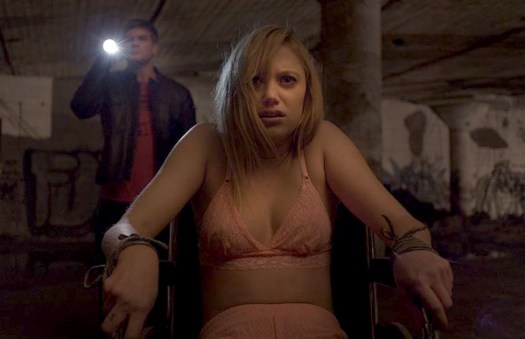
A deadly force that moves towards you slowly but unceasingly and unstoppably — sounds like the stuff of nightmares. And it literally is, having been inspired by a series of nightmares writer-director David Robert Mitchell had as a child. He has not made those childhood fears into a childish movie, however. Far from it. Even leaving aside a couple of splashes of gore, the creature’s frequently nude form, and all the sex stuff, It Follows is adult in its filmmaking attitude. Much like the creature, it often moves slowly, letting its story and situations breathe. This is not a multiplex movie; not a teen-friendly horror flick for date night. It feels more like an indie drama, with Mitchell creating a slow, methodical pace, which doesn’t linger on things — he trusts we’ll spot them. It’s subtle filmmaking, respectful of the audience and our ability to work stuff out. There’s the subject matter, too, about disaffected youth killing time… until they start being stalked by a murderous force, anyway.
One thing I’d say it excels at is creating that ambiance of teenage life. That sense of endless time to do nothing, to be bored — who gets bored once they’re a grown-up and there’s not enough time to do everything you want to do, never mind have time to kill doing nothing? There are parents, but they’re barely present — they exist, but they also aren’t part of your life. They never really tell Jay’s mother what’s going on, nor get the police involved, beyond an initial, fruitless investigation into the boyfriend. Well, why would they? Like being a teen, adults have no real power in your world (i.e. your friendship circle); you can’t talk about all your ‘problems’ with them. Some of this is literally applicable to the film (seriously, are the police going to believe a teenage girl who says she’s being stalked by an invisible killer?), but it’s also part of the film’s broader metaphor.
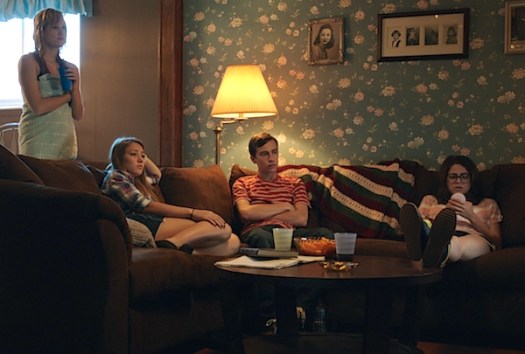
They’re also a decent evocation of normal teens, not the Cool Kids you usually see in movies and TV — they don’t talk in pop culture references or be all hip and aware, like the cast of Sceam or Buffy or something. They’re more normal… apart from the fact they’re always watching black-and-white B-movies, anyway. They’re fumbling their way through life, and the situation they’re in forces them to wake up a little — and they fumble their way through that, too. Again, more metaphors for the real experience of adolescence.
Of course, if you don’t want that kind of stuff from your Horror movie, then I guess It Follows would seem slow and disinterested. So what of the scary stuff? As with pretty much all horror movies, your mileage will vary — perusing various reviews and comment threads shows no consistency in that regard. Personally, I found it more than sufficiently creepy. The whole effect is built on being very atmospheric rather than simplistically Scary. It’s not without its jump scares or freaky moments, but it’s the building sense of dread and tension where it most chills; that has you looking in the back of every frame for what’s coming; longing for a reverse shot, because what if it’s coming from the other direction? There are some very edge-of-your-seat sequences where Mitchell establishes there is something there, that something is coming, but then the camera pans slowly around, or it cuts away, and keeps cutting to other stuff, and you’re begging for it to cut back to the original shot, or for the pan to speed up, so that you can see how things are going, how close it’s getting, to LET US KEEP A BLOODY EYE ON IT.
Ahem.
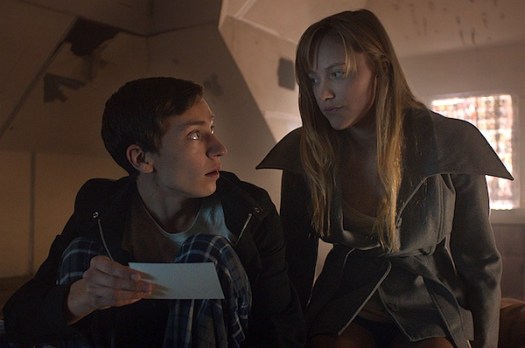
Also from reading others’ comments, it strikes me that the people who are most let down by the film are the ones who are either: a) looking for it to establish and follow a set of rules, or b) reading it as a great big sex metaphor. While it undoubtedly has rules (as a horror movie with a supernatural foe, it requires them) and obviously there’s a sex-related reading (the curse is passed on through sex — how can there not be?), I’m not sure either of these are the film’s main concern; at least, not in the way you’d expect them to be.
People as high and mighty as Quentin Tarantino have criticised the film for its faulty internal logic, for not following its own rules, but I don’t agree. For starters, some of the faults QT calls out are actually explained in the film itself. For seconds, the rules are never established with perfect clarity. We’re given some rules up front, but they come from a scared teenage boy whose only source for this information is his own experience. This isn’t some sage old wise-man or some ancient textbook, this is just some kid who’s been lucky enough to survive a while — who’s to say his observations are 100% accurate? Personally, I don’t think they are. Some people defend the film by saying there are no rules, that it’s operating under dream logic, and that’s fine because the point is to be scary, but I don’t agree with that either. I think the behaviour of “it” does bend the rules we’ve been told, but that’s because the rules we’ve been told are incomplete. I believe it is operating under a set of specific rules, which Mitchell knows but hasn’t fully shared with us. And further, I think that’s not only OK, but actively a good thing. Rules create a safety net — you know what it can and can’t do, and you can work out what to do to defeat it, and, by extension, a way for the characters to win. But if you can’t be certain what it’s going to do next, that’s scarier — and this is a horror movie, not an instruction manual.

As to the sex stuff, the obvious reading is the good old horror movie cliche of “having sex = getting killed”; or, more specifically, “losing virginity = getting killed”. Except that’s not the case at all. There’s a throwaway reference to the fact Jay isn’t a virgin, never mind the lack of general “it’s my first time” handwringing you’d realistically expect if she were, so if it’s a punishment for sex then it’s a bit late coming. Even more omnipresently, the way to beat the curse (albeit temporarily) is to sleep with more people. If the message was intended to be “sex is bad, mmkay kids” then it’d’ve royally fucked that up.
There’s an awful lot of theories that can be crafted out of It Follows — about what it’s saying about sex, about teenage life, about growing up, about the inevitability of death. I don’t think it’s the kind of horror movie that’s designed to scare you for 90 minutes in a darkened cinema in a comforting fashion (there are no pauses or fake-out scares to elicit reassuring laughter). It’s designed to chill you on a more fundamental level, and perhaps to say something about something too — though what those somethings are, well, we can debate that.
I also think its shortage of hard-and-fast rules should not invite derision, but rather our own theories. Like, what’s going on with water — does it really have an aversion to it? If so, why? Can it stop it? Spoilers: apparently not. More spoilers (just skip to the next paragraph if you’ve not seen it): does it require a chance to manifest as one of your parents before it can kill you? We don’t see how it appears to the girl at the start, though note she’s on the phone apologising to her father just before it does. Jay’s friend who dies identifies it as his mom just before we see it fuck him to death. When it finally catches up with Jay in the pool, it’s her dad. Conversely, when it attacks her on the beach earlier it starts by just grabbing her hair — why not get her then?
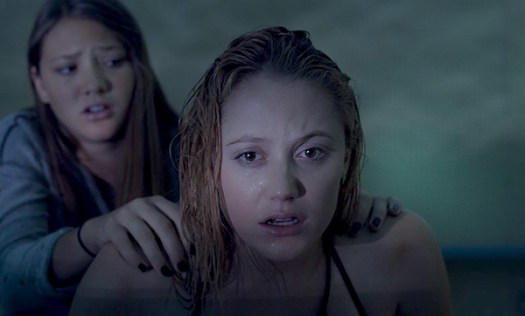
And I haven’t even mentioned the awesome synth score by Disasterpiece, or the era-unspecific production design. Maybe that doesn’t signify anything beyond an aesthetic throwback (the score is very Halloween; there’s some modern tech but they’re not all on their mobiles).
As I said at the start, my experience with the horror genre is too slight to ever go labelling something a genre classic. But this isn’t ‘just’ a horror movie. Like the same year’s The Babadook, there are dramatic elements that stretch out beyond the genre’s usual stomping ground, not to mention an atmosphere of terror that exceeds simplistic attempts to make you jump in your seat every few minutes and call it a day. It’s the kind of film that lingers after the credits roll, as you ponder the gaps it leaves you to ponder, and keep looking over your shoulder, because you never know when something might be following you…

The UK network premiere of It Follows is on Film4 tonight at 9pm.
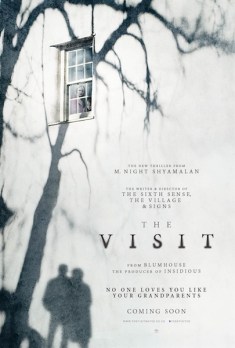 After a sidestep into big-budget director-for-hire movies that brought him even less acclaim than his last couple of self-penned efforts, once-fêted director M. Night Shyamalan goes back to basics with this low-key found-footage horror.
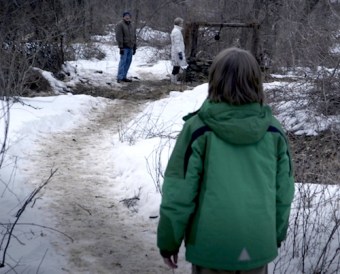 Of course, there’s a big reveal to explain everything that’s been going. People call it a “twist” because it’s a Shyamalan movie, but it’s more of an explanation. I mean, what was going on had to be explained somehow, and the explanation comes at the point where you’d expect the explanation to be. I’m not saying it’s not a twist, because it does change what you think you’ve been seeing, but it’s also not a be-all-and-end-all kind of failed-rug-pull, which Shyamalan’s worst twist-obsessed efforts have been. This one works. Or, it did for me.

 Score:



 One of a couple of films John Carpenter directed “for hire” in an attempt to restore his Hollywood reputation after the box office failure of
  Even if Carpenter was doing it only for kudos with the studios, he still turned in solid work. Christine may not be scary, but she is menacing, and her attacks work as individual sequences. Unsurprisingly it’s not his strongest film, and it’s not the greatest adaptation in the Stephen King movie canon either, but if all movies by jobbing filmmakers were this good then we’d be luckier moviegoers.
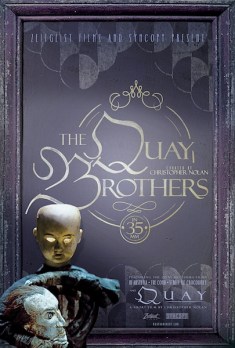 Christopher Nolan made a few headlines last year when his first post-
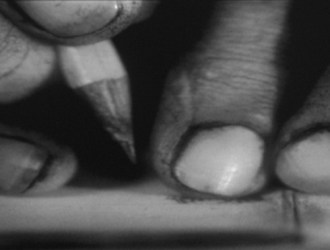 For all that In Absentia initially feels like flailing in deep water without armbands, accompanied with “what have I got myself into?!” thoughts, in retrospect I found it to be the most accessible of the three animations. It’s abstract and confusing for most of its running time, but by the end you can decipher some meaning; you can understand the relevance of the feelings it aims to generate — and if you haven’t got there yourself, or if you’re unsure, there’s a dedication to point you in the right direction. I didn’t get that with the next two; not so easily, anyway, which is why I say they’re less accessible rather than less good per se.
 Michael Brooke notes that it is “setting out to wrong-foot the viewer at every turn, and the result wilfully defies verbal analysis.” What can be easily discerned is that it’s about a dream, and it probably shouldn’t be a surprise that there’s some dream-logic involved. As to what else is to be gleaned, your guess is as good as mine.
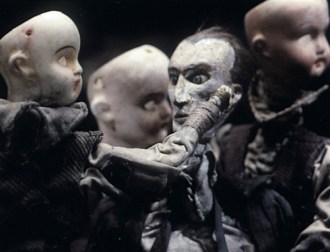 sometimes informative about the world the rest of us live in (In Absentia), sometimes a twisted analogy for it (Street of Crocodiles), and sometimes just fascinatingly unknowable (The Comb). All the films are teasingly oblique, and by all rights that should make them frustrating to the point of irritation, even abandonment… yet they’re kind of compelling nonetheless.
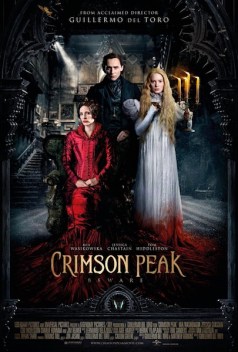 Mia Wasikowska stars opposite a British thesp best known for playing a comic book villain and a red-headed repeat-Oscar-nominee, in a Gothic drama-thriller from an acclaimed non-Anglo director? That’s a description of
 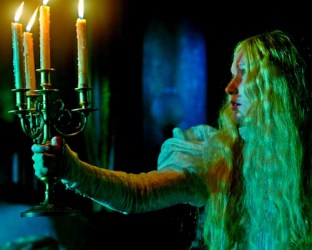 The story actually concerns Edith Cushing (Wasikowska), a well-to-do businessman’s daughter in upstate New York who is occasionally haunted by ghosts. She falls for visiting English gent Sir Thomas Sharpe (Hiddleston) and, long story short, moves with him and his haughty sister Lucille (Chastain) back to their crumbling — literally — pile in the English countryside. The house hides many secrets, and ghosts, too. Having said it’s not a horror movie, it would be unfair to class Crimson Peak as simply a tame drama — as you’d expect from writer-director Guillermo del Toro, those ghosts can be bleedin’ scary, and there are certainly a smattering of good old fashioned jumps to boot.
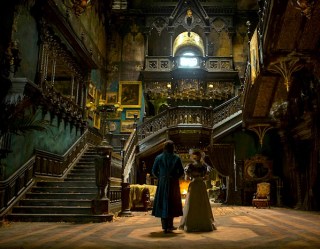 Whatever one’s thoughts on the story and tone of the film, it can’t be denied that its technical merits are extraordinary. Every inch of the design work is gloriously imagined, and the cinematography — the lighting in particular — is spectacular. And that gigantic house set…! And the climactic ‘limbo’ set, too — incredible work. (That’s not a spoiler, incidentally: it was the set’s nickname, not its literal location.) The ghost effects are excellent too — original, creepy, and executed in a way that blurs the lines between make-up, animatronics, and CGI. It’s a shame the film as a whole wasn’t better received, because I imagine that’s all that held it back from numerous awards-season nods.
 There are a good number of well-regarded John Carpenter films I’ve not seen that I could spend my time on, but I chose to expend it on this critically-mauled sci-fi-horror-Western from the first year of the current millennium. But sometimes watching poorly-regarded films pays off, because while Ghosts of Mars is no classic, it is actually pretty entertaining.
 If people thought this had been made in the ’80s, would they view it as kindly as they do some ’80s genre-classics that are just as bad and/or dated?
 The first US feature from the director of
  I appear to be coming at director Ben Wheatley’s films in reverse order (having covered
 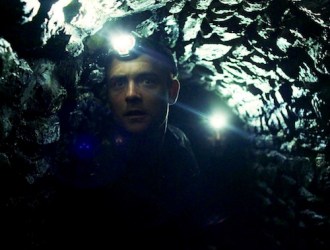 Kill List mixes in its genre elements — and they’re elements from a couple of different genres at that — so gradually that, as I said, it’s hard to discuss them without spoiling the film. (Much like the film itself, this review is getting progressively more revealing, so jump off when you’ve had enough.) It’s kind of a compilation of traditional British movie genres: we begin with kitchen sink, then discover we’re actually watching a crime film, before the final act swerves (though not without foreshadowing) into folk horror. The skill of Wheatley, and his co-writer Amy Jump, is in not making these transitions too implausible. That’s not to say they’re not surprising, but the doom-laden music, inexplicable proclamations by some characters, and a couple of very strange events should all clue the viewer in to the film not being a common-or-garden hitman flick.
 The final act is naturally where the film reveals its overarching purpose… or rather doesn’t reveal, because there are a shortage of answers here. It’s a lot more straightforward than A Field in England, but it still offers few (or, some would say, no) explanations for what’s occurred. According to Wheatley, the screenplay was more explicit about what was happening and why, and so was some of what they shot, but he cut back on the exposition to leave it up to audience interpretation. This isn’t a film to passively watch and have everything explained, but even viewers prepared to do a little work for themselves may find it frustrating.
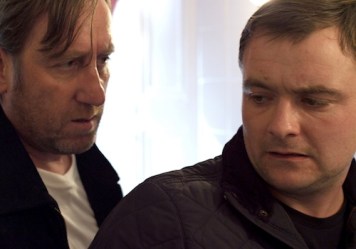 Memorable sequences keep it ticking over throughout — and so they should: taking inspiration from the likes of Kubrick and Stephen King, Wheatley started from specific images and worked backwards to a plot. Here, I think that method has been effective. The abstruse ending won’t be to everyone’s taste, but the journey there is worth experiencing.
 Most of mankind have become vampires, but the blood supply is running out and without it people mutate into monsters. Ethan Hawke’s scientist is developing a substitute, but when he encounters human resistance fighters he learns there may actually be a cure…
 100Films.co.uk