
David Fincher | 145 mins | Blu-ray | 15 / R
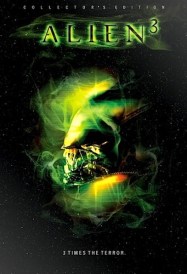 It’s getting on for two years since I last (and first) watched most of the Alien
 Quadrilogy series, provoking some relatively lengthy (for this blog, anyway) debate on my reviews of the three sequels. I refer you to those at the outset for a couple of reasons. One, because a lot of my review of Alien³’s theatrical cut still holds true for this half-hour-longer version; two, because other points in that review may make an interesting counterpoint to the more positive thoughts I now have (“may”); and three, because some of the comments on the reviews also discuss this extended cut, which may also interest you.
They’re also relevant to highlight this point: it’s been two years since I watched Alien³ and I’ve only seen it once. Despite this extended version being 26% longer, that means I still found it hard to spot much of the additional material. I’m sure fans who’d seen the original multiple times in the decade between its theatrical release and this cut appearing in 2003 were able to spot changes much more readily. Nonetheless, a few obvious additions and modifications stand out: an extended opening when Clemens discovers Ripley on the beach; the Alien birthing from an ox (rather than a dog); the lack of a Queen chestburster at the very end. I could’ve turned on the Blu-ray’s “deleted scenes” marker of course, and I did consider that, but I thought it might just get distracting on a first viewing. And speaking technically, I don’t know what the new scenes looked like on the Quadrilogy DVD (as I haven’t watched that copy, obviously), but on Blu-ray the added footage, 2003-era new effects and 2010 re-recorded audio are indistinguishable from the rest of the film.
Readers interested in the history and reasoning of this new, significantly longer cut may appreciate the introduction it had in the Quadrilogy set’s booklet (sadly nowhere to be found on the Anthology Blu-ray). I’ve reproduced the majority of it below:
Following its troubled production and controversial release, Alien 3 slowly became something of a curiosity among serious enthusiasts of the Alien series. Not only would its first-time director, David Fincher, go on to become one of Hollywood’s most sought-after filmmakers but the film itself would generate quite a mystique thanks to heated rumours of creative interference, lost scenes and even a completely different cut of the film that supposedly restored Fincher’s original vision of what many believed to be a seriously compromised work.
Rumour control, here are the facts. There is no wondrous lost “director’s cut” of Alien 3. It doesn’t exist. Indeed, for such a dream to be realised, Fincher would have to be allowed to remake the film from scratch with complete creative control. What does exist is something perhaps equally fascinating.
For the first time, fans can now experience a restored and re-mastered presentation of the 1991 assembly cut of Alien 3. With a running time increased by more than 30 minutes, this Special Edition contains several never-before-seen sequences that offer a fascinating insight into the film’s difficult editing process. This cut also reveals a combination of vintage, previously unreleased optical effects shot and several newly-composited digital effects necessary to seamlessly integrate new footage into the body of the film…
The Alien 3 Special Edition offers fans a unique chance to witness the lost work of a remarkable director.
So there you go. As I mentioned, this version updates the 2003 one with some re-recorded dialogue.
On my original review, Matthew McKinnon commented that as he watched this new cut he realised “it wasn’t shaping up into a more coherent or purposeful movie… just a longer version with more of the same.” I agree that, to an extent, it’s “a longer version with more of the same”, but I found it more coherent too. While the major plot beats still occur at the same time and in fundamentally the same way, perhaps the myriad tweaks have made it clearer just what’s going on? Or perhaps I was just more familiar, having seen it once already? Either way, sequences and events that left me a bit lost last time seem to make perfect sense on this outing.
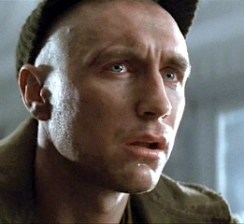 One of the biggest things I remember being told about Alien³, before the Special Edition, was that most of Paul McGann’s performance had been cut; that originally he had a sizeable role that justified his fourth billing, rather than his cameo-sized part in the theatrical cut. It doesn’t feel like there’s an awful lot more of him in this version, though scanning through Movie-Censorship.com’s thorough list of changes one can see a lot of brief shots as well as one or two significant scenes featuring him. Again, despite the sense that little has changed, his character does feel more comprehensible, so maybe these barely-noticeable additions do make all the difference?
As a little aside, I sometimes feel a little sorry for McGann — since his acclaim in The Monocled Mutineer, numerous shots at bigger success seem to have passed him by. He gets a key role in a Hollywood blockbuster, but is then largely cut out; he’s cast as Richard Sharpe in a major ITV series, but is injured and has to pull out (and we can see where that led career-wise for Sean Bean); he’s cast as the Doctor in a big-budget American backdoor pilot for Doctor Who, which flops Stateside and goes nowhere… He’s undoubtedly talented, but these days seemingly forced into lacklustre supporting roles in the likes of Luther. Maybe he doesn’t mind, I don’t know (at least he got “the largest insurance settlement in British television history” for missing out on Sharpe), but it seems like he deserved greater success. Poor guy.
Still, McGann’s performance here is exceptional, even if it’s still brief. He’s just one member of an outstanding British cast though, many of whom are recognisable for the excellent work they’ve done since.  Unsurprisingly, therefore, they’re almost all totally underused. Charles Dance gets the biggest slice of the cake and is as good as ever, but doing little more than show their face we have Pete Postlethwaite, Phil Davis, Peter Guinness, Danny Webb (they don’t all begin with P…) Alien³ is 19 years old now, no one could’ve predicted the future; but viewed with hindsight, the volume of under-utilised talent is almost astounding.
Hindsight also affords other interesting perspectives. Dance’s death is still very effective, for instance. It’s not surprising once you’ve seen the film more than once — obviously — but killing off really the only character our hero (and, by extension, the audience) has become sympathetic to at around the halfway mark? Not unheard of, true (see: Psycho), but still rare enough to be a shock, to disconcert and wrong-foot the viewer.
Plus, we can now look at it in the context of Fincher’s following work. Even though he had limited — often, no — control over much of the project, there are still signs that link it with his later films. It’s stylishly shot for one thing, most of the locations either soaked in shadow or cold light, with an often fluid camera. Darkness litters the film thematically too: setting it on a prison colony for murderers and rapists, the violent attempted gang rape of Ripley, the death and autopsy of a 10-year-old girl… Even if we see no real detail on screen (thank goodness this wasn’t made in recent torture porn-obsessed years), the implication and the emotional connection is harrowing enough. Then there’s the Alien itself, from its ugly birth to its violent murders. Fincher may have not turned so explicitly to horror since, but that brand of darkness does flow on into most of his best films: Se7en, Fight Club, Zodiac.
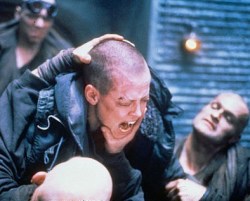 It’s also, perhaps, interesting to remember this being Fincher’s first film. He might seem like an odd choice, a first-timer paling beside the experienced hands of Scott and Cameron. But that would be to forget that, for both, their Alien films were only their second time helming a feature*; and while Cameron’s previous had been sci-fi (The Terminator), Scott’s was period drama The Duellists. A first-timer — especially one versed in commercials and music videos — isn’t all that different, really, and Fincher has certainly gone on to show his worth. Indeed, his very next film was the incredible Se7en.
Alien³’s Special Edition didn’t strike me as massively different from the theatrical cut, despite some obvious changes, with the exception that I now found it to be more intelligible. Whereas before I thought it started well and became less coherent — and, consequently, less good — as it went on, with this version I felt I was following the story and characters throughout. As a result, I enjoyed it more. Perhaps it also benefitted from my viewing situation: the first time I watched it within days of both Alien and Aliens; this time, I chose to watch it in isolation. Whatever the reasons, this Special Edition earns Alien³ an extra star from me.

* Cameron’s name is on Piranha II, and it is a fun joke to think such dross was his directorial debut, but his version (at least) of the behind-the-scenes story suggests it should in honesty be ignored. If you prefer, imagine I said Aliens was only his second major feature.
I watched the Alien³: Special Edition as part of a David Fincher Week. Read my thoughts on all his films to date here.
 OK, it’s far from flawless. It’s still tangled up in the over-complex ongoing story, and peppered with flashbacks, varying from flash frames to large chunks, to try to help you follow it. On the one hand that’s lazy storytelling; on the other, much welcomed — the plot would surely be impossible to navigate without it.
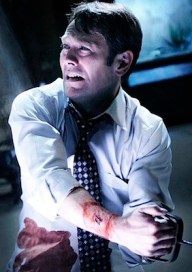 Following it, there’s a nicely edited closing montage. Not particularly relevant — in other entries it’s used to expose the twist, here the twist is pretty self explanatory — but it’s oddly, briefly, rewarding for those of us who’ve sat through all the films so far (and, to be frank, if you haven’t sat through the others, you’d be mad to jump on at this point). Plus there’s an intriguing post-credits scene. No idea what it means or signifies, but it’s clearly laying the groundwork for something in the future.
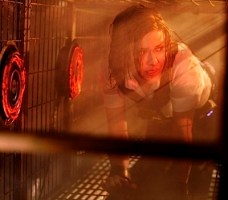 Note: this is an Extended or Extreme or Whatever Edition again. Minor differences only, I believe, which you can find listed
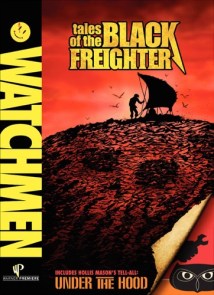 In the world of
  which could well have gone down a more modern-styled route.
 It’ll be interesting to see how it fits into the film when I finally get round to watching The Ultimate Cut — I already have some reservations waiting to be expressed in my review.
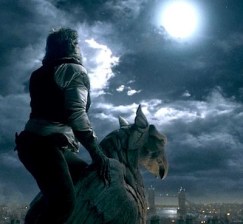
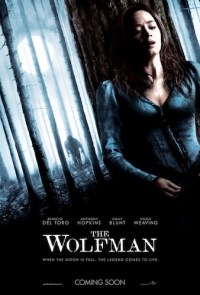 The “extended director’s cut” (as the Blu-ray blurb describes it) of The Wolfman begins with a new CG’d version of Universal’s classic ’30s/’40s logo, the one that I’m sure opened many/most/all of their beloved classic horror movies. As well as being a self consciously cool opening shot, it’s a succinct way for director Joe Johnston to signal his intentions: this is not your modern whizzbang horror movie, but something more classically inspired.
 — perhaps even the totality — or plot developments and, particularly, twists are guessable far in advance. Trying to lose 16 minutes for the theatrical cut was probably a good idea, though some of my favourite moments lie amongst what was excised.
 feels like something I saw in some 12A blockbuster in the last half decade.
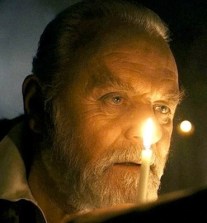 Max Von Sydow’s cameo-sized role (only found in the extended cut) is possibly the film’s best bit. Aside from the fact he’s usually good value, the relevance of the scene itself is unclear. That might sound like a problem, but I choose to see it as making the sequence — and the character — rather intriguing. The rest of the supporting cast are largely British faces recognisable from TV and similarly-sized film roles, playing the parts you’d expect them to and existing primarily as monster ready-meals. Equally, Danny Elfman’s score is disappointingly generic and clichéd, particularly so whenever the film is being the same.
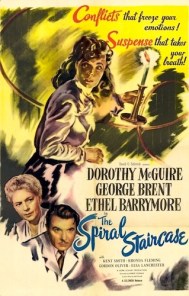 A serial murderer is on the loose in 1900s New England, or 1910s Massachusetts (pick which website you want to believe). His victims are all disabled women, so at the wealthy Warren residence, both family and staff worry for mute maid Helen — particularly as it seems the murderer may be among them…
 Some viewers allege that it’s at this point the story falls apart; that there’s only one possible suspect. I disagree. Though I can’t say the film entirely had me fooled, there are several suspicious characters, particularly if you’re prepared to consider extraordinary leaps of probability — and in genres like gothic horror, film noir and whodunnit, you should be. Indeed, while some see the killer as obvious others may consider them unlikely; but, for the attentive, the groundwork for the motivation is laid throughout.
 A mention for the sound design, too. Even during simple dialogue scenes, where one might expect silence but for the words in a film of this era, rain lashes against the window in the background, the heavy weather a ceaseless reminder of the threat lurking close at hand. It is, to use a cliché, a character in itself. Thanks to the enclosed setting, we spend a fair amount of time with these characters, and there are good performances too, but that’s for another reviewer to discuss — try
 Notorious for having numerous cuts forced upon it by censors, over 40 years after its initial release Witchfinder General — now uncut — seems almost tame. But gore and sadistic violence certainly aren’t the main attractions — there’s a lot more to the film than that.
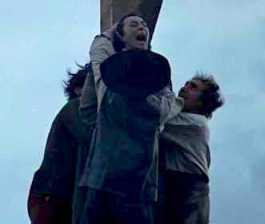 shot against Reeves’ wishes, featuring needlessly topless wenches. This is the cut shown by the BBC.)
 Witchfinder General is more action-adventure than horror.
 Best of all is the witchfinder himself, excellently portrayed by horror stalwart Vincent Price. Indeed, all the credit may lay with him, because it’s his line deliveries and uncertain looks that make the character conflicted early on, a man who may believe he is genuinely doing good for Christian values, but is seduced down darker paths by money, power, lust, and the prospect of revenge. When he allows himself to be lured to Sara’s bedroom as payment for leniency on her uncle, we’re uncertain if he’ll take what’s intended or use her loose ways as proof of witchery. That it’s the former quickly indicates how seriously he takes his espoused Christianity.
 to near-silhouette levels of blackness. It’s even less convincing than that fake blood. I enjoyed the score too. A completely new one was written for the US release, but I presume this was the original because it was slightly calmer and more haunting than one might expect from an action-adventure-horror movie (which I presume was the reasoning for the replacement).
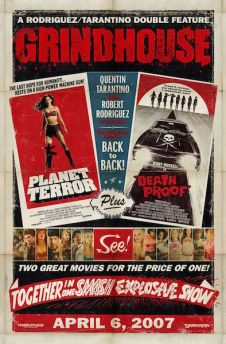 Infamously, on its release in America the much-hyped Rodriguez/Tarantino double bill was an almighty flop, so much so that it wasn’t properly released in its full form outside the US. Which is a bit ironic, if you think about it, because the US is the market least likely to respond to something a little bit experimental.
 Chances are, if you don’t find this opening salvo entertaining in some way the rest of the film is going to prove a struggle.
 It probably works better in context than described on the page, but Rodriguez has marshalled every disparate element to create a cohesive whole that’s exciting and funny. At this point, Grindhouse is firmly headed for a full five-star conceptual success.
 though Roth can’t resist adding his own especially twisted brand of humour (I shan’t describe the final shot here).
 But it’s not just the increasing lack of dilapidated print quality that prevents Death Proof from selling its concept. The screenplay is clearly a QT work, much more so than most of
  and if he chooses to create some more action-centric pictures in the future it would be no bad thing.
 In fact, it might’ve played better if the films were the other way round, as it means Death Proof must be set before Planet Terror. I’d approve of this switch not only for chronological reasons, but because seeing one-scene bit-parters turn up in the-same-but-larger roles in the second film seems like it would be more satisfying as a viewer, rather than re-encountering these (in any case, minor) characters the way we do.
 But Tarantino’s entry lets the side down by seeming to fail in its execution of the film’s conceit. I’m not convinced it would be any better viewed as a standalone Quentin Tarantino Film, but in context it certainly disappoints.
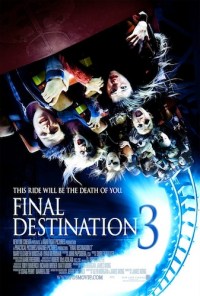 Never mind Death, it’s another force entirely that the makers of Final Destination need to worry about. The law of diminishing returns, to be precise, and it strikes the series hard in its third instalment.
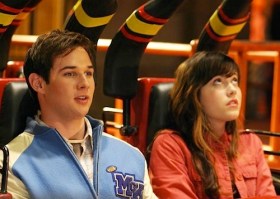 with the ludicrously OTT setups that led to their death. It made it funny.
 Mary Elisabeth Winstead, soon to be seen as the ultimate object of geeky desire in
 Plus, having set up the whole photos-predict-deaths thing, it’s barely used. Most of the pictures are kept out of sight for as long as possible, and only a couple offer reasonably discernible clues to the character’s fate. The others are either blatant — such as the one where a gun’s being pointed at her head (it’s actually a nail gun that does her in, but that hardly qualifies as a twist) — or too meaningless — being half-blinded by a camera flash apparently equates to a firework hitting you in the face, or something.
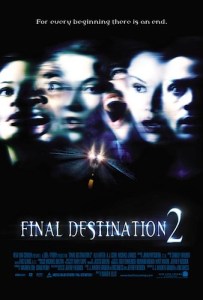 Final Destination 2 is daft. The concept’s daft, the new additions are daft, the characters are daft, and most of all the deaths are daft. And that’s why it’s an awful lot of fun.
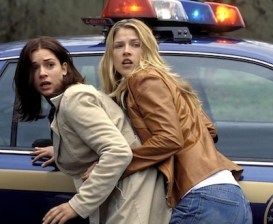 half the fun for the viewer lies in guessing what’s about to happen, and so scatter clues and hints to give us a fighting chance… something they don’t afford many of the characters, of course.
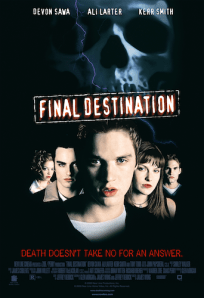 Final Destination is a full decade old this year, which somehow seems too long — it can’t be so old, surely? On the other hand, it fits quite comfortably into that run of teen-centric horror films from the the mid- to late-’90s, like
 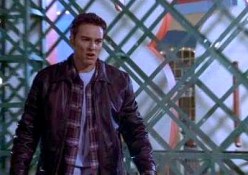 The most important part, all things considered, are the ways Death settles the score. No mysterious “natural causes” demises here — Final Destination is all about inventive executions. Even after a decade, in which some of the Great Big Shocks have been revealed in various Top 10s and “OMG do you remember the bit where…” conversations, some bits remain impressive and/or amusing. And it certainly has fun with a few of them, teasing the viewer with various means of dispatching the victim before they ultimately succumb to one. Or, alternatively, just surprising us with a sudden whack. Both are good. Only one bit — a fidgety-armed corpse — is a thoroughly gratuitous jump-scare.
 but that one solitary shot confirms it must be some kind of entity with a very specific motive. And that’s a shame, because it’s not developed further — i.e. no Big Reveal of the nasty Death-thing — and would’ve been more interesting to play with that ambiguity — is Alex right that it’s all planned, or is it just a series of nasty coincidences?
 100Films.co.uk