
Boris Ingster | 64 mins | TV
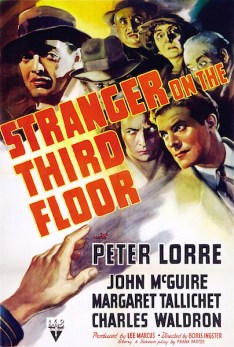 Despite being “released the same month as Raoul Walsh’s They Drive By Night, and four months after Alfred Hitchcock’s Gothic Noir Rebecca,” says Paul Duncan in The Pocket Essential Film Noir, “this is often listed as the first Film Noir”. Not often enough to earn the treatment you’d expect such an accolade to afford, it would seem, as I hear it’s rarely screened and only available on DVD in Spain. That’s a shame, because it’s an entertaining — if brief — example of the genre.
The story is a morality tale of sorts. A journalist is the key witness to convict a man of murder, albeit on fairly circumstantial evidence; the journalist’s fiancee disagrees with what he did, though he tries to persuade her round to his way of thinking; but then the journalist finds himself in virtually the same situation, and it’s up to the fiancee to prove his innocence. And that’s most of the plot I’m afraid, though to be frank it’s fairly ancillary anyway.
The screenplay is a little slight and stretches its credibility — would a man really be convicted on such circumstantial evidence, for example? It plays structural tricks too: at one point the lead character is arrested off screen and the focus switches to his fiancee for the remainder of the film. Perhaps they didn’t have the money left for a cell set. Such leaps suggest an underdeveloped story, but on the bright side it certainly keeps things moving.
Despite these faults, many individual scenes are rather good. The journalist spends half the film pacing his room, for example, contemplating whether his irritating neighbour is dead or not, but it remains gripping. When he sleeps he has a nightmare, a showcase not only for the expressionist-influenced cinematography, but also the writing: the opening trial scene features a humourously inattentive judge and sleepy jury, but the exact same elements return to haunt our hero when he dreams he’s in the dock.
The climax is virtually the only scene to feature top-billed Peter Lorre to any significant degree, here fulfilling a couple of days left on his RKO contract with a small role. Nonetheless, in this one scene he out-acts the rest of the cast put together, using just a few lines of backstory to really flesh out his underwritten character. The sequence where the fiancee tries to escape him is suitably sinister. Still, the scene is over quickly and without the fullest logic in its execution — much like the film as a whole.
Stranger on the Third Floor is so imbued with the recognisable calling cards of noir in its cinematography, characters and plot points that it feels more like an entry in a well-established genre than a formative inclusion. At only just over an hour it is, on the one hand, too brief to dig into its characters or complicate its story, but on the other, it rattles past quickly enough that the good bits impress, the weak bits are only briefly registered, and it’s over long before anyone might even consider considering it a waste of time.

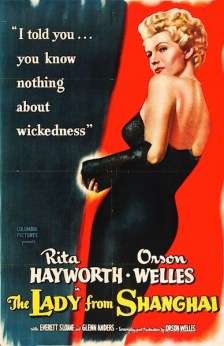 The Lady from Shanghai is an Orson Welles film… which means his original 155-minute cut was forcibly cut down by over an hour, the studio insisted he include more beauty shots of Rita Hayworth, as well as a song for her to sing, and the temp score he provided to the composer was ignored in favour of something Welles hated. Yet for all that — not to mention Welles’ distractingly atrocious Irish accent — it’s still a highly enjoyable film.
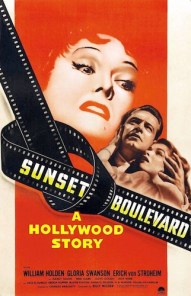 Sunset Blvd. may not be the first movie about the movies, but for the amount of controversy it caused and the impact it’s had it may as well have been. It’s certainly a well respected film — I’m sure I could cite any number of
 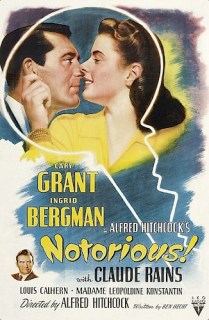 Cary Grant, Ingrid Bergman and Claude Rains star in Alfred Hitchcock’s 7th best film (according to the ever-changing
 Double Indemnity is perhaps the archetypal film noir — unsurprising, really, when you have Raymond Chandler co-adapting a novel by James M. Cain. Present and correct are the femme fatale, dry-witted lead man, voice-over narration, shadowy photography, murder, cover-ups, investigations, twists… The difference to films such as
 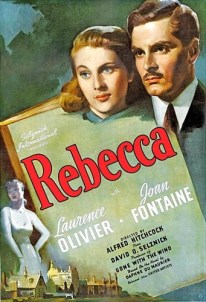 I must confess that I don’t think I’ve come to Rebecca under the best circumstances for judging it as a film in its own right. As with last week’s
 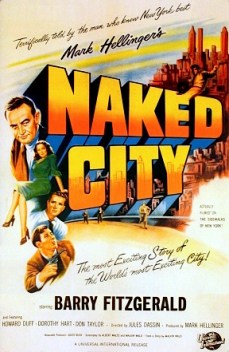 Police procedural film noir, shot entirely on location in New York (unusual at the time).
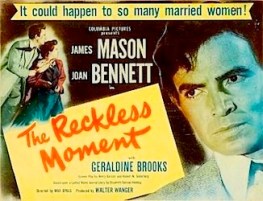 Ophüls’ film noir about a mother who covers up the death of her daughter’s much older boyfriend. I think I’m perhaps erring on the side of generosity with the rating, but it is still quite a good film. Certainly it allowed me to play one of my favourite games: what would I change if I remade it? I had a few quite good ideas, actually. I’m tempted to start writing…
 100Films.co.uk