
Anatole Litvak | 85 mins | TV
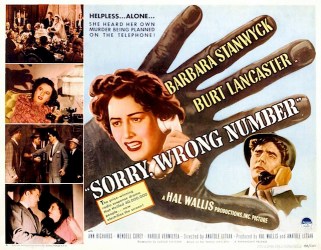 A film noir screenwritten by Lucille Fletcher, “based on her famous radio play” — I love how old movies have credits like that. It sounds like pure hyperbole, but in this case seems to be justified: the original play was broadcast in May 1943 but was so popular they chose to re-stage it with the same lead, Agnes Moorehead, a total of seven times up to 1960. Seven!
It’s easy to see how it would work on radio: the plot is primarily characters talking on the phone, though in this case there are flashbacks and visuals to flesh it out. And there are flashbacks within flashbacks too, just to keep us on our toes. Naturally it’s based around a series of mysteries related to our bed-ridden heroine, who overhears a threat on someone’s life and begins to wonder if it’s actually about her. So we wonder, what is her illness? Is it relevant? Is her paranoia a symptom? All are well played, mixed up with possible reasons and motives for her being murdered, which also shift around neatly.
Barbara Stanwyck portrays a not-very-sympathetic lead character, which makes the viewer question how we feel about her possibly being murdered. We should be against it, but she’s not nice, but she is ill, and her whole life’s falling apart down the phone… 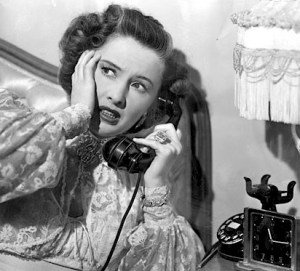 As if keeping us guessing wasn’t enough, our feelings are shifting in this respect too. Arguably it unravels a little late on — when Evans is explaining his part to her, it’s getting a bit implausible — but it’s all redeemed by the finale.
The film concludes with a hair-raising final sequence. I reckon it must be among the most tense, scary and chilling sequences in all of cinema, certainly that I’ve seen. It’s not so much the performances, or the shadow on the wall, or the screeching music — though they all contribute — as the fear of the actual situation: your home, your personal, private, safe space, being invaded, and the first you know of it is an all-too-solid shadow on the wall, coming up the stairs to get you… It’s horridly brilliant.
Most of Sorry, Wrong Number is very good. If that wasn’t enough, the finale cements it as a memorable must-see.

 A World War II espionage thriller about the OSS — spies, basically, and the forerunner to the CIA. Despite all the thrills this should elicit, especially when directed by Fritz Lang, I wasn’t particularly impressed.
 This is probably the benefit of being based on a non-fiction book.
 Fritz Lang is probably best remembered for the films he made in Germany; medium-defining classics like
  but it does manage what might be described as twists in how far it’s willing to go — mainly, who gets killed and how.
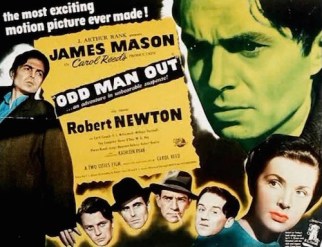 It may be a bit of a cop out to begin a review by pointing you to another, but I must recommend
 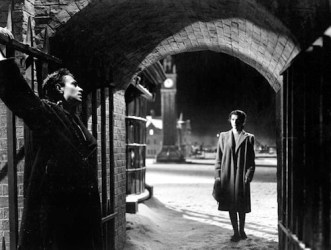 Robert Newton’s Lukey. (You’ll also note Newton’s performance is criticised in Colin’s piece so, in aid of not sounding like I’m too easily influenced, I’d like to point out I didn’t make the connection between his comments and my own notes on Newton until afterwards.) Shell and Lukey have a bit of a point in the end, but I didn’t enjoy getting through them in comparison to the rest of the film.
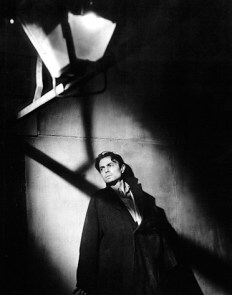 The score, by William Alwyn, is really nice, particularly in certain places — for example when it begins to snow and Johnny wanders the streets, or at its most effective during the haunting climax, as Kathleen hauls a near-dead Johnny through the falling snow towards the safety of the shipyard as the police finally close in.
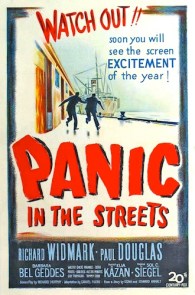 Film noir is a pretty unspecific genre, or unconscious movement, only really defined (however loosely) once it was already over. So to say a film noir isn’t particularly film noir-y might seem a tad daft, but, Panic in the Streets isn’t a particularly film noir-y film noir.
 has a beautifully bad-guy-friendly skull-like face, with his jutting cheek bones and flat-ended nose. (I imagine I’m far from the first to make this observation, but hush.)
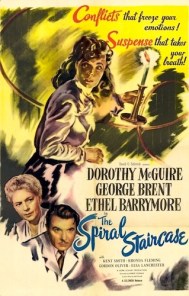 A serial murderer is on the loose in 1900s New England, or 1910s Massachusetts (pick which website you want to believe). His victims are all disabled women, so at the wealthy Warren residence, both family and staff worry for mute maid Helen — particularly as it seems the murderer may be among them…
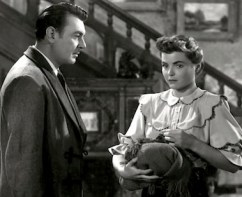 Some viewers allege that it’s at this point the story falls apart; that there’s only one possible suspect. I disagree. Though I can’t say the film entirely had me fooled, there are several suspicious characters, particularly if you’re prepared to consider extraordinary leaps of probability — and in genres like gothic horror, film noir and whodunnit, you should be. Indeed, while some see the killer as obvious others may consider them unlikely; but, for the attentive, the groundwork for the motivation is laid throughout.
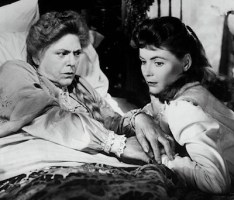 A mention for the sound design, too. Even during simple dialogue scenes, where one might expect silence but for the words in a film of this era, rain lashes against the window in the background, the heavy weather a ceaseless reminder of the threat lurking close at hand. It is, to use a cliché, a character in itself. Thanks to the enclosed setting, we spend a fair amount of time with these characters, and there are good performances too, but that’s for another reviewer to discuss — try
 Force of Evil comes well recommended, with places on several 1,000 Best Movies lists and inclusion both on
  Duncan’s analysis (Force of Evil is one of seven noirs treated to an extended segment in his book) suggests a more complex reading of the film than I took from it, explaining much as symbolic or metaphorical. Considering I didn’t engage with the film, I’m tempted to see Duncan’s reading as a way of rationalising things that either aren’t there or were flawed, but the film’s wider critical acceptance suggests he may well be right.
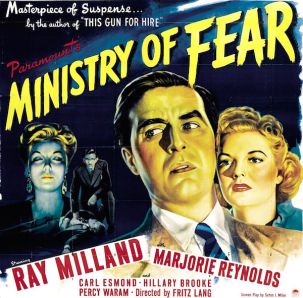 I like cake. It’s all soft and sweet and tasty. But I don’t like cake as much as Stephen Neale, the protagonist of Ministry of Fear.
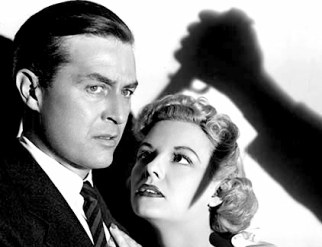 Ministry of Fear isn’t really about cake, but the opening 20 minutes or so plays out more or less as above and it is rather amusing. Less amusing — and, in fact, part of the film’s biggest problem — is a ‘humorous’ epilogue that returns to the cake theme. I found it hilariously funny, but unfortunately for all the wrong reasons. The other part of the problem is the abrupt ending that immediately precedes this brief coda. On the bright side, everything is resolved and you can imagine the post-climax resolution scene for yourself, but it still leaves the tale’s telling cut short.
 The train cake theft and chase, for instance, could be thoroughly laughable thanks to the cake element and what’s clearly a studio-built wood/wasteland, but it’s atmospherically shot and, in its main burst of genius, scored only by the drone of a Nazi air raid taking place overhead. It makes for a more tense and effective soundtrack than most musical scores manage.
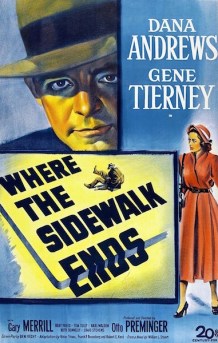 Otto Preminger’s film noir — scripted by Ben Hecht, adapted from William L. Stuart’s novel by Robert E. Kent, Frank P. Rosenberg and Victor Trivas, and quite what the difference between “adapting” and “writing” are I’m not sure — offers complex characters in a multi-layered plot. The ending particularly underlines this: the filmmakers could’ve killed anti-hero Dixon, could’ve had him choose to not open the letter, etc; but the decision he takes and the reactions of others are all relatively complex. Earlier, the sequences following Paine’s death are well constructed to produce the maximum amount of tension; their plotting clever, allowing for multiple (albeit similar) interpretations of events. Things happen which seem irrelevant, but are of course none-more-relevant later. Few films today are so brave as to not explain such things immediately.
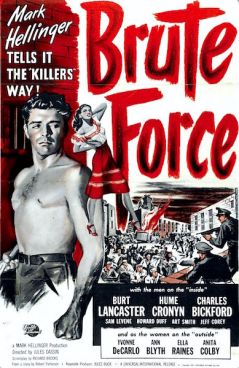 Jules Dassin’s prison-set noir concerns a group of inmates trying to escape from the cruel regime of a vicious warden, allowed free reign by an ineffectual governor and target-driven bureaucrats (nothing changes, eh?)
 100Films.co.uk