
Richard Donner | 121 mins | Blu-ray | 2.35:1 | USA / English | PG / PG-13
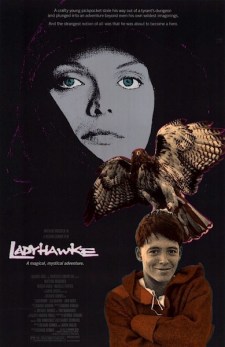 This is one of those films that crops up in the daytime TV schedules now and then and I’d always paid little heed to, because no one else seemed to. Then I read this write-up on Movies Silently and my interest was piqued. (There are many films of interest or recommendation that I haven’t got round to years after hearing of them; other times, I learn of something and watch it more or less instantly. What this says about me I don’t know, but we’ll just have to live with it.)
Ladyhawke is an ’80s medieval fantasy, though relatively light on the fantasy — it’s not Conan the Barbarian. It’s more like an old romance, in the “classical literature” sense rather than the “movie genre” one. (Apparently Warner Bros even marketed it as being based on a real medieval legend, until the screenwriter who actually came up with the story complained to the WGA. Reportedly they paid him off and continued to claim it was a legend. Ah, Hollywood. (Though he has a “story by” credit on the poster, so this may be apocryphal.)) The story concerns fugitive thief Philippe (Matthew Broderick) finding himself indebted to hawk-wielding swordsman Etienne of Navarre (Rutger Hauer), who wants revenge on the bishop (John Wood) who had also imprisoned Philippe — the fact Philippe escaped those dungeons is Navarre’s key to getting in. To add intrigue, that night Philippe is almost murdered by a giant wolf and encounters a mysterious beautiful woman (Michelle Pfeiffer), who disappears with the beast.
“What’s so fantastical about all that?” you may be asking, if you a) have never seen any promotion for the film, and b) didn’t decode the title. So let’s forge ahead with ‘spoiling’ it: the woman is a hawk by day, the man a wolf by night, and they are cursed lovers. See what I mean about “classical-style romance”? The revelation of their situation is played in-film as a mystery and then a twist, and yet it’s central to the film’s concept, how it was marketed, and how it’s discussed today. I always find it weird when movies treat as a big reveal something that’s been readily given away in advance.  Here, there’s a good 45 minutes or so of mystery before said reveal. Obviously, therefore, it would work better as a fresh viewing experience if you didn’t know that going in; but it’s so fundamental to the setup (despite the focus on Philippe, it’s their story) that I wonder if anyone has ever seen it without knowing? On the bright side, it doesn’t really matter: this is not a film where the ‘big twist’ is the point.
Indeed, there’s so much to commend Ladyhawke that I remain baffled as to why I wasn’t more aware of it. Well, there’s one possible explanation: the score. Oh, the score. It’s so reviled that I think it single-handedly explains the entire film’s lack of recognition. The work of prog rocker Andrew Powell, it’s very “of its time”, which means it now doesn’t seem to fit the genre… though, based on people’s comments, I’m not sure it ever did: the music one associates with “the ’80s” has very little in common with what we think of for “medieval fantasy”. It does have its moments though, usually once individual cues have got underway. You’d think you’d get used to it, but no: every time a new bit starts, it still jars. Ah well.
Nonetheless, a terrible score (or “debatably terrible” — it has its fans) is no reason to write-off an entire movie — just look at GoldenEye. Ladyhawke’s many enjoyable elements include some absolutely stunning locations and scenery, often beautifully lensed by Vittorio Storaro. There are good action sequences, in that more freewheeling, less hyper-choreographed way older movies have. They’re also not an end to themselves: this is a story, not a series of set pieces strung together. Concurrently, the screenplay (credited to three writers) is nicely balanced. It’s not a comedy, but it doesn’t feel the need to be po-faced either; the romantic adventure storyline is played straight,  but Philippe occasionally addresses amusing asides to God, for example. It even wisely dodges special effects… most of the time. The few occasions on which it does make motions in that direction, it demonstrates why it was wise not to attempt them more thoroughly. These days they’d slather on the CGI, but shying away from such things is not just due to a lack of technology: it’s far more magical to not be too explicit.
The film also offers an array of likeable characters and performances. For starters: Rutger Hauer as the good guy! Wonders will never cease. In fact, he was originally cast as the villainous captain of the guard, but when the original Navarre, Kurt Russell, dropped out, Hauer got a promotion. It’s a shame, in a way — no offence to Ken Hutchison, who does a solid job, but I wager Hauer would’ve given the villain more presence. Equally, he lends the heroic knight something of an edge that other actors might not have brought. As for the rest, Broderick is a likeable lead; you can believe everyone falls in love with Pfeiffer; Leo McKern turns up as a suitably wise old hermit; and oh look, it’s Alfred Molina, with crazy hair and some prosthetic scars playing a wolf hunter. John Wood’s nameless bishop is an odd primary villain, though. Not afforded much screen time after a couple of scenes early on, we mainly learn of his evil deeds from other characters. Come the climax, he mostly stands there in silence while he’s defeated.
I do wonder if, had I seen Ladyhawke as a kid, among all the other family-friendly ’80s SF/F I watched back then, would it be a beloved childhood favourite? I think it might. 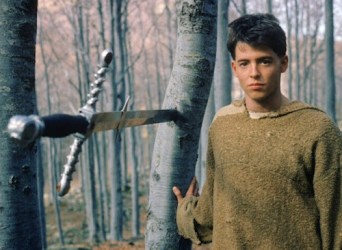 That’s the kind of age when one might be liable to fall in love with it; or, at least, people of (very roughly speaking) my generation would — I suppose Kids These Days fall in love with copious CGI, be that animated or ‘live action’. Anyway, I think it deserves to be less overlooked, and if you’ve never caught it (or not for a while) it certainly merits a chance.

 Four years ago, DreamWorks’
  Tonally, DeBlois has been productively inspired by
  If there’s a flaw, it’s in some of the new characters. The primary villain is underused, introduced too late in the game to become a palpable threat. More time spent building him up, seeing his evil on screen rather than just being told about it, would’ve been appreciated. So too for the mysterious vigilante dragon-rider, who turns out to have a very significant role. The deleted scenes include a prologue that would have introduced the character at the start, which would have better established the mystery and import of their role. It’s clear why it was deleted (to focus on Berk and keep the initial tone light), but I still think it would’ve worked better in the film. In the final cut, the vigilante is mentioned all of once, then turns up and is unmasked about two minutes later. Really, though, these are niggles — even for them, the cumulative consistency is certainly better than, say, its Oscar conquerer
  The kids’ phenomenon of the ’80s/’90s has never quite gone away, and this film is one thing that kept it ticking over in the ’00s. I watched out of nostalgia, which may’ve been a mistake.
 2013 Academy Awards
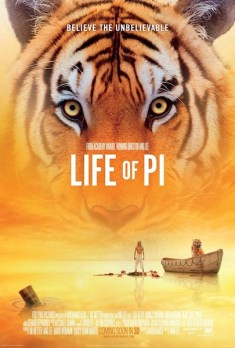 “Unfilmable” — now there’s an adjective you don’t hear tossed about so much these days. For a long time it seemed like it was all the rage to label novels “unfilmable”, but at this point too many ‘unfilmable’ novels have been filmed, and the wonders of CGI have put paid to anything ever again being unfilmable for practical or visual reasons. It may still be an apposite descriptor for works that feature very literary storytelling, though if you can render something like the subjective and unreliable narrator of
  but because of almost-indefinable features of each shot’s crispness, its depth of field, even the compositions. It absolutely works in 2D, and it didn’t leave me longing for 3D in quite the same way as something like the swooping aerial sequences of
 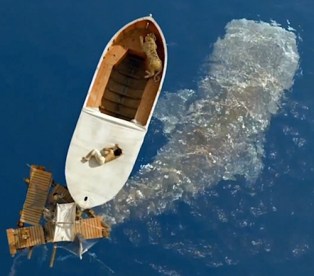 Later, the 4:3 “book cover” shot is just pure indulgence. There’s no reason not to just have empty sea to the left and right of frame, and the “it’s emulating the book cover!” reason/excuse doesn’t come close to passing muster simply because book covers aren’t 4:3. In both cases, then, what was intended to be striking or clever or innovative or in some way effective, I guess, comes across as pointless and distracting and pretentious.
 Reading around a little online, it seems that some people have interpreted the film’s message as being a defence of/justification for/persuasion towards religious faith, and hate it for that. This interests me, because I — coming, I suspect, from a similar perspective on religion — read it as a subtle condemnation of religious stories. Actually, not a condemnation, but a tacit acceptance of the fact that such stories are a nice fairytale, but not the truth. To put it another way, I took the message to be (more or less) that religion is an obvious fiction which people choose to believe because it’s a nicer story than the more plausible alternative, neither of which are provable. I think some focus on the point that the journalist hearing Pi’s story is told it will make him believe in God, and, at the end, the journalist seems to accept that it does. I don’t think that’s the film’s contention, though; I think the film is, in a way, explaining why people believe in God. Or maybe there are just no easy answers.
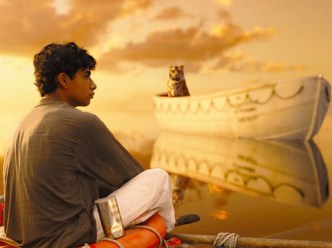 I found Life of Pi to be a little bit of a mixed bag, on the whole, where moments of transcendent wonder-of-cinema beauty rub up against instances of thumb-twiddling; where insightful or emotional revelations rub shoulders with pretentious longueurs. There is much to admire, but there are also parts to endure. The balance of reception lies in its favour, but while some love it unequivocally, a fair number seem to despise it with near-equal fervour. Either way, it’s definitely a film worth watching, and in the best possible quality you can manage, too. It also made me want to read the book, which for a movie I wasn’t even sure how much I liked is certainly an unusual, but positive, accomplishment.
 From the sword and sorcery ‘boom’ of the ’80s, Red Sonja concerns a warrioress going after the evil queen who slaughtered her family and has now seized a magical MacGuffin that will destroy the world or somesuch.
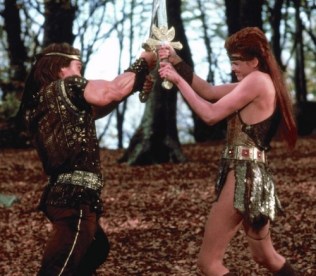 being a particular highlight. Veteran helmer Richard Fleischer’s direction seems to have come in for criticism from some quarters, but I found it adequately unremarkable. Damning with faint praise, I know, but it doesn’t merit slagging off either.
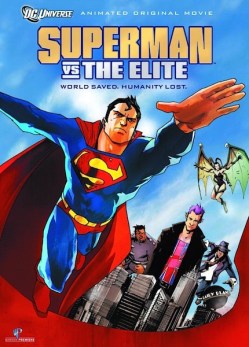 Adapted from acclaimed comic book story What’s So Funny About Truth, Justice & the American Way?, this DC animated movie sees the methods and morals of Superman (George Newbern) being questioned by the public and authorities alike when a super-villain escapes for the umpteenth time and kills more innocent bystanders. In the incident’s wake, a new super-powered team emerges — the titular Elite, led by Manchester Black (Robin Atkin Downes) — and their preparedness to execute criminals is met with great popularity around the world. How much humanity is humanity willing to sacrifice in the pursuit of conflict resolution? Are Superman’s high morals a thing of the past?
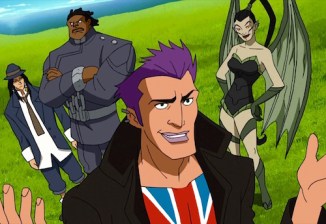 I assumed they were being faithful to a comic that hails from the ’80s, but it was actually published in 2001. It’s like Brit Pop never happened.
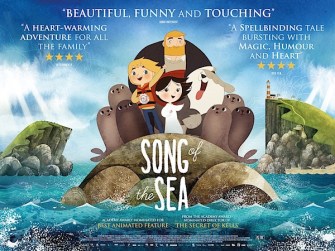 The second feature from director Tomm Moore and his pan-European team of animators (after the excellent, Oscar-nominated
 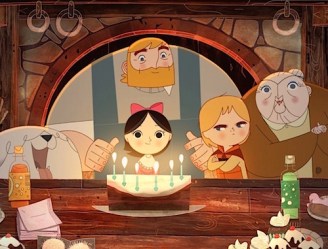 but the motivator for that is clearly resentment towards her for appearing the night his beloved mother left. Their father, too, is hamstrung by his grief, struggling to move on from his wife’s disappearance and fully engage with the world. His kids are his only connection, Saoirse in particular, but his mother makes him realise that clinging to them is damaging their lives too… or is it?
 all are factors that can, and do, elevate the film. Don’t get me wrong: this is a cut above your average animated adventure. I just didn’t enjoy it as much as The Secret of Kells.
 For more positives, Song of the Sea’s animation and design is at least as strong as it was in Moore’s previous film. There’s the ‘house style’ flattened, animated storybook look; a description which could sound like criticism but absolutely is not. Some very beautiful scenes are evoked, meaning that at the very least there’s always imagery to tide you over. I’d list some favourites, but we’d be talking about most of the film. That said, the depiction of a run-down, smoggy Dublin stands out as something different from the countryside idylls of Kells and the rest of the locales in Song of the Sea, but it’s not exactly “beautiful”. Rather, look to the island home of our heroes, a tall rock surrounded by the blue sea; the home of the glowing-eyed long-haired Seanachai (the moment when it suddenly turns around in the montage after Saoirse uses her coat for the first time is my favourite shot in the film, a little sliver of fantasy imagery that magnificently teases what’s to come); or the small sanctuary surrounded by a field of stinging nettles — again, a kind of gentle, on-the-edge-of-the-real-world fantasy that quite appeals to me. The fact the countryside is littered with half-hidden stone figures, which we know to be frozen magical begins, is another nice touch; especially as they’re often surrounded by human litter, the analogy (as I see it) being both that people exist around them but don’t even see them, and also that, presumably through our modern disbelief, we’ve thrown these legends out with our trash.
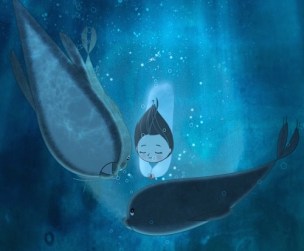 Even as I write, I’m talking myself round to liking Song of the Sea even more than I did on first viewing — and that was quite a lot, albeit coloured by my perception that I didn’t like it as much as The Secret of Kells. If you enjoyed Moore’s earlier film, this unquestionably merits seeking out (if you haven’t already, of course; I mean, I did). If you haven’t seen Kells, well, you’ve so far missed a treat; and now you’re missing two.
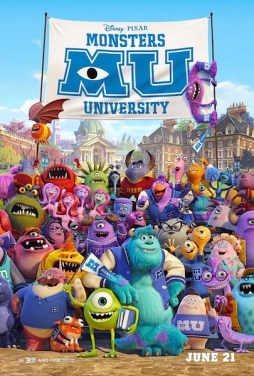 Pixar’s fourth sequel is more
 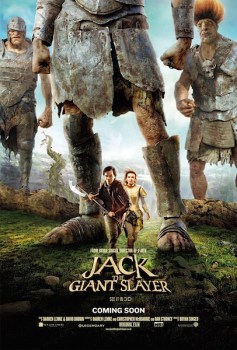 The influence of Peter Jackson’s
 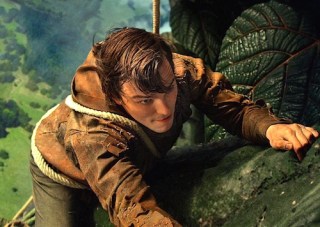 A computer-animated prologue wants to be the one from
 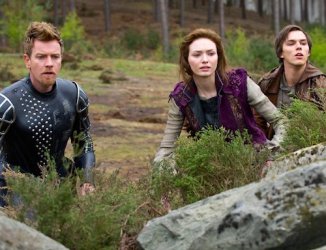 overacted characters, and bright-and-cheerful CGI are more or less acceptable, in a “it’s no classic but it’ll pass two hours just fine” kind of way. Produced on those kinds of terms, this might have passed muster for some. Might.
 Will Smith is the eponymous drunken vagrant, who also has the powers of Superman, in this under-appreciated superhero comedy-drama. Hated by the public for the destruction he causes while ‘helping’, and wanted by the authorities for the same — though they can’t catch him because, you know, superpowers — he gets an image makeover when he saves wannabe entrepreneur Jason Bateman. Bateman’s wife, Charlize Theron, is less sure of Hancock’s merits.
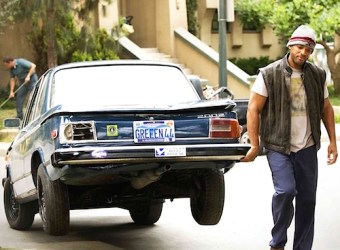 but it rubs against comedy stuff that feels like it’s from a Comedy. The extended cut includes an early sex/ejaculation joke/sequence that wasn’t in the theatrical cut because Berg thought it wasn’t funny and test audiences agreed. Goodness knows why it got put back, other than because of length — it accounts for over half of the extensions (more details
 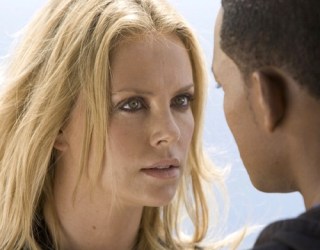 Why indeed, because a) she’s not a supervillain, and b) even if she were, why get changed?! It’s a kind of bait-and-switch: she’s made to look like a villain because we think that’s what she’s about to be revealed as, and a big hero-vs-villain fight follows too… but she isn’t. It’s not quite up there with the magically-changing Batsuits of
  The film would work a lot better on the whole if the tone had been settled on as definitively as Smith’s performance, rather than trying to have its cake and eat it by mining both the “what if this were real?” and “haha, an unlikeable drunk superhero!” versions concurrently. For my money, however, if you treat Hancock as a fairly seriously-intended movie that was forced to contain more (half-arsed) action and (misjudged) comedy for the sake of box office, it’s not a bad experience at all.
 100Films.co.uk