2009 #82
Quentin Tarantino | 153 mins | Blu-ray | 18 / R
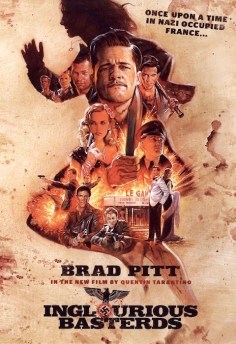 Watching almost any film a second time can affect your opinion of it. It could reveal deeper levels of character or theme; it could allow you to see how the writer(s) subtly foreshadowed events, or built up to the big twist; it could be you spot jokes you were too busy laughing during last time; it could let you look at the imagery now you don’t have to concentrate so hard on the subtitles. Or it could reveal shallowness, that there’s nothing to be gleaned that you didn’t get the first time; or highlight the holes in a plot that seemed so well constructed before; or jokes that were hilarious fall flat when heard more than once; or the action sequences aren’t exciting when robbed of their freshness. A second viewing can reveal that you were too young to get it the first time, or that you’re now too grown up to enjoy it; it can reveal a bad movie isn’t so bad, or that without the hype it’s actually quite good; it can raise a favourite even higher in your estimations, or it can tear it down. And even if a second viewing just reaffirms exactly what you felt the first time, well, when there’s such a chance for change and it doesn’t occur, that’s an effect in itself.
This is why I try to post all my reviews after only seeing a film once. There’s nothing wrong with appraising a film after many viewings — far from it — but that’s not the point of this particular blog, focusing as it does on films I’ve never previously seen. (Whether a newcomer’s perspective is still worth anything once a film is months, years, or decades old is another matter, perhaps for another time.) Unfortunately, though rarely, a film slips through the cracks. As you’ve likely guessed, Inglourious Basterds is such a film: though I named it my favourite film I saw in 2009, I didn’t make any notes or write a review promptly. And so here I find myself, over eight months since I first watched it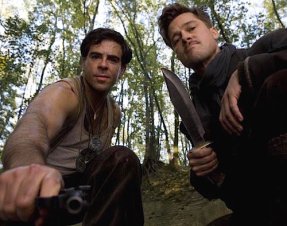 — and, today, a year since its UK release —, having watched it a second time to refresh my memory. But has it changed my opinion?
Inglourious Basterds is, in some respects, a law unto itself. That’s probably why it received such a mixed reaction at Cannes; one that, notably, settled down to generally praiseful by the time it was officially released a few months later. It wasn’t, as had been expected, the story of a group of American Jews dropped behind enemy lines to murder Nazis, thereby spreading terror through the enemy ranks. That’s part of the tale Tarantino eventually brought to the screen, but what you’d expect to make up the bulk of the movie — as Aldo Raine himself puts it, “killin’ Natzis” — is skipped over with a single cut. The film is divided up into five chapters; the second is the one most directly concerned with the Basterds, and it’s also the shortest.
And that’s not the only thing Tarantino does differently. The whole film is a grab-bag of filmmaking styles, techniques and modes, thrown together with a gleeful abandon. Tarantino uses what he wants when he wants it, sometimes for no reason at all, and with no eye to creating a stylistic whole. If he wants a character’s name to appear in huge letters over a freeze-frame of them, he will; that doesn’t mean he’ll use it for every character, or every major character, or for every other character on that one’s side — if he wants it just once, he’ll throw it in just once. It’s like that square Uma Thurman drew in Pulp Fiction, only instead of being one thing once he does it again and again, with any trick he fancies, throughout the film.
I’m tempted to list them, but that would remove some of the fun if you’re yet to see the film. My favourites, however, are the subtitles that don’t always translate things — e.g. when a French character says “oui”, so do the subtitles. It’s pointless really, but also kind of thought provoking too: if, as a non-French-speaker, we say “oui”, knowing what it means, then are we actually saying “yes” or are we saying “oui”? I’m certain, however, that Tarantino’s subtitling choices weren’t designed to elicit such thoughts and probably don’t stand up to the scrutiny they’d require (such as: if the rest of a Frenchman’s French is translated to English, why aren’t his “oui”s? (As it were.))
This is just one of the things that signals the truth of Inglourious Basterds: it’s not really about World War 2 — though you’d be forgiven for thinking it was, considering it’s all set during World War 2 and all the characters are soldiers, resistance fighters or politicians — but is in fact about film, or cinema, or the movies, or whichever name you want to use. It’s not just his mix and match of cinematic techniques that suggests this — though the much-heralded use of Spaghetti Western style on a World War 2 setting works as fabulously as you could hope — but it’s overt in the text too.
 The ending (and skip this paragraph if you haven’t seen the film) is the key to that, as I’m sure you either noticed or have read in other coverage. The power of cinema literally destroys the Nazis, changing the course of the war. Killing Hitler — and the rest — is one of those barmy notions that at first seems wrong, and then seems completely right. “If my characters had existed, this is what would have happened” is one of those genius notions that seems so inescapably obvious you wonder why no one’s done it sooner. Why do you necessarily need to obey history if the rest of your story is fiction anyway?
Back to other matters. It’s interesting just how long the scenes are, and in so few locations. Chapter One takes place solely in a small farmhouse (except for a few minutes outside it); Chapter Four is almost entirely in the La Louisiane bar; Chapter Five almost entirely in Shosanna’s cinema. And while the other two use more locations, their number isn’t great: Chapter Three features the aforementioned cinema, a cafe and a restaurant; Chapter Two a briefing ground, Hitler’s war room, some derelict location, and a prison. This isn’t a full list of locations and scenes, but it’s most of them. Tarantino hasn’t created some writerly exercise — “you are only allowed five locations, one long scene in each” — but he has nonetheless crafted most of his films in long scenes in few locations. I imagine this, along with “all that reading”  (I believe more of the film is subtitled than in English), did little to endear it to the complaining masses who thought they were getting “Kill Bill in WW2”.
The chapter-ified structure and constant introduction of new characters suggests a Pulp Fiction-ish ‘short story collection’ at first, but it becomes clear as the film moves on into its fourth and, certainly, fifth chapters that it actually all builds together as one whole story. The chapter headings serve their purpose, denoting the various stages of the tale and allowing Tarantino to jump around, rather than having to find a way to move more seamlessly from segment to segment or somehow intercut them all. Indeed, unlike the other Tarantino films the use of chapters evokes — i.e. Pulp Fiction and Kill Bill — Inglourious Basterds is quite solidly linear, at least as far as the progression through each chapter is concerned. (Chapter Two jumps about in time a bit, with a Nolan-esque stories-within-stories-within-stories structure, but even then does little to upset the linearity.)
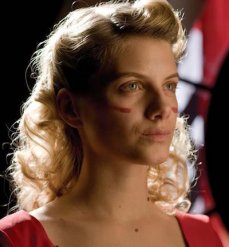 And for all those constantly-introduced characters, the acting is top notch. Christoph Waltz easily deserved the huge pile of awards he garnered, his quirky persona following in a long tradition of calm psychopaths in movies. You always know his pleasantries hide something far nastier; every scene he appears in is instantly tense. Mélanie Laurent is an instant one-to-watch as the film’s real central character, Shosanna, though she seems to have been sadly sidelined by all the praise heaped on Waltz. It doesn’t hurt that she’s the kind of woman you’d happily decorate a whole review with pictures of (though you’ll note I resisted). Michael Fassbender is the very definition of Englishness, without quite slipping into an irritating stereotype. It’s difficult to imagine the originally-cast Simon Pegg in the role, though I’m sure he would’ve brought something… shall we say, different… to it. Brad Pitt’s much-criticised heavily-accented performance is fine. While not as memorable as the others mentioned, I don’t see why some have had such a problem with it.
Between Tarantino’s writing and more excellent performances, we’re also treated to a host of minor but memorable characters: Denis Menochet’s farmer, managing to equal Waltz in the long opening scene; Til Schweiger’s vicious German basterd; Diane Kruger’s glamorous, calm actress-spy; Daniel Brühl’s apparently sweet accidental hero and movie star-to-be; Martin Wuttke’s raving loony Hitler; and others too. Perhaps the only duff note for me was Mike Myers as an English General. I liked the Wayne’s Worlds and Austin Powerses (and haven’t subjected myself to The Love Guru for this reason), and he’s not exactly bad here, but there’s a part of me that couldn’t escape wondering exactly why he was cast in such a small and uncomedic role. A real Brit would’ve been more appropriate, I feel. Perhaps Simon Pegg.
Myers was one of the things I noticed more on my second viewing. So was that “care-free deployment of an abundance of film-specific techniques” — while they’re undoubtedly there, when one expects them they don’t seem nearly so surprising or all-pervading as they did at first. Clearly it’s the shock value: in the same way a jump scare or joke dependent on a surprise twist might only work once, so Tarantino’s occasional and somewhat incongruous flourishes don’t stick out as firmly when you know they’re coming. But that’s not a bad thing. There’s no joyous discovery of something new and slightly different exploding across the screen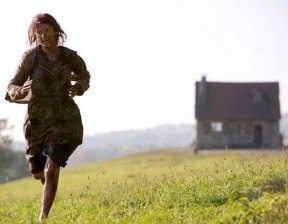 every once in a while, but it also proves they work, that he was right to employ them.
Some people hated Inglourious Basterds (though not enough to keep it out of the IMDb Top 100), be it for the unexpected nature of its story or for the long talky scenes with lots of reading. But that’s just another reason I love it — not to be awkward or Different, but because by being so much its Own Thing it can provoke such strong feelings, in either direction. It’s common for Hollywood to produce films so bland they evoke bags of apathy from those with enough brainpower to realise the film doesn’t have any, so it’s quite nice to have a film that has a brain — and, more importantly, a personality (several, even) — that it isn’t afraid to show off, and isn’t afraid for you to dislike if you want. Love it or hate it, it demands to be seen and judged on its own merits.
To be frank, I’m not sure I liked Inglourious Basterds as much my second time. I may well like it more again on my third, when there’s less personal hype involved. I’d still give it the same star rating though, so at least there’s no conflict there.
You might argue that Pulp Fiction or Reservoir Dogs are better films, but — with its long idiosyncratic speeches and scenes, relatively extreme violence, use and re-appropriation of generic convention, 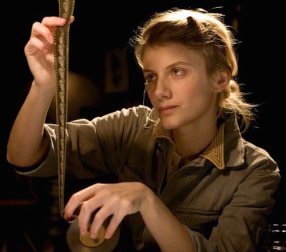 care-free deployment of an abundance of film-specific techniques, and, both through this and also directly in its narrative, its love of film as a medium — Inglourious Basterds isn’t just “a Quentin Tarantino film”, it is Quentin Tarantino. His choice of final line — “You know something, Ultivich? I think this just might be my masterpiece” — is clearly about more than Aldo Raine’s swastika-carving abilities.
Inglourious Basterds is on Film4 tonight, Friday 24th October 2014, at 9pm.
It placed 1st on my list of The Ten Best Films I Saw For the First Time in 2009, which can be read in full here.

 Living Free is, in many ways, a tale of obsession. I’m certain that wasn’t Joy Adamson’s intention in writing the book, and I don’t think it’s the filmmakers’ intention either, but the facts can still play that way. The Adamsons devote months of their time, give up a promising career, spend all their savings, drive themselves into debt, and are nearly killed several times, all in a frequently-extreme effort to save three delinquent lion cubs who would be put down were it not for their sentimental attachment.
 The rest of the story moves into What Happened Next territory: Elsa dies, the Adamsons’ obsession with finding and saving her cubs begins. The film skips the book Living Free, adapting threequel Forever Free instead, presumably for dramatic reasons — I imagine Elsa and cubs just living isn’t as much of a Story as her death and subsequent events.
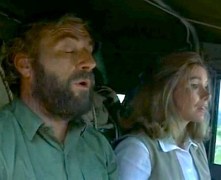 Living Free isn’t as endearing as Born Free. By the very nature of trying to keep the cubs wild, they’re less relatable than Elsa and consequently we become less attached to them. As you may’ve guessed, I found it more interesting to look on the film as a story of obsession, one that threatens to ruin the Adamsons’ lives, though ultimately it has an upbeat ending.
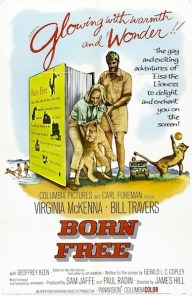 Born Free tells the true story of Joy and George Adamson, a Senior Game Warden in 1950s Kenya, who adopted three lion cubs after mistakenly killing their mother. Though they give two away to a zoo, Joy can’t bear to part with one, Elsa, and so they raise her — until circumstances force them to part with her. Despite Elsa’s age, Joy insists they try to release her into the wild rather than send her to a zoo.
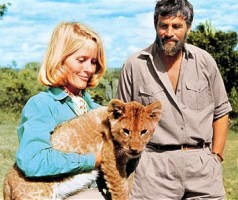 Then there are the other animals, including elephants (always wonderful) and the Adamsons’ adorable pet… rodent… (look, I’m no expert.) Best of all is a head-butting warthog, who has instantly become my favourite film animal. The entire film was worth that sequence.
 This is one of those films I always feel horrendously under-qualified to bother offering any kind of thought on. It’s the kind of film you suspect benefits most not just from repeated viewings and a desire to dig deep into its themes, but also a wider understanding of the director’s work and thematic concerns. This is only compounded in the case of Ozu by the fact I watched
  (which bolsters my belief that his most renowned work is indeed worth a second shot). One issue, I suspect, is that I knew nothing of Ozu before my first experience; having read up on him (if only a little), his idiosyncratic squared-off shots and straight-on close-ups feel less blatant and frequent here, and being aware of their deliberateness perhaps makes them less intrusive. That said, I remain unconvinced by it as a guiding notion — I’m sure there’s a reason beyond the proliferation of American cinema that the visual style we’re used to seeing in most film and TV is, well, the visual style we’re used to seeing.
 when the prospect of marriage and leaving her father seriously raises its head. (And I’m afraid that’s the closest to analysis you’ll find here.)
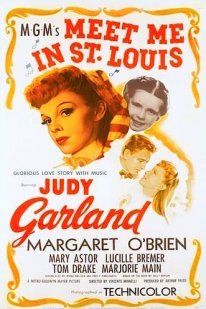 Someone (who exactly is long lost to the depths of my memory) once observed that, though a lot of people claim to not like musicals, they’re quite happy to acknowledge their love for
 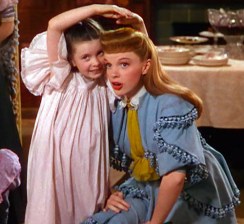 Judy Garland is fine in the lead role — still playing a teen, despite being 21, but suitably distant from Dorothy. Margaret O’Brien receives prominent second billing in the role of ‘Tootie’, despite being just seven years old. She was, I learn, something of a star at the time, in spite of her young age, which perhaps explains the (arguably) undue prominence in both the credits and the film itself. That said, she’s a rather good actress, and picked up an Oscar for her performance here (and other roles she played in 1944).
 I have no love for football. Quite the opposite, in fact. I’d certainly never heard of Brian Clough before this film came along. I didn’t even bother to put it on my list of
  an impressionist who can act a little, due to his penchant for playing real people with unerring accuracy — Kenneth Williams in
 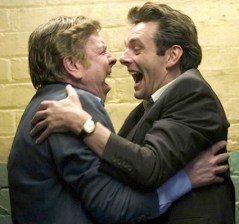 Though this is Sheen’s show, the rest of the cast give able support. Most notable is Timothy Spall as Clough’s right-hand man, Peter Taylor, the quiet force behind Clough’s showy, mouthy public face. Their relationship is — in nasty modern parlance — a “bromance” (I apologise), a fact only underlined by the final scene. It may not be apparent until late on, but if the film is Clough then his relationship with Taylor is its heart. It’s a subtler role that Spall still manages to pull everything out of. Colm Meaney and Jim Broadbent are also noteworthy, as Clough’s unknowing rival and his increasingly exasperated chairman respectively.
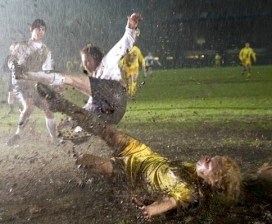 and I seem to remember it in
 Origin stories are, as we well know, all the rage at the moment, and so Ridley Scott follows in the footsteps of
 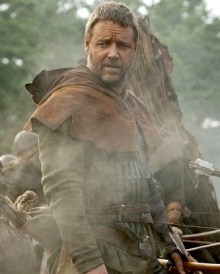 a likely-fictional creation, and so the style is suitably believable, whether it be precisely factual or not.
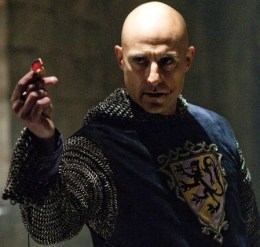 Mark Strong in a villainous role (it might be nice to see him play a good guy sometime, I’m sure he’s capable). Danny Huston’s King Richard is a nicely revisionist take — not the flawless hero we’re used to seeing — which sadly gets too little screen time. Oscar Isaac’s Prince/King John is suitably brattish and inconsistent, but by playing the part fairly straight he doesn’t come close to being as memorable as Alan Rickman, Keith Allen or Toby Stephens in the key villain’s role.
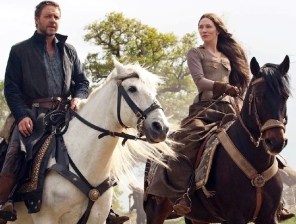 after numerous scenes of them doing stuff, they just are. King John ums and ahs about various things, and if we’re being charitable his chief characteristic is ‘changeable’; and if we’re not, he’s a weakly-written, inconsistent character. Do I believe he’d go charging into the fray during the climax? No, I don’t. If he’d gone in when it was virtually over, just so he could later claim he had? Yes, that would fit.
 I wanted the reviews to be wrong; for Ridley Scott’s Gritty And Realistic™ take on Robin Hood to be worth the potential of the concept. In places, it almost is — the era is evoked stylishly, the battles are largely well-staged if not perfect — but it drags, and ultimately Robin only becomes Robin Hood proper at the film’s end. (In fact, a surprisingly large amount of the trailer was taken from the film’s closing minutes, obviously to imply the usual Robin Hood story.) It’s copied Batman Begins and Casino Royale too precisely in this respect, perhaps. It also makes it feel like nowt but setup for a sequel, over-explaining how (this version of) Robin came to be where he was. As the final card says, “And so the legend begins”.
 The debut feature from director Gurinder Chadha (of
 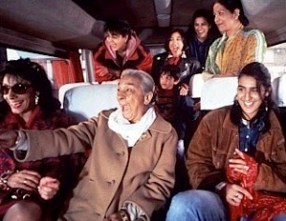 Indeed, there’s certainly evidence that the film was constructed with such an audience in mind: when the women settle down for a traditionally British ‘picnic on the beach’, we’re given a close-up to show they’re eating samosas and bhajis instead of sandwiches and what-have-you. If all the talk of pregnancies, abuse and racism sounds a bit serious, there’s also a good degree of humour and an appropriate lashing of sentiment.
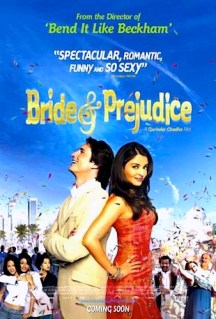 I don’t imagine Bride & Prejudice is going to convert many people who aren’t already predisposed to liking it in some way. That’s not to say it’s not good or doesn’t have potential crossover appeal, but it still has a whole list of things that will put certain viewers off.
 not to mention the numerous adaptations predating either of those, but Bride brings plenty that’s vastly different to the table. It converts the novel very accurately (as best I can tell, having only seen screen versions), retaining both the characterisation and the majority of the plot in a similar sequence of events.
 Little of the plot requires such modification, perhaps thanks to the culture it’s been grafted onto — the predominance of arranged marriages wouldn’t really work in a ’00s British setting — and those bits which are changed are relatively minor. Lydia (here, Lakhi) runs off with Wickham for an afternoon at the London Eye, rather than eloping; Georgiana (here, the slightly more modern Georgina) was impregnated at 16, less legally complicated than the novel’s 15.
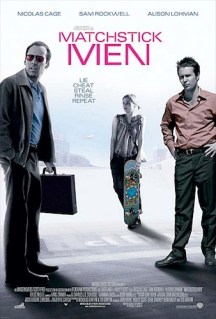 Matchstick Men ends with a twist. One of those great big changes-everything-you’ve-just-seen numbers that have a habit of making a film notorious. Yet I’m almost loath to mention it, because I’ve never read a review, preview, summary or what-have-you of the film that mentions there’s a twist. Maybe I’ve just been reading the wrong pieces; maybe no one cares; maybe they’re all just playing along trying to keep it secret. But not me, because I bloody hated it.
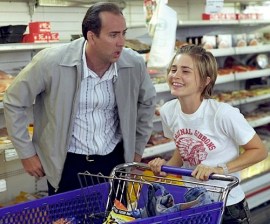 Twists are fine. Twists can be great. As I said, you can guess a twist is coming and it can still work. A really good twist works even when you know for certain it’s coming; its existence raises what you’ve seen, makes it all work even on repeated viewings when the element of surprise is obviously gone. Matchstick Men doesn’t have that kind of twist. It has the kind of twist that undermines everything you’ve just seen. Not because it’s illogical — it isn’t in the slightest — but because it tramples over the film’s emotional resonance, in my opinion.
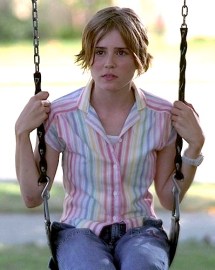 Alison Lohman is also exceptionally good as a 14-year-old girl. It took a scene or two to convince me, but after that I was plenty on board with it. It occasionally takes some effort to remind yourself she was 24. As the third lead, Sam Rockwell plays a typical Sam Rockwell part. He does it very well, naturally, and there’s nothing to fault him on, but he’s been better elsewhere. The rest of the cast are absolutely fine but not exactly called on much — this is Cage’s film, and to a lesser extent Lohman’s. They have the emotional journey, the film’s heart-and-soul around its long(-ish) con ‘plot’ (which could just be lifted from any episode of Hustle… except it’s not even that complex).
  Matchstick Men was a lot better than I’d expected, because most of the coverage I remember shoved it aside as a middle-of-the-road side project for Scott. It’s definitely better than that, if still not the “sweep the Oscars” success