2012 #88
Lena Dunham | 99 mins | TV (HD) | 2.35:1 | USA / English | 15
 Some have been quick to call twenty-something writer-director-actress Lena Dunham “the voice of a generation”; usually older people who think this is how people that age are, because I’m part of Dunham’s generation and she certainly doesn’t speak for me, and you don’t have to go far or look hard on the ‘net to find similar views. But it’s turned out alright for her, as by whatever ridiculously young age she is she’s made this film, got a multi-season series on HBO (the critically divisive Girls), and recently signed a ludicrously lucrative book deal. Clearly, she speaks to someone.
Tiny Furniture, then, comes with a predisposition to dislike it from anyone who isn’t a hipster or desperate to be relevant to hipsters (I feel like this is the point at which to note that it’s recently been inducted into the Criterion Collection). It’s a slow-paced, consciously arthouse-drama-y story film about unlikeable people leading unlikeable lives. I think everyone in it is either selfish or at least self-centred, and even if you buy into any of its characters being more than that, Dunham eventually unmasks them as gits in one way or another.
It’s hard to tell if the film knows everyone appearing in it is so awful, and is inviting us to judge them in some way (be it to look down on them, or to laugh at them, or to just generally dislike them); or if it actually wants us to think they’re all alright really; or if there’s supposed to be some distinction over which ones are good and which ones not so much. If the last, it’s thoroughly unclear to those of us (that’d be most of us) who are just looking in on this self-obsessed world — all of the characters are a much for muchness in their levels of (un)relatability and (un)likeability.
 Trying to read Dunham’s intentions in these regards is complicated by the film being clearly autobiographical. And if it isn’t, it’s working overtime to suggest it is. Dunham writes, directs and stars as the lead character; said character’s mother and sister are played by Dunham’s real mother and sister; I wouldn’t be surprised to learn her friends are played by her friends. Her apparent status as ‘the voice of a generation’ and the little I’ve read about her HBO series suggests to me that this is, if not 100% true to her life experience, at least a fictionalised version of it. Which again begs the question, are we actually meant to like some of these people? To identify with them? It’s clear Dunham has no problem with putting herself down and presenting herself in a negative light, but it feels to be in an angsty, whiny, “you totally get this, yah right?” way.
Yet, for all its characters’ many faults, there is something somewhat engrossing about Tiny Furniture. It’s not the car-crash rubber-necking of watching a bunch of people you dislike make fools of themselves, nor is it a burgeoning understanding that underneath it all these are genuine, relatable people. Perhaps it’s because Dunham can, to some degree, empathise with all of her characters — that almost all have some pros to go along with their cons (except, perhaps, the men) — that she occasionally, sneakily, gets you on board.
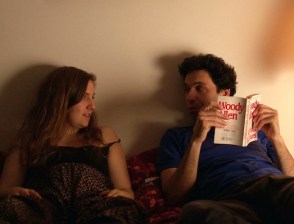 Many reviews cite Woody Allen as an influence, and it’s easy to see why: a small-scale autobiographical dialogue-driven New York-set study of specific people in a specific time. It falls short of such lofty aspirations on a few fronts, not least the evocation of the setting — there’s no trouble doubting this is set in New York, but you don’t feel the city the way you do in Annie Hall or Manhattan or many more of Allen’s works. But comparing a newcomer to a master is always a hiding to nothing for the newbie, so best not judge her too harshly for that.
Visually, the film belies its super-low-budget origins. In part this is the 2.35:1 frame, usually reserved for mega-blockbusters, which makes it ultra-filmic. In part it’s the slick interiors, cleanly shot, often with squared-off framing in longer takes, which comes across as film-literate rather than amateurish dump-the-camera. Only occasional exteriors, like grainy nighttime shots, give away the cheap roots. If nothing else, Dunham knows how to make a film look like a film.
And after all that, there’s the ending. Or, perhaps, the stopping, because does it actually End? I don’t think there’s anything inherently wrong with the concept of an opaque ending; one that, rather than resolve everything entirely, asks the audience to project their own meaning or their own imagined conclusion onto the events witnessed thus far. Rather than reach out and slap you in the face with an explanation, an effective opaque ending (such as Mulholland Drive’s) is like a hand reaching out to you, but you then must work to reach out yourself and grasp that hand. A bad one is like 3D: 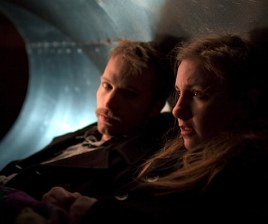 the hand is reaching out to you, but when you reach out to take it you find there’s actually nothing there; it was just an illusion.* I rather suspect Tiny Furniture’s guff about still hearing the ticking clock is that 3D hand.
That said, even as I write this, something struck me. But it’s terribly pretentious (in the full dictionary-defined sense) and so not much better. And weeks after watching the film, I can’t even remember it.
It’s difficult to know what to make of Tiny Furniture. I thought I was going to despise it, yet despite there being no clear sense of storyline, plot or even genuine thematic point, and additionally finding all of the characters to be unrelatable and largely unlikeable, I found it moderately engrossing. It’s not really good, but it’s strangely not bad either.
This review is part of the 100 Films Advent Calendar 2012. Read more here.
* I’m really quite proud of this analogy. I’m totally using it again. ^

 Controversial supernatural mystery drama. Nicole Kidman’s rationalist husband dies suddenly; years later, as she gets engaged to another man, a boy arrives claiming to be her husband reincarnated. More realistic art house drama about grief and insecurity than thrill-giving occult mystery, it nonetheless keeps you guessing as Kidman is slowly convinced by the boy’s tale, while family relationships collapse around her. Full of quiet understated performances, Kidman is particularly captivating and, as the boy, Cameron Bright is mesmerisingly unreadable. Poorly received, with some notable exceptions, Birth is a fascinating film that won’t appeal to everyone, but deserves the right audience.
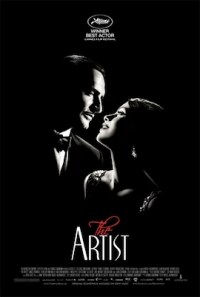 Beginning in 1927, you could (and some have) accuse The Artist of being a remake of
  Besides which, it isn’t a real silent film, and not just because it uses sound on one or two occasions, to very specific effect. Made 80 years after the invention of sound revolutionised cinema over night, The Artist is a tribute and homage to that great era — it’s not trying to beat them at their own game. It’s certainly not the first ‘modern silent’ either, but it’s an appropriate one to have received the most widespread attention (
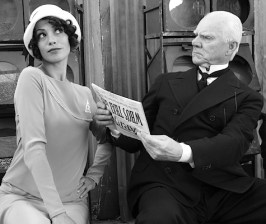 you’d believe they were a precisely-planned specially-constructed set, and unceremonious symbolism is created with former-star George being on the way down and Peppy being on the way up.
 or just faithfully following George around, he draws your attention. I might think that was just me (we’ve been over my love of terriers
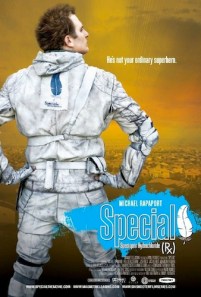 A lot of praise was slung
 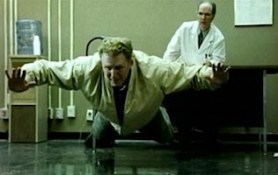 Those after a more genre-aware “real world superhero” movie would do better to stick with Kick-Ass or Super, but those who might embrace something a little different — especially something with an indie sensibility — would do well to take a look. Indeed, being a comic fan is certainly not a prerequisite for enjoyment here.
 Samuel L. Jackson and Tommy Lee Jones star in this military courtroom thriller from the director of
  That’s not all that’s bungled. There’s numerous instances of awkward editing by Augie Hess; a screenplay from Stephen Gaghan that clearly wants to be
 Despite winning a bunch of Canadian film awards, this First World War drama seems to have been really poorly received by critics — the
 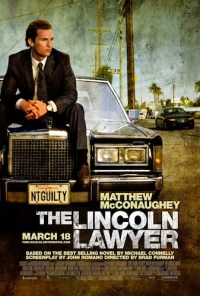 Adapted from a novel by best-selling author Michael Connelly, The Lincoln Lawyer seemed to appear out of nowhere and garner an uncommonly high amount of praise. I’m glad that intrigued me, because, while not a revelatory experience, it’s certainly worth your time.
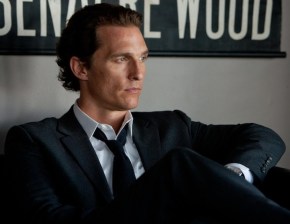 I’m not sure I’ve ever seen McConaughey in anything (nothing I remember, anyway), but my impression has been he’s not all that. Here, though, he nails the slightly-smarmy-but-kinda-likeable street-wise defence attorney Mick Haller. He’s buoyed by a quality cast: Ryan Phillippe is eminently plausible as a rich kid used to getting his own way, while the likes of William H. Macy, Marisa Tomei, John Leguizamo and Bob Gunton offer typically consummate support.
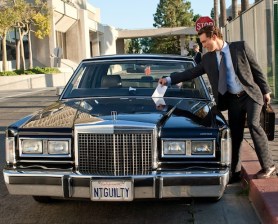 after languishing in development hell for 20 years, he recently paid Paramount $3 million for the rights to his most prolific character. With said character being the half-brother of Haller, and that Lincoln Laywer sequel in development, maybe Connelly’s work is destined to become the Marvel Cinematic Universe of crime/legal film adaptations. This could be the time to get in on the ground floor.
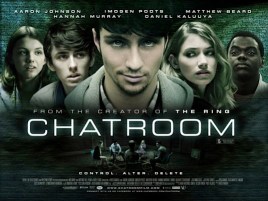 Chatroom is born of — or, at least, partly formed around — trying to find a viable way of depicting the world of online chatrooms on film. Putting on film this world it As It Really Is — people sat at a computer typing at each other — might work well enough for a single scene in
  in this environment is also truthful. There have been many reviews that are completely dismissive of this facet of the film, leaving me to wonder if they were written by people who haven’t used or experienced such things. It’s a shame, then, that the film’s degeneration into a thriller hides the arguably-worthwhile potential to explain to such people what that online world can be like for people/kids using it.
 Despite a strong-ish start, perhaps the whole second half of the film is a wobbly mess; not directionless exactly, because by then it does know broadly where it’s going, but it doesn’t do much to suggest to the viewer that it has a real goal in mind. Character motivations and relationships feel as if they’ve not been fully thought out, or at least not fully brought together on screen. Some threads take inexplicable jumps; others aren’t adequately explained or justified. Occasionally it’s Nakata’s direction that overdoes things, for instance laying the soppy “this bit is emotional” music on thick when Matthew Beard’s performance could easily carry a particular sequence.
 The aforementioned Matthew Beard, perhaps the least recognisable cast member (his
 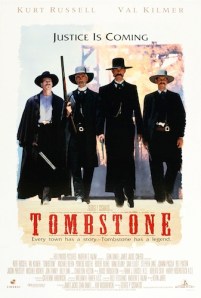 The story of the OK Corral is one I know by name only; I haven’t even seen the
  That may be down to historical accuracy. There’s a distinct feeling of veracity to proceedings, and as I understand it a concerted effort was made in that regard. The Movies perhaps shouldn’t worry about sticking too closely to fact (if you want an accurate lesson, read a textbook), but when they can manage to be both factually accurate and entertaining, it’s all the better. Cosmatos & co appear to balance this well.
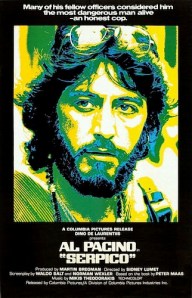 Before
  As the titular copper, it’s a typically strong performance from Al Pacino. Not his best work — I don’t think the part really gives him enough to deliver that — but he’s more often than not the most engaging element of the film. This was his fifth film; considering
  100Films.co.uk