2013 #94
George A. Romero | 127 mins | Blu-ray | 1.78:1 | USA & Italy / English | 18 / NC-17
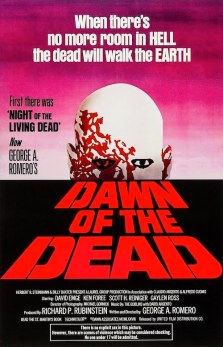 Dawn of the Dead is the Citizen Kane of zombie movies.* And yet, in the same way new viewers arrive at Kane laden with the baggage of its acclaim, and thus come away with a lesser opinion of it, it would seem from user reviews on various websites that Dawn is a less beloved proposition for many a modern zombie acolyte.
Thanks to a shifting timeline, it’s now the late ’70s, but only a few weeks have passed since the zombie outbreak we witnessed in Night of the Living Dead. Society is going to hell: the US public are sentimentally avoiding government orders to burn the dead and abandon their homes. The outbreak, apparently controllable, is getting worse. Four loose acquaintances — a TV producer, her weather ‘copter pilot boyfriend, and a pair of police SWAT officers — escape the madness in the chopper, setting up camp in a deserted mall. Deserted, that is, except for the hordes of undead, flocking to a place that used to be so important to them…
It used to be that people were Clever for spotting the subtext that Dawn is really a critique of mass consumerism. Romero expressed his surprise at this: he didn’t think that theme was subtle, he thought it was blatantly the point. Heck, he even has his characters all but say it two or three times. Today, it’s depressing to see the number of user reviews online that criticise such analysis for being “pretentious”. It’s not pretentious, it’s what the film is about. Those reviews, and so many more like them, focus on the gore and make-up being old-fashioned and unrealistic, or the film not being scary, or there being too little action. Point — thoroughly missed.
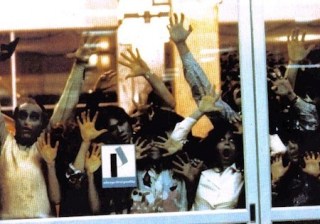 Romero has said he considers his zombie movies to be about the time they were made; a little snapshot of the world (or the US, at least) at the time. Thus consumerism is only one of Dawn’s targets, albeit the easiest to spot. Romero was ahead of his time here: gigantic out-of-town malls of this type were, apparently, new propositions at the time the film was made, and the one that stars here was amongst the country’s largest (it still exists, I believe, but now it’s considered a little’un). It’s not just the zombies who are critiqued either. Our protagonists choose to stay in the mall because it apparently has everything they could ever need, even though it also has the constant threat of the undead. On their first trip out for supplies, they’re as interested in expensive watches as food and tools. As time goes on it only gets worse: they turn their little attic apartment bit into a chic pad, with stylish chairs and all the mod-cons. In a world where the apocalypse has happened, they’re not fighting for their very survival, they’re living the high life. They even ‘rob’ the mall’s bank, “just in case” money is still worth something.
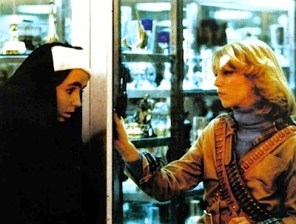
As with Romero’s previous zombie outing, characters are as important as anything, and its through them further social analysis is developed. For instance, there’s Fran, the only woman in the group. A deliberate counterpoint to criticisms of Night…, she’s a capable person, who insists on being involved when the men cut her out. She’s the only one who thinks setting up camp in a place overrun with zombies might be a bad idea; she’s the one who insists on learning to fly the helicopter in case something happens to the one other person who knows how. She doesn’t scream once, a touch added by actress Gaylen Ross: when Romero asked her to scream, she refused, and he never asked again.
 The men, meanwhile, help shape a commentary on society’s desensitisation to violence. There’s disgust early on at having to shoot these human-like creatures in the head to get rid of them, but so unrelenting is such a task that it becomes everyday. This and the consumerism thread come together in the final act, when a gang of bikers invade the mall: declaring that the place is their possession, one of our ‘heroes’ has become so used to killing the living dead that he now has no trouble opening fire on the plain ol’ living.
The film is rich with such analogy and symbolism for them that wants it (there’s even more than I’ve gone into here, including perspectives on immigration and US intervention in overseas conflicts); what’s kind of depressing is that so many viewers today don’t. I’m a fan of a well-constructed largely-mindless action movie as much as the next Bloke, on the right occasion, but that’s not what Romero was purporting to construct. It’s not “pretentious” to see these themes, because that’s why he made the film. Romero didn’t set out to produce a shoot ’em up and accidentally created some social commentary for chin-stroking cineasts to pontificate over — the zombie action is what’s almost incidental; it’s a prism through which to discuss the world.
All that said, it’s not as if the film stints on action. But this is the ’70s — they didn’t build an entire film from back-to-back action sequences then as we do now. These scenes can be suitably tense and exciting when needed, though, as with almost all ‘old’ action movies, they aren’t going to deliver the same hyper-choreographed visceral thrill as their modern-day counterparts. But they are there, and they are what they are.
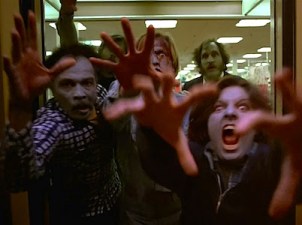 I also don’t hold much truck with that “the effects are bad” waffle. I mean, really, what do you expect? The film’s 35 years old! And y’know what, it’s not that bad. OK, the zombie’s skin tone is a little blatant — special effects maestro Tom Savini has said he was aiming for grey but it registered as rather blue on film. Then the blood is a vibrant red — well, loads of older films have that garish red blood, what of it? In fact, it was specifically requested by Romero, who wanted a comic-book-y colour to match what he saw as a comic-book tone to the violence. Then there’s all the flesh-eating gore, which is by turns heightened to the point of silliness and gorily realistic — the stuff with the guts towards the end… Savini was a war photographer in Vietnam and that in part inspired his effects work. You want to argue with a guy who’s seen the real thing that his work doesn’t look as ‘realistic’ as some post-millennial computer nerd’s hyper-CG version of things?
Aside from thematic weight and violent frivolity, Romero also crafts a character drama. Whereas Night put some archetypes in a situation and stressed them out, to sketch-like effect, Dawn takes its time to explore its characters. In some cases their arcs are clear — likeable but cocky copper Roger gets over-confident and pays for it — while others are barely noticeable. The burgeoning friendship/relationship between Fran and policeman Peter, the most level-headed of all the film’s male characters, is so subtle as to hardly register, but it’s there, in part created by the actors getting on well. They earn (spoilers!) the happy(-ish) ending, an alternate to the fatalistic double suicide Romero planned, tested, but ultimately didn’t even shoot.
 I have to say, the more I think and write about Dawn, the more I come to like it. It’s not really perfect — the biker climax comes almost out of nowhere, and I’m not convinced they were the most effective way to explore an ending. Perhaps this is where the “snapshot of the times” idea begins to fall down: distanced from the time in question, how resonant are those themes? Is that why modern viewers, coming to the film for the first time, miss them? (That’s not to discount the fact that most modern genre film viewers aren’t looking for grown-up viewing, but kids’ movie-style brightly-coloured action — with added gore and swearing to prove it’s actually for adults, despite the lack of adult thought or consideration required. Ironically, these once-B-movie cheap horror/thrillers are now, thanks to their political undertones, more suited to the art house crowd. I see why so many venerate ’70s cinema.) But (to get back to this paragraph’s point) there’s so much in Dawn, so much more than either a zombie kill-fest or a criticism of consumerism, that thoughtful reflection — and, I’m sure, future re-watches — are only to its benefit.
With all these words spent, I’ve not even discussed the throbbing score from Goblin and Dario Argento; or the use of quirky funny stock music to highlight the Comedy of some sequences (including tunes from/also used by Monty Python, which only seems to emphasise the point); or the criticism of religion (which I somehow missed until reading Calum Waddell’s essay in the booklet of Arrow’s Blu-ray! How remiss of me); or the movie’s length — this is definitely an epic! And at times it feels it. Though the methodical way it goes about outlining how you’d set up a new life in a mall is, actually, exactly what I’d want to see from this storyline. You can’t just plonk yourself down there and live, can you? You’ve got to think about where you live, how you stock up, and, in the case of a zombie apocalypse, how you keep the undead at bay… and how you prepare for looters.
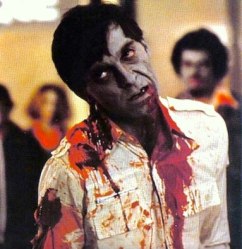 Immediately after viewing, I’d say I didn’t like Dawn as much as Night. Though it has many qualities I admire, it also felt a little less focused and more sprawling. The first I found tense and chilling — a Horror movie, albeit one with observable dramatic and thriller-ish elements. Dawn is, at heart, a Drama — it’s about the people in this situation, that situation happening to be an extreme horror one. But on reflection, the bits I was less sure of pale behind the things it does right.
One thing you can’t doubt is that this inspired the zombie genre even more than Night: the gore, the violence, and so on. It’s just a shame that the filmmakers who have followed in Romero’s footsteps concentrate on those aspects rather than the humour, characterisation, and social critique that are actually what make his films classics.
Part of Week of the Living Dead for Halloween 2013.
A quick note on versions: thanks to international cuts and whatnot, there are numerous variations on Dawn of the Dead. Three key ones are included on Arrow’s UK Blu-ray: the theatrical cut (the only one in HD), the longer Director’s Cut, and the shorter Argento cut. The latter, produced for the Italian market, apparently focuses on action, to the detriment of the dramatic elements. The Director’s Cut is reportedly more of an “initial director’s cut” — a longer version before Romero honed it down to his final, preferred version, which is the theatrical cut. Various people swear by various versions; I just went for the one in HD.
* or should that now be “the Vertigo of zombie movies”? ^

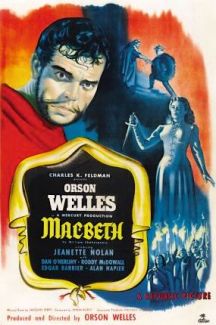 Twelve years on from his innovative, acclaimed, career-bolstering ‘Voodoo Macbeth’, and with the infamous War of the Worlds radio broadcast and films like Citizen Kane, The Magnificent Ambersons and The Lady from Shanghai now under his belt, Orson Welles tried to interest Hollywood in something they’d only attempted a handful of times since the advent of talkies: a Shakespeare adaptation.
 The low budget and quick schedule affect the film across the board, for good and ill. There’s much dramatic staging, with grand sets and doom-laden lighting. The shadow-drenched cinematography may well be a result of the cheap production, but the resulting effect is marvellous. Indeed, all the camerawork is great. There are some striking long takes, including the majority of the night of the murder occurring in one long unbroken shot. The costumes, on the other hand, look like a ragtag bunch of Past Clothing from the studio’s store… which is because they essentially were.
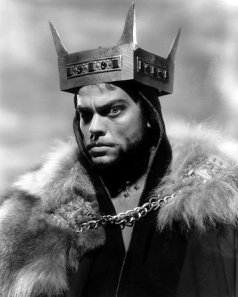 Macbeth himself is hardly in possession of all his faculties at that point, acting like a drunkard; but rather than make the sequence appropriately sinister (it’s in this state that he orders the execution of Banquo and Fleance, for example), it plays up the silliness, which is a shame.
 A black and white Swedish movie in which a knight ponders the existence of God while playing chess with Death? Yep, here we have the stereotype of arthouse cinema. Let’s be honest, it lives up to most of those expectations.
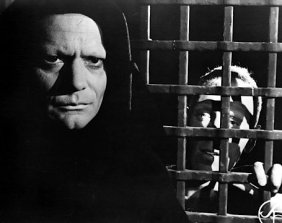 On the more easily-appreciable side, it’s beautifully shot by Gunnar Fischer. It had to be made quickly, on a tight budget, and for that reason Bergman found it imperfect and rough in places. This may be true, but regardless, there are numerous striking compositions, and even more occasions where the rich black-and-white photography looks stick-it-on-your-wall gorgeous. I only watched it on Tartan’s old DVD and, even with mixed feelings about the film itself, I’m sorely tempted to pick up one of the Blu-rays.
 If you were looking for the archetype of an epic movie, Lawrence of Arabia would be a strong contender. It has a wide scope in just about every regard, from the desert locations that stretch as far as the eye can see, to the thousands of extras that fill them, to the glorious 70mm camerawork that captures it all, to the sweeping story that also contains a more personal throughline, to the 3½-hour running time.
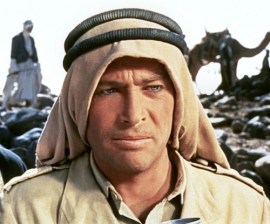 As such, the film hangs on the performance of O’Toole. We’re told Lawrence is an enigmatic figure and his depiction arguably supports that — we never fully get inside his head; we’re always observing him. And yet that’s no bad thing, because even as Lawrence’s confidence waxes and wains, as his allegiances shift and alter, we can feel what he wants to achieve, why he thinks he can. He attempts the impossible and succeeds, which is why he later attempts a bigger impossibility, and must leave the pieces to the more level-headed men, who didn’t have his genius but can therefore play the political game better than he.
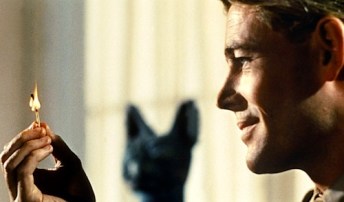 A similar legacy is left by those behind the scenes. Maurice Jarre’s score is the reference point for many a period desert epic — indeed, his music is so synonymous with such settings that it has arguably transcended its source to simply be what music for those locations and times is. It graces a film edited with class by Anne V. Coates, where scenes are allowed to play in luxuriantly long takes at times, while at others smash edits throw us from one location to another. This is undoubtedly supported by F.A. Young’s cinematography, where the wide frame can encompass so much action that there’s no need to cut amongst close-ups; and which can show the world in such majesty that you want it to hold for long, lingering takes. Even viewed on the small screen, the 70mm photography shines, especially on Blu-ray.
 As with any great film, Lawrence of Arabia is at least the sum of its parts. Replace any of the artists I’ve mentioned, or surely many more, and it would not be the film it is. In fact, when working on such a scale, this is more than a film — it’s an experience. And if that sounds pretentious, well, tough. If you haven’t experienced it yet, try not to leave it as long as I did.
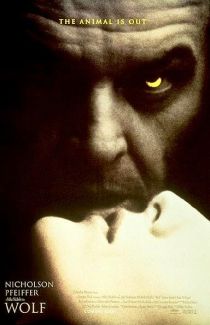 Without meaning to spoil anything, Wolf is rated R for “language and werewolf attacks”! I love the ludicrous specificity the MPAA indulge in sometimes. I know the BBFC’s famous “mild peril” is pretty useless, but at least they draw from an academic- and objective-sounding pool of phrases in their summaries, rather than throwing in ‘advice’ that is meaningless (there are perfectly PG werewolf attacks in other movies).
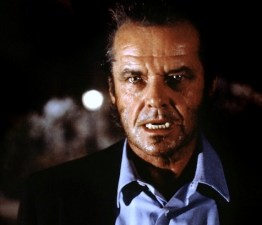 It’s those early sections where the film is at its best, when it tries to stay grounded in some form of realism. Any time it gets too Fantasy, it begins to get a tad silly. The climax in particular seems to come from a different film: Wolf abruptly moves from being an office politics drama with a fantasy edge, to a full-on manwolf-vs-manwolf brawl. As a straight dramatic director, Mike Nichols doesn’t seem to quite have the chops to pull off this fantasy/horror stuff without it beginning to look daft. That might not be entirely his fault, however, as reportedly the film was delayed by months to re-shoot the entire third act. Perhaps originally it had something more in-keeping? That said, he did want Michelle Pfeiffer to wear a red-hood sweatshirt during the finale! She refused, fearing it would harm the film’s credibility. She was right — it’s quite silly enough as it is.
 I can only presume there were hefty paydays for Nicholson and Pfeiffer, both megastars at the time, and possibly Christopher Plummer’s supporting role, maybe Nichols, and on scoring duties (obviously), Ennio Morricone. And maybe those re-shoots were really extensive. Or perhaps they spent it all on the nighttime aerial photography of Manhattan, which is gorgeous — that would’ve been worth it.
 After a decade locked away in motion-capture madness, Robert Zemeckis returned to the realms of the real with this Oscar-nominated drama. Its most high-profile nod was for Denzel Washington, starring as an airline pilot who miraculously crash lands his plane, but is revealed to have been high during the flight. Cue a film that attempts a grown-up account of addiction, but fumbles it, in the process missing the more interesting story of the crash investigation.
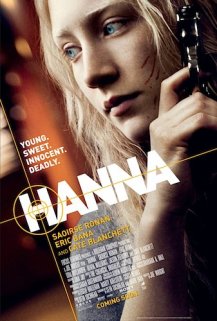 Most action-thrillers are cast from the same mould; it’s the decoration which dictates whether the final product is a Steven Segal or a Jason Bourne.
 Sean Bean and his ragtag band of knights investigate an unaffected village during Ye plague-adled Olden Days in this folk horror from the director of
 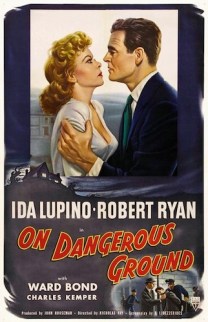 Helmed by acclaimed director Nicholas Ray (
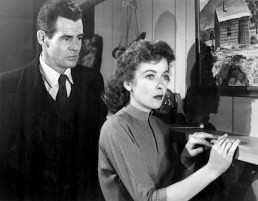 On the plus side, Bernard Herrmann’s score is unequivocally excellent, particularly the pulsating opening theme and the insistent action climax.
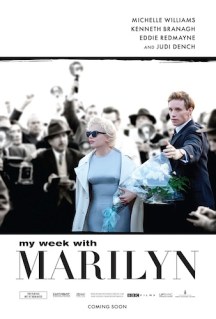 1956: global superstar Marilyn Monroe (Michelle Williams) comes to England to star opposite Laurence Olivier (Kenneth Branagh) in his latest directorial effort,
 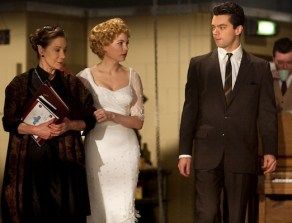 The supporting cast is a veritable who’s who of recognisable British faces, stars of screens both big and small. Barely a speaking part goes by without an actor you’re certain to recognise. I’d list them but, honestly, there are far, far too many. Despite Marilyn coming with a hefty entourage, Williams is the only American in the cast, meaning American accents are lumbered (to varying degrees of success) upon Zoe Wanamaker, Toby Jones, Dougray Scott, and Dominic Cooper. Hey, of course Dominic Cooper’s in it — is it even legal to make a mid-budget British movie without him now?
