
Wally Pfister | 114 mins | streaming (HD) | 2.35:1 | USA, UK & China / English | 12 / PG-13
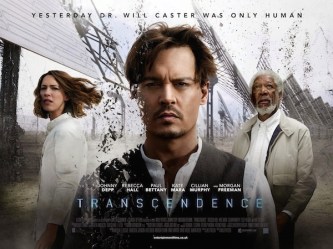 Christopher Nolan’s regular director of photography (he’s lensed seven Nolan films, from Memento to The Dark Knight Rises inclusive) makes his directorial debut with this near-future sci-fi thriller.
Johnny Depp plays scientist Will Caster, one of many artificial intelligence developers who are targeted in a coordinated series of assassination attempts by an anti-technology terrorist group. When he dies, his wife (Rebecca Hall) and best friend (Paul Bettany) use his brain patterns to recreate him as an AI. With access to the entirety of human knowledge as found on the internet, plus a mass of computing power and a lot of money, artificial-Will sets about research and development that will change the world. But his new advances may have a more sinister edge…
Transcendence is best known for the massive negative reaction it received on release, from critics and viewers alike. To be frank, I don’t really know why. Some say it’s too slow — well, I thought it moved like the clappers. What I thought was going to be the story was done in under an hour, from which point it spiralled off in new and interesting directions. How good is its science? I don’t know. I also don’t care — it’s about the characters and the spirit of what they do, more than whether it’s all literally possible. As a layperson, I didn’t think it was so ridiculously implausible that it took me out of the movie.
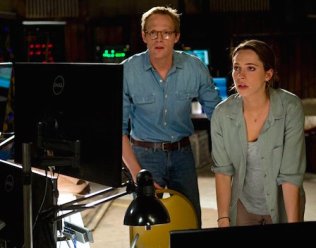 Another element that’s probably too challenging for some is where our allegiances are meant to lie. (Some spoilers follow in this paragraph.) At the start, it’s clear Depp & friends are the heroes and the murderous anti-tech terrorists are the villains. As events unfurl, however, artificial-Will perhaps goes too far, Bettany teams up with the terrorists, and eventually so do the government and Will’s other friends. There is no comeuppance for some characters who are initially begging for it; a good one self-sacrifices somewhat heroically. This doesn’t fit the usual Hollywood mould at all (well, the last bit does, sometimes), no doubt to some’s annoyance. The number of people who clamour for any sliver of originality or texture to their blockbusters, but then are unhappy when they actually get it…
Also up for debate is the film’s relationship with technology. It wouldn’t be wholly unfair to call it sceptical, maybe even Ludditish. That reading is only emphasised by Pfister’s Nolan-esque insistence of shooting on 35mm film, rather than now-standard digital, and going so far as to grade the movie photochemically rather than use a DI. This is an effects-filled film, too, so in all kinds of ways a computer-based post-production would’ve been the sensible way to go. Whether this insistence on old-school methods is artistically merited or not, it serves to underscore the film’s suspicion of where rampant technological advances may take us in the future.
A flaw I will absolutely acknowledge, however, is the film’s opening: set five years on from Will’s death, we see Bettany in a power-less world, where laptops are used as doorstops and discarded mobile phones are strewn across the street. Regular readers will know how much I hate pointless flashforwards at the start of films, but this is one of the worst ever — it gives away almost everything that will happen,  robbing the entire film of tension and nullifying any sense of surprise, and the movie doesn’t compensate with, say, a feeling of crushing inevitability. The climax in particular becomes a drawn-out exercise in connect the dots: we’ve been shown how this all ends up, now we’re just seeing the minutiae of how it got there. There’s no twist or reveal to speak of, just a wait for it to marry up with what we already know.
Some say Depp is wasted in a role where he cops it in the first act and is basically a computer voice from then on. There are pros and cons to this. From an acting standpoint, Hall and Bettany are really the co-leads; from a storytelling perspective, it’s them plus Depp. It pays off repeatedly to have a proper actor, rather than a glorified extra, as the third pillar of that relationship. Plus, having the film’s sole above-the-title star absent himself so early is an effective move — “he can’t die, he’s the star! …oh, he did.” Etc. As an acting showcase, it doesn’t give Depp much to do, other than reign in the flamboyance that is his go-to these days. Points for appropriate understatedness, then.
It’s left to Hall to carry the weight of their relationship. While he’s alive the pair don’t make for the most convincing “most in love couple ever” you’ll ever see, that’s true, but her emotions and dilemmas after his death and in the years that follow are more affecting. That said, this isn’t a low-budget drama. There’s definitely potential with this concept to make a film like that — one that focuses more firmly on the ethical and emotional effects of recreating someone after death (I think there’s an episode of Black Mirror that does something similar, in fact, but I’ve not seen it). Those considerations are in the mix here, but it’s a $100 million blockbuster too, so it has to allow plenty of time for military machinations and an explosive climax.
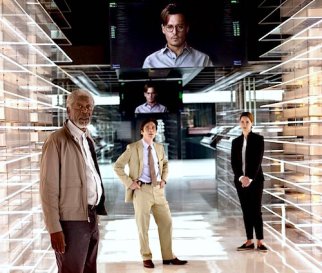 I guess that’s probably the explanation for Transcendence’s poor reception, in the end: it’s too blockbuster-y for viewers who’d like a dramatic exploration of its central moral and scientific issues, but too lacking in action sequences for those who misguidedly expected an SF-action-thriller. I maintain it’s not slow-paced, especially if you think it’s going to be, but nor does it generate doses of adrenaline on a committee-approved schedule. It’s not all it could have been, but if all you’ve heard is the mainstream drubbing, it’s probably better than you expect.

Transcendence debuts on Sky Movies Premiere today at 2:30pm and 8pm.
 An unnamed woman (Martina Gedeck) goes to stay with some friends at their lodge in the Alps. The friends pop into town, leaving their dog behind with the woman. When she wakes up the next morning, they’ve not returned, and she finds an invisible wall surrounding the mountain. Exploring its boundaries, she sees people outside, paused mid-life, as if frozen. As hours turn into days turn into weeks, she begins to realise the need to fend for herself, farming the land and caring for her animals, which come to also include a cow and a cat. As weeks turn into years, she comes to accept her new life, from which it seems there may be no end…
 The Wall starts out with a compelling mysterious premise, but seems to have no interest in exploring it or answering the many questions it raises. In some respects that’s better than the kinds of rote explanation offered by lesser films — you know, “Aliens did it. Why? Because.” — but it’s a bit like a joke without a punchline. Taking the setup as a mere excuse for an exploration of the human condition, I don’t know that it’s that illuminating. Either way, it makes for a sporadically interesting but ultimately unsatisfying experience.
 Robert Redford on a boat with no dialogue for over an hour and a half. That’s not a spurious way of describing All is Lost — that is what it is. Well, OK, he does say a couple of words — more or less literally “a couple”, though.
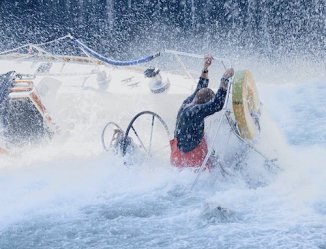 Through chance, coincidence, bad luck, but never forced tension-mounting on the part of the filmmakers (at least, not obviously so), our man’s fortunes go from bad to worse to even worse to even worse than that. Despite his best efforts, he’s on a downward spiral, a seemingly irreversible series of unfortunate events. If you ever had an interest in solo sailing, this is liable to put you off.
 Sometimes self-imposed filmmaking limitations lead to an exercise in competency over good moviemaking — “can we pull this off?” rather than “can we make a good film?” Chandor and co do pull their limitations off, I suspect not because someone set out purely to make a film with one character and no dialogue, but because it’s a gripping, exciting, tense movie, carried by a powerful near-silent performance and first-rate direction.
 Liam Neeson shoots wolves for an arctic drilling company, but when his flight home crashes, he must attempt to lead the small band of survivors across an icy wilderness to the mere hope of safety — pursued all the way by murderous wolves…
 Released the same year as
  Even with the undercurrents of grief and the difficulties of moving on, this is fundamentally a light, amiable romance.
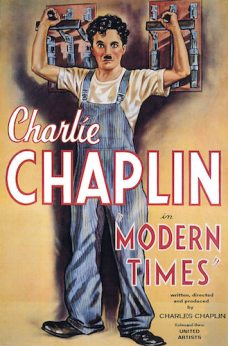 Charlie Chaplin satirises technology and modernisation in arguably
 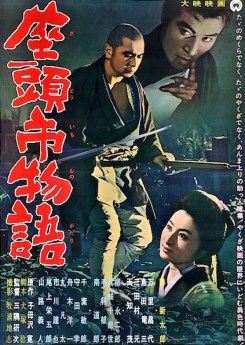 Adapted from a short story by Kan Shimozawa, The Tale of Zatoichi was a low-key release for its studio, Daiei: despite being helmed by “a topflight director”
 But enough hyperbole — what about The Tale itself? The story sees blind masseuse Zatoichi accepting an old invitation to visit an acquaintance, Sukegorô (Eijirô Yanagi). But Sukegorô is a yakuza boss, and he presses Zatoichi to join his side in a brewing war with rival Shigezô (Ryûzô Shimada) — because although he’s blind, the masseuse has legendary sword skills. On Shigezô’s side is a hired samurai, Hirate (Amachi), who Zatoichi encounters by chance. Despite the mutual respect between these two coerced warriors, the eventual gang battle comes down to a duel between them…
 Those prepared for a calmer, more considered film may find much to like, however. Katsu’s understated style holds your attention and makes you want to learn more about the character; not his past, necessarily, but his qualities as a man. The same is true of Amachi, in some ways even more appealing as the doomed ronin. You get a genuine sense that Zatoichi and Hirate would have had a great, long-lasting friendship if they’d met under better circumstances, which makes the manner of their encounter all the more tragic. For all the bluster about a big gang war on the horizon, it’s the relationship between these two men that forms the heart of the film.
 Reportedly this opener is “not the best of [the] series”, but remains “a grand introduction to the character and a touchstone for many of the themes and gags presented in the later films”.
 Seven Samurai used to be a striking anomaly amongst the top ten of
  It’s also unhurried. As Kenneth Turan explains in his essay “The Hours and Times: Kurosawa and the Art of Epic Storytelling” (in the booklet for Criterion’s DVD and Blu-ray releases of the film, and available online
 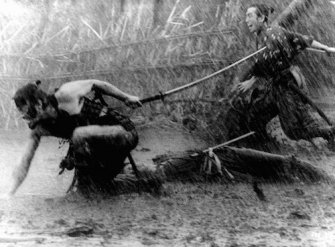 The length ensures our investment in the village, too, just as it does for the samurai. They’re not being paid a fortune — in fact, they’re just being paid food and lodging — so why do they care? Well, food and lodging are better than no food and lodging, for starters; and then, having been in the village so long in preparation, they care for it too. It is, at least for the time being, their home. You can tell an audience this, of course, but one of the few ways to make them feel it is to put them there too — and that’s what the length does. To quote from Turan again,
 the final scene, the way it’s edited and framed, ties the remaining samurai to their deceased comrades, the living and thriving farmers a distant and separate group. Fighting is the way of the past, perhaps, and peaceful farming the future. Or is the samurai’s only purpose to be found in death, because other than that they are redundant?
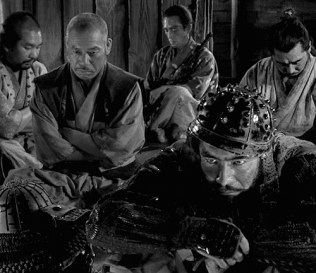 And it wasn’t as if it was overseas viewers who hit on the magic: as Turan reveals, “Toho Studios cut fifty minutes before so much as showing the film to American distributors, fearful that no Westerner would have the stamina for its original length.” The more things change the more they stay the same, I suppose — how many Great Films from Hollywood are ignored by awards bodies and audiences, only to endure in other ways?
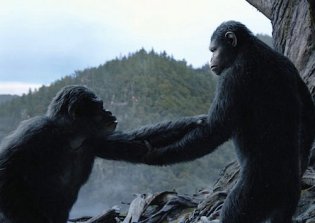 A heady mix of solid writing from Mark Bomback, Rick Jaffa and Amanda Silver, peerless motion-captured performances from the likes of Serkis and Toby Kebbell, and first-rate CG magic from Weta, brings us a set of characters who are compelling and believable. Here is a society trying to define what it wants to be, battling old prejudices in the hope of a peaceful, secure, happy future. If you want to draw analogies to almost any real-world political situation, I’m sure you could.
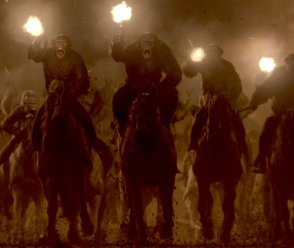 Lest you get the wrong impression, the film isn’t all talk. For various spoiler-y reasons, the fragile relationship between Man and Ape breaks down, and the apes stage an attack on humanity. Here we get perhaps one of the best siege action sequences I can think of, with mankind holed up in a half-constructed skyscraper that sits conveniently at the end of a long street for the apes to charge down. Reeves’ direction is virtuosic here, crafting an epic and exciting sequence even when most of the film’s major players are busy elsewhere. And it’s not even the climax.
 thanks to some surprisingly small-scale narrative choices (the whole thing with the dam doesn’t feel nearly as vital as it should) and Reeves’ direction sometimes being a little straightforward and almost TV-ish. I know I’ve said I hate when people use that as a derogatory comment nowadays, but some repeated locations and shot choices make the film feel cheaper than it was.
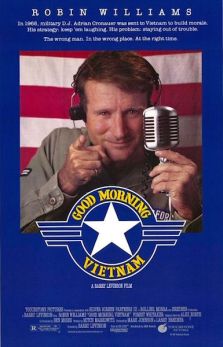 Inspired by the true story of a US Army DJ in Vietnam during the war, the resulting film is a showcase for star Robin Williams — reportedly, his antics aren’t even close to what really happened.
 100Films.co.uk