Casablanca (1942)

100 Films’ 100 Favourites #17

They had a date with fate in Casablanca.

Country: USA
Language: English
Runtime: 102 minutes
BBFC: U
MPAA: PG (1992)

Original Release: 7th December 1942 (Brazil)
US Release: 23rd January 1943
UK Release: December 1942 (BBFC)
First Seen: DVD, 2006

Stars
Humphrey Bogart (The Maltese Falcon, The Big Sleep)
Ingrid Bergman (Notorious, Autumn Sonata)
Paul Henreid (Now, Voyager, Deception)
Claude Rains (The Invisible Man, Notorious)
Conrad Veidt (The Cabinet of Dr. Caligari, The Thief of Bagdad)

Director
Michael Curtiz (The Adventures of Robin Hood, Mildred Pierce)

Screenwriters
Julius J. Epstein (Arsenic and Old Lace, Cross of Iron)
Philip G. Epstein (Arsenic and Old Lace, The Last Time I Saw Paris)
Howard Koch (The Letter, Letter from an Unknown Woman)

Based on
Everybody Comes to Rick’s, an unproduced play by Murray Burnett and Joan Alison. (Despite the film’s popularity, a legal dispute between the playwrights and Warner Bros meant it wasn’t staged until 1991.)

The Story
Controlled by the German-subservient French government, Morocco in 1941 is a congregation point for German officials, collaborating French, and refugees attempting to get to neutral America. When letters of transit allowing that passage come into the possession of nightclub owner Rick Blaine at the same time as the love of his life, Ilsa Lund, walks into his joint with her husband, Resistance leader Victor Laszlo, Rick has some tough decisions to make — and quickly, with corrupt police captain Renault hunting for the letters and German Major Strasser gunning for Laszlo…

Our Hero
Of all the gin joints in all the towns in all the world, everybody comes to Rick’s. That’s because Rick is Humphrey Bogart. You’d go to a bar run by Humphrey Bogart, wouldn’t you?

Our Heroine
The most beautiful woman to ever visit Casablanca (a gross understatement), here’s looking at you, Ingrid Bergman. (Yes, I added this section pretty much just to say that.)

Our Villains
It’s set during World War 2 so, I mean, who do you think?

Best Supporting Character
Claude Rains was the Invisible Man, but here he’s Captain Louis Renault, a corrupt copper who — despite being fourth-billed in a film packed with memorable dialogue — still gets a good many of the best lines.

Memorable Quote
“Of all the gin joints in all the towns in all the world, she walks into mine.” — Rick

Quote Most Likely To Be Used in Everyday Conversation
“Louie, I think this is the beginning of a beautiful friendship.” — Rick

The Most Famous Misquote in Movie History
“Play it again, Sam.” — Rick
(Ilsa says “Play it once, Sam,” and “Play it, Sam.” Rick says, “You played it for her, you can play it for me. If she can take it, I can take it, so play it!”)

Memorable Scene
As Laszlo boards the plane out of Casablanca, Ilsa thinks she’s staying with Rick… until he convinces her to go. Standing in the doorway of an aircraft hanger, it’s probably the film’s most iconic scene — if you’ve not seen it, you’ve certainly seen it parodied.

Memorable Song
You must remember this: a kiss is just a kiss, a sigh is just a sigh. The fundamental things apply, As Time Goes By. Play it again, Sam!

Making of
Casey Robinson re-wrote the film’s romantic scenes and was offered a credit, but turned it down because he only took credit for screenplays he wrote entirely himself. Of course, with that decision he missed out on winning an Oscar.

Awards
3 Oscars (Picture, Director, Screenplay)
5 Oscar nominations (Actor (Humphrey Bogart), Supporting Actor (Claude Rains), Black-and-White Cinematography, Editing, Score)

What the Critics Said
“bear in mind that it goes heavy on the love theme. Although the title and Humphrey Bogart’s name convey the impression of high adventure rather than romance, there’s plenty of the latter for the femme trade. Adventure is there, too, but it’s more as exciting background to the Bogart-Bergman heart department. Bogart, incidentally, as a tender lover (in addition to being a cold-as-ice nitery operator) is a novel characterization” — Variety

Score: 97%

What the Public Say
“the script’s greatest strength is not quotability. It’s character development. Rick, Ilsa, Renault and Laszlo are complex individuals, about whom we care, no matter their flaws. Sam (Dooley Wilson), an African American pianist, is layered by loyalty to Rick and emotional acuity, while Major Strasser, the antagonist, is not a comic book villain. Because he’s a Nazi, we do not like the Major, but director Michael Curtiz and his writers are smart enough not to make him stereotypically evil, instead opting to develop him as determined and efficient. Because all of the characters are so genuine, the filmmakers earn our emotional investment” — Josh, Cinema Parrot Disco

Verdict

Casablanca is remembered now as much for its selection of ever-quotable lines as for anything else — you don’t have to have seen the film to know that if you go walking into all the gin joints in all the towns in all the world and someone’s looking at you, kid, then maybe not today, maybe not tomorrow, but soon you should round up all the usual suspects again, Sam, for the beginning of a beautiful friendship. Or something. It’s much more than that, though: an engaging romantic drama, with enough overtones of noir to keep it snappy, set in perhaps a ’40s equivalent of the Wild West. It may be three-quarters of a century old next year, but it still merits playing again.

#18 will see… Bond begin.

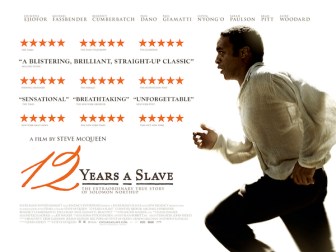
12 Years a Slave (2013)

2016 #3
Steve McQueen | 134 mins | streaming (HD) | 2.35:1 | USA & UK / English | 15 / R

Oscar statue2014 Academy Awards
9 nominations — 3 wins

Winner: Best Picture, Best Supporting Actress, Best Adapted Screenplay.
Nominated: Best Director, Best Actor, Best Supporting Actor, Best Film Editing, Best Costume Design, Best Production Design.


As we know, the Oscars are racist and always have been, especially recently. Like two years ago, when they didn’t give a load of nominations and several awards to a film about slavery from a black director and black screenwriter.
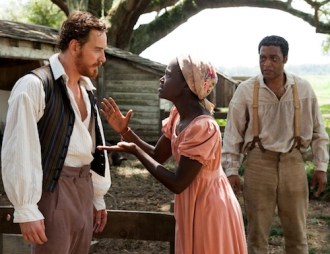
Oh, wait…

That film was, obviously, 12 Years a Slave, the true account of Solomon Northup (Chiwetel Ejiofor), a free black man who was kidnapped from his New York home and sold into slavery in the South. His story provides an overview, of sorts, of the experience of working as a plantation slave, both for a relatively decent master (Benedict Cumberbatch) and an evil SOB (Michael Fassbender).

One person who didn’t win an Oscar was Ejiofor (he lost to Matthew McConaughey, but he did win the BAFTA). His nomination was certainly deserved, though, because it’s an incredible lead performance — restrained most of the time, evoking Solomon’s internal life subtly rather than showily, but with carefully executed break-outs of emotion. Indeed, I’m slightly baffled by online commenters who felt the film was cold and lacking emotion or character. At the risk of getting on a high horse, I wonder if it was just too subtle for some? Ejiofor isn’t sat there tearing his heart out, but I thought there was considerably more to his performance than “looks happy in flashbacks, looks miserable in slavery”.

Nonetheless, the supporting performances are uniformly excellent, too. Paul Giamatti and Brad Pitt may be mere cameos, the presence of such actors highlighting their roles more than their function within the narrative does, but there are very strong turns from Cumberbatch, Paul Dano, Sarah Paulson, and in particular Oscar-winning Lupita Nyong’o, who will break your heart, and Michael Fassbender, who is overdue the gong for his many varied and accomplished performances. (I doubt his forthcoming triple of X-Men 6, video game adaptation Assassin’s Creed, and prequel-sequel Alien: Covenant will do anything for him in that regard, but he’s not yet 40, and that’s the prime part of a man’s life for Oscar winning, apparently.)

Steve McQueen’s direction is classical but effective, rarely drawing attention to itself when it has more important things to convey. That’s not to sell it short, though. A scene in which Fassbender’s plantation owner forces Solomon to do something unthinkable is achieved in a single roaming take that lasts nearly five minutes; a tour de force of camerawork, performance, and behind-the-scenes choreography, which only serves to heighten the tension and horror of the experience by never cutting.

Unsurprisingly, 12 Years a Slave is not an easily digestible film — it’s about a disgusting part of human history, and doesn’t shy away from some of its horrors. That said, it’s watchable thanks to the top tier performances, consummate direction, and moving storytelling.

5 out of 5

12 Years a Slave was viewed as part of my What Do You Mean You Haven’t Seen…? 2016 project, which you can read more about here.

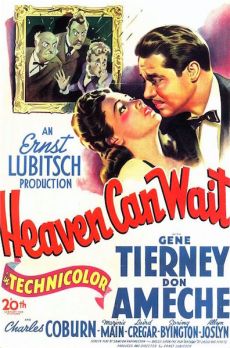
Heaven Can Wait (1943)

2015 #198
Ernst Lubitsch | 108 mins | TV | 4:3 | USA / English | U

My first experience of Lubitsch’s US output concerns a man who arrives on Hell’s doorstep and reflects on his life to explain why he’s there.

It starts brilliantly: the bookend scenes are excellent, and the early parts of the plot are buoyed by consistent wit and enjoyable characters, particularly Charles Coburn as a slyly raucous grandfather. As it heads into its second half, it loses momentum and focus, the most entertaining characters disappear, and it takes its time plodding to a finale.

An enjoyable film with a lot of amusement value, just a little too long for its own good.

4 out of 5

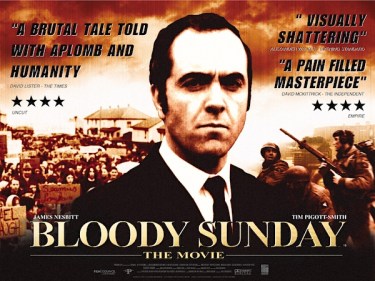
Bloody Sunday (2002)

100 Films’ 100 Favourites #14

January 30, 1972
a day written in history
a day when innocence died
when truth was sacrificed
and lives were changed forever

Country: UK & Ireland
Language: English
Runtime: 110 minutes
BBFC: 15
MPAA: R

Original Release: 20th January 2002 (UK)
First Seen: TV, 20th January 2002

Stars
James Nesbitt (Millions, The Hobbit: An Unexpected Journey)
Tim Pigott-Smith (The Remains of the Day, V for Vendetta)
Nicholas Farrell (Chariots of Fire, Hamlet)
Kathy Kiera Clarke (The Most Fertile Man in Ireland, Cherrybomb)

Director
Paul Greengrass (United 93, Captain Phillips)

Screenwriter
Paul Greengrass (The Murder of Stephen Lawrence, United 93)

The Story
Derry, Northern Ireland, 30th January 1972: MP Ivan Cooper leads a peaceful march to protest internment. British paratroopers observing the march, geed up after previous conflicts, respond to minor rioting by shooting into the unarmed crowd and at fleeing civilians.

Our Hero
James Nesbitt stars as MP and civil rights activist Ivan Cooper, a Protestant who was elected in a mostly Catholic constituency, and the organiser of what was supposed to be a peaceful protest march.

Our Villains
The British Army don’t come across in the best light, with Tim Piggot-Smith’s Major General Robert Ford issuing hostile orders, and the troops eager for a fight. The depiction is tempered by Nicholas Farrell as Brigadier Patrick MacLellan, battling his conscious even as he must carry out his orders.

Memorable Quote
“I just want to say this to the British Government. You know what you’ve just done, don’t you? You’ve destroyed the civil rights movement, and you’ve given the IRA the biggest victory it will ever have. All over this city tonight, young men — boys — will be joining the IRA, and you will reap a whirlwind.” — Ivan Cooper

Memorable Scene
After the day is done, Ivan Cooper delivers the above statement at a press conference. Intercut, at inconspicuous locations and under the cover of dark, young men queue up to join the IRA.

Technical Wizardry
Shot handheld on 16mm by cinematographer Ivan Strasburg, Bloody Sunday looks like news footage. It’s not trying to pass itself off as documentary, but rather it places the viewer in the heart of events. Clever shot selection and Clare Douglas’ editing mean that, even though a sense of confusion is evoked, the chronology and geography of events is maintained.

Making of
“Making the film Bloody Sunday was important for me, not only as an actor but for my understanding of myself as an Ulsterman. It helped me realise that this episode was the watershed, and that the ensuing 30 years of conflict in Northern Ireland were in large part due to what happened that day in 1972. For it was on that night that young men all over the country joined up with the IRA in a sense of rage and injustice at what had happened.” — James Nesbitt, The Independent

Awards
1 BAFTA TV Award (Photography and Lighting)
4 BAFTA TV Award nominations (Actor (James Nesbitt), Single Drama, Editing, Sound)
2 British Independent Film Awards (Actor (James Nesbitt), Director)
3 British Independent Film Award nominations (Best British Independent Film, Screenplay, Technical Achievement (Cinematography))
4 Irish Film and Television Awards (Feature Film, Director, Script, Sound)
4 Irish Film and Television Award nominations (Actor (James Nesbitt), Actress (Kathy Kiera Clarke), Photography, Editing)
Won the Golden Bear at the Berlin International Film Festival (tied with Spirited Away).

What the Critics Said
“you have to remind yourself at moments that you’re not looking at a documentary. […] Filmed in 16mm, with a hand-held camera that seems to be breathlessly attempting to keep up with the chaotic events, the movie has a stunning immediacy. It doesn’t feel as if Greengrass has staged the events, but that his camera (in the expert hands of cinematographer Ivan Strasburg) happened to be there when the tragedy occurred, a witness to the British officers’ planning, to the marchers’ anger and panic, to the soldiers’ gung-ho macho and to the cover-up that followed.” — David Ansen, Newsweek

Score: 92%

What the Public Say
“The film has been criticized by some as focusing too much on the Cooper character, encouraging a “great man” view of history. This criticism seems overblown when one considers the breadth of Bloody Sunday, but Greengrass does acknowledge an interest in placing Cooper at the fore as a kind of “man between worlds,” being a Protestant politician campaigning for peace across Northern Ireland and for civil rights denied to his Catholic countrymen.” — spinenumbered, Make Mine Criterion!
(Be advised, the Criterion Collection edition of the film described in this article is wishful thinking rather than a genuine release.)

Verdict

Bloody Sunday is a tough film to write about in a somewhat frivolous format like this one. It’s a film about a terrible moment in history, a shameful day for the British Army and a tragic one for the people of Northern Ireland, which it presents with documentary realism and an objective perspective, more concerned with presenting the facts as best it can than with apportioning blame. Even given that, it’s an inescapably emotional and affecting film. Powerful moviemaking.

#15 will be… extreme ways.

Ex Machina (2015)

2016 #26
Alex Garland | 108 mins | Blu-ray | 2.40:1 | UK / English | 15 / R

BAFTABritish Academy Film Awards 2016
5 nominations

Nominated: Best British Film; Best Supporting Actress (Alicia Vikander); Best Original Screenplay; Best Special Visual Effects; Outstanding Debut by a British Writer, Director or Producer.

A British sci-fi movie from a first-time director will tomorrow take a place at the table (well, in the auditorium) alongside 2015’s biggest awards contenders, as it vies for multiple gongs at this year’s BAFTAs — and it stands a very plausible chance of walking away with several of them, too. I hope it does, because, after a year that brought us awards-quality sci-fi bombast (Mad Max, Star Wars), it’s fantastic that a small film about three people sat in rooms talking can stand toe-to-toe with them as one of the year’s best.

The increasingly ubiquitous (and deservedly so) Domhnall Gleeson stars as Caleb, a programmer at search engine giant Google Bluebook who wins a staff lottery to spend a week with the company’s reclusive founder, Nathan, played by the increasingly ubiquitous (and deservedly so) Oscar Isaac. However, on his arrival he learns he’s not just there to hang out: Nathan wants him to perform a Turing test on an AI he’s built. The point of the Turing test (as I’m sure you know) is for a human to interact with an AI but not realise it’s an AI, so Caleb’s surprised when said AI — Ava, played by the increasingly ubiquitous (and deservedly so) Alicia Vikander — comes in the form of a robot that’s obviously a robot. The real test is whether Caleb can know he’s talking to something non-human and still come to be convinced it’s human. As Caleb begins his interviews with Ava, it becomes apparent that there’s something else going on at this remote facility, where regular power cuts mean they’re all locked in…

As is probably clear, Ex Machina is a sci-fi movie of the thoughtful variety. It’s a film that considers ideas of artificial life, how we test it and what it means to create it, and only gradually builds in thriller elements that pay off in its final twenty-or-so minutes. In truth, it’s not the most thorough deconstruction of what it means to be human and whether artificial intelligence can have that right, but it does touch on these issues and, in so doing, leaves them open for the viewer to mull over for themselves, or debate with friends, or however else one likes to consider their movies post-viewing (like, I dunno, writing about them on the internet or something).

There are thematic similarities to Blade Runner, which (in case you’ve not seen it) also deals with the humanity or otherwise of man-made intelligence. Mulling on that comparison, I’m tempted to say Ex Machina is almost the inverse of Blade Runner, in this regard: Ridley Scott’s classic is ostensibly an SF-noir thriller (Harrison Ford is a cop hunting down some rogue robots), but by its end has revealed a considered exploration of what it means to be human, and whether these artificial creatures can lay claim to that. Conversely, Alex Garland’s film seems like it’s sitting us down to consider those same issues, but is actually laying the groundwork for revelations and twists that build to an edge-of-your-seat climax. I’m not saying one’s better than the other in this respect, just that they’re approaching the same topics almost from opposite ends.

Also like Blade Runner, Ex Machina is an exceptionally well made and performed film. Not in the same way as Blade Runner — it’s bright and clean and modern, in a Google-y, Apple-y kind of way — but to a similar level of internal consistency and accomplishment. Gleeson’s Caleb may seem a little plain, a blank page for the other characters to write on, but as his insecurities begin to come to the fore you realise that’s almost the point. Isaac is suitably overbearing as the alcohol-dependent genius behind Bluebook and Ava, an initially affable but quickly disquieting presence — he may be a threat, or may just be a bit odd. And his dance scene is surely one of 2015’s highlights (there’s an extended version hidden on the US Blu-ray, which is a treat). Garnering the most praise (and awards) is Alicia Vikander’s take on an AI. It’s a tricky role to tackle, because she’s not just a robot — that would defeat the point of Nathan’s exercise — but nor is she fully human. It’s a tightrope of a role, a fine line to walk, and Vikander negotiates it with aplomb. To say too much more would be to spoil it.

Aside from the acting, the film’s most striking element is surely the design of Ava. Her face and hands appear to be human, but everything else is robotic, and much of it transparent. This isn’t a case of slipping an actor into a suit painted with circuitboards — you can see the metal limbs and motors in her arms and legs, the metal spine in her back, the various computers or power sources or whatever glowing and spinning inside her. Occasionally she dresses in clothes and her workings are covered, but she spends most of the film with them on display. The CGI is literally flawless, which for a relatively-low-budget little British sci-fi-drama is all the more remarkable. I guess the visual effects awards are going to go to the big films, Star Wars or Mad Max or The Revenant (the bear seems to be very popular), but I do wonder if the work here is more deserving. You know how it must’ve been done — mo-cap suits and CGI — but there’s still a feeling of “how did they do that?”, because it’s so faultless. In fact, you don’t even wonder how they did it, because you just accept it; it’s only if you actively stop to consider it that you realise it’s physically impossible and must be CGI.

Those after a dissertation-like hard-science deconstruction of the meaning and possibilities of AI will likely find Ex Machina slightly lacking, as will anyone after the crash-bang thrills most mainstream sci-fi provides. Viewers prepared for a decently thought-provoking dramatic thriller about near-future tech, however, should be both engrossed, and grateful that movies like this are (for the time being) still getting made.
5 out of 5

The British Academy Film Awards are tomorrow night, televised on BBC One from 9pm.

Ex Machina placed 20th on my list of The 20 Best Films I Saw For the First Time in 2016, which can be read in full here.

The Martian (2015)

2016 #25
Ridley Scott | 142 mins | Blu-ray | 2.40:1 | USA & UK / English | 12 / PG-13

Oscar statue2016 Academy Awards
7 nominations

Nominated: Best Picture, Best Actor (Matt Damon), Best Adapted Screenplay, Best Sound Mixing, Best Sound Editing, Best Visual Effects, Best Production Design.


Ridley Scott’s latest arrives on Blu-ray in the UK today, with a disappointing dearth of special features (disliked Exodus gets a 2½-hour making-of, four hours of additional features, plus a commentary; award-winning The Martian gets 24 minutes plus a few in-universe documentaries — what?!) Never mind that, though: how good is the film deemed the best comedy or musical of 2015? (If you somehow missed that news, you’ll appreciate the addition of a “seriously” here.)

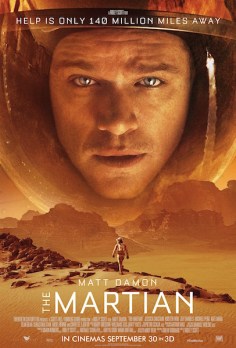
In the relatively near future, mankind is on its third manned mission to Mars. When a colossal storm rolls in, the decision to made to evacuate the Mars base. During the escape, biologist Mark Watney (Matt Damon) is struck by debris and apparently killed, and his crew mates are forced to leave him for dead. He isn’t dead, though, but he is injured and alone on a planet 140 million miles from home, with no way to communicate with Earth, and not enough energy, oxygen, or food to see him through the four years until the next Mars mission is scheduled to arrive. Refusing to give in to inevitable death, Watney only has one choice: science the shit out of this.

That sounds like a laugh-a-minute premise, right? And there’s a major subplot about disco music, so it’s practically a musical too!

No, the HFPA are just idiots — The Martian is neither a comedy nor a musical. It is the latest in a growing subgenre of serious-minded near-future sci-fi adventures, though, following in the footsteps of 2013 Oscar winner Gravity and 2014 Oscar washout Interstellar. Where The Martian differs is in the element that tricked Golden Globes voters into thinking they could get away with giving it a comedy nomination (and win): rather than being stuffed to bursting with po-faced peril, it has a lightness of touch and regular doses of humour, making it probably the most feel-good serious sci-fi movie since ever.

Whether that’s appropriate or not is another matter. A well-argued review by the ghost of 82 assesses that the film has none of the darkness or loneliness you should expect of a man stranded alone on an alien world with a slim chance of survival or rescue. I don’t disagree that the film doesn’t contain much of that feeling, nor would I argue that such a tone isn’t a viable way to frame this narrative, but I don’t think that’s what Scott was aiming to convey. This telling of the story (I haven’t read the original novel, so can’t say how it compares tonally) is an adventure; a feel-good tale of hope and survival against the odds. The film doesn’t offer us despair because Watney doesn’t despair — he just gets on with trying to fix it. On the couple of occasions when his fixes go wrong, his chirpiness breaks down, his frustration comes out, and in some respects it’s all the more effective for being limited to those handful of occasions — we’re suddenly reminded that, in spite of his optimism and his success and all the fun we’re having watching it, he’s stranded 140 million miles away and even the slightest mistake can spell total disaster.
Matt Damon is a talented enough actor to lead us through all of this. Best remembered in recent years for serious fare like the Bourne films (“serious” in the sense of “not comedic” as opposed to “realistic”), Damon has done his fair share of comedies before now, and skits for TV shows and the like too. This is perhaps his first film to bring those two sides together as equally necessary parts of the whole — serious when he’s struggling with science problems or facing the reality of his situation, funny when he’s taking it all as light-heartedly as he can. Sometimes, such as in emotional conversations with friends or colleagues stuck millions of miles away, he even has to do both at once.

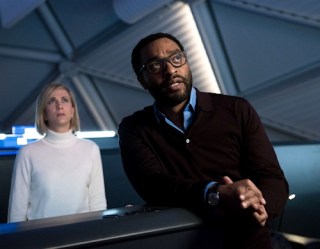
While Damon is stuck on Mars by himself, a starry supporting cast actually get to interact with each other. This is a quality ensemble and, short of writing an epic essay of a review where I just praise them all one by one, there’s little to do but list their names. That said, Jessica Chastain gets the most brazenly emotional beats as the commander who chose to leave Watney behind and has to face the consequences of her decision; Jeff Daniels treads a line between being an evil bureaucrat and just a regular bureaucrat (apparently consideration was given to turning him into a full-blown villain; thank goodness they swerved that bullet); Chiwetel Ejiofor brings easy gravitas to NASA’s director of Mars missions; Michael Peña provides some additional comic relief, if not as strikingly as he did in Ant-Man then at least as effectively; and Sean Bean doesn’t die. No offence to Sean Bean, but let’s be honest, at this point in his career that is the most notable facet of his appearance here. That and the Lord of the Rings reference.

It would be too damning to describe Ridley Scott’s direction as unremarkable, but at the same time it feels lacking in distinctiveness. Apparently there was some interview where he commented on how easy he found directing The Martian, I think with intended reference to the use of digital photography, but I think you get a sense of that from the film as a whole. That stops it from being over-directed, at least, and it’s certainly not poorly made, but if you didn’t know then you wouldn’t be nodding along going, “oh yes, this is definitely a Ridley Scott movie.” I’m not sure that’s a bad thing. Considering his fiddling is what scuppered the promising screenplays that initiated both Robin Hood and Prometheus, and his other works this decade (The Counsellor and Exodus: Gods and Kings) haven’t exactly met with great acclaim, maybe his dropping in almost as a director-for-hire (screenwriter Drew Goddard was attached to direct, but got sidetracked into the now-cancelled Sinister Six Amazing Spider-Man spin-off), and helming the film in a kind of directorial autopilot, is part of what saved it from a similar fate.

I’ve read at least one review that described The Martian as “an instant sci-fi classic”, and at least one other that described it as “no sci-fi classic”. I’m going to sit on the fence of that debate for the time being. What I will say is that it is undoubtedly an accomplished piece of entertainment. For a film that primarily concerns itself with a man applying scientific principles to tasks like “growing potatoes”, that’s surely some kind of achievement. In our current climate (both in society in general and in the “more explosions less talking, please” state of blockbuster cinema), to make space travel — and science in general — seem fun and appealing to the masses is no bad thing whatsoever.
5 out of 5

As mentioned, The Martian is released on DVD and Blu-ray in the UK today.

It placed 17th on my list of The 20 Best Films I Saw For the First Time in 2016, which can be read in full here.

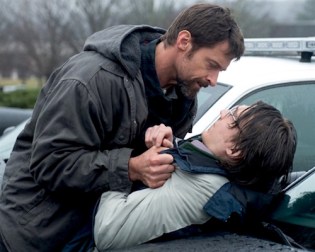
Prisoners (2013)

2016 #22
Denis Villeneuve | 153 mins | Blu-ray | 1.78:1 | USA / English | 15 / R

Yesterday I wrote about Predestination, a twisty sci-fi thriller in which I guessed all the twists long before the end, but it didn’t matter because the film had more to offer. Today I find myself in the same situation: Prisoners is a thriller (though not of the sci-fi variety) centred around some mysteries that lead to big twists, all of which I guessed with complete accuracy about one-third of the way through.* I don’t say this to boast — well, I do a little — but my other point is this: while it proved a bit of a distraction, occasionally feeling like I was sitting through aimless red herrings as I waited to be proved right, there’s more to Prisoners than just OMG moments.

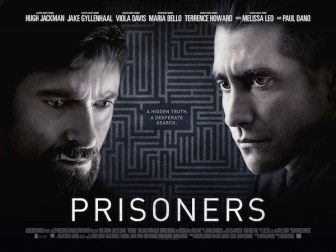
We set our scene on Thanksgiving in the small, slightly rundown Pennsylvania city of Conyers, where the Dover and Birch families gather for the traditional lunch at the latter’s house. As things transpire, they can’t find their two little girls, and a suspicious RV parked down the street has disappeared. Fearing the worst, they call the police, who track down the RV and its driver, an adult with the mental capacity of a ten-year-old. The girls are nowhere to be found. He’s the obvious suspect, but he couldn’t’ve taken them… could he? As Detective Loki (Jake Gyllenhaal) pursues an increasingly complex investigation, unsatisfied Dover patriarch Keller (Hugh Jackman) thinks he might need to take matters into his own hands…

There’s a lot going on in Prisoners. While the basic format is straightforward, it’s realised in the form of a multi-stranded narrative full of well-drawn characters with complications of their own. Jackman and Gyllenhaal may be top billed and on the poster (well, an air-brushed waxwork vague approximation of Jackman was on the poster), but there’s actually a powerful ensemble cast here, and it’s their performances that help the film to stand out from the thriller crowd — as well as to overcome the fact I guessed all the twists.
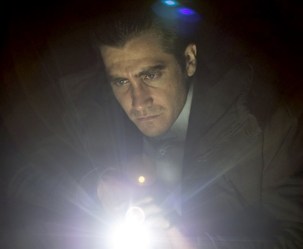
So we have: Maria Bello as Grace Dover, who begins to crack under the mental pressure of her daughter’s disappearance. Terrence Howard as Franklin Birch, who, based on their houses, is clearly in a better financial situation than Keller, but is he man enough to help Keller do what he feels needs doing? His wife, Nancy, played by Viola Davis, may at first suggest a fragility to match Grace’s, but it soon becomes clear she wears the trousers in this marriage. As mentally stunted suspect Alex Jones, Paul Dano gives a well-managed dialogue-light performance, not straying into caricature. The aunt who raised him, Holly, played by Melissa Leo, is protective, but also doesn’t seem all that shocked by the accusations levelled against him.

Then we do have our two leads. I think Gyllenhaal’s Det. Loki may be supposed to come across as a first-rate cop — he’s certainly so good that he can tear his Captain a new one about not doing stuff properly and not get a dressing-down for it — but he struck me as a little less than ideal. I mean, he’s effectively a small-town cop suddenly stuck in a child-kidnapping (and possibly murder) case — of course he should be out of his depth. He’s not a bad detective, just not the usual genius-level investigator you normally find in thrillers, and at times you feel he’s muddling his way through the investigation as best he can. Aside from giving Loki the slightly-affected tic of blinking too much, Gyllenhaal offers a reasonably restrained performance. (I’d love to know what the blinking was in aid of, but the film is woefully understocked with special features.)
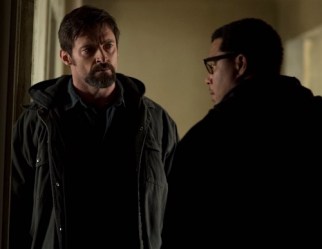
Jackman gets a showier turn as Keller Dover, the dad who prides himself on being a strong, capable, prepared-for-anything kinda guy. This is partly a value his father instilled in him, he tells his son, but you have to think there’s an element of it being a response to the emasculation of not being able to fully provide for his family — there’s not much work around, he mentions, and their home environment clearly isn’t as well-appointed as the Birches’. He does have a basement full of survivalist gear, though, and we first meet him coaxing his son into shooting his first deer. This is a man ready to do what he feels is necessary, and what he feels is necessary takes him — and, by association, several of the other characters, and indeed the whole film — to some dark places.

Not that the film needs any help accessing dark places. The truth behind what’s happened to the girls is very dark indeed… though that would be spoiler territory. I thought it was a good solution, even if I did guess it so early on, but I’ve seen others suggest it’s too neat. I dunno, but I think it’s come to something when a film answering all its questions and explaining all its threads is seen as a bad thing.

Denis Villeneuve’s direction gives the sense of a non-Hollywood background with the occasional arty shot choice or composition, though not to a distracting extent. He’s aided by serial Oscar loser Roger Deakins on DP duty, who once again demonstrates why he shouldn’t have a golden man already, he should have a cupboard full. The photography here doesn’t flaunt itself with hyper-grading or endless visual trickery, but is consistently rich and varied. Deakins may also be the best action cinematographer working — pair what he brought to Skyfall with a climactic car dash here and you have a more impressive action demo reel than you’d expect from the kind of guy who has multiple Oscar nominations to his name.

In the end, I find it a little hard to succinctly assess Prisoners. We have a film of complex characters brought to life with vivid performances, though the latter are not adverse to an element of grandstanding, and some of their actions slip into genre familiarity. So too the narrative, which for all its twists and turns isn’t a world away from any number of airport-bookstore doorstop thrillers — and that length is certainly mirrored in the two-and-a-half-hour running time. The fact that I was waiting for my predictions to be confirmed also colours my perception somewhat, because while I don’t think the film completely leans on its twists, it was a bit of a distraction. Nonetheless, you can’t deny the quality of the moviemaking, particularly Villeneuve’s sweeping direction and Deakins’ rich cinematography.

As a thriller that is also a drama about people caught up in those events, and the lengths to which some of them may be prepared to go, Prisoners is a must-see for anyone with the stomach for some dark material (though don’t let me overemphasise that point — it’s not as bleak as, say, Se7en). Is it a classic in its own right, though? Not sure. But it is very, very good.
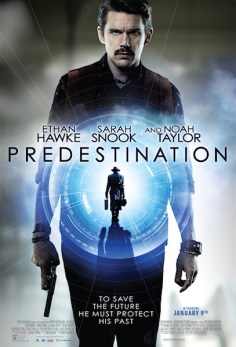
4 out of 5

The UK network premiere of Prisoners is on Channel 4 tonight at 9pm.

* For those playing along at home: the precise moment I got it (explained in non-spoilery terms) was when Det. Loki visits an old lady and watches a VHS. ^

Predestination (2014)

2016 #21
The Spierig Brothers | 98 mins | Blu-ray | 2.40:1 | Australia / English | 15 / R

A man walks into a bar in ’70s New York. The bartender strikes up a conversation, which leads to a wager: if the man’s story is the most incredible the bartender has ever heard, he’ll give him a free bottle of whiskey. It had better be pretty good, because what we know that the man doesn’t is that the bartender, played by Ethan Hawke, is an agent for the Temporal Agency, travelling through time to stop crime before it happens; and he’s just had his face burnt off and completely rebuilt while failing to stop a notorious terrorist known as the Fizzle Bomber. Beat that.

That said, the man’s story is pretty incredible too — but as the telling of it makes up over half the movie, and it’s full of its own twists, I shan’t get into spoiler territory. Predestination is a film that rewards knowing as little as possible, especially as the seasoned sci-fi viewer/reader has a fair chance of guessing a good number of its twists (possibly all of them) long before they’re revealed by the film. Fortunately that doesn’t really matter, because the tale remains an engaging and thought-provoking one, with many thematic points to consider, and not just of a science-fictional nature — there are human and historical issues in play here too, which is undoubtedly a rarity in modern screen SF.

We’re guided through this by a laid-back performance from Hawke, which turns intense when needed, but even more so by an affecting, transformative, award-winning turn from Australian actress Sarah Snook. She really should be much in demand after this. Chunks of the film are just a two-hander between Hawke and Snook, yet it effortlessly captivates throughout these stretches. That’s in part thanks to the fascinating nature of the narrative, adapted faithfully from Robert A. Heinlein’s short story All You Zombies (it has nothing to do with zombies — the story’s from the ’50s, before our modern conception of a zombie was formulated), as well as the direction of the Spierig brothers.

I don’t know how many people will remember, but the pair got a bit of attention back in the early ’00s with their debut feature Undead, because they not only wrote and directed it, but also edited it and created the CG effects at home on their laptops. That’s more commonplace nowadays (well, Gareth Edwards did it for Monsters, anyway), but was A Big Thing in certain circles back then. (I bought Undead on DVD at the time but have never got round to watching it. Plus ça change.) I thought they’d disappeared after that, but they were responsible for vampire thriller (and Channel 5 staple) Daybreakers in 2009. This is their third feature. Working from a low budget once again, they take us to alternate-history versions of the ’40s, ’50s, ’60s, ’70s and ’80s, from bars to orphanages to universities to training for the space programme to the headquarters of a time travelling police organisation and more. To my eyes, it never looked cheap. Sure, it’s not overloaded with CGI, but it doesn’t need to be. I never got the sense anyone was having to hold back because of the low budget. Others may disagree, because I have seen people express the opposite opinion, but I think they’re wrong, so there.

Predestination is the latest reminder that “sci-fi” is not a byword for “action-adventure”. It certainly won’t satisfy the needs of the action-hungry fan (it’s not devoid of the odd punch-up or explosion, but they’re far from the point). For anyone interested in something a bit more intellectual, a bit more thought-provoking, particularly if you like the (potential) complications of time travel, or issues of gender and identity, then Predestination has a lot to offer, even if you guess the twists.

5 out of 5

Predestination placed 5th on my list of The 20 Best Films I Saw For the First Time in 2016, which can be read in full here.

It is available on Sky Movies on demand and Now TV from today. It debuts on Sky Movies Premiere next Friday, February 12th, at 11:30am and 10:20pm.

Purists be aware: existing British releases completely muffed up the aspect ratio (reportedly it’s both open matte and cropped), so there’s every chance Sky’s copy will be similarly afflicted.

Come Drink with Me (1966)

aka Dà Zuì Xiá

2015 #178
King Chuan (aka King Hu) | 91 mins | streaming (HD) | 2.35:1 | Hong Kong / Mandarin

The first wuxia film directed by King Hu (King Chuan, that’s Hu! #MildlyRacistHomophoneJoke), the success of which allowed him to make his next even-more-significant movies in the genre, Come Drink with Me sees a gang kidnap the governor’s son to use him as leverage to release their leader. Instead, the governor sends his daughter, Golden Swallow (Cheng Pei-pei), to rescue her brother. She receives some help from local drunkard Fan Da-Pei (Yueh Hua), who may be more than he’s letting on…
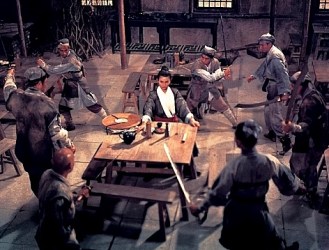
The film features good swordplay action, for the era — i.e. it’s not as tightly choreographed as you’d expect today. There’s a mix of huge free-for-all clashes, and Leone-esque long pauses followed by short bursts of violence. It also establishes Hu’s tendency to feature a strong female protagonist. Okay, she has to be saved by a man in the middle of the film, but at the climax she’s back kicking ass. To cement the point, it’s the female guards who fare best in the climactic battle, surviving long after most of the men have been slaughtered.

For all the fun, the story gets derailed a bit halfway through. Revealing that Fan Da-Pei is not just a drunk but actually an awesome fighter is okay — the groundwork is laid — but shifting the focus on to him and his old rivalry, which springs up out of nowhere two-thirds of the way through, isn’t good. Even the final duel is based on this last-minute subplot. It feels like a late-in-the-day addition designed to add a one-on-one aspect to a climax that would otherwise be about two ‘armies’ duking it out.

But this is a structural niggle, really. There’s so much else to enjoy — not just the action, but some amusing scenes, engaging characters, strikingly brutal villains (they not only kill a child (you wouldn’t get that in most movies) but they do it for no particular reason), and beautiful widescreen Technicolor cinematography — that it doesn’t grate too much.
Two points to be aware of when viewing. Firstly, when Golden Swallow arrives she’s pretending to be a man. This isn’t obvious to the viewer because she’s rather pretty, but all the characters behave as if she’s a fella nonetheless. Secondly, the version available on Netflix doesn’t bother to subtitle a couple of songs, which is frustrating because it’s clear from dialogue that they convey plot points. You get the gist, but it’s not as thorough as it should be. (Hopefully Film4’s screening will be more complete.)

I confess, I primarily watched Come Drink with Me because last year Masters of Cinema released Hu’s next film, Dragon Inn, and this week released the one he made after that, A Touch of Zen — I do like to watch things in order. Those follow-ups are regarded as seminal classics of the genre, a conversation Come Drink with Me doesn’t often come into. Whether that’s right or not, I’m glad to have been led to it, because it’s a very good swordplay movie in its own right. If Dragon Inn and A Touch of Zen are indeed even better, they’re a very exciting prospect.

4 out of 5

The UK TV premiere of Come Drink with Me is on Film4 tonight at 11:15pm.

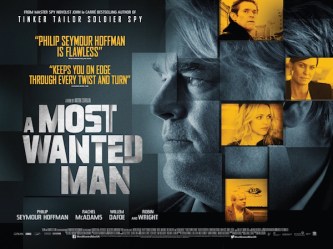
A Most Wanted Man (2014)

2015 #186
Anton Corbijn | 122 mins | streaming (HD) | 2.35:1 | UK, USA & Germany / English | 15 / R

John le Carré adaptation starring Philip Seymour Hoffman as a German secret intelligence operative who must battle internal politicking while tracking a political refugee who may actually be a terrorist.

A typically complex plot requires the viewer to keep their attention level high. Some find the story a plod, but (one languorous interrogation sequence aside) I thought it relatively brisk, aided by accent-defying performances from Hoffman, Willem Dafoe, Robin Wright, Rachel McAdams, and Grigoriy Dobrygin as the refugee. Though beware: its level of realism, with real-life levels of compromise and betrayal, doesn’t make for an ultimately cheery or triumphant conclusion.

4 out of 5