
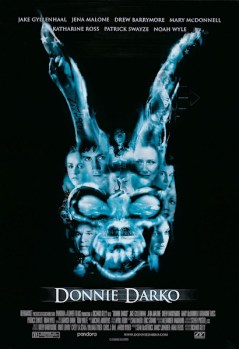
forty-two minutes, twelve seconds…
that is when the world will end.
Country: USA
Language: English
Runtime: 113 minutes | 134 minutes (director’s cut)
BBFC: 15
MPAA: R

Original Release: 26th October 2001
UK Release: 25th October 2002
First Seen: cinema, November 2002
Stars
Jake Gyllenhaal (Brokeback Mountain, Prince of Persia: The Sands of Time)
Jena Malone (Saved!, Batman v Superman: Dawn of Justice – Ultimate Edition)
Noah Wyle (A Few Good Men, The World Made Straight)
Drew Barrymore (Never Been Kissed, 50 First Dates)
Patrick Swayze (Dirty Dancing, Ghost)
Director
Richard Kelly (Southland Tales, The Box)
Screenwriter
Richard Kelly (Domino, Southland Tales)
The Story
Troubled teen Donnie Darko is saved from a jet engine falling on his bedroom by a vision of a grotesque rabbit that tells him the world will end in less than a month. Over the coming weeks, more strange and possibly supernatural events occur, and it all gets quite complicated and stuff.
Our Hero
“Donnie Darko. What the hell kind of name is that? It’s like some sort of superhero or something.” “What makes you think I’m not?” The eponymous teenager is a troubled young man, possibly suffering from paranoid schizophrenia, who begins to perform acts under the influence of his imaginary rabbit friend.
Our Villains
Who’s the greatest evil: Frank, the six-foot imaginary rabbit who proclaims the world is going to end; Jim Cunningham, the motivational speaker with dark secrets; or moral-crusading gym teacher Kitty Farmer?
Best Supporting Character
New girl in town Gretchen may be the only person who ‘gets’ Donnie. Bonus points to Kelly for writing a geek-fantasy girlfriend character who doesn’t conform to the Manic Pixie Dream Girl stereotype.
Memorable Quote
Donnie: “Why are you wearing that stupid bunny suit?”
Frank: “Why are you wearing that stupid man suit?”
Quote Most Likely To Be Used in Everyday Conversation
“Sometimes I doubt your commitment to Sparkle Motion.” — Kitty Farmer
Memorable Scene
Donnie wakes up in the middle of nowhere at dawn, in his pyjamas but with his bike discarded nearby. As he rides home, we see snapshots of his small town and his family, all set to The Killing Moon by Echo and the Bunnymen.
Memorable Music
The film makes strong use of contemporary pop music. It all seems to sit perfectly, which is a little ironic as a good number of tracks were changed because they couldn’t afford the rights on such a low budget. The director’s cut restores some of the original choices, which was a mistake. The film’s soundtrack composer, Michael Andrews, and his chum Gary Jules recorded a cover of Tears for Fears’ Mad World for the film, which wound up being the coveted UK Christmas number one for 2003 (beating the likes of The Darkness’ Christmas Time (Don’t Let the Bells End), and Bill Nighy’s Christmas is All Around from Love Actually).
Next time…
Whoever owns the rights attempted to cash in with sequel S. Darko, about Donnie’s younger sister. Richard Kelly wasn’t involved at all. It was not well received.
Awards
Toronto Film Critics Association Awards special citation for “the best film not to receive a proper theatrical release in Canada”.
What the Critics Said
“has a texture and tang all its own, despite its remarkable mixture of genres and expressive modes — horror, romance, science fiction, teen flicks, and Robert Bresson meets Generation Y, to name a few. There’s also a dry realism in its evocation of suburban life, which abrades nicely against the bouts of slow- and fast-motion photography that jiggle time and make the ordinary shiver. Kelly, who also wrote the script, has a great ear for family dinner-table arguments about politics, teenage debates about the sexual habits of Smurfs, and the quotidian absurdities of small-town colloquy. Local busybody Kitty Farmer’s near-hysterical complaint to Donnie’s mother, “Sometimes I doubt your commitment to Sparkle Motion” (the name of their daughters’ dance troupe), is for some unfathomable reason my favourite line of dialogue this year.” — Leslie Felperin, Sight & Sound
 Score:
 85%
85%What the American Critics Said About the Director’s Cut
“First-time writer-director Richard Kelly’s breathtakingly ambitious Donnie Darko was one of the best pictures released in 2001. Now that it has returned in a 20-minute longer — and richer — director’s cut, it seems sure to be ranked as one of the key American films of the decade.” — Kevin Thomas, Los Angeles Times
What the British Critics Said About the Director’s Cut
“If it’s your first viewing, you should still be wowed by an astounding masterpiece. But this is undoubtedly the lesser of the two cuts, and since you have the choice, you should stick with version one. […] All this director has done is cut a star off his five-star debut.” — William Thomas, Empire
Score: 91%What the Public Say
“Maybe Richard Kelly’s fate is to be the cult circuit’s Michael Cimino — forever admired for one great film amid subsequent missteps, including a director’s cut of the same movie. Kelly has yet to match the mysterious mood or magnitude of his filmmaking debut […] a collision of time-travel sci-fi, commentary on ’80s Reaganomics malaise and teen angst that’s simultaneously witty and poignant. Non-Darkolytes should start with the enigmatic theatrical cut and proceed further if curious.” — Nick Rogers, The Film Yap

When it finally made its way to UK shores, about a year after its initial US release, Donnie Darko was something of a hit — it made more money here than Stateside, in fact. I know several people who stumbled upon it “just because it was showing”. Conversely, I made a special trip to see it at a distant cinema at an inconvenient hour, having heard about it from US reviews. I would’ve been 16, which is probably the best kind of age to become enamoured of its misunderstood teen hero and its complicated, semi-inexplicable sci-fi story. I haven’t actually watched it for years, and never made time for the divisive director’s cut, but (whatever I’d think of it now) it remains a key touchstone in my teenage film experience.

#27 will be… 
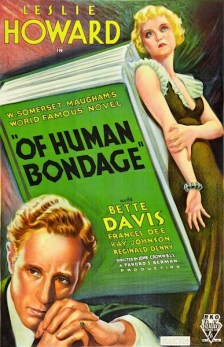 W. Somerset Maugham’s semi-autobiographical novel Of Human Bondage is, per
 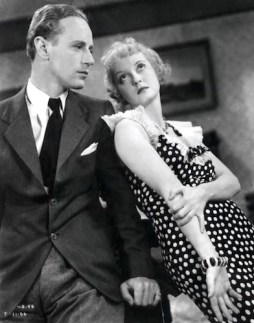 so she destroys his belongings and disappears. Eventually he meets her again, when she’s in search of his medical opinion. She has contracted syphilis from working as a prostitute, but rejects Philip’s advice to quit. Her ultimate fate remains unknown.
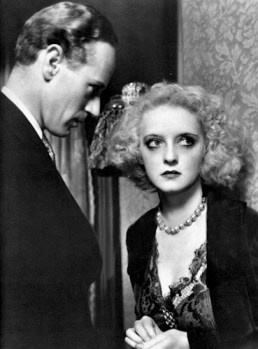
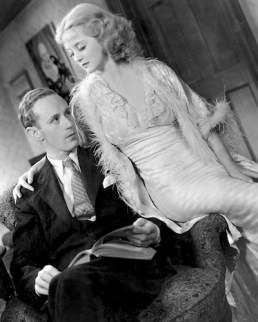 The film begins in Paris, with Philip (Leslie Howard) being told he’ll never make it as an artist. He instantly decides to become a medical student, during which time he meets Mildred (Bette Davis). From there, the rest of the film follows the plot described in the second paragraph, albeit with some notable modifications (which I’ll come to later), with parts of the third paragraph (the patient, his daughter, abandoning travel for marriage) surfacing during the third act.
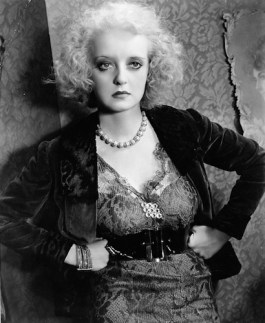 In the film it’s not syphilis that does for her, but tuberculosis, and prostitution is never mentioned, or even really alluded to. The changes were no doubt due to the infamous Production Code. (There are paintings of naked French women all over Philip’s apartment, though, but I guess that counts as Art. Sadly, there’s no meta-funny dialogue about painting anyone like one of his French girls.) Of Human Bondage is often labelled as a Pre-Code film — as coming from that narrow era between the Code being invented and anyone seriously bothering to apply it. The latter came about in 1934, when an amendment to the Code stated that any film released after July 1st 1934 had to receive a certificate of approval before it could be released. Of Human Bondage premiered on June 28th, which I guess is why it gets labelled a Pre-Code film, but it went on wide release from July 20th, so fell under the Code’s new remit after all. The print held by the Library of Congress (used for the US Blu-ray release) even has the Code certificate at the start (it’s #53, if you’re curious).
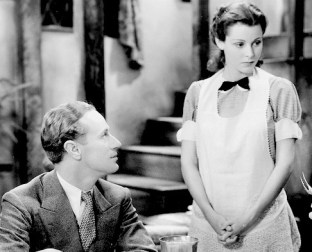 When Davis is off screen, it feels like the film is waiting for her to return. Her arc aside, it’s a take-it-or-leave-it damp squib of a drama — there’s nothing wrong with it, it’s just not all that engaging. Howard has definitely been better; his romance with Sally arrives too late to have much emotional weight, though it’s easy to believe he could fall in love with Frances Dee at first sight.
 and independent firm Price Waterhouse were hired to manage the voting next year — a job they still do today.
 Scorsese tells the story of Jesus in this controversial epic adapted from Nikos Kazantzakis’ novel. I have no idea how much is actually rooted in scripture — a disclaimer is keen to establish the film isn’t based on the Gospels, but obviously that’s just to appease the devout.


 2013 Academy Awards
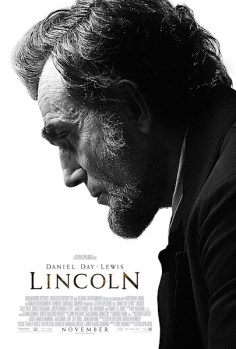 Daniel Day-Lewis allegedly stars in this account of the final months of President Abraham Lincoln’s life, which might more pertinently be called The 13th Amendment due to where its focus lies. I say “allegedly” because I’m not convinced they didn’t find a way to resurrect Lincoln to appear as himself, then just pretended it was Day-Lewis acting.
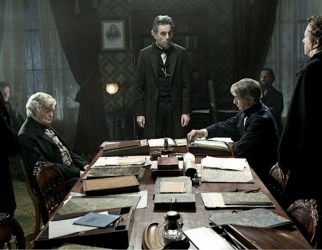 who might be persuaded to vote which way, and how they might be persuaded, and what they will want in return, and what deals need to be struck, and so on and so forth — sounds like it might make for an engrossing movie, then there’s a fair chance Lincoln will be your cup of tea. A not-insignificant proportion of viewers protest that it is boring, however, and while I in no way agree with them, your mileage may vary.
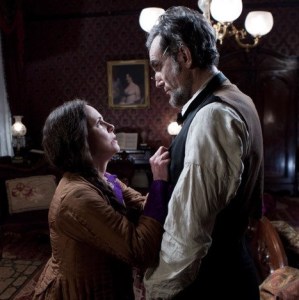 Not to do anyone else in the film — or, indeed, any other performance in any film ever — a disservice, but Day-Lewis embodies the President in a way few other actors have ever embodied a role. It’s quite remarkable.
 For me, there are few black marks (unfortunate choice of phrase…) to be held against Lincoln. Does it give in to Spielberg’s sentimentality? Yeah, a little — but it’s a long, long way from the worst case of that, and I think you’d be nitpicky (or have a different opinion on history, which, you know, is a matter of opinion) to criticise the film too harshly for that. As to whether it’s boring, that’s entirely a matter of preference. If you think The West Wing is boring, people who write lists of “the greatest TV shows ever” will disagree with you, and you also likely won’t like Lincoln. I like The West Wing, though.
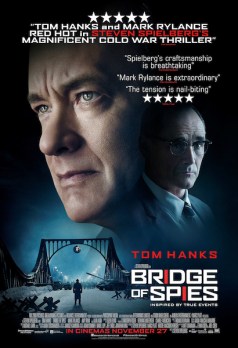 Steven Spielberg’s true-story Cold War drama stars Tom Hanks as insurance lawyer James B. Donovan, who is tapped to defend captured Soviet spy Rudolf Abel (Mark Rylance). After Donovan insists on doing his job properly, he manages to spare Abel the death penalty — which comes in handy when the Soviets capture spy-plane pilot Francis Gary Powers (Austin Stowell) and a prisoner exchange is suggested, which the Russians want Donovan to negotiate.
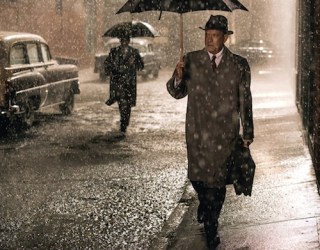 If we’re talking storytelling oddities, another is the manner in which Powers’ backstory is integrated. As Donovan continues to defend Abel, the film suddenly becomes subjected to scattered interjections, in which we see pilots being selected and then trained to fly secret reconnaissance missions in a new kind of plane. Any viewer who has read the blurb will know where this is going, but it’s so disconnected to the rest of the narrative that it felt misplaced, at least to me. The same is true when we suddenly meet Frederic Pryor (Will Rogers), an American student in Berlin who’s mistaken for a spy and arrested by the East. It turns out we need to know about him because Donovan attempts to use his negotiations to get a two-for-one deal, exchanging Abel for both Powers and Pryor. Knowing the stories of the men Donovan will be negotiating for is not a bad point, but I can’t help but feel there was a smoother way to integrate them into the film’s overall narrative.
 hints at emotions under the surface rather than declaiming them. A lesser film would’ve made a point of this — would’ve had Hanks’ lawyer struggling to understand and relate to his client’s low-key nature — but, instead, Donovan is a man who can identify with this mode of being, at least to an extent. There’s a reason they talk a couple of times about the ‘stoikiy muzhik’.
 allows the whole film to be equally as subtle, even as it remains gripping and entertaining. However, the storytelling quirks are a mixed success, the pace they sometimes lend offset by the almost non sequitur style of the captured Americans’ backstories. Nonetheless, this is a classy but still enjoyable dramatic thriller, which takes a seat among Spielberg’s better works.
 After martial arts student Fang Cheng is killed protecting his master, the latter takes in Cheng’s infant son, Fang Kang, as his student. Years later, Fang Kang is bullied by his aristocratic classmates and treated as a servant by the master’s daughter, Pei, though he’s a better student than any of them. Eventually goaded into leaving, his fellows corner him, challenge him, accidentally lop off his sword arm, and leave him for dead. Kids, eh? Fortunately, Kang is found by orphan Xiao Man, who nurses him back to health. With the help of an old textbook, he learns to fight left-handed, which is handy because there’s a conspiracy underway to kill all of his master’s former pupils…
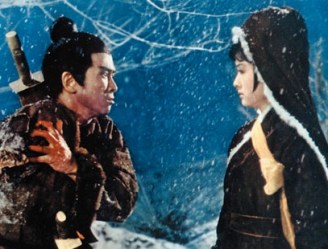 However, for me the film also worked very well as a drama, and even sometimes as a romantic drama. Fang Kang is an interesting protagonist. His lifestyle is torn from him, and rather than simplistically train to regain it or give up entirely, he battles with that decision. He returns to that way of life only to defend himself and his rescuer, and then out of a sense of loyalty to the master who raised him, but he’s also prepared to abandon the martial life to be a farmer… when the job is done, naturally. Jimmy Wang Yu, in a star-making turn, sells this character arc as well as anyone in a kung fu picture ever has. He’s also (somewhat) torn between two women, the kindly and supportive Xiao Man, and brat-with-a-heart Pei. While no one could truthfully call this a romantic picture, the love-triangle aspect also functions surprisingly well.
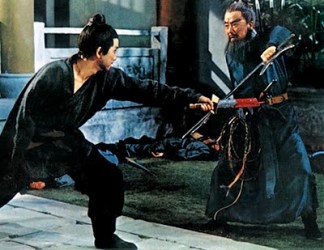 I disagree with that. Perhaps those lists are based on the abundance of action in these films, by which metric this probably has too much drama — though, as I said, it’s not devoid of fisticuffs and swordplay. Combine that with a solid story, engaging characters, and a brisk pace (even with its near-two-hour running time), and you have one of my favourite Shaw Brothers movies I’ve yet seen.

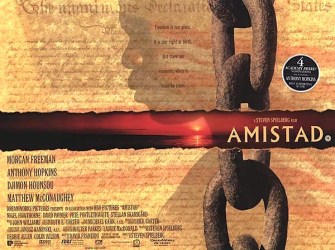 Feeling in need of more intellectual fare after helming
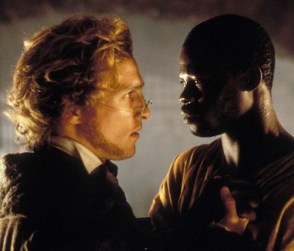
  Though Spielberg is certainly not immune to the Africans’ plight — the depiction of life on a slave ship is appropriately harrowing — it’s clear from early on which side he expects us to identify with, in terms of cultural background if not shared morality: as survivors of the mutiny talk the next day, the slavers’ Spanish dialogue is subtitled but the slaves’ African dialect is not. It’s a simple but effective technique to align us with one side — as I say, not morally (in no regard is Spielberg trying to apologise for the slavers), but socially. Unfortunately, it’s not sustainable: later, when we need to understand the Africans to follow a scene’s point, their dialogue is suddenly subtitled, and from then it’s sporadically translated as needed. I can see why that choice was made, but it makes the unsubtitled bits feel like a cheat.
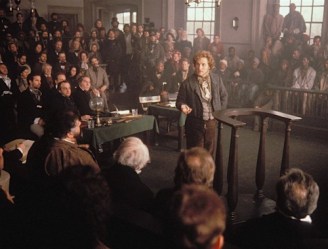 This can be said of Spielberg’s approach to the drama, too. Some of the courtroom stuff is suitably mired in legal technicalities and argument, but by film’s end it gets a little bit too… what’s the word? Not “preachy”. Not “sentimental”, exactly, though it’s born of that old criticism of Spielberg. “Melodramatic” may be on the money, though. It doesn’t help that everything reaches a climax — not only narratively, but also in the way it’s written, shot, acted, and scored — only for it to be revealed that it’s just the end of act two. Okay, that’s the truth of what happened (or near enough, for the purposes of this dramatisation), and by adapting it in that way it emulates the emotions the characters experienced; but from the audience’s perspective, you feel like you’ve reached the end… only to be served up another half-hour of movie. And it’s a long film too, so you feel that. It gets by because it’s fundamentally a good film, with strong performances and technical merits, but it’s a little bumpy for a bit.
 It’s easy to criticise Amistad, because Spielberg makes the production of very good movies look effortless, so the missteps stand out all the more. The story of La Amistad and its ‘cargo’ is a powerful one, and Spielberg has — naturally — turned it into a good film; but by remixing history to over-egg the message, it loses a little something. A valiant effort, but a film like
  Macbeth is my favourite Shakespeare play. Not that I’m a great scholar of the Bard, but I’ve seen and/or read enough to have a favourite. I also think it’s one of his most accessible works: its story and characters are relatively straightforward without being devoid of complexity; it’s got some immensely effective imagery and dialogue, including a solid compliment of famous lines; and it’s not excessively long either (it’s Shakespeare’s shortest tragedy, in fact). I also studied it twice over in secondary school, so I know it fairly well. Now, this doesn’t mean I have exacting standards when it comes to film adaptations (Shakespeare is plenty open to interpretation), but it does mean I have my expectations up, especially as there isn’t a film version of Macbeth that could reasonably be described as “definitive” (though I know
  What I mean, more specifically, is that he’s visualised parts of the text; applied the old rule of “show don’t tell”. So rather than a messenger giving the King a full account of Macbeth being awesome in battle, we see some of the combat; Banquo has hardly any lines early on, but we still understand his friendship with Macbeth just from the way they look at one another and go into battle together.
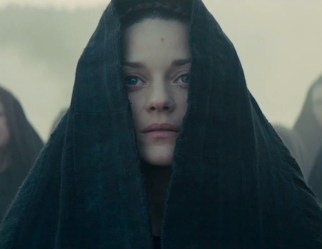 Cotillard is fantastic in all of this, and certainly worked hard for it: the way the French language applies emphasis is not suited to delivering iambic pentameter, apparently, so she worked hard with a dialect coach to nail her delivery. Her accent clearly marks Lady Macbeth as the only non-Scottish character here, which becomes another layer added to this interpretation.
 a good film based on a computer game.
 100Films.co.uk