Your Name. (2016)

aka Kimi no na wa.

2017 #168
Makoto Shinkai | 107 mins | Blu-ray | 1.78:1 | Japan / Japanese | 12 / PG
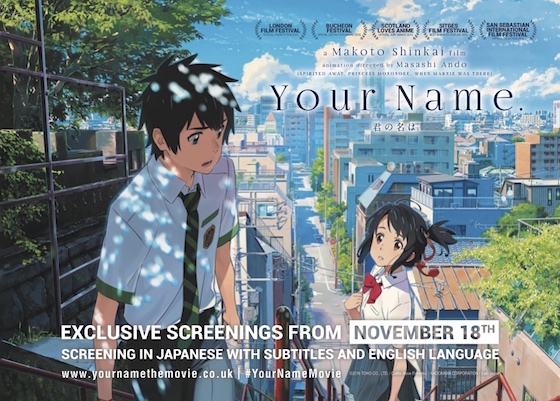
Your Name

If you’ve not heard about Your Name then… well, where have you been for the past year? It was a colossal hit in its native Japan during the back end of 2016, spending 12 weeks at #1 to become the fourth highest-grossing film of all time there (behind only Spirited Away, Titanic, and Frozen). It’s also the only anime not made by Studio Ghibli to gross over ¥10 billion at the Japanese box office. Critical acclaim has followed as it’s been released around the rest of the world too, hailing writer-director Makoto Shinkai as the new Miyazaki. It’s hard to imagine higher praise for an animator. The film reached UK cinemas last November, but then took a whole year to hit DVD and Blu-ray (I guess thanks to Japanese studios’ usual restrictive licensing agreements), and as of this week is available to stream for Amazon Prime members. So when I finally sat down to watch it this week it had a bit of weight on its shoulders — at this point it runs the risk of being a victim of its own hype.

The film introduces us to Mitsuha, a teenage girl in a sleepy country town — more a village, really (it doesn’t even have a cafe!) — who wishes for a more exciting life in the big city. Her friends tell her she was acting weird the day before, but she can’t remember any of it. Then she wakes up in the body of Taki, a teenage boy living in Tokyo. Assuming it’s a dream — a very long, very realistic dream — she stumbles through his life for a day. To cut to the obvious, Mitsuha and Taki soon realise they’re actually swapping bodies, apparently at random but for a whole day each time. (The literal translation of the film’s Japanese title is What is your name, which kinda makes more sense.) They find ways to deal with it, but a big explanation for why it’s happening is looming…

That feeling when you wake up and realise a boy's been inside you... er, as it were

That comes in the form of a hefty twist about halfway through the movie. I’ve read some very different reactions to that development and what follows it — criticism of it for shifting the film into something generic after a more original first half; praise for it elevating the film into something more original after the generic first half. I guess your mileage will vary. For me, it kind of glossed over some of the body-swap stuff to get to a place where there was still time to deal with what happens next. Conversely, there are plenty of intersex body-swap movies — how much do we need to go over that again? But there are generic elements to the second half too.

That said, the way it uses Japanese folklore to bring all the threads together is a bit different, at least for us Westerners. I don’t know if it’s based on genuine beliefs or if it’s a mythology imagined for the film, but it conveys some effective and affecting ideas. It builds to an emotional climax and, ultimately, a perfectly satisfying ending. Well, unless… At times you feel there were perhaps other, more unusual directions the film could have explored. Fair enough, that clearly wasn’t the story Shinkai wanted to tell; but some viewers may think those less well-trodden paths would’ve made for a better movie. Of course, that would’ve neutered its appeal to others; but then Mark Kermode compared it to Romeo and Juliet in terms of how it might appeal to teenagers, and that certainly doesn’t have a happy ending…
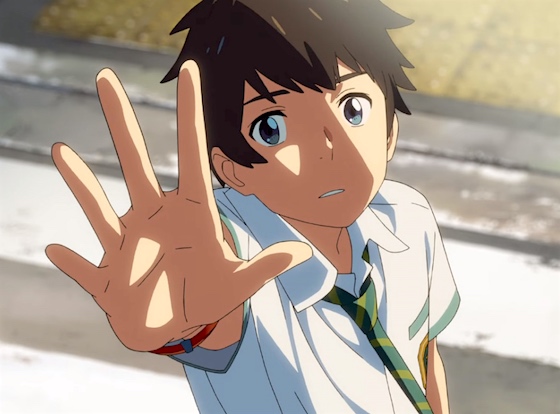
Taki reaching for Mitsuha's boobs, probably. He loves feeling her boobs.

I’m not just talking about the finale, though. For example: while in Taki’s body, Mitsuha displays his “feminine side”, which leads to a date with a girl he’s had a crush on for ages. On the day of the date, Taki is in his own body, which leaves Mitsuha upset because she’d wanted to go on the date. Surely you can see how this is possibly building in a direction where Mitsuha realises something about herself; something she might not have noticed living in a very traditional little town. But that’s not where Your Name is going — and, as I said, fair enough — but it’s not a bad idea for a movie (is it?)

Nonetheless, at times the story is quite complicated, with overlapping dialogue, or a density of information conveyed in images, on-screen text, and dialogue simultaneously. I mention this because watching the English dub might make for a more manageable experience, at least on first viewing. (That said, there’s one gag which only works in Japanese, and the subtitles work at a rate of knots to explain the joke while it’s happening. I watched the English dubbed version of the scene afterwards and it kind of fudges the gag away, because there’s no way to translate it into English.) That said, other bits of the story are just straight up jumbly, but trust that there’s a reason for that — you may get confused about who’s in whose body when, but the film makes enough sense in the end.

Pretty pictures

One thing I have no problem praising unequivocally is the imagery. The film is visually ravishing; the animation thoroughly gorgeous. Its use of colour and light is beautiful; the detail in the art and its movement is almost photo-real, without the uncanny valley effect you often get from rotoscoping. Shinkai also seems to have a live-action-esque feel for shots and editing, particularly in his use of montage, which lends a very filmic feel. At other times it benefits from animation’s freedom to be less literal, particularly in one sequence apparently created with pencils and chalk.

I do think the hype around Your Name ended up as a problem for me. I was expecting to be blown away by its amazingness, the expectation of which got in the way of just appreciating the film for what it is. That said, I definitely liked it a lot. Despite using some building blocks familiar from other movies, it mixes them together with some fresh perspectives to create a film that is thoroughly romantic, in multiple senses of the word.

4 out of 5

As I mentioned, Your Name is now available on Amazon Prime Video in the UK, in both subtitled and dubbed versions.
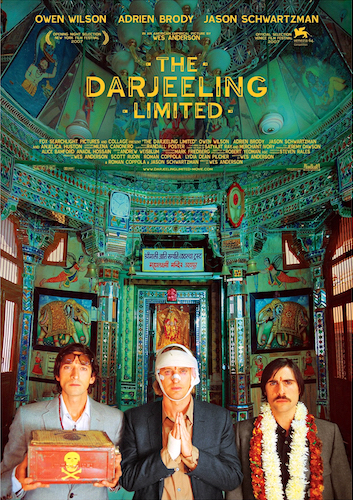
The Darjeeling Limited (2007)

2017 #35

Whoa there! Hold your horses! Before The Darjeeling Limited, we need to talk about…

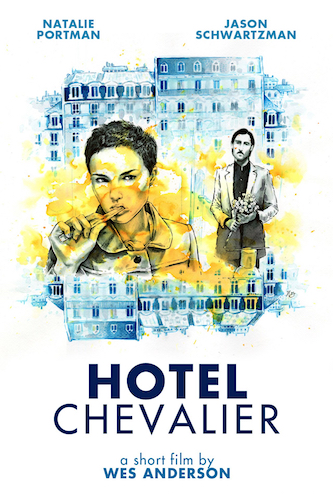
Hotel Chevalier
(2007)

2017 #34a
Wes Anderson | 13 mins | streaming (HD) | 2.35:1 | USA & France / English | 15 / R

Hotel Chevalier

The short film that exists as a kind-of-prequel, kind-of-Part-One to The Darjeeling Limited. It’s probably best remembered for its controversies — around whether or not it was attached to the feature’s theatrical release (it was, then it wasn’t, then it was); and around Natalie Portman’s ass, firstly because oh my God you get to see Natalie Portman’s ass, then later about whether or not she regretted baring it (long story short: she didn’t). The former issue annoyed fans at the time for reasons that, a decade later, are immaterial (though if you’re interested you can read about it here). The latter… well, frankly, I guess it got a lot of attention because, a) men are men, and b) what else there is to talk about from the short isn’t necessarily all that obvious.

In it we’re introduced to Jason Schwartzman’s character from The Darjeeling Limited, one of the feature’s three leads, who here is seen lazing about in a Paris hotel room when he gets a phone call from a woman, who shortly thereafter arrives. Then they talk and stuff. All shot with director Wes Anderson’s usual style, because obviously.

Natalie Portman's ass not pictured

Hotel Chevalier exists in a weird in-between state, where it’s almost essential to the main film (the feature includes numerous callbacks to it; some inconsequential, others that I’m not sure make sense without seeing the short), but it also feels like the right decision to have left it out of the film. Its setting and the presence of only one of the trio of main characters mean it feels like a different entity, and if it had been in the feature itself, even as a prologue, it would’ve shifted the focus onto Schwartzman as the primary character. I don’t think that would’ve been right.

So maybe it’s just a glorified deleted scene, then? Or maybe there was something I didn’t get and I’m doing it a disservice. The thing it most reminds me of, watching in 2017, is those Blade Runner 2049 shorts: it informs the main feature without being an essential component of it. So, while I didn’t dislike it, I don’t know how much it has to offer outside of setting up part of The Darjeeling Limited. Unless you just want to see Natalie Portman’s ass, of course.

3 out of 5

You can watch Hotel Chevalier on YouTube here.

The Darjeeling Limited
(2007)

2017 #35
Wes Anderson | 88 mins | streaming (HD) | 2.35:1 | USA / English | 15 / R

The Darjeeling Limited

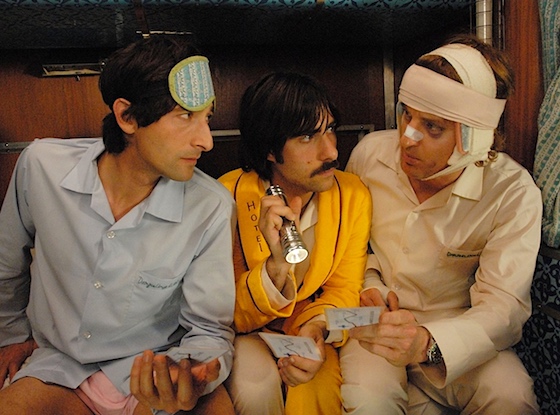
So, the film proper. It’s the story of three estranged brothers (Adrien Brody, Owen Wilson, and Jason Schwartzman) who reunite a year after their father’s funeral. One of them has organised a train trip across India so they can reconnect, although he also has an ulterior motive…

My impression has always been that The Darjeeling Limited is a lesser work on Wes Anderson’s CV. I don’t remember it making much of a splash when it came out — maybe I’m wrong, but “another film where Wes Anderson does what Wes Anderson does” was my impression at the time — and I don’t think I’ve seen it discussed a great deal since. As someone who still feels new to Anderson’s world and is working through his oeuvre in a roundabout fashion, I don’t necessarily disagree with this sentiment. If you want to find out what’s so great about Anderson, there are certainly other places to start.

Brothers on a train

That said, I did enjoy the film. Anderson’s mannered camerawork, kooky characters, and shaggy dog storylines seem to have gelled well with my own sensibilities. Conversely, finally getting round to this review nine months after I saw the film, I can’t remember many specifics. It’s a movie I’ll likely add to my Wes Anderson Blu-ray collection someday (for comparison, I can’t definitely say the same about Rushmore), and will be happy to revisit, but for the time being I’ve exhausted what little thoughts I had about it.

4 out of 5

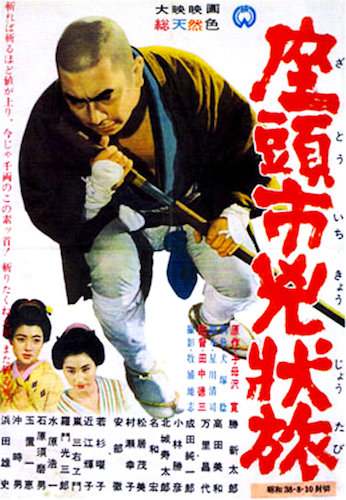
Zatoichi the Fugitive (1963)

aka Zatôichi kyôjô-tabi

2017 #159
Tokuzô Tanaka | 86 mins | Blu-ray | 2.35:1 | Japan / Japanese

Zatoichi the Fugitive

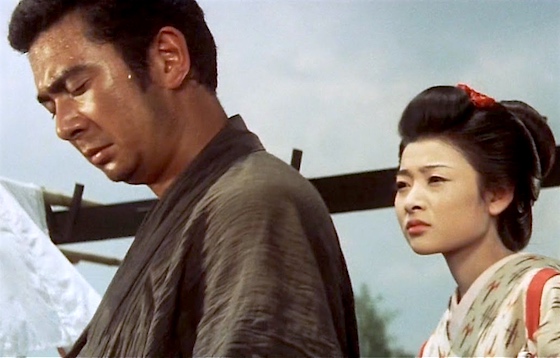
His sword is shiny and ice-cold. The only thing it won’t cut in this whole wide world is oil and the bond of lovers.

The fourth film in the Zatoichi series finds the blind masseur (Shintaro Katsu) with a bounty on his head, which only increases when he kills the first person who tries to claim it. Travelling to a nearby village to apologise to the guy’s mother, Ichi finds himself in the middle of a yakuza scheme to grab territory from a young boss. There’s also the small matter of a ronin (Jutarô Hôjô) and his companion, Ichi’s old love Otane (Masayo Banri).

That’s the straightforward version — much of the plot is an overly complex account of yakuza plotting that, frankly, I sometimes struggled to follow. Especially at the start, there are so many bosses to keep track of, with broadly similar names, all of whom are more often referred to in dialogue than established on screen. I got my head round it eventually, but it took some work. It makes stretches of the film a bit dry and awkward, however.

Fortunately, that’s not all that’s going on. Otane is back from films one and two, but she’s different to how Ichi remembers her. Rather than just bringing back a familiar face for the sake of it, the film uses her to make a point about how people aren’t always who we think they are — a bit like Ichi himself, in fact. I imagine this would be even more effective if I’d watched The Fugitive closer to when I watched her previous two appearances, but there’s enough information recapped within the film to get the gist. It also continues what seems to be a definite theme of the Zatoichi films (at least so far) about past people and actions coming back to haunt our hero.

The bond of lovers

However, the best part of the film is the final 20 minutes, a tour de force of emotion and action that sees Ichi surrounded and, enraged into action, taking down an army that stands between him and vengeance. Said vengeance comes in the form of a one-on-one sword duel, of course. Obviously we know our hero will triumph, but it’s still a tense scene, especially as it seems to be a rare occasion when Ichi’s been out-fought. This third act elevates the whole movie, its very existence justifying everything that came before.

Reading other reviews, I’ve seen The Fugitive described as both “one of the weaker installments in the series” and “thus far the best [of the series,] a spectacular action-packed entry that deftly showcases why this series matters so much.” I think this stems to which you weigh heavier between the first-rate climax (plus a few choice sequences before that) and the occasionally dry plotting earlier in the movie. For me, the way it eventually comes together and concludes makes it all worth it.

4 out of 5

Napoleon (1927)

aka Napoléon vu par Abel Gance

2016 #184
Abel Gance | 333 mins | Blu-ray | 1.33:1 + 4:1 | France / silent (English) | PG / G

Napoleon

At one point in time, arguments over rights made it seem unlikely you’d ever be able to see Abel Gance’s epic biopic of French leader Napoléon Bonaparte if you were a regular person not prone to attending all-day cinema screenings with a live orchestra and multiple intermissions. But a year ago this week things panned out so that the BFI were finally able to release it on Blu-ray. While a theatrical marathon is probably still the best way to see the film (if only for the full effect of the famed triptych finale), this release is certainly more convenient and accessible. Apparently it sold better than expected, too — I guess that’s what happens when you combine years of anticipation with being a worldwide-exclusive release of a film of this stature. It’s also a daunting film to review — for the aforementioned reasons, plus its length and its artistic importance. Nonetheless, here are what thoughts I had.

At 5½ hours, Napoleon is rather like a miniseries from the silent era — a comparison that feels more apt than ever in this age of binge-watching. It’s divided into four acts, each running anywhere from 49 to 114 minutes, but it could even be subdivided into further episodes: Napoleon’s schooldays; his observation of the French Revolution; his opposition to Corsica being sold to England; the siege of Toulon (which takes up all of Act 2 and is the best bit, in my opinion); the reign of terror (a half-hour section that barely features Napoleon); a chunk where he falls for and woos Josephine that plays like a rom-com; the invasion of Italy… Yet despite that length, the film doesn’t even reach the Napoleonic Wars. No wonder Gance wanted to do six movies — or six seasons, as we might interpret it today. (In the end, he went over-schedule and over-budget on this first film, covering just two-thirds of the story he’d intended and spending the budget for the entire series. I imagine I’d outrage some silent film fans/scholars if I called him the Peter Jackson of his day…)

Albert Dieudonne as Napoleon

Part of the fourth act is that triptych climax, a 21-minute sequence shot with three cameras side-by-side, and therefore designed to projected on three 1.33:1 screens side-by-side, to create a 4:1 widescreen image. It’s undeniably less powerful when rendered as a thin strip across a 16:9 television, suddenly shrinking the height of the image rather than suddenly tripling its width, but what other choice is there? (Well, if you’ve got three sets of equipment, the three-disc Blu-ray contains each screen full size, one per disc, so you could set it up yourself.) Even shrunk like that, the imagery in the sequence remains stunning. I bet the effect is marvellous when seen as intended. (There’s an alternate single-screen ending, which is quite different. It contains fundamentally the same ‘plot’, but there’s one whole new sequence, and the others are truncated or slightly rearranged. Worst of all, it loses the tricolour-inspired finale.)

Widescreen properly arrived when CinemaScope was invented in 1953, so Gance was about 25 years ahead of his time with that technique. It’s Napoleon’s most striking innovation, but the whole film shows off a surfeit of cinematic techniques: a wide variety of shot lengths (close-ups, medium, long, wide, etc, etc); tracks and pans, many of them fast; handheld photography, including what we’d now call ShakyCam; swaying back and forth, in and out of focus, or swinging over a large crowd; mounted on fast-moving vehicles, including dipping under the waves on a boat; in the thick of the action rather than observing it from a distance; multiple exposures and superimposition; animated maps to indicate Napoleon’s strategising; split screen; split-second impressionistically-fast cutting… and most of that’s found in just the first hour! Some of this is stuff that would still feel revolutionary when filmmakers were doing it 20, 30, even 40 years later. The fast-cut pulse-racing action scenes, like a horseback chase on Corsica, are not what you commonly expect from a silent movie, especially an ‘artistic’ one rather than a swashbuckler, say.

Epic

Lest you think a film of this vintage must be in black and white, Napoleon features a lot of tinting and toning, which works very well at times to create striking and meaningful imagery: golden sunlight illuminating the debut of La Marseillaise; the burning red of revolution forged in a furnace; a tumultuous purple ocean… Similarly, Carl Davis’ original score is great, helping to emphasise the emotion and lend the images a storytelling shape. Again, the sequence with La Marseillaise is a good example; a particularly effective tour de force. Davis makes good use of other familiar tunes for shorthand — there are variations on Rule, Britannia whenever the British are involved, for instance.

Making Abel Gance’s Napoleon was an epic undertaking, as was its decades-long reconstruction, as is the viewing experience (it is 5½ hours, after all). It may not be perfect for all of that immense running time (which does not merit adjectives like “indulgent” or “excessive” but is, nonetheless, long), but it is a monumental achievement in cinema that undoubtedly deserves full marks.

5 out of 5

That completes my reviews from 2016, finally.

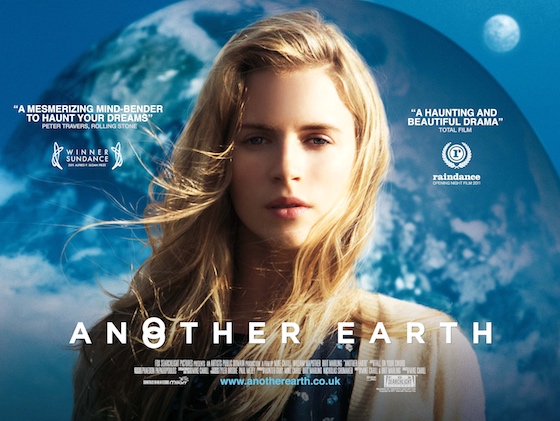
Another Earth (2011)

2017 #15
Mike Cahill | 92 mins | streaming (HD) | 16:9 | USA / English | 12 / PG-13

Another Earth

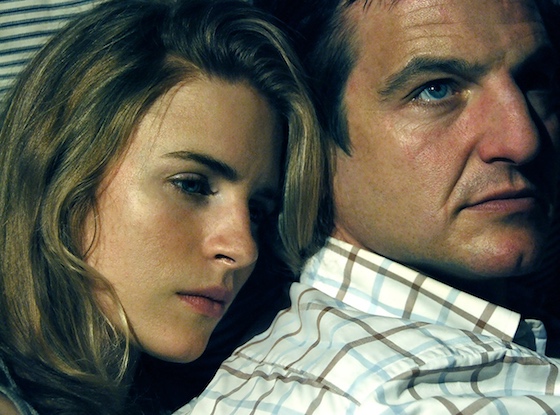
Driving home drunk, 17-year-old Rhoda (Brit Marling) hits another car, leaving its driver, John (William Mapother), in a coma and killing his pregnant wife and their young son. Released from prison four years later, her grand life plans abandoned, Rhoda seeks out John to apologise, but when he doesn’t recognise her she pretends to be from a cleaning service and becomes his maid. Meanwhile, a planet that seems to be a mirror image of Earth has appeared in the sky and one member of the public can win a place on an exploration mission.

Bit of a curveball, that, isn’t it? The main thrust of the film is a very grounded character drama about two emotionally damaged people and how they connect with each other, but there’s this big old sci-fi plot ticking away in the background — one which is referenced in the title of the film and all its marketing too, which immediately elevates its importance in the film: it’s not just a funny little background quirk, it’s central to what’s happening or will happen.

By combining these two disparate genres Another Earth moves outside the accepted norms of either, which seems to discombobulate some viewers. I’ve seen it decried for not ditching the sci-fi stuff to focus on the characters’ emotional situation and relationship, and the same for not ditching the emotional stuff to focus on the sci-fi concepts. Personally, I think the film is doing exactly what it sets out to do: using aspects of each genre to comment on, reflect, and influence the other. That’s not to say it’s in some way a deconstruction of genre — it’s not working with tropes or clichés, at least not deliberately — but I mean it’s using a sci-fi idea to influence what could just be a straight-up dramatic story, and using a realistic human drama to explore a sci-fi concept from a different angle. Truth be told, I think some people can’t quite handle that. Of course, some people just think it doesn’t do it very well, which is fine. I thought it was at least interesting.

Emotionally damaged

Perhaps it doesn’t help that some of it looks like shit, as if it was shot by some inexperienced amateurs using their home movie camera… which it was. After having the idea for the film, co-writer/director Mike Cahill and co-writer/star Marling began shooting it using just an HD camcorder, even before they’d secured any funding. Well, haven’t they done well for themselves? Still, there are worse-looking movies.

Another Earth may not please those looking for a straight science-fiction movie, nor those after a grounded character drama, but for anyone open to a combination of the two — a plausible, human-scale take on a high SF concept — it’s certainly worth a look.

4 out of 5

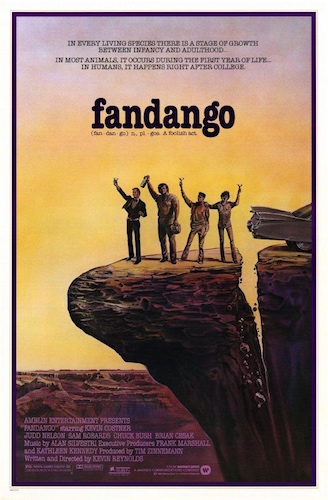
Fandango (1985)

2017 #22
Kevin Reynolds | 91 mins | streaming (HD) | 16:9 | USA / English | 15 / PG

Fandango

In this coming-of-age comedy drama, pitched as “celebrating the privilege of youth”, a group of college buddies — two of whom are about to be drafted into Vietnam — go on a final road trip to celebrate their graduation and defer the impending seriousness of adulthood.

Fandango began life as a student short made by writer-director Kevin Reynolds that just featured the skydiving sequence. That was seen by, of all people, Steven Spielberg, who liked it enough that he gave Reynolds the money to develop a feature film around the idea. But when he saw the finished result, Spielberg distanced himself from it — he even had his name taken off the credits. No idea why — it’s a super movie. If we’re being picky then its structure is a little episodic, but the scrapes the gang get into are linked by arcs that chart their characters’ development, which is where the film has its heart. It’s also resplendent with nice little touches, like well-composed shots (for a first timer, Reynolds clearly knew what he was doing), poignant character moments, and some occasionally profound dialogue, too. A sequence that sees the guys fighting with fireworks in a graveyard, foreshadowing the war several of them are about to head off to, is a particular standout.

Boys will be boys

Kevin Costner, tearing through Texas as a free-spirited college flunk-out wearing one-armed sunglasses, an increasingly grubby tailcoat, and a shit-eating grin, has never seemed cooler. That almost masks the fact that it’s also a very good performance, actually. It might’ve been forgotten under some of the blockbusters he did, and some of the crap in more recent years, but the guy can act. The lead cast surrounding him is equally as likeable — it genuinely feels like hanging out with a ragtag gang of college mates on their last hurrah. The final act stretches credibility pretty darn thin with what those guys are able to pull off, but it’s nonetheless a suitably emotive finale.

I’d never even heard of Fandango until the ghost of 82 recommended it to me last year, which is possibly the end result of Spielberg having disowned it. The history of cinema is no doubt littered with these little gems that, for whatever reason, only resonated with some people at the time. One of the real benefits of the blogging era is that we can recommend them on.

4 out of 5

Anomalisa (2015)

2017 #2
Charlie Kaufman & Duke Johnson | 90 mins | streaming (HD) | 2.35:1 | USA / English | 15 / R

Anomalisa

Written and co-directed by Charlie Kaufman (of Being John Malkovich, Eternal Sunshine of the Spotless Mind, and so on), Anomalisa tells the story of Michael (David Thewlis), a depressed customer service expert who perceives everyone else as looking and sounding the same — until he meets Lisa (Jennifer Jason Leigh), whose uniqueness to him immediately attracts Michael.

If you hadn’t noticed, Anomalisa (a portmanteau of “anomaly” and “Lisa”, not “anonymous” and “Lisa” as I’d assumed) is an animated movie. Although an everyday kind of drama that would be largely achievable in live-action, it uses the form to its advantage when depicting the central conceit, giving every character who isn’t Michael and Lisa the same face and having them all voiced by the same actor (Tom Noonan). For me, this was the most effective part of the movie. It’s a really neat way of executing the concept of not being able to tell people apart. Noonan is the film’s real star, too, voicing “everyone else” in a way that makes them sound plausibly unique but also all the same, a tricky balancing act that he nails.

The one thing that did disappoint me about it was this: the inability to distinguish people is a genuine medical condition, but the film tackles it only as a signifier of Michael’s depression rather than as an issue some people live with. Conversely, I presume that’s a pretty rare condition, whereas depression and isolated feelings are increasingly widespread, so the film perhaps has more to say in that regard. Ultimately, I shouldn’t be criticising a film for not being about something it’s not trying to be about (even when I thought that was what it was going to be about).

Even puppets get the blues

As for the rest of the movie… hm. It takes an age to get going, but once it does there are a few funny scenes (the “toy” shop; the hotel shower; Michael struggling with his room key), and who’d’ve thought a puppet movie would have one of the more realistic sex scenes in the movies? Especially as it pulls that off without becoming laughable thanks to Team America. More pertinently, it gradually unfurls a sometimes touching story about isolation and love. However, by the time it reaches the happy-sad ending (one person’s life seems to have been transformed; the other continues to be miserable), I wasn’t sure what it all signified. Maybe the line that “sometimes the lesson is there is no lesson” is very relevant.

So, some good stuff, but that long slow open takes getting over, and I’m not sure what it all meant.

4 out of 5

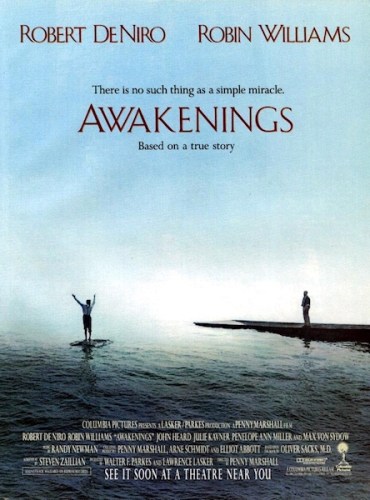
Awakenings (1990)

2017 #154
Penny Marshall | 116 mins | TV | 16:9 | USA / English | 12 / PG-13

Awakenings

Based on a true story, Awakenings tells of Dr Malcolm Sayer (Robin Williams), who stumbles across an element of responsiveness in previously catatonic patients on his hospital ward. Finding a condition that links them buried in their medical histories, he supposes that a newly-invented drug might help their condition, subsequently testing it on Leonard (Robert De Niro), who ‘wakes up’ for the first time in 30 years. As Sayer continues his work, the new treatment reinvigorates the lives of more people than just the patients.

I hadn’t even heard of Awakenings until the untimely passing of Robin Williams, when it was brought to my attention by Mike of Films on the Box (er, I think — I can’t find where this occurred. Either it’s on someone else’s blog or I’ve entirely misremembered the circumstances). Frankly, I’m not sure why it isn’t better remembered. Okay, it’s a little schmaltzy towards the end, but there are plenty of films that are worse for that which are held in higher esteem by some. Perhaps it’s not schmaltzy enough for those people, but still too much for people who hate that kind of thing? Or maybe it’s something else — but I don’t know what, because the rest of the film is packed with quality and subtlety.

Such qualities are to be found in its writing — a screenplay by Steven Zaillian that conveys not only the usual story, character, and emotion, but also relates medical facts and processes in a way that is expedient to the narrative but still seems genuine. Whether it is or not I couldn’t say, but I didn’t feel conned by movieland brevity. Such qualities are to be found in the directing — unshowy work by Penny Marshall which matches the screenplay for its attention to detail in a way that never makes it feel as if we’re being fed a lot of information (although we are); that finds moments of beauty and life in the humanity of the characters, their plights, their successes, and their connections.

You waking up me? Well I'm the only one here...

Such qualities are to be found in the acting — De Niro’s immersive performance as a teenager trapped in a 50-year-old’s body, bookended by a medical condition so extreme that in lesser hands it could easily have become a caricature. Also Williams, giving quite possibly the most restrained performance of his career, but fully relatable as the socially inept doctor who is slowly, almost imperceptibly, brought out of his shell. And also an array of supporting performers, who each get their moment to shine in one way or another — although “shine” feels like the wrong word because, again, it’s understated. One or two moments aside (the schmaltziness I mentioned), there’s no grandstanding here.

Combine those successes with the knowledge that this is a true story (heck, you wouldn’t believe it if it weren’t) only makes the film’s events — and its messages about being attentive of others and embracing the life we’re given — all the more powerful.

4 out of 5

The Exorcist (1973)

2017 #150
William Friedkin | 122 mins | Blu-ray | 16:9 | USA / English & Arabic* | 18 / R

The Exorcist

Did you know The Exorcist was based on a true story? I didn’t, until I watched some of the special features on the Blu-ray release. “Based on” is a bit of a stretch, to be honest. “Inspired by” would be more accurate. But you get the sense from author and screenwriter William Peter Blatty that he believes all this stuff so much that he thinks “based on” would be fine.

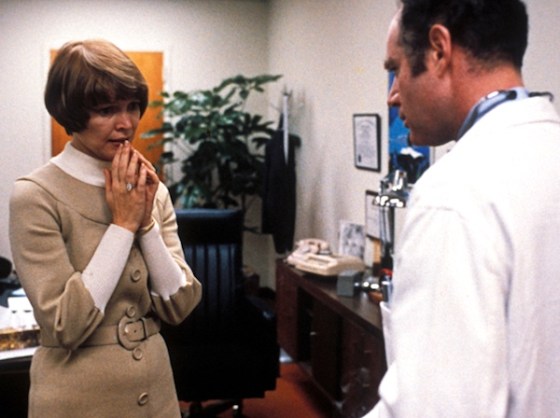
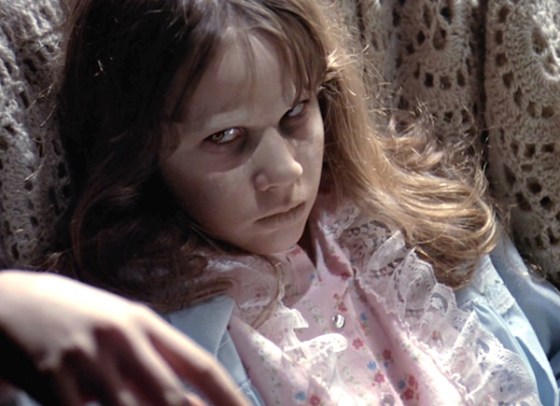
The Exorcist does start out very plausibly. It’s about Regan MacNeil (Linda Blair), a sweet 12-year-old kid living with her mother Chris (Ellen Burstyn) in Washington, D.C. But one day Regan begins to act oddly: delivering insults and soiling herself at a party; yelling obscenities; slapping her beloved mother; somehow causing her bed to shake uncontrollably… Doctors run tests, but they reveal nothing. The only suggestion they’ve left to give is that Regan may believe she’s possessed by an evil spirit, and that she might be tricked into believing she’s cured if the church will perform a little-known procedure called an exorcism.

Worried mother

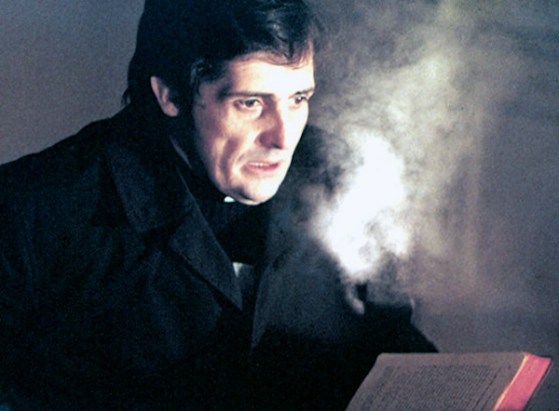
Everyone’s so busy talking about The Scary Stuff when it comes to The Exorcist, no one ever tells you how low-key and grounded a lot of it is. Okay, the talking in voices and spinning heads and vomiting green gunk and bloody crucifix masturbation are pretty memorable, so fair enough. Before that, though, it’s more of a character drama, about a single mother struggling to handle what appears to be her daughter’s out-of-control mental health problems. Meanwhile, a priest, Father Karras (Jason Miller), struggles with a crisis of faith brought on in part by his ailing mother. Naturally these two threads align when Chris calls on Karras to investigate Regan’s condition.

Another thing I’ve never heard about The Exorcist is how good Miller is. This is his film debut, before which he was a stage actor, but he delivers a very naturalistic performance as a man of the cloth who also has his head screwed on — his training in psychology keeps him suitably skeptical of what’s going on with Regan. Events conspire to challenge his point of view, of course. Karras has the clearest arc of anyone in the film, giving Miller the most scope to develop his role. I’d venture he’s the film’s most interesting character.

Father Karras

That’s not to dismiss Burstyn, who’s also excellent as the very together mom who begins to crack under the increasing strain of her daughter’s worsening, inexplicable condition. As said daughter, Blair’s performance is certainly memorable, though the potency of Regan is aided by special effects and voice work from another actress. Although second billed, Max von Sydow only pops in at the beginning and end in the titular role of Father Merrin. It’s no wonder someone later thought Merrin’s past was ripe for a prequel, because there’s a backstory there that’s only hinted at.

And no one ever says how little Tubular Bells is in it, either.

The thing people do say about The Exorcist is how scary it is. Tales of audiences fainting and running out during its initial theatrical run are the stuff of movie legend. Today its releases are branded as “the scariest film ever made”, with the justification of several polls that have named it thus. I can well believe that, in the early ’70s, it was indeed the most shocking film most people had ever seen, certainly from a major studio. The extreme bad language, the gruesome special effects, the morally depraved acts, and all of it happening to a child…

Regan... or is it?

It was surely an element of sensibilities being offended (especially in America), as much as it was actual horror, that provoked such radical reactions from audiences back in the day. Nowadays we’re a bit more deadened to those things — the last 40+ years have served up plenty of elaborate gore, and potty-mouthed pre-teen girls are more likely to be found in comedies (Hit-Girl is even younger than Regan when she utters the C word in Kick-Ass, for example). I also thought it frequently undermined its own intensity by cutting away from the scary scenes to more mundane stuff. Maybe the goal was to never give those scenes an ‘out’ — we always seem to leave them when supernatural stuff is still going on — but for me it killed the momentum that was building.

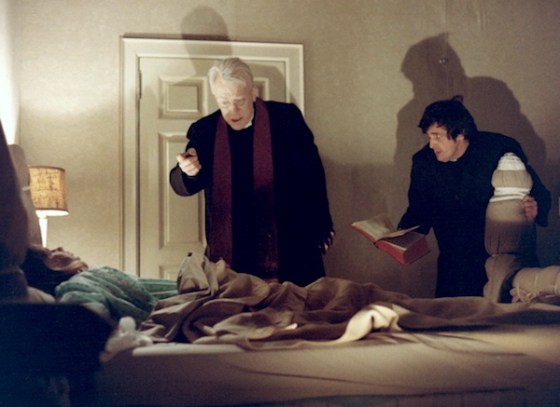
That’s not to say the horrific and shocking stuff is no longer powerful. What really works in its favour is how long the film spends being grounded and plausible — most of the first hour is a ’70s social drama about a child with a mental health problem. That level of realism helps the later horror scenes be all the more effective. They quite quickly transcend the realms of the plausible (unless you’re some kind of religious fanatic, I guess), but the grounded setup lends weight to them nonetheless. The climax in particular — the actual exorcism — might just be silly without the realistic world it’s been placed in. Instead, it’s a suitably tense climax.

The exorcism

Obviously it was the extreme stuff that caught people’s attention and earnt The Exorcist a reputation that it still trades off to this day. However, I’d say it’s best regarded, not as a fright-fest, but as a film about characters: the mother who’ll do anything for her child; the priest battling with a crisis of faith. It’s a drama about real people in extreme circumstances, it’s just that these extreme circumstances happen to be horror movie fodder. In this respect it’s such a film of the ‘70s, which I mean in the best possible way.

5 out of 5

The Exorcist was viewed as part of my Blindspot 2017 project, which you can read more about here.

* IMDb lists half a dozen other languages, but Arabic’s the only one I remember being significant enough to earn subtitles. ^

Musical Review Roundup

My blog is alive with the sound of music, courtesy of…

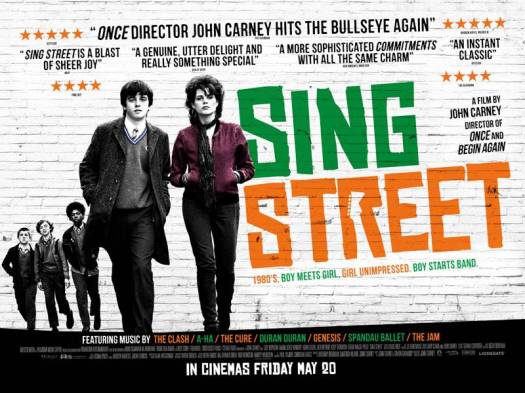
  • Sing Street (2016)
  • Jersey Boys (2014)
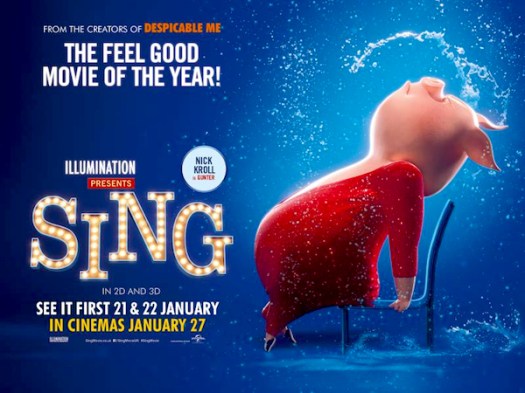
  • Sing (2016)
  • Into the Woods (2014)


    Sing Street
    (2016)

    2017 #13
    John Carney | 106 mins | streaming (HD) | 2.35:1 | Ireland, UK & USA / English | 12 / PG-13

    Sing Street

    A struggling busker — sorry, a failing record exec — no, sorry, a misfit teenage boy… sets out to impress a beautiful fellow busker — sorry, a promising singer-songwriter — no, sorry, a cool girl… by helping her record a record — sorry, by coercing her to record a record — no, sorry, by persuading her to star in the music video for the record he’s recorded. Except he hasn’t actually recorded that record yet. In fact, he doesn’t even have a band.

    Yes, the writer-director of Once and Begin Again has, in some respects, made the same film again. Yet somehow the formula keeps working. Here there’s extra charm by it being school kids dealing with first love and finding their place in the world. It’s something we all go through, so there’s a universality and nostalgia to it that perhaps isn’t present in the story of twenty/thirty-somethings who are still floundering around (especially Begin Again, which made them cool twenty/thirty-somethings living in cool New York).

    It’s fuelled by endearing performances, particularly from young leads Ferdia Walsh-Peelo and Lucy Boynton, and a soundtrack of era-aping toe-tappers — in an alternate (better) universe, The Riddle of the Model and Drive It Like You Stole It competed for the Best Original Song Oscar, and one of them won it too. And those are just the highlights — the rest of the soundtrack is fab as well. I imagine if you were a music-loving teenager in the ’80s, this movie is your childhood fantasy.

    5 out of 5

    Sing Street placed 7th on my list of The 17 Best Films I Saw For the First Time in 2017, which can be read in full here.

    Jersey Boys
    (2014)

    2017 #97
    Clint Eastwood | 134 mins | streaming (HD) | 2.35:1 | USA / English | 15 / R

    Jersey Boys

    A musical biopic about Frankie Valli and the Four Seasons doesn’t seem like a very Clint Eastwood film at first glance, but when it turns out to be kind of Goodfellas but with the music industry, it becomes at least a little more understandable.

    Based on the hit Broadway musical, it retains a staginess of structure — the four band members take turns narrating the story by speaking to camera — while also opening out the settings so it feels less “jukebox musical” and more “biopic with songs”. It takes some liberties with the chronology of events for dramatic effect, but that’s the movies for you.

    The shape of the story feels familiar and it feels leisurely in the time it takes to tell it, but the songs are good and most of it is perfectly likeable. It’s by no means a bad movie, just not one that’s likely to alight any passion.

    3 out of 5

    Sing
    (2016)

    2017 #107
    Garth Jennings | 108 mins | download (HD+3D) | 1.85:1 | USA / English | U / PG

    Sing

    The seventh feature from Illumination (aka the Minions people) comes across like a cut-price Zootopia: in a world where animals live side-by-side in cities like humans, a struggling theatre owner launches an X Factor-esque singing competition to revive his fortunes. Naturally there’s a motley cast of participants, all with celebrity voices, and hijinks ensue.

    Apparently the film features 65 pop songs, the rights to which cost 15% of the budget — if true, that’s over $11 million just in music rights. The big musical numbers (all covers, obviously) are fine, with the best bit ironically being the new Stevie Wonder song on the end credits, which is accompanied by Busby Berkeley-ing squid. Elsewhere, there are some moments of inventiveness, but it doesn’t feel as fully realised as Zootropolis. Perhaps that’s part and parcel of Illumination’s ethos: to make films that translate internationally, presumably by being quite homogeneous. And to make them cheaply (their budgets are typically half of a Pixar movie), which has its own pros and cons.

    Anyway, the end result is fine. Much like Jersey Boys, Sing is perfectly watchable without ever transcending into anything exceptional.

    3 out of 5

    Into the Woods
    (2014)

    2017 #118
    Rob Marshall | 125 mins | streaming (HD) | 2.39:1 | USA, UK & Canada / English | PG / PG

    Into the Woods

    Fairytales are combined and rejigged in Stephen Sondheim’s Broadway musical, here brought to the screen by the director of Chicago. The original is a work that definitely has its fans, but doesn’t seem to have crossed over in the way of, say, Phantom of the Opera or Les Mis — I confess, I’m not sure I’d even heard of it before the film was announced.

    The film adaptation readily suggests why that might be. For one, it’s light on hummable tunes. It’s almost sung through, with only a few bits seeming to stand out as discrete songs in their own right. For example, it takes the opening number a full 15 minutes to reach its culmination, having been diverted into a few asides. Said song culminates with most of the main characters going into the woods while singing about how they’re going into the woods, and yet the film doesn’t put its title card there. The placement of a title card is a dying art, I tell you.

    Performances are a mixed bag. Everyone can sing, at least (by no means guaranteed in a modern Hollywood musical adaptation), and the likes of Emily Blunt, James Corden, and Anna Kendrick are largely engaging, but then you’ve got Little Red Riding Hood and her incredibly irritating accent. Fortunately, she gets eaten. Unfortunately, she gets rescued. On the bright side there’s Chris Pine, his performance well judged to send up the romantic hero role. You may remember Meryl Streep got a few supporting actress nominations for this, which is ludicrous. It’s not that she’s bad, but she’s in no way of deserving of an Oscar.

    There are witty and clever bits, both of story and music, but in between these flashes it feels kind of nothingy. It’s also overlong — the plot wraps up at the halfway point, with the second half (presumably what comes after an interval on stage) feeling like a weak sequel to the decent first half. All in all, another one for the “fine, but could do better” pile.

    3 out of 5