Rocky II (1979)

2018 #131
Sylvester Stallone | 119 mins | Blu-ray | 1.85:1 | USA / English | PG / PG

Rocky II

This first sequel could fairly have been titled Rocky Part II: picking up where the first film left off (literally — the first six minutes are just a replay of Rocky’s final fight), it goes on to detail what happens next for both Rocky (Sylvester Stallone) and his world-champion opponent, Apollo Creed (Carl Weathers). For the former, his childlike naïveté and heart of gold sees him carelessly burn through his newfound wealth as he tries to give the love of his life (Talia Shire) everything he thinks she wants. For the latter, it means an ongoing niggle that he didn’t really win the fight, so he tries to goad Rocky into a rematch.

Like the first movie, a lot of Rocky II is more of a character-based drama than a sport-driven movie, this time about someone who had a taste of the big time struggling to re-adapt to normal life. It’s not that Rocky’s ego has outgrown his means — he doesn’t seem to mind going back to working menial jobs when the money runs out — but his overestimation of his success means that he does indeed find himself in that position. It’s not bad as a dramatic work — it’s got the same writer as the first movie, after all, here also stepping up to direct (and did you know he wrote a novelisation too?) — but we know where it’s all headed, and so the second half is better than the first.

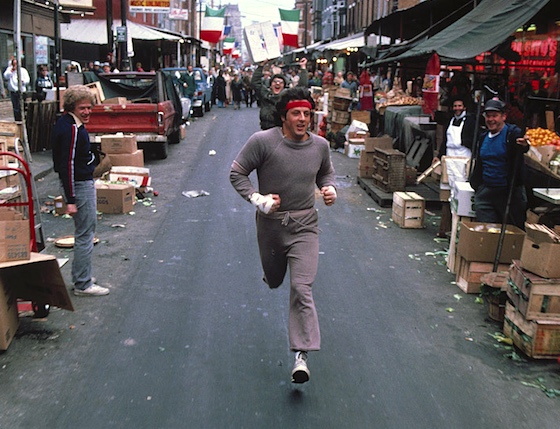
Run, Rocky, run!

Again, Stallone doesn’t lose sight of keeping events moderately grounded: Rocky struggles to focus on his training regime, and it begins to look like Creed may be right that his success in their first bout was all fluke. Of course, this is as much an underdog fairytale as the first movie was, and so events transpire to finally give Rocky his motivation, culminating in a triumphant revisit to the first film’s famous running-up-the-steps bit. The finale is, naturally, the big boxing rematch, where Stallone really shows off his directing chops: it’s a tense, drag-out duel that easily exceeds the first film’s for visceral impact.

On the whole, I wouldn’t say Rocky II is better than its predecessor — indeed, maybe it’s not quite as good — but I enjoyed it about the same; maybe even slightly more by the end. The Rocky sequels have a collectively poor rep, but I think this is a worthy follow-up.

4 out of 5

The UK network TV premiere of the latest Rocky sequel, Creed, is on ITV tonight at 9:30pm.

Victoria & Abdul (2017)

2018 #52
Stephen Frears | 112 mins | streaming (HD) | 2.35:1 | UK & USA / English, Urdu & Hindi | 12 / PG-13

Victoria & Abdul

Returning to the role that earnt her first Oscar nomination, Dame Judi Dench stars as an even older Queen Victoria, who once again gets involved in a friendship with a foreign servant to the exasperation of those around her. If it wasn’t based on a true story, the similarities to Mrs Brown would make Victoria & Abdul look like a slipshod copycat sequel. Okay, this isn’t technically a sequel, but the similarities can’t be ignored.

Where the earlier film aimed for dramatic weight as a portrait of a grieving and isolated monarch finding human connection again, here the goal seems to be more comedic. Perhaps. I mean, if often shoots for funny, but it’s not funny enough to be an outright comedy. At other times it’s more straightforwardly dramatic, especially as it gets towards the end, but there’s a nagging sensation that the facts have been bent to fit the expected shape of the narrative. The film begins with a card that says it’s “based on real events… mostly”, which feels a little too comical for a heritage drama such as this, and was perhaps more intended it as a “get out of jail free” card for its historical accuracy. (I don’t know what the facts are, mind, so I can’t vouch for or condemn the film’s faithfulness to them.)

Turns out we are very much amused

Dench is very good, as you’d expect. The rest of the cast don’t get to deliver as much range, but they’re a quality bunch of performers and so are easily up to what they’re given. It’s also as pretty a production as you’d expect, with Oscar-nominated makeup and costumes, plus opulent production design and grand location choices, all shown off by Danny Cohen’s pleasant cinematography.

I read someone else assess that it’s not as good as its individual parts, and I think that’s fair. Most of the scenes, moments, and performances are strong — there are notably funny bits, dramatic bits, emotional bits; even unexpected complications in how it handles some of the characters — but when it’s all put together, it doesn’t quite coalesce. If you think you’re the kind of person who’d enjoy this movie, there’s every chance it will please you no end. Otherwise, while it does have definite qualities, it doesn’t do quite enough to transcend its trappings.

3 out of 5

Victoria & Abdul is available on Sky Cinema from today.

Yojimbo (1961)

aka Yôjinbô

2017 #126
Akira Kurosawa | 111 mins | DVD | 2.35:1 | Japan / Japanese | PG

Yojimbo

Best known to many viewers as the film Sergio Leone ripped off to make A Fistful of Dollars, Akira Kurosawa’s Yojimbo is itself already a Western in all but setting: it stars Toshiro Mifune as Sanjuro, a ronin who wanders into a village where two gangs are at loggerheads, a conflict from which the regular folk cower in fear. Where Kurosawa deviates from the Western, at least as they had been made to that point, is that Sanjuro isn’t a clean-cut hero who’ll side with the good guys and get this mess sorted — he’s a mercenary, primarily out for his own interests; and besides, there are no good guys to join: both gangs are equally bad.

In his essay that accompanies Criterion’s release of the film, Alexander Sesonske argues that Kurosawa is actually combining “two typically American genres”. So we have “a classic Western setting, with dust and leaves blowing across the wide, empty street that runs the length of a village, a lone stranger passes as frightened faces peer from behind shutters”, mixed with the morals (or lack thereof) of a gangster movie, with everyone a crook hoping to merely outgun the others. That all comes wrapped in the milieu of a samurai movie, meaning instead of pistol duels or scattershot machine-gun fire we get flashing blades. Indeed, Yojimbo was the first film to have a sound effect for a sword slashing human flesh — they had to experiment to get it right, because it had never been done. Considering the film also features severed limbs and squirting blood, the BBFC’s PG seems awfully lenient…

Observing the conflict

Given all that, it seems like this is an almost mercilessly nihilistic film. It’s set in a town that’s been fucked up by the never-ending gang warfare, and over the course of the story nearly everyone dies, many of them in brutally violent fashion. Even the hero seems remorseless, killing freely and plotting to get the two gangs to massacre each other because he sees a way to profit. Sesonske asserts that “Yojimbo lacks the intellectual challenge of Rashomon, the moral resonance of Ikiru, or the sweep and grandeur of Seven Samurai”, which may all be true to an extent, but we shouldn’t disregard what the film does offer: a bleak worldview that chimes with the careless brutality of the world as we know it.

Even in such hopelessness there is beauty, and here, at least, that comes from Kazuo Miyagawa’s gorgeous black-and-white cinematography. With many incredibly blocked and framed shots, it’s no wonder Kurosawa has been so copied — his visuals are always amazing. His exacting desires may’ve created various production issues (the specially-built set, made with extreme period accuracy, was unprecedentedly expensive; to create the windswept effect they used all of the studio’s wind machines, which was so powerful actors couldn’t open their eyes and camera cranes couldn’t complete moves; and he used all of the studio’s big lights for night scenes, but the way they pulsated meant lens filters had to be used to compensate), but it doesn’t half look good in the end.

5 out of 5

Yojimbo was viewed as part of my Blindspot 2017 project, which you can read more about here.

Almost Oscar-Worthy Review Roundup

Each of these films was nominated for multiple Oscars… but failed to win a single one.

In today’s roundup:

  • Big (1988) — nominated for Best Actor (Tom Hanks) and Best Original Screenplay.
  • Frost/Nixon (2008) — nominated for Best Picture, Best Actor (Frank Langella), Best Director, Best Adapted Screenplay, and Best Editing.
  • Lion (2016) — nominated for Best Picture, Best Supporting Actor (Dev Patel), Best Supporting Actress (Nicole Kidman), Best Adapted Screenplay, Best Cinematography, and Best Original Score.


    Big
    (1988)

    2017 #91
    Penny Marshall | 100 mins | TV (HD) | 1.85:1 | USA / English | PG* / PG

    Big

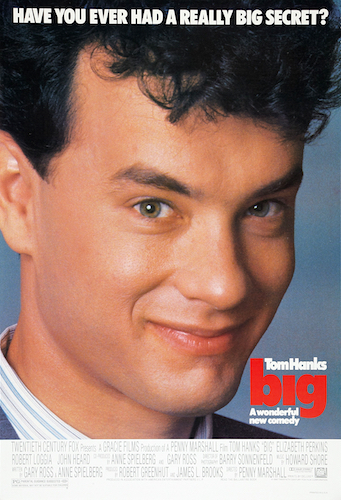
    Big is one of those strange gaps in my viewing — the kind of film I feel I should’ve seen when I was a kid in the early ’90s but didn’t.

    Anyway, in case you’ve forgotten, it’s the one where a 12-year-old boy makes a wish and ends up as an adult, played by Tom Hanks. Rather than solve this problem in a day or two, he ends up moving to the city, getting a job, an apartment, a relationship, and all that grown-up stuff. Maybe it’s just me, but I didn’t expect that level of scale from a movie like this. Generally there’s some hijinks around “kid in an adult’s body” and it’s all solved in a day or two, but the length of time the kid’s predicament rolls on for allows the movie to tap into more than that. I mean, it’s still a funny movie, but it’s got a message about how it’s important to remember the childlike spirit, but also that it’s OK to be at whatever stage in life you’re at — don’t rush it.

    Plus the whole thing has a kind of sweet innocence that you rarely see in movies nowadays. We’re all too cynical, too concerned with realism (even in fantasy movies). If you made it today, it’d ether have to be sexed/toughened up for a PG-13, or kiddified (and likely animated) for a G. That said, that the 12-year-old boy in a man’s body is happy to sleep with the hot woman, apparently without it bothering his conscience one iota, is by far the most realistic thing about this movie.

    4 out of 5

    * The UK PG version is cut by two seconds to remove an F word. The cut is really obvious, too — was there not a TV version with an ADR’d non-swear? Anyway, it was classified uncut as a 12 in 2008, though that’s not the version they show on TV, clearly. ^

    Frost/Nixon
    (2008)

    2017 #136
    Ron Howard | 117 mins | DVD | 2.35:1 | USA, UK & France / English | 15 / R

    Frost/Nixon

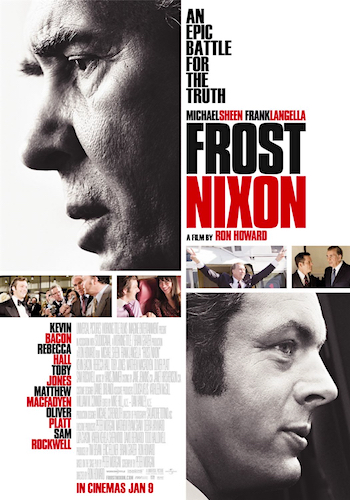
    Peter Morgan’s acclaimed play about the famous interviews between David Frost and President Richard Nixon (the ones where he said “when the President does it, that means it’s not illegal”) transfers to the big screen with its two lead cast members intact (Michael Sheen as Frost and Frank Langella as Nixon) and Ron Howard at the helm.

    As a film, it almost embodies every pro and con that’s ever been aimed at Howard’s directing: it’s classy and thoughtful, in the way you’d expect from a director who’s helmed eleven Oscar-nominated movies* and won two himself; but it also, for example, employs an odd framing device of having the supporting cast be interviewed as if for a documentary, which exists solely as an on-the-nose way of integrating direct-to-audience narration from the original play — my point being, it’s a bit straightforward and workmanlike.

    Still, when you’ve got actors of the calibre of Sheen and Langella giving first-rate performances (the latter got an Oscar nomination, the former didn’t, I reckon only because Americans aren’t as familiar with David Frost as us Brits are — his embodiment of the man is spot-on), and doing so in a story that’s inherently compelling (even if somewhat embellished from reality — but hey, that’s the movies!), what more do you need?

    4 out of 5

    * Many of those only in technical categories, but hey, an Oscar nom is an Oscar nom. ^

    Lion
    (2016)

    2017 #103
    Garth Davis | 119 mins | streaming (HD) | 2.35:1 | UK, Australia & USA / English, Hindi & Bengali | PG / PG-13

    Lion

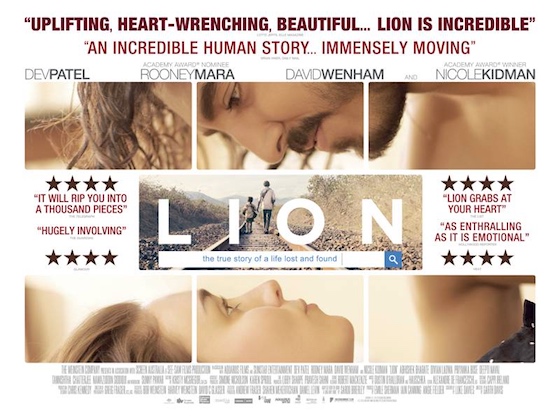
    Slumdog Millionaire meets Google product placement in this film, which is remarkably based on a true story — or based on a remarkable true story, if you want to be kinder. It’s the story of Saroo Brierley, a young Indian boy (played by newcomer Sunny Pawar) who is separated from his family, ends up in an orphanage, and is adopted by Australian parents. As an adult (played by Dev Patel), he resolves to find his birthplace and family — using Google Earth.

    If it was fiction then it’d be too fantastic to believe, but because it’s true it packs a strong emotional weight, not least Saroo’s relationship with is adoptive parents, played by Nicole Kidman and David Wenham. The star of the show, however, is Dev Patel. You may remember there was controversy about him being put up for Supporting Actor awards, deemed “category fraud” by some because Saroo is the lead role. Conversely, he shares it with young Sunny Pawar, and Patel doesn’t appear until almost halfway through the film. Well, the “category fraud” people are more on the money, and it’s testament to Patel’s performance that it doesn’t feel like he’s only in half the film. Pawar is great — both plausible and sweetly likeable — but while watching I didn’t realise the movie had a near 50/50 split between young and adult Saroo. Maybe this means the first half is pacier, but its not that the second part feels slow, more that Patel has to carry greater emotional weight.

    Mother and son

    Rooney Mara is also in the film, as adult Saroo’s girlfriend. Her character is in fact based on multiple real-life girlfriends, but it makes sense to consolidate them into one character for the sake of an emotional throughline. However, her storyline ultimately goes nowhere — it ends with Saroo asking her to “wait for me”. Did she? Did he go back to her? It’s not the point of the film — that’s about him finding his family, and after that emotional climax you don’t really want an epilogue about whether he gets back with his girlfriend or not — but it still feels like it’s left hanging. I suppose it isn’t — I guess we’re meant to presume she does wait for him and they get together when he returns and live happily ever after — but it doesn’t feel resolved. It shouldn’t matter — as I say, it’s not the point — but, because of that, it does.

    So it’s not a perfect movie, but it packs enough of an emotional punch to make up for it.

    4 out of 5

  • Gangster Review Roundup

    In today’s roundup:

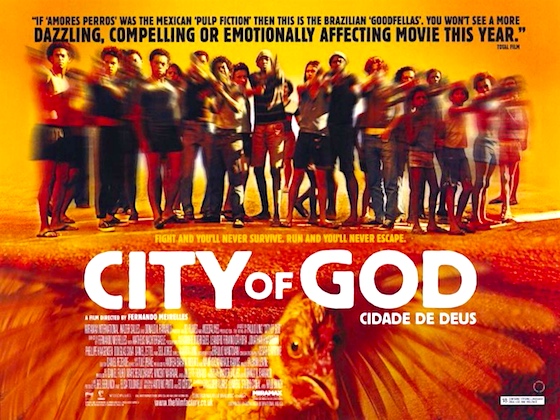
  • City of God (2002)
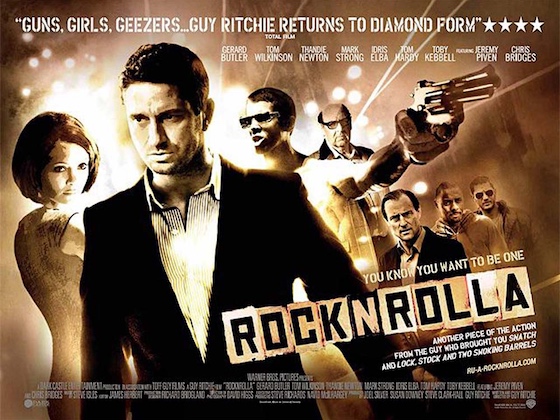
  • RocknRolla (2008)
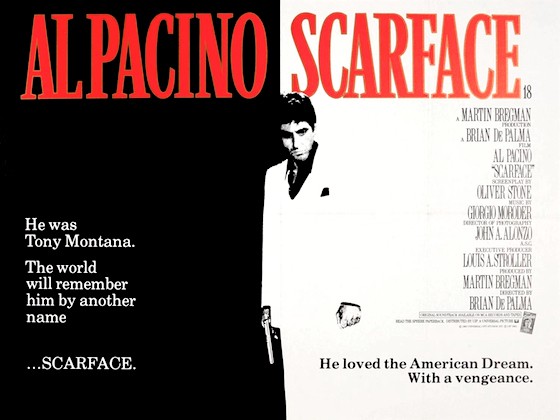
  • Scarface (1983)


    City of God
    (2002)

    aka Cidade de Deus

    2017 #100
    Fernando Meirelles | 129 mins | DVD + download* | 1.85:1 | Brazil & France / Portuguese | 18 / R

    City of God

    What better insight into my film watching habits than this, a movie I’d been meaning to get round to for the best part of 14 years (ever since it topped Empire’s list of the best films of 2003, around the same time as I was getting into film ‘seriously’, i.e. as more than just “movies I like to watch”). Plus, it was one of my Blindspot picks back in 2015 (but didn’t get watched, obv), and it was the highest ranked film on the IMDb Top 250 that I’d not seen — all good reasons why I made it 2017’s #100.

    Adapted from a novel that was based on real events, it tells the story of how organised crime grew in Rio de Janeiro’s Cidade de Deus favela — the “City of God” of the title — from the late ’60s to the early ’80s. The main thing that struck me watching it now is how much it reminded me of the TV series Romanzo Criminale — both are basically about young people taking over and running all the crime in a city. The fact that they’re also both inspired by true stories (the series depicts a criminal gang in Rome through the ’70s and ’80s) is intriguing for different reasons. They also share certain stylistic similarities, I think, in particular the almost documentary-like visuals. The series came later, of course, so if one did inspire the other then this isn’t the copycat.

    At the risk of turning this into a review of something else, I must say that, while Romanzo Criminale is a favourite of mine (I included it in my 2017 list of Favourite TV Series of the Last 10 Years), City of God was a work I admired more than loved. Nonetheless, for anyone who likes crime epics, this is a must-see (but, uh, so is Romanzo Criminale).

    5 out of 5

    * Possibly because it’s just been sat on a shelf for over a decade (possibly just through sheer bad luck), my DVD was corrupted about halfway through and I had to, uh, source another copy. ^

    RocknRolla
    (2008)

    2017 #146
    Guy Ritchie | 110 mins | streaming (HD) | 16:9 | UK, USA & France / English & Russian | 15 / R

    RocknRolla

    In my review of Snatch I commented that its contemporary reviews were along the lines of “oh, Lock Stock again”, and yet now it’s pretty well regarded. My memories of RocknRolla’s contemporary reviews are “oh, another Guy Ritchie London gangster film — isn’t it time he did something new?” And yet, it now seems to be pretty well regarded. Not as much as Lock Stock and Snatch, but better than you’d think “Guy Ritchie does the same schtick for a fourth time” would merit.

    Well, it is a case of Ritchie doing his usual schtick (thank God he did eventually move on, at least applying the same broad MO to some new genres), but a cast that includes the likes of Idris Elba, Tom Hardy, Mark Strong, Tom Wilkinson, and Thandie Newton can’t help but elevate the material. Gerard Butler is ostensibly the lead, front-and-centre on the poster, but the movie follows the standard Ritchie template: an ensemble cast in a variety of story threads that bump into each other and overlap in different ways at different times. Even if the specifics aren’t the same as his other films, and the cinematography is more slick and big-budget than the grimy ’90s indie visuals of his debut and sophomore flick, the general style feels very familiar.

    Ultimately, I enjoyed it more than Snatch, but maybe I was just in the right mood — I mean, like I said, they’re all fundamentally the same kind of thing.

    4 out of 5

    Scarface
    (1983)

    2018 #14
    Brian De Palma | 170 mins | Blu-ray | 2.35:1 | USA / English & Spanish | 18 / R

    Scarface

    Brian De Palma’s in-name-only remake of 1932 gangster classic Scarface follows Al Pacino’s Cuban immigrant Tony Montana as he rises up the ranks of organised crime in ’80s Miami. As it turns out, it’s not easy being at the top.

    A near-three-hour epic (what is it with gangster movies being three hours long?), interest is sustained through Pacino’s wild-eyed performance, De Palma’s slick direction, and a story that at least has enough incident to merit that length. Also, early-career Michelle Pfeiffer, who gives a good performance as Montana’s increasingly miserable gal but, frankly, could just stand there and still keep half the population interested.

    Apparently a favourite movie among rappers, I guess some people get the wrong message from Scarface. I suppose the stylishness with which it’s produced has the side effect of idolising the lifestyle Montana and co lead, but the way it gradually crumbles and destroys everything should be a pretty clear indicator of how such things actually go. Still, it all makes for a heady mix.

    5 out of 5

    Scarface was viewed as part of What Do You Mean You Haven’t Seen…? 2018.

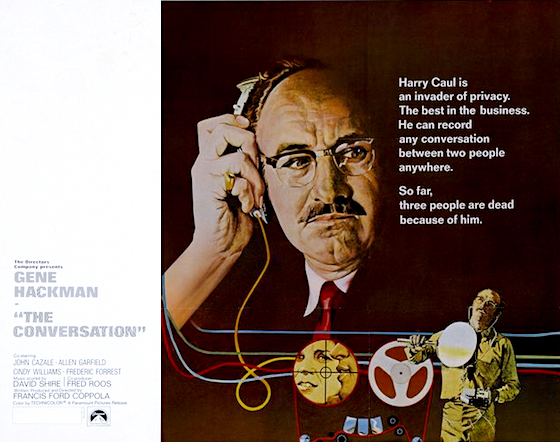
  • The Conversation (1974)

    2017 #10
    Francis Ford Coppola | 114 mins | Blu-ray | 1.85:1 | USA / English | 12 / PG

    The Conversation

    In the mind of writer-director Francis Ford Coppola, the concept for The Conversation started out as a puzzle, a story that used repetition to make the audience reconsider what they thought they knew — “not like Rashomon where you present it in different ways each time,” Coppola told Brian De Palma (in this interview, which is a must-read for anyone interested in the genesis and making of The Conversation). “Let them be the exact lines but have new meanings in context. In other words, as the film goes along, the audience goes with it because you are constantly giving them the same lines they’ve already heard, yet as they learn a little bit more about the situation they will interpret things differently.” That element is unquestionably still in the film — it propels its plot and generates its twist — but Coppola was a very character-driven filmmaker, and so he couldn’t help but flesh out the man who was listening to those lines over and over again.

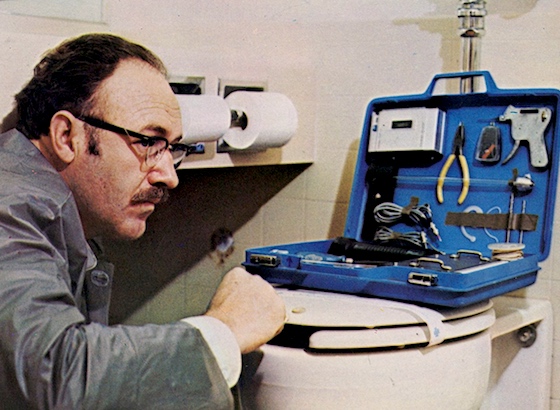
    That man is Harry Caul (Gene Hackman), a professional eavesdropper — people pay him to record what other people are saying in private. When Coppola conceived the film, this was just an interesting world to play around in. By the time it was produced and released, Watergate had recently happened and the film could not have been more timely. Nonetheless, the end result is not merely an espionage mystery, but also a character study about what kind of man would perform this work. So we do see how Harry goes about his job, but these scenes are almost as much about telling us who this man is (methodical, thorough, clever, inventive) as they are about furthering the plot (which, naturally, they’re central to).

    Here he just looks like a toilet repair man...

    It’s also about how the job affects him. One part of that is paranoia — an obvious reaction when you think about it. Harry has multiple locks on his apartment door, and one major early sequence is based around him trying to establish how a kindly neighbour had got in to leave him a gift — a seemingly innocuous thing, but the potential it holds has him terrified. Come the end of the film, such behaviour takes on a maddening new dimension. But perhaps an even bigger problem is conscience. Harry lies to himself about the nature of his work, because once upon a time a trio of deaths resulted from it. He says they weren’t his fault because he was just doing his job, but he still clearly carries the guilt of it, and that is what ultimately leads him into a new predicament. Not that that ends well either. Yes, it all comes to a very ’70s conclusion: bleak.

    Coppola’s original vision for the film, as a puzzle for the viewer to be solved, survives into the final cut, though anyone watching it just to solve the riddle may find it slow going at times. That’s because Coppola’s other filmmaking instinct, to explore character, has naturally taken hold, and so the movie is as much about the bugger as the bugging. And so it’s very much two things hand in hand: the mystery of what’s going on in the recording, and a study of the psychology of a man who does this for a living. It’s all the richer for being both.

    5 out of 5

    The Conversation was viewed as part of my Blindspot 2017 project, which you can read more about here.

    Adventures of Zatoichi (1964)

    aka Zatôichi sekisho-yaburi

    2018 #108
    Kimiyoshi Yasuda | 86 mins | Blu-ray | 2.35:1 | Japan / Japanese

    Adventures of Zatoichi

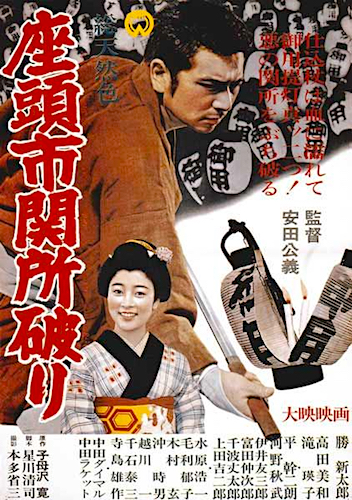
    Another Zatoichi film (the ninth now), another super-generic title. Only in English, mind: best I can work out, the Japanese title translates as something like Zatoichi Breaks Through the Barrier or (considering what happens in the final act) possibly Zatoichi Guard Station Break-In. Even if you can’t translate it in a way that sounds reasonable in English, why not go for something like Zatoichi’s New Year? (That’s when the film’s set, and is referenced many times.) Okay, maybe it doesn’t sound super exciting, but at least it’s more distinctive than Adventures of Zatoichi, which could be literally any of the films.

    Anyway, titling issues aside, the fourth and final Zatoichi film put out in 1964 (which I guess made the New Year thing even more appropriate on its original release) sees Ichi arrive in a village near Mount Myogi, where he intends to be for the first light of the new year. Lots of merchants have also gathered there for the festival, but the local yakuza are demanding an unreasonably high percentage of the takings as tax. Although this subplot facilitates some comic relief in the complaining of a pair of travelling performers, Ichi has other concerns on his mind: there are a couple of good-hearted young women who each need Ichi’s help defending them from the murderous stupidity of men. One, her brother has escaped prison and returned to town; the other, her father, a village elder, has gone missing and she’s looking for him. Both have something to do with the yakuza. In a slight twist on the usual formula, Ichi’s prodigious reputation means the gangsters are afraid of him (rather than assuming they can beat him), but he’s still got his work cut out getting to the bottom of a conspiracy between the gang’s boss and the local magistrate. That’s not to mention the intriguing connection Ichi finds with the village’s old drunkard…

    Z boys

    Everyone else seems to rate Adventures of Zatoichi somewhat poorly. It’s ranked 20th out of 25 by Letterboxd users, the lowest of the series so far, and below some of the post-series Zatoichi films. The Digital Bits go even further, placing it in their bottom three (they haven’t ranked the films, but I checked all their ratings and they only gave three Cs). Other reviews include comments like “a workmanlike but satisfying episode” (Paghat the Ratgirl), “the quality level dips a notch after the outstanding original eight” (D. Trull), and “one of the more ordinary run-of-the-mill Zatoichi films” (Jacob Olsen). Not outright condemnation then, but definite damning with faint praise.

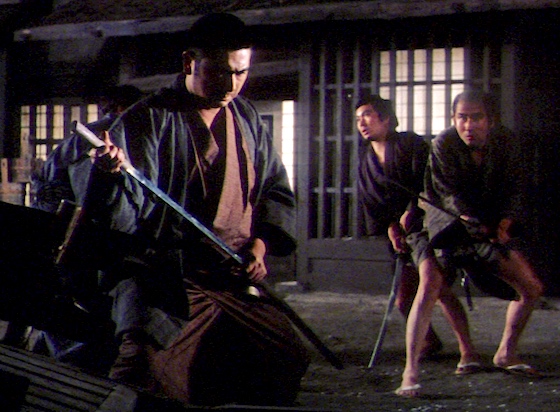
    Conversely, I thought it was rather brilliant. It has a nice, clear, well-connected narrative (something I haven’t always found in previous instalments). There’s a great cast of supporting characters, lots of small roles who all make their mark. It creates almost an ensemble around Ichi, which is a nice change of pace — it really feels like it’s set in a bustling village, rather than a half-empty town where Ichi only encounters three or four people. Tonally the film displays an effective mix of humour, action, drama, and emotion, making for an all-round entertainment. It may not have a unique setup to mark it out like Fight, Zatoichi, Fight, or the flashy direction of Chest of Gold and Flashing Sword, but it’s an above-average example of “standard” Zatoichi. It even boasts another top-drawer climax, with a well-shot and precisely-performed one-on-one duel in gently falling first snow, followed by Ichi taking out a small army to get at the men responsible. Again, it’s not as exceptionally striking visually as some of the recent big finales, but it’s superbly done nonetheless.

    Live by the sword, pretend to die by the sword

    Also, the film contains one of my favourite moments of the series so far, which is both amusing and encapsulates the character of our hero. In it, Ichi slashes his way through four assailants, then pauses… a moment later, three of them drop dead. Seeing this, the fourth just… lies down beside them. Despite being blind, Ichi can tell the chap’s still alive; but rather than finish him off, Ichi simply motions for him to leave. It’s both funny and shows Ichi’s compassion: he kills because he has to, when people attack, not for the sake of it, or even for a grudge. Similar to this is his badass summation of what just happened near the end: “I only came here to worship the first light of the new year. I expected a quiet journey, with no need to draw the blade in this cane. You brought this all on yourselves.”

    In fairness, the film is not without its problems. The early story about the merchants and the tax rate doesn’t really go anywhere. It establishes the magistrate and boss are bad folk, but then it disappears underneath the other storylines. Also, I didn’t get wholly invested in the conflict between Ichi and the gang’s yojimbo. These kinds of subplots always feel like a do-over of the first film to me, so maybe that’s why more time isn’t spent on it. It makes for a couple of impressive bursts of swordplay and one heart-to-heart chat, but no more than that.

    Adventures of Zatoichi may not be the very best movie this series has to offer, but in revelling in its formula, and doing so much of it so well, it’s one of the films I’ve enjoyed the most. In fact, this would probably be a really good one to introduce people to the series: it’s got most of the key elements, all done really well. It doesn’t deserve to be as overlooked as it seems to be.

    4 out of 5

    Rocky (1976)

    2018 #57
    John G. Avildsen | 120 mins | Blu-ray | 1.85:1 | USA / English | PG / PG

    Rocky

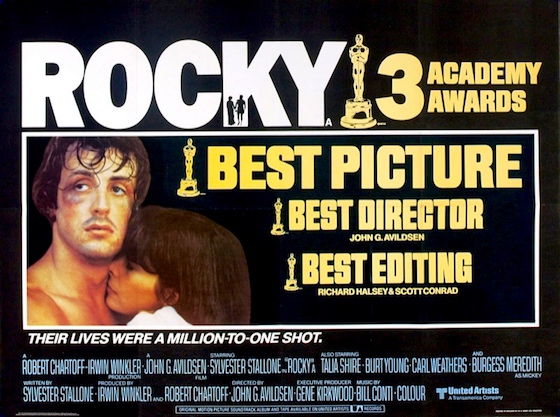
    His name is Sylvester Stallone. He’s the star of a new film called Rocky. He has been described as handsome, tough, talented, sexy, sensitive, dynamic, and brilliant. He’s been compared to Brando, Newman, Pacino, and De Niro. He’s been called “a top contender for an Academy Award”.

    His name is Sylvester Stallone, but you will always remember him as… Rocky.

    So goes the narration to Rocky’s original trailers and TV spots. We don’t get trailers like that anymore, do we? Now we just get Bryce Dallas Howard pretending to roar like a T-Rex while encouraging us to join Odeon Première Club. (I’ve been forced to sit through that far too often, and I’ve only been to the cinema four times this year.) But I digress. The narration also indicates the road Stallone could’ve gone down — imagine if he’d made a career writing and starring in movies like this, following through on all those comparisons the trailer made, rather than going down the action meathead route. A weird thought now, isn’t it?

    If you’ve never seen Rocky, you might assume it’s broadly similar to the films Stallone would mostly go on to star in, but it isn’t, really. It’s the story of a smalltime coulda-been boxer left slumming it, when, through sheer luck, he gets a shot at the big leagues. Yes, it’s an underdog sports film — the movie that “inspired a nation” (as a friend once said to me, “inspired them to do what, I don’t know. Get up and turn it off, probably”) — but it’s staged with a level of realism that such fantasies don’t normally reach for. And it’s certainly nothing like the indestructible super-action-hero of sundry later Stallone vehicles.

    Meat, standing in for a head

    Indeed, Rocky manages to both embody what we now think of as ’70s-style filmmaking — gritty and cynical and kinda miserable — with the other side of ’70s filmmaking — the decade that, between the likes of Jaws and Star Wars, gave us the populist blockbuster as we know it. So, on the one hand, Rocky lives in a dingy little bedsit, spending his days enforcing for a loan shark and plodding the derelict streets of a decrepit city; on the other, he still has hopes and ambitions, and these come to pass when he’s selected to fight world champion Apollo Creed — a real underdog sports story. This duality carries through right to the end (spoilers!): our hero loses the fight, your typical “’70s” downbeat finale; but he also goes the distance, an achievement no one else has managed, and he gets the girl. Considering the movie we’ve just watched, it’s a perfect climax: it maintains the film’s two apparently-irreconcilable (but demonstrably reconcilable) tonal halves right to the very end.

    Another major part of the film is Rocky’s faltering attempts to woo a shy pet shop worker, Adrian (Talia Shire). Most of their relationship is beautifully portrayed — tentative, cautious, sweet, and quite touching — a complete 180 from how you’d expect a character defined as “a boxer” to behave. Unfortunately, one key moment hasn’t aged so well. There’s a scene at the end of Rocky and Adrian’s first date where he badgers her into going into his apartment, which she clearly doesn’t want to do; then, despite her obvious discomfort, he tries to get her to sit with him; when she won’t, he walks towards her and, hanging off an overhead pipe, looms over her, demanding to know what’s wrong; then, as she heads for the door, he stops her, one hand over the locks and the other against the wall, trapping her in the corner; and then he informs her he’s going to kiss her, but she doesn’t have to kiss him back, and then he does. And she kisses him back, of course.

    Adriaaan!

    This scene plays very, very differently in a post-#MeToo world than I imagine it has at any other point in the past 42 years. I mean, I’m sure some people realised its awkwardness quite some time ago — women before men, no doubt — but there’s no avoiding it now. And it’s an odd scene, because clearly the filmmakers know Adrian would be uncomfortable — as I say, her whole attitude portrays that; and I presume they know why she’d be uncomfortable too; and yet it still ends with her giving in to Rocky’s persistent advances. Well, I guess the best we can say is it’s of its era, but its content, and how it makes us feel about Rocky as a character, risks becoming a barrier nowadays. His behaviour doesn’t continue in that vein, thankfully… or is that actually worse, making such behaviour normal rather than a warning sign? Are such conversations relevant about a 42-year-old movie?

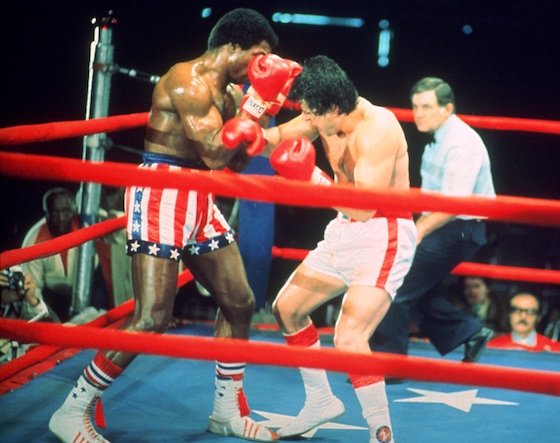
    Conversely, the film’s depiction of race feels kind of progressive. Most of the white guys we meet are bums eking out an existence, legally or otherwise, while the black guy (surrounded by a mostly black entourage, too) is successful, respected, dressed in finery, and in a position to offer the white guy a one-in-a-million shot at success. Maybe this contrast was just a coincidence, but it feels like it’s making some kind of point. Of course, once they get in the ring for the climax, the black guy is the “bad guy” and our hero is a white guy, so…

    Black vs white

    I don’t think Rocky was consciously built to sustain such readings, mind — these are just things that struck me while watching it in 2018. At heart it’s a straightforward, inspirational tale — “a charming, grimy and beautiful fairytale”, as John Simon described it in New York Magazine — about someone with unrealised potential getting a final shot. Arguably it gains more power from being semi-autobiographical: Stallone penned the screenplay (and later insisted on starring) as a similar last-shot attempt at his chosen career. It ultimately netted him two Oscar nominations, one for writing and one for acting, though he won neither — but then, what could be a more fitting mirror of the film itself?

    4 out of 5

    Rocky is on ITV tonight at 11:15pm.

    It was viewed as part of my What Do You Mean You Haven’t Seen…? 2018 project, which you can read more about here.

    Review Roundup

    This may look like a pretty random selection for a review roundup… and it is. But they do have two things in common: I watched them all in 2017, and I gave them all 3 stars.

    Yeah, not much, is it?

    Anyway, in today’s roundup:

  • The Girl on the Train (2016)
  • Lions for Lambs (2007)
  • Tea for Two (1950)


    The Girl on the Train
    (2016)

    2017 #113
    Tate Taylor | 112 mins | streaming (HD) | 1.85:1 | USA / English | 15 / R

    The Girl on the Train

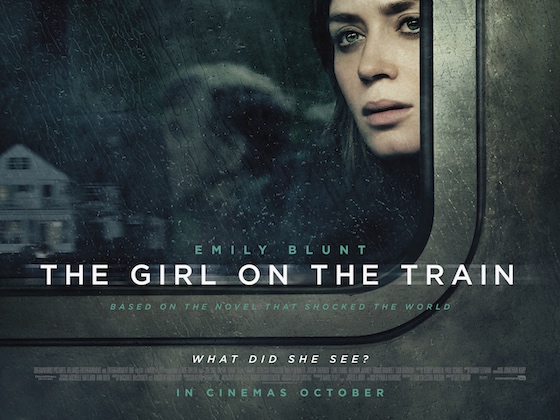
    Based on a bestselling novel, The Girl on the Train stars Emily Blunt as Rachel, an alcoholic divorcee whose commuter train passes her old home every day. She tortures herself by observing her ex (Justin Theroux), his new wife (Rebecca Ferguson) and their child, as well as her former neighbours Scott (Luke Evans) and Megan (Haley Bennett), who she imagines living a perfect life. But after Rachel sees something that shatters the image she’s created, she wakes up from a black out, with mysterious injuries, and to the news that Megan has gone missing…

    The whole story unfurls with a good deal of histrionics and a questionable level of psychological realism, but as a straightforward potboiler it has some degree of entertainment value. In fact, if it had been made with a little more panache then it may even have been seen as a throwback to the kind of melodramas they produced in the ’40s and ’50s. Because it doesn’t seem to have that level of self-awareness, I guess it’s just the modern-day equivalent.

    3 out of 5

    Lions for Lambs
    (2007)

    2017 #121
    Robert Redford | 92 mins | streaming (HD) | 2.35:1 | USA / English | 15 / R

    Lions for Lambs

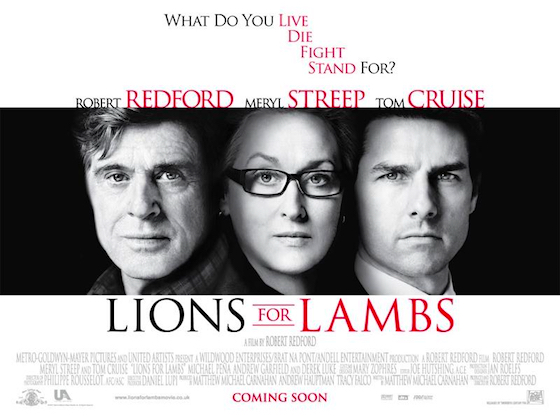
    The US intervention in the Middle East is obviously one of the most significant geopolitical events of our age, but how many films have really got to grips with it? Some, like The Hurt Locker, have given a sense of its impact to those on the ground. Lions for Lambs tried to take a more intellectual standpoint, with three interconnected storylines: a young and ambitious US senator (Tom Cruise) details a new military strategy to an experienced and sceptical journalist (Meryl Streep); a college professor (Robert Redford) tries to engage a talented but apathetic student (Andrew Garfield); and two soldiers become stranded in Afghanistan (Michael Peña and Derek Luke), providing a link between the other two stories.

    Screenwriter Matthew Michael Carnahan originally conceived the work as a play, before realising the Afghanistan section needed the scale of a movie. Nonetheless, his original conception shows through: the film is very talky and stagey, and the other two storylines could certainly be performed on stage with no changes necessary. You can also tell it’s driven by disillusionment in the US’s actions, and it has everyone in its critical sights: the government, the media, the education system… It feels more like a polemic than a movie, lecturing the viewer; although, like everyone else, it doesn’t seem to offer any firm answers.

    Streep and Cruise both give excellent performances. I suppose being a smarmy senator isn’t much of a stretch for the latter, but Streep’s turn as an insecure journalist is the highlight of the film. You need acting of that calibre to keep you invested in a movie like this, and it almost works, but ultimately the film has too little to say.

    3 out of 5

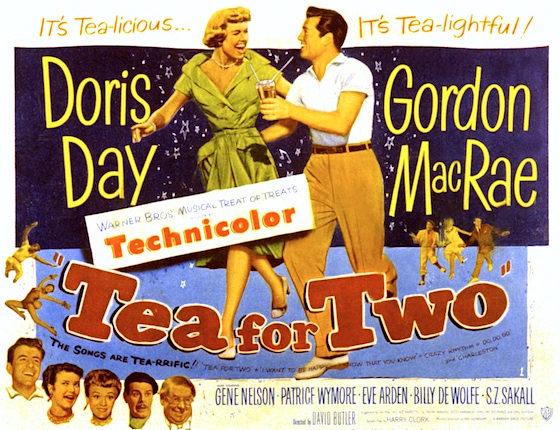
    Tea for Two
    (1950)

    2017 #162
    David Butler | 94 mins | DVD | 4:3 | USA / English | U

    Tea for Two

    Musical comedy starring Doris Day (radiant as ever) and Gordon MacRae (given little to do as her love interest).

    The songs are largely forgettable, with a couple of sweet exceptions, but at least there are other things to recommend it, like some impressive dancing from Gene Nelson, particularly during a routine on a flight of stairs. There’s a solid helping of amusing one-liners too, most of them claimed by Eve Arden as Day’s wry assistant Pauline, the rest by S.Z. Sakall as her embattled uncle. Said uncle is, by turns, a bumbling old codger and an underhanded schemer who uses tricks to try to ruin his niece’s happiness just so he can win a bet. Best not to dwell on that too much…

    The same goes for the rushed ending, in which our heroine is in financial ruin, so her assistant basically whores herself out to a rich lawyer so they can still put on the show. Hurrah! And talking of things not to dwell on, there’s also the title, which has absolutely nothing to do with the story (other than it being probably the best song). Conversely, the name of the play it’s based on — No, No, Nanette — is bang on. Ah well.

    Nonetheless, Tea for Two is all-round likeable entertainment; the kind of movie you put on for a pleasantly gentle Sunday afternoon.

    3 out of 5

  • Fight, Zatoichi, Fight (1964)

    aka Zatôichi kesshô-tabi

    2018 #76
    Kenji Misumi | 88 mins | Blu-ray | 2.35:1 | Japan / Japanese

    Fight, Zatoichi, Fight

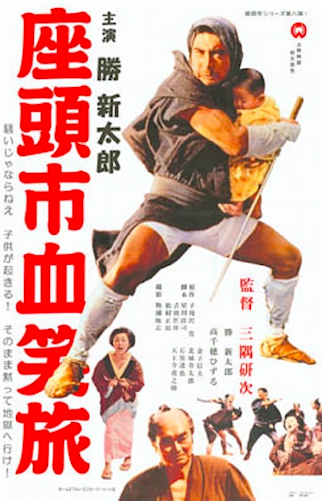
    It’s a bit ironic that whoever chose the English-language titles* for the Zatoichi films decided to emphasise fighting in the name of this eighth instalment, because it’s perhaps the least concerned with Ichi’s sword skills so far. That’s not to say there aren’t a couple of nifty sequences of blade-clashing fun, but they’re not the film’s focus. You might think that’s antithetical to the series’ purpose, and yet Fight, Zatoichi, Fight is widely regarded as one of the series’ finest instalments, perhaps even the best of all.

    It begins, as so many Zatoichi films do, with our hero on the run from some gangsters who want to kill him. Ichi accepts a ride from a pair of passing palanquin carriers, but his would-be assailants spot this and resolve to attack further down the road. Before they make their move, Ichi hears a woman struggling along with her baby, and insists she take the palanquin instead. The assassins don’t see the switch, however, and so attack nonetheless, killing the mother. Her papers reveal she was returning to her husband, the baby’s father, and Ichi, blaming himself for her death, insists he make the 65-mile journey to return the infant personally.

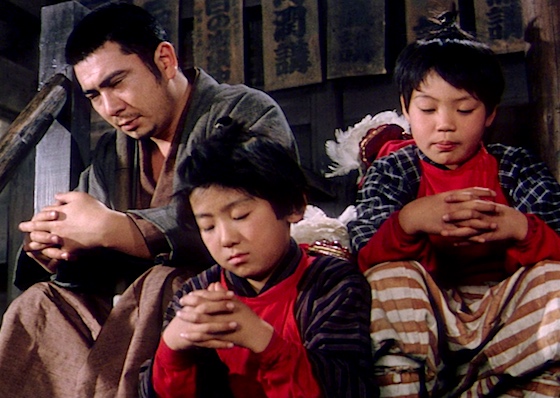
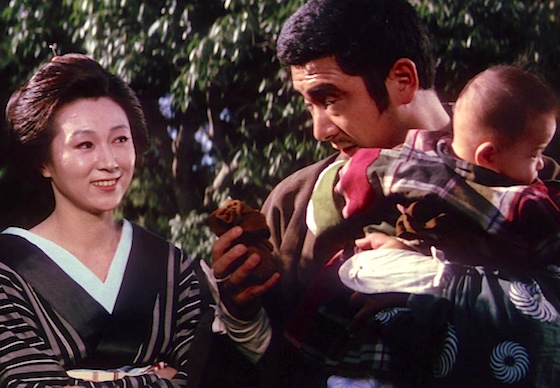
    This is where Fight differs from the norm, because it’s at least as concerned with Ichi’s need to care for the child as it is with him fending off the assassins, who naturally pursue him on his way. The impromptu sidestep into de facto fatherhood leads to plenty of goofy comedy, much of it around bodily fluids, like when and where the baby pees, the stench of its used nappies, and also a scene where Ichi tries to get the kid to suckle on him while they wait for actual milk. Another amusing sequence sees Ichi hire a prostitute for the night, but only so she can look after the baby and he can get some sleep. But he keeps waking back up nonetheless, each time insisting on doing just one more thing for the child.

    Family unit

    You see, Ichi really cares for the kid, and this is where the other side of the equation comes in: as well as comedy, the situation also brings up a good deal of character-driven seriousness, as Ichi is forced to reflect on the lifestyle he has chosen for himself. No one is better than Shintaro Katsu at playing both sides, transitioning between warm humorousness and grim introspection in the blink of an eye.

    But it’s not only internally that Ichi has cause to consider his lifestyle. Halfway along their journey, Ichi inadvertently saves the life of a female pickpocket, Ko, who he then employs to be the baby’s nanny — mainly so he can teach her better ways and reform her. But she’s a pretty young lady, so naturally she falls for blind old Ichi, and for the child too, and suddenly they’re a little family unit. Ko wants it to stay that way, for them to raise the baby together; and, despite his protestations to the contrary, Ichi has come to really like the child, and would probably like that life too. But, without spoiling anything, events transpire to make Ichi realise such an existence just isn’t possible for him, and he must do the right thing for the child’s sake. In the end, despite the laughter along the way, Fight, Zatoichi, Fight is a pretty emotional and sad film, with our hero ending up as he began, and as he always must: alone on the road.

    Lest you think it’s too downbeat, let’s talk about the action! Despite being on babysitting duties, there are still some great fight scenes: there’s one where assailants keep bursting into a hut where Ichi’s trying to change the baby’s nappy (now that’s multitasking); and a gambling scene where he catches a cheating boss in the act, with an ensuing fight outside where Ichi keeps shh-ing his attackers because the baby’s asleep. Then the finale lives up to the series’ recent penchant for exciting visuals: the amassed villains surround Ichi with flaming torches in an effort to confuse his hearing, and as our hero slashes away at them even his clothing catches fire. Sure, we know he must prevail, but there’s real jeopardy in this one.

    Fiery climax

    So, in many respects, Fight, Zatoichi, Fight has it all. It’s even got a unity of story and structure that feels almost rare in the series — everything connects up, pays off, has relevance; unlike other films, which often seem to start with a bit of superfluous action or something. But what it has most of all is a storyline that is unique and emotional, and therefore memorable and affecting. It’s easy to see why the film is so often elevated as one of the series’ very best. It’s probably best appreciated as part of the series, rather than as a newcomer’s entry point, because part of its effectiveness lies in it being different from the norm. That said, it stands as an excellent film in its own right.

    5 out of 5

    (A quick caveat: although this is the first Zatoichi film I’ve given full marks, I would, with hindsight, award the same to the first movie as well.)

    Fight, Zatoichi, Fight placed 20th on my list of The 26 Best Films I Saw For the First Time in 2018.

    * I say “chose” because a literal translation would be something like Zatoichi’s Journey of Blood and Laughter. ^