
Faiza Ahmad Khan | 66 mins | streaming | 16:9 | Singapore, Japan, South Korea & India / Urdu & Hindi
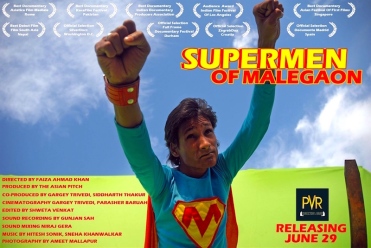 In the impoverished Indian town of Malegaon, everyone either works on the power looms and is paid a pittance, or is unemployed and so has even less; apart from the women, who are squirrelled away out of sight at home. The population is 75% Muslim, the remainder Hindu, and that leads to tension. Outside of work, there is nothing to do for entertainment… except go to the movies. And Malegaon loves the movies.
A number of years ago, one movie lover and video parlour owner, Sheikh Nasir, decided to make his own film. He remade the beloved Indian classic Sholay, but with its setting relocated to Malegaon, and turned it into a kind of spoof. It was recorded on video, edited VCR to VCR, by someone who had learnt filmmaking only by watching films themselves and seeing the behind-the-scenes outtakes on the credits of Jackie Chan movies. He didn’t even realise a film crew consisted of more than one person. Yet Malegaon ke Sholay was a local hit, and so Nasir decided to produce more. All of his films are spoof remakes of popular Bollywood and Hollywood productions, but set in Malegaon and engaging with local issues. They’re something of craze, so much so the people have a nickname for it: Mollywood.
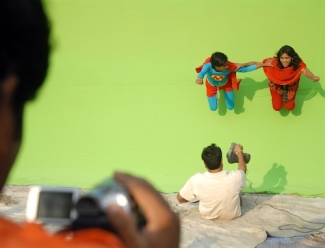 Supermen of Malegaon is the making-of story of Nasir’s most ambitious production to date. Having seen the use of greenscreen in one of those behind-the-scenes outtakes, he realised he could use the process to make a special effects movie — specifically, to make Superman fly to Malegaon. This documentary follows the trials and tribulations of Nasir and his band of hobby filmmakers through their film’s writing, planning, and its sometimes troubled shoot, until it’s completed. In the process, we meet some genuine characters, learn something of the unique lifestyle of Malegaon itself, and maybe even learn something about ourselves too.
The latter is the kind of claim liable to have your everyman viewer thinking, “yeah, right.” It’s a huge, horrid cliché for films to preach about following your dreams, or of finding something life enhancing through simple pleasures even when living in hardship; and generally movies that shove such ideals down our throats are gratingly earnest and/or sentimentally vacuous. Supermen of Malegaon is neither. There is no forcing here — insightful observations spring forth unassumingly; life lessons build up gradually and naturally. This is a film that doesn’t labour a point; doesn’t try to force some heartwarming message on you; but there’s every chance it will, almost incidentally, make you believe in the power of movies.
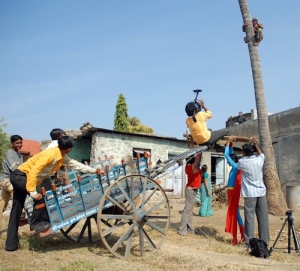 Even if it doesn’t, the situation in ‘Mollywood’ is an interesting one. This is a cottage industry: everyone involved has day jobs, funding the movies out of their own pocket, or by borrowing cash, or with favours, or by selling in-film adverts to local businesses — yes, that’s right, product placement, not that anyone involved would know that term. Women from Malegaon cannot appear in or work on the films due to local attitudes, so actresses are hired from nearby villages; the screenplay is written and shooting schedule arranged so that the actress only needs to be involved for the minimum number of days, to save money. Bicycles and motorbikes are used to create tracking shots; the director gets a piggyback for a high angle, or is raised and lowered on the arm of a cart to create a crane shot. The ingenuity and inventiveness of these literally-self-taught moviemakers is astonishing.
It really matters to them, too. As one young extra observes, people are keen to do anything they can to be involved, because being in a Mollywood movie buys you street cred in Malegaon. These things are that popular.
And yet it remains just a hobby… or it does for Nasir, anyway. He loves movies and so just wants to make them. He says that even if he was offered a job in Bollywood, he wouldn’t go. Not everyone shares his view: one of his relatives wants to make films as a career; Nasir is vocally against the idea — you can’t support a household doing this, he says. His films cost a pittance: at one point he tries to buy software to do the greenscreen and is quoted a price of $4,000, 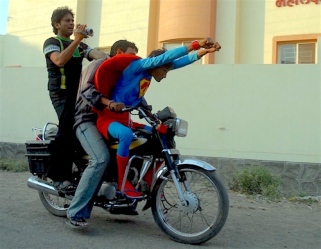 which he turns down because he could make four whole films for that much money. Even that little is scraped together. Mollywood moviemaking isn’t a money spinner, it’s a hobby. Still, one of the writers wants to make it as a proper writer; wants to go to Bombay and do it as his career. This has been his aim for 15 years, he says, and Bombay is no closer.
So there’s sadness here too, and controversy (to Western eyes, the position of women seems ludicrously unacceptable), and yet the ingenuity of these people, the endurance, the sheer love of cinema and the want to be involved, to not only recreate it but to forge something new, with their own enjoyment as the sole reward, is heartwarming, maybe even life enhancing. These are amateur filmmakers, working in their own backyard with a consumer video camera, who have greater integrity than all of Hollywood put together — and are still making movies, not falling to pieces and dying out, as Hollywood seems to think it would if it ever manned up.
In an interview, the director commented that “someone said after watching the film: ‘If you are about to give up on your dream, watch Supermen of Malegaon’.” I can believe that would work. A reviewer said that “if you don’t like it, then it can only mean that films were never really your thing in the first place.” A bold statement, but I’m inclined to agree. 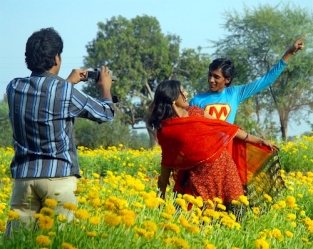 It’s an incredible, one-of-a-kind film; more powerful and life-affirming than it perhaps has any right to be. But then the filmmakers of Malegaon don’t really care about such things. They make movies because they want to, whether they ‘should’ or not; they make them better than you might expect; and it enriches their lives. Their story may do the same for you. In my opinion, it’s an essential film; a true must-see.

The UK TV premiere of Supermen of Malegaon is on Channel 4 tonight at 1:30am. It’s also available on YouTube.
It placed 4th on my list of The Ten Best Films I Saw For the First Time in 2015, which can be read in full here.
 For generations of people, the work of Gerry Anderson and AP Films / Century 21 are an irrevocable part of their childhood. For my part, I grew up during their big ’90s revival — the era of Anthea Turner’s make of Tracy Island on Blue Peter (though as no one in my family is particularly crafty (as it were) I had a Proper One), etc — so memories of
  And finally (for this summary, at least), Anderson’s ever-present desire for realism led him to invent an aid system to aid his puppeteers. In order to control the puppets, the operators were positioned above the sets, afforded only a bird’s eye view — a hard position from which to make them perform well, considering they couldn’t see what they were actually doing as it appeared on camera. So Anderson devised a way for a video feed to be run from the film camera up to a TV monitor for the puppeteers. The process also meant the director and cinematographer could see exactly what the camera saw, including the ability to rewind and review footage, meaning that, if there was a worry about a mistake, it was no longer necessary to either wait for the film to be developed or shoot another take just in case. This system, if you aren’t familiar with it, is known as video assist and is an industry standard on film shoots (digital filming removes the need for it, of course, but that’s a very recent development).
 For instance: for all his achievements in the field, Anderson never actually wanted to work with puppets — as a burgeoning TV production company desperate for work in the ’50s, AP Films were approached by a writer to produce a puppet series, so they did; that led to her commissioning another; they thought they could do better work by themselves, so they did; and it continued to spiral from there. Anderson constantly pushed for the puppets to be better — for their movements to be more realistic, for their lip-sync to be genuinely synced (again, innovating new technology to achieve this), for their proportions to be like humans rather than caricatures. But these advances eventually went too far, at times angering the puppeteers. They didn’t approve of the realistically-scaled puppet heads featured from Captain Scarlet onwards — they were harder to puppeteer convincingly, divorced of the margin of error that bigger heads allowed (and, arguably, needed); and they removed the puppet-ness of the puppets.
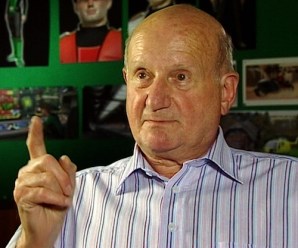 I’ve wound up telling interesting stories of Anderson & co rather than really reviewing Filmed in Supermarionation per se, but that’s because it’s an interesting story and the film tells it so very well (better than me. Oops.) For anyone who grew up with these programmes, this is an insightful, informative tribute to their ingenuity and quality. If you’re not familiar with them — if you don’t feel that ineffable childhood affection — I guess it doesn’t offer quite as much. Nonetheless, it remains the story of an incredible, pioneering endeavour that helped put the quality of British filmmaking on the map. It’s fun to think that, at a time when British culture was conquering the world and breaking new ground, through the likes of the grand extravagance of the James Bond movies and the subversive brilliance of the Beatles, standing toe to toe with them were a bunch of people in a tin shed with some puppets.
 Jon Schnepp’s widely-reviewed documentary about the batshit-crazy Nic Cage-starring Tim Burton-directed Superman movie that almost happened in 1999. If all you’ve seen are the photos of a stoned-looking Cage in a light-up abomination of a Superman costume that leaked onto the internet a few years ago, prepare to be amazed. Indeed, those infamous photos and footage are an aberration that this documentary explains.
 There seem to be an increasing number of “making-of documentaries about films that didn’t get made”, to the extent where it’s almost turning into a sub-genre. The highly-praised
 Christopher Lee narrates as a bunch of talking heads (writers, actors, psychologists) discuss the titular. The topics are quite universal — the psychological underpinnings apply not just to DC, not even just to comics, but to all fiction. Side effect: DC’s villains don’t always look so special.
 Possibly-crazy people offer definitely-crazy theories on the subtextual meaning of
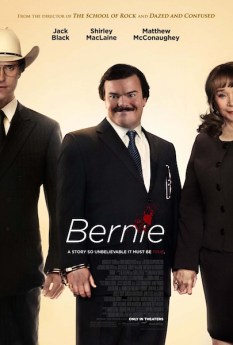 I seem to vaguely remember dismissing Bernie as just ‘Another Jack Black Comedy’ back whenever it came out (in the UK, that wasn’t until April 2013), and essentially forgot about it until earlier this month when it came up on
  (If you’re observing similarities to Midnight in the Garden of Good and Evil there, you’re not the first: the magazine article that inspired Bernie, published around the same time as
 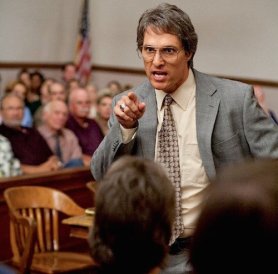 The local attorney seeking Bernie’s prosecution is played by man-of-the-moment Matthew McConaughey. I don’t know when we’re meant to deem the start of his “McConaissance”, but I’m not sure this really qualifies as part of it. Not that he’s bad, but it feels like the kind of played-straight comedy Southerner I’ve seen him do a few times now; indeed, it’s how he comes across in real life, from what I’ve seen. It fits the role like a glove, but doesn’t make for a remarkable performance.
 The debut of director Daniel Minahan — who’s since helmed episodes of over a dozen TV shows, including HBO hits
  You know the kind of people who wait ages and ages for something and really want it and pre-order it or whatever and then when it finally arrives they… add it to a pile and don’t get round to watching/reading/listening to it for even longer than the ‘forever’ they were waiting in the first place? If you don’t, you do now — that’s me.
 To be precise, Panahi’s ban is from filmmaking, writing screenplays, leaving the country, or giving interviews, so they conclude that reading aloud an existing screenplay while someone else films him doesn’t contravene any of those rules. Nonetheless, the edited (not-a-)film was smuggled out of Iran on a USB stick hidden in a cake in time for its Cannes premiere.
 In fact, despite the singular input and focus put into this ‘project’, it could be used quite successfully as part of an argument against auteur theory. But that isn’t what it sets out to do either.
 questions that are always worth asking about purported documentaries.
 A behind-the-scenes making-of with a difference, American Movie: The Making of Northwestern (to give its full title) is a documentary about wannabe-filmmaker Mark Borchardt attempting to produce a horror feature film with little more than some mates and good intentions, battling against a lack of money, interest, and dedication. It descends, quickly, into the kind of farcicality that leads some to assume it’s a
  Whatever you take away from it, American Movie feels like a must-see for certain sections of film fandom, particularly anyone who wants to make a movie themselves. Its appeal is broader than that though, an everyday story of adversity that isn’t so much overcome as temporarily averted. It’s not bleak or sad, but it is melancholic. And, whatever the morals of it, often laugh-out-loud funny.
 100Films.co.uk