The Dark Knight: The IMAX Experience (2008)

2008 #48a
Christopher Nolan | 152 mins | IMAX | 12A / PG-13
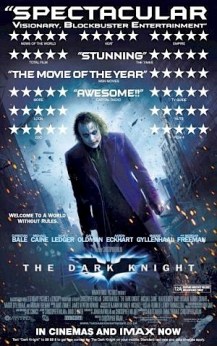
The Dark Knight: The IMAX ExperienceOne of the joys of spending five weeks of this summer in New York is that I have the opportunity to see anything that’s out in the US before the UK early. I haven’t entirely used this to my advantage (no trip to Hellboy II, for example, which has almost left theatres here but is still a few weeks off at home), but I have been to the much-anticipated new Batman movie, The Dark Knight… twice. Unlike in the UK, I have relatively easy access to an IMAX here, and, as any good Bat-fan will know, this means I was not only able to see TDK one week early, but also on the screen it (or, at least, parts of it) were specially shot for. Of course, despite the film virtually being on loop at Manhattan’s sole IMAX screen, the high demand for tickets means I had to wait til the second Saturday to see it writ so large — and even then I was fairly lucky, as some showings sold out inside of two hours.

As I’ve reviewed the film before, and my feelings on it have barely changed with a second viewing just one week later, it seems sensible to focus on the IMAX aspect. For those who somehow missed the news, The Dark Knight is the first Hollywood blockbuster to be specially shot for IMAX — not all of it, but six key sequences… or so they say. From what I could tell, while some whole sequences were indeed shot on IMAX film, often it was used just for bits of scenes, or now and then for the more dramatic establishing shots. For example, every aerial shot in the film — and, as those who’ve seen it will know, there are a fair few — appears to have been shot with IMAX cameras. The choice of sequences to shoot on IMAX is also intriguing. Some reviewers asserted it was “obvious” scenes were IMAXed even on a 35mm print, but I think they might be in for a surprise. Yes, the bank robbery opening, the car chase, and elements of the climax all receive the IMAX treatment, but elsewhere smaller scale action sequences and even some dramatic scenes are awarded the vision-filling honour.

It all looks stunning, of course: the resolution is visibly increased whenever the IMAX film kicks in (the rest of the film, blown-up from 35mm, is blurry and grainy by comparison but still doesn’t come out too badly) and the added size and scope of the format serve to underline the scenes for which it’s employed. While most of them are worthy, if sometimes unexpected, there are times when one wonders if scenes were picked just to make up the numbers with something not especially challenging. That said, it’s always nice to see, so one can’t complain too much. I didn’t find IMAX to be an especially viewer-friendly format for a two-and-a-half-hour feature though — it’s designed to fill your vision, an aim it achieves admirably, but when trying to watch a regular movie it entails an unusual amount of head turning, as well as trying very hard to notice everything right into the depths of your peripheral vision. It was certainly an experience, as the advertising subtitle suggests, but it won’t be for everyone and I’m not sure I’d bother again without some notable incentive (such as the one Dark Knight offers — none of these new-fangled 3D films have been interesting enough to tempt me yet). In some respects, what interests me most is what debates and opinions the use of IMAX will provoke about the film’s correct aspect ratio when it comes to DVD/Blu-ray time. I don’t care to predict what people will say, but I suspect it will be amusing to observe.

One final note: watching this just one week after I first saw it in a normal cinema (one week & one hour, to be exact!), it seemed to me that the odd shot was trimmed slightly or actually missing. Quite why this would be I don’t know, and it may just be my memory playing tricks, especially as the running time listed on the BBFC is actually slightly longer for the IMAX version (as seems to be standard, from a quick look at a few other IMAXed films — I’m sure someone knows why). The differences — if indeed there are any — are minor, but I felt I should mention it.

There’s no questioning The Dark Knight‘s brilliance in its own right, in my mind — it may be questionable whether it’s the Best Film Ever (surprisingly, it still sits at #1 on the IMDb Top 250), but at the same time I genuinely enjoyed this more than any other film I’ve seen from that top ten (and probably beyond). Whatever size screen you see it on, this film is an amazing experience — but some of it was shot especially for IMAX and those bits do look spectacular on the extra-huge screen. If you have the chance, this is really how Dark Knight should be seen — especially as it’s always possible that you won’t have the chance again.

5 out of 5

As if two reviews wasn’t enough, I shared more of my thoughts on The Dark Knight (this time when considered next to Batman Begins) here.

On the off chance anyone’s wondering what happened to #48, it’s WALL-E and the review’s on its way. But I’ve been sat on this one for a week (and not got round to the WALL-E one for over a week!), so I thought I’d just get on and post this, sequence be damned.
The Dark Knight (2008)

2008 #47
Christopher Nolan | 152 mins | cinema | 12A / PG-13

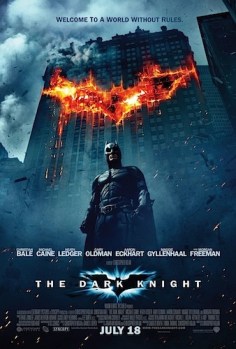
The Dark KnightThe Dark Knight — the sixth film in the modern Batman series (though not connected to the first four) — comes with a heavy weight of expectation on its back. It’s the sequel to the last film, Batman Begins, which relaunched the flailing series in style and is one of the best comic book movies ever — so Nolan and co had to top that. There was Heath Ledger’s death, a sad accident that has heaped extra focus on his penultimate performance here (his final one, in The Imaginarium of Doctor Parnassus, is currently in post-production with no release date) — especially as some sources cited his appropriation of the Joker’s mindset as related to his death. And then there were the trailers too, which caused ridiculous levels of excitement among some — personally, I found them a tad lacking. But I was fairly confident that, a bit like Begins, The Dark Knight would turn out to be the sort of film that doesn’t necessarily trail all that well but is excellent when seen.

And I was right. In this respect, it’s because the action sequences aren’t the point of the film. They occur when required by the story, while still being well-spaced and appropriately exciting, rather than serving as check-boxes for a plot designed primarily to link them together — the latter being what most blockbusters seem to settle for these days. Many are pleasantly old-school in style, the stunts performed largely for real, and at least one major example is even left without music. On the odd occasion when effects must have been used, they’re seamlessly achieved. The most obvious use of CGI — which I won’t describe for the sake of spoilers, though many will already know about — is incredibly well done. All of this helps ground the film in a perhaps-surprising (for some) degree of reality, one that goes far beyond what other ‘realistic’ superhero movies have strived for.

In fact, this realism is probably The Dark Knight‘s main strength. Obviously there’s never going to be a real city where a billionaire dressed in bat-inspired armour protects the populace from a deranged man in clown make-up, but if there were then this is how it would be. Where Burton’s two Bat-films were “dark”, and Schumacher’s were “gaudy” (or “crap”), Nolan’s pair are “real”. It’s an excellent thriller as well as everything else. The focus of the plot — at least at first — is on the mob and their control over Gotham, and it’s from their criminal desires — plus the very existence of Batman — that the Joker grows. Ledger’s performance is as outstanding as you’ll have heard said elsewhere, and while it still feels like a supporting role it receives more attention than the psychology of Bruce Wayne/Batman — which, considering that’s what Batman Begins focused on, seems fair enough. Every other performance is equally as flawless (I’ll name names in a moment), but it’s Ledger’s disturbing, engrossing turn that will stay with you. He is the Joker, in a way Jack Nicholson certainly never was, and — among obviously more upsetting effects of his premature death — the fact we’ll never see him in a rematch is a huge shame.

As Harvey Dent, Aaron Eckhart’s role is much larger than I was expecting. The floating-head posters that seemed to divide the film between him, the Joker and Batman are spot on — they’re the three central characters, everything revolves around them, their actions, choices, and emotions. While Ledger may dominate with his (appropriate) theatricality, Eckhart is more the heart of the film, with a genuinely tragic story. Viewed in this light, the order of the film’s final scenes — which I think some may see as incorrectly balanced, perhaps even anticlimactic — make all the more sense. However, I don’t mean to undersell the rest of the cast by highlighting Ledger and Eckhart — in their supporting parts, Michael Caine, Maggie Gyllenhaal, and especially Gary Oldman and Morgan Freeman, all do brilliant work. The talented Christian Bale manages to hold his own as the ambiguously heroic crimefighter, even against the more obviously attention-grabbing performances of Ledger and Eckhart.

As with other superior superhero sequels like X2 or Spider-Man 2, The Dark Knight uses the groundwork of its successful predecessor to craft an experience that’s even greater. In fact, there’s an awful lot more that could be said about the qualities of The Dark Knight. At two-and-a-half hours, it’s a packed epic of a movie — which makes Nolan’s confident juggling of plot threads, character development, several large performances, action sequences, and more, all the more impressive. I certainly enjoyed seeing it with a large, American (importantly), opening-weekend crowd — several moments produced whoops and sustained applause from the audience, as well as a good number of well-deserved laughs.

The Dark Knight is great entertainment, with a good deal of meat on its bones too — the performances and emotional stories are as engrossing as the thriller-ish plot and impressive action. When all is considered, it’s possibly as perfect a thriller/blockbuster as they come. In fact, as I publish this, The Dark Knight sits at #1 — the best film of all time ever — on IMDb. It will drop, of course, because that’s opening-weekend fan-led gut reaction for you… but, even when time’s passed, I’m certain it deserves to remain high on the list.

5 out of 5

Sadly (though not surprisingly) the Manhattan IMAX was booked solid all through opening weekend (and most of next week, at least). As soon as I manage to see it on the extra-big screen, I’ll share my thoughts here. You can also read even more of my thoughts on the film (this time when considered next to Batman Begins) here.

The Dark Knight placed 1st on my list of The Ten Best Films I Saw For the First Time in 2008, which can be read in full here.

Hard Boiled (1992)

aka Lat sau san taam

2008 #43
John Woo | 122 mins | DVD | 18 / R

Hard BoiledThe first John Woo film I saw was Mission: Impossible II. I think. It may’ve been Face/Off, which I love, but this works better with M:I-2 because most people don’t like it. Personally, I like M:I-2. It’s not the greatest action thriller ever, but it has its moments and the plot isn’t half as complex as some like to claim. It’s certainly more fun than Brian de Palma’s Euro-thriller first film, which in retrospect looks a bit like a proto-Bourne. Of course, what M:I-2 really had going for it were its action sequences, which are occasionally a bit out there but always expertly done. Face/Off’s are even better again. Anyone with a basic understanding of structure can’t fail to see what I’m going to say about Hard Boiled.

I don’t think realism is Woo’s strong point — at least, not in his straight-up action movies. That’s not a flaw, though, but a deliberate choice — he dispenses with the realism of what a gunfight would be like (presumably, bloody scary and with fewer shots fired) and pushes the male fantasy of mindless slaughter to the limit. Which means his action sequences are pure adrenaline-pumping fun. Chow Yun-Fat single handedly slaughtering a warehouse full of heavily armed gangsters? Well, of course! Or directly hitting a small object wedged in an electrical pipe with a shaky shooting arm? Naturally! The action may have all the realism of a Dali painting, but it also has all the gleeful fun of repeating everything your sibling said when you were five — except with more choreography. It’s a cliché, but there’s something about Woo’s action that makes you want to use the word “balletic”. Not that I’ve ever really watched ballet. I expect it involves fewer guns.

These sequences seem to have been designed with one thing in mind — cool. And they are. There are a few holes in the plot and characters’ logic, but that doesn’t matter when they can leap around firing two pistols at once and always hit their target, while the bad guys — who could shoot just fine when they slaughtered some innocents a few minutes ago — keep missing them… with machine guns. If you think about it too hard then of course it’s nonsensical, but somehow, in some way, this sort of action seems to appeal to most men (not all, of course, and if you enjoy it then don’t worry, it doesn’t mean you’re a bloodthirsty braindead weirdo). One particularly astounding sequence is achieved in a single long take, as Yun-Fat and Tony Leung make their way down several corridors killing Very Bad Men literally left, right and centre. It’s both exciting and technically impressive, considering how many squibs, blood packs, weapons and extras must have been involved to pull it off in one uncut shot.

If you don’t care for people shooting at each other, especially when it pushes believability beyond the limit, then there’s not really anything for you here. There’s some male bonding stuff, and other bits about duty and honour and sacrifice, and a climactic subplot involving lots of cwute lickle baby-wabies; but Hard Boiled is most at home when the bullets are flying and things are blowing up. And what a lovely home it is.

4 out of 5

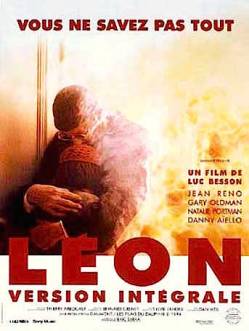
Léon: Version Intégrale (1994/1996)

2008 #42
Luc Besson | 127 mins | DVD | 15*

Léon: Version IntégraleI first saw Léon about 10 years ago, back when video was still an acceptable way of watching things. A friend leant it to me, insisting it was a film I absolutely had to see, and he wasn’t wrong. It’s remained one of my favourite films ever since, though typically I haven’t watched it more than once or twice in the intervening decade. (It also fostered a love for Sting’s closing song, Shape of My Heart, which is criminally missing from a Greatest Hits CD my dad owned (even though his dire song from Demolition Man is on there), and in moderately recent years was indifferently reused by both Sugababes and Craig David.)
I became aware of this extended cut a few years ago, a little while before it was released on R1 DVD. Having held out for a UK R2 release for about half a decade now, I gave in and bought the (apparently superior, and also in a Steelbook, which always has a way of persuading me) German R2. It’s labelled as a “Director’s Cut” but, as Besson states in the relatively lengthy booklet (translated with the aid of [the now defunct] Babel Fish), “the second version is neither better nor worse than the original” — it’s not a preferred cut, just a different, extended one.

But personally, I prefer this version. Not because there’s anything wrong with the original — far from it — but because this one has more. Sometimes you can have too much of a good thing of course, but I don’t think that’s happened here. The additions build on the characters and relationships, primarily between the two leads, and also add extra doses of humour and action. Besson wasn’t necessarily wrong to remove these things from his original cut — the extent of Léon and Mathilda’s relationship is especially controversial for some, and the extended scenes of Léon training Mathilda as a Cleaner are arguably extraneous — but they all add to the experience. Wisely, he doesn’t seem to have touched what was already there. Everything that was great about the original — from the astounding performances of Jean Reno, Natalie Portman and Gary Oldman, to the thrilling action sequences, and plenty else in between — remains intact. They’ve not been buggered about with, just expanded around.

Ultimately, the reason I prefer this version is quite simple: I love the film and the characters, I could happily take more of them, and I very much enjoyed all of the added material. I can understand objections to the insinuations about Léon and Mathilda’s relationship, but I didn’t find it any creepier here than it was before (besides which, any paedophilic notions come from her and he quashes them). The quality of the performances in the new scenes, plus other solid additions, make all the new bits worthwhile.

The version intégrale isn’t too much of a good thing, then, just more of a great thing. To my mind, Léon (in either cut) is unquestionably essential.

5 out of 5

* The original cut of Léon was last classified in 1996 and given an 18. The longer version was classified in 2009 and received a 15. That must be a pretty rare case of a longer version (technically) having a lower certificate. ^

The Adventures of Sherlock Holmes (1939)

2008 #39
Alfred Werker | 79 mins | DVD | PG

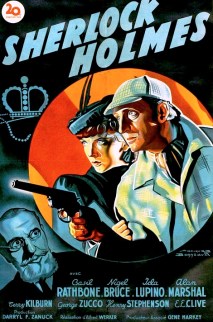
The Adventures of Sherlock HolmesNever mind waiting two or three years for a sequel these days — after the 1939 Hound of the Baskervilles was a box office success, Fox had a sequel out just five months later! I reviewed that first Rathbone/Bruce film back in February, promising an irregular series reviewing the further thirteen pictures the pair starred in. Well, I’ve finally got round to watching the second, and while I was a tad harsh on the first I found myself enjoying this one more.

The Adventures of Sherlock Holmes pits the titular detective against his arch-nemesis, Moriarty, in what’s really speaking a relatively weak plot — most depressing of all is how easily Moriarty’s plan to distract Holmes almost succeeds. But never mind that! There’s rain-lashed, fog-drenched Victorian London streets! Brutal murders by foul foreigners! Dastardly plots against the crown! Galloping carriages! Romantic subplots! A smattering of comedy! A song-and-dance number! (No, really, there is.) And a final shoot out… in the Tower of London! You can’t escape the joyous feeling that this was designed as pure entertainment, literally including something for everyone.

Bruce’s Watson may bumble about too much for the purists (me included, more often than not), the murder plot lacks proper explanation (the production notes on Optimum’s DVD pleasingly expand on this), Rathbone’s characterisation of Holmes may be a touch too friendly… but by then I’m just nitpicking. This sequel is atmospherically, entertainingly and excitingly executed, and that’s plenty good enough for me.

4 out of 5

Sweeney Todd: The Demon Barber of Fleet Street (2007)

2008 #30
Tim Burton | 112 mins | DVD | 18 / R

Sweeney ToddTim Burton and Johnny Depp collaborate for the sixth time (as the DVD’s blurb is so keen to point out) for a film adaptation of Stephen Sondheim’s musical adaptation of the classic tale of the titular barber who slaughters instead of shaves and sells the resultant meat to all of London in the pies of his accomplice, Mrs Lovett.
As with 2005’s Charlie and the Chocolate Factory, the announcement of Burton as director of Sweeney Todd was one of those “well, of course” moments, despite the vastly different audiences. And with Burton come Depp and Helena Bonham Carter, naturally. But whereas the eventual product of Charlie resulted in a “that’s that done then” feeling of the inevitable, Sweeney is more of an unknown quantity for me — I’m familiar with the basic story, of course, but not this particular version. It’s a dark tale, but told here in a heavily stylised manner — no gritty realism to be found (for that try the Ray Winstone TV movie), but instead there’s bold and striking performances, design, direction, and storytelling. One is tempted to call it “theatrical”, but the direction is anything but and the actors do much more than project for the benefit of the back row. It’s anti-naturalistic in all elements, which suits both the ghoulish and musical subject matters perfectly, but is consequently not to everyone’s taste.

As for the musical elements, Sweeney is done in an operatic style — the majority of dialogue is sung and the story is almost entirely told through these songs, rather than having a couple of numbers peppered throughout (quite how they managed to edit a trailer that was both comprehensible and light on song is near miraculous). Anyone who’s seen an Andrew Lloyd Webber production will be familiar with this way of doing things. Personally, I find it a more immersive style — everyone’s singing from the word go, not disconcertingly launching into song a little way in. The cast’s voices may not be perfect (and I’m far from a knowledgeable judge), but they do the job more than adequately. Rough moments almost add to the film’s style, and the cast’s acting abilities more than make up for them anyway. One casting oddity is Anthony Head, who turns up for a sole inconsequential line. He may not be a regular film actor, but surely he’s bigger (and certainly better) than a glorified extra? He’s not even listed in the end credits. I smell deleted scenes… (A bit of IMDb reading reveals I’m right. Sadly, these aren’t included on the DVD.)

The other striking element of Sweeney Todd is its look. London here is a dingy monochrome metropolis, interrupted only by fanciful fairytale-coloured fantasies like the song By the Sea, and, of course, gallons of vibrant spurting blood. Wisely held off until relatively late in the film, when the blood comes it is all the more shocking. And from that point it flows like wine — or, more accurately, squirts like a stamped-on ketchup bottle — in perfectly judged amounts: it gushes far more than you’d normally see but, because Burton never pushes it to the mad excess that Tarantino did in Kill Bill, it remains on the disturbing side of believable. The stylised theatricality of it almost makes you question the high classifications, but the underlying morals and sheer bloody volume ultimately justify them.

Yet there’s something missing from Sweeney Todd. I can’t work out what it is — perhaps the numerous numbers Burton cut or trimmed have unbalanced proceedings slightly, in some frustratingly ephemeral way? — but despite all this praise and only vague criticisms, I’m certain it’s a four-star film. A very solid four, to be sure, but it doesn’t achieve enough to pass higher.

4 out of 5

Sweeney Todd: The Demon Barber of Fleet Street is on Channel 4 tonight, Saturday 9th August 2014, at 11:10pm.

L.A. Confidential (1997)

2008 #26
Curtis Hanson | 132 mins | DVD | 18 / R

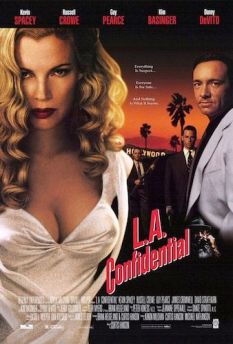
L.A. ConfidentialOnce again I’m watching an adaptation shortly after plowing through the source novel, a situation that has so far proved awkward for giving films a fair assessment. L.A. Confidential is an especially tricky one: how does a 480-page, densely written, intricately plotted crime novel, spanning seven years and “no fewer than four and perhaps as many as a dozen major crimes”, translate into a two-and-a-quarter-hour film? With more than a few surprises, as it turns out, because the apparently minor changes near the film’s start turn out to be the proverbial pebble in a pond: their ripples spread so far that, by the second half, not even a reader who can remember the many details of the novel’s complex plot will know for sure what’s coming.

This isn’t necessarily a bad thing. If screenwriters Hanson and Brian Helgeland had tried to squeeze in everything the movie would have been rushed even at three hours. Instead they’ve excised several unnecessary subplots and trimmed others to the bare minimum. Most impressively, they’ve picked apart several of the multitudinous plot threads and completely restructured them. It’s an incredible feat of adaptation. The downside is that some great strands are lost. Ed Exley’s father plays a huge role in the novel but is completely absent here; Inez Soto, the victim of a brutal gang rape, is reduced from a key supporting character to a couple of lines. Another connected loss is some characterisation. Jack Vincennes and Exley lose the most, though Bud White’s development is tied too closely to the main storyline. That said, the characters are still mostly there, painted quickly and precisely; they may lack some of the depth and complexity the novel can offer, but that’s an almost unavoidable difference between a film and a long, well-written novel. To make a good film such sacrifices are necessary — even though it’s been simplified, the novel’s complex plot is still a long way from becoming straightforward.

What impressed me most about L.A. Confidential is that, despite spending huge chunks of the film pondering what they’d cut and changed, I still enjoyed it immensely. Even while distracted with thoughts of the novel, its differences and its relative merits, I could still enjoy the fantastic filmmaking. The casting is perfect, especially Spacey, Pearce and Crowe (perhaps the last most of all, considering his penchant for real life violence). For once it really is as if the roles were written for them, making it easy to forget that Pearce and Crowe were virtually unknown at the time. They’re supported by a cracking screenplay (which I think I’ve praised plenty already) and beautiful direction, which manages to evoke the period without being shot like a period film — Hanson has stated that he aimed to make it period-accurate but shoot it like a modern thriller, and he’s succeeded. There may be one or two imperfections (the music felt a little repetitive to me, for example), but they’re slight and it seems churlish to pick on them in any depth.

I look forward to watching L.A. Confidential again without the novel hanging over my head. I’ve made my comparisons now, and my memory’s weak enough that, by the time I get round to watching it again (perhaps when the long-rumoured special edition re-release turns up), I’ll have forgotten enough of the novel’s specifics to not be bothered by them. I expect I’ll enjoy it even more then. It’s an excellent achievement, both as an adaptation and a film in its own right. You can’t say fairer than that.

5 out of 5

Rashomon (1950)

2008 #24
Akira Kurosawa | 88 mins | DVD | 12 / PG-13

RashomonOne has to wonder if Dr. Gregory House was exposed to Rashomon at a young age. House’s universal truth — “everyone lies” — is also the conclusion of Kurosawa’s much-lauded film, in which four witnesses tell different versions of the events surrounding a samurai’s murder.

The “Rashomon” of the title is one of two gates to Kyoto, built in 789 and in disrepair and disrepute by the film’s 12th Century setting, but thanks to this film the word has come to signify a narrative that retells the same event from multiple perspectives. Mentioning it seems unavoidable when writing about a film (or episode of TV, or novel, or…) with such a structure, as reviews of recent thriller Vantage Point would attest. However, most similar tales aren’t quite as radical as this ‘original’ (which is based on two short stories by Ryunosuke Akutagawa), in which the four tales differ wildly.

Justifiably, much has been written about Rashomon, both critically and analytically. As such I’m not going to dig too deeply here, but instead just highlight a couple of reasons why it’s so acclaimed. For one, it looks great. Kazuo Miyagawa’s cinematography is exemplary, producing gorgeous rain at the gate, wonderful shadows in the forest, and employing numerous inventive shots and moves, always effective rather than showy. Fumio Hayasaka’s music underscores proceedings beautifully, coming into its own during long dialogue-free sequences. The performances are also accomplished, especially Toshiro Mifune as laughing bandit Tajomaru, but also Masayuki Mori’s largely silent turn as the murdered samurai, and Fumiko Honma’s chillingly freaky medium.

As I said, there’s much more that could be (and has been) written about Rashomon — I’ve not even touched on the intricacies of the plot, the presentation of the courthouse scenes, the significance of the fights, and so on. Certain viewers might be put off by the subtitles, the black and white photography, the film’s age, and its occasional ‘arthouse’-ness — and, I confess, I’m one of the first people to get fed up with films like Tati’s Play Time or Ozu’s Tokyo Story — but, for me, Rashomon was an incredibly enjoyable first encounter with Kurosawa.

5 out of 5

Rashomon placed 5th on my list of The Ten Best Films I Saw For the First Time in 2008, which can be read in full here.

Double Indemnity (1944)

2008 #20
Billy Wilder | 108 mins | download | PG

This review could be seen to contain some spoilers.

Double IndemnityDouble Indemnity is perhaps the archetypal film noir — unsurprising, really, when you have Raymond Chandler co-adapting a novel by James M. Cain. Present and correct are the femme fatale, dry-witted lead man, voice-over narration, shadowy photography, murder, cover-ups, investigations, twists… The difference to films such as The Big Sleep is that the hero is the villain: our narrator, insurance salesman Walter Neff, conspires with Phyllis Dietrichson to murder her wealthy husband for the payout from an accident insurance policy — the double indemnity clause of the title. Neff even has the perfect plan… but, perhaps, too perfect…
Once again I’m viewing this in the context of its source novel (see previous such reviews), and it makes for a very faithful retelling of Cain’s novel. Some of the subplots are sadly lost, not only for time but probably for reasons of taste (Wilder struggled to get the film made in the first place, as the ostensible heroes are both murders and adulterers), some of the names are changed (maybe there was something objectionable about “Huff” and “Nirdlinger”?), and the ending is modified, perhaps with an eye to partially redeeming Neff. In some ways the film’s variant finale is more in keeping, especially for the character of Keyes, but I expect the merits of both versions could be debated. Chandler’s influence as screenwriter is clear in the dialogue. Many lines and exchanges ring with his unmistakable style, which is generally much wittier than that found in the novel.

The real feat of Double Indemnity The Film is that none of these changes jar too much, leaving us with that rare thing: a film that changes the original, but leaves both as excellent pieces of work.

5 out of 5

Ocean’s Thirteen (2007)

2008 #11
Steven Soderbergh | 117 mins | DVD | PG / PG-13

Ocean's ThirteenLast year I reviewed Ocean’s Twelve, and came to the conclusion that it had been slightly harshly treated by critics — while not a patch on the first film, it was a decent enough heist romp. Now it’s the turn of last year’s threequel and, by contrast, I found it to be distinctly overrated.

In fact, I’d personally put Thirteen at about the same level as Twelve. The return to both a Las Vegas setting and the first’s glossy cinematography seem to have fooled many into thinking it’s more like Eleven, but the convoluted and over-long plot (needlessly complicated by some chronologically variable storytelling), relative lack of humour, over-abundance of under-used characters, and lacklustre finale belie the truth.

Thirteen is Twelve with Eleven’s sheen. Its critical success relative to its immediate predecessor is, I think, another of the gang’s expertly executed cons.

3 out of 5