The 100-Week Roundup XXI

I’m sure regular readers — who hungrily consume every word I publish with a near-religious commitment, right? — are well aware of the purpose of these 100-week roundups; but for the sake of newcomers discovering them for the first time, perhaps stumbling here wearily via an IMDb link, I feel it’s overdue that I come up with some kind of generic introduction to stick on each one. Maybe something like this:

The 100-Week Roundup covers films I still haven’t reviewed 100 weeks after watching them. Sometimes these are short ‘proper’ reviews; sometimes they’re only quick thoughts, or even just the notes I made while viewing. This week’s collection includes the final film leftover from January 2019 and the first few to be rounded up from that February

  • The Player (1992)
  • The Guernsey Literary and Potato Peel Pie Society (2018)
  • First Reformed (2017)
  • Gods and Monsters (1998)


    The Player
    (1992)

    2019 #8
    Robert Altman | 124 mins | Blu-ray | 1.85:1 | USA / English | 15 / R

    The Player

    Robert Altman’s satirical look at the world of Hollywood filmmaking stars Tim Robbins as a studio executive who rejects tens of thousands of prospective screenplays a year. When he begins to receive threatening postcards from an anonymous rejected writer, at the same time as his job seems under threat from a new employee, he’s led down a rabbit hole of suspicion and paranoia that may ruin more than just his career…

    You don’t get movies that are much more “insider Hollywood” than The Player, concerned as it is with the workings of the studio system, and packed to the rafters with cameos, both famous (big-name actors) and not (several of the guys who pitch in the film are real screenwriters). Such a focus would seemed primed to make a film inaccessible — witty and clever to those in the know, but leaving the rest of us shut out. That’s not the case here. While there’s no doubting the truthfulness (at least, in a satirical sense) of Altman’s depiction of Hollywood’s inner workings, he’s taking general aim at the entire world of it. Plus, there’s always the mystery/thriller storyline to keep us hooked.

    And in its insightfulness, the film is ahead of its time. As observed by Sam Wasson in his essay for the film’s Criterion release — written in 2016, but only more accurate five years further on — “today, when it’s the IP and not the script, or the director, or even the actor, that gets the movie made, when films are green-lit before they are written, and studios, I keep hearing, hire weaker directors because they’re easier to control, I think of that meeting, midway into The Player… when [Robbins] muses aloud to a roomful of colleagues, ‘I was just thinking what an interesting concept it is to eliminate the writer from the artistic process. If we can just get rid of these actors and directors, maybe we’ve got something here.’” I guess someone was taking notes…

    5 out of 5

    The Player was viewed as part of Blindspot 2019.

    The Guernsey Literary and
    Potato Peel Pie Society

    (2018)

    2019 #12
    Mike Newell | 123 mins | digital (HD) | 1.85:1 | UK, France & USA / English | 12
    The Guernsey Literary and Potato Peel Pie Society

    In the aftermath of World War II, a writer (Lily James) forms an unexpected bond with the residents of Guernsey when she decides to write about the book club they formed during the island’s Nazi occupation. — adapted from IMDb

    Here we have a film that seemed to come in for a fair bit of flack in critical circles, and I can’t help but wonder if it a large part of it is simply down to the title. As I wrote in the February 2019 Arbies, it’s self-consciously whimsical, but “I can kind of see what they were going for… but they took it too far and now it’s a more horrible mouthful than the pie itself.”

    In fairness to the film’s detractors, that wasn’t their only nitpick. Another is that, although she’s ostensibly the protagonist and therefore a proactive character, James’s role is basically to keep asking the other characters what happened in the past until they explain the plot to her. That’s not an entirely inaccurate assessment of how the story unfolds. Virtually the only dramatic tension comes from the fact the other characters, all of whom know what went on, won’t reveal it until they (or, rather, the plot) decide it’s time to. Then again, stuff like having an active protagonist is one of those rules of drama that I sometimes feel is a rule just because it’s a rule — if your story is engrossing and entertaining anyway, why not have the ‘hero’ be little more than a narrator to guide us through what went on? Anyway, I’m not sure Literary and Potato Peel Pie Society was built to support such technical debates.

    Naturally, there’s a romance storyline too. That’s all very twee, of course, but the flashbacks to life under occupation give the film more grit than some gave it credit for. This isn’t a hard-hitting war movie, but nor is it simply an airy-fairy romance in pretty locations with an overdose of the sugary quirkiness that the title implies. Taken as a whole, it’s a perfectly decent melodrama-ish movie, that delivers on both a “chick flick”-ish romantic level and as some kind of recognition for the efforts of ordinary people during the war.

    4 out of 5

    First Reformed
    (2017)

    2019 #13
    Paul Schrader | 113 mins | digital (HD) | 1.37:1 | USA, UK & Australia / English | 15 / R
    First Reformed

    The pastor (Ethan Hawke) of a small church in upstate New York is asked for help by a pregnant parishioner (Amanda Seyfried) whose husband is a radical environmentalist. When the situation takes a tragic turn, the pastor must cope with mounting despair brought on by tragedy, worldly concerns, and his tormented past. — adapted from IMDb

    My first note about First Reformed is: I’m glad I didn’t watch the trailer first — it gives away almost all the salient details of the climax. So there’s a warning to you, too. (Naturally, the above plot description is written to not give too much away.)

    Continuing in that non-spoiler-y vein, then, all I can share from my notes about the ending is that it definitely seems designed to provoke debate — about the rights and wrongs of what does and doesn’t happen; about the choices made; about the way it chooses to conclude. The problem (or, some might feel, advantage) of being vague about this is that there’s no meaningful way to engage with said debate. Oh well.

    Before we get to the contentious conclusion, First Reformed appears to be a quiet little drama about personal despair and grief. It sort of morphs into something very different — almost a polemic about climax change. I say “sort of” because it also retains its smaller character-specific focus by using such big world-affecting things as a metaphor or mirror for individual dejection and hope. The character in question is Ethan Hawke’s pastor, and it’s very much a character study of him (Amanda Seyfried, a big name given co-billing on posters, etc, doesn’t have a huge amount to do — even when her character is involved in several exceptionally emotional situations, she remains very calm). With the whole film on his shoulders, Hawke is excellent, navigating us through his character’s rather internal conflicts with an assured performance.

    It was a good enough turn to put him in the awards conversation, as I remember, but not to secure any major nominations. The film did get an Oscar nod for its screenplay, written by director Paul Schrader, but it lost to Green Book. The less said about that the better, maybe.

    4 out of 5

    Gods and Monsters
    (1998)

    2019 #16
    Bill Condon | 105 mins | digital (HD) | 16:9 | USA & UK / English | 15 / R
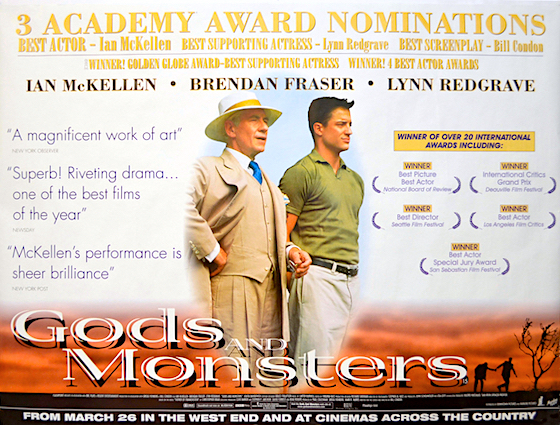
    Gods and Monsters

    James Whale (played here by Ian McKellen) was the director of such acclaimed classics of the 1930s as Frankenstein, The Invisible Man, and Show Boat. By 1957, he was long since retired, and when he suffers a stroke it causes him to reflect on his memories — of his earlier life in England; of his movie career; and of his time in the trenches during World War I. He recounts these experiences to his new gardener, Clay (Brendan Fraser), a strapping ex-Marine who Whale persuades to model for him. Their friendship grows, even as Clay is wary of Whale’s homosexuality, and Whale’s health deteriorates.

    Viewed now, there are definitely parallels between this and another film starring Ian McKellen and directed by Bill Condon, Mr. Holmes. Both concern a dying old man (McKellen), cared for by a characterful housekeeper (here, Lynn Redgrave), who connects with a younger male while reflecting on former glories. No offence meant to Condon, but if he were a more noted director then I guess more people would have discussed the similarities between the two works, for good or ill (are they mirrored explorations of a similar theme, or just self plagiarism?) Of the two, Gods and Monsters is probably the more effective, benefitting from being based on a real person and true events in its exploration of who this person was.

    4 out of 5

  • The 100-Week Roundup XVII

    Continuing my push to wrap up leftover reviews from 2018, here are three more to finish off that November

  • Danger: Diabolik (1968)
  • Boy (2010)
  • Dad’s Army (2016)


    Danger: Diabolik
    (1968)

    aka Diabolik

    2018 #243
    Mario Bava | 96 mins | TV (HD) | 16:9 | Italy & France / English | 12 / PG-13

    Danger: Diabolik

    This starts off like a normal-looking crime thriller, with cops transporting millions of dollars in fake money while the real cash goes in a decoy… but then the decoy is ambushed by supercriminal Diabolik using multi-coloured smoke, and suddenly everything takes an abrupt turn into trippy ‘60s-ness. After escaping with the loot, Diabolik and his girl risk some nasty paper cuts by rolling around in the cash naked… on a giant rotating circular bed. Ah, the ’60s. And that, really, is the best summation of Danger: Diabolik: it looks and feels just like a Euro-comic of the era. If you made it today, with the benefits of hindsight and every cultural touchstone under the sun, you could barely make it more “60s”. For example, there’s a long-ish sequence in a swinging nightclub for virtually no reason — exactly the sort of thing you’d expect from an Austin Powers movie.

    On the downside, the storyline is a bit episodic. It’s also clear that it was cheaply made in places, and yet other parts look great, like Diabolik’s underground lair set. Apparently director Mario Bava had a budget of $3 million but brought it in for just $400,000, which I guess explains that. But that inconsistency extends to the overall imagery and style of the film: some of it is striking and memorable, but even more is just… fine; adequate; could be taken from anything made by anyone.

    Ultimately, I like the idea of Diabolik a lot more than the actual execution, which didn’t seem nearly as wild and idiosyncratic as many of the positive reviews make out. When it works, it’s got a comic-book, campy, Saturday-morning-adventure-serial charm, with a mildly raunchy edge (there are skimpy outfits and some kissing, and a naked woman covered up by banknotes, but that’s your lot), and it certainly operates by its own crazy-fun logic rather than the rules of real life. But, even with that going on, it doesn’t all come together as thrillingly and entertainingly as it could or should. I can well imagine a right-minded kind of director remaking it and transforming it into something that really nailed those influences and made for a much more striking, exciting ride. Well, there’s a new version due in 2021, so we can but hope.

    3 out of 5

    Boy
    (2010)

    2018 #244
    Taika Waititi | 84 mins | TV (HD) | 1.85:1 | New Zealand / English | 15

    Boy

    The second film directed by Taika Waititi (after Eagle vs Shark) feels somewhat like a semi-autobiographical dry run for his later work. It’s a whimsical comedy that hides depths of very real drama, just like Hunt for the Wilderpeople or Jojo Rabbit, but it lacks their polish and refinement — it’s not as funny, and it doesn’t fully tap into what that drama ultimately means. It plays like a strong calling card: indicative of what the writer-director is capable of and intends to shoot for, but clearly not yet at their full potential. Mind you, the heights Waititi later reached are so high that this “not there yet” effort is still very good.

    4 out of 5

    Dad’s Army
    (2016)

    2018 #245
    Oliver Parker | 96 mins | TV (HD) | 2.35:1 | UK / English & German | PG

    Dad's Army

    1960s/70s World War II sitcom Dad’s Army is enduringly popular — repeats on BBC Two (one of the UK’s main TV networks, for those that don’t know) regularly garner viewing figures that eclipse new programming. So it’s no surprise that someone decided it would be a good idea to give it a big-screen reboot… and it’s equally as unsurprising that it was largely a failure. Making a successful sitcom is a large part down to luck. You don’t just need funny scripts, but also to cast it well so that the characters really come alive; and getting the lead bang-on isn’t enough: for a comedy to really work, everyone needs to be great in their own role and to blend perfectly as an ensemble. Capturing that “lightning in a bottle” factor once is hard enough, but to repeat it? Who do you think you are kidding, Mr Filmmaker?

    You can see how they tried. The premise is obviously solid gold, so that box is already ticked. Then the new cast is stuffed with names: Toby Jones, Bill Nighy, Michael Gambon, Tom Courtenay, Bill Paterson, Daniel Mays… If anything, they’re over-qualified for this kind of project. Indeed, if you stop and think about it, you do wonder: how many of them are comedians, really? And maybe that was the problem. If you were casting a biopic about the making of the show, this would be a top-drawer ensemble; but to recreate its comedic magic? That said, it’s not impossible: when they remade the series’ missing episodes with a new cast, it worked very well.

    So maybe the secret is the script, after all. It’s definitely a weak link here. The humour is so gentle, it’s not even bothering to be very funny. There are lots of double entendres, though to say they have more than one meaning is generous. There are plenty of nods and winks to the original in an attempt to keep fans happy, including trotting out all the familiar catchphrases, but usually they’re shoved in rather than occurring naturally in dialogue. The female characters largely fare better than the men, though perhaps that’s just because they’re more original creations. Some might argue such a shift is a necessary correction to the male-orientated series, but it also isn’t really the point. Worst of all, at times it feels like the film wants to be some kind of thriller. It even ends with a big action sequence shootout! I can’t think of much that’d be less Dad’s Army than that.

    2 out of 5

  • The 100-Week Roundup XV

    I’ve fallen terribly behind with these 100-Week Roundups — I should be on to films from 2019 by now (because 100 weeks is c.23 months), but I still have 17 reviews from 2018 to go. I considered trying to cram more into each roundup, but that just takes longer to compile, so my aim is to post a more-than-average number of roundups in the next fortnight with the goal of at least completing 2018 before 2020 ends. We’ll see how that goes.

    For now, we’re in November 2018 and looking at…

  • The Other Side of the Wind (2018)
  • Batman & Mr. Freeze: SubZero (1998)
  • Paper Moon (1973)
  • Hitchcock/Truffaut (2015)


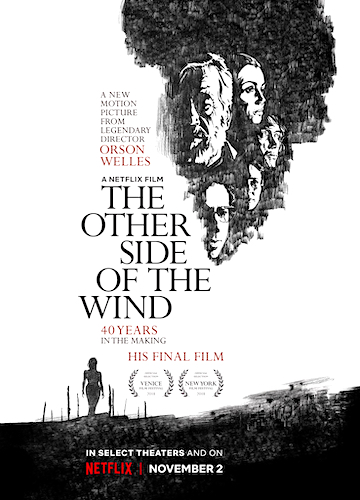
    The Other Side of the Wind
    (2018)

    2018 #226
    Orson Welles | 122 mins | digital (UHD) | 1.37:1 + 1.85:1 | France, Iran & USA / English | 15 / R

    The Other Side of the Wind

    One of my draft intros for The Other Side of the Wind was to talk about how it feels like “a 2018 film” because it’s different; innovative; unique — modern. But then to note that, of course, it was all shot in the 1970s, but never completed for financial and legal reasons. That’s only partially true, though, because while it does feel modern in some ways, it still looks and feels very ’70s; and while it’s no doubt experimental and avant-garde, it’s in a very ’70s way. And the look of the film stock is very ’70s. It’s a strange, undoubtedly compromised movie — but so are many of the films Orson Welles managed to complete while he was alive, thanks to studio interference, so it’s hardly a sore thumb in that regard.

    The film tells the story of the final days of Jake Hannaford (John Huston), a film director working on his comeback movie (you’ve gotta think there’s some autobiography in here, then, right?) It’s a portrait of the man’s final hours, supposedly assembled from dozens of sources that were shooting him at the time — Welles prefiguring the ‘found footage’ genre by a decade or two. But this isn’t a horror movie… well, not in the traditional sense: in my notes I described it as “a frantically-cut display of pompous self-declared intellectuals pontificating about something and nothing in a battle of pretentiousness. That perhaps explains why, at a time when Netflix movies routinely ‘break out’, the flash of interest the film’s release provoked has not resulted in any kind of sustained wide admiration.

    Whatever your thoughts on the final film (and it’s clearly one for cineastes and completists rather than general audiences), it seems remarkable that it took so long for anyone to be willing to fund the completion of a film by The Great Orson Welles. But that’s actually a story unto itself, told in the accompanying documentary A Final Cut for Orson: 40 Years in the Making (which is hidden in the film’s “Trailers & More” section, but is definitely worth seeking out if you’re interested). Among the revelations there are that Welles shot almost 100 hours of footage, spread across 1,083 film elements, all of which had to be fully inventoried. Matching it up was a problem that would have been insurmountable even ten years ago; it’s only possible now thanks to digital techniques and algorithms — and, of course, a big chunk of change from Netflix. Welles had only cut together about 45 minutes, with the rest completed based on the style of those parts, his notes and letters, and recordings of some of his direction that was retained on the sound reels.

    Was the effort worth it? It’s certainly a fascinating project to see brought to some kind of fruition. In the end, I’m not sure what it all signified. The story is pretty straightforward, but it’s jumbled in amongst a lot of hyperactive editing, as well as a bizarre film-within-a-film. There are things here which still feel ahead of their time even now, and things that were certainly ahead of their time when shot in the early ’70s (even if other people have done them since), which is always exciting. Combine that with Welles’s status and this is unquestionably a fascinating, must-see movie for cinephiles.

    3 out of 5

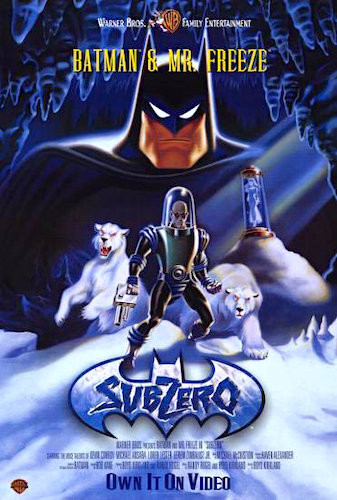
    Batman & Mr. Freeze: SubZero
    (1998)

    2018 #227
    Boyd Kirkland | 67 mins | Blu-ray | 1.33:1 | USA / English | PG

    Batman & Mr. Freeze: SubZero

    It’s now so ingrained in Bat-canon that it’s easy to forget, but Batman: The Animated Series actually invented Mr Freeze’s backstory about his dead wife, etc. It was so successful that the episode (Heart of Ice) won an Emmy, the character was brought back to life in the comics (complete with this new backstory), and just a few years later it was used in Batman & Robin (which, considering how much that film was happy to ignore about other characters, e.g. Bane, just goes to show… something).

    So, with The Animated Series responsible for such a major revival of the character, it kinda makes sense they’d choose him to star in their second animated feature — although another version of events is he was chosen to tie-in with Batman & Robin, but then SubZero was pushed back after the live-action film was a critical flop. That makes sense, because while Heart of Ice is fantastic and influential, none of Freeze’s other Animated Series appearances have a great deal to offer. TV episode Deep Freeze is sci-fi B-movie gubbins featuring Freeze as a cog in the plot rather than its driving force; and, after all the effort to humanise him, in Cold Comfort he’s just a villain doing villainous things with incredibly thin motivation.

    SubZero is, at least, a step above those. It doesn’t withstand comparison to its predecessor movie, the genuine classic Mask of the Phantasm — that had entertainment value for kids, but was also a thoughtful, mature story about what drives Bruce Wayne to be Batman. SubZero, on the other hand, is just an action-adventure ride. It’s not bad for what it is (there’s a pretty great car chase halfway through, and the explosive climax aboard an abandoned oil derrick going up in flames is rather good), but no more than that. At least it finally provides a neat end to Freeze’s story… even if it is kinda hurried in a last-minute news report.

    3 out of 5

    Paper Moon
    (1973)

    2018 #235
    Peter Bogdanovich | 98 mins | TV (HD) | 1.85:1 | USA / English | PG / PG

    Paper Moon

    I do try to avoid this situation arising in a ‘review’, but I watched Paper Moon over two years ago and didn’t make any significant notes on it, so I’m afraid I can’t say much of my own opinion. What I can tell you is that I happened to spot it in the TV schedule and decided to watch it primarily to tick it off the IMDb Top 250, thinking it was a bit of an also-ran on that list (based on iCheckMovies, it’s not very widely regarded outside of IMDb; indeed, it’s not even on the Top 250 anymore). But that was serendipitous, because I wound up really enjoying it.

    Sticking with IMDb, here are some interesting points of trivia:

    “At 1 hour, 6 minutes, 58 seconds, Tatum O’Neal’s performance is the longest to ever win an Academy Award in a supporting acting category.” I guess category fraud isn’t a recent phenomena: O’Neal’s a lead — the lead, even — but I bet that supporting award was an easier win, especially as she was a child. Which also ties to this item: “some Hollywood insiders suspected that O’Neal’s performance was ‘manufactured’ by director Peter Bogdanovich. It was revealed that the director had gone to great lengths, sometimes requiring as many as 50 takes, to capture the ‘effortless’ natural quality for which Tatum was critically praised.” But I’ll add a big “hmm” to that point, because I think it’s very much a point of view thing. Every performance in a movie is “manufactured”, in the sense that multiple takes are done and the director and editor later make selections — is requiring 50 takes for a child actor to nail it any different than Kubrick or Fincher putting adult actors through 100 or more takes until they get what they want?

    On a more positive note, “Orson Welles, a close friend of Bogdanovich, did some uncredited consulting on the cinematography. It was Welles who suggested shooting black and white photography through a red filter, adding higher contrast to the images.” Good idea, Orson, because the film does look rather gorgeous.

    5 out of 5

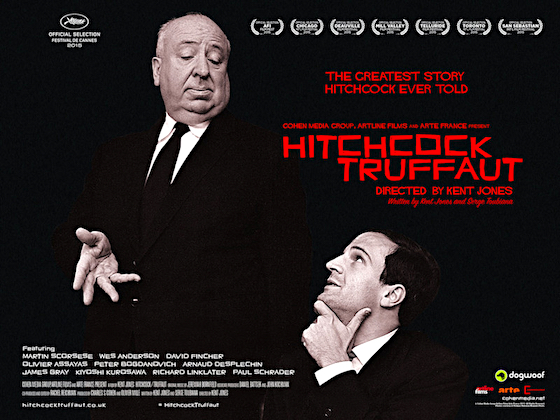
    Hitchcock/Truffaut
    (2015)

    2018 #236
    Kent Jones | 77 mins | TV | 16:9 | France & USA / English, French & Japanese | 12 / PG-13

    Hitchcock/Truffaut

    In 1962, film directors Alfred Hitchcock and François Truffaut locked themselves away in Hollywood for a week to excavate the secrets behind the mise-en-scène in cinema. Based on the original recordings of this meeting — used to produce the mythical book Hitchcock/Truffaut — this film illustrates the greatest cinema lesson of all time… Hitchcock’s incredibly modern art is elucidated and explained by today’s leading filmmakers, who discuss how Truffaut’s book influenced their work. — adapted from IMDb

    This film version of Hitchcock/Truffaut is about so much at once. On balance, it’s mostly about analysing Hitchcock’s films; but it’s also about the interview itself; and the importance and impact of the book, both on the general critical perception of Hitchcock and how it influenced specific directors; but it’s also about how Hitchcock’s actual films have influenced those directors; and there’s also insights into directing from those directors; and also some bits on Truffaut’s films, and the differences between him and Hitchcock as filmmakers. Whew!

    It’s a funny film, really: it acknowledges the book’s influence, but doesn’t really dig into it; it analyses some of Hitch’s obsessions and films (most especially Vertigo and Psycho), but not comprehensively. Some have said it feels like a companion piece to the book; I’ve not read the book, but I can believe that — if the book were a movie, this would be a special feature on the DVD. Less kindly, you could call it a feature-length advert — certainly, I really want to get the book now. (I got it as a Christmas present not long after. I’ve not read it yet.)

    That said, here’s an iInteresting counterpoint from a Letterboxd review: “One of the things (just one) that makes the book so essential is that it’s a discussion of the craft of filmmaking from two (very different) filmmakers. In adding commentary from a wide variety of other directors, Jones highlights that element of the book while widening and updating its focus: it isn’t just a conversation between Hitchcock and Truffaut, but between those two men and David Fincher, and James Gray and Kyoshi Kurosawa and Arnaud Desplechin, etc. Rather than a mere supplement to the book, a video essay adding moving pictures to the book’s conversations, Jones’s film builds something new and on-going upon it.”

    I didn’t think Hitchcock/Truffaut (the film) was all it could be; and yet, thanks to the topics discussed and people interviewed, it’s still a must-see for any fan of Hitchcock, or just movies in general.

    4 out of 5

  • Enola Holmes (2020)

    2020 #214
    Harry Bradbeer | 123 mins | digital (UHD) | 2.35:1 | UK / English | 12 / PG-13

    Enola Holmes

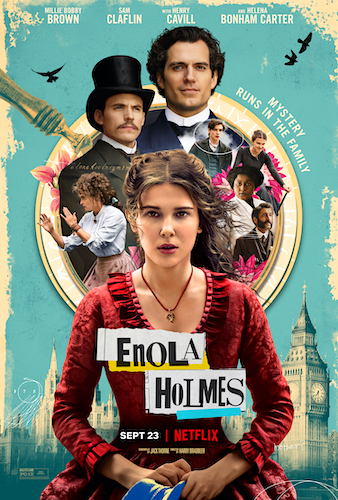
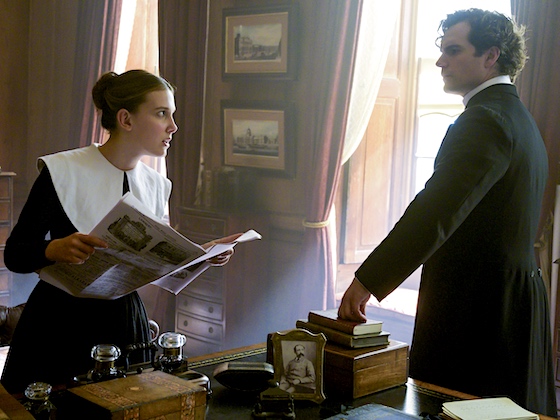
    The latest screen incarnation of Sherlock Holmes is not really about the Great Detective at all. Instead, Enola Holmes introduces us to his eponymous young sister — not part of Sir Arthur Conan Doyle’s original canon, but a creation of author Nancy Springer, on whose series of young adult mystery novels this film is based. (Nor, I feel I should point out, was Sherlock’s Eurus drawn from canon, despite what some hardcore Sherlock fans berating Netflix’s Enola promos seem to believe.) Indeed, the film imagines a whole family for Sherlock and his elder brother Mycroft: a father who died when Enola was young; and a mother, Eudoria, who has since raised Enola to be a multi-talented, independent, forward-thinking young woman.

    But when Enola (Mille Bobby Brown) wakes on her 16th birthday, she finds that Eudoria (Helena Bonham Carter) has disappeared. She summons her brothers, famous detective Sherlock (Henry Cavill) and uptight government man Mycroft (Sam Claflin), and various clues to Eudoria’s actions and intentions are unearthed — but not always shared among the siblings, because the brothers want little to do with their younger sister, resolving to send her to a finishing school to learn how to be a ‘proper’ lady. That doesn’t fit with Enola’s plans, though, so she escapes and runs away to find her mother. On her journey, she runs into similarly young Lord Tewkesbury (Louis Partridge), who is also on the run from his family, for reasons that, it will emerge, are even more sinister than Enola’s…

    Enola and Sherlock

    As a story set in the world of Sherlock Holmes, Enola Holmes is… well… um… Look, I’ve been fond of Henry Cavill since The Tudors, but he’s not my idea of Sherlock Holmes; and apparently Dr Watson doesn’t even exist? Sacrilege! While I can’t forgive the latter, the weird casting decision of Cavill is somewhat justified by the film itself. I’m not sure it was conceived to include a ‘traditional’ Holmes, and Cavill fits the character as he has been written: as an admirable, kindly, almost mentor-like older brother to Enola. Perhaps if they’d cast a more traditionally Holmesian actor then that person would have managed to shift it towards a traditional portrayal, but I suspect that’s not what the filmmakers wanted. Arguably that makes this a bad Holmes adaptation (if you’ve changed the style and nature of the character, is it actually an “adaptation”?), but then, it’s not really about him.

    It’s about Enola — as per, y’know, the title — and in that role Mille Bobby Brown proves that her success as Eleven in Stranger Things was not a fluke. In the wrong hands, the confident, capable, and headstrong Enola could have been brattish, but Brown brings enough charm to sweep us along. She frequently turns to speak to camera, like some kind of Victorian teenage Fleabag, which, again, could have been irritating, but mostly works to bring us into her confidence and, occasionally, underscore the fun and thrill of her adventure. However, there’s more room for nuance in how the character is written. Enola is by no means perfect, but we’re rarely allowed to see deficiencies. This works when she’s putting on a brave face to a world that would underestimate her, but a little more sense that she’s new to all this and doesn’t always get it right wouldn’t go amiss.

    Victorian teenage Fleabag

    So, while I don’t imagine Sherlockians will be inducting this into their favourite screen iterations of the Great Detective, it works as a female-led YA mystery-adventure. Originally produced by Warner Bros for a cinematic release, but sold to Netflix after the pandemic hit, I suspect this might have actually done quite well in cinemas. It’s good fun, accessible entertainment; the kind of thing that once upon a time would have been a PG-rated family blockbuster hit (nowadays it’s rated 12/PG-13, though with their “allow children in so long as they’re with adults” rules, those certs are really the modern-day equivalent of what used to be PG). Now, it looks to have been a hit for Netflix: it seems to have been widely viewed, based on how the number of ratings on IMDb and Letterboxd shot up over the first 24 hours (and kept going), and it’s been the #1 film on Netflix UK for a whole week (and, apparently, set a record for being #1 in the most countries on its release day). I suspect this won’t be the last adventure we see for Miss Holmes…

    4 out of 5

    Enola Holmes is available on Netflix now.

    Memories of Murder (2003)

    aka Salinui chueok

    2019 #15
    Bong Joon Ho | 131 mins | download (HD) | 1.85:1 | South Korea / Korean | 15

    Memories of Murder

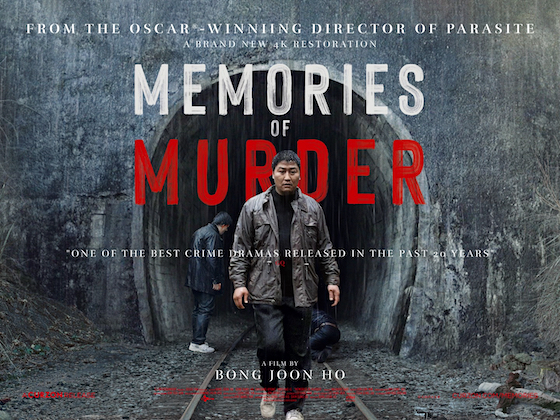
    South Korean director Bong Joon Ho has gradually risen in prominence over the past few years, culminating in Parasite’s history-making success at this year’s Oscars (yes, that was only earlier this year). Memories of Murder wasn’t his debut work, but it was what initially garnered him some attention outside Korea. It’s been surprisingly hard to come by for a while now, but a new 4K restoration is released in the UK via Curzon today (it’s coming to US cinemas for a limited run in October, and new Blu-ray releases (including one from Criterion) will follow).

    In 1986, two women are raped and murdered in provincial South Korea. The local detective, Park Doo-man (Bong regular Song Kang-ho), has never dealt with a case of this magnitude and relies on old-fashioned methods — his main one being to have his partner, Cho (Kim Roi-ha), beat confessions out of suspects. After a modern-minded big-city ‘tec, Seo Tae-yoon (Kim Sang-kyung), volunteers to help, the old and the new clash. As more crimes are committed, more clues are gathered, and more suspects are apprehended, but then cleared. Can the police ever get close to their man?

    Loosely based on the true story of Korea’s first serial murders, and taking a procedural approach to the crime thriller genre, Memories of Murder invites comparison to David Fincher’s Zodiac for its methodical, realistic narrative style and plot that follows obsessed investigators chasing unsolved murders in the past. Zodiac is one of my favourite films (it placed 3rd in 100 Favourites II), so it’s a tall order to be pitched against it. Fortunately, Memories of Murder is strong enough to withstand the comparison.

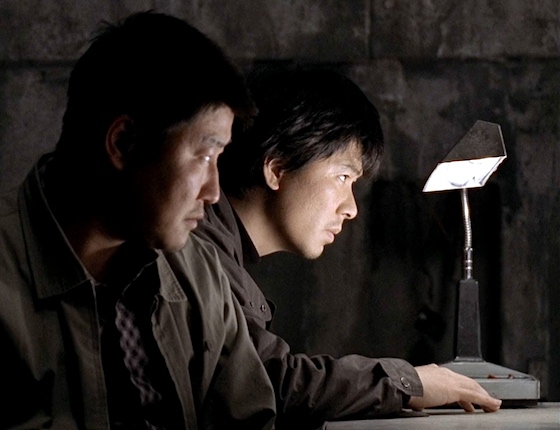
    Investigators

    A lot of praise that applies to Zodiac could be copy-and-pasted here. In addition to the facets I’ve already mentioned, there are several fine performances (not least from Song, who’s clearly become a Bong regular for a reason); several striking set piece crimes and/or discoveries without indulging in glorification of real crimes; and a commentary on the methods and obsessions of investigators that goes beyond ‘doing the job’. It does none of this in the same way as Fincher would a couple of years later, but it’s a different perspective within the same genre headspace.

    Memories of Murder is already a well-regarded film (on top of a 91% Tomatometer score, it’s on the IMDb Top 250 and in the top 100 of Letterboxd’s version ) but, having been out of widespread circulation for a few years, and with renewed interest in Bong’s back catalogue, it’s ripe for wider (re)discovery.

    5 out of 5

    Memories of Murder is available to rent on Curzon Home Cinema from today.

    It placed 5th on my list of The Best Films I Saw in 2019, after being viewed as part of What Do You Mean You Haven’t Seen…? 2019.

    The 100-Week Roundup XI

    This week: an underrated crime thriller based on the same true-life story as a Hitchcock classic; an investigation of the trauma left by conflict in a film I’ve nicknamed “Gulf War Rashomon”; and a test of this “just post my notes already” roundup format with one of my favourite films I watched in 2018.

    They are…

  • Compulsion (1959)
  • Heathers (1988)
  • Courage Under Fire (1996)


    Compulsion
    (1959)

    2018 #194
    Richard Fleischer | 99 mins | TV | 2.35:1 | USA / English | 12

    Compulsion

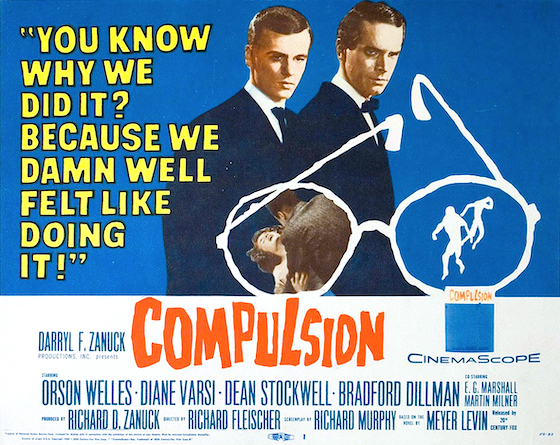
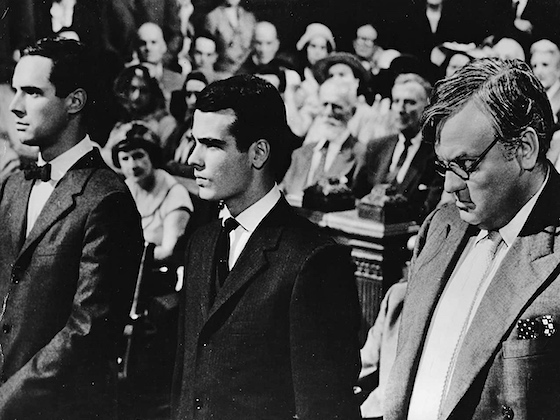
    Based on a novel that was based on the Leopold and Loeb case (which has also been the inspiration for various other films, most notably Alfred Hitchcock’s Rope), Compulsion is the story of two students who think their intellectual superiority will allow them to get away with the perfect murder.

    Playing the students, Dean Stockwell and Bradford Dillman are both fantastic. They’re two different types of well-to-do prodigies: Dillman charming and cocksure; Stockwell both awkward and supremely confident of his own exceptionalness. Their performances keep things compelling, even as the events unfolding are a foregone conclusion. You should and will hate them — even if they weren’t murderers, they’d be insufferable pricks (they sound like any number of modern-day politicians, don’t they?); that they’re cold-blooded killers just makes them worse. But even though you’ll never root for them, they’re still addictively watchable. Also, bearing in mind when the film was made, there’s a strong undercurrent of their homosexuality. It disappears as the film goes on, becoming more concerned with the case than the relationship between the two guys, but it’s discernibly there at the start.

    And then Orson Welles turns up. Despite getting top billing, he has more of a third act cameo that turns into the film’s most grandstanding moment: his closing speech at the trial; a real tour de force against capital punishment. Apparently it was issued on vinyl, it’s that good. The three stars got and get all the recognition (they shared Best Actor at Cannes that year), but there are also fine supporting performances from Martin Milner and Diane Varsi as a couple of fellow students who get caught up in the case in different ways; and E.G. Marshall is very good as DA Horn, the man who eventually catches the guys and therefore becomes Welles’ courtroom nemesis. He’s particularly understated during Welles’ big speech, gradually shifting from annoyance and hatred to agreement, ultimately rising to his feet at the end as if in a silent standing ovation.

    Stillman, Stockwell and Welles

    Aside from that obvious Big Scene, there are several other memorable ones: Dillman calmly talking to his teddy bear while Stockwell frantically searches for misplaced glasses, for example; or the cat-and-mouse scenes where the DA interviews the lads separately. Much of it is fantastically shot, too. There’s an occasional showy bit (like focusing on glasses on a nightstand as it gets dark outside, then showing the culprit and investigator reflected one in each lens), but also a general level of quality that often helps emphasise the darkness in the lads’ souls.

    I don’t think Compulsion is widely discussed anymore (it has fewer ratings on IMDb than Love on a Leash!), but I thought it was a brilliant film; one that can withstand comparison to more-acclaimed versions of the same story. It’s definitely underrated today.

    5 out of 5

    Heathers
    (1988)

    2018 #196
    Michael Lehmann | 103 mins | Blu-ray | 1.85:1 | USA / English | 15 / R

    Heathers

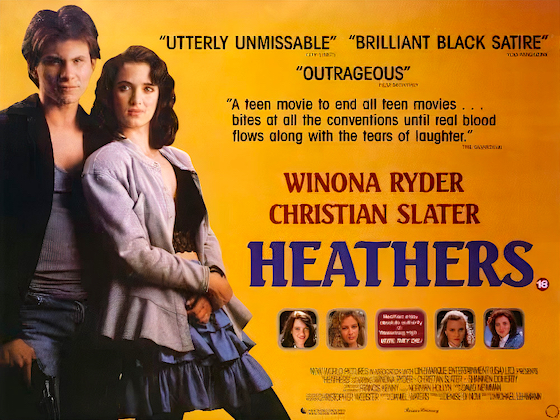
    Heathers was one of my favourite films I watched in 2018 (it placed 5th on my list of The 26 Best Films I Saw For the First Time in 2018), but I didn’t make any notes on it at the time, and (obviously) it’s now two years since I watched it. Oh dear.

    So, in the spirit of the point of these roundups (to clear old unreviewed films, regardless of how much or little I have to say about them), we’ll have to make do with repeating my brief summary from the aforementioned “best of” list. Though I’ll also add that I watched this on Arrow’s then-new Blu-ray edition, which comes from a 4K restoration and looks absolutely fantastic.

    The darkness that’s barely concealed beneath the pleasant veneer of American high schools is exposed in this pitch-black comedy, which mixes violent teen wish fulfilment with a certain degree of societal satire to boundary-pushing effect. It’s not as transgressively shocking 30 years on as it might’ve been back in the ’80s, but it’s still so very.

    5 out of 5

    Courage Under Fire
    (1996)

    2018 #197
    Edward Zwick | 108 mins | TV (HD) | 1.85:1 | USA / English | 15 / R

    Courage Under Fire

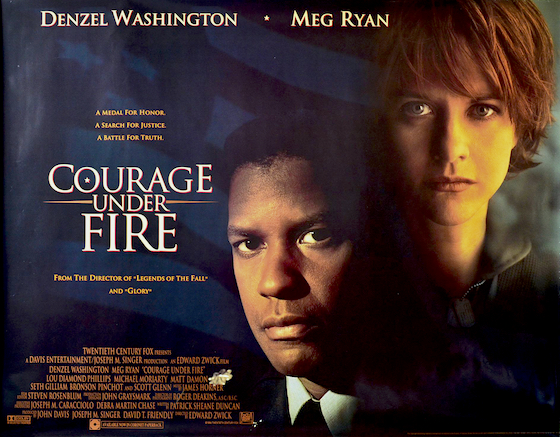
    It’s “Gulf War Rashomon” when a traumatised tank commander (Denzel Washington) encounters conflicting accounts of what happened while he investigates whether a helicopter pilot (Meg Ryan) deserves to be posthumously awarded the Medal of Honor, which would make her the first woman to receive it. As higher-ups put pressure on him to just push the honour through, he remains committed to uncovering the truth…

    The mystery of what really went on is not as clever or engrossing as the film thinks it is, but it still works as a meditation on how we acknowledge wartime heroism and the place of truth in doing so. It’s also a consideration of how many people are affected, in different ways, by the sacrifices of war.

    There are some decent performances along the way: Washington is always good value, and a before-he-was-famous Matt Damon demonstrates his commitment to the profession by losing a ton of weight between filming the flashback and “present day” scenes (endangering his health in the process) to portray a medical specialist indelibly affected by what went on ‘over there’. Apparently Mark Kermode said the casting of Meg Ryan as a chopper pilot was “the benchmark for a casting decision so ludicrous that it takes the viewer out of the film,” but I suspect that says more about how she was regarded at the time (best known for romcoms) than her actual performance (she’s no standout, but she’s fine).

    3 out of 5

  • The Equalizer 2 (2018)

    2020 #25
    Antoine Fuqua | 116 mins | digital (HD) | 2.39:1 | USA / English, Turkish & French | 15 / R

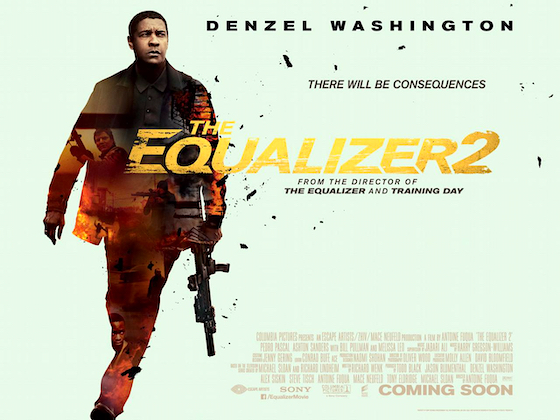
    The Equalizer 2

    Now we’re equalised, bitch.

    Sadly, that is not a line Denzel actually says in this movie. The film would be about 50% better if he did. Instead, what we get is an action-thriller where both the action and thrills are, literally, few and far between.

    For those who skipped the first film, Denzel is playing Robert McCall, a former Marine and intelligence agent who retired to a life of inconspicuous normality, but has been tempted back into righting some of the wrongs of the world — or “equalizing” them, I guess. This time, an array of subplots eventually gives way to a story in which McCall sets out to avenge the murder of a friend.

    I mention the subplots there because they’re the film’s biggest problem. As a result of them, it’s… so… slow… To start with, the subplots are a couple of small ‘cases’ introduced in the first half-hour, presumably to try to liven the film up because the main storyline is crawling along. Neither works. I’m not here for a pleasant drama about a Lyft driver who does kindly things for others — I want to see Denzel Washington kicking the asses of nasty buggers. The first film was noteworthy for investing more time in its supporting characters than is typical for the action-thriller genre, but this one takes that notion to extremes.

    Even when the main plot does get moving, it takes over an hour to get to a ‘twist’ that’s obvious just from reading the cast list. At least it doesn’t try to save it for the end, I guess. That reveal leads to a wannabe-Taken-phone-speech declaration from Denzel, which should’ve come a lot earlier. It’s not as memorable as the Taken one (though the final line lands), but at least it’s a moment of drama and the film perks up after it — but by then we’re well over an hour in to a less-than-two-hours movie.

    A rare moment of almost-action

    From there it’s a short hop, skip and jump to a climax set amidst a horrendous storm in an abandoned seaside town. It’s a nice concept and it’s solidly executed, but it’s an at-most 20-minute sequence and it’s not exceptional, just a lot more engaging than the film’s other 100 minutes, so it doesn’t really justify sitting through the rest of the movie. However, I did not realise that flour could be explosive, but turns out it can, so in that sense at least this was educational for me.

    (FYI, the film was cut in the UK to get a 15 certificate, removing some of the more extreme gore (insides hanging out, a spine being severed, etc). The 4K Blu-ray release is uncut and rated 18 (presumably so they could just port the disc rather than having to faff with edits/a new transfer). On Netflix it has an 18 icon, so I guess it’s also the uncut version, should that concern you either way.)

    The Equalizer 2 isn’t a terrible film, but it is quite a boring one. Not just slow paced — genuinely boring. A raft of subplots don’t really go anywhere or serve any purpose, the main story is incredibly thin, and the limited action sequences do little to balance the books.

    2 out of 5

    The Equalizer 2 is available on Netflix in the UK from today.

    The 100-Week Roundup VII

    If I were being slavishly accurate about weeks, there should be seven films in this roundup. But that seemed a bit much, so — as the next one of these wasn’t due until the end of the month — I’ve split it in two.

    In this roundup, the final films I watched in July 2018.…

  • The Garden of Words (2013)
  • The Secret in Their Eyes (2009)
  • Paul (2011)
  • The Way of the Gun (2000)


    The Garden of Words
    (2013)

    aka Koto no ha no niwa

    2018 #170
    Makoto Shinkai | 46 mins | streaming (HD) | 16:9 | Japan / Japanese | 12

    The Garden of Words

    If the only anime director’s name you know is Hayao Miyazaki, you could do worse than familiarise yourself with Makoto Shinkai, director of recent popular hits Your Name and Weathering with You. He’d already been gaining attention with the films he made before those, which include short feature The Garden of Words.

    It revolves around two individuals: a 15-year-old schoolboy who aspires to be a shoemaker, and a 27-year-old woman. They meet one day in a park during a rainstorm and develop a connection. According to Shinkai, the film is a love story between two people “who feel lonely or incomplete in their social relations, but who don’t feel that they need to fix this loneliness.” That’s an interesting perspective, because while there’s undoubtedly a significant element of loneliness in the film, it’s accompanied by an element of depression; that these two characters seem unfilled. Without wanting to spoil anything, it seems to be the connection between the two that ‘saves’ them and elevates their lives — i.e. they did need to fix their loneliness. Perhaps it’s a disconnect between intention and execution that led me note that “where it ends up going isn’t as good as where it begins”. Nonetheless, the characters are engaging, and their emotional turmoil and connection are affecting. It also leaves room for personal interpretation with an open ending — it does reach a conclusion of sorts, but there’s clearly space the viewer to imagine what comes next.

    The animation is simply stunning — both beautiful in itself, and in its technical accomplishment. For that reason, if given the choice, it might be tempting to opt for an English dub, but I’d advise to stick with the original Japanese. I’ve written before about how I’m regularly conflicted when watching anime about whether to go for the original Japanese or an English dub, and I do often I go for the latter — I must admit I’m swayed by the recognisable voice casts on Ghibli films, for example; and, generally speaking, it allows you to appreciate the visuals more when you’re not having to read a lot of subtitles. Nonetheless, this time I chose the Japanese audio, and I’m glad I did: it’s subtle and calm, like the film itself, and the quietness and gentle pace mean there’s not an overabundance of distracting reading (unlike in Your Name, for example). I popped on a bit of the American dub afterwards and it felt all wrong by comparison — somehow brash and decidedly inauthentic. On the bright side, either track sounds luscious in 5.1, with the rain falling all around you, which serves to really immerse the viewer in the situation alongside the characters.

    4 out of 5

    The Secret in Their Eyes
    (2009)

    aka El secreto de sus ojos

    2018 #171
    Juan José Campanella | 129 mins | download (HD) | 2.35:1 | Argentina & Spain / Spanish | 18 / R

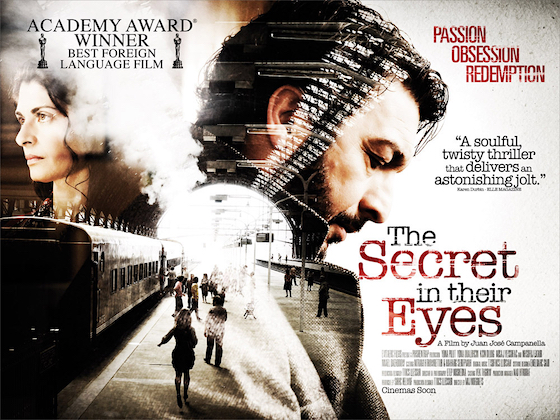
    The Secret in Their Eyes

    A surprise winner of the Best Foreign Language Oscar in 2010 (it beat A Prophet and Michael Haneke’s The White Ribbon), Argentina’s The Secret in Their Eyes is a murder mystery, two very different love stories, and a musing on the nature of justice, especially within a corrupt system.

    Primarily, it’s a procedural thriller about a decades-old unsolved case that one of the original investigators is revisiting in the hopes of finding closure. As that, I thought the film was probably a bit too long — despite some solid thematic weight, the unnecessarily slow pace at times make it feel a smidge self-important for what is fundamentally a crime thriller. That said, those other facets that have been added to supplement the storyline — the romance side; the passage of time (how do people deal with such life-changing events over the ensuing decades?) — do bring something to the film, elevating it beyond standard police procedural fare.

    Even as ‘just’ that, it pulls off some spectacular feats: the famous single-take at the football match really is an all-timer, and the final twist is unexpected and a perfect capper. I was this close to giving it full marks, and maybe when I revisit it someday I will.

    4 out of 5

    Paul
    Extended Edition
    (2011)

    2018 #172
    Greg Mottle | 109 mins | Blu-ray | 2.35:1 | UK & USA / English & Klingon | 15

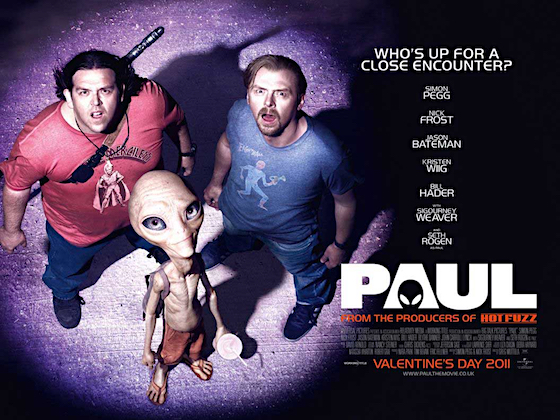
    Paul

    On a post-ComicCon road trip around the US’s UFO heartland, a pair of British geeks (Simon Pegg and Nick Frost) bump into an actual alien, the eponymous Paul (Seth Rogen), who’s on the run from a government facility. Cue a kind of “E.T. for grownups” as the trio — and a widening assortment of supporting characters — endeavour to evade the authorities and get Paul home.

    Mistaken by some for the third part of the Three Flavours Cornetto trilogy (thanks to it starring Pegg and Frost, but it’s missing the vital ingredient of director Edgar Wright, who was committed to Scott Pilgrim), Paul lacks the sharpness of that trilogy at its best. However, it’s full of likeability — in the characters, and of course the humour — to the point where it actually manages to get a bit emotional at the end. It’s also chock full of references and quotes for fellow geeks to spot, some of which are incredibly well-timed to have fantastic impact.

    As for the extended cut, there’s a comparison here. As usual, the theatrical cut was R-rated in the US but the extended one is unrated there, but (also as usually) I don’t think there’s anything that wouldn’t pass at R. The running time difference is about five-and-a-half minutes, but there are 41 differences crammed into that time. It seems like some fairly memorable jokes were cut and others added back — nothing earth shattering, but enough to call the extended cut the preferable one.

    4 out of 5

    The Way of the Gun
    (2000)

    2018 #173
    Christopher McQuarrie | 120 mins | Blu-ray | 16:9 | USA / English | 18 / R

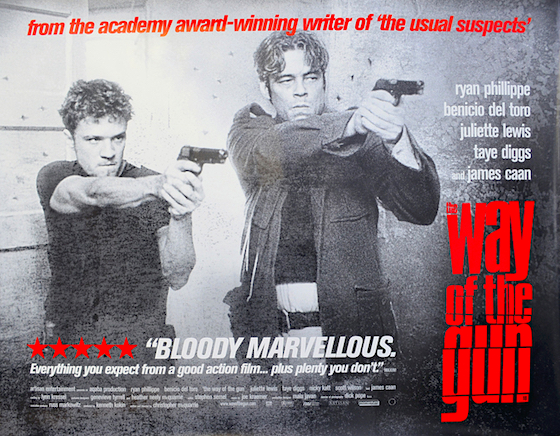
    The Way of the Gun

    The debut directorial feature from screenwriter Christopher McQuarrie (who made his name penning the likes of The Usual Suspects and more recently has found success as the regular writer-director of the Mission: Impossible movies), is one of those ’90s crime comedy-dramas — you know, the kind of thing we describe as “Tarantino-esque”, for good reason. It has its fans, but McQuarrie tends to refer to it disparagingly on social media, no doubt in part because it landed him in “director jail” for over a decade. Personally, I agree with McQuarrie (I usually do): it’s not a failure, but it’s not much of a success either.

    My main problem with it is that it’s over-long and over-complicated. Both of those are thanks to too many characters with too many motivations. It’s possible to get your head round it all in the end, but there’s a stretch in the middle where it feels like work. But rather than slow things down and spell it out, it might be better if it moved through them all quicker — at least then it would be pacy. It’s also rather dully shot by Dick Pope, who was later Oscar-nominated for the likes of The Illusionist and Mr. Turner, but has plied most of his trade in the grounded world of Mike Leigh movies, which perhaps explains that. There are still two or three good shots, plus a neat oner that indicates the direction McQ’s style would head.

    There are flashes of McQuarrie’s brilliance elsewhere too, including some nice bits of dialogue and a couple of good sequences. The action scenes, in particular, demonstrate he had a strong skill there from the start. They feel very grounded and real — just the way the characters move; that they’re constantly reloading; how it ends when everyone’s out of bullets. McQuarrie’s brother, a Navy SEAL, was the technical advisor for these scenes, which explains their accuracy. The final shoot-out, with all of that going on, is the best bit of the movie. Well, at least it ends on a high.

    3 out of 5

  • The 100-Week Roundup VI

    Here’s another quartet of reviews from my July 2018 viewing, with an all-star cast both behind the camera (Stanley Kubrick, Ridley Scott) and in front of it (Keanu Reeves, Leonardo DiCaprio, Russell Crowe, etc).

    In this week’s roundup…

  • The Day the Earth Stood Still (2008)
  • Full Metal Jacket (1987)
  • Wind River (2017)
  • Body of Lies (2008)


    The Day the Earth Stood Still
    (2008)

    2018 #163
    Scott Derrickson | 104 mins | Blu-ray | 2.35:1 | USA & Canada / English & Mandarin | 12 / PG-13

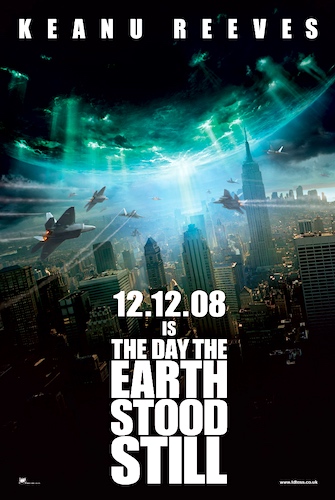
    The Day the Earth Stood Still

    Blockbuster remake of the 1951 sci-fi classic, starring Keanu Reeves as an alien who has come to “save the Earth”.

    The original might be best remembered for its message about mankind. The do-over doesn’t so much attempt serious “humanity are the problem” moralising as just nod in that general direction. Instead, it conforms to the Hollywood-remake stereotype of simplification, using the plot as an excuse for a CGI destructathon. Even as that it’s a bit of a damp squib, with no genuinely impressive sequences; some of the CGI is pretty crap, even, like the first appearance of the giant robot GORT.

    I know we all love him now because he seems like a genuinely wonderful guy in real life and the John Wick movies are cool, but, still, the role of an emotionally cold alien pretending to be human but struggling to understand what truly makes us ‘us’ is a perfect fit for Keanu Reeves and his usual acting style. Jaden Smith is equally perfect casting as an irritating brat of a kid. Jennifer Connelly struggles gamely to be the heart of the film, and there are small or cameo roles for the likes of Kathy Bates, Jon Hamm, and John Cleese, none of whom can really elevate the basic material they’re given.

    All in all, it’s inoffensively bland, with some light sci-fi ideas, a bit of loose moralising, and a bunch of pixels whooshing about. Perhaps with a better creative team — or without the demands of a studio blockbuster budget — it could’ve been more; something genuinely thought-provoking about the value (or otherwise) of humanity. But it isn’t.

    3 out of 5

    Full Metal Jacket
    (1987)

    2018 #165
    Stanley Kubrick | 117 mins | Blu-ray | 16:9 | UK & USA / English | 15 / R

    Full Metal Jacket

    Kubrick’s anti-war war movie, about the dehumanisation of abusive army training, the virtue and success of kindness, and how combat can erode and destroy the soul. It’s “a Vietnam movie”, but Kubrick wasn’t interested in Nam per se, rather “the phenomenon of war” and what happens to young men when you turn them into killing machines.

    It’s a film of two halves: first, the training; then, the war. The first half is the better known one, and some people will tell you it goes downhill when they leave training. That first part is indeed horrid but effective and meaningful, but I thought the second half lived up to its impact too.

    A film about war’s effect on people requires strong performances, and fortunately it has those. Most famous is R. Lee Ermey’s nasty drill instructor — an unquestionably accurate portrayal of the real thing, because Ermey used to be one. He was originally hired as a consultant, but decided he wanted the role and convinced Kubrick to cast him, then rewrote his dialogue — the obscenity-strewn insults are all Ermey’s own. But for my money the best performance in the movie comes from Vincent D’Onofrio. Apparently he got the part just because he was a friend of Matthew Modine — it was his first film role — but he’s fantastic. And nowadays best known as a gun-happy right-wing nut-job on Twitter, Adam Baldwin is very convincing as, er, a gun-happy right-wing nut-job.

    Naturally, Kubrick’s work is as on-point as ever. A climactic action scene pits the entire troop against just one sniper, which is both thrilling and horrifyingly brutal. The film’s final death is excruciatingly drawn out, to really convey its emotional toll. Douglas Milsome’s photography frequently looks stunning as well. The fire-lit final act is as visually gorgeous as it is suspenseful and gruelling.

    To paraphrase a commentator in the Between Good and Evil documentary, Kubrick “takes the sympathetic characters and breaks them down so that, by the end, there’s no one left to root for, and the sympathy you feel is not for the character, but for what they’d lost.” And another notes how much you can see Iraq in the film, as if Kubrick was predicting the future of urban warfare too. Or, another way of looking at it: how little changes; how few lessons we learn.

    5 out of 5

    Full Metal Jacket was viewed as part of What Do You Mean You Haven’t Seen…? 2018.

    It placed 8th on my list of The Best Films I Saw in 2018.

    Wind River
    (2017)

    2018 #166
    Taylor Sheridan | 107 mins | streaming (HD) | 2.35:1 | USA, UK & Canada / English | 15 / R

    Wind River

    A veteran hunter helps an FBI agent investigate the murder of a young woman on a Wyoming Native American reservation.IMDb

    What follows is a neo-Western crime thriller, written and directed by Taylor Sheridan. As a genre piece, it’s most noteworthy for how well it handles the reveal of whodunnit. Just as you think the film’s getting to the point where they find who did it, but it’s only a suspicion and they’re going to have to go off and prove it, the film takes a hard left in a different direction that’s perfectly handled. To quote from a comment on iCheckMovies, the way it goes about this “seemed truly unique to this genre. The closest comparison I can think of is from Se7en, when [Se7en spoilers!] Kevin Spacey just turns up and hands himself in, completely out of the blue. It unexpectedly shattered the cat and mouse formula that people expected it to follow.” By dispensing with narrative oneupmanship (i.e. trying really, really hard to pull a twist out of thin air, as most mystery/thrillers do), it lets “the story unfold into more of a tragedy than the standard mystery or thriller you might expect it to be.”

    Talking of other reviews, some people are heavily critical of the film having a white male lead when it’s supposed to be about the plight of Native Americans, and especially Native American women. Well, yes, to an extent that’s true, but this is where fantasy rubs up against reality: do you really think a movie with a Native American lead would find it easy to get funding, distribution, and gain attention? Sometimes these things are a necessary ‘evil’ if your goal is to reach a wider audience and thereby spread the message. Besides, the film makes a point of treating the white characters as outsiders, in various ways. It’s not pretending this is how it should be, nor that they’re welcomed like, “hooray, the white people are here to save us!” If anything it’s used to emphasise the point: the Native American cops can’t solve the case themselves because they’re underfunded and understaffed; they have no choice but to rely on white people being prepared to help. That’s an indictment in itself.

    Altogether, this is a powerful movie — arguably Taylor Sheridan’s best, most mature screenplay (which is saying something for the man who wrote Sicario and Hell or High Water), and features a superb performance from Jeremy Renner, reminding you why he was Oscar-nominated for The Hurt Locker before his attempts to be a blockbuster action star.

    4 out of 5

    Body of Lies
    (2008)

    2018 #168
    Ridley Scott | 128 mins | download (HD) | 2.40:1 | USA & UK / English & Arabic | 15 / R

    Body of Lies

    A CIA agent on the ground in Jordan hunts down a powerful terrorist leader while being caught between the unclear intentions of his American supervisors and Jordan Intelligence.IMDb

    That’s the simple version, anyhow, because I thought the film itself got a bit long-winded and complicated; but if you enjoy spy movies, it’s smattered with some good bits of tradecraft stuff. That said, I’m not sure I buy Leonardo DiCaprio as the CIA’s man in the Middle East — he stands out like a sore thumb there; not good for a spy.

    Meanwhile, Russell Crowe commands complex world-changing missions over the phone while taking his kids to school or watching a football match — a nice touch, I thought, contrasting mundanity with these high-stakes actions. (Quite why he “had” to gain 50lbs for the role is beyond me, though. Sounds like he just fancied being lazy about his diet and exercise regime.) Still, the standout from the cast is the ever-excellent Mark Strong as the head of Jordanian intelligence, a man who is urbane and always immaculately dressed, but does not suffer those who disrespect him, exhibiting a kind of calm fury-cum-disappointment when they offend him.

    For all the confusion I felt about the plot, what I presume is the intended theme (that America can’t win because it refuses to respect or understand the culture of both its enemies and allies in the Middle East; and that the supposed good guys aren’t any better than the bad guys) comes across quite effectively. It’s also about the ineffectiveness of advanced technology. The CIA, so focused on their shiny new bells and whistles, lose out in the end to old fashioned personal interaction and patient preparation.

    Body of Lies seems somewhat torn between making these points and being an entertaining action-thriller. Ultimately it straddles the two stools, not quite satisfying as either — it has its moments, for sure, but it’s less than the sum of its parts. Maybe Ridley should’ve left the spy thrillers to his brother…

    3 out of 5

  • The 100-Week Roundup V

    Like last time, these five films are connected not only by when I watched them (July 2018), but also by a shared star rating.

    Incidentally, it’s about to be a busy time for these 100-week roundups — there should be one every week for the next few weeks to keep up with my backlog. (As time goes on, such frequency may become commonplace.)

    In this week’s roundup…

  • Muppet Treasure Island (1996)
  • Blade of the Immortal (2017)
  • Cash on Demand (1961)
  • Free Enterprise (1998)
  • Iron Monkey (1993)


    Muppet Treasure Island
    (1996)

    2018 #147
    Brian Henson | 96 mins | TV | 1.85:1 | USA / English | U / G

    Muppet Treasure Island

    Following the success of The Muppet Christmas Carol, the little felt fellas turned their attention to another classic of Victorian English literature, Robert Louis Stevenson’s piratical adventure Treasure Island. For my money, the result is even better — it’s so good that it made me want to finally read the novel, or at least watch a ‘proper’ adaptation. (Two years later, I’ve done neither. Typical.)

    Why Muppet Treasure Island doesn’t attract the same level of love that’s reserved for their Christmas Carol is beyond me, because it’s really a lot of fun. I’m predisposed to enjoy piratical movies, for whatever reason, so perhaps it appeals to me more than average; but even allowing for such bias, I think this is one of the more enjoyable Muppet movies — if I were to rank them, it would be a toss up between this and the 2011 reboot for first place.

    The best bit is definitely the songs, which are properly good. It helps when you’ve got the likes of Tim Curry to sing them, of course. They’re not all the kind of outright comedy numbers you’d expect, either: the opener, Shiver Me Timbers, is quite dark, in fact. They’re supported by a score by Hans Zimmer, which with hindsight sounds like a dry run for Pirates of the Caribbean. There are seven songs in all, and only one that I didn’t really like, which I’d regard as a good hit rate for a musical.

    To top it off, the film ends with a Muppet sword fight. Really, what more could you want?

    4 out of 5

    Muppet Treasure Island placed 17th on my list of The Best Films I Saw in 2018.

    Blade of the Immortal
    (2017)

    aka Mugen no jûnin

    2018 #148
    Takashi Miike | 142 mins | Blu-ray | 2.35:1 | Japan, UK & South Korea / Japanese | 18 / R

    Blade of the Immortal

    Billed as the 100th film directed by Takashi Miike (which it isn’t, but hey), Blade of the Immortal is actually the first one I’ve seen by the (in)famous director. Based on a manga series, it’s about a samurai who’s rendered immortal to serve penance for his crimes, and the young woman who engages him as a bodyguard to avenge her murdered family.

    It’s a bit episodic at first, as our (anti)hero battles through the villains’ top swordsmen one by one, but that means there’s a regular feed of action sequences between the two bookends that are highlighted in the promotion: how he fights 100 men at the beginning, and 300 men for the climax. That last half-hour is an epic flurry of violence, by the end of which rivers of blood flow — literally.

    Aside from the combat, dramatically and thematically a lot of it is about the difference between good and bad, hero and villain; how, really, there’s not so much difference after all — sometimes it’s just a matter of perspective. It could’ve gone for a more streamlined, straightforward revenge narrative, but it throws many characters into the mix with attendant thematic points, which do lend more texture. Or, if you don’t fancy thinking about that stuff, there’s just a lot of really good fight scenes.

    4 out of 5

    Cash on Demand
    (1961)

    2018 #154
    Quentin Lawrence | 77 mins | TV | 4:3 | UK / English | PG

    Cash on Demand

    This Brit-noir came to my attention thanks to the ghost of 82’s review after Indicator included it in one of their Hammer sets (though I caught it on TV). It’s basically a real-time single location thriller (so right up my street) starring Peter Cushing as a bank manager faced with a clever robber — far from a showy heist, this is a calm, almost sedentary robbery… which ultimately gives way to a furious bevy of twists and counter-twists in the film’s closing minutes.

    It’s led by an excellent performance from Cushing, who convinces entirely as an uptight jobsworth brought low by the stress he must endure, which reveals his true character. The film’s focus is on the ringer he goes through thanks to the heist, rather than on clever details of the heist itself — certain plot points are never explained, but it doesn’t matter because this isn’t about the robbery, it’s about how the robbery affects Cushing. To that end, he’s also nicely contrasted with André Morell as the affable thief, particularly as the pair spend much of the film in extended two-handers. Quentin Lawrence’s direction is unflashy but effective, allowing their performances to shine. It’s almost televisual, though with more setups than anything studio-bound of that era would’ve allowed. No surprise, then, that he only directed a handful of films, mostly plying his trade in ’60s and ’70s TV series.

    I do wonder if we could have spent more time with the rest of the bank’s staff, who remain unaware a robbery is taking place. As it stands, they’re all established at the beginning, but then mostly pushed aside until near the end, when they conduct their own investigation for all of two scenes. What if that was expanded into a proper B-plot through the movie? I think it could make the film even better by adding the potential for even more tension. Perhaps it could withstand an expanded remake…

    4 out of 5

    Free Enterprise
    (1998)

    2018 #158
    Robert Meyer Burnett | 109 mins | streaming | 4:3 | USA / English | 15 / R

    Free Enterprise

    Relationship/sex comedy meets geek reference-athon in this ’90s indie that plays like Swingers meets Clerks (he says never having seen Clerks, so that’s just an assumption of what it’s like).

    It slots into what seems like a very ’90s subgenre: the “young film-loving people trying to break into Hollywood” thing. I’m sure there are lots of societal and industrial reasons why there were so many movies in that vein produced in the ’90s. It also comes with the era’s schtick of dialogue loaded to the nines with pop culture references. It’s perhaps an overfamiliar style now, but here it’s at least quite witty and well performed.

    Indeed, this is so a ’90s indie all-round — you know, like the early Tarantinos, and everyone who copied his dialogue’s voice, that kind of thing. If that’s not your bag, you’ll hate Free Enterprise. But if you enjoy that style of film, and if you love geek culture too, well, this was made for you. Literally, I should think. It certainly felt made for me, and I’m not even a Trekkie. To laypeople, it might just look like “Swingers with geek references”, or conversely (to use that old stereotype of geeks), “my life but with sex”.

    So, to give it a 4-star rating feels like a very personal reaction — I think you’ve got to hit the right confluence of interests to get the maximum enjoyment out of this movie. But if you do, it’s really rather good.

    4 out of 5

    Iron Monkey
    (1993)

    aka Siu nin Wong Fei Hung chi: Tit ma lau

    2018 #160
    Yuen Woo-ping | 90 mins | Blu-ray | 1.85:1 | Hong Kong / Cantonese | 12 / PG-13

    Iron Monkey

    Back around the time I was first getting interested in Asian action cinema — when the Hong Kong Legends DVD label was doing sterling work bringing so many titles to the UK market in extras-packed editions — Iron Monkey was fêted as an absolute modern classic. I think it was one of the first to get a two-disc special edition from HKL too, as if to emphasise its importance. But I never got round to watching it, and so now it perhaps came overburdened with expectation. I found it to be a mix of impressively choreographed action, goofy humour, and a rather slight plot.

    The fights are definitely the star; without those, it’s no great shakes. But then, what do you come to this kind of movie for? It’s definitely one I need to revisit and reassess. (And as it’s been two years now, maybe it’s about time I did…)

    4 out of 5