
Christopher Cain | 102 mins | TV (HD) | 1.85:1 | USA / English | 18 / R
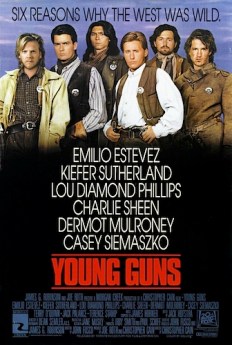 Way back in March, the ever-excellent Colin at Ride the High Country covered a series of films about Billy the Kid, including this late-’80s effort. To quote from the comments section: “I would have been in that target demographic too when I first saw it… around 20 years old or so… I wonder how it would play now to an audience of a similar age.” Well, as someone who watched it when closer to 20 than 30, I shall step up to the task.
Considering this is ‘the Brat Pack Western’, one might well expect a modernised, sanitised West; something like Wild Wild West or Jonah Hex; something rated PG-13. Instead the film seems to have begun life as a serious attempt at a Billy the Kid biography, right down to bloody violence that earns it an R in the US and even an 18 over here. This intention seems to survive — bar a music-video-styled opening, a couple of lines of dialogue, and the wailing ’80s guitar score — but how successful it was is another matter.
I don’t know about historical accuracy in this case, not knowing much more about Billy the Kid than I’ve gleaned from… well, this film, and Colin’s series. Playing loose with facts can work in a film’s favour — as many a filmmaker has noted in the past, they’re making entertainment not documentary — but it can be galling to one who knows the truth. In the way it presents events, this one feels accurate — things like characters appearing only to die immediately; the kind of thing that doesn’t sit well narratively but might be the truth. If it isn’t accurate, this is all the more dangerous: there’s a difference between changing facts so something works as a film narrative and presenting the wrong thing as the truth. 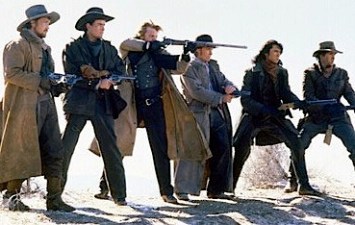 Though if someone was planning to use Young Guns to research the real-life facts of these events, more fool them in the first place. Wikipedia says (without citation) that “historian Dr. Paul Hutton has called Young Guns the most historically accurate of all prior Billy the Kid films”. We’ll leave it at that for now.
As a film in itself, then, the narrative is a bit scrappy. Our heroes wander around killing some people, racing about the country sometimes for no discernible reason and with chunks apparently missing. For instance, they head to Mexico just for the challenge of it — we’re told it’s a hard road, laden with bounty hunters out to get them — but the film cuts from their decision to make this journey to their arrival with a rapturous welcome. Eh? I have no idea if this stuff was shot and cut for time, or if someone needed to have a long hard look at the screenplay. Or even a quick glance.
The finale is also implausible. One assumes the characters who survive must have survived in reality and the others must’ve died, but the way it’s played here it doesn’t make a great deal of sense. How did they defeat those overwhelming odds? How did they pull off that escape? It might pass muster with The Hero Is Invulnerable movie logic, but not as a claim to depicting real-life events. 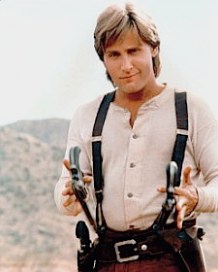 And that’s without mentioning the overuse of dated slow-motion that descends upon its eventual climax.
As for the Brat Pack themselves, Emilio Estevez’s version of Billy the Kid seems to descend during the film from above-himself hot-head out for revenge to giggling loon. This isn’t really character development, more as if halfway through Estevez realised how much fun it was to laugh and so kept doing it. Charlie Sheen gets the honour of (spoilers!) being killed off halfway through. As one of the most recognisable members of the ‘Brat Pack’, here playing the leader of the gang, it works as an effective surprise.
Kiefer Sutherland has the best part though. He’s given the only subplot that approaches anything meaningful and also almost all the best lines (not that there are many). The remainder go to Jack Palance, who isn’t around enough to create a great villain but makes a commendably good hash of it in his brief time. Equally brief is Terence Stamp’s part. I have to say I’m no fan of Stamp — everywhere I’ve seen him he seems awkwardly flat, often phoning it in — but here he’s not bad. This may be because his role’s quite small and relatively subdued as it is. Patrick Wayne appears as Pat Garrett for a knowing cameo; the kind of small role which any viewer can tell Means Something, but if you don’t know what he means there’s no explanation proffered (until the final scene, anyway, when Sutherland narrates a “what happened next” for the surviving characters).
 Young Guns is not a particularly likeable film, managing to miss both its potential target audiences: it’s not serious-minded enough for Western enthusiasts, let down by the Brat Pack cast and (it seems) historical accuracy; but it’s surely not fun or modernised enough to appeal to a younger (or younger-minded) crowd. Though clearly it did well enough as it spawned a sequel two years later. I didn’t hate it, I just didn’t particularly like it.

Young Guns is on Channel 5 tomorrow, Sunday 13th November, at 11:15pm.
Young Guns is on 5USA tonight, Tuesday 30th December 2014, at 9pm. It’s sequel, Young Guns II: Blaze of Glory, follows at 11pm.
After four years and three months doing 100 Films, this became the first new film I’ve seen which has a title beginning with the letter Y — the last unaccounted-for letter. Hurrah!
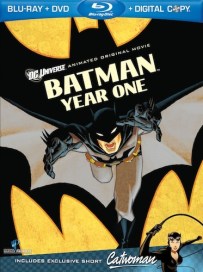 DC Comics’ latest direct-to-DVD animated movie is an adaptation of Frank Miller and David Mazzucchelli’s seminal 1987 Batman story, acclaimed as one of the greatest graphic novels of all time, and one of those that is often credited with helping the comic book medium grow up in the late ’80s.
 As with the comic, this is a very down-to-Earth version of the Batman story. It’s even less sci-fi-y than Chris Nolan’s much-praised realistic films, in fact. There’s no Batmobile, no Batcave, no Bat signal, only a few gadgets (and those that are used are fully plausible), no cartoonish super-villains… This Gotham is a city where crime comes from gangsters, drug dealers, muggers and a thoroughly corrupt police force, and that’s what Batman sets out to fight. As in the Nolan films, the costumed foes will come later, a response to the Bat himself. It’s not afraid to take its time telling this story either. Especially at the start, the pace is very measured — there’s no rush to action or to Batman, but instead a slow build of character and drama. Some may see this as a flaw — those after a Batman Action Movie, largely — but it sets the tone for what is a more character-driven tale.
 Cranston, given easily the fullest character, gives the best performance too. Star of
  Indeed, you can tell Nolan cherry-picked most of Year One’s best scenes for his version, because they’re generally speaking the ones that shine here too. (It makes me want to watch Begins again to see just how much of this made it in there.)
 Unfortunately Batman: Year One has arrived at the party a bit too late to be the definitive screen telling of Batman’s origin — by taking the best bits of Miller & Mazzucchelli’s tale and expanding it with some work of their own, Chris Nolan & friends take that title. But as a film in its own right, Year One is largely successful. Children (or childish fans) seeking animated Batman thrills may be disappointed by its slower pace and focus on character, because this is solid adult-focused entertainment.
 “Sherlock Holmes vs. Jack the Ripper” would be the easiest way to describe this pulpy ’60s effort. It’s far from the only example of this sub-sub-genre:
  and though by the end it’s explained who sent it, I was none the wiser what they’d been intending. And I watched the revelation scene twice too. Still, at least the important bit — who the murderer is ‘n’ all that — is quite neat.
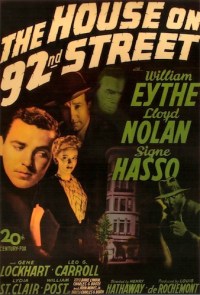 Here’s an unusual one from the pantheon of film noir. These days we’d probably call it a docu-drama, though thankfully there are no talking heads, but there is a factual voiceover narration. The story, we’re told, comes from the FBI’s files and is based on a real case —
  how they really work and investigate a case. At the time I imagine this was a fascinating procedural; now, we’re all a bit more familiar with how such things go, but it still works as an historical document.
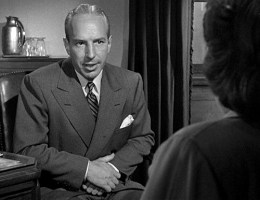 Might be because no one ever knew they were making a film noir, eh? How can you expect something to conform to a set of rules that were only defined after the fact? Hathaway and co didn’t fail at making a noir, they just made a film that doesn’t fit the later-defined template as well as the films used to define said template. I know, four words from some other online critic hardly merit a whole paragraph, but it does bug me when people write daft things like that.
 Law Abiding Citizen is a revenge movie with a (slight) difference: wronged man Gerard Butler isn’t just going after the two criminals who invaded his home and murdered his wife and daughter — he’s going after the legal system that let one of the men walk free.
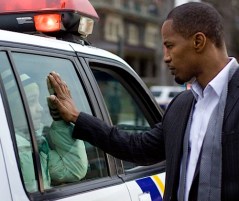 He attends the execution of the aforementioned criminal, but something goes wrong — instead of going to sleep with a lethal injection, the attacker suffers an agonising and horrific death. Someone must have swapped the chemicals. The prosecutors’ thoughts leap to the other criminal, but I’m sure we’ve all guessed who’s really behind this. And so Butler’s sprawling revenge mission begins…
 On the issue of who the film thinks is good and who it thinks is bad,
 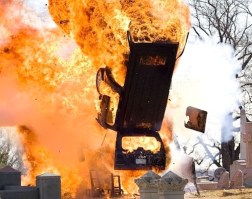 It is a little far-fetched, granted, but it’s not so outside the rules the film sets up for itself that I find it unacceptable.
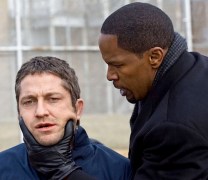 As an action-thriller that actually has something to think about wrapped up in it, I considered being a bit lenient in my score (much as I was to
  Michael Caine killing hoodies. How great does that sound? As a film premise, that’s awesome. If it doesn’t get you excited about seeing this movie, then what kind of film fan are you, eh?
 Which in some ways is quite a chilling way to feel. I’ll be buying the Daily Mail and watching Sky News next.
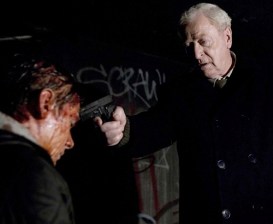 Whatever you may think of the revenge thriller it turns into, I think it’s hard to deny these early scenes have a realism and power. It is, of course, to the credit of Caine that he performs all this flawlessly. Oh yes, he’s (to quote another review) “the king of cool” when blowing away the scum that surround him, but before that he’s an affecting old gent, abandoned by the world.
 The counter to that would be that a murder spree may be viscerally satisfying but isn’t a real-world solution, so this is just as useless at relevancy as Death Wish.
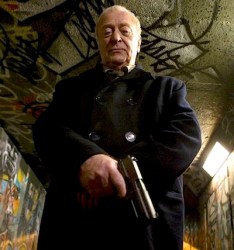 Some will think it tackles these, others that it’s just a facile revenge movie; some will think it’s cool, others despicable; some will think it plausible, others anything but. Or maybe, rather like me, you’ll think it’s all of those things, however mutually exclusive they may seem.
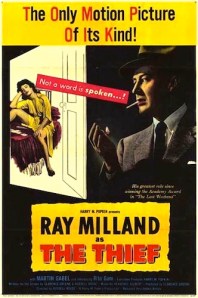 Ray Milland stars as Dr. Allan Fields, a nuclear physicist working at the United States Atomic Energy Commission, who is photographing secret files and passing them to The Other Side, until something goes wrong and the authorities are on his tail. But that’s almost beside the point, because if The Thief is known for anything it’s for its dialogue — as the poster proclaims, “not a word is spoken…!”
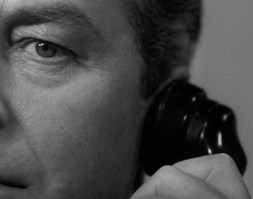 Obviously we can look back to the silent cinema for that kind of thing, but while that era could probably still teach many filmmakers something about visual storytelling, it’s hard to deny that the advent of synchronised sound adds a helluva lot to the ability of film — if it didn’t, it wouldn’t have taken over so fast and remained virtually 100% dominant for the last 80+ years.
 Perhaps this is why the villains are never explicitly named. But they’re definitely not American! Tsk tsk. More crucially, it’s a bit slow at times — it seems to take longer to explain things when stuck doing them through visuals alone. That said, it could probably have survived a speedier approach even doing what it does — perhaps, then, Rouse is playing for time: the film only runs 87 minutes in spite of its pace.
 John Carpenter’s rough-and-ready ’70s exploitation B-movie is remade as a slick ’00s action B-movie dressed up as an A-movie by director Jean-François Richet (who would go on to find far greater critical acclaim with his two-part French crime epic
 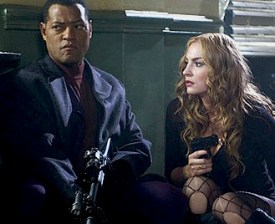 I don’t have hard timings to back this up, but I think the siege starts earlier and lasts longer here. It certainly felt that way, in part because the character of the father (whose act of revenge leads the gang to the precinct in the original) is gone. Of course, the film is about the titular assault on the titular station, so I think this refocussing is more than fair enough. It, naturally, emphasises the siege element of a film about a siege, something the original almost reneged on with its lengthy setup.
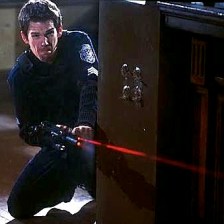 The only reason the prologue is necessary is if you want to begin your movie with an action sequence… so that’s why it there then. It’s also set in a sun-drenched summery atmosphere, totally at odds with the well-evoked wintery New Year that pervades post-titlecard. Consequently, looking back on the prologue, it feels even more out of place. I think it’s also designed to set a Gritty tone, with its rundown apartment and drugs deal and all that palaver; probably because the rest of the film is too far-fetched, if you were hoping viewers were going to be in mind of
  criminals inside the precinct are black or (in one case) hispanic. Ouch. You could try to argue we’ve developed past the need to force anti-stereotyping in casting; or you could argue this is a mainstream studio remake that felt the need to fall back on the familiar. It might not be a noticeable point were it not for it being so markedly different to the original.
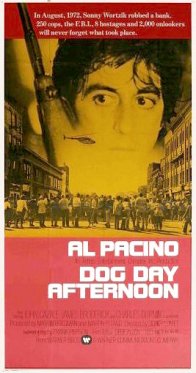 On August 22nd 1972, John Wojtowicz and Salvatore Naturile attempted to rob a Brooklyn bank to raise money for Wojtowicz’s male wife to have a sex change operation. The ensuing hostage situation was watched live on TV by millions of New Yorkers. If you made it up people wouldn’t believe it — especially in the ’70s — which is why this film, closely based on those events, strives so hard for naturalism. And it succeeds, and then some.
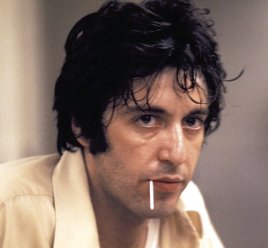 to try to circumvent built-in prejudices that would’ve adversely affected an audience’s reaction too soon. It still works now — it’s not a twist, per se, but it is likely to change one’s perspective on the film and its characters mid-flow, which is always interesting.
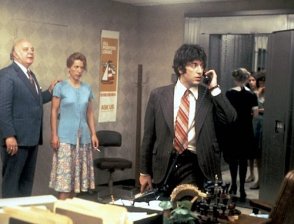 In trying to get a handle on the real Sonny when he was starting on the screenplay, Pierson talked to various people who knew him, but struggled to reconcile their conflicting accounts of the same man. The link he found was that Sonny was always trying to please people, and that’s what he used: in the film, he’s not just out for himself or his boyfriend, but also trying to placate and please his hostages, the police, the media, his partner, his mum, his other wife… Pierson and Pacino do indeed make him a different man to all of them, and this is one of the reasons Sonny is such a great character and a great performance: he’s genuinely three-dimensional. All of us behave differently, to some degree, when we’re with different people — we don’t necessarily realise it, because they’re all facets of the same us, but we do it — so to put that into a character is to make him real.
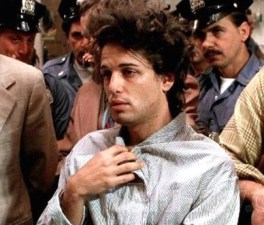 throughout the film trying to avoid turning any of these unusual characters into freaks, and Sarandon pitches it right. He plays the truth of a conflicted, confused character; a man who is perhaps easily led but hard to please, I think. As with the rest of the cast, the little touches he brings — such as starting a sure-to-be-emotional phone call to a man currently in the middle of a tense hostage situation with “so how are you?” — sell the reality of the piece.
 of today’s grainy shakycam stuff, this just feels real; the heart and truth of it come through, not the surface sheen of it being documentary footage. That’s more important.
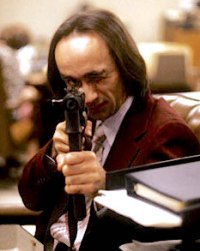 Pierson’s screenplay won at the Oscars. The film was also nominated for Best Picture, Actor, Supporting Actor and Editing, but this was the year of
  The film treads a delicate line between drama, comedy and thriller, but doesn’t once tip too far in any direction. It’s got several genuine laughs, but none compromise its serious side or claim to reality — it’s tense and touching too. Anyone else making a film about an extraordinary situation, be it a true story or from the mind of a crazed writer, would do well to look at Lumet’s work here.
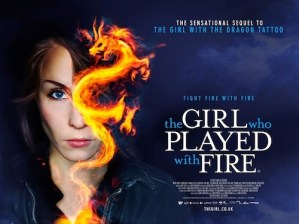 Creating any kind of sequel is hard — the endless array of failed attempts is testament to that — but I think creating a direct sequel to a successful crime thriller may be the hardest.
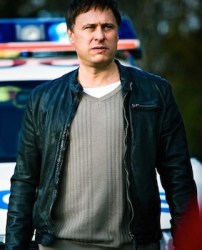 and they need a brand new case to become embroiled in. And it’s got to be as good as the last one, but it can’t be the same because we’ve had that mystery solved. You could have a different solution, of course; you could change some of the details, naturally; but police dramas on TV vary their types of murders every week for a reason. So in your new tale, the new characters have to be just as interesting as the first batch, the new mystery has to be just as intriguing too, and it really ought to be a notably different crime being investigated.
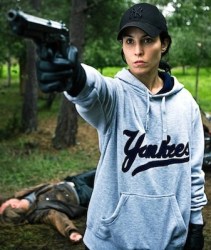 One solution to the sequel problem is to “make it personal”, and that’s exactly what we get in The Girl Who Played with Fire. A journalist and his girlfriend working for Mikael are murdered and Lisbeth is suspected of the crime. It’s somewhere around here that the coincidences begin to pile up. It makes perfect sense as a plot in itself, but in bringing Mikael and Lisbeth back together it doesn’t work — it’s not related to their previous encounter, so it’s entirely coincidental. Coincidence is a dangerous thing in fiction; it asks your audience to accept something that doesn’t fit our logic of how stories work. It happens all the time in real life of course, but in real life a flipped coin with a 50/50 chance of being heads or tails could turn up heads twenty times in a row, but a person asked to estimate twenty results of a flipped coin will never put more than two or three of one side in a row (unless they know to subvert it… look, this isn’t the point).
 it’s never seriously looked into and, consequently, other dramas have tackled the issue with greater depth, sensitivity and insight. What Mikael and Lisbeth are actually looking into is a conspiracy of sorts around some murders. The way the trail is followed isn’t as clever as it was in Dragon Tattoo and, consequently, isn’t as interesting. The two protagonists go about their investigations independently. This is a long-held technique in novel writing — multiple strands allows the author to alternate which is followed from chapter to chapter, almost by itself providing momentum and the must-keep-reading factor as the reader has to race through the next chapter to rejoin the thread of the previous one (it’s not that simple or we’d all be churning them out… but look, I’m getting off the point again). The problem here is that Dragon Tattoo was largely at its best when the two were together, so keeping them apart is less satisfying. To top that off, they’re each finding out different things, which means as the audience we can feel a few steps ahead of the characters as we have the benefit of both sides of the case. That’s not always a bad thing, but it can be slightly disconcerting when you know the answers your hero is still searching for.
 Despite Lisbeth being the focus of much of the attention laden on these books/films/remakes, she’s a less engaging character when by herself. Here she shuffles around silently, digging up files that she and we stare at to reveal information. There are only a few moments for her (and, consequently, Noomi Rapace) to show off what endeared her to viewers before — her confrontation with a pair of arson-bent bikers, for instance.
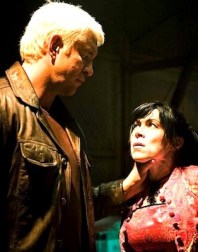 It also feels less filmic than the first film. Is it poor direction? Is it just the opened-up 1.78:1 ratio? I’ve read that all three films were shot like this, as they were intended for Swedish TV, meaning Dragon Tattoo’s Blu-ray is cropped to 2.35:1. You hardly ever see 2.35:1 on TV (
 100Films.co.uk