
Gareth Evans | 150 mins | Blu-ray | 2.40:1 | Indonesia & USA / Indonesian, English & Japanese | 18*
 I wasn’t as impressed as some were by The Raid when I finally got round to watching it two years ago — in my review I said its action was merely equal to other Asian fight flicks, asserted that Dredd had done the same story in a more rounded fashion, and compared the whole thing to Mamma Mia. To use a term that came up in my comments recently: where Mamma Mia is a chick flick, The Raid is definitely a dick flick. That’s probably why it’s taken me this long to get round to its sequel, which was at least as well-liked by the viewing public, if not more so (it has a higher rating on IMDb) — but I couldn’t trust that last time, so why this time? However, it turns out The Raid 2 is an entirely different kettle of fish.
That’s certainly true of the plot — this may be the least “just a rehash of the first film” sequel ever made. Starting mere hours after its predecessor finished, the sequel begins with good cop Rama (Iko Uwais) being co-opted into an anti-corruption internal affairs unit. It’s not just about doing the right thing, though: Rama wants a shot at Bejo (Alex Abbad), a rising criminal who murdered Rama’s brother. Rama is promptly asked to leave his wife and young son behind to go undercover in a prison with the aim of getting close to Uco (Arifin Putra), the son of powerful mob boss Bangun (Tio Pakusadewo). Unfortunately, instead of being sentenced to a couple of months as promised, Rama is given years in jail. Nonetheless, he manages to ingratiate himself with his target, and upon his eventual release is immediately granted a position in Bangun’s organisation. And, look, this is meant to be a review, not a plot summary — it all just spirals from there.
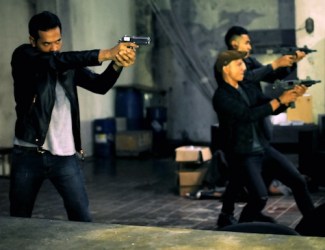 Where the first film was an efficient, simple thriller designed almost solely to link the startling action sequences, here writer-director Gareth Evans has created a sprawling crime epic. Anyone who’s seen the kind of gangster actioners Hong Kong cinema has produced since the ’80s or so will feel in familiar territory. That’s no bad thing, however, just a point of genre comparison. By expanding the world he’s created out in every direction, Evans has created a work that is not only bigger in a literal sense, but also deeper, more complex, and more interesting than the straightforward adrenaline rush of the movie that made his name.
That’s not to say The Raid 2 skimps on the action front, mind. Oh no. Far from it. If anything, the physical displays here are even greater, and certainly more varied. A free-for-all riot in a muddy prison yard brings to mind the church fight from Kingsman in its crazed frenzy; the first film’s Mad Dog, Yayan Ruhian, is back as a new character who gets a remarkable battle around a multi-level nightclub; the instantly iconic and aptly named Hammer Girl (Julie Estelle) gets a showcase on a subway car, and later double teams with her chum Baseball Bat Man (Very Tri Yulisman) to take on Rama; and that’s not even the climax, as our hero goes toe to toe with knife-wielding henchman The Assassin (Cecep Arief Rahman) in a kitchen-set rumble that has to be seen to be believed.
 But as incredible as each of those are — and indeed they are — the highest of highlights is surely the car chase. There’s a chance you’ll have heard about this even if you’re not especially interested in the film: a bit of behind-the-scenes detail about how they achieved one particular shot went viral a couple of years ago. If you haven’t seen that, nor the film, then don’t seek it out — it actually kinda spoils it a little bit, knowing how it was done. (Without spoiling it, it was all done practically, whereas a Hollywood blockbuster would undoubtedly have done it with CGI — and spent as much on that one shot as Evans and co have on this entire movie.) The sequence is more than just one technically-impressive shot, however, but an exciting and innovative action scene all round, that definitely pushed the boundaries of the filmmakers’ capabilities (they had to get in a specialist outfit from overseas to help realise their ambitions).
Those are just the highlights — there are numerous smaller but no less accomplished sequences elsewhere, too. To be precise, there are 19 fight scenes, featuring more complex choreography than the first film — and it’s one of the fight choreographers who said that, so it must be true. The two-and-a-half hour running time may mean The Raid 2 isn’t the unrelenting action-fest that the first film was, but those memorable combats are just as much a part of the film’s DNA. I don’t think anyone’s going to feel shortchanged.
From a filmmaking point of view, it’s even more accomplished. Evans demonstrated he knew how to lens action in the first movie, but here the whole movie looks more polished and more expensive (even though it only cost $4.5 million). There’s greater ambition on display in every facet, including both the choreography and the camerawork. 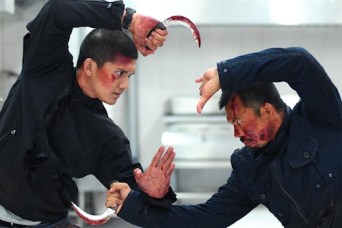 Most Hollywood blockbusters seem to push (or exceed) the two-and-a-half hour mark these days, and even when it fills that time, it feels like it’s partly because no one quite knew when to cut back. The Raid 2, however, feels suitably epic — just as you think a film that’s two-and-a-half hours long ought to feel, really.
For me, The Raid 2 outclasses its predecessor in every possible way, from the deeper and more involving story, to the jaw-dropping feats of choreography and performance, to the more assured and polished filmmaking. An instant action classic.

The Raid 2 will be available on Amazon Prime Instant Video UK from tomorrow.
It placed 2nd on my list of The 20 Best Films I Saw For the First Time in 2016, which can be read in full here.
* The MPAA insisted on 4½ seconds of cuts to get an R rating. The UK version is uncut. ^
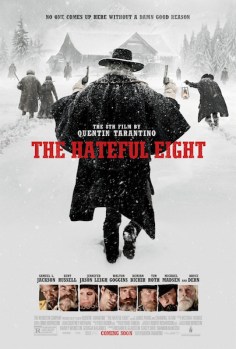 Quentin Tarantino hadn’t made a film in the same genre as his preceding movie for almost 20 years when The Hateful Eight came out — his second go-round with the Western genre, after the Spaghetti-ish thrills of
 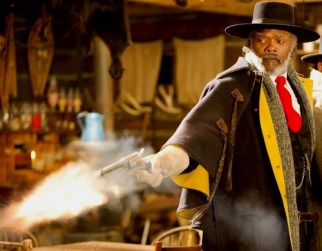 And it’s all in a remote, isolated location which has been cut off by weather, and every character is hiding some nefarious past — so far, so And Then There Were None. All of this comes dressed in QT’s famed dialogue, unfurled at the somewhat languorous pace he’s gradually been cultivating for a few movies now, and topped off with a few doses of the old ultra-violence.
 Ultra Panavision 70 produces an ultra-wide 2.76:1 frame (for those not in the know, your widescreen TV is only 1.78:1), which for such an intimate story has struck people as odd ever since it was announced. In fact, it pays off in (at least) two ways: firstly, all the scene-setting scenery looks magnificent; secondly, for a lot of the film there’s stuff going on in the background or at the edge of frame — it’s not just a series of close-ups or two-shots where the ancillary detail is either non-existent or doesn’t matter, but one where that ‘background’ detail is sometimes very instructive to what is going on. Tarantino also uses the full width a lot of the time, placing two figures at either edge of the image — this really isn’t a film you could crop (thank goodness it doesn’t exist in the pan & scan era!)
 as if to bring the point home (and that’s far from the only thing about The Hateful Eight that’s indebted to The Thing, but I’ll leave that for someone else to dig into another time). Even though this is the first time he’s had a full score composed for one of his films, Tarantino still sources a couple of well-selected songs from elsewhere, including a very apt credits track by Roy Orbison.


 Score:



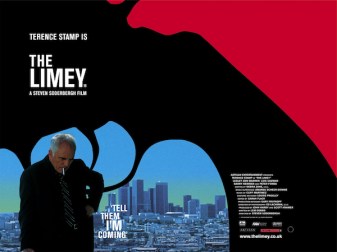 There’s an argument to be made that, from a cinematic perspective, mainstream US cinema these days is boring. Look at the kind of films American auteurs were producing in and around the studio system in the ’90s and early ’00s:
  This isn’t a conceit Soderbergh uses for one scene, or wheels out now and then, but an overall approach. Some sequences are more thick with it than others, but it’s always right around the corner. It creates a unique sensation. Not disconcerting, exactly, but mysterious and querying. It has you constantly question what you’re watching — is it a memory? A plan? A fantasy? A delusion? It draws connections back and forth across the timeline of the story, bringing out thematic angles. At its most key, it helps explain what happens at the end (too bluntly for some reviewers, I should add). This collage-like style — which unlike, say, Memento’s back-to-front narrative has no obvious in-story point — will certainly not be to everyone’s taste, but it presents an interesting challenge to our usual ideas of how a film should be constructed.
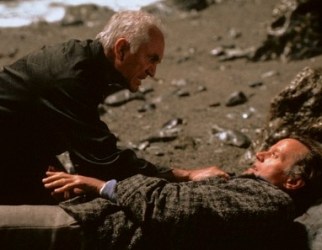 Despite the visual trickery, The Limey still works pretty well as a straightforward thriller. You have to be prepared to accept the slippery editing, because there’s no avoiding it, but the throughline of Stamp tracking down bad men and how he deals with them is still here. Personally, I’ve never much rated Stamp as an actor, but somehow he fits here. He’s a fish out of water, a man out of place — way out of place — and possibly out of time, too, seeming like a ’60s or ’70s British gangster transported to turn-of-the-millennium L.A. It’s no discredit to the supporting cast that they mainly exist to bob around in his wake.
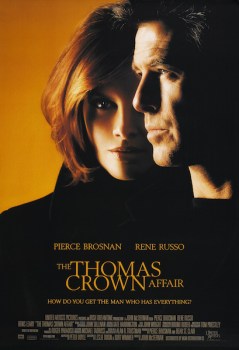 Once upon a time, John McTiernan was an action auteur, known for films that sat comfortably on the “mainstream modern classics” scale, like
 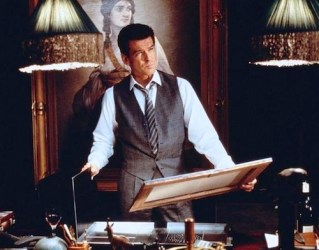 McTiernan’s action background comes to the fore in a pair of extended heist scenes at either end of the movie, which are surely the standout parts. The seductions and plot twists in between these bookends are certainly entertaining and may even keep you guessing, but it’s the heists that pack the most entertainment. They’re the kind of thing we don’t see so much nowadays, at least not in mainstream movies, because any sequence designed to provide excitement is a fight of some kind, and most of those are shot in the shaky-cam style. There’s none of that palaver here, just perfectly choreographed cutting between the various players in each heist, and some well-chosen music — as if being ably to do awesome stuff accompanied by the James Bond Theme wasn’t cool enough, here Brosnan gets to do the same to Nina Simone’s Sinnerman.
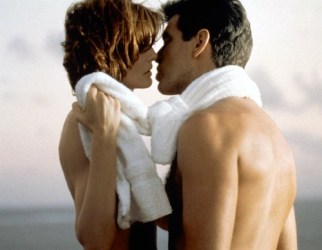 The Thomas Crown Affair may not be the best film on any of its principals’ CVs (well, except perhaps for Russo’s), but it’s a consistently enjoyable light thriller with a couple of particularly memorable sequences and a fun central dynamic. Apparently it’s better than the original, too. There’s long been talk of a sequel, but it seems to have gone the way of McTiernan’s career, which is a shame.
 If you hadn’t heard of Veronica Mars before 13th March 2013, you almost certainly did soon after. That’s the date Rob Thomas, creator of the six-years-dead
  There’s no denying that this is primarily a film for fans of the TV series — well, they did fund it, after all. The best way to get the most out of the film is to have watched all 64 episodes of the show first; preferably soon before, in fact, so you can remember who all the minor characters are. However, creator-cowriter-director Rob Thomas is no fool: you don’t produce a successful movie that continues a little-watched TV show by making it a requirement that you’ve watched 64 hours of TV first. (I mean, Joss Whedon knew that with
 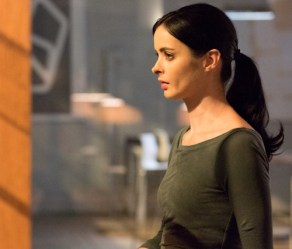 school who weren’t actually in the TV series, which might give you a flavour of how it works both for fans and newcomers. The case itself isn’t a bad mystery, but at the same time it’s a little subservient to the other goings-on. I suppose you could argue this is really a comedy-drama about a woman reconnecting with her past life and past friends, and she just happens to have a murder to investigate at the same time.
 To bring up Firefly/Serenity again, I think there’s a reasonable parallel between how those relate to each other, and how they can work for newbies, and how Veronica Mars the TV series and Veronica Mars the movie relate. To wit: in an ideal world, you’d watch all of the series and then the film; but TV series can be long commitments, and for a spot of ‘dipping your toe in the water’, you can also start with the movie and go back to the series for the full picture. Sure, some things are going to be spoiled doing it that way round — but hey, not everyone who’s in the series but not the film ends up dead, I promise.
 More than just a nostalgia trip for people who were there first time round, the movie is a strong addition to the Veronica Mars canon — as someone who didn’t discover the series until the Kickstarter campaign, I thought the film was a heck of a lot of fun, and a wonderful capstone to a mostly-great series. That said, there’s plenty of room for further cases… someday… hopefully…



 After the success of
 I appear to be coming at director Ben Wheatley’s films in reverse order (having covered
 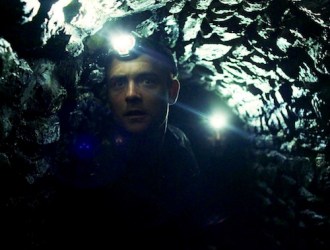 Kill List mixes in its genre elements — and they’re elements from a couple of different genres at that — so gradually that, as I said, it’s hard to discuss them without spoiling the film. (Much like the film itself, this review is getting progressively more revealing, so jump off when you’ve had enough.) It’s kind of a compilation of traditional British movie genres: we begin with kitchen sink, then discover we’re actually watching a crime film, before the final act swerves (though not without foreshadowing) into folk horror. The skill of Wheatley, and his co-writer Amy Jump, is in not making these transitions too implausible. That’s not to say they’re not surprising, but the doom-laden music, inexplicable proclamations by some characters, and a couple of very strange events should all clue the viewer in to the film not being a common-or-garden hitman flick.
 The final act is naturally where the film reveals its overarching purpose… or rather doesn’t reveal, because there are a shortage of answers here. It’s a lot more straightforward than A Field in England, but it still offers few (or, some would say, no) explanations for what’s occurred. According to Wheatley, the screenplay was more explicit about what was happening and why, and so was some of what they shot, but he cut back on the exposition to leave it up to audience interpretation. This isn’t a film to passively watch and have everything explained, but even viewers prepared to do a little work for themselves may find it frustrating.
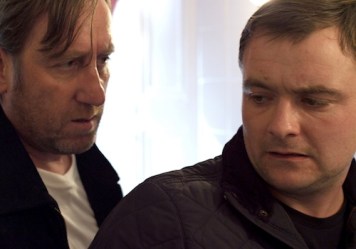 Memorable sequences keep it ticking over throughout — and so they should: taking inspiration from the likes of Kubrick and Stephen King, Wheatley started from specific images and worked backwards to a plot. Here, I think that method has been effective. The abstruse ending won’t be to everyone’s taste, but the journey there is worth experiencing.
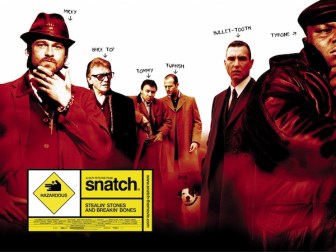 Guy Ritchie’s second feature met with relative indifference 16 years ago, consensus deeming it
  100Films.co.uk