2011 #71
James Gunn | 96 mins* | Blu-ray | 1.85:1 | USA / English | 18 / R
 If Kick-Ass was the fantasy version of “ordinary man becomes superhero” then Super is the hard-hitting, suitably-silly, ‘real’ version. And it’s not often you get to describe a film in which God rips the roof off a house, reaches down with anime-inspired tentacles, slices open a man’s head and plants an idea in his mind — literally — as “hard-hitting” and “real”.
It stars The Office’s Rainn Wilson as odd diner cook Frank, whose wife (Liv Tyler) leaves him for a local drug dealer (Kevin Bacon). Inspired by a cheap TV show starring Christian superhero the Holy Avenger (Nathan Fillion) — and the aforementioned finger of God — Frank sets out to fight crime as costumed hero the Crimson Bolt. Researching power-less heroes at the local comic shop, Frank meets Libby (Ellen Page), whose equal weirdness leads to her helping him and becoming his sidekick.
Super seems ready-made for cult status. Not in the self-conscious way of something like Snakes on a Plane, but in the genuine way of a film that’s quirky and different. It’s a comedy, but one with brutally realistic violence and visions of demons and faces in vomit. Unlike Kick-Ass (the blatantly obvious point of comparison, not least because they were made and released around the same time), 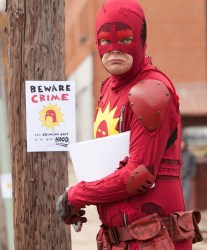 which moves fairly swiftly into the fantasy of being a successful superhero, Super stays quite grounded. The ending allows itself to be a little more triumphantly heroic, but not far beyond the bounds of realism (unlike Kick-Ass).
It emphasises the likely real-life difficulties of being a ‘superhero’. Frank has to get out books on sewing to make his awkward patchwork costume; he goes out on patrol, only to find no crime whatsoever; when he finds out where the drug dealers are, he gets beaten up; other crime he fights include “butting in line” (or, as we’d call it on this side of the Atlantic, queue jumping) or car-keying; and half the people recognise Frank despite his mask. No mob-level gangsters played by Mark Strong here.
Realism is the overriding principle throughout, from characters to dialogue to acting to fighting to direction. Obviously Frank’s visions (the tentacles, the demons, the vomit-face) are extremely not-real, but as representations of his mental delusions thy get a pass. Gunn’s direction has a rough, ultra-low-budget feel, yet can be quite stylishly put together when it needs to be, suggesting he’s made a choice rather than isn’t capable of something slicker. It’s even more effective at making the film seem real-world than the usual Hollywood handheld-and-grainy schtick that passes for realism.
Gunn says that his film is “about the deconstruction of the superhero myth. Who is Spider-Man or Batman? We assume that they are heroic characters but,  really, they are deciding something is right and something else is wrong”. The psychology of superheroes has been a factor to one degree or another for decades now, not least the Batman films making the parallel between the hero and his villains, but the difference in Super is it’s not a parallel — it’s primarily the heroes who are messed up. The villains are criminals and quite nasty at times, but they’re mostly quite normal. They may deserve their comeuppance, but wisely — and interestingly — they’re not over-written or over-played to heighten them to the level of the psycho-hero. The Crimson Bolt is a sledgehammer to crack a nut, even more so than Batman in Begins or (of course) Kick-Ass. Those two are at least going up against the top of big organised crime; Crimson Bolt just faces a local drug dealer.
The heroes are disturbed even outside their chosen vocation: Frank has weird visions, odd catchphrases, extreme reactions to relatively trivial things; Libby is secretly ultra-violent, gets off on their costumes, etc. Gunn says the film asks if it’s “psychotic for someone to put on a mask and a cape and go out and battle what they perceive as being ‘evil’?”, but I don’t think it sets out to specifically psychoanalyse these people. Still, it makes clear how barmy you’d have to be to give the superhero thing a go yourself. That said, Gunn argues that “I don’t think [Frank] necessarily is crazy.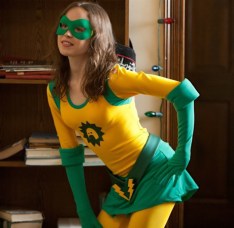 Super is about a troubled human being and his relationship with faith, morality and what he perceives as his calling… I think that is part of why we gave him Ellen Page as a sidekick — because her character, Boltie, actually is insane. The Crimson Bolt is not doing what he does because he enjoys hurting people but Boltie is and that is the difference between the two of them. It starts to become a concern when you enjoy the violence.”
A great cast brings these factors out with ease. Wilson does deranged hero well, not overplaying the comedy side of it. Page is suitably hyper as Libby, capturing a particular facet of The Youth of Today perfectly (again). Bacon is a fantastic villain, not so much menacing or psychopathic as just… I don’t know. That’s almost why it’s so good: it’s hard to say where he’s gone with it. Also worth singling out is Michael Rooker, playing Bacon’s top henchman, Abe. It could have been quite a basic henchman part, but he makes it more with expressions and line delivery (certainly more that than the lines themselves). He’s the only one on the villain’s side who realises the Crimson Bolt might actually be a threat. You kind of want him to cone through in the end, to turn good and live; but he does his job, which is probably truer.
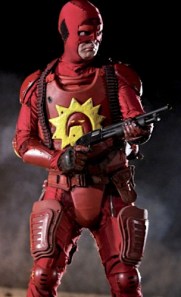 For all its grounded reality, Super lets loose in the final fifteen minutes, creating a punch-packing sequence that’s the rival of any comic book movie. It’s emotionally-charged action, all the more powerful for its semi-amateur-ness and realistic brutality. It climaxes in a face-to-face between our hero and the villain which is as good as any you’ll find in such a film. Is it revelling in the extremity of its violence? You might argue it is, but I don’t think it’s celebrating its gore so much as the triumph of its hero. And that’s followed by a neat epilogue, which I won’t reveal details of but is a kind of ending I’ve been wanting to see for a while.
Between the comedy, the ultra-violence, the rough edges, the slick climax, the characters’ silly catchphrases, the well-worded climactic face-off, you could argue Super has an uneven tone. I would disagree, as would Gunn: “I agree that the structure and tone of this film is very atypical… I enjoy films that surprise me and which are not formulaic and take twists and turns that I do not see coming. My life doesn’t roll along to just one ‘tone’ — one day it might be a comedy and the next a tragedy”. I’ve said in the past and I’m sure I’ll say it again: I wish more po-faced dramas would realise this.
All the technical elements come together to support the film’s main thrust. There’s a great soundtrack, mixing some choice bits of score by Tyler Bates, finding the appropriate quirky tone generally but adjusting to an action vibe for the climax, with an obscure selection of songs that seem well-chosen but not too heavy-handed. As an example, it includes  a decade-old track by Sweden’s 2007 Eurovision entry (they came 18th of 24. Don’t laugh — we were joint 22nd). And, despite the low budget, there’s great special effects. The tentacles are the rival of any big-budget movie; the blood and guts are all gruesomely realistic, not filmicly censored or reduced or cheaply fake; handdrawn-style Batman “kapow”s (etc) are very effective. The title sequence, in a similar style as the latter, but with a dance routine, is also a ton of fun.
So, to the big question: is Super better than Kick-Ass? I’m not sure. Personally, I loved them both. Some people will hate both, perhaps for different reasons. Gunn acknowledges there’s a definite connection: “I understand why people keep mentioning Kick-Ass… but let me clear this up. I wrote the script to Super in 2003 and worked on it for a long time… I think that the similarities are apparent, but I still wanted to get this story out there. I think what works in our favour is that people think it looks like Kick-Ass on the outside but when they see it they realise that we are less cartoonish and maybe a little more unpredictable.”
I certainly agree that it’s to Super’s advantage that it’s quite different to a regular film; more uniquely styled than Kick-Ass’s mainstream aims. Indeed, as Gunn also says, “I think that so many movies today try to be everything to all people and I’m a little sick of it. Super is not for everyone. It is for some people.” And for the people it’s for, I think it’s exceptional. If you were to compile a list of the greatest superhero movies, I believe Super’s unique style and perspective — plus its excellent climax — would earn itself a place right near the top.
Super is on Sky Movies Premiere from tonight at 12:15am, continuing all week.
Super placed 5th on my list of The Ten Best Films I Saw For the First Time in 2011, which can be read in full here.
All quotes taken from an article by Calum Waddell in Judge Dredd Megazine #313.
* I first watched Super on the UK Blu-ray, where it runs 92 minutes thanks to PAL speed-up. The US BD (my second viewing) runs the correct 96. Image quality was better too, I thought, though if you’re considering a purchase do note it’s Region A locked. ^

 Pixar have always attached original short films to their feature releases. As part of what seems to be their increasing franchisation, however, they’re not always wholly original now: Hawaiian Vacation was the short attached to Cars 2. And it’s the first in a series of Toy Story shorts: the second, Small Fry, appeared in cinemas before The Muppets; the third, Partysaurus Rex, comes with Finding Nemo 3D later this year.
 Hawaiian Vacation doesn’t exactly allay these fears — its very existence is proof of that — but at least it’s an entertaining piece in its own right. It succeeds partly by not overreaching itself — this isn’t Toy Story 4 and it doesn’t try to be. It reminds us of the characters and gives them each a story beat, while remaining funny, entertaining and sweet, all in under six minutes. Cars 2 can’t manage that in 106.
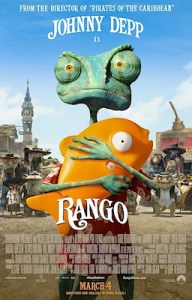 There seem to be an increasing number of live-action directors sticking their oar into animated films; and not just lending their ideas and name, as Tim Burton did with
 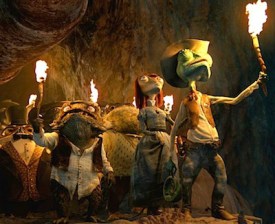 Indeed, perhaps the most striking thing about Rango is ILM’s hallmark, the extraordinary realism. Though some of the characters are rendered cartoonishly (just look at Rango’s face) and all are of course anthropomorphised, the textures and lighting are as true-to-life as any of their work in live-action movies. They consciously went for a photographic look, as if it had been shot with real cameras, including consultation with Oscar-winning cinematographer Roger Deakins, and it paid off because the whole thing looks incredible. I know I only just recommended it in the last paragraph, but the making-ofs are really great for an insight into why the film looks and feels so different to most current computer-animated films. The sequences of them recording performance reference are incredible — they essentially shot some scenes in full, with the entire cast, in costume, with full props, some sets, blocking, marks, camera angles, improvisation… (The only thing lacking on the Blu-ray is a
 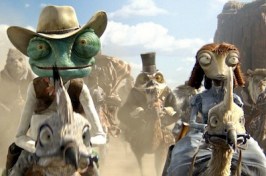 Back to the film itself. I know it’s less interesting, and it is far too slow at the start, but when it eventually gets underway it becomes very entertaining. Somewhere in the middle there’s a five-minute wagon/bat chase that’s a properly exciting action sequence, excellently realised. It was so good I watched it again immediately afterwards. It’s got a clever use of Wagner too, as well as some regular Hans Zimmer action scoring. Zimmer’s score throughout is top quality, referencing Morricone and all the other staples of Westerns.
 The plot, however, is clearly borrowed from
  With its detailed references to other films and real-world visual aesthetic, Rango may be more likely to find appreciation among grown-ups than the children who are the typical target for English-language feature animation. Then again, there’s that immature humour I mentioned. A ‘family’ film indeed. Either way, it’s an entertaining addition to — and alternative from — American animation’s usual offerings.
 Pixar, oh exalted studio of wondrous excellence, who produce naught but critically-acclaimed and audience-beloved films that may as well just be given the Best Animated Feature Oscar without the need for fellow nominees, dropped the ball with
 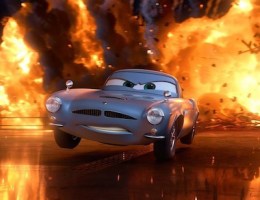 here we get an international spy movie — much more fun. The espionage stuff is clearly inspired by Bond (the primary secret service is British, for starters), and the opening eight minutes — an action sequence starring the film’s Michael Caine-voiced Bond analogy — is probably the best stuff in either Cars movie. Actors like Caine and Emily Mortimer lend the whole affair some much-needed class.
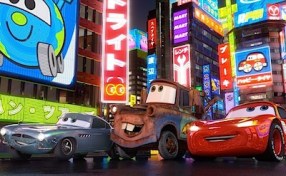 the back-and-forth battling, the last-minute surge, etc etc — so it’s not really any loss.
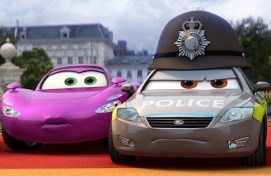 why is the police car wearing a giant hat?!
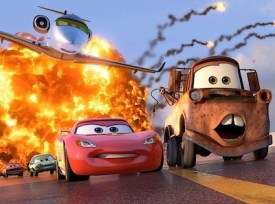 entertaining films, how can they also produce something so uninspired?
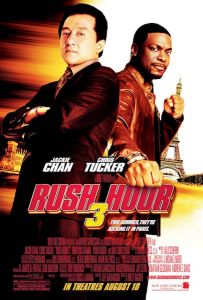 Belated sequels are often the worst kind, an actor/director/studio returning to past glories in the hope of creating new success. Even when they work, they’re not a patch on the original. (I’m sure there must be exceptions, but nothing comes to mind.) The third entry in the
 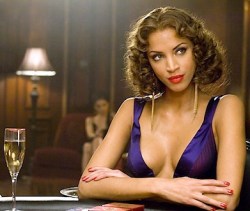 It’s ostensibly a thriller (albeit a comedy-action-thriller) and so there are plot twists, but they’re wholly predictable. It also lacks clarity in its villain, I felt — who it is, what they’re doing, why they’re doing it, and so on. It weakens the film, especially the ending: there’s the usual big action climax, followed by a little bit of business that dilutes the impact of the ending. It’s just badly structured.
 plus some sparing atop the Eiffel Tower (or, I presume, a surprisingly good set thereof) — is occasionally spectacular and single-handedly almost justifies the entire film’s existence. A car chase/fight through the streets of Paris is the other best bit, buoyed by both unusual choreography and Yvan Attal’s French taxi driver George, who’s probably the film’s best character.
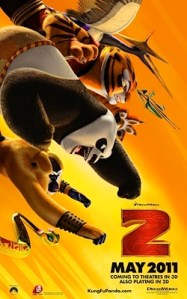 The first
 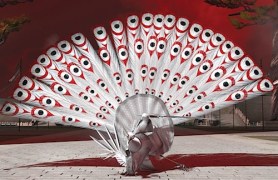 Thirdly, it has Gary Oldman as a villain. That should be wondrous, but it isn’t. He’s fine. Gary Oldman villains aren’t fine, they’re classic characters. But no, this one’s just fine. I guess he needed some cash.
 Hopefully the inevitable third entry (this ends with a very obvious setup for where the series will go next) can regain some more of the first film’s magic. As things stand, I found Panda 2 to be a fairly decent 90 minutes — though, saying that, a slightly slow one — but not one that came close to the numerous joys of its forebear. Disappointing.
 Sometimes you watch one of the most acclaimed films of all time and find yourself with very little to say about it. La Règle du jeu — or, as it’s commonly known in America thanks to Criterion’s incessant title translation (in fairness, that’s probably the most sensible way to combat the mass attitude of “argh! it’s in Foreign!”), The Rules of the Game
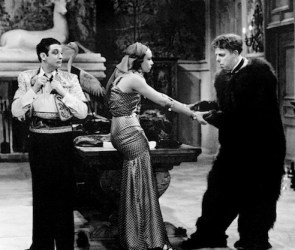 There’s a lot packed in, and I can see how multiple viewings could reveal even more going on. Perhaps a better researched awareness of the period (beyond the obvious Eve Of War, though that’s important) and of French class structure at the time is necessary to get the full richness of Renoir’s vision. The fact it was banned by the French government due to being bad for morale, then also banned by the occupying Nazis, suggests it did have a lot of social relevance.
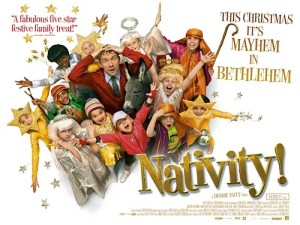 Yes, this is exactly the kind of review I should be posting in April. But hey, it’s Easter! That’s about Jesus too, right? (It’ll have to do, I’m not hanging on ’til next Christmas.)
 No one promised grim social realism — it’s a Christmas family film, with some moral messages and a sort of romance and sweet kids and a cute dog. And regular readers know how much I love a cute dog.
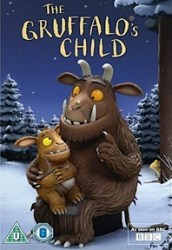 Shown on BBC One over Christmas, this animated adaptation of Julia Donaldson and Axel Scheffler’s The Gruffalo’s Child is the sequel to the Oscar-nominated adaptation of Julia Donaldson and Axel Scheffler’s The Gruffalo (of course). For my money, it’s every bit as good as the first film.
 Apparently MySpace had some hand in the creation of this movie. Remember MySpace? It’s what there was before Facebook. It was always rubbish, it just took a lot of people a long time to realise that. Anyway, some reviews seem to dwell on its involvement in the production of this movie —
  Most of the cast is drawn from the pool marked “British character actors” — you may or may not know the names, but you’ll probably know most of the faces. The lead is Eddie Marsan (Lestrade in
  100Films.co.uk