The Room (2003)

2018 #81
Tommy Wiseau | 99 mins | download (HD) | 16:9 | USA / English | NR / R
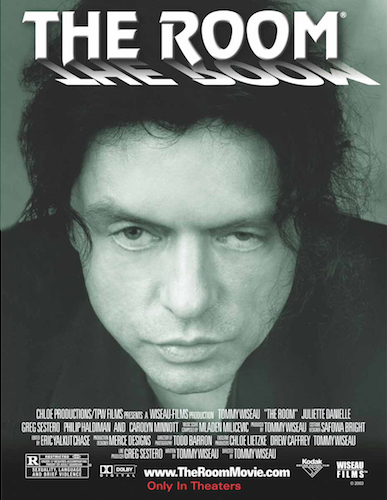
The Room

I did not enjoy it, it’s not true, it’s bullshit, I did not enjoy it, I did naht!

Oh hi reader.

You’ve heard of The Room, right? Well, if you hadn’t before last year’s awards season, you probably have now, thanks to James Franco’s fictionalised account of its making, The Disaster Artist. I can’t remember when I first heard of The Room, but it was certainly after it had already gained a reputation among some people for being (as someone once put it) “the Citizen Kane of bad movies”; the kind of movie where its fans attend midnight screenings in costume, shout out phrases, throw items in the air, and all that palaver.

Ostensibly the story of the relationship woes of twentysomethings in San Francisco, there is nothing wrong with The Room… for the first two minutes. Then Tommy Wiseau enters a room and opens his mouth. There are no words to accurately describe Wiseau — he has to be witnessed to be believed. From there out, the film is so distractingly ridiculous that it’s easy to forget what any of it is supposed to be about. For the first half-hour it feels like they’re making a soft-core porno: the plot seems designed purely to facilitate sexual encounters (at one point a couple walk into a room and start getting it on before we’ve learnt anything else about them), most of which last several minutes to the sound of cheesy pop music (though they’ve cut out any explicit bits, so don’t go watching it just to get your jollies).

Room for a threesome?

From there, stuff just… happens. Characters come and go at random (three actors quit the project midway through shooting, so Wiseau sometimes just invented a new character rather than reshoot existing scenes); subplots about nothing pop up now and then; and people generally behave like no human being has ever behaved. Production values are all over the place, like the sets: many are amateur-theatre-level under-designed, yet some scenes take place on a rooftop where the view has been green-screened in fairly well. It’s also awfully misogynistic… but when it’s so awful generally, does that even matter? And yet some parts almost transcend the horror: the scene on the rooftop after they save Denny from being shot is like fucking poetry, with all its repetition and… stuff. I mean, it’s really bad poetry… but really funny poetry.

I guess some people would say you have to watch The Room at one of those cinema screenings packed with die-hard fans to get the most out of it, but they also say that about Rocky Horror and I’ve never found that to be true. Of course, Rocky Horror is actually a good film, whereas The Room is only entertaining because of how bad it is. The full 99-minute experience is a bit of a drag at times, waiting for the really funny bits to roll round, but the level of incompetence is so consistent that it remains fascinating throughout.
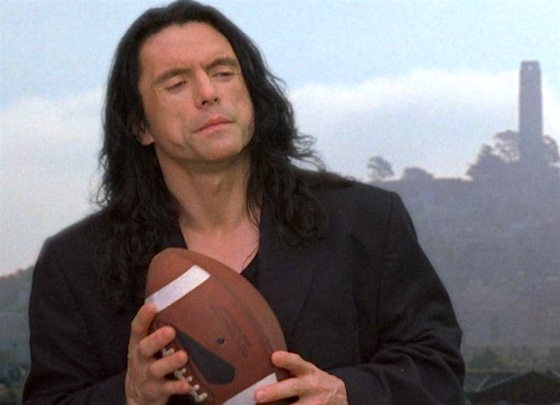
A real human being?

However, that does make it almost impossible to rate accurately. As what it sets out to be — a serious drama about the love lives of a group of friends — it’s irredeemably awful. But that’s not why we watch it. As a so-bad-it’s-good film to laugh at… yeah, it’s pretty funny. And as that’s why I watched it, that’s how I’ll mark it: for the level of enjoyment I got out of it, irrespective of what was intended.

4 out of 5

James Franco’s dramatisation of the making of The Room, The Disaster Artist, is on Sky Cinema from today. My review is here.
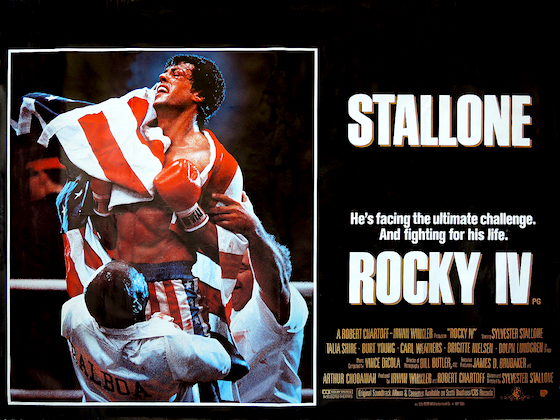
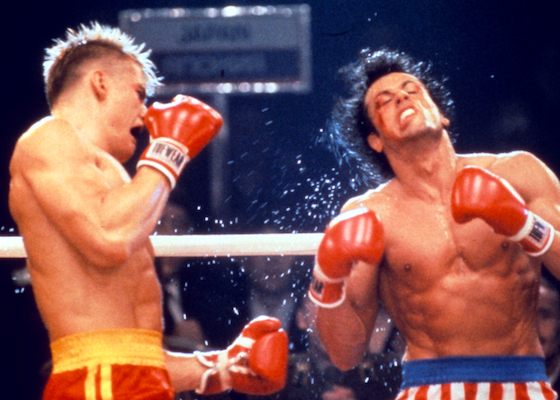
Rocky IV (1985)

2018 #152
Sylvester Stallone | 92 mins | Blu-ray | 1.85:1 | USA / English & Russian | PG / PG

Rocky IV

Rocky goes a bit Rambo for an instalment that abandons the series’ early gritty social realism roots in favour of an anti-Soviet propaganda cartoon tone. And, in fact, it was released the same year as First Blood Part II, which actually marked Rambo’s shift from being about a vet with PTSD to an “America, fuck yeah!” action series. What was up with Stallone in ’85?

Anyway, back to Rocky. This time, his opponent in the ring is Ivan Drago (Dolph Lundgren), a poster boy for Soviet superiority and their advanced training methods. With Drago’s team harping about his brilliance, Rocky’s friend Apollo Creed (Carl Weathers) elects to come out of retirement to fight him and prove America’s supremacy. But the fight goes sideways, setting up a grudge match between Drago and Rocky.

Interpreting a sports movie as really being about the conflict between the USA and the Soviet Union might normally be considered subtextual analysis, but that’s not the case here — it couldn’t be more blatant. Sometimes this is as hilariously preposterous as you’d expect (Rocky’s victory speech is greeted by a standing ovation from the Soviet politburo!), but other bits actually work quite well. Take the sequence before the Creed-Drago fight: on one hand it’s a ludicrously OTT musical number; on the other, that’s the point, as shown by Drago’s confusion at the flashy spectacle going on around him, intercut with his wife’s exasperated sighs. It’s the mentality of the USA vs. the USSR encapsulated in a glitzy floorshow vs. a heavy frown.

USSR in the back

This isn’t the only bit of music in Rocky IV, though. Oh no. Far from it. Halfway through, the film basically stops dead for the sake of a music video montage of scenes from all four movies. It’s meant to signify a moment of introspection for Rocky, but it goes on for the length of an entire song. And that’s certainly not the only montage. Oh no. Far from it. At one point there’s a training montage… followed by another training montage. It’s like a spoof of itself.

And I haven’t even mentioned the robot that Paulie receives as a gift, which seems to have an AI. No, seriously. Later, he gives it a woman’s voice and refers to it as “his girl” while it delivers him beer and plays its favourite song. No, seriously.

Some people were trying a bit harder than writer-director Stallone, though. There’s a good supporting turn from Brigitte Nielsen, giving off Lady Macbeth vibes as Drago’s wife — she’s like his voice, doing all the talking in America while he just glowers around as a silent hulk of muscle. Carl Weathers is also given some good material as a Creed who’s miserable when out of the limelight, jumping at the chance to revive his fame — he revels in the renewed attention, even if it might mean his death.

Rocky IV is not a good film, but between the so-ridiculous-it’s-fun bulk and the genuinely good flashes, it’s certainly entertaining.

3 out of 5


And now, a special bonus review…

Rocky VI
(1986)

aka Rock’y

2018 #152a
Aki Kaurismäki | 8 mins | streaming | 1.85:1 | Finland / English & Finnish

Rocky VI

An early work from Finnish director Aki Kaurismäki (one of those world cinema names I recognise but couldn’t tell you a single film by), Rocky VI is not, in fact, the sixth entry in the Rocky franchise, but a short parody of the fourth one (the Roman numerals in the title being an inversion of the real film’s IV, obv.). Kaurismäki described the short as “my revenge on Mr. Stallone, who I think is an asshole.” Don’t hold back, Aki, tell us what you really think!

The film is basically all a music montage — so that’s quite accurate, then. In it, weedy little American Rock’y fights burly bushy-browed Russian fatso Igor. Rock’y spends several rounds getting absolutely pummelled, eventually falling over dead without Igor having to throw a punch. And that’s the end.

It’s too slight to be especially funny, with nothing to say other than “hey, wasn’t Rocky IV just pro-American propaganda?”, which I think we all knew. Really, Rocky IV is a better parody of Rocky IV than Rocky VI is.

2 out of 5

My Life as a Courgette (2016)

aka Ma vie de Courgette / My Life as a Zucchini

2018 #3
Claude Barras | 66 mins | streaming (HD) | 1.85:1 | France & Switzerland / English | PG / PG-13

My Life as a Courgette

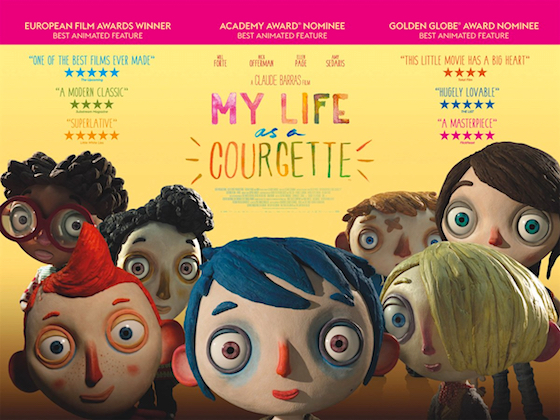
My Life as a Courgette (or, to use the American name for the vegetable, Zucchini) is the story of young lad Icare — who prefers to be called “Courgette”, his mother’s nickname for him — and his life after he is taken into an orphanage. If you’ve heard of it, it’s most likely because it was nominated for Best Animated Feature at the 2017 Oscars.

It’s adapted from the novel Autobiographie d’une Courgette by Gilles Paris, which was apparently a realistic portrayal of the lives of orphans in France. As you can see, the film takes a more cartoonish style, at least on the surface. In fact, the whimsical production design belies the very serious nature of the story — it’s not as monumentally grim as it could be, given the subject matter, but it doesn’t shy away from some very dark areas. It handles these with an understated, calm maturity that is both befitting and refreshing. The animation itself is equally sophisticated, with innumerable little touches that add finesse and richness to the work.

Orphaned

I watched the English dubbed version, because Amazon Prime gave me no choice (the original French version is available on Amazon Video, but for some reason not also included with Prime). Fortunately, despite having a US voice cast, they stuck with “Courgette”, meaning there’s no constant annoyance of the main character being called the wrong thing. (I do wonder, though: did they have to record it all twice, or did the American release rename the film My Life as a Zucchini but then call the kid Courgette anyway?) Fortunately, the dubbing wasn’t at all bad. Of particular note is Nick Offerman, giving a remarkable restrained performance as the gentle and kindly cop Raymond. As for Courgette and his fellow orphans, I don’t know if they cast actual kids or used adult soundalikes, but they also provided uniformly strong voice work.

My Life as a Courgette is one of those “weird foreign animations” that often manages an Oscar nod but doesn’t stand a snowball’s chance in Hell of winning thanks to the conservativeness of Oscar voters — there’s no way a mature, restrained animation with a quirky visual style is going to beat the latest shiny-CGI fun-time from Pixar or Disney. For those with broader tastes, however, it’s definitely worth a look.

4 out of 5

The Past Month on TV #37

Another later-than-usual TV review, because my TV viewing was affected by the same stuff that’s seen my post count plummet this month, as well as kept this month’s film numbers down (more on that on Saturday). Consequently, I waited until I’d actually watched enough TV to make this post somewhat worthwhile…

Although, despite what I said in last month’s “next month”, I still haven’t watched Lost in Space. Maybe next month (but don’t count on it).

Disenchantment  Season 1
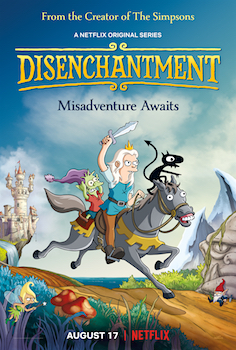
DisenchantmentThe first new series from The Simpsons creator Matt Groening in almost 20 years, Disenchantment is a riff on the fantasy genre. It follows the misadventures of Princess Bean of Dreamland, a rebellious sort who prefers to sneak out of the castle and get drunk in the pub than… well, do anything else. In the first episode, she and we are introduced to her personal demon, Luci, and Elfo, an elf who has left his happy-clappy kingdom to explore the misery of the wider world. This trio form the heart of the show, though naturally there’s a wider ensemble to help fuel storylines.

You may’ve heard the series has come in for a bit of a drubbing from critics, which I’m not sure is wholly fair. It’s not the most consistently funny show, with background gags sometimes providing bigger laughs than the main stories or situations, but it raises chuckles with decent regularity. It’s also not the most original concoction on TV, with some familiar characters and relationships, just grafted onto a fantasy setting. Although at least it has the good sense to create its own fantasy world, rather than being a direct spoof of, say, a certain other show that has brought the genre widespread attention. Whether it’s set in a fully-realised world or one the writers are creating on the fly, I’m not sure, but there’s a lot of room left to explore.

But even if it’s not hilarious or groundbreaking, the first season builds up a nice little rhythm as it goes along. The weakest episodes are undoubtedly the first few, which are somewhat swamped under setup. After a few standalone stories in the middle — which vary in quality from some of the season’s best instalments to, well, not — things begin to come together for a highly serialised run at the end, which finds a use for many disparate bits from those standalone episodes, and all culminates in a cliffhanger. Fortunately, Netflix’s original commission was for twice as many episodes as are in this first run, so we’re guaranteed a second batch. This serialisation works better for a streaming show than completely standalone episodes, although Disenchantment thankfully doesn’t lose sight of being consumable in episode-sized bites.

So, while it may take most of the season to truly warm to the characters and for the series to find its groove, it does get there, and suggests brighter things in the future. Whether it will ever attain the cult following enjoyed by Groening’s other series is arguably a long-shot (can lightning strike thrice?), but it has potential.

Hang Ups  Series 1 Episodes 1-3
Hang UpsLoosely based on the US series Web Therapy, this new sitcom stars Stephen Mangan as Richard Pitt, a therapist offering his services over the internet. The filming style (each client only appears for a few minutes per episode, popping up now and again throughout the series, always via webcam) allowed them to attract a rather phenomenal supporting cast, including the likes of David Bradley, Charles Dance, Celia Imrie, Richard E. Grant, and David Tennant. The way each episode pingpongs around the various clients and Richard’s many, many personal problems (his marriage, his kids, his parents, his siblings, his bank balance) makes for a whip-crack pace that has pros and cons — each episode seems to disappear in a flash, having at once both dashed through some plot and also gone nowhere. Partly this is the result of an abundance of characters — some of the clients are basically one-off sketches, which is fine, but the regulars’ stories can only advance in small increments. I’m left wondering if it might’ve actually worked better with less going on. Still, the quality cast means characters do get rounded out speedily, and when it works it can be pretty funny.
Also watched…
  • The Comedy Lineup Season 1 Episodes 2,5,8 — Netflix’s series of 15-minute standup sets from up-and-coming comics. Naturally, that means the quality is varied. I only watched a semi-random sampling, and some were very good and some were pretty weak. A new batch of episodes is released tomorrow.
  • Magic for Humans Season 1 Episodes 1-3 — I love a good magic show, and this Netflix series is definitely a contender. Magician Justin Willman’s cheeky-chappy persona may grate with some viewers, but his tricks — a mix of hip variations on old standards and wonder-inducing new stunts — are dazzlingly effective.
  • Mark Kermode’s Secrets of Cinema Episodes 3-5 — So good (see my review from last month) that they’ve decided to keep it on iPlayer for a whole year. No word on a second series, as far as I’m aware, but fingers crossed.

    Things to Catch Up On
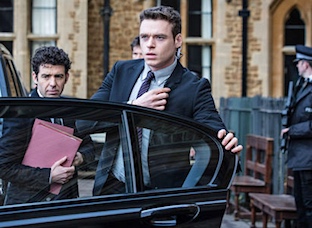
    BodyguardThis month, I have mostly been missing Bodyguard, the new BBC One thriller from Line of Duty creator Jed Mercurio that premiered with a two-day double-bill last weekend. It seemed to go down well, based on the ratings and what I saw on Twitter (while avoiding spoilers!) As usual, I intend to wait until the whole series has aired (or most of it, at least) and then whisk through the lot.

    Next month… everyone’s least favourite Marvel Netflix show returns. But there’s a new showrunner and a lower episode count, so fingers crossed Iron Fist feels worth the 10-hour investment this time.

  • Conquest Program No.9

    2018 #158a-d
    30 mins | DVD | 4:3 | USA / silent (English)

    Conquest Program No.9 advertisement

    We all know the cinema experience of today: 20 minutes of TV adverts that we’d fast-forward at home but have no say in on the big screen, followed by 10 minutes of movie trailers that we’ve already watched on YouTube, and, finally, the film we’ve paid to see. But back in the day the theatrical programme was less unedifying, with short films of various stripes preceding the headline film (hence the term “feature film”, obv.)

    For her DVD release of the 1917 feature Kidnapped (more about that in my review here), Fritzi Kramer of Movies Silently was able to source the four short films that were bundled with it as part of “Conquest Program No.9”. The Conquest Programs were the idea of distributor George Kleine and created by Thomas Edison’s film company. Eleven were created in all, each one bundling together a feature film and a mix of shorts to create a complete bill of wholesome entertainment. By specifically recreating Program No.9, the Kidnapped DVD doesn’t just offer an approximation of what a night at the movies in 1917 might’ve been a bit like, but rather a genuine was-definitely-shown-in-theatres programme from the time.

    Friends, Romans and Leo

    The programme opens with a twelve-minute comedy short, Friends, Romans and Leo, directed by Alan Crosland, who also helmed Kidnapped, and featuring several of the feature’s leading players too. It’s a bit of Roman farcing about, concerning an “emperor” who’s so in debt he lets the moneylender marry his daughter rather than call in the mortgage on his garage. I’m sure that’s exactly how Roman politics worked. Then, an unwanted and useless servant is cast into the gladiatorial ring to face the hulking Brutal Brutus, and also Leo, a man in a lion costume… er, I mean: Leo, a lion. This bit, at least, has some amusing pratfalling. It’s not big (it’s a short film, after all), it’s not clever (characters speak in a mix of Olde Worlde English (“thou hast been good to me”) and modern slang (“that’s a twenty-karat rock, girlie!”)), and it’s not particularly amusing to today’s eyes either, although the second half is at least diverting enough. Certainly, a grown man titting about in a lion suit has its own kind of charm.

    Up next is a seven-minute “fairy tale in silhouette”, Little Red Riding Hood. I’d assumed it was going to be some kind of puppet animation job, but no, it’s live-action shot in silhouette, presumably for a kind of stylistic, picture-book-ish look. This means we’re treated to another man in an animal costume — the wolf, of course — but this outfit is less good than Leo’s, something even the silhouetted visuals can’t hide. The short rattles through the traditional story with no significant variations, which feels a little quaint viewed from the vantage point of over a century later. That said, it does include this immortal line: “It must be grandmama for it is her cap, but how very strange this bad cold makes her look!” Because people can always be identified by their caps, and colds make you look like a wolf.

    Little Red Riding Hood

    Talking of quaint, that clearly wasn’t a concept alien to 1917 audiences, as the third short implies. Titled Quaint Provincetown, it’s a seven-minute travelogue about a quiet little seaside town and its almost throwback way of life (even for 1917!) A series of lifestyle scenes rather than a narrative documentary, it’s a fascinating window into the past, which arguably makes it the most interesting of these films for the modern viewer. That said, how much of it was captured actuality and how much was staged, who knows — for example, at one point we watch a couple of boys have a fight in the street while their friends egg them on, which you feel the filmmakers can’t’ve just happened upon. Still, kids, eh? I guess some things never change.

    Finally, Microscopic Pond Life is a four-minute look at… well, what it says on the tin. This is, broadly speaking, stuff we’re nowadays familiar with from a young age thanks to science lessons and whatnot, but I imagine it must’ve been quite incredible to see these minuscule organisms in action for the first time. You’re not going to learn a lot of detailed scientific information from a 100-year-old short like this, but it remains a fascinating glimpse of the tiniest of lifeforms.

    Microscopic Pond Life

    Viewed today, this selection of short films is, at worst, an insight into a time long gone — one of the nearest experiences we’re likely to get to time travel. At best, the films themselves retain some inherent interest and entertainment value. As Fritzi puts it in her booklet accompanying the DVD, “the ninth Conquest program is not filled with hidden masterpieces, just good solid programmers that would have entertained the average American audience in 1917.” Very true, and fair enough.

    3 out of 5

    Read my review of Conquest Program No.9’s feature film, Kidnapped, here.
    The DVD is now available to purchase from Amazon.com.

    Christopher Robin (2018)

    2018 #180
    Marc Forster | 104 mins | cinema | 2.39:1 | USA / English | PG / PG

    Christopher Robin

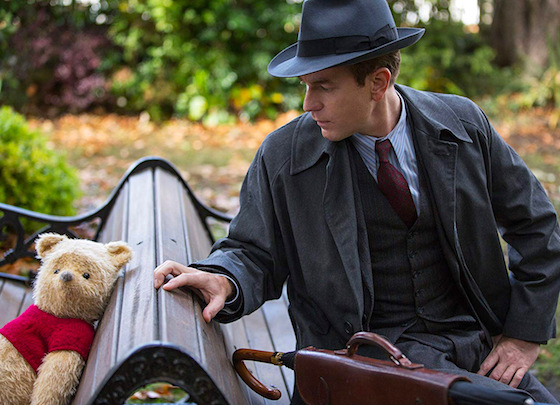
    Disney appear to have found a rich seam to mine for box office gold when it comes to live-action remakes of their most popular animated properties. Some have been variations different enough to almost stand on their own two feet; others have been straight-up remakes, because why mess with success. Christopher Robin is, perhaps, the most original so far. There have been many Winnie the Pooh adaptations down the years, as well as original movies and TV series featuring the same characters, so rather than remake any of those, here Disney have set about telling another brand-new story (although it begins with an adaptation of one of A.A. Milne’s very best Pooh stories, which is nice). This new tale justifies its live-action form by moving beyond the confines of the Hundred Acre Wood; and it also, smartly, trades on our own childhood nostalgia for the silly old bear.

    We all remember Christopher Robin as a small boy, but small boys grow up, and now Christopher (Ewan McGregor) is an adult in post-war London with a wife (Hayley Atwell) and young daughter, Madeline (Bronte Carmichael). He works for a luggage company that is facing the prospect of firing most of Christopher’s team, unless he can find 20% of cuts; so instead of going away with his family for a nice weekend in the country, he must stay and work — again. With both his personal and professional lives on the brink of collapse, Christopher is very stressed.

    Pooh in the park

    Meanwhile, in his childhood playground of the Hundred Acre Wood, Winnie the Pooh (a convincingly cuddly CGI creation, given voice by Pooh’s regular performer, Jim Cummings) awakens one morning to find all his friends are missing. Deeply concerned, he wanders through the door through which Christopher Robin used to appear, and finds himself in London, where who should he bump into but his old childhood friend — now all grown up and serious. But Pooh is still a childlike innocent, of course (don’t worry, they haven’t given him a Ted-style makeover), and maybe that attitude is just what Christopher needs.

    Having said they haven’t made Pooh into Ted (thank goodness — I like Ted, but that really isn’t the spirit of this franchise), there’s more than a little whiff of Paddington here. It’s not the exact same plot, but the overall theme — of a naïve but good-hearted bear arriving to help humans overcome their problems with kindness — is certainly similar. Indeed, many beats of the story that unfolds are familiar — the climax is somewhat borrowed from Mary Poppins, for example; and you’ll know how every subplot will end as soon as it’s introduced. For some viewers, this will render the film pointless and clichéd. For others… well, it’s not really the point.

    The joy of Christopher Robin is it takes those recycled elements and filters them through the prism of Pooh. If you too loved Pooh as a child, or an adult, then Christopher’s journey to rediscover that connection is relatable and supportable. And it’s simply a delight to spend time with the characters, as Pooh casually (and accidentally) dispenses heartfelt wisdom that both delights and, occasionally, may even cause you to think.

    Tigger on the loose

    The other denizens of the Hundred Acre Wood do pop up too: miserable old Eeyore (Brad Garrett) stole the show for the audience I watched with; Tigger (also Cummings, after test audiences objected to Chris O’Dowd’s English-accented take on the character!) is as exuberant as ever; and Piglet (Nick Mohammed) remains the voice of caution and cowardice, and as sweet as ever. As “the main ones”, those four get the most to do in the story, but there are also appearances from Rabbit (Peter Capaldi), Owl (Toby Jones), Kanga (Sophie Okonedo), and Roo (Sara Sheen) to complete the set; and with actors that good providing the voices, they make their mark.

    But, really, this is all about Pooh. Well, Pooh and Christopher Robin — the title’s not inaccurate. For those who don’t feel a connection to the bear of very little brain, I guess the familiarity of the narrative he’s part of in this film will drag down enjoyment — this, I presume, is why the reviews have been somewhat mixed. But, in my opinion, a little Pooh goes a long way — as Christopher says, he may be a bear of very little brain, but he’s also a bear of very big heart. The combination makes for a film that is amusing, sweet, and thoroughly delightful.

    4 out of 5

    Christopher Robin is in UK cinemas now.

    Zatoichi and the Doomed Man (1965)

    aka Zatôichi sakate-giri

    2018 #157
    Kazuo Mori | 78 mins | Blu-ray | 2.35:1 | Japan / Japanese

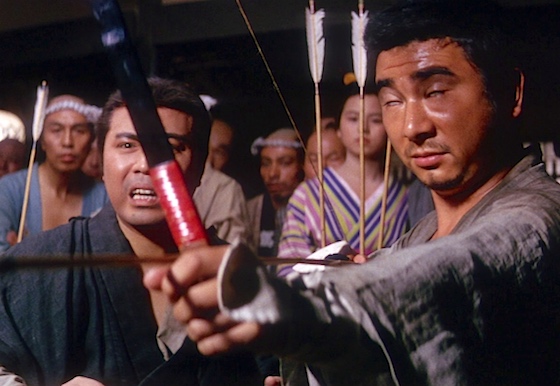
    Zatoichi and the Doomed Man

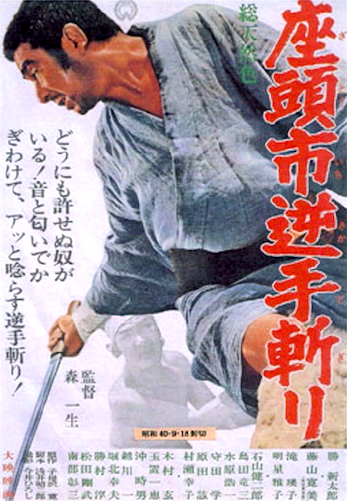
    The eleventh film in the Zatoichi series is perhaps the first one that could legitimately be described as bad. It’s not outright terrible, but the plot doesn’t hold together very well, and there are only a couple of redeeming scenes.

    The first of these is at the very start, when the film opens on the striking image of Ichi receiving lashes as punishment for an initially-unspecified crime. They seem almost a minor inconvenience to our hero, however, who is more concerned with questions he has for his punisher about this cellmate of the previous night. It turns out he was the eponymous “doomed man”: a fellow who’s been incarcerated on a murder charge, but claims he’s innocent, and urges Ichi to track down the gang bosses who can vouch for him. Uncharacteristically, Ichi resolves not to help, but fate has other plans…

    That reliance on fate to marshal Ichi around led me to dub this Zatoichi and the Coincidental Coincidences of Coincidence. He’s constantly stumbling back onto the film’s plot even when he tries to avoid it, or bumping into the people he needs to find, or bumping into people who happen to be connected to other people he happens to know. It’s easily the most poorly-constructed story of the series so far. That’s not limited to its dependence on coincidence, either: half the stuff it sets up doesn’t even pay off or come together in a reasonable fashion. Although the initial “wrong man” setup is enticing, rather than do anything interesting or different with that, it just turns out to be the series’ usual: some bosses have betrayed the chap as part of a scheme to control the area. And to rub salt in the wound, we learn about this in a scene where one conspirator explains what they’ve already done to his co-conspirator. Oh dear.

    Shenanigans

    It’s a very slight story — not even enough to sustain the brief sub-80-minute running time, it would seem, as we’re ‘treated’ to an array of unrelated shenanigans. The primary one is a young man who starts following Ichi around, then later impersonates the famed blind masseur for financial gain — and, supposedly, for comic effect. He’s played by Kanbi Fujiyama, who (according to Chris D. in his notes accompanying Criterion’s release) “was a noted funnyman in mid-to-late-sixties Japan, appearing in sidekick roles in many of Toei studios’ ninkyo (chivalrous) yakuza films.” Reading other reviews, a lot of people seem to find his schtick hilarious, but I thought he was the most irritating comic relief character the series has yet foisted upon us — and he’s basically the co-lead of this instalment, so we get to see far too much of him. He eventually turns out to have a connection to the main plot too, which is emblematic of the whole movie: the connection is a complete coincidence, dumped on us via random exposition late in the game, and then not paid off in any way. It’s entirely pointless. At one point he disappears from the film entirely. Due to how it was handled, I began to wonder if we were meant to infer he’d died off screen. But then he turns up again in the epilogue, as it merely to confirm that wasn’t the case.

    That stands in opposition to the film’s main plot — you know, the titular one about the “doomed man” — which is resolved offscreen while Ichi’s already going on his merry way. It’s just one aspect that feels rushed (despite the short running time and ‘comedy’ distractions), or as if scenes were deleted. This is particularly noticeable as it pertains to the female interest, Oyone (Eiko Taki). Ichi rescues her thanks to a little trick she pulls, but then she seems ungratefully indifferent to him… until she’s suddenly hanging around near the end, hoping (as the women in these films always do) that he won’t run off while her back’s turned. Which is exactly what he does, of course.

    Zatoichi with the doomed man

    You may remember I said there were some good bits. One is the pre-titles, which I already partly discussed. They’re effective thanks to some strong photography from Hiroshi Imai and the way they flip around with our expectations to create mystery (even if the reason Ichi’s receiving those lashings is completely irrelevant to the rest of the film). The other is the finale. As usual, the movie climaxes with Ichi having to take on an army of goons single-handed, but this one adds some spice with a seaside location, strewn with fishing nets (which get brought into the action) and covered with an early morning sea mist. It’s also beautifully shot, and there’s nicely choreographed combat. It’s easily the highlight of the film.

    Other reviewers are not so harsh on The Doomed Man, going so far as to call it a “fine entry” in the series, or “thoughtful [and] hilarious”. And yet, those reviews can’t seem to help spotting the flaws in spite of themselves. Walter Biggins’ review at Quiet Bubble is a series of questions about why the film is so poor, with the last query being the most baffling of all: “why, despite all this opacity all my questions, did I end up liking this movie so much?” I’ve no idea, mate. Several other reviews make comments along the lines of, “Ichi behaves uncharacteristically here, but there must be a good reason for that” — or it’s just crappy, inconsistent writing. At least Letterboxd users agree with me: it’s ranked 24th out of the main series’ 25 films (the only one lower is the 23rd film, Zatoichi at Large — which, incidentally, is by the same director).

    “Here's the end of the plot — go give it to someone and get this over with!”

    For me, The Doomed Man is by a clear margin the weakest Zatoichi film so far. As nowadays I very much look forward to my regular appointments with Ichi, being so underwhelmed left me feeling disappointed: it wasn’t worth the wait since the last film, nor was it really enough to tide me over until the next one. For those reasons I considered giving it a lowly two stars, but that felt a bit harsh: it certainly isn’t without merit (the climactic fight is a stunner), and it’s always nice to spend time in Ichi’s company, even if he is being inconsistently written. Nonetheless, it only earns that third star by the skin of its teeth. This is a “for completists only” instalment.

    3 out of 5

    When Harry Met Sally… (1989)

    2018 #77
    Rob Reiner | 95 mins | streaming (HD) | 1.85:1 | USA / English | 15 / R

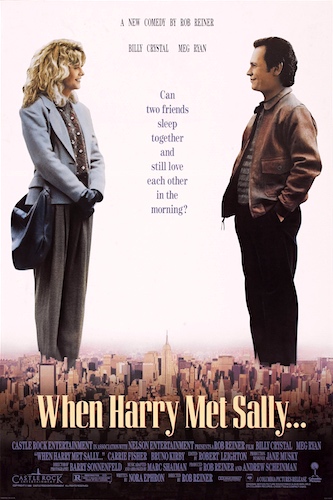
    When Harry Met Sally...

    Written by the queen of the romcom, Nora Ephron, When Harry Met Sally is almost a deconstruction of the genre: its titular protagonists are just friends, but (the film asks) can a man and a woman ever be ‘just friends’? It perhaps feels like a dated question today, when almost 30 more years of gender equality have pushed heavily towards the answer being “yes, of course”, but that doesn’t matter for two very good reasons: first, the film still stands as an insight into the nature of relationships in the ’80s and ’90s; and second, it’s just a really good film.

    It begins in 1977, when Harry (Billy Crystal) and Sally (Meg Ryan) are recent graduates who meet through a mutual friend. They soon go their separate ways, and then the film catches up with them in 1982, and again in 1987 — and that’s just act one. It’s an interesting opening gambit to chart the pair’s backstory. It dodges the usual romcom thing of people who’ve just met falling instantly in love, but also does more than introducing us to two friends and telling us “they’ve always been friends” — it shows that friendship. I don’t think I’ve read anyone else talk about this part of the film, I guess because it really ‘gets going’ in the ’87 segment, but I think it’s an interesting way of beginning things, and gives a different grounding to the relationship drama we then see unfold.

    It’s an immaculately constructed film all round, both on a macro and a micro scale. For the latter, there’s a single-take four-way phone call between the two protagonists and their respective best friends that is a thing of beauty (and apparently took 60 takes to get right!) It also manages to make New Years and Auld Lang Syne feel relevant to the plot, rather than just an obvious big occasion on which to set the finale. That’s a neat trick to pull off. Even the seemingly-random interludes showing interviews with long-married couples have a pay-off at the end that, once again, reiterates my point about how put-together this is.

    Just friends...?

    On that macro scale, it again subverts the usual romcom structure simply by having the characters be hyper-aware of the possibility they could sleep together, and regularly discussing whether they should or will. They’re not just bungling through this relationship, happening to fall into all the usual clichés, like so many romcom characters before and since — instead, they’re actually thinking their way through it, aware of the pitfalls. And yet they fall into some anyway, and the film does sometimes follow predictable structure and does hit some of those clichés — but it always manages to make them ring true.

    This truthfulness — about male-female friendships, mainly — is probably the film’s biggest asset. Is it still accurate about those dynamics almost three decades later? Despite what I said earlier, maybe it is. And even if it isn’t, I reckon it was bang on point for the ’80s and ’90s, and isn’t that enough? It tells you about the time it was made, even if it doesn’t tell you about today. It all adds up to mean that, when the inevitable happens at the end, it doesn’t feel like an obvious outcome, but something earned and emotional.

    4 out of 5

    Killing Gunther (2017)

    2018 #83
    Taran Killam | 93 mins | streaming (HD) | 1.85:1 | USA / English, German & Spanish | 15 / R

    Killing Gunther

    Do you ever have that feeling where you want to watch a film but you don’t want it to be anything too demanding or important? I do. I’ve watched (and subsequently reviewed) plenty of films with that underlying motivation. Killing Gunther is the latest that absolutely fits that bill. I had paid it absolutely no heed whatsoever until I happened to see a trailer that looked moderately amusing. Bolstered by a Rotten Tomatoes pullquote that described it as “a very affectionate take on the [hitman action] genre, so it’s much easier to overlook its shortcomings if that happens to be a genre that you’re a fan of,” I decided it was worth a punt.

    Framed as a mockumentary, it’s the story of a hitman (Taran Killam) who sets out to kill the world’s greatest hitman, Gunther (Arnold Schwarzenegger), and assembles a team of oddball fellow hitman to do so. Unfortunately for them, Gunther is so damn good that he’s always several steps ahead.

    As a comedy, I thought it was funny. Not always super original or absolutely hilarious, but ticking enough. As an action movie, some of the single-take assassination scenes are done quite well. It was clearly produced on a low budget, so the action sequences don’t really fulfil on an adrenaline-junkie level, but they work decently in context.

    Gunther vs... that other guy

    For Arnie fans, it’s worth noting that he doesn’t actually turn up until over an hour into the movie. Put another way, he’s not in 72% of the film. Really, it’s just an extended cameo. It would’ve been a neat surprise if his appearance was a secret, but the whole marketing campaign is based around him (which makes sense, but still).

    If you hate mockumentaries, or indie comedies with more ambition than budget, or are coming just to see plenty of Arnie, then Killing Gunther is one to skip. If the concept and style appeals, however, it’s a decent 90 minutes for a lazy evening.

    3 out of 5

    Review Roundup: 15-Rated Comedies

    You don’t have to be an adult to like today’s reviewed movies, but… you do have to be a teenager. Still being a teenager would probably help you enjoy them, too.

    In today’s roundup:

  • Airplane II: The Sequel (1982)
  • Hot Tub Time Machine (2010)
  • Sausage Party (2016)


    Airplane II: The Sequel
    (1982)

    2018 #17
    Ken Finkleman | 81 mins | DVD | 16:9 | USA / English | 15* / PG

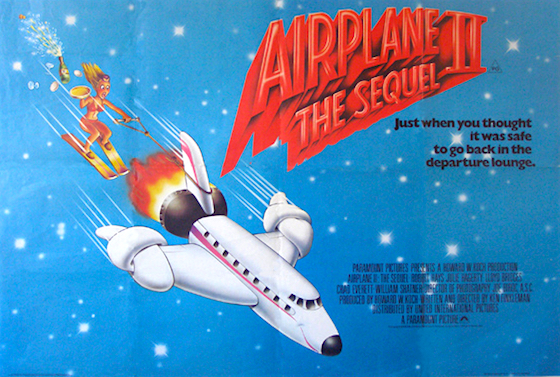
    Airplane II: The Sequel

    Comedy sequels are a funny business. Generally the first film’s been a big enough hit that people want to cash in, but can lightning strike twice? Well, the number of comedy trilogies (or more) suggests the answer is “yes”… or at least that enough people liked the first one enough that they went to see the second one and, regardless of what they actually thought of it, that persuaded people there should be a third.

    Airplane is widely regarded as one of the best comedies of all time. There is no Airplane III. Those two facts might suggest something about Airplane II — though it’s a film which even included a gag in its title, so it’s off to a good start.

    Watched now, over 35 years after its release, Airplane II has a certain vein of humour that hasn’t aged well. Ha ha, those two men kissed like they were a couple! Ha ha, that priest was looking at Altar Boy magazine like it was Playboy! Ha ha, everyone has to slap an hysterical woman! At least one of those gags would probably get you fired from a directing job at Disney nowadays… But to focus on those is to pick on the film’s weak points. Another would be that it has a few too many rehashes of jokes from the first one. Well, what comedy sequel doesn’t? That aside, much of the rest is pretty darn funny.

    3 out of 5

    * This was rated PG on its original theatrical release, but that was cut. The uncut version has consistently been rated 15 on video. ^

    Hot Tub Time Machine
    (2010)

    2018 #51
    Steve Pink | 97 mins | streaming (HD) | 1.85:1 | USA / English | 15*

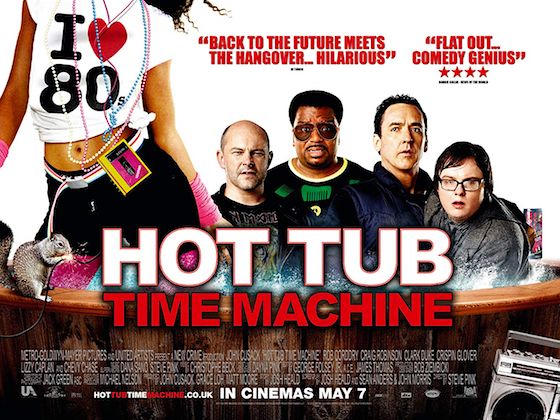
    Hot Tub Time Machine

    I don’t know why I felt the need to watch Hot Tub Time Machine. Maybe just because it found its way onto my 50 Unseen list back in 2010 (I guess people talked about it at the time. Has it lasted? I don’t think so). Maybe because it’s got “time machine” in the title and so the sci-fi implication draws me in, especially as a Doctor Who fan. I don’t know. Whatever, it’s been vaguely on my radar for the past eight years and, when I wanted something undemanding one Friday night, its time finally came.

    As the title implies, it’s about a hot tub… that’s a time machine. Four dudes get in it and find themselves in the bodies of their ’80s selves. Except for one who wasn’t born at the time, who just finds himself in the past. Yeah, the logic of it is really shaky.

    Nonetheless, it actually has a couple of solid thematic and plot ideas buried away, to do with fate and second chances and stuff, but those are mired in execution that’s both derivative (of both Back to the Future and stuff like The Hangover — and, I swear, I hadn’t seen the quote on the above poster when I wrote that) and often unfunny (unless you really like that lowest-common-denominator gross-out stuff). There are some genuine laughs, but they’re infrequent enough that they might just’ve been accidents. Another part of the problem is that for the eventual pay-offs to work you need to be invested in the characters. The film makes half an attempt to give us reasons to care about the guys, but they didn’t connect for me. Maybe if that worked better, the later stuff would land too.

    I didn’t hate Hot Tub Time Machine — it was passably amusing for a time-filler — but it wasn’t great either. My score errs on the harsh side, because I definitely liked it less than other movies I’ve recently given 3 stars.

    2 out of 5

    * I watched the extended “unrated” version, hence no MPAA certificate. It’s less than two minutes longer (comparison here), with no material that would challenge an R rating. ^

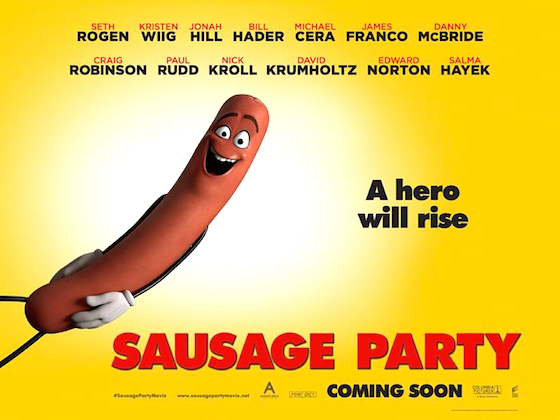
    Sausage Party
    (2016)

    2018 #37
    Greg Tiernan & Conrad Vernon | 85 mins | streaming (HD) | 1.85:1 | USA & Canada / English | 15 / R

    Sausage Party

    A movie about sentient food that parodies the inherent stupidity of religion — I mean, what’s not to like? Well, it’s from the minds of Seth Rogen, Evan Goldberg, and co (Jonah Hill as a story co-credit), so if you don’t like their kind of humour…

    Certainly, it’s incredibly rude and crude — even more so than they’d necessarily intended: they were so certain they’d get an NC-17 rating from the MPAA that the version they submitted included some extra extreme material, the hope being that would act as a distraction so that what they actually wanted in the film would pass as an R. However, the MPAA only insisted on one relatively minor change. I imagine that was to the massive, long, graphic orgy scene. There are no words for it. And yet, it only got a 15 over here — you really have to be very extreme to get an 18 these days, huh? Or maybe it’s just because it just involved food…

    For all the eye-watering content, at least the film has the good grace to also be quite witty and clever at times. I guess some of the ‘satire’ is a bit on the nose, but it works for what it is. I mean, no one comes to a film like this expecting subtle social commentary, do they? And if the analogies for religious belief are a bit on the nose, well, maybe that’s what it takes to get through to those people…

    4 out of 5