
Tom Hooper | 113 mins | Blu-ray | 12 / R
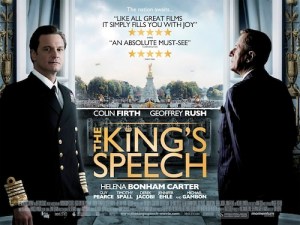 Britain seems to be having a grand time of it at the Oscars of late — following Slumdog Millionaire’s triumph two years ago, the last ceremony saw this scoop all the major gongs (and that’s not to mention the other films that have gained isolated noms and wins in the past couple of years). Considering, as someone said recently, there’s no such thing as a “British film industry”, that’s not bad. But award wins mean diddly-squat in the long run — look at the number of classic films and acclaimed directors who’ve never won — so is The King’s Speech actually worth it?
The core of the film, the screenplay, is excellent — dramatic, funny, truthful. It won Best Original Screenplay… but surely it was an adapted screenplay? It’s so grounded in real events, based (at least in part, or so I thought) on the real man’s diaries and the book that was in turn based on them. When the Adapted Screenplay nominations include films loosely inspired by short films and semi-spin-offs from TV series that don’t even feature many of the same characters, never mind actually adapting their source for the big screen, surely something like this is definitely adapted? Who knows… or, frankly, cares — it’s still good, that’s what matters.  And if the authors of the book missed out on an on-screen credit, at least they’ve had plenty of tie-in promotion (including a featurette on the Blu-ray).
Hooper’s direction is fine, good even, but it’s no Social Network. Fincher was robbed there. At least he’s in good company. Hooper’s one of those directors (who seem to have emerged recently) who sometimes frame their actors small with a lot of empty wall around and above them. I don’t like this one bit. Stop it. Otherwise, I don’t think he has a distinct style (and that awful type of shot certainly isn’t distinctly his anyway). I’m not saying it needs to be obviously, batteringly A [Director]’s Film to deserve best direction — indeed, one can go so far down that route that it definitely doesn’t deserve the award — but Hooper’s work doesn’t hold a candle to Fincher’s refined style.
The headline win, though, was Colin Firth for Best Actor. I think it’s fair to say there was an element of It’s About Time about him taking it, but unlike, say, Scorsese’s win for The Departed, this wasn’t just a lifetime achievement award dressed up as a real one — Firth equally earnt it with this performance alone. Taking on the part of a stammerer is always a tricky job, and does play into the Academy’s fondness for actors playing at being disabled or impaired, 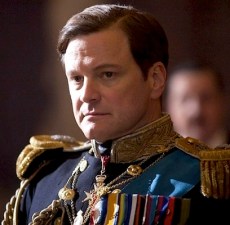 but Firth presents a much more convincing stammerer than you usually see (I have this on good authority from someone who knows several stammerers). It’s not just the Oscar bait element he nails though, as he also brings truth and gravitas to the rest of the role. It’s a complex part — he’s a man who has the throne unexpectedly thrust upon him, at a transitional time for the monarchy, as the nation is launched into one of its most difficult periods.
While Firth garnered all the praise, co-lead (not just Supporting Actor) Geoffrey Rush has been a little more overlooked. It’s a subtle turn but it’s the relationship between the two men that really makes the film. It’s easy to see how such an unshowy part was missed in some quarters during awards season, but Rush is wonderful. Rounding out the leads, Helena Bonham Carter seems to be returning to the heritage roles of her early career, but the more alternative path she’s carved since then lends an edge to the forthright but supportive spouse. It’s interesting to keep in mind the image we have of the Queen Mother from the modern era when looking at her as a younger woman.
But the quality casting doesn’t end there: in support are an array of cameo-sized roles from some exceptional actors, many of them leads in their own right normally. Most notable are Michael Gambon as the old-fashioned, but loving, King George V; 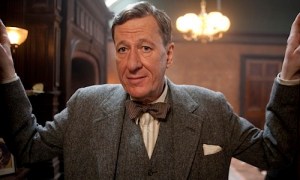 Guy Pearce as the youthful, playboy-ish David / King Edward VIII; Timothy Spall doing a decent Churchill impersonation, which sparks one nice moment just before the titular speech; plus Outnumbered’s Ramona Marquez, pretty much stealing every scene she’s in (as usual) as the young Princess Margaret.
I don’t usually comment on my viewing medium — I include it at the top because it can affect all sorts of things, but I don’t feel especially qualified to review the quality of a Blu-ray or cinema or much else — but, occasionally, there’s something worth noticing. The UK BD of The King’s Speech is one of those: instead of running at film-speed 24fps in 1080p, like most movie BDs, this is 1080i/25fps — to put it another way, it has PAL speed-up (how much difference there is between “p” and “i” is debatable). This is naturally disappointing and begs the question “why?”, though when actually viewing the movie the audio doesn’t sound off (but then I’ve never thought it does when watching UK DVDs, so if you’re attuned to that kind of thing maybe it is) and it still represents a definitely HD image.
But I also felt I should mention it before commenting on the film’s visuals, in case it’s affected the visual style. I was going to comment on its slightly unusual look, for instance, which often represents strong pastel colours (when its not succumbing to the ubiquitous teal-and-orange), at the same time presenting a kind of desaturated, often cold feel. 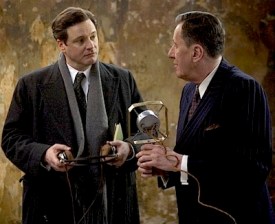 It looks odd, and to be honest I’m struggling to place my finger on what exactly is odd about it, but it’s slightly off-normal, slightly stylised, and I quite like it… but considering Momentum seem to have ballsed up the transfer to at least some degree, I’m not sure how much the oddness is a choice of Hooper and DoP Danny Cohen and how much a dodgy transfer/compression. Screen-grabs of the US release (which is at least 1080p, but not wholly praised in other areas, it seems) don’t help much. But as I said, I’m no real expert on Blu-ray quality, so don’t take my word as gospel by any means.
Let’s try not to get too distracted by such oddities, though. Even if directorially and cinematographically The King’s Speech isn’t the triumph a film lover might like their Oscar winners to be, it’s more than made up for by an exceptional screenplay and an array of highest-quality performances. It’s impossible to say how any film will be remembered in the future, but it seems to me this one is a solidly deserving winner.

 Fresh from winning three BAFTAs (out of six nominations), the Aaron Sorkin-written David Fincher-directed telling of the birth of Facebook arrives on DVD and Blu-ray in the UK today. Notice that Sorkin and Fincher have equal-sized billing on
  Conversely, look at all the film’s conversations. Let’s draw on one that’s discussed in the making-of material, the scene between Mark Zuckerberg and Sean Parker in the club: as Fincher says, he could’ve had a Steadicam endlessly circling them or something similar to make it seem Fast and Hip, but in reality you need to see the conversation, and especially Mark’s reactions, so instead it’s just a good old fashioned shot-reverse-shot. For all his visual prowess, it’s understanding this need for simplicity and (g)old standard techniques when appropriate that Fincher has had a handle on throughout his career.
 Also, that it’s going to be funny and exciting. That style colours the film: fast talk, complex talk, but funny. As people admit in the special features, this is a very dialogue-driven film. Don’t misunderstand me, though: the dialogue scenes are not one-note by any means — there are slow scenes, and even scenes without any dialogue — but anyone anticipating the full implications of “Screenplay by Aaron Sorkin” will not be disappointed.
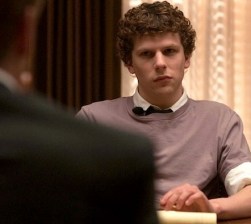
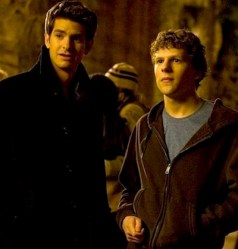 Nominated but unvictorious were stars Jesse Eisenberg and Andrew Garfield, for Best Actor and Best Supporting Actor respectively. They’re not the only ones deserving praise though, because every performance is bang on. Eisenberg manages the enviable feat of making Mark a plausible genius, an entertaining friend and an absolute bastard, not in different scenes but, often, all within the same line of dialogue. There are lines that made me laugh out loud while at the same time thinking “what a [four-letter name of choice]”. That’s Sorkin’s writing too, of course, but Eisenberg nails it.
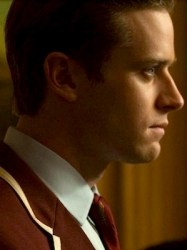 Then there’s Justin Timberlake. I can understand why people would be wary of such casting, and playing the bad boy/playboy part of Napster creator — and destructor — Sean Parker might not seem too much of a stretch. Actually, there are moments that require a little more than that, and Timberlake’s up to the task. Armie Hammer tackles the dual role of the Winklevoss twins. You can’t tell which is which, beyond that in any given scene one will be hotheaded and one calmer. I expect it’s always the same one that’s whichever, but as they both look exactly the same…
 it’s set to an addictive electronic rendition of In the Hall of the Mountain King, and though the whole sequence is a showpiece, that’s as much thanks to the music as the visuals. These are just two specific examples — throughout, the music excels.
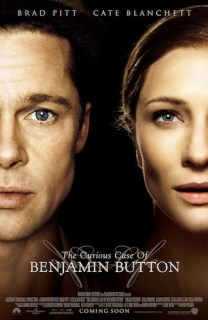 Benjamin Button was released in UK cinemas two years ago last week. Time really does fly. The critical reception was a little divisive — the
  The visuals in general may be Benjamin Button’s strongpoint, holding up a variety of era-evoking colour palettes and other design elements as it passes throughout the 20th Century. Flashback-like asides are conveyed in older film styles — scratchy prints for instance, or with a silent movie aesthetic — that on the one hand could seem an inappropriate indulgence, but objectively work very nicely. For a director who has a reputation in some corners for exhibiting excessive flair with swish shots and effects, Fincher shows steady restraint here — as he did in
  but Button didn’t feel nearly as episodic, nor nearly so obsessed with History. Benjamin encounters foreign diplomats and is embroiled in World War 2, but both are relatively non-specific and don’t colour his life in the way Gump’s parade of Defining Moments do. Instead the storytelling is character focused. Viewer awareness of time passing in the narrative is left to the odd snippet of dialogue or obvious jump; aside from a few clear points, there’s a less convincing sense of era than Fincher evoked in Zodiac. Whether this matters or not is debatable — Button isn’t a chronicle of the 20th Century through one man’s eyes, which is what Gump arguably was, but is rather the story of a (somewhat unusual) life lived during that timed period.
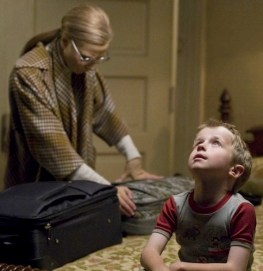 Or perhaps it’s the very point: the more things change, the more they stay the same. Benjamin is ageing in completely the opposite direction to the rest of us, and yet his life isn’t all that different. Witness the end of the film (naturally, spoilers follow): Benjamin loses his language and memory, his life fading away as his brain fails. Presumably this is because he’s regressing to childhood, his brain shrinking and devolving to that of a child/toddler/newborn, but don’t we see the same thing happen to adults with dementia? As Daisy observes earlier in the film, “we all end up in diapers”. A life backwards is not so different to a life forwards, then. It’s all in how you live it, that kind of thing.
 Ultimately, Benjamin Button strikes me as less than the sum of its parts. Bits are good, even very good — “bits” both as in story episodes and technical elements; and I particularly like the sections with Jared Harris, who’s always worth watching — but what does it add up to? It’s quite long and, unlike Zodiac, feels it. It may be easy to admire, but I find it awkward to love.
 There’s probably a worthwhile biopic to be made about Verity Lambert. In 1963, she became not only the youngest-ever producer of a BBC television programme, but the first female one too; the programme she was charged with launching was
  Before I set off really critiquing the film, let’s just remember this: it’s a student effort. In that context, I’ve seen far worse — heck, I’ve been involved in the production of worse. Cowell and Guy have set themselves an almost Herculean task by choosing a period tale, which obviously necessitates all sorts of extra effort in terms of costumes, locations, dialogue… And to make it worse, they’ve chosen the ’60s, evoked so faultlessly in almost 40 hours (and counting) of
  which he accepts with merely a muttered “damn” when she leaves. Sorry, what? There’s nothing believable in that scene, never mind accurate.
 Technically, the piece is just as much a mixed bag. Stephen Cheung’s direction picks out some decent angles, avoiding the flat point-and-shoot trap some student filmmakers are apt to fall into, while the sepia-ish wash helps the period tone and adds a small amount of welcome gloss. The editing is a little rough around the edges, particularly at scene changes and toward the end. YouTube claims it’s viewable in 1080p — whether something went wrong in shooting, editing or at YouTube’s end I don’t know, but it isn’t that high quality. (This last point doesn’t impact on my score at all, it’s just an observation.)
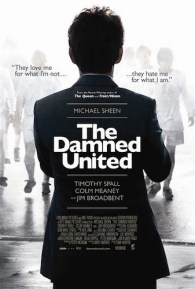 I have no love for football. Quite the opposite, in fact. I’d certainly never heard of Brian Clough before this film came along. I didn’t even bother to put it on my list of
  an impressionist who can act a little, due to his penchant for playing real people with unerring accuracy — Kenneth Williams in
 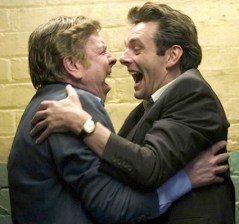 Though this is Sheen’s show, the rest of the cast give able support. Most notable is Timothy Spall as Clough’s right-hand man, Peter Taylor, the quiet force behind Clough’s showy, mouthy public face. Their relationship is — in nasty modern parlance — a “bromance” (I apologise), a fact only underlined by the final scene. It may not be apparent until late on, but if the film is Clough then his relationship with Taylor is its heart. It’s a subtler role that Spall still manages to pull everything out of. Colm Meaney and Jim Broadbent are also noteworthy, as Clough’s unknowing rival and his increasingly exasperated chairman respectively.
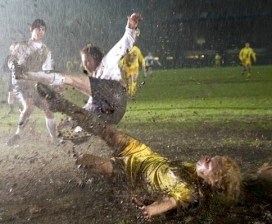 and I seem to remember it in
  Public Enemies came out nearly a year ago now, and I remember two things about its release: firstly, that the first review I saw was Empire’s, which
  What it brings here is an unusual quality. It’s clearly fiction, of course, albeit fiction based on fact, and there are still plenty of extravagant angles and editing so that you’re never in danger of thinking Mann is trying to pass this off as a documentary. But couple the raw cinematography with a meticulous attention to period detail, with a sound mix that is consciously rough and real, and you get a sense that this is how it was — it’s not a glossified movie version, it’s a How It Was one. Public Enemies is to the old gangster film as
 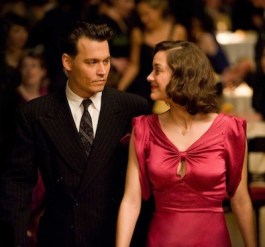 The characters do and don’t lack depth. The relationship between Dillinger and Billie is a significant part of the film, receiving roughly equal attention to Dillinger’s criminal deeds — it’s his final words to her that close the film, not his death. Christian Bales’ G-man, Melvin Purvis, on the other hand, is less developed, but to say he lacks any character is to do Bale’s performance a disservice. Behind Purvis’ blunt dialogue and stolid manner, and in slight gaps and lapses around it, one gets a sense of the true man and his real thoughts. The postscript — that he resigned from the FBI a year later and ultimately took his own life — reinforces and confirms the subtleties Bale injects into the performance.
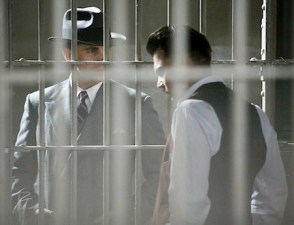 Mann does his best, cutting around Dillinger in the movie theatre, the bizarrely-apt film he’s watching (this isn’t dramatic licence — Dillinger really saw
  is largely well converted to a dramatic piece, if occasionally a little episodic (as is the way with all biopics) and overlong towards the end.
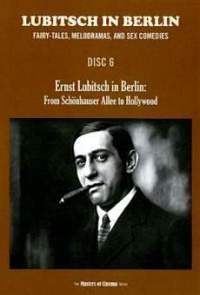 Part biography, part making-of, part analytical retrospective, Robert Fischer’s documentary does what it says on the tin: tells the story of the life and work of actor/director Ernst Lubitsch from his formative years, living on Schönhauser Allee in Berlin, to when he made the move to America in the early 1920s.
 In an age where Henry VIII is young, slim and sometimes irritatingly called “Henry 8”, not to mention more interested in shagging every young girl he can find than in, well, anything else, it’s somewhat refreshing to return to a time when he was always older, fatter and more interested in polishing off a huge slab of meat than seeing his wife. OK, so they call him “Heinrich VIII”, but at least that’s because this production team spoke a different language.
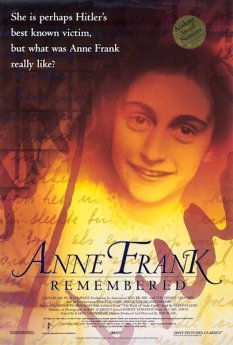 Anne Frank’s is arguably the best-known individual story of the Holocaust, perhaps because the diary of a 13-year-old girl in hiding from the Nazis — and, sadly, eventually captured by them — makes a perfect gateway for young people into learning about those atrocities.
 Director Julian Jarrold seems to have found his cinematic niche in “coming a bit late”. His
  100Films.co.uk