
Julian Schnabel | 112 mins | download | 12A / PG-13
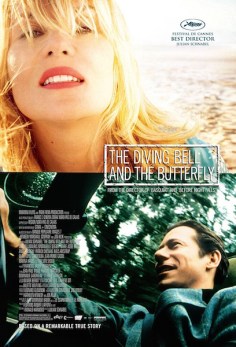 Le Scaphandre et le Papillon, as it’s titled in its original French, has until now been on my (unwritten) ‘List of Films to Avoid’, alongside the likes of Ichi the Killer, Hostel, Caligula, and Salo. Strange company for an Oscar-nominated drama I know, but whereas those others have visceral horror that I have no real desire to deal with, the situation of Diving Bell’s central character, Jean-Dominique Bauby, which is exacerbated by it being a true story, seemed too horrendous to bear. In a similar way to how one might struggle to think about death if one doesn’t believe in an afterlife, the idea of being paralysed but for one eye is an almost unimaginably tortuous fate. Nonetheless, in the wake of a huge amount of praise — and in the name of finding a film starring Mathieu Amalric for My Quantum of Solace Film Season — I resolved myself and hoped for the best.
The most striking thing about the film is that, for about the first 40 minutes, it takes place almost entirely within the head of Jean-Do, as Bauby is affectionately known. From the opening shot we literally see through his his eyes, blurry and limited as that is, and hear his thoughts, which brings us a lot closer to him than any character in the film can be as we soon realise he can’t speak. During this first third the film only ventures outside Jean-Do’s immediate vision for memories or imaginings — although the viewer might perceive them as breaks from the prison of his mind due to the change in imagery, we’re actually still stuck inside his head, just as he is. One begins to wonder if the whole film will be told this way, or, if it does break free, how Schnabel and writer Ronald Harwood are going to find a cinematically plausible way to achieve this after so long. (Pleasingly, when do they it doesn’t feel like a contrivance.)
Jean-Do’s situation is obviously far from everyday, so this device makes for a highly effective — and, indeed, affective — form of identification. As we can see all he sees and hear all he hears, and as he can’t feel anything, we’re being given access to his entire sensory experience and, through his voice over, we even have access to his thoughts. (I say “his entire sensory experience” — it’s never mentioned whether he can taste or smell; but as his paralysed mouth means he’s unable to eat I presume the former isn’t much of a consideration at least.) This style also creates some exceptionally uncomfortable moments, such as when Jean-Do’s right eye has to be sewn up so as it doesn’t dry out, even though it still works at the time. As we see from his vision, we see the eyelid being half-closed and the needle pushing through as if it were our own. Again, it brings the viewer a lot closer to his experience than watching the act objectively from a third-person perspective would.
It’s not just the effect on Jean-Do that we’re privy to, however. As the story progresses we encounter his family: an estranged wife, three children, a mistress, and a house-bound father. The pain these relatives feel is both varied and palpable, as is the added pain for Jean-Do. He can’t play with his kids, or even really communicate with them, and his mistress is too afraid to visit — in one scene, his disability means they have to communicate uncomfortably through his wife. Arguably most affecting of all is his father. Played by Max von Sydow, the couple of scenes featuring him are beautifully understated in both direction and performance, but it’s their attempt at a phone conversation, using only the awkward blinking system developed by Jean-Do’s speech therapist, that is absolutely heartbreaking.
Incidentally, the scenes where Jean-Do uses this method — which, put simply, involves him choosing one letter at a time — are quite odd to watch for an English viewer. Obviously the word is being spelt in French, but the subtitles unsurprisingly spell the word in English. It’s the only sensible way to convey the point, but it makes for an especially odd disjunct between original dialogue and the subtitle translation. It’s not so much a flaw as something that distracted me at times, but I can’t come up with a better solution.
As Jean-Do, Amalric is required to give a rather unusual performance — not just because he’s stuck with only the use of one eye, but because for much of the film Jean-Do is omnipresent while Amalric is nowhere to be seen. This in-his-head style means that the direction, cinematography, editing and sound design are as much part of the character as the work Amalric does. He rarely actually narrates anything — it’s sort of a half voiceover, with snippets of thoughts and the like. That said, it’s to the credit of his work with this slight material, and to those on the technical side, that when he does actually appear on screen it doesn’t seem unusual or disconnected.
I’m not sure where I got the notion that The Diving Bell and the Butterfly would be truly excruciating to watch, but, as anyone who has seen the film will surely be aware, it isn’t. Schnabel and Harwood employ a variety of techniques to make you understand the real-life horror of Jean-Do’s situation, but these don’t tip the film into sensationalism or terror. In fact, despite the measures taken to enable the viewer to identify with Jean-Do and make his a very personal drama, I found it was primarily interesting on a documentary level — understanding the hard, slow, awkward processes of recovery (as much as he can) and coping (to a degree); how it might feel to be in that situation, or stuck in similar aspects of human experience, such as in the visit from a former Beirut hostage.
In fact, if the film had a message it would surely be, “live every day as if it’s your last”. That might sound a bit corny — something which I certainly wouldn’t accuse the film of being — but it’s never been presented so starkly. Never mind dying, thereby having no chance to realise what you didn’t do — Jean-Do is a prisoner, tortured with all the things he never did or didn’t do enough, and the knowledge that he will never be able to do them again.

 These days perhaps even more praised than
 Stephen Fry leads a starry British ensemble in this biopic of poet, novelist, playwright and genius Oscar Wilde. The film focuses not on Wilde’s literary achievements and public life, but on his private relationships with various men, and in particular his obsession with the young Lord ‘Bosie’; of course, eventually, all of these things collide.
 Period drama focusing on the friendship between Queen Victoria and her Highland servant John Brown, alongside political threats faced by the British monarchy in the 1860s.
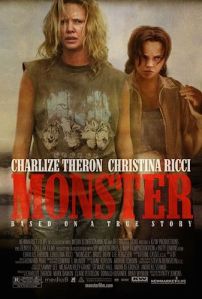 Charlize Theron uglies up (and wins an Oscar) portraying Aileen Wuornos, one of America’s first female serial killers, in this ‘true crime’ biopic. The film focuses on her 9-month relationship with Selby, played by Christina Ricci, which is also the period in which she killed several men (many of them, especially initially, not undeserving of their fate).
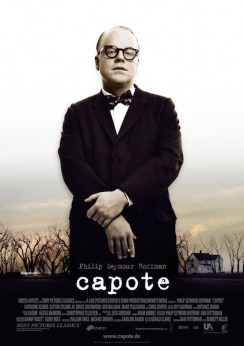 It is, unsurprisingly, Philip Seymour Hoffman’s Oscar-winning lead performance that dominates this movie. While the title might suggest a biopic, the film actually concentrates on the five year period in which Truman Capote researched and wrote his non-fiction novel In Cold Blood.
 It’s easy to see why
  “You’ve heard the story of Jesse James, of how he lived and died; If you’re still in need of something to read, here’s the story of Bonnie and Clyde.”
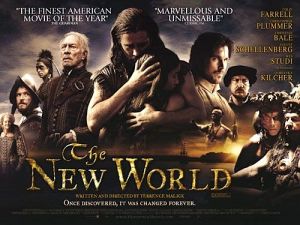 Slowly paced and beautifully photographed, this is about as far from Disney’s telling of the story (in
  George Clooney’s directorial debut is part biopic, part comedy, and part spy thriller.
 100Films.co.uk