

now it needs a body.
Original Title: Kôkaku Kidôtai
Also Known As: Mobile Armored Riot Police: Ghost in the Shell (Japan)

Country: Japan
Language: Japanese
Runtime: 83 minutes
BBFC: 15
Original Release: 18th November 1995 (Japan)
UK Release: 8th December 1995
First Seen: DVD, 2000
Stars
Atsuko Tanaka (Ghost in the Shell 2: Innocence, Bayonetta: Bloody Fate)
Akio Ôtsuka (Black Jack, Paprika)
Kôichi Yamadera (Ninja Scroll, Cowboy Bebop: The Movie)
Yutaka Nakano (Cowboy Bebop: The Movie, Ghost in the Shell 2: Innocence)
Tamio Ôki (Journey to Agartha, Wolf Children)
Director
Mamoru Oshii (Patlabor: The Movie, Ghost in the Shell 2: Innocence)
Screenwriter
Kazunori Itō (Patlabor: The Movie, .hack//SIGN)
Based on
The Ghost in the Shell (攻殻機動隊 Kōkaku Kidōtai, literally Mobile Armoured Riot Police), a manga by Masamune Shirow.
The Story
Japan, 2029: Public Security officer Major Motoko Kusanagi and her team are assigned to track down and capture a dangerous hacker known as the Puppet Master, but they soon find themselves embroiled in a far-reaching conspiracy…
Our Hero
In a future world where humans can undergo varying degrees of cyberisation, Major Motoko Kusanagi is a “full-body prosthesis augmented-cybernetic human” — only her brain is organic. Her body is a generic mass production model, so she can blend in while being a kick-ass law enforcement officer.
Our Villain
The Puppet Master, a cyber criminal who hacks into people’s brains and gives them false memories. But is there something even worse going on behind the hacker?
Best Supporting Character
Kusanagi’s second-in-command Batou is stoic to the point of brusqueness — apparently quite a different characterisation to his portrayal in other Ghost in the Shell media.
Memorable Quote
“If we all reacted the same way, we’d be predictable, and there’s always more than one way to view a situation. What’s true for the group is also true for the individual. It’s simple: overspecialise, and you breed in weakness. It’s slow death.” — Major Kusanagi
Memorable Scene
Pursuing the Puppet Master, Kusanagi comes face to face with a six-legged tank. After a blazing gun battle, she tries to physically rip it open, her cybernetic body straining to breaking point — and beyond…
Technical Wizardry
Ghost in the Shell was groundbreaking in its skilful combination of traditional 2D animation with CGI additions. It used a process called “digitally generated animation” (DGA), which combined cel animation with computer graphics to create lens effects that simulated depth, motion, and unusual lightning techniques, as well as mixing in 3D CGI and digital audio.
Letting the Side Down
In 2008, Oshii revisited the film to create Ghost in the Shell 2.0, which regraded the colour, replaced some of the original animation with new CGI, omitted several scenes, and featured a remixed and re-recorded soundtrack. (More details here.) As is almost always the case when directors fiddle with their creations decades later, it wasn’t well received by fans.
Next time…
As befalls many a popular anime franchise, Ghost in the Shell has spawned a raft of sequels and reboots. The only direct sequel, Innocence, was released in 2004. TV series Ghost in the Shell: Stand Alone Complex ran for two seasons between 2002 and 2005, with the first run compiled into movie The Laughing Man and the second into Individual Eleven, all of which were followed by a final film, Solid State Society. Another reboot came in 2013 with direct-to-video series Ghost in the Shell: Arise, which so far totals five episodes and, last year, continuation film Ghost in the Shell: The New Movie. (Only four episodes have so far been released in the West, but the movie — which continues the story from the fifth episode — came out on Monday in the UK. Just to make things more complicated.) A live-action American remake is currently shooting for release in March 2017 — you’ve probably heard about it.
Awards
5 Annie Awards nominations (Animated Feature, Directing, Producing, Writing, Production Design)
What the Critics Said
“When Akira first blasted out of Japan back in 1991 it looked like the Western concept of widescreen animation would be changed forever. […] Unfortunately, it was not to be. Sure, on video, the Manga scene has gone from strength to strength, but as far as theatrical releases are concerned, nothing has really come along to match Akira’s sheer retina-scalding magnificence. Until now. […] From its baddie-eviscerating opening sequence through innumerable car chases, shoot outs and tongue-in-cheek dialogue exchanges, this is exactly the kind of film that James Cameron would make if they ever let him through the Disney front gates.” — Clark Collis, Empire
 Score:
 95%
95%What the Public Say
“both the film and Oshii have fallen into a kind of disrepute among the anime community. The common line on GITS is that it’s wordy, masturbatory, and pretentious with nothing going on intellectually and that the (plainly inferior but more easily accessible) GITS: SAC is a better alternative. I wanted to write this article to respond to that notion. GITS is a highly thoughtful film and worthy of comparison to virtually any scifi feature you could name. ” — tamerlane, too long for twitlonger

Ghost in the Shell was the first anime I consciously saw, which maybe helps it earn a place here. It’s an initially accessible movie that’s also very complicated — there are pulse-pounding action scenes and a thriller storyline to keep things exciting, but also a lot of deep philosophical discussions, touching on themes of gender and identity. I think for some viewers the latter are a negative, while for others they’re the entire point. (I imagine the forthcoming Hollywood remake will either ditch or seriously curtail them, but you never know.) The combination makes for a stimulating (in multiple senses) sci-fi actioner.

Next… who ya gonna call? #37 !
 Well now, hasn’t this been a long time coming? Just over two years since its western disc release was first announced, just over three years since it debuted in Japanese cinemas, and just over four-and-a-half years since
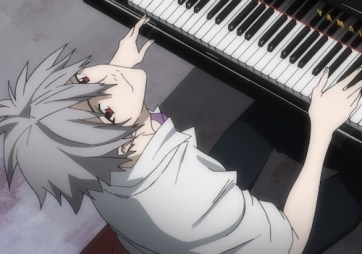
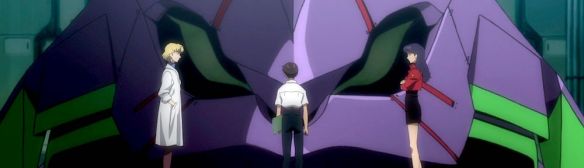
  Change, and the embracing or rejection of it, is surely one of the major themes of Evangelion. This is more explicitly debated as 3.33 moves into its middle section, where we get an extended dose of Shinji’s traditional insecurities. Hey, it wouldn’t be Evangelion without Shinji having a self-pitying whinge, right? Fortunately there’s more going on than that, but this is a section light on action and heavy on the series’ more thoughtful elements. There are answers to some of the mysteries, but it again wouldn’t be Evangelion if it all made easy sense. At the same time, Shinji bonds with new Eva pilot Kaworu. A controversial character, apparently, and not just because of the homosexual overtones (which some reviewers claim to miss, presumably because they’re blind), but the scenes where they harmonise by playing piano together are quite fantastically animated.
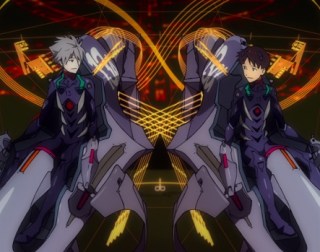
 3.33 divides quite neatly into three half-hour sections. I guess that should be expected, as the whole tetralogy has been based in traditional Japanese ideas of narrative/musical structure, hence the films’ Japanese titles incorporating the names for the three movements: jo, ha, and kyū (序破急), which roughly equate to “beginning”, “middle”, and “end”. As discussed, the first is fantastic, some of the best material in the entire series, in my estimation. Also as discussed, the second is a lot slower, but has its plus points too. The third… ah, the third. Here we get some more action, which will please anyone who thrills to Eva combat, but it is also utterly mind-boggling. I’ve been reading up on a few fan sites since watching, and I’m still not absolutely sure what was going on or what it signified. You won’t find any enlightenment in the disc’s special features, which present a long list of extras at first glance, but turn out to be 19 repetitive trailers, TV spots, and promo reels. Yes, nineteen.
 So when will that conclusion come? Well, a few years ago Anno ‘joked’ that the finale might be released “four to six years” after 3.33. As we’re already almost at four years with no sign of a release date, I guess it wasn’t so much of a ‘joke’ after all. An English-friendly DVD/Blu-ray will inevitably take an additional couple of years, too. So an indefinite, but undoubtedly lengthy, wait begins…



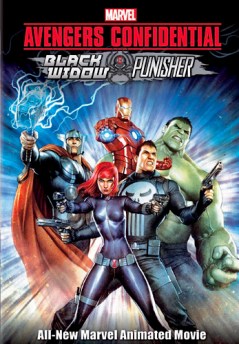 Anime take on Marvel properties. S.H.I.E.L.D. agent Black Widow teams up with vigilante Frank Castle, aka the Punisher, to investigate a threat to global security.
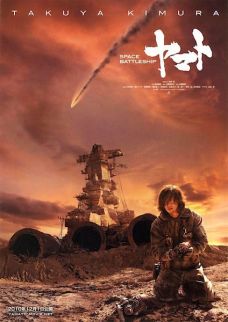 A live-action adaptation of the popular, influential and long-lasting anime franchise, known in the US as Star Blazers (here’s
 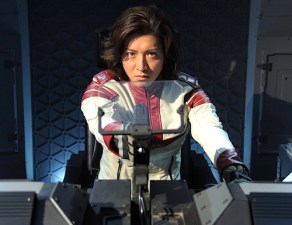 But this isn’t a mega-budget production (
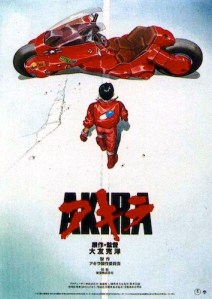 For many Westerners of a certain generation, Akira was their first (conscious) exposure to anime. Not so me: a step or two down,
 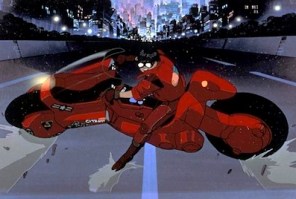 The visuals remain something to be savoured; they’re probably the film’s strongest point, in my opinion. Akira was an expensive production and it pays off on screen. It’s not just the bike chases that I appreciated either, while an extra decade of experience made the ending a bit less freakish! The other strong point is the audio. The BD’s booklet goes on about “hypersonic” sound. I’ve no idea if that worked on my system, but it sounded fantastic regardless.
 Once, a few years ago, SFX published an anime special (it was their first, I think) with a rundown of the Best Ever Anime Films. You’d expect it to be topped by something regularly cited and, considering the source magazine, science-fiction/fantasy-y —
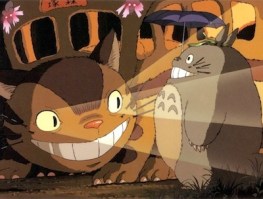
  It’s not scary in the slightest (well, maybe in the slightest, for some kids, but note the U and G ratings), but in terms of how it balances real-life dramas with the fantasy element. Only in both the real and fantasy worlds it’s a lot nicer, friendlier and cheerier than del Toro’s acclaimed fantasy-horror. To put it more succinctly, they share a similar structure and balance, but a completely different tone.
 The English-friendly version has advantages too: I love any subtitles which use semicolons. It’s not inundated with them, but there was at least one. Semicolons are so underused. I love a good semicolon.
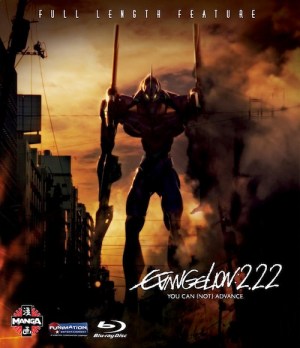 Just over a year since the
  For my money, the first 40 minutes or so of the film are (by and large) the best bits. It opens with a barnstorming action sequence, a great scene for newbies and fans alike as we’re introduced to Eva pilot Mari, who didn’t appear in the TV series. That she then disappears for most of the film, only to make a thoroughly mysterious return later, is one of those explanation-lacking flaws. I’m sure it won’t look so bad once the next two films provide us with answers. Well, I hope not.
 Then the gang take a trip to a scientific installation which is trying to preserve the oceans and their wildlife. It feels like animation shouldn’t be as effective for such a sequence as, say, the footage in a David Attenborough documentary, but nonetheless it feels extraordinary, in its own way. It also marks itself out with the interaction of the characters on a fun day out rather than their usual high-pressure monster-fighting world. And then it’s back to that world for another impressive three-on-one Angel attack.
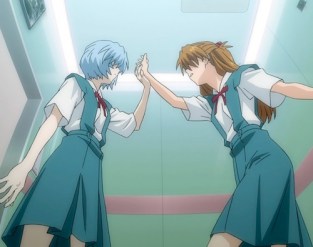 But it’s all building somewhere. For one, there’s another of the film’s best sequences — certainly, its most shocking, which readily earns the 15 certificate. I don’t want to spoil it for anyone yet to see the film, because it’s one of the plot points that differs from the TV series, but it involves the death of a main character in a brutal, deranged way. I say “death” — they pop up in the third film trailer that runs after the end credits, so there’s more to this yet…
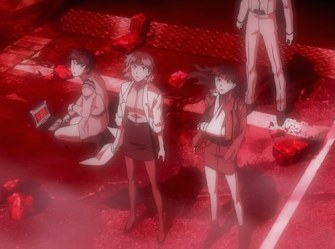 And then, after the end credits, there’s a brief scene that throws another spanner in the works! Double-cliffhanger-tastic… one might say…
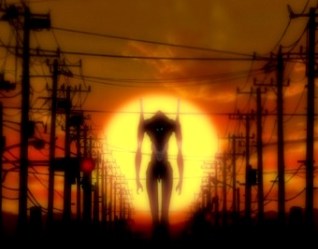 In short, if you’ve always liked Evangelion then you won’t be waiting for me to tell you this is a must-see reimagining; if
 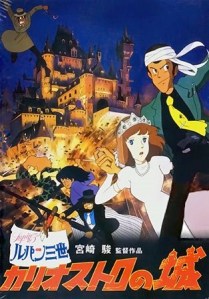 The Castle of Cagliostro, the second animated big-screen spin-off from manga-inspired anime TV series
  As I mentioned, this is the second spin-off film from a TV series, and at times it does feel like it: characters turn up under the impression the audience already knows who they are and what their connection is to the others. It’s not a major problem — most are introduced well enough within the context of the film that it can still be easily followed — but it’s there.
 Um, where was I? Oh yes: Indiana Jones; Roger Moore-era James Bond — it’s that kind of tone, more or less, and if you enjoy that kind of film then I don’t see why you wouldn’t enjoy this. Unless you think cartoons are for kiddies only (in which case, see the long sentence at the end of the last paragraph).
 Speed Racer feels like an unfair place to kick off
  Even some of the performances stand out, not something you’d expect from such a (for want of a better word) lightweight tale. Of particular note are Susan Sarandon as Mom and Christina Ricci’s Trixie, whose huge eyes help render her perhaps one of the most perfect live-action versions of an anime character ever seen. Yes, the characters mostly exist to service their place in the plot, but the odd scene or glance or line delivery adds some subtlety here and there.
 And, to specifically rubbish his opinions here, Phantom Menace is praised for being “made to be looked at more than listened to… filled with wonderful visuals” and condemns Speed Racer because “whatever information that passes from your retinas to your brain is conveyed through optical design and not so much through more traditional devices such as dialogue, narrative, performance or characterization… you could look at it with the sound off and it wouldn’t matter.” Not that Film’s unique factor (over novels or radio or what have you) is its visual sense, and a silent film that can be told through image alone, devoid of any intertitles, was once a lofty aim. I’m sure Ebert could readily explain why Phantom Menace’s visual splendour is a good thing and why Speed Racer’s is so terrible, but, on the other hand… pot, meet kettle.
 Back to Speed Racer. In every respect it’s like a living cartoon, and it’s the Wachowskis’ commitment to this aesthetic in every single respect that makes it work where others have floundered. It’s not perfect, I suppose. It may run a little long at two-and-a-quarter hours; but then, it so rarely lets up that I didn’t mind a jot. And the kid is often annoying; but then, as annoying little kids in films go, I’ve seen worse. At times I even liked him.
 100Films.co.uk