Bao (2018)

2018 #233a
Domee Shi | 8 mins | Blu-ray (3D) | 1.85:1 | USA / silent | PG / G

Bao

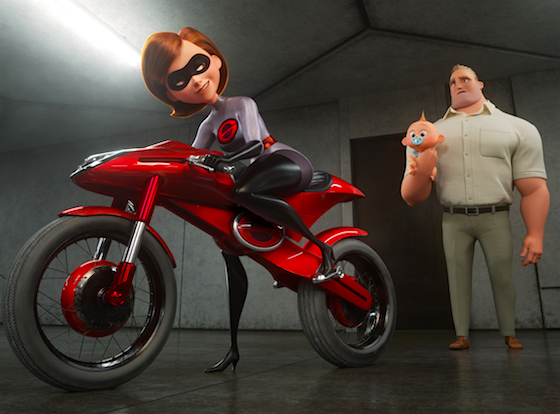
This short film from Pixar played before Incredibles 2 in cinemas, so naturally it accompanies it on Blu-ray too. In it, a Chinese-Canadian woman is steaming dumplings (the titular bao) when one comes to life and grows into a little dough boy, who she begins to raise as a son.

As with many of the best short films, Bao takes a simple theme (though to say what the real core of the short is would give away some of the ending) and executes it succinctly. As is often the case with Pixar’s work, it aims at packing an emotional wallop, using it’s fantastical story to elucidate a real-life situation. It also doesn’t stint visually, with an overall animation quality that wouldn’t be out of place in a feature.

Bao is perhaps most notable as the first Pixar short to be directed by a woman. It only took 35 years and 35 shorts to get there. Considering some of the recent stories about the company, and the reputation it was gaining as a “boy’s club”, I guess this couldn’t come at a better time, though perhaps it’s to their credit that they didn’t seem to harp on about this aspect (I stumbled across the fact on Wikipedia). Given the quality and clarity of work on display, perhaps writer-director Domee Shi will get to be Pixar’s first female feature director too.

4 out of 5

Incredibles 2 (2018)

2018 #233
Brad Bird | 118 mins | Blu-ray (3D) | 2.39:1 | USA / English | PG / PG

Incredibles 2

Brad Bird — the director behind The Iron Giant, Ratatouille, and not letting them release the IMAX version of Mission: Impossible – Ghost Protocol on Blu-ray (I will never be over that) — returns to the movie that made his name with what must be Pixar’s most-requested (probably “only requested”, actually) sequel, Incredibles 2.

It’s been 14 years for us viewers since the last Parr family adventure, but in-universe it’s been no time at all — literally, as Incredibles 2 picks up by recapping the closing moments of The Incredibles, which saw the eponymous family of superheroes about to face off against villain The Underminer. That confrontation goes disastrously awry, landing the family in a whole heap of trouble; but it also attracts the attention of media mogul Winston Deavor (Bob Odenkirk), who believes superheroes should be made legal again. Recruiting parents Bob and Helen Parr — aka Mr Incredible (Craig T. Nelson) and Elastigirl (Holly Hunter) — and their friend Frozone (Samuel L. Jackson) to his cause, the first step in Deavor’s public relations plan revolves around public crimefighting appearances by Elastigirl… alone. This leaves Bob holding the baby, literally, as he’s stuck at home with the kids while his wife gets to have all the fun.

At its most basic, Incredibles 2 is a gender-reversed do-over of the first movie… to a fault, in fact. The closing moments of the first film suggest a “family of superheroes” future for the Parrs, with them battling crime together. The sequel immediately works to put everything back in its place: the kids aren’t allowed to use their powers (until they must for the climax, natch); one of the parents gets to go off and be a superhero, while the other has to stay at home. The difference is it’s the man staying at home, and where Helen was consummate at looking after the kids, Bob finds it a challenge — because Men, amirite?

Left holding the baby... literally

Part of what made The Incredibles so successful as a movie was it mixed a plausible family dynamic in with the superhero capers, but here that home life aspect is what holds the film back, because Bob’s struggles with the kids are 66.6% cliché. His son struggles with homework, and Bob doesn’t know how to do it either! His daughter has boyfriend problems! The 33.3% that works comes courtesy of baby Jack-Jack, who is beginning to develop powers — plural. As the middle of the film drags on, becoming a bit “we get the point!” with Bob’s familial woes, the bright spot is continually Jack-Jack’s humorous madcap antics.

Mind you, the actual storyline in the superhero section isn’t much better. It revolves around the hunt for a mysterious villain, which naturally ends in a twist reveal… but as their true identity is pretty obvious as soon as they first appear earlier on, that reveal is a long time coming. Depending how critical you want to be, this part of the movie also has a lot of thematic points that seem to peter out or had nowhere to go in the first place. Is the film trying to say something about our addiction to screens and media? About the merits of vigilantism over bureaucracy? The dangers of being reliant on ‘higher powers’ to look after us? It touches on these things, and more, but they’re only given passing reference. Okay, yes, when you boil it down this is “just” a kids’ action-adventure movie and maybe we shouldn’t expect too much depth of thought… but Pixar are always hailed as being much more than that. Is it too much to expect that, if they’re going to introduce a topic or perspective, they’ll also at least close it out somehow?

Yet for all these story woes, Incredibles 2 does indeed work as a colourful action-adventure movie; gloriously so. The action sequences are absolutely thrilling, beautifully choreographed and constructed. They’re even better in 3D, too — Elastigirl’s stretchy powers seem to have been made for the format. And while the middle of the film may refuse to pay off the “family of superheroes” thing, the opening sequence and climax let them all in on the action, and it’s all the better for it.

Stretchy superheroics

What made The Incredibles one of Pixar’s best films, and one of the best films in the whole superhero genre, was the way it combined the action and adventure with family dynamics and concerns, seamlessly marrying the two. The sequel lacks the clarity and connectedness that first movie boasted, working very well as a fun superhero action movie but struggling as a family comedy-drama. It’s still an entertaining time (the sometimes-slow mid-section aside), but it’s not the genre and studio standout that the first film was.

4 out of 5

Incredibles 2 was released on DVD and Blu-ray (2D & 3D, but no 4K) in the UK this week.

Persepolis (2007)

2018 #27
Marjane Satrapi & Vincent Paronnaud | 92 mins | streaming (HD) | 1.85:1 | France & Iran / English | 12 / PG-13

Persepolis

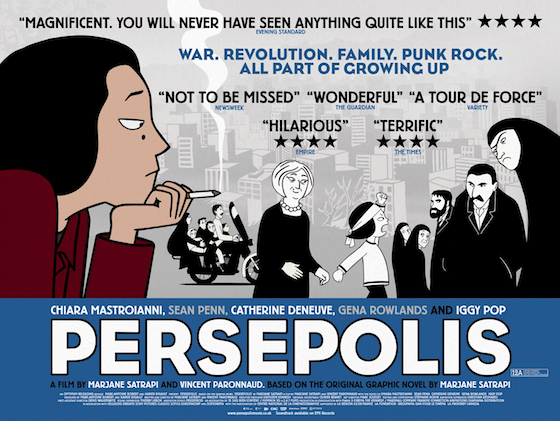
Adapted from co-director Marjane Satrapi’s autobiographical graphic novel, Persepolis is the story of an Iranian girl coming of age in the ’70s and ’80s, during and after the Iranian Revolution. Such a broad description is probably the only way to succinctly summarise it, because it’s kind of a sprawling film, about many different things — just like a life, I suppose. As well as being part biography, it’s also part history lesson, with a normal-family’s eye-view of the revolution and what followed.

Some of the events we’re shown are crazy-specific to her life (Satrapi has certainly lived a life!), and some of it is very specific to her background (i.e. all the Iranian Revolution stuff), but some of it is also very universal. For example, a sequence where she falls in love with a guy sees him depicted as a perfect, angelic boyfriend that she spends many magical times with… until he sleeps with someone else, then when she reflects on their relationship he’s an ugly ogre, and all those wonderful memories have a rotten mirror. Plenty of us have been through something akin to that, right?

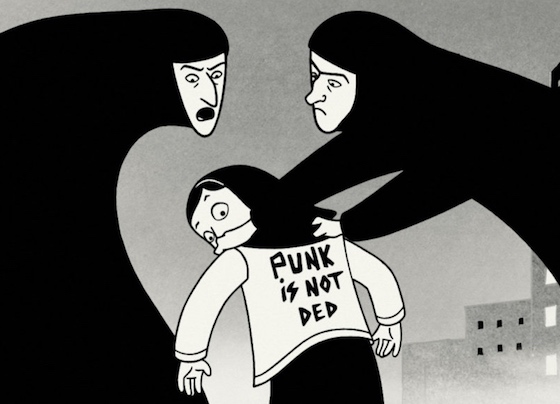
Such subjective depictions are one of the benefits of the film being animated. Drawn in a simple, cartoonish style and mostly presented in black-and-white, the visuals are striking and sometimes very effective, but can also have something of a distancing effect — the atrocities of the revolution don’t hit home in quite the same way when, say, they’re executing a black-and-white cartoon rather than a real girl. Conversely, it was Satrapi who insisted on adapting her novel in animated form, with the goal of keeping it universal — in her opinion, “with live-action, it would have turned into a story of people living in a distant land who don’t look like us. At best, it would have been an exotic story, and at worst, a ‘Third-World’ story.” I suppose there’s some truth to that.

Punk is probably ded in Iran

I believe the film was produced in French, but the copy I had access to only offered the English dub. Unfortunately, this is frequently quite poor — the actors sound like they’re reading out slabs of text as quickly as they possibly can, rather than really delivering the lines. I can only presume this was necessary to fit the animation, but the end result leaves the audio feeling like a bad school presentation. I don’t hold this against the film itself, but it’s a word of warning if you have a choice of audio.

Persepolis is only an hour-and-a-half, but it’s a long one thanks to the scope of what it covers. It’s a frequently dark and bleak film too, taking in not just a violent revolution but also things like depression and attempted suicide. Frankly, it’s the kind of film which I don’t know if I’ll ever bother to watch it again, but it’s also a fascinating and informative experience that I’m unquestionably glad I’ve seen.

4 out of 5

Batman Ninja (2018)

2018 #146
Junpei Mizusaki | 85 mins | Blu-ray | 1.78:1 | Japan & USA / English | 12 / PG-13

Batman Ninja

“This is madness,” exclaims Batman at one point relatively early on in this anime interpretation of the DC superhero. He could be speaking on behalf of us viewers… although, at that point, he — and we — don’t even know the half of it…

The story begins when a scientific experiment gone wrong hurtles Batman, most of the Bat-family, and Arkham Asylum’s inmates back in time to feudal Japan. Due to a quirk of the machine, the Dark Knight himself arrives years after everyone else, which has given the villains a chance to take control, each establishing their own fiefdom. Batman and his allies must find a way to send everyone back to the present day, before history is irreparably altered.

That’s just the start of the bonkers stuff that goes down in this film — never has the term “bat-shit crazy” been more appropriate. I mean, as if the basic setup wasn’t inherently barmy enough, by the time it gets to (spoilers!) a climax where the villains’ mansions morph into giant robots that then combine into a Joker-headed super-giant robot that fights against a giant monkey-samurai made up of hundreds of flute-controlled little monkeys, you’ll be wondering just how strong the filmmakers’ drugs were. And that’s not even the end of it. I don’t think there’s any rational way to assess the quality of the plot here — either you go with it and revel in the madness, or you just give up because it’s too much.

Na-na-na-na-na-na-na-na Ninja!

The sense of possibly-drug-induced unreality is only heightened by the chosen animation style. The film’s clearly been produced with 3D computer animation, but rendered in a style designed to emulate 2D cel animation. It has the frenetic hyper-real movement made possible by the former, while otherwise trying as hard as possible to look like the latter, which makes for a weird disconnect. When you marry that up to the over-detailed, sometimes grotesque character and location designs, plus an overabundance of eye-popping colour, it becomes a surreal sensory overload. Oh, and at one point it changes style completely, just because it does, into some kind of sketchy watercolour thing, but only for a little while.

Batman Ninja is a strange movie all around. I wouldn’t say I enjoyed it, but it was certainly an experience. Would our collective culture be better off if such madness was reined in, or is the world a better place for having this kind of battiness? You may have to judge for yourself, though I think only the bold or the foolish need apply.

3 out of 5

Batman Ninja is now available on Netflix UK.

Mary and Max (2009)

2018 #202
Adam Elliot | 92 mins | download (HD) | 16:9 | Australia / English & Yiddish | 12

Mary and Max

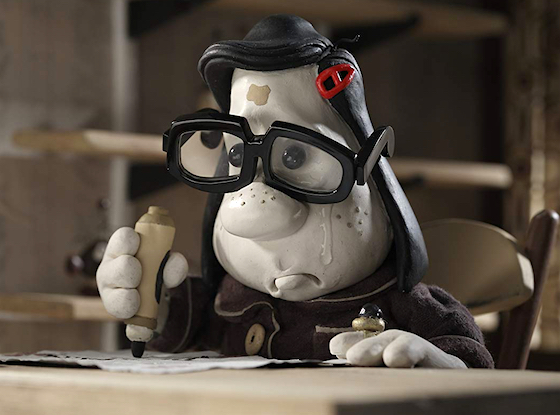
I heard about Mary and Max around when it first came out. I can’t remember the context anymore, but it must’ve been positive because I’ve been meaning to watch it ever since; a desire only reiterated by its surprisingly firm placement on IMDb’s Top 250 (at time of writing, it’s ranked 176th). Nine years since said initial release (nine years?! Where does time go?!), I finally got round to, er, acquiring it, only for it to then pop up on Prime Video. C’est la vie, I guess.

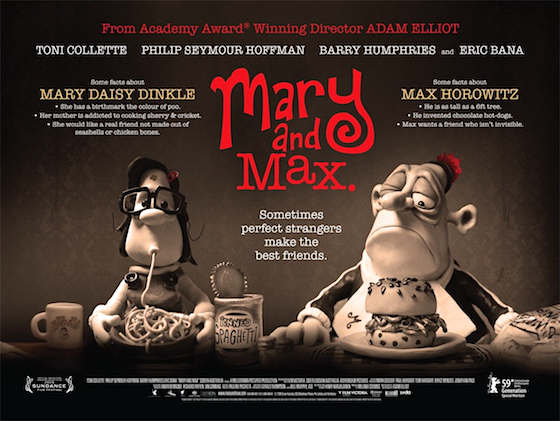
Anyway, it’s about two very different and geographically distant, but similarly lonely, individuals who come into contact by the magic of mail. Mary Daisy Dinkle (voiced initially by Bethany Whitmore and later by Toni Collette) is a little girl living in the suburbs of Melbourne, Australia, who randomly selects a name in an address book at the post office and sends that person a letter. That person turns out to be Max Horowitz (voiced by Philip Seymour Hoffman, unrecognisably, at least to me), a middle-aged obese New Yorker with mental health problems. He replies, and an unlikely, long-lasting pen-pal relationship is born.

The film labels itself as being based on a true story, but writer-director Adam Elliot has said (according to IMDb) that Max was inspired by “a pen-friend in New York who I’ve been writing to for over twenty years.” So, less “based on a true story” and more “very loosely inspired by a true story” — I mean, at least half the narrative (all the shit Mary goes through) is completely fictional. Does that matter? Maybe not… but also, kinda. While the film presents a gloomy, issue-heavy take on life, it also has a whimsical side, and that “true story” claim feels like it’s trying to justify both how grim things get and how fantastical they sometimes are, too. The fact it isn’t true — that it is, at least in part, just the product of the director’s kooky imagination — therefore feels like a bit of a con, at least to me.

Crying on crayon

Still, that doesn’t mean Mary and Max is without merit. It has an empathy for people who are disadvantaged and troubled, and for the importance of finding some measure of happiness in life, however small or awkward, that is quite touching. The heavily stylised designs, desaturated colour scheme, and stop-motion animation method suit the material well — as I said, there’s a lot of bleakness here, as both Mary and Max are battered by life, which juxtaposes effectively with the “kids’ picture book” visual aesthetic. That also allows for some flights of fancy which just wouldn’t work if the film were live action. Plus, as with almost any stop-motion movie, it’s an impressive technical achievement (trivia time: there were 133 sets, 212 puppets, and 475 miniature props, including a fully-functional typewriter that took nine weeks to create!)

Mary and Max’s position on a viewer-rated list like the IMDb Top 250 surprises me, because it’s an oddball little film that would seem to appeal primarily to a certain kind of viewer, and probably alienate many others with its unique mix of quirkiness and spirit-crushing realism. It makes for a sometimes uncomfortable experience — perhaps deliberately so — but underneath that lies a fundamental humanity that is, in a way, quite moving.

4 out of 5

Mary and Max is available on Amazon Prime Video UK as of yesterday.

Jin-Roh: The Wolf Brigade (1999)

aka Jin-Rô

2018 #212
Hiroyuki Okiura | 102 mins | DVD | 1.85:1 | Japan / Japanese | 15 / R

Jin-Roh: The Wolf Brigade

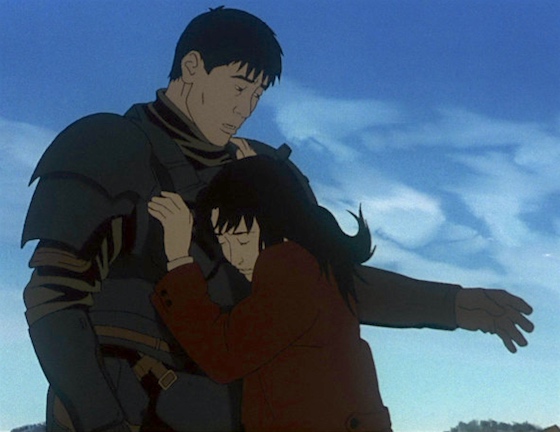
Jin-Roh has enough cool costumes and bursts of ultra-violence to cut together a trailer that looks like a kinda-typical anime action-fest, but that’s really hiding a thoughtful, complicated (oh so complicated) drama about an unlikely romance and military conspiracies.

If that sounds like a bizarre mix… well, it is. Jin-Roh is a film that likes to pull tricks on its audience (maybe those action-packed trailers were deliberate rather than marketers just doing their best to sell the thing!), and one of the tricks it plays is to constantly wrongfoot you about what kind of movie it’s meant to be. First it’s a kind of action thriller about terrorists vs. police; then it’s a subtle romance between two damaged individuals; then it’s a conspiracy thriller, and also an espionage drama; and finally it’s some kind of allegorical tragedy. As it moves through those various phases, the characters — and, by extension, us — are subjected to crosses, double crosses, and triple crosses. Good luck keeping up…

Set in an alternate history where Germany occupied Japan after World War 2 (I’m not sure that’s made clear enough in the film, but hey-ho — maybe it’s obvious to Japanese viewers), the film picks things up a couple of decades later, with Japan free from occupation but having to fight antagonistic forces from within. With many guerrilla cells having combined to form terrorist group The Sect, the security services consequently created Kerberos, a controversial police paramilitary unit, to combat them. When Kerberos corporal Kazuki Fuse fails to shoot a bomb-carrying girl and she blows herself up, he’s punished by being sent back to basic training. At the same, he meets the girl’s sister and begins to form a bond with her. Meanwhile, his failure has thrown the future of Kerberos into doubt, setting political machinations whirring every which way.

Little Red Riding Hood... and the Big Bad Wolf?

I’ll admit, I got pretty lost with all the various factions, who was plotting what and when and why, and which side everyone was supposed to be on. Perhaps I was lulled into not paying enough attention because, as I noted above, the film appears to be a tender, understated examination of the relationship between two scarred individuals struggling to cope with the same recent tragedy from different sides, before it abruptly takes a hard turn into an intricate conspiracy thriller. Reading a plot description afterwards, I managed to get my head around it, though it didn’t resolve one quandary I felt at the end of the film itself: that it’s hard to know who we’re meant to be rooting for. Did the good guys win? Did the bad guys win? Were there actually any good guys — was anyone right? Personally, I’m fine with a film where there are no heroes, where everyone’s a bad guy and one of those bad guys wins; my problem is that I was left feeling unclear about whether that was the case or not.

Mixed feelings, then. It’s a well-made film (even watching on a crummy window-boxed DVD), but all those whiplash-inducing turns and confusion-producing twists left me somewhat reeling and bewildered.

3 out of 5

The Korean live-action remake, Illang: The Wolf Brigade, is available on Netflix from today.

(As is Daredevil season 3, Making a Murderer season 2, a brand-new Derren Brown special, and over half-a-dozen other series and films I’ve not heard of — why dump so much on one day, Netflix?!)

My Life as a Courgette (2016)

aka Ma vie de Courgette / My Life as a Zucchini

2018 #3
Claude Barras | 66 mins | streaming (HD) | 1.85:1 | France & Switzerland / English | PG / PG-13

My Life as a Courgette

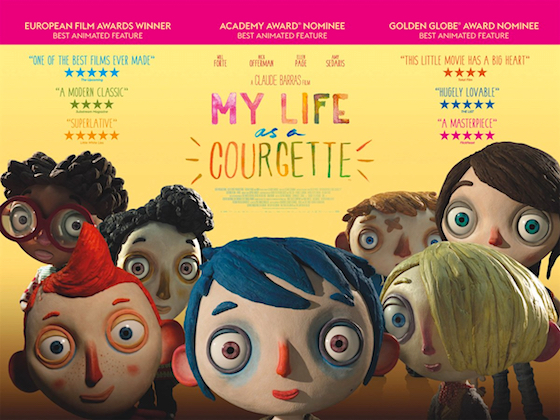
My Life as a Courgette (or, to use the American name for the vegetable, Zucchini) is the story of young lad Icare — who prefers to be called “Courgette”, his mother’s nickname for him — and his life after he is taken into an orphanage. If you’ve heard of it, it’s most likely because it was nominated for Best Animated Feature at the 2017 Oscars.

It’s adapted from the novel Autobiographie d’une Courgette by Gilles Paris, which was apparently a realistic portrayal of the lives of orphans in France. As you can see, the film takes a more cartoonish style, at least on the surface. In fact, the whimsical production design belies the very serious nature of the story — it’s not as monumentally grim as it could be, given the subject matter, but it doesn’t shy away from some very dark areas. It handles these with an understated, calm maturity that is both befitting and refreshing. The animation itself is equally sophisticated, with innumerable little touches that add finesse and richness to the work.

Orphaned

I watched the English dubbed version, because Amazon Prime gave me no choice (the original French version is available on Amazon Video, but for some reason not also included with Prime). Fortunately, despite having a US voice cast, they stuck with “Courgette”, meaning there’s no constant annoyance of the main character being called the wrong thing. (I do wonder, though: did they have to record it all twice, or did the American release rename the film My Life as a Zucchini but then call the kid Courgette anyway?) Fortunately, the dubbing wasn’t at all bad. Of particular note is Nick Offerman, giving a remarkable restrained performance as the gentle and kindly cop Raymond. As for Courgette and his fellow orphans, I don’t know if they cast actual kids or used adult soundalikes, but they also provided uniformly strong voice work.

My Life as a Courgette is one of those “weird foreign animations” that often manages an Oscar nod but doesn’t stand a snowball’s chance in Hell of winning thanks to the conservativeness of Oscar voters — there’s no way a mature, restrained animation with a quirky visual style is going to beat the latest shiny-CGI fun-time from Pixar or Disney. For those with broader tastes, however, it’s definitely worth a look.

4 out of 5

The Past Month on TV #37

Another later-than-usual TV review, because my TV viewing was affected by the same stuff that’s seen my post count plummet this month, as well as kept this month’s film numbers down (more on that on Saturday). Consequently, I waited until I’d actually watched enough TV to make this post somewhat worthwhile…

Although, despite what I said in last month’s “next month”, I still haven’t watched Lost in Space. Maybe next month (but don’t count on it).

Disenchantment  Season 1
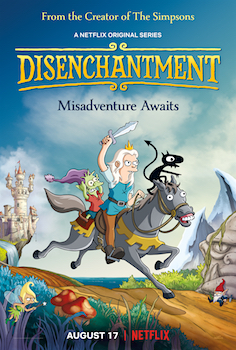
DisenchantmentThe first new series from The Simpsons creator Matt Groening in almost 20 years, Disenchantment is a riff on the fantasy genre. It follows the misadventures of Princess Bean of Dreamland, a rebellious sort who prefers to sneak out of the castle and get drunk in the pub than… well, do anything else. In the first episode, she and we are introduced to her personal demon, Luci, and Elfo, an elf who has left his happy-clappy kingdom to explore the misery of the wider world. This trio form the heart of the show, though naturally there’s a wider ensemble to help fuel storylines.

You may’ve heard the series has come in for a bit of a drubbing from critics, which I’m not sure is wholly fair. It’s not the most consistently funny show, with background gags sometimes providing bigger laughs than the main stories or situations, but it raises chuckles with decent regularity. It’s also not the most original concoction on TV, with some familiar characters and relationships, just grafted onto a fantasy setting. Although at least it has the good sense to create its own fantasy world, rather than being a direct spoof of, say, a certain other show that has brought the genre widespread attention. Whether it’s set in a fully-realised world or one the writers are creating on the fly, I’m not sure, but there’s a lot of room left to explore.

But even if it’s not hilarious or groundbreaking, the first season builds up a nice little rhythm as it goes along. The weakest episodes are undoubtedly the first few, which are somewhat swamped under setup. After a few standalone stories in the middle — which vary in quality from some of the season’s best instalments to, well, not — things begin to come together for a highly serialised run at the end, which finds a use for many disparate bits from those standalone episodes, and all culminates in a cliffhanger. Fortunately, Netflix’s original commission was for twice as many episodes as are in this first run, so we’re guaranteed a second batch. This serialisation works better for a streaming show than completely standalone episodes, although Disenchantment thankfully doesn’t lose sight of being consumable in episode-sized bites.

So, while it may take most of the season to truly warm to the characters and for the series to find its groove, it does get there, and suggests brighter things in the future. Whether it will ever attain the cult following enjoyed by Groening’s other series is arguably a long-shot (can lightning strike thrice?), but it has potential.

Hang Ups  Series 1 Episodes 1-3
Hang UpsLoosely based on the US series Web Therapy, this new sitcom stars Stephen Mangan as Richard Pitt, a therapist offering his services over the internet. The filming style (each client only appears for a few minutes per episode, popping up now and again throughout the series, always via webcam) allowed them to attract a rather phenomenal supporting cast, including the likes of David Bradley, Charles Dance, Celia Imrie, Richard E. Grant, and David Tennant. The way each episode pingpongs around the various clients and Richard’s many, many personal problems (his marriage, his kids, his parents, his siblings, his bank balance) makes for a whip-crack pace that has pros and cons — each episode seems to disappear in a flash, having at once both dashed through some plot and also gone nowhere. Partly this is the result of an abundance of characters — some of the clients are basically one-off sketches, which is fine, but the regulars’ stories can only advance in small increments. I’m left wondering if it might’ve actually worked better with less going on. Still, the quality cast means characters do get rounded out speedily, and when it works it can be pretty funny.

Also watched…
  • The Comedy Lineup Season 1 Episodes 2,5,8 — Netflix’s series of 15-minute standup sets from up-and-coming comics. Naturally, that means the quality is varied. I only watched a semi-random sampling, and some were very good and some were pretty weak. A new batch of episodes is released tomorrow.
  • Magic for Humans Season 1 Episodes 1-3 — I love a good magic show, and this Netflix series is definitely a contender. Magician Justin Willman’s cheeky-chappy persona may grate with some viewers, but his tricks — a mix of hip variations on old standards and wonder-inducing new stunts — are dazzlingly effective.
  • Mark Kermode’s Secrets of Cinema Episodes 3-5 — So good (see my review from last month) that they’ve decided to keep it on iPlayer for a whole year. No word on a second series, as far as I’m aware, but fingers crossed.

    Things to Catch Up On
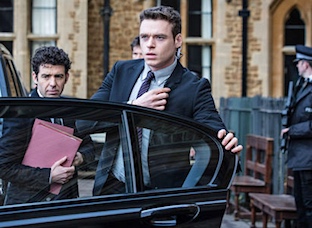
    BodyguardThis month, I have mostly been missing Bodyguard, the new BBC One thriller from Line of Duty creator Jed Mercurio that premiered with a two-day double-bill last weekend. It seemed to go down well, based on the ratings and what I saw on Twitter (while avoiding spoilers!) As usual, I intend to wait until the whole series has aired (or most of it, at least) and then whisk through the lot.

    Next month… everyone’s least favourite Marvel Netflix show returns. But there’s a new showrunner and a lower episode count, so fingers crossed Iron Fist feels worth the 10-hour investment this time.

  • Seoul Station (2016)

    aka Seoulyeok

    2018 #184
    Yeon Sang-ho | 92 mins | streaming (HD) | 1.85:1 | South Korea / Korean | 15

    Seoul Station

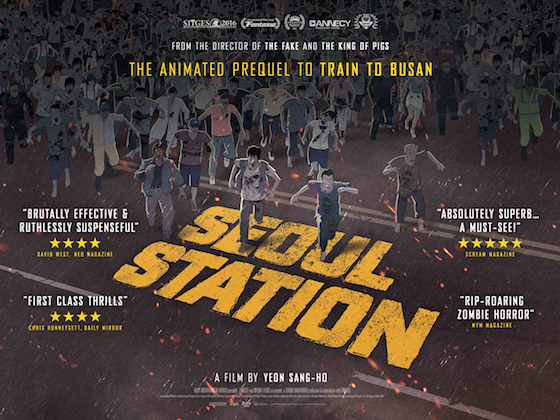
    Before he made zombie masterpiece Train to Busan, director Yeon Sang-ho was an animation director with several features to his name. So perhaps it’s not surprising that, to accompany his aforementioned live-action debut, he also helmed this animated prequel.

    Apparently set one day before the events of Busan (there’s no obvious indication on screen of how the films’ timelines line up), Seoul Station depicts events as the zombie outbreak expands at the titular transportation hub. Through this we follow Hye-sun (Shim Eun-kyung), a young runaway struggling to make ends meet living with her good-for-nothing boyfriend, Ki-woong (Lee Joon). Hye-sun’s father, Suk-gyu (Ryu Seung-ryong), has finally tracked her down, but arrives just after his daughter and Ki-woong have an argument and she runs off — and then the zombie thing happens. As Hye-sun struggles to escape the undead hordes, Ki-woong and Suk-gyu team up to search for her.

    Like Train to Busan, then, Seoul Station revolves around a struggling father-daughter relationship — though this one’s of a very different sort. That’s apparent from the off, but to say too much more would be a last-act spoiler. Suffice to say, it all comes to a very dark, grim ending, with none of the redemption or hopefulness of the main film. It also continues the live-actioner’s theme of other humans being the real villains, with the actions of selfish cowards being as much a threat to survival as the flesh-eating monsters. It feels like Yeon is being critical of Korean culture, taking potshots at the treatment of the homeless, the uselessness of the police, and more. Most of that stuff plays universally, mind, but the film hardly connects with it in a meaningful way. For example, we see one homeless guy struggle to get help for his injured and dying brother, as person after person either refuses help or begrudgingly does the least they can. “They should do more,” the film implies. But if they had, what would change? In this scenario, nothing — the guy’s been infected by zombie-disease; they’d all wind up undead too and it would spread faster.

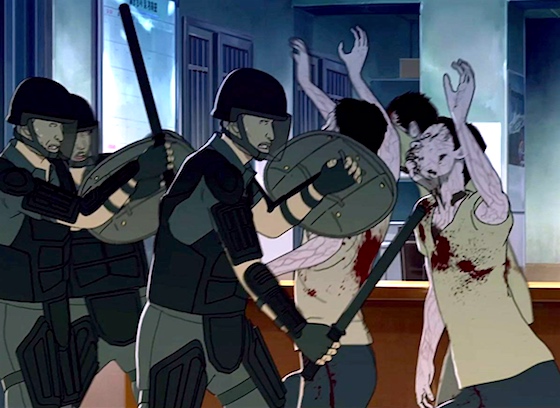
    Police brutality

    Half-assed social commentary aside, there are some really neat, original ideas in here, like a scene where Hye-sun must hold her nerve as she precariously tightrope-walks across the empty shell of a building, while behind her the mindless zombies throw themselves off the building onto the structure, their lack of dexterity leading most of them to plummet straight through it… but not all of them. Plus, as alluded above, there’s at least one solid twist. On the down side, it’s a bit slow — it takes 20 minutes for the zombie outbreak to start, for no particularly good reason; and though it mostly picks up after that, it occasionally loses focus again. The animation is of variable quality, too: some of it is very good, but at other times it feels kind of floaty, and there’s a very bizarre motion-blur effect applied to character movement.

    Unlike Train to Busan, Seoul Station can’t quite coalesce its good ideas into anything more meaningful than a zombie thriller. Plus, the ultimate grimness of the finale feels almost mean-spirited and cruel rather than pointed. It’s not a bad zombie flick by any means, but there’s an even better movie waiting to be refined out of its best ideas, and so it’s not as transcendentally great as its live-action forebear.

    3 out of 5

    The UK TV premiere of Seoul Station is on Film4 tonight at 11:15pm.

    Review Roundup: 15-Rated Comedies

    You don’t have to be an adult to like today’s reviewed movies, but… you do have to be a teenager. Still being a teenager would probably help you enjoy them, too.

    In today’s roundup:

  • Airplane II: The Sequel (1982)
  • Hot Tub Time Machine (2010)
  • Sausage Party (2016)


    Airplane II: The Sequel
    (1982)

    2018 #17
    Ken Finkleman | 81 mins | DVD | 16:9 | USA / English | 15* / PG

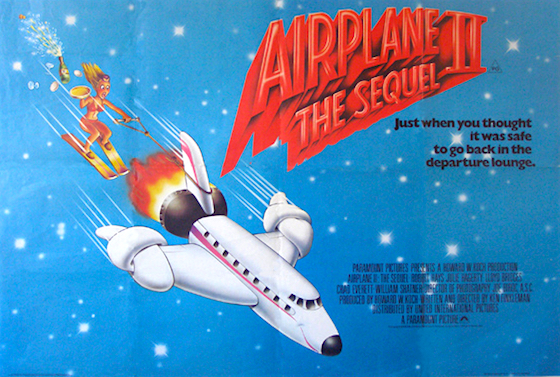
    Airplane II: The Sequel

    Comedy sequels are a funny business. Generally the first film’s been a big enough hit that people want to cash in, but can lightning strike twice? Well, the number of comedy trilogies (or more) suggests the answer is “yes”… or at least that enough people liked the first one enough that they went to see the second one and, regardless of what they actually thought of it, that persuaded people there should be a third.

    Airplane is widely regarded as one of the best comedies of all time. There is no Airplane III. Those two facts might suggest something about Airplane II — though it’s a film which even included a gag in its title, so it’s off to a good start.

    Watched now, over 35 years after its release, Airplane II has a certain vein of humour that hasn’t aged well. Ha ha, those two men kissed like they were a couple! Ha ha, that priest was looking at Altar Boy magazine like it was Playboy! Ha ha, everyone has to slap an hysterical woman! At least one of those gags would probably get you fired from a directing job at Disney nowadays… But to focus on those is to pick on the film’s weak points. Another would be that it has a few too many rehashes of jokes from the first one. Well, what comedy sequel doesn’t? That aside, much of the rest is pretty darn funny.

    3 out of 5

    * This was rated PG on its original theatrical release, but that was cut. The uncut version has consistently been rated 15 on video. ^

    Hot Tub Time Machine
    (2010)

    2018 #51
    Steve Pink | 97 mins | streaming (HD) | 1.85:1 | USA / English | 15*

    Hot Tub Time Machine

    I don’t know why I felt the need to watch Hot Tub Time Machine. Maybe just because it found its way onto my 50 Unseen list back in 2010 (I guess people talked about it at the time. Has it lasted? I don’t think so). Maybe because it’s got “time machine” in the title and so the sci-fi implication draws me in, especially as a Doctor Who fan. I don’t know. Whatever, it’s been vaguely on my radar for the past eight years and, when I wanted something undemanding one Friday night, its time finally came.

    As the title implies, it’s about a hot tub… that’s a time machine. Four dudes get in it and find themselves in the bodies of their ’80s selves. Except for one who wasn’t born at the time, who just finds himself in the past. Yeah, the logic of it is really shaky.

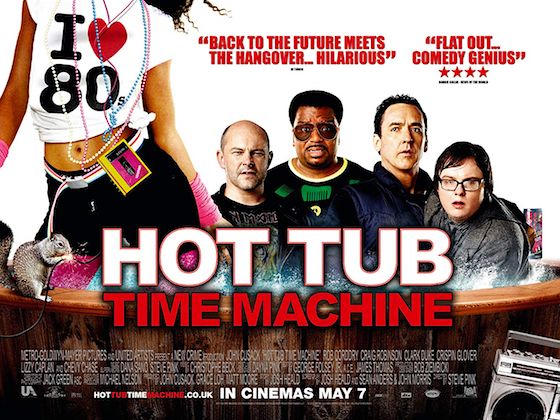
    Nonetheless, it actually has a couple of solid thematic and plot ideas buried away, to do with fate and second chances and stuff, but those are mired in execution that’s both derivative (of both Back to the Future and stuff like The Hangover — and, I swear, I hadn’t seen the quote on the above poster when I wrote that) and often unfunny (unless you really like that lowest-common-denominator gross-out stuff). There are some genuine laughs, but they’re infrequent enough that they might just’ve been accidents. Another part of the problem is that for the eventual pay-offs to work you need to be invested in the characters. The film makes half an attempt to give us reasons to care about the guys, but they didn’t connect for me. Maybe if that worked better, the later stuff would land too.

    I didn’t hate Hot Tub Time Machine — it was passably amusing for a time-filler — but it wasn’t great either. My score errs on the harsh side, because I definitely liked it less than other movies I’ve recently given 3 stars.

    2 out of 5

    * I watched the extended “unrated” version, hence no MPAA certificate. It’s less than two minutes longer (comparison here), with no material that would challenge an R rating. ^

    Sausage Party
    (2016)

    2018 #37
    Greg Tiernan & Conrad Vernon | 85 mins | streaming (HD) | 1.85:1 | USA & Canada / English | 15 / R

    Sausage Party

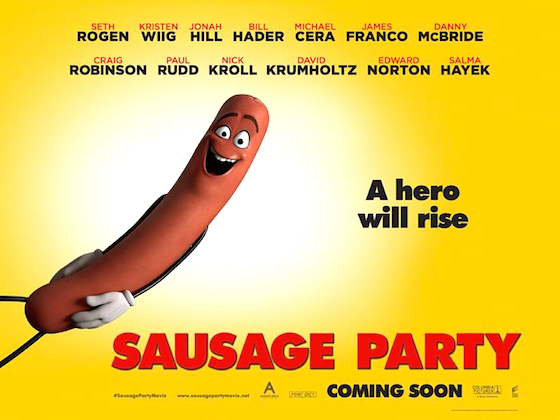
    A movie about sentient food that parodies the inherent stupidity of religion — I mean, what’s not to like? Well, it’s from the minds of Seth Rogen, Evan Goldberg, and co (Jonah Hill as a story co-credit), so if you don’t like their kind of humour…

    Certainly, it’s incredibly rude and crude — even more so than they’d necessarily intended: they were so certain they’d get an NC-17 rating from the MPAA that the version they submitted included some extra extreme material, the hope being that would act as a distraction so that what they actually wanted in the film would pass as an R. However, the MPAA only insisted on one relatively minor change. I imagine that was to the massive, long, graphic orgy scene. There are no words for it. And yet, it only got a 15 over here — you really have to be very extreme to get an 18 these days, huh? Or maybe it’s just because it just involved food…

    For all the eye-watering content, at least the film has the good grace to also be quite witty and clever at times. I guess some of the ‘satire’ is a bit on the nose, but it works for what it is. I mean, no one comes to a film like this expecting subtle social commentary, do they? And if the analogies for religious belief are a bit on the nose, well, maybe that’s what it takes to get through to those people…

    4 out of 5