
Peter Jackson | 144 mins | Blu-ray | 2.40:1 | USA & New Zealand / English | 12 / PG-13
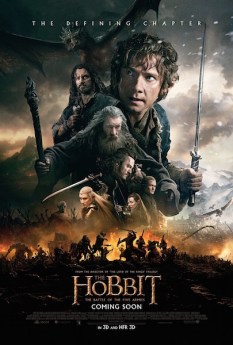 Peter Jackson’s epic Tolkien adaptation blunders its way to a conclusion with an instalment some have declared the trilogy’s best, presumably because they really enjoy watching someone else play video games. That’s what about half of this sextet-completing movie feels like, as it concludes the three-part Hobbit narrative with a CGI-riddled rendering of the titular battle. It’s the shortest film in Jackson’s Middle-earth magnum opus, though it comes to something when a film the best part of two-and-a-half hours long is described as “short”.
Before said battle, the movie finds itself with some business to attend to: we pick up immediately where the second part left off, with giant dragon Smaug flying towards Laketown with destruction on his mind. Kicking things off with a gigantic ten-minute action sequence isn’t a wholly bad decision pacing-wise, but this particular sequence is the wrong way to do it. Really, it’s the second film’s climax displaced — once Smaug is dealt with, a whole slew of new developments and subplots grow out of it, and that’s where the material that feels like it belongs in this film commences. Of course, that means there’s a lot of talking and manoeuvring, both politically and literally as people and troops shuffle about the board. Were it not for the big opening, there wouldn’t be an action sequence for about half the movie, and I guess that’s not considered acceptable in the modern blockbuster environment.
Now, if you were to watch all three films in one sitting, I suppose it wouldn’t matter precisely where the breaks fall. But how many people are actually going to do that? Not first-timers, that’s for sure. And then you’d get the problem of massive action sequences butting up against each other: the one that opens this film, right after the dwarfs-vs.-Smaug sequence invented during reshoots to take its place at the end of Film 2. Surely there were two other options available to Jackson when he made the decision to extend from a duology to a trilogy: he could have ended Film 2 before it even reached Smaug, 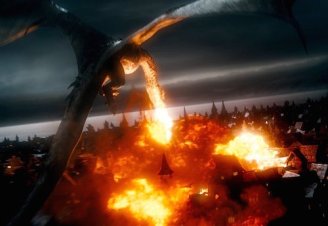 or he could have ended the second film with Smaug defeated and added more material to this third film to reach his desired running time. Or not even bothered adding stuff: if you lost the Smaug opener, The Battle of the Five Armies would still be over two hours long, which anywhere but Middle-earth is considered a decent length for a movie.
The rest of the film is a mixed bag for different reasons. For instance, Ryan Gage’s Alfrid is given a significant role — that’s the Mayor of Laketown’s assistant, if you’ve (understandably) forgotten who he is. Every minute that’s spent on his “comic relief” part is a minute wasted, and there are far too many minutes of it. Why that wasn’t left to the extended cut is anybody’s guess. It wouldn’t be particularly palatable there either — he’s just irritating, his actions predictable and unfunny — but longer versions are where there’s time for such indulgence. Conversely, Tauriel and Legolas are underused, wandering off on a completely aimless mission before wandering back for the battle.
Said battle feels a long time coming, but when it arrives… well, it’s a long time happening. It’s an epic by default, due to its sheer length. There are good bits, like the effort that has clearly been put into working out the armies’ tactics and the ebb and flow they would create. Wide aerial shots showing legions of troops swarming in formation, directed by generals with flags and horns mounted on high, are rather effective. 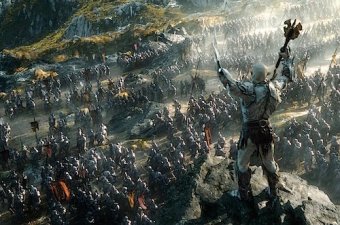 On the ground, the meat of the conflict only occurs when individual heroes are parcelled off into one-on-one duels. None of these particularly stand out, however, other than Legolas athletically jumping around a collapsing bridge that’s all so much CGI. This is where my earlier video game comparison really comes into play.
Some characters die. The impact is little-felt because of all the noise and bluster. That’s partly because there’s not really enough time for all the characters, of which there are more than ever. As with the second film, there’s been criticism that Martin Freeman’s eponymous Bilbo is barely featured, and, as with the second film, I disagree. Freeman’s not especially well-served in the acting stakes — Bilbo’s character development remains completed by the first part — but there’s still a focus on the actions of the little hero, some of which are pivotal.
Coming out of things best is Richard Armitage as Thorin, who succumbs to the paranoid madness that has afflicted generations of his family. Can he overcome it to do the right thing? The extent of this is sometimes laid on a little thick, but that’s the filmmakers’ fault (maybe this is another place that would benefit from a few trims) rather than Armitage’s performance. As the leaders of two of the titular armies, Lee Pace (elves) and Luke Evans (humans) also get a bit of a part to play, but the remaining dwarfs are given short shrift. That includes those played by James Nesbitt, Ken Stott and Aidan Turner, 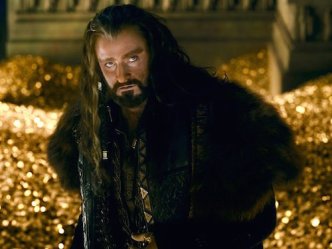 all of whom I’d thought would have more to do in the second and third parts of the trilogy. Turner, in particular, should have expected a bigger boost from Jackson’s decision to enrol him in an interracial romantic triangle, but it feels like they pulled back from that story thread a little after it proved unpopular in the previous film. It’s still obviously there, I just expected more of it.
On balance, The Battle of the Five Armies is probably the weakest of the three Hobbit films. Really, it’s just one big battle with a lengthy preamble. I can sort of see why Jackson felt like he could extend his original second film into a second and third — if you imagine them shorn of the reshoot-added bits, there’s still too much material for a single feature. The better solution, I suspect, would have been to accept splitting it into two shorter (i.e. regular-length) films, applying a bit of restraint in the process, rather than padding things further in an attempt to create two epics out of one ultra-epic.
As the credits begin, we’re treated to a sequence that emulates the one from Return of the King, with pencil sketches of the main cast alongside their names. On the Lord of the Rings concluder, it felt earnt; a special ending to a grand adventure. Here, it doesn’t. If anything, it feels like a reminder that the story we’ve just seen may have pushed to reach Lord of the Rings-level epicness, but is really just a tale of a small group going on an eventful hike, capped with a fairly large skirmish. A contemplative, momentous credit sequence does not feel warranted.
 I was something of a defender of Jackson’s version of The Hobbit at first. I enjoyed An Unexpected Journey and stand by my comment that, while it’s not The Lord of the Rings, it is the next best thing. As the trilogy has dragged on, however, it’s been dragged out, and the shine has gone off it. I still think there are elements to commend it, but I also think it could have been executed better. It’s hard to imagine an even longer version will improve much this time.

The Hobbit: The Battle of the Five Armies is released on DVD and Blu-ray in the UK on Monday.
My review of the Extended Edition can now be read here.
 As
As 


 At the start of their audio commentary on The Desolation of Smaug, co-screenwriters Peter Jackson and Philippa Boyens note that, when the decision was made to extend the already-shot Hobbit duology to a trilogy, it wasn’t a third movie that need to be created but a second. That is to say, it was the middle instalment that required the most extra material, including a new prologue and climax. The
 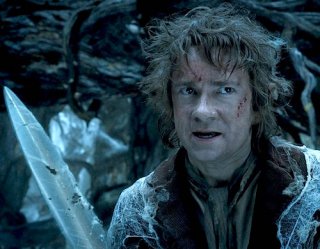 The extended cut amps him up even more, with an extra part in Mirkwood and a moment where he stands up for Thorin in Laketown. In fairness, he doesn’t have as much character development in this film as the first, while Thorin is on a definite arc and Gandalf is off on his own side-plot, but he’s undoubtedly a key character. I really don’t understand that complaint.
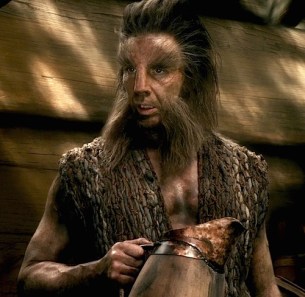 Even if some of the additions are worthless, on balance this is a better version of the film: more Beorn, more of the atmospheric Mirkwood, an additional character whose appearance will hopefully pay off in the extended
 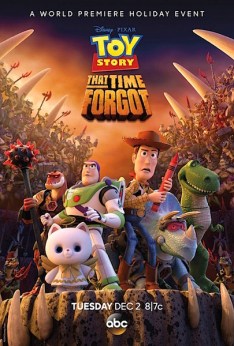 The second Toy Story TV special, and the fifth short adventure for the characters that perhaps should have had their last hurrah in
  The whole thing just feels undercooked. Apparently it took three years to make, with two of those dedicated to development. The Battlesaurs toy line was imagined in full, for example. There’s evidence of that on screen, but it’s just an impression that there’s a lot of background work we’re not getting to see. A TV special gives them limited time to explore the new world they’ve created, of course, but
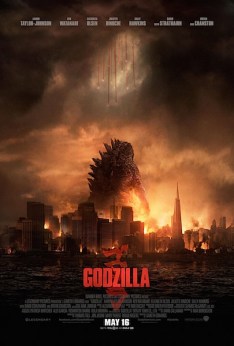 The second attempt at a US re-imagining of Godzilla received mixed reviews last summer, though there can be little doubt that it’s much more successful than the first,
  He’s denying us shots of it not to punish the viewer or to trick us, but literally to tease us, to build excitement and suspense and desire for the final battle. Too many people aren’t used to this — modern blockbusters have trained them for non-stop show-us-all-you’ve-got action from start to finish — and that’s a shame, and their loss, because Edwards’ method is superior to, and ultimately more entertaining than, 95% of other similar blockbusters.
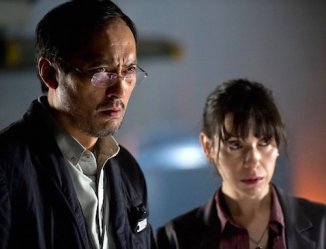 that simply aren’t present in the functional dialogue they have to work with, simply in the way they stand, the way they look at things… It’s not the focus of the film, it’ll pass many people by (indeed, it has), but I think there are some fine performances here. Not awards-winning ones, obviously, but in the hands of lesser actors, they would’ve been so much poorer.
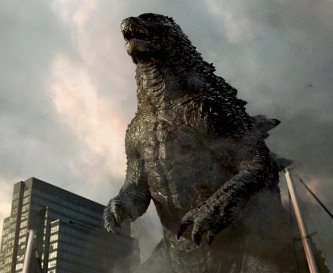 later, he slips quietly into the bay). Maybe, maybe not, but they always look big — more importantly, they feel big. There are various reasons for this, including Edwards’ shot choices: we often see them from a human perspective on the ground; when we do see wider shots, they’re from suitably far away, or high up, like a helicopter shot (if it were real…) Too many directors shoot their giant monsters with angles and perspectives as if they’re human-sized, which makes them come across as human-sized even when there’s a building next to them, never mind when they’re in places without reference points (coughatsea,PacifcRimcough). Edwards never does this, and it pays off. More than once I regretted that I can never be bothered to go to the cinema any more, because I bet this looked stunning on the big screen (I know I’m certainly
  most present big-budget summer tentpoles. That it got a little lost and under-appreciated in a summer of mega-hits is a real shame — it may not quite match summer 2014’s high points of
 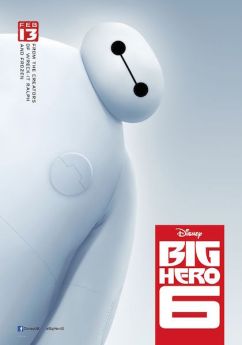 This year’s Best Animated Film Oscar winner is not this year’s best animated film. Not by a long stroke. What it is is one great character, one great emotional plot/subplot, and a lot of stuff that feels like every other big-budget action-orientated CGI animation of the past few years. Most succinctly, this is little more than (as
  The element that is an unequivocal success is Baymax. A soft robot — made of inflated vinyl so as to be genuinely huggable — he’s sweet, funny, and always entertaining. Memorable moments abound, in particular a sequence where his batteries run low, and his interpretation of a fist-bump (a recording booth improvisation by Adsit that was worked into the film). The movie truly comes alive whenever he’s on screen, but conversely loses some magic whenever he’s pushed into the background.
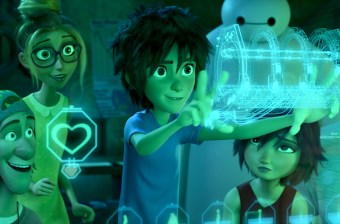 Big Hero 6 is by no means a bad film. It will certainly entertain its target age group, especially if they haven’t seen the other CG spectacles it nabs from. That aside, the entire thing is worth a look purely for Baymax and a few stand out moments — all of them involving the aforementioned vinyl robot, of course. Otherwise, it’s pretty by-the-book. The five-star-level praise it’s attracted in some quarters is completely unwarranted.
 Despite looking like a 100-minute toy commercial with an irritating theme song, plus a moral message about nonconformity that seems like it’ll get bungled (but doesn’t), The Lego Movie is so much more — and better — than that.
 The first film to be advertised in space (
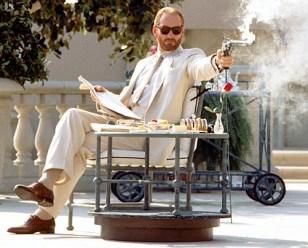 That said, it’s probably a good thing this isn’t a whole movie of “fictional characters in the real world” — you can imagine how that would play out; all the predictable “fish out of water” hijinks. However, at just over two hours, this isn’t a short film, and cutting out some of the middle wouldn’t have hurt.
 Robert Redford on a boat with no dialogue for over an hour and a half. That’s not a spurious way of describing All is Lost — that is what it is. Well, OK, he does say a couple of words — more or less literally “a couple”, though.
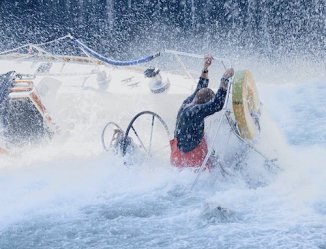 Through chance, coincidence, bad luck, but never forced tension-mounting on the part of the filmmakers (at least, not obviously so), our man’s fortunes go from bad to worse to even worse to even worse than that. Despite his best efforts, he’s on a downward spiral, a seemingly irreversible series of unfortunate events. If you ever had an interest in solo sailing, this is liable to put you off.
 Sometimes self-imposed filmmaking limitations lead to an exercise in competency over good moviemaking — “can we pull this off?” rather than “can we make a good film?” Chandor and co do pull their limitations off, I suspect not because someone set out purely to make a film with one character and no dialogue, but because it’s a gripping, exciting, tense movie, carried by a powerful near-silent performance and first-rate direction.
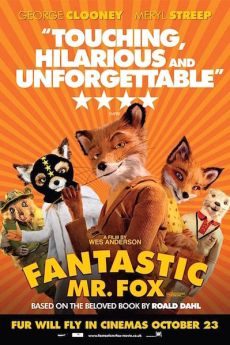 Quirky cult-y director Wes Anderson tries his hand at stop motion animation with this Roald Dahl adaptation, in which an all-star cast voice the tribulations of a gaggle of talking animals — led by the eponymous vulpine — who come into conflict with three vicious farmers.
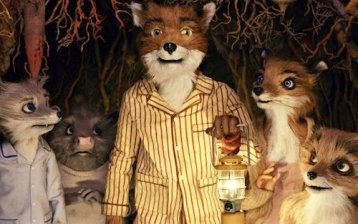 Compositionally, I thought I’d get sick of the squared-off 2D style, but Anderson’s cleverer than that. It might look flat and lacking in dimension at first, but that’s the starting point for variation, including some great bits of depth (farmer Bean trashing a caravan is a particular highlight of this), and when it breaks form (like a rabid dog chase) it’s all the more effective. There’s also a fantastic score by Alexandre Desplat. Not your usual plinky-plonky Quirky Kids’ Movie music (though there are instances of that), but something more raucous. Nice spaghetti Western riffs, too.
 Fantastic Mr. Fox is the kind of film I feel I may enjoy more on a re-watch. Indeed, some comments on film social networking sites (e.g.
  100Films.co.uk