
Pete Docter | 95 mins | Blu-ray | 1.78:1 | USA / English | U / PG
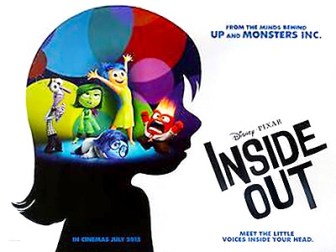 Pixar haven’t had the greatest start to the second decade of the 21st Century. After somehow managing to get lightning to strike thrice with Toy Story 3, they released two mediocre sequels (Cars 2 and Monsters University), and their only original film of the period, Brave, endured a mixed-to-poor reception also (I’ve still not got round to seeing it). This might go some way towards explaining why their release for this year has attracted such acclaim, despite it offering a pretty rote storyline dressed up in some fancy ‘original idea’ clothing (not that it is a truly original idea) and a modicum of genuine emotional resonance.
You see, this is the story of Riley (Kaitlyn Dias), an 11-year-old kid who moves from her small home town to San Francisco and struggles to cope. That’s because the anthropomorphised emotions who live in her head and control her moods and memories are thrown for six, especially when de facto leader Joy (Amy Poehler) and the accidentally-ruinous Sadness (Phyllis Smith) get sucked out of the control room and in to the depths of Riley’s memory, from where they have to find their way back in time to sort everything out. Fancy idea: anthropomorphised emotions. Rote storyline: mismatched pair get lost, have to find way back in time to fix things. Genuine emotional resonance: once-happy 11-year-old kid rendered miserable and struggling to find her place.
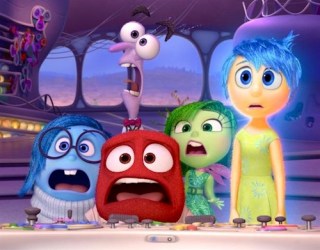 It surprises me not a jot that a Pixar film has been over-praised by critics and initial viewers. That’s pretty much my view of the their last couple of efforts before the recent doldrums, too. Those were, specifically, WALL-E and Up, both of which feature incredible, innovative, boundary-pushing openings followed by rote, familiar, genre-bound second halves. They’re both good films, but the five-star bits are contained within the first 10 to 30 minutes, followed by three- or four-star entertainments for the rest of the running time. Inside Out isn’t quite the same, because the super-high-quality bits aren’t concentrated anywhere. Instead they’re sprinkled here and there, moments of cleverness (though not genius — as I said, the concepts aren’t exactly original) hung on an easy, well-worn formula.
You don’t have to dig very deep into the Blu-ray’s special features to get an idea of how this happened. The story went through many, many, many iterations over the years and years it was in development. No wonder they wound up beating it into such a familiar shape as the quest narrative. It may also explain why some events don’t quite seem explained. I could’ve missed something, of course, but I was wondering why they were demolishing stuff in Riley’s Imagination Land until a deleted scene (culled from a very different take on the story) explained it. Many of the characters are just built from archetypes, too, like a sports-minded dad who doesn’t actually listen to mom — never seen that anywhere before!
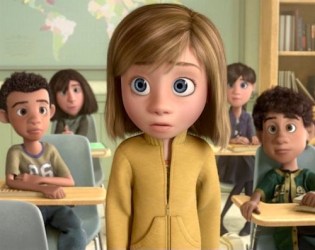 It certainly isn’t as clever or meaningful as some people have tried to make it out to be. For example, a whole internet discussion was sparked by the fact that Riley (an 11-year-old girl, remember) has emotions that are personified as a mix of male and female. When we get a glimpse inside other characters’ heads, their emotions are all of a single gender. ‘What is this saying?’, the internet wonders. Is it to do with the fact that all gender is fluid? That gender is fluid pre-puberty? As Riley is the only one with these mixed genders, are we meant to infer she’s transgender? Fertile ground for discussion. In fact, the answers are: no, no, and no. Director Pete Docter has said he just felt some emotions were more masculine (Anger in particular) and so that’s why they’re male in Riley’s head. Why the single genders in other characters? Shorthand. We only meet them briefly, after all.
Of course, now we’re touching on the issue of the relevance of authorial intent versus consumers’ reading of the final work, which isn’t a discussion I have much interest in engaging with right now. Suffice to say, whatever anyone’s readings of gender issues in Inside Out, none were intended by the filmmakers, and so you’re projecting something on to it rather than being able to unearth a coherent statement.
In other matters, there are some nice jokes and nods aimed squarely at adult viewers, the best being a passing reference to a ’70s noir. (Yes, really. Don’t worry, you’ll spot it.) Meanwhile, the animation and design is fine. I feel that’s the best I can say about it, 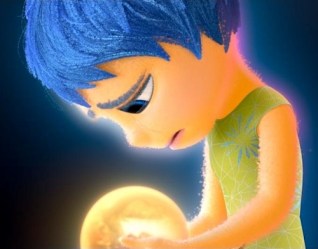 other than that the loose, floating, ‘bubbly’ edges of the emotion characters are quite neat. Apparently the effect was originally meant only for Joy and was immensely difficult to animate, but just as it was to be scrapped John Lasseter commented on how great it was and asked for it to be added to all the characters. Well done Mr Lasseter, though apparently it was an absolute headache for the technical team.
I do wonder if it’s just because this is the first really good original Pixar film for quite a long time (six years and five films on from Up, to be precise) that it’s gone down so well. It is good — there are some neat ideas and a strong moral lesson (even if, as with everything else, it’s not a totally original one; though from the way it’s discussed in some circles (not least the film’s own special features), you’d think it was a philosophical revelation of Nobel-winning proportions). In some respects, these qualities makes it almost a return to Pixar’s early praise-magnet form, which is enough for some to go wild for it. For me, the style and shape of the story those elements are airlifted into is so familiar that there’s little room for surprise (one highly emotional moment excepted). Maybe clearer heads will eventually prevail and people will rein it in a little.

Inside Out is released on DVD and Blu-ray in the UK tomorrow.
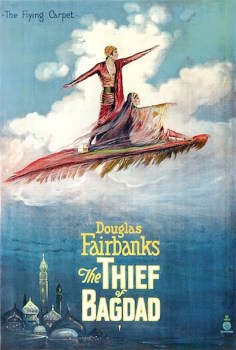 Douglas Fairbanks started out in comedies, where he was so popular he was quickly established as “the King of Hollywood”, which allowed him to attempt something different: an historical adventure film.
 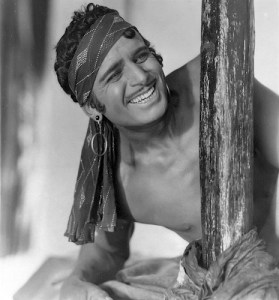 of course, which alerts the Mongol Prince to the attempted deception — though as he’s “the Governor of Wah Hoo and the Island of Wak”, he’s a fine one to talk. The thief manages to make it to see the princess anyway. She instantly falls in love with him, and he realises he loves her too, so can’t just kidnap her. His whole value system is undermined! But now he’ll have to win her hand by more honest means. Well, she already loves him, so he’s halfway there; but he’s an imposter, so there’s that to sort out yet.
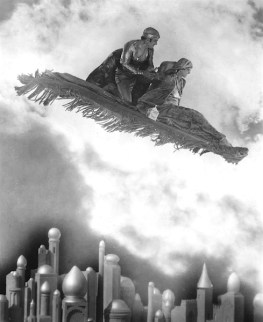 Even more impressive are the sets. The work of famed Hollywood designer William Cameron Menzies, at the time Fairbanks felt Menzies was too inexperienced to work on such a big project. Undeterred, he created a collection of detailed drawings and convinced the star/producer. No surprise that worked, because Menzies’ designs are extraordinary. His complex, detailed, unreal drawings are recreated accurately on screen (examples of this can be seen in the ‘video essay’ included on the film’s Blu-ray releases, for instance), using numerous techniques to create truly fantastical scenes: ginormous sets (they covered six-and-a-half acres), built on a reflective enamel floor (which had to be constantly re-enamelled throughout the shoot) and painted in certain ways to make them appear floaty; or glass matte paintings used to seamlessly extended or enhance shots. Reportedly 20,000 feet of film — that’s hours and hours worth — were shot just to test the lighting and painting of the sets.
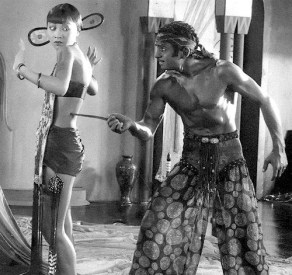 In a star-making supporting role, Anna May Wong is indeed memorable as a traitorous handmaiden. That’s more than can be said of her employer: Johnston is a bit of a non-starter as the princess, which I guess is what happens when you have to re-cast because your original choice departs part way through production. Comedian Snitz Edwards was also a mid-production replacement, drafted in to provide comic relief. It wasn’t necessary: he doesn’t add much, and Fairbanks had it covered.
 The second release in Warner Premiere’s series of direct-to-video DC Universe Animated Original Movies (which now stretches to
 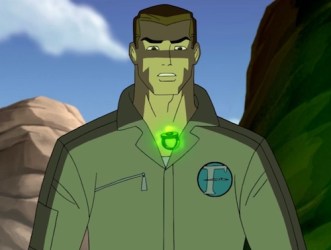 However, there are definitely bits that could’ve been sacrificed or abridged further (the Flash’s two early action sequences, for instance) to make more room to tell the story in full.
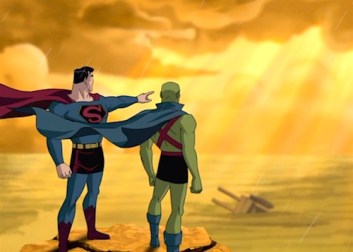 I really wanted to like The New Frontier, for all sorts of reasons. It does start well, with moments of promise sparkling here and there, but the longer it spends juggling so many balls, the fewer it can keep flying smoothly. (Do balls “fly” when juggled? Anyway, you get my point.) Considered as a whole, the overall result is fairly disappointing.
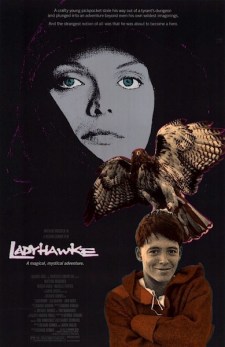 This is one of those films that crops up in the daytime TV schedules now and then and I’d always paid little heed to, because no one else seemed to. Then I read
  Here, there’s a good 45 minutes or so of mystery before said reveal. Obviously, therefore, it would work better as a fresh viewing experience if you didn’t know that going in; but it’s so fundamental to the setup (despite the focus on Philippe, it’s their story) that I wonder if anyone has ever seen it without knowing? On the bright side, it doesn’t really matter: this is not a film where the ‘big twist’ is the point.
 but Philippe occasionally addresses amusing asides to God, for example. It even wisely dodges special effects… most of the time. The few occasions on which it does make motions in that direction, it demonstrates why it was wise not to attempt them more thoroughly. These days they’d slather on the CGI, but shying away from such things is not just due to a lack of technology: it’s far more magical to not be too explicit.
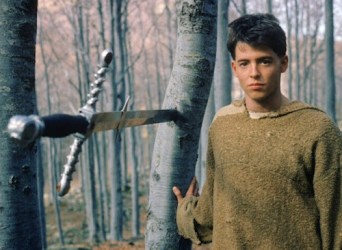 That’s the kind of age when one might be liable to fall in love with it; or, at least, people of (very roughly speaking) my generation would — I suppose Kids These Days fall in love with copious CGI, be that animated or ‘live action’. Anyway, I think it deserves to be less overlooked, and if you’ve never caught it (or not for a while) it certainly merits a chance.
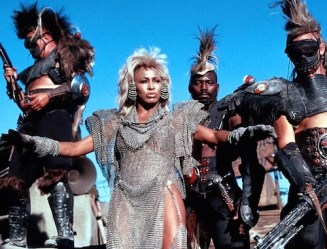
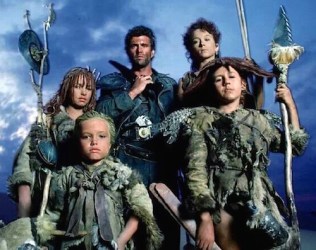
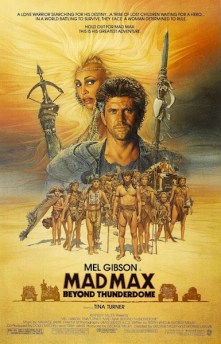 The third (and, for 30 years, final) Mad Max movie sees the titular post-apocalyptic drifter (Mel Gibson) rock up at last-outpost-of-humanity Bartertown in search of his pilfered car and camels. Max finds himself dragged before the town’s ruler, Aunty (Tina Turner), who has a job for him: kill the mutinous overseer of the city’s power supply, Master Blaster. As payment, she’ll arrange for the return of his belongings. The only conditions are he can’t reveal Aunty has employed him, and he has to do it in a fair fight in the town’s arena of combative justice — the Thunderdome. And then the story goes beyond that, funnily enough.
 I didn’t even notice the change in level until I read those comments afterwards. The film still reaches a 15 certificate in the UK, so clearly it isn’t toned down that much. And the lack of visible blood doesn’t mean it lacks creativity: Roger Ebert
  that have been forced to coexist because neither was enough to sustain an entire feature, but at least neither part feels unduly padded, meaning the narrative keeps on rolling. It doesn’t hit the same heights as the exceptional Mad Max 2 — especially with a climax that invites a direct comparison, and is good but not as good — but, as a post-apocalyptic action-adventure movie in its own right, it’s a good film.
 If you’re not au fait with the
  as both sides attempt to rally ordinary people to their cause through the power of the media. It’s a tale that’s as timely as ever, surely.
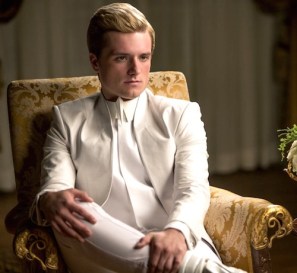 I must say that (as someone who hasn’t read the book) it didn’t feel overly like the first half of something longer to me. Of course there’s a cliffhanger and stuff, but there was at the end of the last film as well. This is no worse than that. If anything, I felt Mockingjay Part 1 built to its ending more successfully — I was quite surprised when
 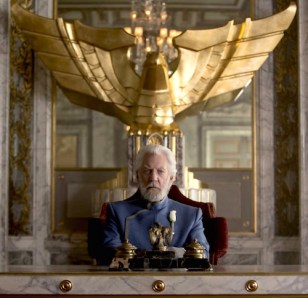 it may be your favourite instalment so far (and you wouldn’t be alone in that view). For me, Catching Fire is the best of the three because it crystallises both of those constituent elements; and if the first film was purely the action side (with a bit of the politics), then here we find its mirror image: purely politics (with a bit of action). Either way, perhaps the ultimate fate of all these films rests on how well
 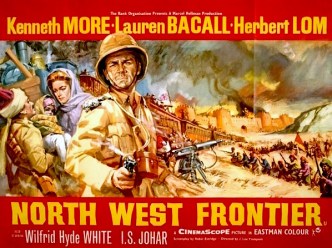 British Army Captain Scott (Kenneth More) is charged with getting an Indian child prince and his American governess (Lauren Bacall) to safety as rebels attempt to murder him. With the palace under siege, their only hope is a barely-ready rust-bucket train engine, a single passenger carriage, and a long journey through enemy territory joined by a motley group of diplomats and hangers-on who’ve bargained their way on to this last train.
 on the train by her governor husband, and Eugene Deckers is an arms dealer, who consequently no one likes but who remains unashamed of his trade. Through this prism there’s some discussion of the merits or otherwise of the British Empire and Indian independence, which some will judge to be extolling old-fashioned values, and others will take as little more than a (probably unnecessary) hat-tip in the direction of real politics.
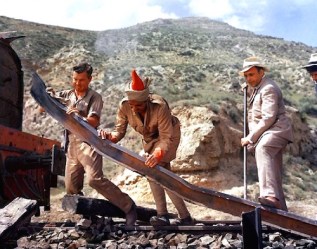 North West Frontier, on the other hand, sounds like a Western — which was perhaps the intention: the film’s structure and story style is fundamentally a fit for that genre, albeit British-made and geographically relocated. The storyline immediately brings to mind John Ford’s
 Four years ago, DreamWorks’
  Tonally, DeBlois has been productively inspired by
  If there’s a flaw, it’s in some of the new characters. The primary villain is underused, introduced too late in the game to become a palpable threat. More time spent building him up, seeing his evil on screen rather than just being told about it, would’ve been appreciated. So too for the mysterious vigilante dragon-rider, who turns out to have a very significant role. The deleted scenes include a prologue that would have introduced the character at the start, which would have better established the mystery and import of their role. It’s clear why it was deleted (to focus on Berk and keep the initial tone light), but I still think it would’ve worked better in the film. In the final cut, the vigilante is mentioned all of once, then turns up and is unmasked about two minutes later. Really, though, these are niggles — even for them, the cumulative consistency is certainly better than, say, its Oscar conquerer
  Nine months on from its theatrical debut, I’ve managed to remain remarkably spoiler-free about Interstellar, the ninth feature from director Christopher Nolan. “Matthew McConaughey lives on a farm and somehow ends up in space with Anne Hathaway,” is about all I knew going in. That and the somewhat divisive critical reception it had received, leaving what many had assumed could be an Oscar favourite with a disappointing tally of nominations (and its studio to have backed the wrong horse, resulting in
  More plot happens. Interstellar is the kind of film where you could get an awful long way through the story just trying to explain the setup. That’s a certain style of storytelling, and in its own way a positive one — a plot that is constantly moving and updating, rather than one that presents a basic setup, runs on the spot with it for a while, then wraps it up. The latter is how most narratives unfold, which is why reviews can so often summarise said setup and that’s fine. Nonetheless, Interstellar’s first act goes on too long, and could do with a good trim. (For an alternative view on why the first act is in some respects the best part of the film and needed more development, read
  Based on a skim through online reaction, some viewers would indeed love even more, while others would despise it. One thing I find interesting about this apparently diverse reaction is that you can find an abundance of negative/semi-negative comments and reviews by people who write such things, but nonetheless the average user scores on the likes of
 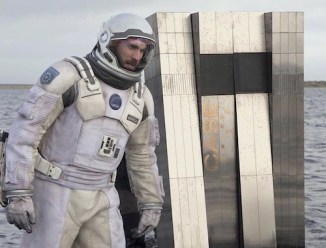 From a filmmaking perspective, there is surely nothing to fault. The visuals are incredible. As you’d expect, the IMAX footage looks absolutely stunning. Every time the Blu-ray reverted back to 2.40:1 I was a little disappointed. A sneaky part of me thinks Warner deliberately make these sequences look less good to ramp up the quality of the IMAX footage (I felt the same about
 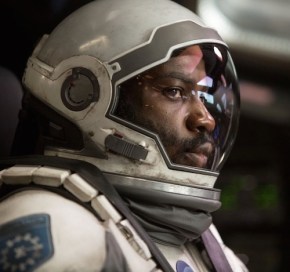 Anne Hathaway is largely understated, but slivers of emotion seep through when appropriate; and Michael Caine actually gets to do a bit of Acting in a Nolan film for a change, rather than just turning up as a wise old dispenser of exposition — though don’t worry, he does that too. One of the stand-outs for me was David Gyasi, getting a role that was subtly stronger and more thought-provoking than several of his more famous colleagues, and executing it with aplomb too. Similarly, the voices of semi-sentient robots TARS and CASE — Bill Irwin and Josh “he’ll always be ‘that guy from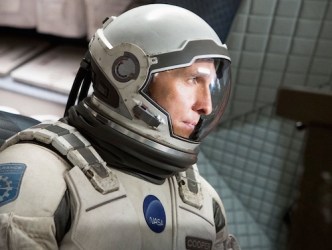
 The kids’ phenomenon of the ’80s/’90s has never quite gone away, and this film is one thing that kept it ticking over in the ’00s. I watched out of nostalgia, which may’ve been a mistake.
 100Films.co.uk