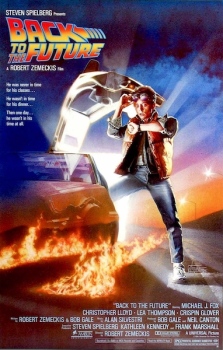
Back to the Future Part III (1990)

100 Films’ 100 Favourites #7

They’ve saved the best trip for last…
But this time they may
have gone too far.

Country: USA
Language: English
Runtime: 118 minutes
BBFC: PG
MPAA: PG

Original Release: 25th May 1990 (USA)
UK Release: 11th July 1990
First Seen: VHS, c.1991

Stars
Michael J. Fox (Homeward Bound: The Incredible Journey, The American President)
Christopher Lloyd (Who Framed Roger Rabbit, Things to Do in Denver When You’re Dead)
Mary Steenburgen (Parenthood, Step Brothers)
Thomas F. Wilson (Back to the Future, Born to Be Wild)
Lea Thompson (SpaceCamp, Some Kind of Wonderful)

Director
Robert Zemeckis (Death Becomes Her, The Polar Express)

Screenwriter
Bob Gale (Used Cars, Back to the Future)

The Story
With Doc stuck in 1885, Marty McFly must travel back to save him before he’s killed by Biff Tannen’s ancestor, Buford “Mad Dog” Tannen. With the DeLorean damaged during his arrival in the past, they also have to come up with a plan to get back to their correct time…

Our Heroes
Marty McFly finally grows as a human being as he learns some stuff this time, while Michael J. Fox also gets to ham it up a little as his Irish ancestor, Seamus. Christopher Lloyd, meanwhile, is still the one and only Doc.

Our Villain
It’s Thomas F. Wilson again, this time as Biff’s trigger-happy Wild West ancestor, Buford ‘Mad Dog’ Tannen. Who also gets covered in excrement.

Best Supporting Character
Mary Steenburgen is one of the few wholly original characters in either sequel, the love of Doc’s life, Clara Clayton. She’s also a confident, competent, and capable female character — a character type that’s only now ceasing to be a rarity in effects-y blockbusters, 25 years after this was made.

Memorable Quote
“Your future hasn’t been written yet. No one’s has. Your future is whatever you make it. So make it a good one, both of you.” — Doc

Memorable Scene
Marty and Doc hijack a train in the hope of using it to get the DeLorean up to the required 88mph. As the looted locomotive heads towards a mighty fall off an unfinished bridge, it turns out Clara is on board too. Tension! Action! Excitement! What more do you want from a climax?

Truly Special Effect
With the DeLorean destroyed, the film ends with a reveal of Doc’s new time machine, and it’s awesome.

Making of
There are tonnes of lines, jokes, characters, locations, and even background details referenced back and forth across the whole trilogy, but only one actual scene appears in all three: the moment Marty travels from 1955 to 1985. It’s the climax to the first film, then appears at the end of Part II, and consequently is in the ‘recap’ at the start of Part III.

Previously on…
Part III indeed: this picks up exactly where the second film left off, and they were shot back-to-back. It’s fundamentally standalone other than that, mind.

Next time…
As mentioned on the first film, Back to the Future has continued in an animated series, theme park ride, video game, and a comic book that started last year. Plus Doc Brown turned up in A Million Ways to Die in the West, so… there’s that…

Awards
2 Saturn Awards (Supporting Actor (Thomas F. Wilson), Music)
4 Saturn nominations (Science Fiction Film, Director, Supporting Actress (Mary Steenburgen), Costumes)
Nominated for the Hugo for Best Dramatic Presentation.

What the Critics Said
Back To The Future Part II teed off a lot of critics by not being a remake of the first film, and for daring to be a) complicated, b) very fast and c) heartless. Part III, which is slightly less fleet of foot, restores heart interest of the first film and has a satisfying complete storyline.” — Kim Newman, Empire

Score: 74%

What the Public Say
“One of the clearest indications of an excellent series is an ending is so satisfying you can’t even be mad the adventure is over. Part III delivers a happy ending so well-rounded […] there is no yearning for more story. I remember feeling quite content after seeing that movie for the first time; actually more like thrilled that the trilogy ended on such a great note.” — Avril Brown, Comics Waiting Room

Verdict

The consensus used to be that Part III was unquestionably the weakest part of the trilogy, a slightly bizarre Old West-set addendum to the first two. These days, I feel like an increasing number of people say it’s definitely better than Part II. Personally, I’ve always had a particular fondness for it. I’m not entirely sure why. Much like the second film, it can’t attain the perfection of the first movie, but it can be the next best thing — a fun and funny adventure with these great characters. And even as I say “they’re not as good as the first one”, I don’t wholly believe it: to me, Back to the Future never has and never will be just one film, or one film and its two sequels — it’s a trilogy; a three-parter. (So there.)

#8 will be… an alliterative origin.
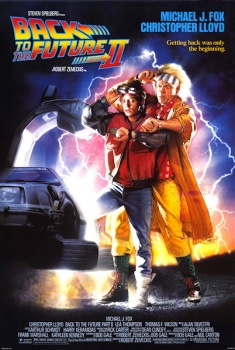

Back to the Future Part II (1989)

100 Films’ 100 Favourites #6

Getting back was only the beginning.

Country: USA
Language: English
Runtime: 108 minutes
BBFC: PG
MPAA: PG

Original Release: 22nd November 1989 (USA)
UK Release: 24th November 1989
First Seen: VHS, c.1991

Stars
Michael J. Fox (Doc Hollywood, The Frighteners)
Christopher Lloyd (Clue, The Pagemaster)
Lea Thompson (Red Dawn, Casual Sex?)
Thomas F. Wilson (Back to the Future, High Strung)
Elisabeth Shue (Adventures in Babysitting, Leaving Las Vegas)

Director
Robert Zemeckis (Who Framed Roger Rabbit, Cast Away)

Screenwriter
Bob Gale (1941, Interstate 60: Episodes of the Road)

The Story
Marty and Doc travel forward to 2015 to save Marty’s son from imprisonment, but this allows future-Biff to steal the DeLorean, taking it back to 1955 to allows his younger self to profit from future knowledge. Faced with a nightmare version of 1985, Marty must travel back into the events of the first movie to fix things.

Our Heroes
Michael J. Fox is not only Marty McFly, but older Marty McFly, and his son, Marty McFly Jr., and also… his daughter, Marlene McFly. Just in case you’d forgotten these were comedy movies, I guess. Christopher Lloyd, meanwhile, is the one and only Doc.

Our Villain
It’s Thomas F. Wilson’s Biff again, but this time he’s not just a bully, but someone who — thanks to his meddling in time — represents a threat to Marty’s whole lifestyle. And he’s a right nasty piece of work in the dystopian variant of 1985, too. Still gets covered in excrement, mind.

Best Supporting Character
Spare a thought for Marty’s girlfriend, Jennifer. The end of the first film has her getting in the DeLorean with Doc and Marty, because she was there and the ending was never intended to lead to anything (yes, kids, once upon a time movies weren’t made with the assumption there’d be sequels). Come the second film, Zemeckis and Gale were stuck having to integrate her into the story, which they did by… knocking her out early on and leaving her out of it.

Memorable Quote
“The time-traveling is just too dangerous. Better that I devote myself to study the other great mystery of the universe: women!” — Doc

Memorable Scene
30 years in the future, they’re still making crappy Jaws sequels. (The irony now is, in the real 2015 we were still getting often-crappy sequels to pretty much every major ’70s/’80s franchise except for Jaws.)

Technical Wizardry
You’ll believe a board can hover. Well, you probably won’t, but some people did. That’s just testament to how well made the sequence is.

Truly Special Effect
Quite apart from the hoverboard, the sequence where they first arrive in 2015 — a ‘road’ of flying cars in a rainy nighttime sky — is a triumph of model work.

Making of
For various reasons (possibly moral, possibly financial) Crispin Glover refused to return as Marty’s father, George McFly. Instead, the filmmakers used outtakes from the first film, as well as an actor wearing prosthetics made from casts of Glover taken for the first film. Glover objected to his likeness being used without permission, sued, and Universal settled out of court. More than that, it led to a change in contract rules at the Screen Actors Guild to stop the same thing happening again. (See also: The Four Musketeers.)

Previously on…
Not only does Part II pick up exactly where the first film ended, it goes back into its events and interacts with them.

Next time…
Part II ends with a huge cliffhanger, leading directly into the series’ final trilogy-forming instalment.

Awards
1 Oscar nomination (Visual Effects)
1 BAFTA (Special Effects)
1 Saturn Award (Special Effects)
3 Saturn nominations (Science Fiction Film, Costumes, Make-Up)

What the Critics Said
“Like its predecessor, Back to the Future Part II does not merely warp time; it twists it, shakes it and stands it on its ear. But as before, the film’s technical brilliance is the least of its appeals. Satirically acute, intricately structured and deftly paced, it is at heart stout, good and untainted by easy sentiment.” — Richard Schickel, TIME

Score: 63%

What the Public Say
“the biggest prediction the film nails is not any one piece of technology, but our reaction to it: indifference met with annoyance of its imperfections. The movie focuses not on what the technology can do, but on what it can’t. The skyway’s jammed. Marty’s hover board doesn’t work on water. The voice-activated home-entrance lights don’t turn on when Jennifer enters. […] What we get is “the future” as “the present.” None of the doom, destruction and dystopia of Blade Runner or The Time Machine. 2015 Hill Valley and 2015 Chicago are just like 1985 Hill Valley and 1985 Chicago, only with cooler stuff.” — Jack M Silverstein, ReadJack.com

Verdict

There are some who consider Back to the Future an all-time classic and think the two sequels are meritless wastes of space. There are others who see them as a complete trilogy of more-or-less equal quality. Considering that ever since I’ve seen them all three parts have existed, it isn’t much surprise I’m one of the latter. Part II may not have the elegant simplicity of the first film, but it still has plenty of original and exciting ideas, not least using the time travel conceit to go back into the first movie. It may not be as good, but it’s a fine adventure in its own right.

#7 will be… wicky wicky wild wild West.

Back to the Future (1985)

100 Films’ 100 Favourites #5

He was never in time for his classes…
He wasn’t in time for his dinner…
Then one day…
He wasn’t in his time at all.

Country: USA
Language: English
Runtime: 116 minutes
BBFC: PG
MPAA: PG

Original Release: 3rd July 1985 (USA)
UK Release: 4th December 1985
First Seen: VHS, c.1991

Stars
Michael J. Fox (Teen Wolf, Stuart Little)
Christopher Lloyd (Star Trek III: The Search for Spock, The Addams Family)
Lea Thompson (All the Right Moves, Howard the Duck)
Crispin Glover (Willard, Alice in Wonderland)
Thomas F. Wilson (Action Jackson, The Heat)

Director
Robert Zemeckis (Romancing the Stone, Forrest Gump)

Screenwriters
Bob Gale (I Wanna Hold Your Hand, Trespass)
Robert Zemeckis (1941, A Christmas Carol)

The Story
After Marty McFly travels back to 1955 in a time machine invented by his friend, Dr. Emmett “Doc” Brown, he accidentally prevents his teenaged parents from meeting. It’s up to Marty to make them fall in love and therefore ensure his own existence.

Our Hero
A star-making turn from Michael J. Fox as Marty McFly, cocky teen and guitar hero.

Our Villain
Thomas F. Wilson is Biff Tannen: in the ’80s, McFly Sr’s bullying supervisor; in the ’50s, McFly Sr’s high school bully. Prone to getting covered in excrement.

Best Supporting Character
An equally iconic turn from Christopher Lloyd as Doc, mad scientist extraordinaire.

Memorable Quote
“Roads? Where we’re going, we don’t need roads.” — Doc

Memorable Scene
The climax: Marty’s one hope to get back to 1985 is a bolt of lightning that will strike the town’s clock tower, which he can use to power the DeLorean. As the moment approaches, Doc battles to connect the wiring, and Marty must make sure the car is travelling at the right speed at the right moment… Well, of course they succeed, and Doc skips happily between the time machine’s flaming tyre tracks.

Write the Theme Tune…
In a rare case of an iconic movie theme from the ’70s and ’80s not composed by John Williams, Back to the Future’s memorable motif was composed by Alan Silvestri.

Technical Wizardry
To some, the DeLorean is a failed automobile. To a generation (and, probably, every generation since) it’s one of the most iconic movie cars of all time. “Are you telling me that you built a time machine… out of a DeLorean?” “The way I see it, if you’re gonna build a time machine into a car, why not do it with some style?” Genius.

Making of
It’s now quite well known that Eric Stoltz was originally cast as Marty, and had even started filming before it was decided he wasn’t right and was replaced with Michael J. Fox. This wasn’t after just a day or two of production, though: Stoltz filmed for four weeks, completing a significant chunk of the film. So much, in fact, that it wasn’t all re-shot with Fox: most of the material without Marty actually on screen was retained (Fox had to film reverse angles for dialogue scenes without the other actors present), and a couple of long shots in the finished film actually feature Stoltz.

Next time…
Two direct sequels (the first of which picks up immediately from the end of this one), as well as an animated series, an iconic theme park ride, a computer game from adventure maestros Telltale, an ongoing comic book that launched last year, and a semi-disastrous Secret Cinema event.

Awards
1 Oscar (Sound Effects Editing)
3 Oscar nominations (Original Screenplay, Sound, Original Song)
5 BAFTA nominations (Film, Original Screenplay, Editing, Production Design, Visual Effects)
3 Saturn Awards (Science Fiction Film, Actor, Special Effects)
6 Saturn nominations (Director, Supporting Actor (Crispin Glover and Christopher Lloyd), Supporting Actress (Lea Thompson), Music, Costumes)
Won the Hugo for Best Dramatic Presentation.

What the Critics Said
“though it is hardly one of the greater flights of cinematic imagination to be seen since science fantasy reared its head as mass appeal material again, it would be virtually impossible not to enjoy it in some way or another.” — Derek Malcolm, The Guardian

Score: 96%

What the Public Say
“nothing short of an example of screen-writing brilliance. Tightly pack[ed] and interwoven from the opening scene to the final ‘cliffhanger’ which, let’s face it, was never meant to be a cliffhanger as much as just a cool and intriguing ending to a stand alone film.” — nEoFILM

Verdict

Who knew a movie about mother-son incest could be one of the most entertaining family comedies ever made? That’s because it’s magnificently written, faultlessly performed, packed with inventiveness… oh, and because the mother is the same age as the son, doesn’t know he’s her son, and the incest doesn’t actually happen. Ah, time travel! A notoriously difficult sci-fi nut to crack, another reason BTTF succeeds is because it isn’t really about time travel. One of those times where talent and good fortune come together to craft perfect movie entertainment.

Roads? Where #6 is going, it doesn’t need roads…

The Lone Ranger (2013)

2015 #177
Gore Verbinski | 149 mins | streaming (HD) | 2.35:1 | USA / English | 12 / PG-13

Hated by Americans and loved (well, ok, “liked”) by everyone else (well, ok, “by lots, but by no means all, of people who reside outside America”), Disney’s attempt to pull a Pirates of the Caribbean on Western adventure IP The Lone Ranger is by no means as successful as the first instalment in their piratical franchise, but is at least the equal of its sequels — and, in some cases, their better.

The convoluted plot sees us arrive with John Reid (Armie Hammer) in the frontier town where he grew up, where his brother Dan (James Badge Dale) is now sheriff. Construction of the railroad is running by the town, spearheaded by Latham Cole (Tom Wilkinson), who letches after Dan’s wife (Ruth Wilson); but work is plagued by a band of outlaws led by Butch Cavendish (William Fichtner). Receiving information on his whereabouts, Dan rounds up a posse and heads out to tackle him, with John insisting on tagging along. Unfortunately it’s an ambush and they’re all slaughtered (oh dear)… except John just about survives, and is found and nursed back to life by a Native American, Tonto (Johnny Depp). He has his own grievances, and together they set out on a mission of revenge.

And if you’re wondering where Helena Bonham Carter is in all that: despite her prominence on many of the posters, her role is really just a cameo. That’s marketing, folks.

I know some people complain about simplistic stories that are used to just string action sequences together, and that’s a perfectly valid thing to get annoyed about, but The Lone Ranger swings to the other extreme and uses an over-complicated story to string together its action sequences. All it actually needs is a little streamlining, because the film is allowed to swing off into too many sideplots. This makes the middle of the film a slog, and you feel every minute of its excessive two-and-a-half-hour running time.
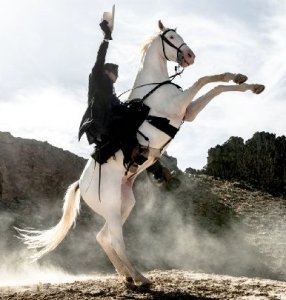
That slog is made worthwhile by what comes before and after said middle: a pair of train-based action sequences that are each truly fantastic. The second, in particular, is arguably amongst the grandest climaxes ever put on screen (providing you don’t feel it’s tipped too far into being overblown, of course). It’s inventively choreographed, fluidly shot, and perfectly scored with just an extended barnstorming version of the Lone Ranger’s theme music (aka the William Tell Overture). It’s an adrenaline-pumping action sequence that single-handedly justifies the entire film’s existence, if you’re into that kind of thing.

With multiple trains, horses, actors, guns, stunts, and copious CGI to tie it together, that sequence must’ve cost a bomb. Notoriously, the whole film was deemed too expensive and Disney insisted the budget be slashed, resulting in delays… and it still cost a fortune. That, quite apart from the negative critical response in the US, is a big part of why it flopped at the box office — a recurring problem for Disney at the minute. To be frank, I’m not convinced anyone made a truly concerted effort to stem the overspend. When a gaggle of CG rabbits hopped on screen, all I could think was, “who allowed this?!” You’ve got a massively over-budgeted film that the studio want cut back, and one reason for that is CG bunnies that have almost no bearing on anything whatsoever! The amount of time and effort that must’ve gone into creating those fairly-realistic rabbits for such a short amount of screen time… it cost millions, surely. Millions that could’ve been saved with a simple snip during the writing stage if only someone had said, “well, those bunnies don’t add anything and they’ll be bloody expensive, so let’s lose them.”
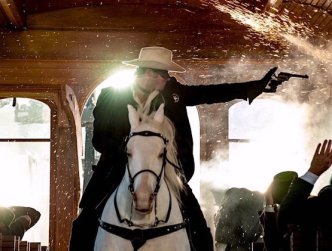
So criticism is not unfounded, but the film doesn’t deserve the level of vitriolic scorn poured on it by the US press and, consequently, public. Discussing this, the “critical response” section on the film’s Wikipedia page is interesting, and this part pretty much nails it:

Mark Hughes of Forbes, analyzing what he felt was a “flop-hungry” press desiring to “control the narrative and render the outcome they insisted was unavoidable” for a highly expensive movie with much-publicized production troubles, found the film “about a hundred times better than you think it is … [a] well-written, well-acted, superbly directed adventure story.”

I’m not quite as effusive as Hughes, but The Lone Ranger is worth the time of anyone who enjoys an action-adventure blockbuster. It’s a three-star adventure-comedy bookended by a pair of five-star railroad action sequences, which make the trudge through the film’s middle hour-or-so feel worthwhile. There was a better movie to be made here — one that was half-an-hour shorter, more focused, and probably several tens of millions of dollars cheaper to make — but that doesn’t mean the one we got is meritless.

4 out of 5

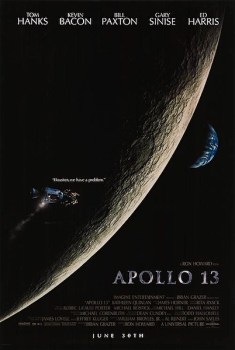
Apollo 13 (1995)

100 Films’ 100 Favourites #4

“Houston, we have a problem.”

Country: USA
Language: English
Runtime: 140 minutes
BBFC: PG
MPAA: PG

Original Release: 30th June 1995 (USA)
UK Release: 22nd September 1995
First Seen: cinema, 1995

Stars
Tom Hanks (Philadelphia, Saving Private Ryan)
Bill Paxton (Tombstone, Twister)
Kevin Bacon (Footloose, The Woodsman)
Gary Sinise (Forrest Gump, Snake Eyes)
Ed Harris (The Right Stuff, The Truman Show)

Director
Ron Howard (Willow, A Beautiful Mind)

Screenwriter
William Broyles Jr. (Cast Away, Flags of Our Fathers)
Al Reinert (For All Mankind, Final Fantasy: The Spirits Within)

Based on
Lost Moon, a true-story book by Jim Lovell & Jeffrey Kluger.

The Story
The third manned mission to land on the Moon launches to little public interest… but that all changes when an accident cripples the spacecraft. Not only will the three astronauts on board not be landing on the Moon, but they might not be able to make it back to Earth…

Our Hero
Everybody — from the three men who may die in space, to the spurned astronaut who locks himself in the simulator to find a solution, to the dozens of mission commanders and tech guys who work round the clock to keep the astronauts alive and bring them home.

Best Supporting Character
The whole cast are pretty great, but Ed Harris really earnt his Oscar nomination as the commander in Mission Control, Gene Kranz. (See also: memorable quote, below.)

Memorable Quote
NASA Director: “This could be the worst disaster NASA’s ever faced.”
Gene Kranz: “With all due respect, sir, I believe this is gonna be our finest hour.”

Memorable Scene
After surviving days in space on dwindling power, slingshotting the craft round the moon, and adjusting course last-minute to actually aim at Earth, the crippled remains of Apollo 13 enter the atmosphere. There will be three minutes of radio silence before they know if the astronauts have survived reentry. Everyone watches and waits. Silence. Three minutes is reached. Silence. Three minutes thirty seconds passes… In the command center, at the astronauts’ home, at Jay Lovell’s school, everyone waits. Four minutes passes… Goodness, it’s shamelessly manipulative filmmaking, but if your hair isn’t on end and you aren’t practically on your feet cheering with everyone else, you truly are immune.

Technical Wizardry
Gravity used a shedload of groundbreaking tech and computer graphics to simulate zero-G. 20 years earlier, Apollo 13 wasn’t so lucky, so how did they do it? In part, for real. Sets were built inside NASA’s (in)famous ‘Vomit Comet’, an airplane that flies in parabolic arcs to give astronauts an experience of zero-G, but only for 23 seconds at a time. With such a small window, shots to be achieved were carefully planned out, and cast and crew endured over 500 arcs in 13 days to film the necessary footage.

Truly Special Effect
The lift-off sequence, a combination of models and CGI without a single frame of stock footage, is iconic. For me, at least, the shot tracking down the side of the craft as the supports pull away is as indelible an image of an Apollo launch as any documentary footage.

Letting the Side Down
Two decades on, some of the CG effects (especially on Earth) are beginning to show their age. (The model work still looks grand, though.)

Making of
According to Ron Howard in a 20th anniversary interview, Tom Hanks was cast because they thought he was the actor the world would most want to save.

Next time…
The film was followed by 12-part HBO series From the Earth to the Moon, which tells the entire story of the US’s quest to put a man on the moon, from the creation of NASA to the end of the Apollo programme. It’s really good.

Awards
2 Oscars (Sound, Film Editing)
7 Oscar nominations (Picture, Supporting Actor (Ed Harris), Supporting Actress (Kathleen Quinlan), Adapted Screenplay, Art Direction-Set Decoration, Visual Effects, Original Score)
2 BAFTAs (Special Effects, Production Design)
3 BAFTA nominations (Cinematography, Editing, Sound)
1 Saturn nomination (Action/Adventure Film)
Nominated for the Hugo for Best Dramatic Presentation.

What the Critics Said
“In the end, this failed mission seems like the most impressive achievement of the entire space program: a triumph not of planning but of inspired improvisation.” — Terrence Rafferty, The New Yorker

Score: 95%

What the Public Say
“filmmakers combined elements most go to the movies for — drama, comedy, suspense, thrills, and tug of the heart. After reading Lost Moon I’ve come to appreciate the William Broyles Jr. and Al Reinert screenplay the more. Given the archival detail Lovell and Kluger documented, getting a good portion of it into a 140-minute movie was its own remarkable feat.” — le0pard13, It Rains… You Get Wet

Verdict

What could have been one of the US space program’s greatest tragedies turned out to be one of its greatest successes, a sensation that is conveyed by Ron Howard’s thrilling rendition of events. The film is too emotionally manipulative for some palates, but by and large it works magnificently for me. Bonus points are earnt for rejecting sycophancy in favour of depicting the people involved as human beings who endured and triumphed in extraordinary circumstances.

#5 will be… reached at 88mph.

Ender’s Game (2013)

2015 #146
Gavin Hood | 114 mins | streaming (HD) | 2.35:1 | USA / English | 12 / PG-13

Adapted from the classic young adult sci-fi novel by Orson Scott “bigoted idiot” Card, Ender’s Game is the story of Andrew “Ender” Wiggin (Asa Butterfield), who displays uncommon aptitude in a military programme to train children to fight against an alien race that attacked Earth decades earlier. Sent to a training centre in space, Ender must battle his fellow candidates to prove their worth to their hardened commander, Colonel Hyrum Graff (Harrison Ford), ready for the real battle to come.

Ender’s Game endured a pretty mixed reception a couple of years ago (not helped by the media exposure given to Card’s less-than-savoury personal views), and it’s quite a mixed film: for every positive, a negative follows close behind. It’s not helped by its first act, where the film seems to struggle with its own setup. After that, however, it’s a fairly well structured story, in which you can actually believe Ender is learning to be a better leader. Normally when a movie features “an excellent military strategist” we’re told that and never shown it, but here we see how Ender’s skills as a strategist develop and are exhibited.

The rest of writer-director Gavin Hood’s screenplay is, again, a mixed bag. The dialogue is frequently clunky, particularly struggling with exposition — there are utterly dead scenes where characters just explain the plot to each other — but, while it is at no point strong, it’s often serviceable. There are strong themes, however, several of which have relevance to our modern world. Unfortunately, none feel fully developed or explored. It tips its hat to things like drone warfare, child soldiers, and understanding our enemy, but that’s all it does: acknowledge those parallels exist, then refuse to explore them. Conversely, the music is too heavy-handed, taking on the burden of providing emotion that’s lacking from the screenplay.
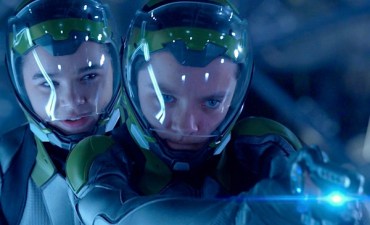
Most of the cast are very good. Asa Butterfield well conveys a moderately complex character, though I can believe others’ comments that Ender is more fully developed in the book. Hailee Steinfeld and Abigail Breslin offer able support; Harrison Ford proves he’s still awesome; Ben Kingsley battles what turns out to be a New Zealand accent (I’d assumed it was South African) in a cameo-sized turn; Viola Davis is ludicrously underused — she does basically nothing, then walks into Ford’s office and essentially declares, “I am no longer needed by the plot, I quit.”

At least there are solid action/sci-fi thrills on offer. The inter-student practice fights in the Danger Room (or whatever it was called) are really good — suitably exciting and fun, with impressive effects work. There are many good visuals in the film, but then strong CGI is par for the course these days. That’s why the space station stuff is best: the alien race and their planet are well-realised but also feel like nothing new; and the space station’s corridors, offices, and bunk room sets are well done, though as derived from familiar real-life and/or near-future styles as much as many other SF movies; but the station’s giant glass-walled zero-G training arena is stunning.

Sadly, after all that training fun, once the cadets jet off to the other side of the galaxy for a rushed third act, interest evaporates speedily. It even has to work hard to sell its own twist as a twist! (Spoilers follow in this paragraph.) In a simulation for a war, Ender does what he’d do to win that war. Then he’s told it wasn’t a simulation, it was the actual war… and he’s all cross. I mean, okay, the fella kinda has a point when he gets angry afterwards: they’ve lied to him, and maybe he would’ve behaved differently if he’d known. But the point of the training was to teach them what they needed to do to win, and it taught them that, and he did it. Maybe this twist works in the book, but in the film it felt somehow unearned.
Ender’s Game is not all it could be, but as a straightforward young-adult sci-fi action-adventure, I really rather enjoyed the majority of it.

4 out of 5

The 36th Chamber of Shaolin (1978)

aka Shao Lin san shi liu fang / Master Killer

2016 #6
Liu Chia-liang | 111 mins | streaming (HD) | 2.35:1 | Hong Kong / Mandarin | 15 / R

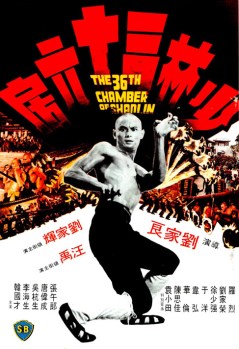
Widely regard as one of (if not the) greatest kung fu movies ever made, The 36th Chamber of Shaolin introduces us to San Te (Gordon Liu), a student whose hometown is oppressed by forces of the ruling Qing dynasty. He and his classmates join the underground resistance run by his teacher, only to wind up witnessing his friends and mentors be hunted, tortured, and killed. Faced with a similar fate, San Te escapes to the Shaolin Temple, widely known for being home to the best kung fu around. The temple’s monks refuse to teach martial arts to normal folk, nor help by joining the fight — they’re Buddhists, after all. Nonetheless, San Te manages to inveigle his way in to their company, and years of training begin.
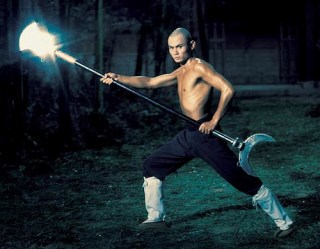
Said training — where San Te must progress through the Shaolin Temple’s 35 (not 36) chambers one by one — makes up the bulk of the film, though there are lengthy bookends dealing with the reason he goes there in the first place and what he later does with that training. If the notion of watching chamber after chamber after chamber (times 35) sounds dull, don’t worry, we only actually see ten of them, and several of those via an extended montage. The chambers take the form of challenges, which San Te must overcome by either puzzling them out or developing some kind of physical or mental acuity. Their content is varied and innovative, which makes them engrossing to watch even as they make the film episodic, but the nature of the challenges makes the movie different from the usual fight-after-fight-after-fight structure of kung fu flicks.

If it’s combat you want, though, never fear: everybody is kung fu fighting at regular intervals. Displays of physical skill and speed are de rigueur for these kind of films, but the combat here is as impressive as any. While the initial training takes the form of tangentially-related skills tests, San Te is eventually learning how to use weapons, and when he finally graduates from the 35th chamber he has to prove himself in combat, first against the temple’s justice, then when he returns to the outside world and seeks vengeance. Fights both with and without weapons are imaginatively choreographed and executed with the customary speed and precision.
Much as you won’t enjoy many a musical if you can’t accept people just bursting into song, you won’t enjoy many a kung fu movie if you can’t accept a story told primarily through back-to-back action sequences. The 36th Chamber of Shaolin is more-or-less that kind of movie, though the differing styles of the chambers’ challenges bring pleasing variety. Is it the greatest kung fu film of all time? I’m no expert, but it’s certainly inventive, masterfully performed, and suitably different from any such movie I’ve yet seen.

4 out of 5

The 36th Chamber of Shaolin is on Film4 tonight at 10:55pm. It kicks off a short season of martial arts movies — more details here.

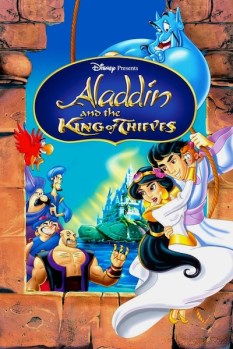
Aladdin and the King of Thieves (1996)

2015 #196
Tad Stones | 82 mins | streaming (HD) | 16:9* | USA / English | U

For most of the ’90s and ’00s, Disney churned out direct-to-video sequels to many of their most beloved animated classics. They have a reputation for being unremittingly awful, hence why Pixar’s John Lasseter put a stop to their production after he became Disney’s Chief Creative Officer in 2006. Despite that reputation, however, there are those who say one or two are actually quite good. One of those (and the only one I’ve previously seen) is The Lion King 1½ (released as The Lion King 3 in the UK), which is a sort of a Rosencrantz and Guildenstern Are Dead to the original film’s Hamlet, re-telling the story from the perspective of Timon and Pumbaa. I saw it years ago but would vouch for its relative quality — when I first re-watched The Lion King after, I briefly thought some scenes were missing, which I guess is testament to how well it fits.

Another such-praised sequel is this follow-up to Disney’s 1992 Animated Classic. It’s actually the second sequel (the first was also the first of those Disney DTV sequels) and also follows an 86-episode TV series. Fortunately, the makers dropped an early idea to use one of the series’ main villains as the film’s antagonist, and so it functions perfectly as a direct sequel to the original movie. Which is nice, because that first sequel isn’t meant to be very good and I imagine the TV series is hard to come by nowadays. Plus, neither of those can claim an ever-so-important distinction that this can: it features the return of Robin Williams as the Genie.

The film begins on the wedding day of Aladdin (Scott Weinger) and Jasmine (Linda Larkin), which is interrupted by the mysterious Cassim, the King of Thieves (John Rhys-Davies), and his gang of forty thieves seeking to steal an oracle from among the wedding gifts. Although they fail, the oracle informs Aladdin that the answers he seeks about his long-departed father are to be found with the forty thieves… I expect you can guess where that’s going. Fortunately the film gets there pretty quickly, then transitions into a story about the possible redemption (or not) of Cassim alongside the quest for the Hand of Midas, capable of turning whatever it touches into gold (natch).
The King of Thieves has a few things in its favour. It’ll come as no surprise that the biggest and best is Williams reprising his iconic performance, and consequently being responsible for most of the film’s humour. There are a couple of fun nods to some of Williams’ other best-remembered roles, and plenty to other Disney films too. The rest of the film offers a fast-paced, action-packed narrative, with a few musical numbers to boot. The songs are certainly not as memorable as those found in proper Disney movies, but most are decent while they last. Jasmine gets somewhat short shrift, but this is really a story about father and son.

Those who dislike Disney’s Aladdin won’t find anything to enjoy here, but for fans of the original, Aladdin and the King of Thieves is a solid, fun follow-up.

4 out of 5

* The film was made for release on VHS, so it’s no surprise that the OAR is 1.33:1. The HD version is cropped for 16:9. It’s mostly alright, though anyone with an eye for composition will find it obvious at times. ^

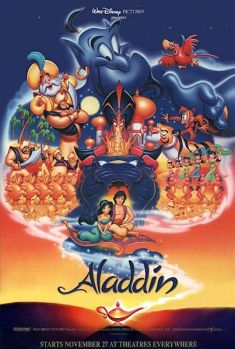
Aladdin (1992)

100 Films’ 100 Favourites #1

Imagine if you had three wishes,
three hopes, three dreams
and they all could come true.

Country: USA
Language: English
Runtime: 90 minutes
BBFC: U
MPAA: G

Original Release: 25th November 1992 (USA)
UK Release: 18th November 1993
First Seen: VHS, c.1993

Stars
Scott Weinger (Aladdin and the King of Thieves, Shredder)
Robin Williams (Good Will Hunting, Insomnia)
Linda Larkin (The Return of Jafar, Joshua)
Jonathan Freeman (The Return of Jafar, The Ice Storm)

Directors
Ron Clements (Basil the Great Mouse Detective, Hercules)
John Musker (The Little Mermaid, The Princess and the Frog)

Screenwriters
Ron Clements (The Little Mermaid, The Princess and the Frog)
John Musker (Basil the Great Mouse Detective, Hercules)
Ted Elliott (The Mask of Zorro, Pirates of the Caribbean: The Curse of the Black Pearl)
Terry Rossio (Shrek, Pirates of the Caribbean: At World’s End)

Story by
Deep breath… Burny Mattinson and Roger Allers, Daan Jippes, Kevin Harkey, Sue Nichols, Francis Glebas, Darrell Rooney, Larry Leker, James Fujii, Kirk Hanson, Kevin Lima, Rebecca Rees, David S. Smith, Chris Sanders, Brian Pimental & Patrick A. Ventura.

Based on
The folktale of Aladdin and the magic lamp from One Thousand and One Nights, aka The Arabian Nights.

Music
Alan Menken (Little Shop of Horrors, Tangled)

Lyrics
Howard Ashman (Little Shop of Horrors, Beauty and the Beast)
Tim Rice (The Lion King, Evita)

The Story
Street urchin Aladdin falls for bored Princess Jasmine when she sneaks out of her palace one day, leading him to the clutches of evil vizier Jafar, who needs Aladdin to retrieve a magic lamp as part of his scheme to rule the land. When Aladdin accidentally discovers the lamp’s inhabitant, a wish-granting Genie, he uses his wishes to set about wooing the princess. Jafar, of course, has other ideas…

Our Hero
One jump ahead of the bread line, one swing ahead of the sword, steals only what he can’t afford (that’s everything). Riffraff, street rat, scoundrel. It’s Aladdin, of course.

Our Villain
Grand Vizier Jafar, a plotting underling — the kind of role that has strong precedent in fiction, I’m sure, though Conrad Veidt as villainous Grand Vizier Jaffar in The Thief of Bagdad is rather clearly the direct inspiration.

Best Supporting Character
Oh, I don’t know, maybe… the Genie! Fantastically voiced by a heavily-improvising Robin Williams, praise is also deserved for Eric Goldberg’s character animation, which matches him every step of the way. In fact, it was an animation Goldberg created using one of Williams’ stand-up routines that convinced the comic to take the part.

Memorable Quote
Aladdin: “You’re a prisoner?”
Genie: “It’s all part and parcel, the whole genie gig. Phenomenal cosmic powers! Itty bitty living space.”

Memorable Scene
Trapped in a desert cave, Aladdin accidentally rubs a lamp and unleashes the Genie — and with it, Robin Williams’ all-time-great hilarious performance.

Best Song
For me, it’s Prince Ali, the huge Genie-led number as a disguised Aladdin arrives back in town in grandiose style. The Genie’s big solo number, Friend Like Me, is an incredibly close second. Soppy A Whole New World won all the awards, because of course it did.

Truly Special Effect
Only the second time Disney used CGI with 2D character animation. In Beauty and the Beast, it built a room for the characters to dance in; here, there’s a character (the entrance to the cave) and a whole action sequence (the flying carpet escape from said cave). It earnt the team a BAFTA nomination. There’s no shame in what they lost to: Jurassic Park.

Making of
Robin Williams ad-libbed so much of his role as the Genie — generating almost 16 hours worth of material, in fact — that the film was rejected for a Best Adapted Screenplay Oscar nomination.

Previously on…
Aladdin is Disney’s 31st Animated Classic, their official canon of animated movies. It’s the fourth film in the “Disney Renaissance”, the decade-long period (starting with The Little Mermaid and ending with Tarzan) when they had a run of films that were critically and financially successful (unlike those before and after said period).

Next time…
Two direct-to-video sequels, the second of which is quite good; in between those, a TV series ran for 86 episodes(!); a Broadway adaptation debuted in 2014 (it’s coming to the West End in May); not to mention numerous video games and appearances in other works, almost all still voiced by the less-starry names among the original cast. The go-to new voice for the Genie? Dan “Homer Simpson” Castellaneta.

Awards
2 Oscars (Original Song (A Whole New World), Original Score)
3 Oscar nominations (Sound, Sound Effects Editing, Original Song (Friend Like Me))
2 BAFTA nominations (Score, Special Effects)
1 Annie Award (Animated Feature)
3 Saturn Awards (Fantasy Film, Supporting Actor (Robin Williams), Younger Actor (Scott Weinger))
1 Saturn nomination (Music)
Nominated for the Hugo for Best Dramatic Presentation.

What the Critics Said
“What will children make of a film whose main attraction — the Genie himself — has such obvious parent appeal? They needn’t know precisely what Mr. Williams is evoking to understand how funny he is. […] What will come through clearly to audiences of any age is the breathless euphoria of Mr. Williams’s free associations, in which no subject is off-limits, not even Disney itself.” — Janet Maslin, The New York Times

Score: 94%

What the Public Say
“the perfect Disney film, one that cleverly combines the sensibilities of classic and modern audiences, one that matches toe to toe with many of the studio’s greatest films. You may prefer the emotional heart-ache of The Lion King or the romantic magic from Beauty and the Beast, but I would always prefer the witty and charming Aladdin.” — feedingbrett @ Letterboxd

Verdict

Hailing from slap-bang in the middle of the Disney Renaissance, Aladdin may not be quite as strong as the films either side of it (Beauty and the Beast and The Lion King), but it’s the next best thing. Buoyed by Robin Williams’ top-drawer performance (have I mentioned that yet?), multiple toe-tapping musical numbers, and a dastardly villain who’s among Disney’s best — and is just one of several great supporting characters here, actually — Aladdin is an A-grade animated Arabian adventure.

In #2 no one can hear you scream.

Sherlock: The Abominable Bride (2016)

2016 #1
Douglas Mackinnon | 89 mins | TV (HD) | 16:9 | UK / English | 15

Screened in UK cinemas simultaneously with its TV premiere (and coming to the big screen in various other countries over the next week or so, too), the latest episode of the BBC’s modern-day Sherlock Holmes series is actually a standalone adventure set in the character’s original Victorian time period.
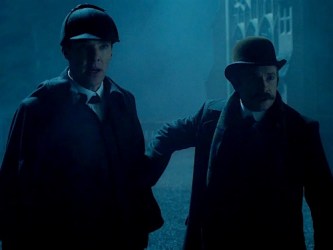
The rest of this review will be spoiler-filled, but before I get into that I’ll say this: if you’re someone who’s a Sherlock Holmes fan but not keen on Sherlock and are wondering if the changed temporal setting means this special might be of interest to you, then I think it’s fair to say it won’t.

1895: detective Sherlock Holmes (Benedict Cumberbatch) and his sidekick / companion / chronicler Dr. Watson (Martin Freeman) learn of the case of Emelia Ricoletti, who committed suicide by shooting herself in the head in public… and then later that evening murdered her husband. Despite the intriguing impossibility of the crime, Holmes’ thoughts are for some reason preoccupied with his deceased nemesis, Prof. Moriarty…

It would’ve been a bit weird if Sherlock completely abandoned everything that has marked the series out for an aside of an adventure in Victorian London, and so it is from the start. While there is certainly a different feel — not just the obvious trappings of horse-drawn carriages, candlelight, costuming, and so forth, but in the way the characters speak and behave — it’s still spun from the same cloth as the regular series. These are recognisably the Holmes and Watson we commonly know as Sherlock and John, surrounded by versions of Mrs Hudson, Mary Watson and Inspector Lestrade that aren’t so very different from their present-day incarnations.

The case they find themselves embroiled in is a little more period than usual, however, with lashings of Gothic and some of the trappings of a Christmas ghost story. The episode is co-written by series creators Mark Gatiss and Steven Moffat, and anyone familiar with Gatiss’ wider work can clearly see his influence here. Moffat brings his trademark fast-paced intricately-tricksy plotting, for which individual viewers’ mileage varies greatly: some find it genius, some find it tedious. Is it clever, or does it just think it’s clever? Is it impossible to follow, or were you just not paying enough attention? As to the first question, I think it’s a bit of both; as to the second, I think the episode ultimately answers everything, but you might need to realise a few things for yourself.
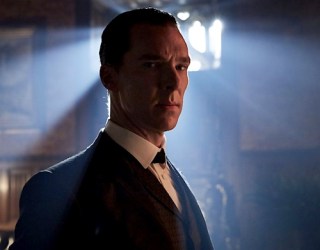
Much of The Abominable Bride is a lot of fun. The mystery is fairly engrossing, though we’re frequently sidetracked into character interplay — such is Sherlock’s way. There are many entertaining scenes of this, however, not least Holmes and Watson’s arrival at the Diogenes Club and the state of the version of Mycroft they find therein. Douglas Mackinnon’s direction is atmospheric, retaining the series’ usual flashy, whizzing editing and camerawork at times, and incorporating suitably horror-esque elements at others. Anyone after a fully traditional take on a Victorian Holmes and Watson can always revisit Jeremy Brett — here we have Victorian Holmes through the filter of Sherlock, and it works.

Until the last half-hour or so, anyway, when the modern version suddenly comes crashing in. At first it seems like a clever interlude; a little reminder of the true time period for this version of the characters, and a tease for season four. But it quickly transpires that, no, this episode isn’t actually a wholly standalone aside from the main series — Gatiss and Moffat have found a way to integrate it into continuity. For me, this is where the special begins to come apart at the seams; not because I inherently object to this integration, but because from that point on the episode begins to jump back and forth between the present, the imagined past, and various other dream-state asides. It’s almost entirely justified by the beautifully-shot Reichenbach Falls sequence, but a spot of cinematographic prettiness doesn’t really excuse the way the story goes a little haywire. The least successful part of all, for me, is that it calls into question the solution for the case we’ve just been presented with… but then doesn’t get round to offering another, meaning you kind of feel like the case hasn’t been solved, even though it presumably has been, with the first solution. I think.
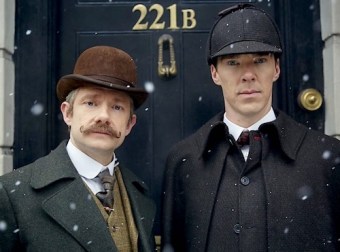
All of which kerfuffling makes The Abominable Bride a tricky beast. From the promotional trailers and blurbs, it may’ve looked like a standalone Victorian Sherlock Holmes adventure that happens to star the cast of the present-set Sherlock — hence why I felt it worth offering that clarification back in paragraph two, because, despite not being connected to a full series (the next one of which will probably appear in exactly one year’s time), in reality this is Episode 10 of Sherlock — and, tonally, feels like it.

As someone who enjoys Sherlock Holmes in his proper era but is also a fan of this modern day version (I would say “a big fan”, but I’m not one of those people), I’d rather they’d played this a little more straightforward. Not a lot — it’s still under the umbrella of Sherlock after all, and the era-transposed stylistic flourishes in the first hour-ish worked very nicely in my opinion — but the mixed-up mishmash of the final act dilutes the effectiveness of the entire experience. There’s fun and thrills to be had along the way, but in another form it could perhaps have been a Sherlockian classic in its own right.

4 out of 5

Sherlock: The Abominable Bride is available on the BBC iPlayer for most of January. It’s in cinemas worldwide over the next few days, including in the US on the 5th and 6th. An extras-filled two-disc special edition is out on the 11th.