
Taika Waititi | 101 mins | streaming (HD) | 2.35:1 | New Zealand / English | 12 / PG-13

The most recent feature from the director of the very-different-to-each-other What We Do in the Shadows and Thor: Ragnarok, this very-different-again* adventure-comedy-drama was a surprise hit in its native New Zealand, then around the rest of the world, before it wound up as Empire magazine’s pick for the best film of 2016.
Young Ricky Baker (Julian Dennison) is a delinquent who’s been rejected by every foster family in the city, so in a last-ditch attempt to avoid juvie he’s homed at the remote farm of kindly Bella (Rima Te Wiata) and her terse, irritable husband, Hec (Sam Neill). Despite initial misgivings, Ricky warms to his new home, so when child services threaten to take him away again he runs away into the bush. He’s soon found by Hec, but as child services launch a nationwide manhunt for the missing pair, they decide to go on the run as fugitives.
So yes, let’s get the obvious out of the way: Ricky and Hec end up bonding and working together and all that jazz. But this isn’t the kind of movie where it’s all about developing mutual respect and having heartfelt hugs and making declarations of everlasting father-son love. Well, maybe it is a little, in its own way — but it’s also the kind of movie where they (spoilers!) write awesome birthday songs, end up in a punch-up with some hunters, steal all-important loo roll, meet a girl worthy of the old Flake adverts, eat relaxing sausages, stumble into a vicious fight with a giant boar, and engage in the wildest third-act police car chase since… I dunno, Blues Brothers or something.

Writer-director Waititi (adapting the book Wild Pork and Watercress by Barry Crump) keeps a fairly tight hand on the film’s tone, a slightly leftfield view of the world that isn’t as extremely stylised as, say, Wes Anderson, but nonetheless is heightened beyond the normal boundaries of real-life. I only say a “fairly tight” grip because a couple of comic cameos arguably stretch things a little too far, but that’s a minor complaint. Mostly he’s skilful in balancing the comedy with genuine emotion, so that the former never neuters the latter, but equally the latter never dares become too sickly. The events of the plot may not be plausible, but the emotional underpinnings are.
Nonetheless, it’s regularly hilarious, especially when centred on Dennison and Neill’s interactions. It’s the kind of role and deadpan performance that will no doubt have some hailing Dennison as a real find, and maybe he will be, or maybe he’ll go the way of most child stars with “breakthrough” roles like this and never be heard from again. Pardon my cynicism, but it seems to be such a perfect marrying of actor and role that I’m not sure it marks the start of a glittering career so much as one superb turn. Maybe I’m wrong; time will tell. Neill, on the other hand, juggles grumpiness, likeability, and pathos in a manner that suggests his near-relegation to “the guy from Jurassic Park” for the last quarter-century is a real shame. I’m not intending to dismiss everything he’s done between then and now (some of which I’m a definite fan of), but this is likely the best showcase of his abilities for a long time.

The rest of the cast don’t shirk, with particular note to the kind of double act performed by Rachel House and Oscar Kightley as (respectively) the ‘dedicated’ child services agent and her escorting policeman who lead the manhunt. Whoever was in charge of the soundtrack did an excellent job with several amusing song picks, while the highlight of the score (credited to three composers) is an unusual use of the increasingly ubiquitous Christmas tune Carol of the Bells (the scene in question has nothing to do with Christmas, for starters). Cinematographically, DP Lachlan Milne makes marvellous use of New Zealand’s truly majestical scenery — well, why wouldn’t you?
Whether or not Hunt for the Wilderpeople is the best film of last year is immaterial — I mean, it’s a little film from a small country on the other side of the world: it’s not like it’s going to be in competition this awards season, is it? But maybe it should be. Few films get to be this funny without being overworked, this sweet without being cloying, and this quirky without being keraaazy, all at the same time.

In the UK, Hunt for the Wilderpeople is available on Netflix now, and is released on DVD and Blu-ray tomorrow.
It placed 4th on my list of The 17 Best Films I Saw For the First Time in 2017, which can be read in full here.
* Well, from what I know they all seem very different to each other — I’ve not seen the other two. ^



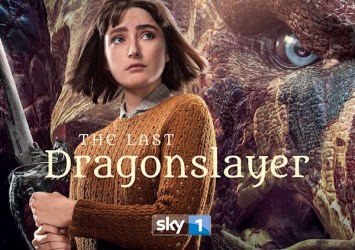 I’m not sure whether to commend or condemn Sky1 for having the balls to schedule a light family-friendly fantasy drama against
 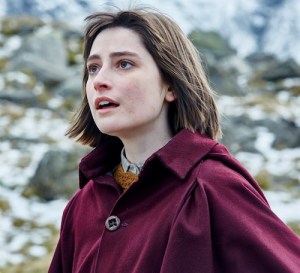 About now you’re probably thinking The Last Dragonslayer is completely derivative of every other major young-adult fantasy franchise of the last… well, forever. It’s hard to deny that the plot is, at least in its broadest thematic strokes, a pretty familiar affair. What makes the enterprise worthwhile is its humorous execution. This isn’t a spoof of the genre, more a satirical mash-up of familiar fantasy building blocks and modern life. So, for example, the king’s chief knight is also a pop star, followed around by a gaggle of adoring female fans; when Jennifer finds herself in need of money, her dragonslaying assistant signs a sponsorship deal with soft drink brand Fizzipop that requires her to film an advert, make at least two promotional appearances, and wear a branded T-shirt until the dragon is slain. It’s this whimsical slant on our world that is arguably Dragonslayer’s most successful aspect.
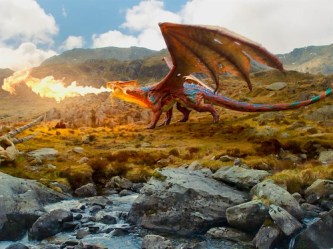 I guess The Last Dragonslayer’s irreverent, sometimes silly tone won’t be to all tastes, but I enjoyed it very much. Unsurprisingly (all things considered) the book is the first in a series, and so not everything is fully resolved by the film’s end. Let’s hope that, in spite of their scheduling, it’s done well enough for Sky that sequels are forthcoming.
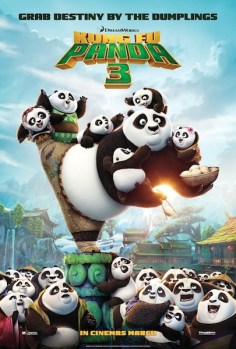 Po and co are back in a movie that bucks the sequel trend by being perhaps the best Kung Fu Panda yet.
 I hope for humanity’s sake the version on Sky Cinema retains the original voices.
 At the tail end of last month, a story did the rounds on entertainment sites about a fan edit that took the eight-film, 20-hour Harry Potter series and reduced it into a single movie that ran just 78 minutes — a reduction of over 93%. You see stories about these kind of fan edits all the time (or you do if you read certain sites, anyway), but I usually don’t get round to watching them. I mean, who has time for a dozens-of-hours supercut that puts every piece of footage from every Marvel movie (and short) into chronological order, or whatever? But as I was
 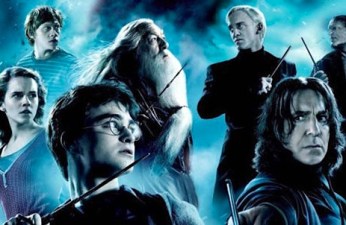 Wizardhood focuses in on the main narrative of Harry vs Voldemort, and the need to destroy the Horcruxes. In practice, that means there’s a chunk of
  The first live-action non-saga movie to take us to a long time ago in a galaxy far, far away, this initial entry in what is sure to be a never-ending series of so-called “Anthology” movies really puts the “War” into Star Wars.
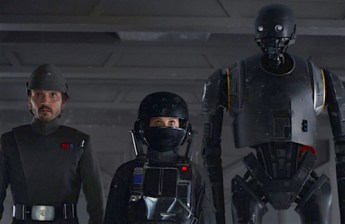 Unfortunately, the plot starts off almost as jumbled as my mixed metaphors there. “Jumbled” may be unfair, but it’s a little scrappy, initially jumping around all over the place in a way that’s tricky to follow even if you’ve read up on the film and have an idea who you’re being introduced to and why. It must be a right pain for neophyte viewers. There can be a fine line between praising a film for requiring its viewers to pay attention and do some work, and criticising it for being disarrayed and not making things clear. Personally, I thought Rogue One was sat right on that line for much of its first act, until a few big expositional infodumps come along to explain the storyline.
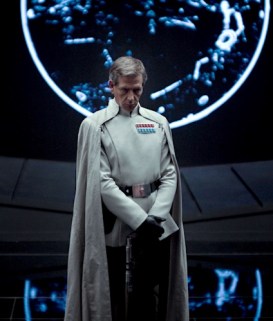 Then we come to perhaps the film’s most discussed character: Grand Moff Tarkin, played by Peter Cushing’s computer-generated face overlaid on the motion capture and voice of
 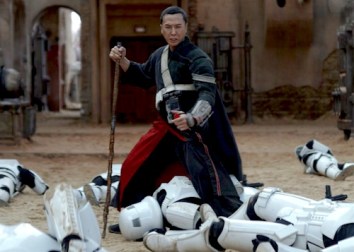 Continuing such comparison to the wider Star Wars galaxy, some have said Rogue One is the
  Much discussion of Rogue One seems to have revolved around whether it’s better than The Force Awakens. At the risk of sitting on the fence, I can see both sides. On the one hand, Edwards is a much more interesting filmmaker than J.J. Abrams. The latter is adept at aping the work of others, having now been in charge of multiple movies that are mostly derivative but nonetheless entertaining. Edwards’ career is still a little fresh and blockbuster-centric to risk describing him as an auteur, but his

 Score:






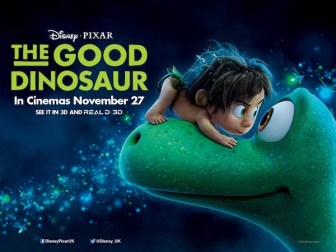 Once upon a time, Pixar could do no wrong. Then
  Pixar have on several occasions produced films with an innovative opening act that descends into derivative kids’ animation runaround territory.
 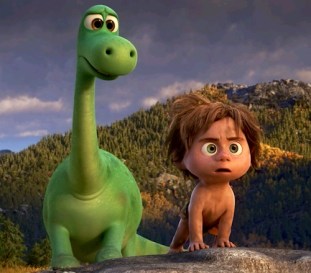 Perhaps most powerful of all is the relationship it creates between Arlo and a young human child he befriends, Spot. With humanity in a much earlier state of evolution, Spot is basically characterised as a dog — the way he moves, comes to his name, follows scents, shakes, scratches and enjoys being scratched, and so on — so of course I warmed to him. Nonetheless, though the building blocks used to create their friendship are very familiar, the way the film sells its emotional arc is ultimately immensely effective. Its resolution may even bring a tear to the eye.
 100Films.co.uk