Zatoichi Goes to the Fire Festival (1970)

aka Zatôichi abare himatsuri

2019 #80
Kenji Misumi | 96 mins | Blu-ray | 2.35:1 | Japan / Japanese | 15
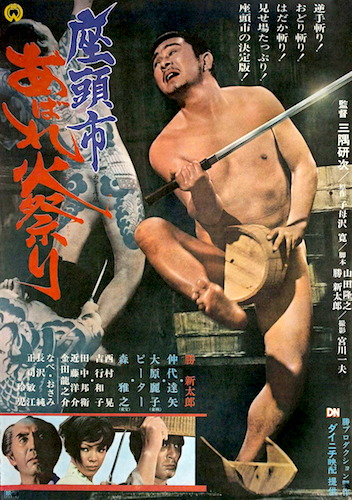
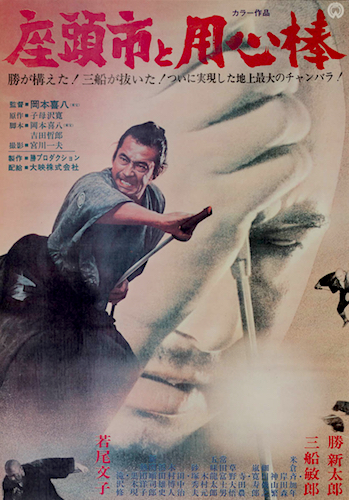
Zatoichi Goes to the Fire Festival

No, this isn’t a film about a samurai at a ‘luxury’ music festival (and that’s the extent of Fyre references you’ll get here, because I’ve not watched either documentary and don’t really know much about it). Rather, this 21st entry in the long-running Zatoichi series (once released on UK DVD as Zatoichi at the Fire Festival, and also known by sundry other variations of those words) sees the eponymous blind masseur-cum-swordsman clash with evil underworld boss Yamikubo (Masayuki Mori). This boss is as blind as Ichi, which he initially uses to claim a kinship with the masseur, but then Yamikubo engages in a series of schemes to kill our hero. Meanwhile, a nameless ronin (Tatsuya Nakadai) stalks Ichi too, intending to kill him for an imagined slight.

More or less business as usual for a Zatoichi adventure, then. The blindness of the villain should really add an extra frisson of something — it’s a clear parallel with Ichi, after all — but I’m not sure it does, in actuality. More striking is that Fire Festival is pretty sex obsessed. Sex has been a factor of Zatoichi films before, but I’m not sure any other is as consumed by it as this one. It starts with a mistress auction and teases of nudity; the mystery ronin’s quest is to kill everyone who slept with his wife, which he thinks includes Ichi; the major set-piece is a fight in a bathhouse between Ichi and an army of assassins, all of whom are stark naked; Ichi spends an evening with five prostitutes; the villains decide the best way to kill our hero is with a honey trap (who winds up genuinely falling for Ichi, of course); there’s the roadhouse owners we randomly come across, who are casually perverse… and that’s all before the one-hour mark. Though if you’re expecting to see flashes of flesh, the nude scenes feature almost Austin Powers-level endeavours to make sure nothing explicit is shown.

A sweet transvestite?

There’s also an androgynous fellow called Umeji, who’s played be Peter, aka Pītā, aka Shinnosuke Ikehata — to quote his Wikipedia page, “one of Japan’s most famous gay entertainers, Peter’s androgynous appearance has enabled him to often play transvestite characters and he often appears on stage in women’s clothing.” He first gained attention the year before, as the lead in Funeral Parade of Roses, and later would have a supporting role in Akira Kurosawa’s Ran. Here he’s the pimp of those aforementioned five prostitutes, part of an attempt to prove he’s a “real man”. That doesn’t really work out, so his next attempt is to try seducing Ichi. It’s a startling, unexpected sequence in a genre film of this era, especially as he seems to get quite far — I mean, they end up under a bedsheet where we can’t see exactly what’s going on… until a knife slips out, anyway, with which Umeji was trying to kill Ichi. Naturally Ichi’s not impressed by that murder attempt, although he has nothing to say about the apparent homosexuality.

Peter isn’t the only noteworthy face here. Easily missed by Western audiences are Utae and Reiji Shoji as that roadhouse couple I mentioned — apparently they came from family of famous comedians, which perhaps explains all the screen time they’re given. More recognisable is Nakadai, who would also later star in Ran, and also appeared in Yojimbo and The Human Condition trilogy, amongst many more. One of those others is another samurai movie, The Sword of Doom, in which he reportedly plays a very similar character to his role here — I’ve not seen it so can’t vouch for that myself, but many other reviews cite the comparison. Depending which of those you listen to, he’s either “comically bad” (DVD Talk) or “puts in a stellar performance” (Lard Biscuit Enterprises). His character is a bit of an odd one — his motivation is thin and decisions border on nonsensical — but Nakadai brings immense presence to the role nonetheless.
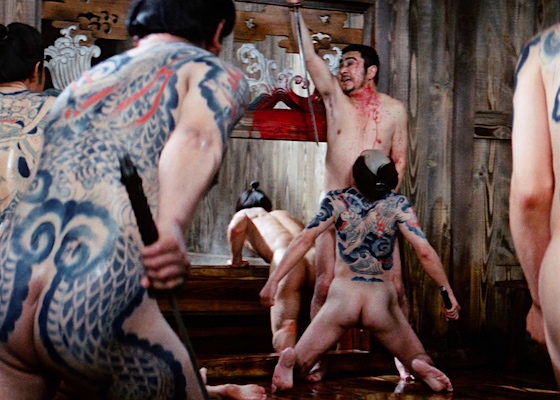
Is that a katana or are you just happy to see me?

Mind, most of the rest of the film’s plot is similarly confounding. It starts with a title sequence in which Ichi tries to run away from a little barking dog, ends with an out-of-nowhere scene where Ichi turns down a horse ride, and in between is almost as odd and randomly constructed as those two extremes. And yet it does tick most of the regular Zatoichi boxes, especially in terms of the action scenes. They’re as slickly choreographed and staged as ever, continuing to come up with fresh ideas even after all these movies. The nude bathhouse fight is the obvious standout, but there’s also a finale where Ichi faces down an army and a cunning foe with a hostage, but has a trick up his sleeve… literally! (Ho ho ho.)

If you’re wondering where the titular festival has got to in all this, well, it never really turns up. The climax does begin with Ichi stranded in the middle of a lake that’s then set alight, but that’s not really a “fire festival”, is it? But it is a visually arresting sequence, just one of several throughout the film. This is the last contribution to the Zatoichi films from director Kenji Misumi, who directed the first and would end up tied for the title of the series’ most prolific director; and also for cinematographer Kazuo Miyagawa, who shot six of the films for various directors; and they both go out on a visual high with their work here. (I don’t like to over-clutter my reviews with pictures, so here are just a few additional memorable shots I grabbed. And this is really in a class of its own for images that evoke a sense of smell. Don’t say I didn’t warn you.)

The film’s story, as I said, is less commendable. Altogether, it makes for a movie that I wouldn’t rank among the Zatoichi series’ finest achievements, but nonetheless has its share of entertainment value for fans.

4 out of 5

Shaft (2000)

2019 #37
John Singleton | 99 mins | streaming (HD) | 2.39:1 | USA & Germany / English | 18 / R

Shaft (2000)

With there now being another ‘reboot’ for the black private dick who’s a sex machine to all the chicks (released a couple of weeks ago in the US, and available on Netflix today in the rest of the world), I thought it was about time I got round to the first ‘reboot’ (I saw the original yonks ago, long before this blog existed). I’ve put ‘reboot’ in inverted commas both times there because, despite the unadorned titles of both the 2000 and 2019 films, both are actually continuations of the ’70s original: Samuel L. Jackson plays John Shaft II, the nephew of the original Shaft, played by Richard Roundtree, who pops by for a cameo here. Jackson and Roundtree reprise their roles again in Shaft 2019-flavour, alongside Jessie Usher as John Shaft III.

(Would it’ve been cool if they’d actually called this Shaft 2000? I feel like it would’ve. Maybe by the year 2000 the idea of sticking 2000 on a title to make it cool/futuristic was over, I dunno, but I feel like it would’ve worked. And because they didn’t, we’ve now got three movies called simply Shaft that all exist in the same continuity. Madness.)

Anyway, back to the first time they rebooted-but-didn’t Shaft. Jackson’s character isn’t actually a private dick, but a proper copper… that is until sleazy rich-kid Walter Wade Jr (a hot-off-American Psycho Christian Bale) literally gets away with murder, prompting Shaft Jr to go freelance to catch his man.

A black cop frisking a rich white guy? What is this, a sci-fi movie?

This Shaft is almost 20 years old now (obviously), and yet all the white privilege bullshit that drives its story makes it feel like it could’ve been made yesterday. (Why are you so enable to evolve societally, America?) Other than that apparently-eternal timeliness, it’s a pretty standard kinda thriller, with most of its charm coming via an array of likeable performances. As well as the reliably cool Jackson and reliably psychopathic Bale, there are memorable early-career turns from Jeffrey Wright and Toni Collette, plus Vanessa Williams as Shaft’s cop colleague who lends a hand even after he leaves the force.

The original Shaft spawned two big-screen sequels and seven more TV movies, but there was no such future for the new incarnation: Jackson’s disappointment with the film, plus a box office performance that was regarded as mediocre (although it opened at #1 and returned over $100 million off its $46 million budget), was enough to scupper a planned follow-up… at least until this year’s reboot-that-isn’t. Reportedly that’s not so great either (with a 31% score on Rotten Tomatoes, a 6th place opening in the US, and of course going directly to Netflix everywhere else), but, given the series’ history, I wouldn’t write Shaft off just yet. After the 29-year gap between Shaft Mk.I and Shaft Mk.II, and then 19 years between Shaft Mk.II and Shaft Mk.III, maybe in 2028 we’ll be treated to a film about child detective John Shaft IV. Naturally, the film itself will just be called Shaft.

3 out of 5

Zathura: A Space Adventure (2005)

2018 #67
Jon Favreau | 97 mins | streaming (HD) | 1.85:1 | USA / English | PG / PG

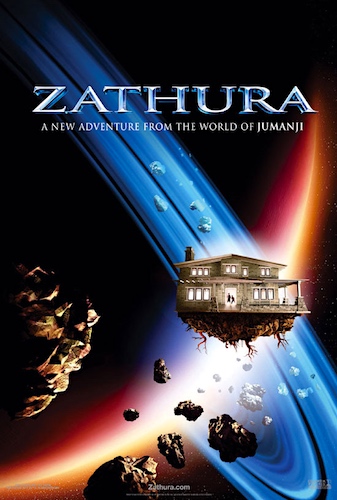
Zathura

Before Jumanji: Welcome to the Jungle there was Zathura, which is sort of a sequel to Jumanji… but more of a spin-off, I guess… well, really it’s a completely unrelated movie with the exact same plot. Inspired by another book by the same author, it sees two kids (Jonah Bobo and a very baby-faced Josh Hutcherson) discover an old board game that comes to life with terrifying consequences, and the only way to make it stop is to finish the game. But this game is about space, so it’s completely different, obviously.

Unsurprisingly, it’s difficult to avoid assessing the film’s quality in comparison it to its predecessor. The thing that struck me most was it feels less consequential than Jumanji, somehow. In the previous film the stakes feel high — you worry they won’t beat the game or make it out alive. Perhaps that’s because of Robin Williams’ character getting trapped in the game at the start, which makes you believe things can go wrong. Whereas here, it just feels like crazy shit will keep happening until they finish. It may also be because you can infer ‘rules’ in Jumanji — we know monkeys are going to be mischievous, tigers might eat you, etc — whereas in Zathura, because it’s sci-fi, it’s all made up. And it feels made up as it goes along, too — because it’s not based on real life or an existing brand, we don’t know the characters, the monsters, etc.

Similarly, the characters benefit from way too much luck. The kids keep not reacting fast enough to stop or save things, but then something fortunate happens so things go their way. Maybe you could sell this as a deliberate thing — like, the game wants to be finished — but that’s not how it plays out. They just keep getting lucky, in a not-great-screenwriting way. Perhaps I’m projecting problems where there are none in these observations, but it’s just another factor towards not feeling jeopardy like I did in Jumanji. Overall, Zathura was just more… pleasant.

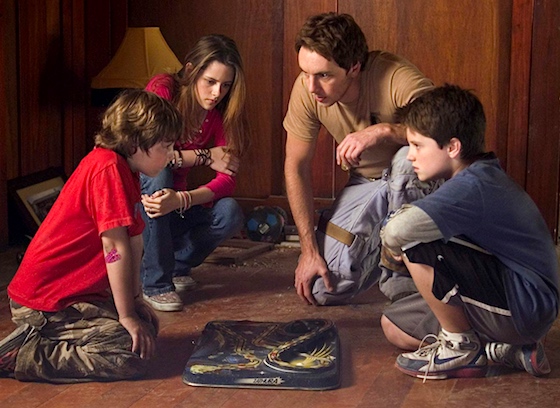
Play the game

That said, I had some more specific niggles. For a film that should’ve been trying to avoid accusations of being a rip-off, they invite it further by (spoiler alert!) giving one character a backstory that’s a riff on Robin Williams’ from the first movie. Zathura comes at it from a different angle, at least, but that’s a mixed blessing: it doesn’t have the same emotional effect because we only learn about it belatedly, but at least that means it isn’t ripping off Jumanji’s entire narrative structure, and also allows for a neat twist later on. There’s some time travel stuff that doesn’t wholly hang together, but then does it ever?

Equally, you can clearly tell they weren’t paying enough attention to every aspect of the screenplay: the older sister (played by a pre-fame Kristen Stewart, by-the-by) gets put in hibernation for five turns, but it takes eight turns before she wakes up. How no one noticed that is baffling — did they not think to just count it in the script? Even if they somehow missed it until post-production, all it would’ve taken is a dubbed line or two. “Five turns” sounds like a lot of gameplay to miss, so maybe they just thought “eight turns” would sound too ridiculous, but did they not think someone would spot it?!

Plot logic aside, at least the film has some great effects and design work. Jumanji has aged badly in that respect (the CGI is pretty ropey), whereas Zathura still looks great, in part because there’s actually a lot of props and models involved. The performances are pretty decent, too. Director Jon Favreau clearly has a talent for working with kids — the pair here; Mowgli in his Jungle Book; Robert Downey Jr… But in all seriousness, he gets really good performances out of these children.

Holy meteors!

Also worth noting is that the UK version was originally cut to get a PG… and remains cut, because the uncut rating wouldn’t just be a 12, it’d be a 15! That’s because of “imitable techniques”, which in this case means using an aerosol as a blowtorch to set fire to a sofa. The main thing I find interesting about this is that presumably the original cut shows the Astronaut setting fire to the sofa, whereas in the UK version it just suddenly cuts to him stood beside a sofa on fire, which is so much funnier. Hurrah for censorship, I guess.

And so we come to the score. Zathura is one of those films I find a little awkward to rate, because I did enjoy it — in some respects, more than I enjoyed Jumanji when I rewatched that recently — but it also doesn’t feel as polished and complete as its predecessor in terms of story and characters. Even as I had fun, I saw many things I felt could’ve been sharpened up. For that reason, I’ve erred towards a lower rating.

3 out of 5

Murder Mystery (2019)

2019 #96
Kyle Newacheck | 97 mins | streaming (UHD) | 2.00:1 | USA / English | 12 / PG-13

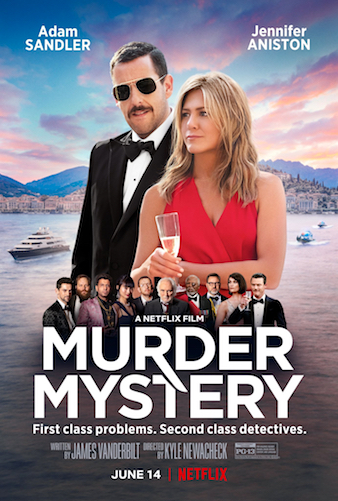
Murder Mystery

Murder Mystery is a murder mystery in which there is a murder under mysterious circumstances, and it falls to vacationing NY cop Nick Spitz (Adam Sandler) and his murder-mystery-loving wife Audrey (Jennifer Aniston) to solve these mysterious murders.

I’m no great fan of Sandler, and he’s probably the least funny person in this film, but I also didn’t find him outright objectionable. His character — an underachieving middle-aged beat cop who pretends to be a detective to his long-suffering wife — seems like the kind of guy who’d think he’s funnier than he is, so Sandler’s attempts at humour mostly come off as in-character. Put another way, it works in spite of itself. Of the two leads, Aniston is definitely the one doing the most work for the film, both in terms of actually being amusing and giving it some kind of emotional character arc.

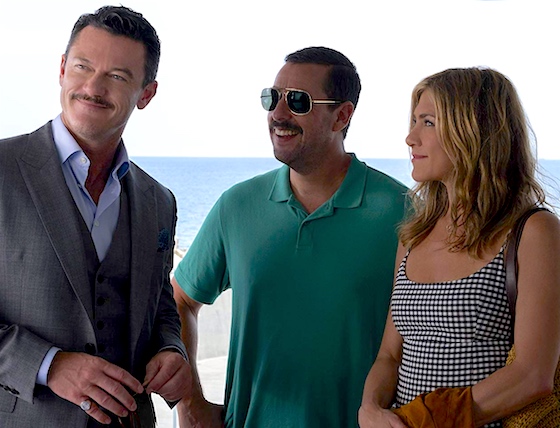
Detectives or suspects?

The actual mystery plot is no great shakes — there are two glaring clues early on that give most of the game away, especially if you’re well-versed in watching murder mysteries and spotting such hints. That’s somewhat beside the point, though, because there’s enough fun to be had along the way to make up for it, and there are still some reasonable red herrings. The fact the cast is staffed by an array of experienced mostly-British thesps, many of whom have no doubt appeared in their share of ‘real’ murder mysteries — the likes of Luke Evans, Gemma Arterton, Adeel Akhtar, David Walliams, and Terence Stamp — definitely helps keep proceedings afloat.

There are a few of action-y scenes — a shoot-out, some hijinks on a hotel ledge, a decent car chase for the finale — that keep the momentum up too. Plus it mostly looks suitably luxuriant and exotic (the odd bout of iffy green screen aside), matching its high-class backdrop and French Riviera setting. Altogether, it makes for a suitably easy-watching 90-minutes in front of Netflix.

3 out of 5

Murder Mystery is available on Netflix everywhere now.

Zatoichi Meets Yojimbo (1970)

aka Zatôichi to Yôjinbô

2019 #60
Kihachi Okamoto | 116 mins | Blu-ray | 2.35:1 | Japan / Japanese | 12

Zatoichi Meets Yojimbo

Having released anything up to four films a year for seven years, the Zatoichi series took 1969 off (apparently producer/star Shintaro Katsu had some other projects to focus on). But when it returned in 1970 it was with a big gun: as the title indicates, the main guest star for this film is the lead character from Akira Kurosawa’s films Yojimbo and Sanjuro, played by the great Toshiro Mifune. I don’t know if that was a deliberate move to mark the series’ 20th movie or if they weren’t even conscious of the milestone, but it certainly feels like it was meant to be a special occasion. “Meant to be” being the operative part of that sentence, because the result is sadly one of the least enjoyable entries in the series so far.

The film sees Ichi (Katsu) return to his hometown, which has rather gone to the dogs thanks to a local yakuza gang. Never one to just stand back or move along, Ichi ends up embroiled in the arguments between a powerful merchant (Osamu Takizawa) and his two wayward sons, one a yakuza boss (Masakane Yonekura), the other an employee of the government mint (Toshiyuki Hosokawa), who’s up to some kind of shenanigans with the gold that drives the plot… I think. Mifune’s character factors into all this as a ronin who’s been hired by the yakuza son to protect him, or kill his father, or something along those lines.

As you may have gathered, the plot here is by turns confusing and dull — one of those that loses you so thoroughly you just want to give up on trying to work it out. It has something to do with the people who make gold coins making them less well, and a hidden bar of gold that has something to do with that somehow, and a bunch of spies and stuff who are all looking for the gold bar, and some kind of feud or rivalry or disagreement between the local yakuza and Takizawa’s businessman, which may or may not have nothing to do with all the gold stuff… I think. This wouldn’t be the first Zatoichi film with an underwhelming or unintelligible plot, but it tells it with so little verve, and with so few entertaining distractions (there’s not much action, and even less humour), that there’s nothing to make up for it.

Katsu vs Mifune

And to add insult to injury, the titular concept of the movie is a bait and switch: Mifune is not actually playing the character from Kurosawa’s films. “Yojimbo” means “bodyguard”, so it’s not like, say, casting Sean Connery in a film and calling it Meets James Bond only to have him play some unrelated character, but the promise of the title is clear and unfulfilled. It’s not like Mifune is playing an off-brand knock-off, either: he happens to be fulfilling the same job as bodyguard so that everyone can keep calling him yojimbo, but his actual name is Taisaku Sasa (not Sanjuro, as in Kurosawa’s films) and his character is nothing like his role in Kurosawa’s films (he doesn’t even look the same!) Seeing Zatoichi go head-to-head with the ‘real’ Yojimbo, with all his cunning scheming, could’ve been great. Instead, while Sasa is still a skilled swordsman, he’s a bit pathetic — lovelorn and, it would seem, not actually very good at his real job (which, as it turns out, is spying). Some of the scenes between Katsu and Mifune are good, at least. Not all of them, but some is better than none, I suppose. Ultimately, however, it’s one of the biggest disappointments in a film filled with them.

There’s plenty to be filled, too, because this is by far the longest of the original Zatoichi films: the others average 87 minutes apiece, making Meets Yojimbo a full half-hour longer than normal, and almost 20 minutes longer than even the next longest. There’s quite an extensive supporting cast, bringing with them all the varied subplots that having so many characters entails. Whether that’s what produced the extended running time, or whether an extended running time was desired so they shoved all those extra people in, I don’t know. It’s a bit of a chicken-and-egg situation, because either way the result is a jumble that I don’t think was a good idea. Few of them have an opportunity to leave a mark — there’s too much going on, and we’re all here for Mifune and Katsu anyway.

Something I could have learned...

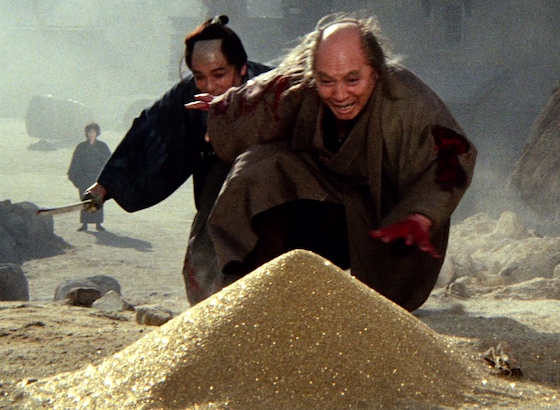
Eventually the story comes down to a simple, familiar message: “greed is bad”. The much-desired gold bar turns out to be hidden as gold dust, which ends up blowing away in the wind. It’s almost fitting and symbolic… except it only happens once most of the cast are dead or past it anyway, so it doesn’t necessarily symbolise much. I mean, there’s hardly anyone left to notice it happen. And it’s followed by a final scene that, like most of the rest of the plot, left me slightly confused. The town blacksmith tells yojimbo that Ichi isn’t motivated by gold… then we see Ichi realise his pouch of gold dust has been cut and emptied, so he scrabbles around in the dirt searching for the rest (which has blown away), when Mifune joins him. “You too?” “Just like you,” they say. And then they go their separate ways. So… they are motivated by gold? Or… they’re not, because it’s gone and they… aren’t? I don’t know if I’m being dim, or if the film bungled its own message, or if it just doesn’t have anything to say. It could be no deeper than a straight-up samurai adventure movie, of course. It would be better if it were.

This is the only Zatoichi film for director Kihachi Okamoto, who apparently was a prestige hire. I don’t think he did a particularly good job, to be honest. There’s the muddled plot, as discussed, which unfurls at a slow pace. The action scenes, often such a highlight, aren’t particularly well shot. It’s visually a very dark film, which kinda matches the grim tone, but is arguably taken too far. As Walter Biggins puts it at Quiet Bubble, “murk dominates. People wears blacks and browns. Eyes are cold, haunted, even in daytime[…] Even supposedly well-lit interiors look like homages to Rembrandt. This is a world half-glimpsed, that we squint at”. It was shot by cinematographer Kazuo Miyagawa, who worked on numerous Japanese classics and several other Zatoichi movies — I praised his work on Zatoichi and the Chest of Gold, for example. It’s not that what he’s done here is bad per se — there are certainly some nice individual shots, particularly around the climax — but, well, there were clearly some choices made about lighting and the colour palette.

Windswept

I knew going in that Zatoichi Meets Yojimbo isn’t a particularly well regarded film, but I held out hope it was one of those occasions where I’d find the consensus wrong. Unfortunately, it wasn’t. In fact, it’s arguably the worst film in the series. It’s not just that it’s a poor Zatoichi film (which it is), it’s that it should’ve been a great one, showcasing the meeting of two top samurai heroes and the charismatic actors who play them. There may be outright lesser films in the Zatoichi series than this, but none could equal the crushing disappointment it engenders.

2 out of 5

For what it’s worth, Katsu and Mifune co-starred in another samurai movie the same year, Machibuse, aka Incident at Blood Pass. I’ve heard it’s a lot better, so I’ll endeavour to review it at a later date.

Review Roundup

As foretold in my most recent progress report, June is off to a slow start here at 100 Films. Or a non-start, really, as I’ve yet to watch any films this month and this is my first post since the 1st. Hopefully it won’t stay that way all month (I’ve got my Blindspot and WDYMYHS tasks to get on with, if nothing else).

For the time being, here a handful of reviews of things I watched over a year ago but have only just written up:

  • O Brother, Where Art Thou? (2000)
  • Allied (2016)
  • American Made (2017)


    O Brother, Where Art Thou?
    (2000)

    2018 #106
    Joel Coen | 103 mins | streaming (HD) | 2.39:1 | UK, France & USA / English | 12 / PG-13

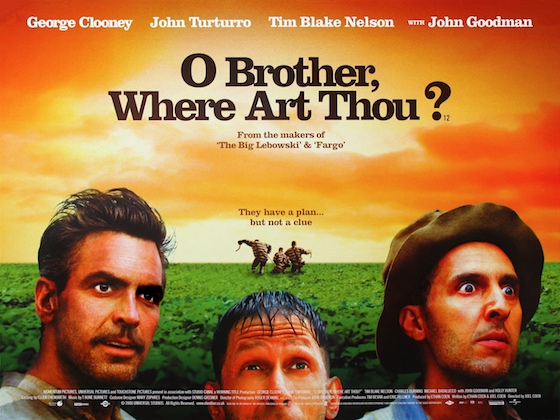
    O Brother, Where Art Thou?

    The eighth movie from the Coen brothers (eighth, and yet they still weren’t being allowed a shared directing credit! No wonder that stupid DGA rule pisses people off) is one of their movies that I found less objectionable. Oh, sure, most of their stuff that I’ve reviewed I’ve given four stars (as well as a couple of threes), but that’s more out of admiration than affection — for whatever reason, their style, so popular with many cineastes, just doesn’t quite work for me; even when I like one of their films there’s often still something about it I find faintly irritating.

    Anyway, for this one they decided to adapt Homer’s Odyssey, but set in the American Deep South during the Great Depression. Apparently neither of the brothers had ever actually read The Odyssey, instead knowing it through cultural osmosis and film adaptations, which is perhaps why the film bears strikingly minimal resemblance to its supposed source text. Rather, this is a story about songs, hitchhiking, and casual animal cruelty, in which the KKK is defeated by the power of old-timey music. Hurrah!

    It’s mostly fairly amusing. If it was all meant to signify something, I don’t know what — it just seemed a pretty fun romp. I thought some of the music was okay. (Other people liked the latter more. Considerably more: the “soundtrack became an unlikely blockbuster, even surpassing the success of the film. By early 2001, it had sold five million copies, spawned a documentary film, three follow-up albums (O Sister and O Sister 2), two concert tours, and won Country Music Awards for Album of the Year and Single of the Year. It also won five Grammys, including Album of the Year, and hit #1 on the Billboard album charts the week of March 15 2002, 63 weeks after its release and over a year after the release of the film.” Jesus…)

    Anyway, that’s why it gets 4 stars. I liked it. Didn’t love it. Laughed a bit. Not a lot. Some of the music was alright. Not all of it. Naturally it’s well made (Roger Deakins!) without being exceptionally anything. Harsher critics might say that amounts to a 3, but I’m a nice guy.

    4 out of 5

    Allied
    (2016)

    2018 #116
    Robert Zemeckis | 119 mins | streaming (HD) | 2.39:1 | USA, UK & China / English & French | 15 / R

    Allied

    Brad Pitt and Marion Cotillard star as a pair of intelligence agents who fall in love in Mr. & Mrs. Smith: WW2 Edition. Settling down together in England, all is lovely for them… until one comes under suspicion of working for the enemy…

    Overall Allied is a very decent spy thriller, let down somewhat by a middle section that’s lacking in the requisite tension and a twee monologue coda. But the first 40 minutes, set in Morocco and depicting the mission where the lovers first meet, are pretty great; there’s plenty of neat little tradecraft touches scattered throughout; and there are some pretty visuals too. There are also some moments that are marred by more CGI than should be necessary for a WW2 drama, but hey-ho, it’s a Robert Zemeckis film.

    That said, Brad Pitt’s performance is a bit… off. He never really seems connected with the material. Perhaps he was trying to play old-fashioned stoic, but too often it comes across as bored. It also constantly looked like he’d been digitally de-aged, but maybe that’s because I was watching a 720p stream; or maybe he had been, though goodness knows why they’d bother.

    Anyway, these are niggles, so how much they bother you will affect your personal enjoyment. I still liked the film a lot nonetheless.

    4 out of 5

    American Made
    (2017)

    2018 #124
    Doug Liman | 109 mins | streaming (HD) | 1.85:1 | USA & Japan / English & Spanish | 15 / R

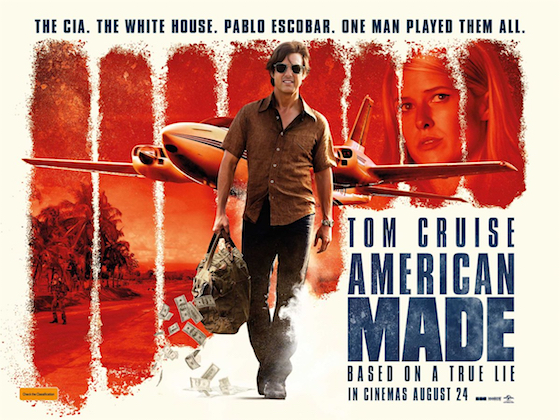
    American Made

    Described by director Doug Liman as “a fun lie based on a true story,” American Made is the obviously-not-that-truthful-then ‘true story’ of Barry Seal, a pilot who was recruited by the CIA to do some spying and ended up becoming a major cocaine smuggler in the ’80s.

    Starring ever-charismatic Tom Cruise as Seal, the film turns a potentially serious bit of history (as I understand it, the events underpinning this tale fed into the infamous Iran-Contra affair) into an entertaining romp. Indeed, the seriousness of the ending is a bit of a tonal jerk after all the lightness that came before, which I guess is the downside of having to stick to the facts.

    Still, it’s such a fun watch on the whole — a sliver long, perhaps, even though it’s comfortably under two hours, but it does have a lot of story to get through. Parts of that come via some spectacular montages, which convey chunks of story succinctly and are enjoyable in their own right. Liman doesn’t get a whole lot of attention nowadays, I think, but it seems he’s still got it where it counts.

    4 out of 5

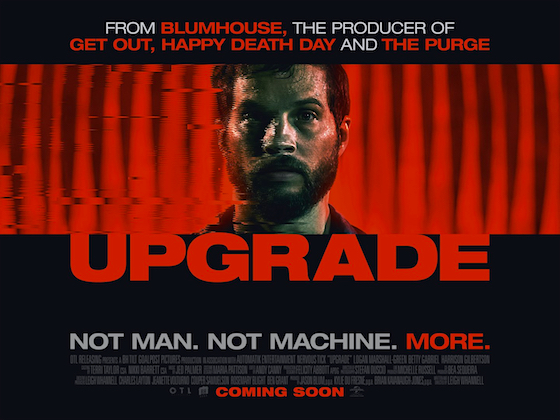
  • Upgrade (2018)

    2019 #44
    Leigh Whannell | 100 mins | streaming (HD) | 2.35:1 | Australia / English | 15 / R

    Upgrade

    Leigh Whannell is best known for co-creating the Saw and Insidious franchises, so he steps outside of his horror stomping ground to write and direct this cyberpunk action-thriller. It’s set in the kind of near future where we have self-driving cars (and similar tech), but there are still people who prefer the old ways, like mechanic Grey (Logan Marshall-Green), who makes his living restoring classic cars for people like tech genius and entrepreneur Eron Keen (Harrison Gilbertson). After an incident leaves Grey paralysed, Eron offers to help by implanting him with a cutting-edge top-secret chip he’s developed called STEM. It works even better than expected, and Grey begins to use his newfound abilities to hunt for the men who did this to him.

    On one level, Upgrade is a straightforward sci-fi action-thriller, following Grey’s investigation as it leads him to some shady figures who have near-future tech of their own, and then they fight. While that may seem simplistic, it’s full of neat little touches, particular in the action’s choreography — it almost begs a rewatch just to see everything that’s going on in the frantic fight scenes. I don’t mean “frantic” in the over-cut, can’t-see-shit sense of so many action sequences in the last couple of decades — in fact, Whannell often uses wide shots and long-ish takes — but there’s so much going on, with the characters making decisions at such speed (boosted by that body-modifying tech), that parts do become a bit of a blur.

    Change can be painful

    On another level, the film has something to say about the technology that drives its storyline. Okay, maybe it doesn’t have a lot to say, and if you’re well-versed in sci-fi they’re not necessarily original comments either, but it poses questions and makes you think about what could be just around the corner, and what value it might have, or what danger it might pose. Plus it pushes the story into some interesting places; places a low-budget Australian-produced movie can go that other mainstream-minded sci-fi/action flicks wouldn’t dare. If you’ve ever seen a Saw film then you can guess that Whannell likes twists, especially of the “sting in the tail” variety, and Upgrade has more than its fair share of last-minute switcheroos. How many you see coming is up to you — one seemed glaringly obvious to me, but anticipating that ‘reveal’ blinded me to some more that came after.

    Combining those two levels renders Upgrade a strong mix of straight-up action thrills and thought-provoking near-future sci-fi. A definite must-see for genre fans.

    4 out of 5

    Upgrade is available on Sky Cinema from today.

    The Matrix Revolutions (2003)

    The 100 Films Guide to…

    The Matrix Revolutions

    Everything that has a beginning
    has an end.

    Country: USA
    Language: English
    Runtime: 129 minutes
    BBFC: 15
    MPAA: R

    Original Release: 5th November 2003 (60 countries, including the UK and USA)
    Budget: $150 million
    Worldwide Gross: $427.3 million

    Stars
    Keanu Reeves (Bill & Ted’s Excellent Adventure, 47 Ronin)
    Laurence Fishburne (Boyz n the Hood, Mystic River)
    Carrie-Anne Moss (Chocolat, Disturbia)
    Hugo Weaving (Captain America: The First Avenger, Mortal Engines)

    Directors
    The Wachowskis (Bound, Jupiter Ascending)

    Screenwriters
    The Wachowskis (The Matrix, Speed Racer)


    The Story
    With Neo having rejected the destiny prescribed for him, but discovering his power is greater than previously thought possible, he sets out on a long-shot mission to save humanity, even as the machines prepare to destroy mankind’s last city.

    Our Heroes
    The trilogy centres on the actions of Neo, Trinity, and Morpheus, but in many respects they’re just part of an ensemble in this finale, with many other characters getting to be in command of screen time, including the likes of ace pilot Niobe, Neo-idoliser the Kid, and a whole bunch of citizens of Zion during the big battle.

    Our Villains
    The machines threaten the surviving humans, while in the Matrix the increasingly dominant Agent Smith threatens Neo’s chances to save them all.

    Best Supporting Character
    Amongst the many humans fighting to save Zion, perhaps the most noteworthy is the captain of the Armoured Personal Unit corps, Mifune, who’s as much of a badass as the guy he’s obviously named after.

    Memorable Quote
    “Everything that has a beginning has an end. I see the end coming, I see the darkness spreading. I see death.” — The Oracle

    Memorable Scene
    Before Reloaded there was much hype about the “Burly Brawl”, in which Neo fights dozens of Agent Smiths. Unfortunately the final result was marred by some iffy CGI and overshadowed by the freeway chase. Here, we get the sequel: the so-called “Super Burly Brawl”, in which Neo fights just one super-powered Agent Smith in what remains of the Matrix, and it’s a much more exciting, visually extraordinary climax.

    Memorable Music
    Don Davis’ score for the trilogy has always used a mix of electronic-y rock and more traditional orchestral music, but the epic final battle adds choral voices to the mix in a very effective way. Thankfully rejecting the idea that they sing just “oohs and aahs” or, even worse, “this is the one, see what he can do” in plain English, Davis instead had the choir sing the Pavamana Mantra, so it’s not just nice texture in the soundtrack but meaningful too.

    Truly Special Effect
    There’s nothing as obviously groundbreaking or original as in the other two films, but a lot of the effects still hold up exceptionally well 15 years down the line. It’s difficult to imagine how the battle of Zion (created through a mixture of live-action, miniatures, and CGI) could be achieved any better today.

    Letting the Side Down
    The untimely death of actress Gloria Foster, who played the Oracle in the first two films, necessitated her recasting for this final instalment. Unfortunately, her replacement just isn’t as good, seeming to struggle with her portentous dialogue.

    Making of
    Christopher Nolan gets a lot of credit for bringing regular films into the IMAX market (or vice versa, depending how you look at it) with actually shooting on the format for The Dark Knight (a notion copied since, obviously), but Revolutions was actually the first live-action feature film to be released in IMAX at the same time as its regular theatrical release.

    Previously on…
    The story began in The Matrix and continued in The Matrix Reloaded, while spin-off anime shorts The Animatrix and video game Enter the Matrix filled in some of the blanks.

    Next time…
    The story continued in MMORPG The Matrix Online, which ran from 2004 to 2009. Rumours of some kind of reboot or continuation flare up now and then.

    Awards
    1 Razzie nomination (Worst Director)
    3 Saturn Award nominations (Science Fiction Film, Costumes, Special Effects)

    Verdict

    I used to think Revolutions was better than Reloaded, mainly because at least it brought everything to an end and didn’t have that confusing stuff with the Architect. But reflecting on the sequels now, I have to agree with the consensus that this isn’t as good — there’s nothing that matches the highway sequence for entertainment value, and, actually, the lack of overt philosophising is almost to its detriment. It does have its moments (see: Memorable Scene), and I do think it ultimately comes to powerful resolutions, but the journey to them doesn’t have the same spark.

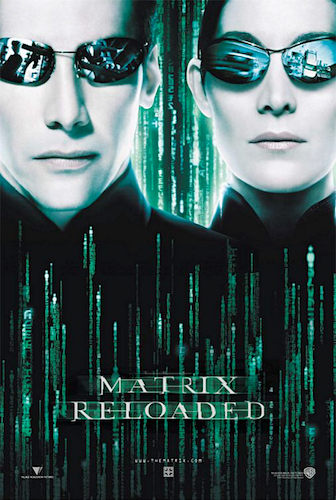
    The Matrix Reloaded (2003)

    The 100 Films Guide to…

    The Matrix Reloaded

    Free Your Mind.

    Country: USA
    Language: English
    Runtime: 138 minutes
    BBFC: 15
    MPAA: R

    Original Release: 15th May 2003 (US & others)
    UK Release: 21st May 2003
    Budget: $150 million
    Worldwide Gross: $742.1 million

    Stars
    Keanu Reeves (Point Break, Man of Tai Chi)
    Laurence Fishburne (What’s Love Got to Do With It, Contagion)
    Carrie-Anne Moss (Red Planet, Unthinkable)
    Hugo Weaving (Babe, Transformers)

    Directors
    The Wachowskis (The Matrix, Cloud Atlas)

    Screenwriters
    The Wachowskis (Assassins, Sense8)


    The Story
    With just 72 hours until the machines arrive to destroy mankind’s last city, all ships are ordered to return home for its defence. But Morpheus still believes the answer to their salvation lies in the Matrix itself and what Neo is meant to do there.

    Our Heroes
    Neo is just a man, but within the Matrix has abilities and power beyond any other. As he journeys deeper in the fake-world’s workings, can he free mankind? Will his love for fellow freedom fighter Trinity get in his way? Is their captain, Morpheus, misguided in his belief that Neo is The One?

    Our Villains
    As hordes of machines drill down to the human city of Zion, a more pressing threat is Agent Smith, who has found a way to multiply himself and is on the warpath within the Matrix, with his sights set on Neo.

    Best Supporting Character
    The Merovingian is a snobby Frenchman (is there any other kind, ho ho) who holds prisoner a key program our heroes need access to. First, they’ll have to endure his philosophising; after, they’ll have to fend off the men he sends to kill them.

    Memorable Quote
    “Now consider the alternative. What if I am right? What if the prophecy is true? What if tomorrow the war could be over? Isn’t that worth fighting for? Isn’t that worth dying for?” — Morpheus

    Memorable Scene
    The freeway chase. It’s so long it almost doesn’t count as just one scene, but it’s spectacular quarter-of-an-hour long action sequence packed to bursting with impressive stunts and effects.

    Technical Wizardry
    See above. The logistics of filming the sequence are mind-boggling. Now they’d just throw it all together in a computer with a bit of green screen for the actors, but back in the early ’00s they built a massive stretch of freeway and filmed most of the practical stunts for real — and it’s all the better for it, of course.

    Truly Special Effect
    Some of the CGI is a little ropey 15 years on (though the digital body doubles looked just as bad at the time as they do now, to be honest), but all of the real-world stuff with Zion and its ships still looks fantastic.

    Letting the Side Down
    Depending on your point of view, the climax is either philosophically engaging or impenetrably incomprehensible. I feel like repeat viewings and time have made it more understandable, but it’s still suffused with more big ideas than people expect to find in their blockbuster movies.

    Making of
    The Matrix Reloaded” is a funny title when you think about it. I mean, it’s very much “from our perspective” — in the film’s world the Matrix has never stopped running, so it’s not being reloaded; it’s an allusion to computer-y stuff and the fact this is a sequel, nothing to do with the actual content of the film. Though I guess it’s not really any weirder than just sticking “2” on the end or whatever, so…

    Previously on…
    In 1999, sci-fi actioner The Matrix blew everyone’s minds. In the run-up to this sequel there was also The Animatrix, a series of anime short films that explained some of the backstory to the films’ world and detailed certain events that occurred between the first film and its sequels.

    Next time…
    The video game Enter the Matrix occurs alongside Reloaded, featuring characters and situations from the film in a parallel storyline. It included around 45 minutes of live-action scenes shot by the Wachowskis, which has since been made available on the film’s DVD/Blu-ray/etc releases. Later the same year, The Matrix Revolutions concluded the trilogy, while MMORPG The Matrix Online continued the story. There have also been other video games and some comic books, but for a modern media franchise it’s been quite tightly controlled beyond that.

    Awards
    1 Razzie nomination (Worst Director)
    1 World Stunt Award (Best Overall Stunt by a Stunt Woman (for motorcycle work in the freeway chase))
    3 World Stunt Awards nominations (Best Fight (for the chateau hallway), Best Stunt Coordination Feature Film, Best Overall Stunt by a Woman (for a car stunt in the freeway chase))

    Verdict

    The Matrix sequels are generally viewed as a big disappointment, which isn’t wholly accurate or fair (for one thing, this first sequel actually has pretty solid ratings online, from both critics and viewers). It was always a big ask to follow-up a movie as original, groundbreaking, and straight-up entertaining as the first Matrix, and that the Wachowskis chose to do so by doubling down on the mythology and underpinning ideas obviously wasn’t successful with too many people. So perhaps making the plot 50% a straightforward quest-against-time narrative and 50% impenetrable philosophy lectures wasn’t the best idea, but the action sequences are still absolutely stunning. And, actually, if you bother to engage with the film on its own level, there’s some interesting stuff here.

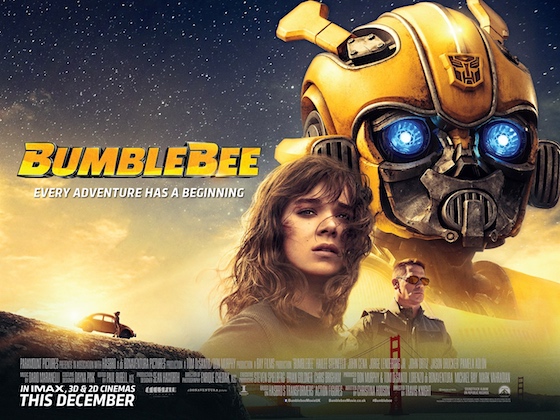
    Bumblebee (2018)

    2019 #83
    Travis Knight | 114 mins | Blu-ray (UHD) | 16:9 | USA & China / English | PG / PG-13

    Bumblebee

    The live-action Transformers movies, eh? Seemingly hated by everyone, critics and fans alike, and yet combined the first five grossed almost $4.4 billion at the global box office. Nonetheless, with the fifth one being the lowest grossing so far, and Michael Bay finally making good on his oft-repeated desire to leave the series’ director’s chair, someone clearly felt it was time for a change. That brings us to Bumblebee, a spin-off (it’s focused around the de facto second-in-command Transformer) cum prequel (it’s set in the ’80s, explaining some events that occurred before the 2007 movie) cum soft reboot (with redesigned characters and nothing that explicitly ties it to the Bay films, this could be the start of a whole new continuity). Did fans finally get what they want? Well, maybe, but it obviously didn’t work for the wider audience: the film took $468 million worldwide, which is good in itself but still represents almost a $140 million drop from the previous film. And it didn’t work for me, either: Bumblebee isn’t necessarily any better than the best of the Bay-era films, it’s just middling in different ways.

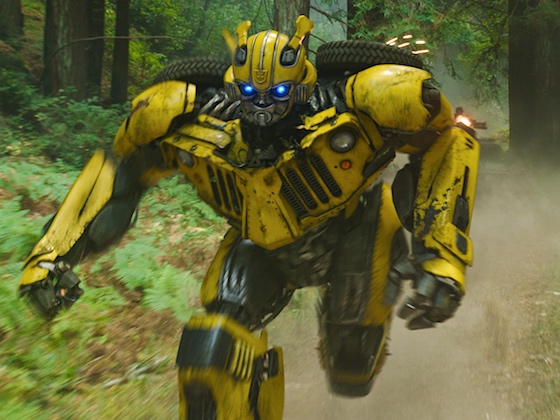
    The film begins much like Man of Steel: launching us into a conflict between aliens on a distant planet. I criticised that film for throwing us into the deep end with a bunch of hard-sci-fi mumbo-jumbo, and I find similar fault here. I guess the point is to get an Epic Action Sequence up front (unlike Man of Steel, where it’s political arguing, here it’s a full-blown battle) and to show off the new-look old-style Transformers, which have been modelled more on their appearance in the ’80s cartoon series. But it does nothing to dispel the notion that this is nothing like the Bay films — it’s just another frenzy of metal-on-metal and garbled mythology. Then Bumblebee, who’s mainly identifiable as “the yellow Transformer”, gets sent off to Earth, where he accidentally winds up in a scrap with some military types. More action, but with a slight change of pace.

    Bayhem never dies

    Only after all this has gone down do we finally get to the supposed point of the movie. We’re introduced to Charlie (Hailee Steinfeld), a teenager in 1980s California who likes listening to 1980s music and wearing 1980s clothes and doing other 1980s things because this is set in the 1980s. She’s down on her luck for various reasons, but what she really wants is a car. She finds one in a boat scrapyard (totally logical), but that turns out to be Bumblebee in disguise, and suddenly she has a giant robot for a best friend. But Captain Military Man (John Cena — I have no idea what his character name was. I could look it up, but this was more amusing), who Bumblebee fought with in that second action sequence, is on the hunt for our big yellow friend, and so are some Decepticons (the bad robots).

    The “a girl and her robot” angle is what the film was sold on, combined with the ’80s setting to suggest a throwback to movies of that era, like E.T. and so on. I quite like it as a concept — it’s certainly a change of pace from the increasingly overblown city-destroying world-saving antics of the earlier films — but it’s the execution that disappointed me. It takes too long to get it up and running. Even after the palaver I’ve already described, it spins its wheels on Charlie getting Bumblebee started, on comedic interludes with her family, on establishing a wannabe-love-interest for her (a guy who both works opposite her at a fairground and is her next door neighbour, yet apparently she’s never even noticed. Incidentally, I can’t remember his name either). There’s altogether too much time spent on the military and Decepticons hunting ‘Bee, too, especially considering it amounts to little that’s meaningful. I mean, specifically two Decepticons turn up on Earth, and they’re therefore the film’s primary villains, but I can’t remember their names either. Their personalities amount to “the one who plans” and “the one who just wants to shoot everything”.

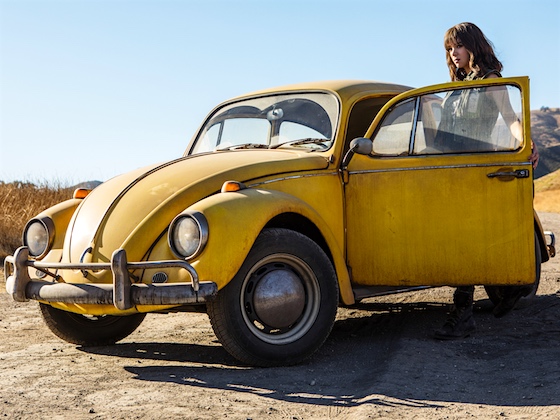
    A girl and her robot... which is disguised as a car

    But after nearly an hour of this faff, the film gets good, with Charlie and Neighbour Boy getting up to some enjoyable ’80s kids’ movie-style antics with their friendly giant robot. But oh, then it’s time for the climax, so it’s back to explosions and indistinguishable chunks of metal hitting each other.

    This is why it’s frustrating to me, because for a brief bit of time in the middle you see what I think this movie really wanted to be, and what I really wanted it to be, before it descends back into Bayhem-with-calmer-editing. Incoming director Travis Knight (whose only previous credit is the exceptional Kubo and the Two Strings) handles individual sequences well, suggesting he was a canny hire, but the film’s problem is bigger than that. The wonky pace and structure devotes time in the wrong places, leading to underdeveloped character beats (the big payoff for Charlie’s emotional subplot actually made me laugh out loud, which was not the intended effect) and taking too long to get to where it wants to be — just as it’s getting good, it has to dart off into a finale that doesn’t have enough impact, because we’re not really invested in the villains either.

    Talking of what the movie “should’ve been”, a word on the certification. Bumblebee was originally given a 12A by the BBFC, just like every other modern blockbuster, but there was some kerfuffle in Australia that led to it being cut down under, and it seems that version was tamer enough to get a PG in the UK, so that’s the one that was released here (and, I think, everywhere outside the US). It loses about six seconds of injury and violence, apparently. There was a time earlier this century when anything below PG-13 was a bad thing, because they thought teens/adults would write the film off as being kids’ fare. Maybe that’s changed. Maybe it just doesn’t apply in the UK. Maybe they thought being a PG wouldn’t put grownups off (as an adult, who looks at the certificate, especially for the sixth movie in a well-established franchise?) but would allow more kids in. Who knows. It is what it is. I’m not sure it’s worth caring about.

    This cute dog is also in it a bit

    Also, another thing about differing releases: I wish they’d put it out on 3D Blu-ray somewhere, so that I could’ve bought that version. As noted at the start, I watched the 4K UHD disc, and the (upscaled) picture was fine but not spectacular (aside from one or two bits, and the usual benefits of HDR), but there were whole chunks I feel would’ve benefited from 3D. The Bay movies certainly did. I know those of us who enjoy the format are more in the minority than ever, but it seems that interest remains in some markets (looking at other titles that didn’t get a 3D release in the US and UK but did elsewhere, countries like Germany, Italy, Japan, and India seem to be among the lucky ones), so I don’t know why this hasn’t turned up in any of them.

    Anyway. If Bumblebee managed its structure and pace better it’d be a lot more fun. I feel like, even with just the material that made it to the final cut, you could do a radical re-edit and turn it into a much better movie — ditch the Cybertron crap, cut way back on the baddies hunting for ‘Bee, get the relationship between Charlie and ‘Bee up and running faster, then focus on their teenage hijinks. Instead, someone thought it would be neat to bookend the film’s heart with a bunch of Bay-esque whooshbangery, and it gets in the way.

    3 out of 5

    Bumblebee is released on DVD and Blu-ray (regular and 4K UHD flavours) in the UK today.