Aliens (1986)

2009 #14
James Cameron | 132 mins | DVD | 18 / R

Once upon a time, sequels were universally regarded as Bad — the inferior product of a great original; most frequently a remake in continuation’s clothing. These days we regularly see sequels that continue and expand on their predecessor, frequently leading to higher praise and a better reputation. It’s almost become expected, in fact — look at the number of reviews of Star Trek that express more anticipation for the inevitable sequel than the one just released (my own included). The archetypical “sequel that betters the original” was always James Cameron’s Terminator 2: Judgment Day — though currently critics often seem to pick X2 — but long before either of these Cameron was ahead of even himself with this sequel to Ridley Scott’s acclaimed sci-fi/horror.

The difference here, perhaps, is that Scott’s movie was so well-regarded and well-known in the first place. But Cameron cannily marks his sequel out by making it totally different, much more so than X2 to X-Men or even T2 to The Terminator. Where Alien is a Horror Movie — but in space — Aliens is a War Movie — but in space. The story structure is somewhat reminiscent of Apocalypse Now, for example; the central characters are a team of marines, as opposed to the original’s ordinary guys; where the first film’s design was dark, shadowy and oppressive, here it’s all gleaming tech, tanks and guns and spaceships and the like; and, just to underline the point, the score is full of military drums. If Scott’s could have been translated to any modern-day industrial setting, Cameron’s could be in any modern-day war zone. It works because Cameron builds on the original without ignoring it, and it succeeds because he then makes a fine war movie in its own right.

The elements Cameron chooses to retain from the first film aren’t necessarily obvious, but all are very wise. He continues its believable, realist aesthetic: businessmen wear suits, for example, and while some of the military outfits and weaponry are clearly grounded in sci-fi, it’s all only one step removed from what we see in reality. He’s also not afraid of a slow build-up — thirty minutes passes before they even arrive at the planet, and, just like Scott, he keeps the Aliens off screen for almost an hour. Nor is he afraid of acknowledging the first film, something a less assured filmmakers might shy away from in the hope it would be forgotten and no comparisons would be made. There are many references back to it, but especially the first ten minutes, which are effectively a coda to Scott’s movie before Cameron’s can properly begin.

When it does, the title is apt: Scott’s film had one monster stalking his crew, Cameron has an army of them. Their first appearance is in a brilliantly directed epic skirmish, a solid burst of action that decimates the cast within minutes and helps pay off the slow build. Again learning from Scott, Cameron keeps the creatures in shadow, showing just enough to convey their horror but not enough to make them look silly or ineffectively realised. However, he ensures that when we do see more of them — such as the attack on the base, or the climax with the Queen — what we manage to glimpse still hides any technical shortcomings, resulting in a truly alien enemy that is flawlessly executed. In fact, despite the greater volume of Aliens surely creating a bigger effects challenge, they look even better than in Alien, shorn of such weakness as glove-like hands and keeping the awkward legs (nearly always a shortcoming of creature design) out of shot.

Are the Aliens even creepier and more menacing here? Maybe — there are more of them, which naturally increases the stakes, but we’re also shown even more of they’re capabilities. Despite the all-out battles, Cameron still relies on building tension. As Doctor Who fans will certainly be aware, the film becomes a classic Base Under Siege story once the remaining marines are holed up in the abandoned base, and most of the siege is done without any direct attacks — it’s all preparation, build up, waiting for the big moments. When it comes, it’s one huge attack that then leads straight into the climax — appropriately, the best bit of all. The Alien Queen is a clever invention, creating a Ripley vs Alien finale that mirrors the first film, but ups the ante in line with the new genre by making said Alien bigger and badder. The resulting Power Loader vs Queen battle is justly famous, a flawless marriage of writing (plot, dialogue, seeded elements), effects (without a pixel of CGI, of course), direction and choreography to create a perfect finale.

It’s easy to see why opinions are divided over which of the first two Alien films is better. Both are near-flawless sci-fi masterpieces, but for different reasons. It interests me that Scott’s original comes out top on lists like IMDb’s (though only by 15 places), because on the surface the action movie antics of Aliens would seem more crowd-pleasing. Personally, I’m going to cop out of a decision and merely reiterate that both are excellent and, by being so different but doing what they each do so well, make for a great pair.

5 out of 5

Tomorrow, Alien³.

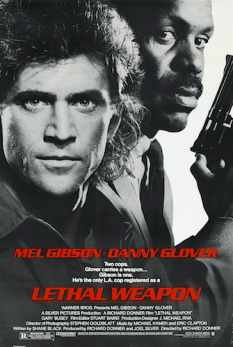
Lethal Weapon (1987)

2009 #8
Richard Donner | 110 mins | download | 18 / R

Lethal WeaponLethal Weapon comes from another era — an era in which R-rated films were still allowed to be blockbusters. One only needs to look at the classifications attached to the most recent instalments of formerly-R-rated ’80s franchises — primarily, Terminator 3: Rise of the Machines and Die Hard 4.0, both PG-13 — to see how things have changed. Of course, maybe they have just cause: Watchmen, the first proper R-rated blockbuster for a while, has been labelled a box office disappointment (because that’s what $150m worldwide in two weeks is these days).

I digress. Though, my mind frequently wandered during Lethal Weapon — often to Die Hard. This may predate the Bruce Willis franchise by several years, but it’s a testament to the fame of that film’s Christmas setting that my first thought was they’d ripped it off (Lethal Weapon, like Die Hard, begins with a classic Christmas song over an urban setting). And my next thought was, did they not have a costume budget? The film opens with a young girl, lazing provocatively with one tit out… at first, before Donner makes sure to show them both off thoroughly before she hurls herself from a building; and then we find Danny Glover’s Murtaugh in the bath and Mel Gibson’s Riggs wandering around showing his arse off. Nudity is fine in its place, of course, but here it’s so gratuitous that it sets a low tone — to be fair, one the film does little to belie.

More seriously then: the plot is full of holes with great gaps in its logic, especially as it heads towards the climax. There’s also no mystery — the investigation is just an excuse to string together action set pieces and comedic buddy scenes, neither of which are much cop, and most of the story is conveyed in a couple of info-dumps that supporting characters volunteer for no definite reason. The dialogue and performances are appalling — “may I remind you of some stuff you already know, that’s convenient exposition for the audience, thoroughly explaining the troubles of the main character and the scene you just saw”. I’ve seen better episodes of Murder, She Wrote. Their motivation makes about as much sense too — “tell me the truth!” “But they’ll kill my daughter!” “We can protect her!” “No you can’t!” “Tell me!” “Oh OK then.”

The villains aren’t just poorly drawn, they’re barely sketched at all. There’s an early scene where we see how Hard they are, then they just turn up in time for the climax and do little more than get chased around and die explosively, and in the wrong order to boot. At the very end, our heroes capture the one remaining bad guy… and then have a fight. Why? Because they do. And then all the police turn up and just watch this punch-up going on. It’s the thinnest excuse for a final fight ever put on film, and consequently the least tense — none of those officers are going to let the villain kill Riggs, and even if he did beat or kill him he’s not going to escape. There is literally no point to it. It’s appalling writing, and dire filmmaking to have left it in.

Oh, and Murtaugh smashes a car into his own front room for no reason.

Lethal Weapon probably wants to be a lot better than it is. Was it supposed to be a drama about these two cops with any old investigation plot stuck on, or a standard action-thriller with too much time spent on character? At best, it falls somewhere between the two — they’re not real characters (i.e. it wouldn’t pass as a drama if you cut out the thriller), each being made up of several stock Action-Thriller Hero traits; but nor is the plot the main focus, what with it being rather generic and not especially interesting or at all complex. The leads’ repartee and bonding is more interesting than the actual plot, and is surely the explanation for the film’s enduring popularity and three sequels, though to be honest I didn’t get it.

I’d always thought Lethal Weapon must be alright — after all, as I said, it’s had an enduring popularity and was written by Shane Black, who went on to both write and direct the thoroughly wonderful (and underrated) Kiss Kiss Bang Bang (with Robert Downey Jr being fantastic a good few years before his popularity resurgence in Iron Man) — but having seen it, I struggle to see why people like it to any significant degree.

2 out of 5

ITV1 are showing Lethal Weapon tonight at 10:15pm.
Lethal Weapon is on Watch tonight, Tuesday 23rd September 2014, at 10pm.

Watchmen (2009)

2009 #9
Zack Snyder | 162 mins | cinema | 18 / R

This review contains major spoilers.
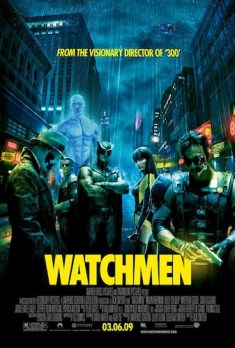
Watchmen didn’t flop. Let’s get that out of the way.

Did it do less business than expected? Yes. Were expectations unreasonably high? Unquestionably. After the barnstorming success of The Dark Knight I think some expected a repeat run, but they forgot that while TDK was dark, it still had clear heroes, clear villains, a massively popular franchise and — let’s be honest — a highly-publicised, highly-acclaimed final performance from a certain tragic young actor. Watchmen, by comparison, is densely plotted, morally ambiguous, a tad on the long side, with unknown characters, an unclear story (in the marketing at least) and no mass recognition. And it was rated R. All this considered, it did phenomenally well, and at the end of the day it’s WB’s fault for spending $150m on something that, realistically speaking, wasn’t going to make that back on opening weekend.

But this isn’t meant to be a rant about the box office. Now that the dust has settled somewhat from the initial flurry of reviews — which on the whole seemed to either hail it as an instant classic or an unrelenting mess (though some more reasonable ones found the middle ground) — and with the dubiously-featured UK DVD and Blu-ray releases just announced, it seems about time to add a few of my thoughts to the already-overflowing mix. In doing this I find it impossible to fully divorce myself from the fact that I’m a fan of the book, so can only really view this adaptation from that perspective; just as I think anyone who’s read the book can’t truly imagine quite how a non-reader will take this, whatever they may claim. The only people who can do that are people who haven’t read the book, and there have been plenty of those reviews around too.

But even as a fan, my opinions are not as predetermined as some might think. Watchmen is incredibly faithful to its source material (some notable tweaks and omissions aside), but while some have loved it for this, others have viewed it as weak or pointless. Perhaps some of the complaints about faithfulness stem from the fact that we’re actually unused to seeing faithful superhero adaptations — “adaptations” being the operative word. Across seven Batmans, five Supermans, four X-Mens, three Spider-Mans, two Hulks, and countless others, how many actually adapt a specific book? Most, if not all, develop their own story around the notion of the character(s), or take some degree of inspiration from various storylines, tailoring a new tale for the different medium (well, theoretically). In choosing to adapt the source rather than make a film starring the same characters, Watchmen places itself more in line with other literary adaptations than other superhero movies. Some would argue this context still renders it more of a Da Vinci Code than a Godfather, but it’s perhaps still appropriate to debate that rather than if it’s more a Hulk than a Dark Knight.

The consistent faithfulness is a bit of a mixed bag. For much of the film it’s a great story well re-told, and its climax actually manages to improve on the original’s to the extent that, if Alan Moore ever actually watched it (which he won’t), I’d like to think he’d be man enough to admit that this one change at least was an improvement. Similarly, in the novel I wasn’t convinced Rorschach’s final moments made sense — it seemed out of character. On screen, however, Jackie Earle Haley completely sells it, his final scream becoming one of the film’s most memorable moments. Other elements are retained with no thought, however: the intercutting of Dan and Laurie’s alley fight with Dr Manhattan’s press conference is an effective (if blunt) sequence in the novel, but on screen makes little sense — even though I know the story and know the events of both scenes, this choice left me struggling to follow events. Even worse, the sudden and unexplained presence of Ozymandias’ pet big cat is almost baffling to a viewer familiar with the source, and so I can only imagine how little sense Bubastis must make to a new viewer. Consequently, his demise has no emotional weight.

The final scene is a bit of a misstep as well. In the book it’s a perfect little coda, beautifully ambiguous and tied to several of the novel’s themes. On screen, Snyder overplays it, allowing it to drag on with pointless dialogue and leaving the point of the scene feeling forced — equally a fault of David Hayter and Alex Tse’s script, then. Part of the problem is that it’s lumbered with introducing a subplot and its characters for the sake of the payoff, both of which develop slowly and appropriately in the novel. The details of that particular subplot are not the only elements that are missed from the original: the novel contains a lot of details of street life in Manhattan, for example, which makes the city’s ultimate destruction more personal for the reader. Some of these scenes have been filmed and, knowing that an aptly-titled (for once) Director’s Cut is on the way, it’s at times hard not to view the theatrically-released Watchmen as an abridged version. While it is still more complex than some critics (both pro and fan) give it credit for, the missing nuances and subplots would strengthen the whole experience. We can but hope it’s these that the Director’s Cut will include, rather than just a collection of completist-pleasing trims.

It’s easy to complain about Watchmen — clearly — but, actually, I really enjoyed it. Snyder has arguably created a live-action version of the graphic novel rather than creating a film in its own right, but is that really a bad thing? It’s what many literary adaptations aspire to, the only difference here is there were already some pictures to directly transfer. Some will disagree, and if you do then this is a perfect argument for why Non-Fans should be in charge of film adaptions — Fans are too concerned with pleasing other Fans, in this case being rigorously faithful; Non-Fans often just want to make the best movie possible based on the source material, rather than making the best translation (or, perhaps, re-appropriation). Perhaps it’s too fine a line to walk; perhaps Snyder was too afraid to change anything; or perhaps it’s just a case of damned if you do (“it’s exactly the same, what’s the point?”) and damned if you don’t (“he changed too much, it’s not Watchmen!”).

In their faithfulness, Snyder, Hayter and Tse retain much of the story and character elements that made the original great. If the aim was to take the page and put it on screen, the screenplay is near flawless, embellishing some moments and even fixing others, while excising subplots so wisely I didn’t miss much. As stated, however, the definitive cut is surely the forthcoming one. As for Snyder’s direction, he mostly does a good job, recreating iconic panels — occasionally with too much reverence, true — but enlivening other sequences in his own way. In fact, for all the moans of reverence, some of the novel’s more filmic ‘cuts’ are actually abandoned (I’m thinking specifically of the ins & outs of flashbacks during the Comedian’s funeral). Photography wise, most of the film was far too dark, and I couldn’t help but wonder if it had been shot too much with DVD/Blu-ray in mind and suffered when projected. I suppose we’ll see later…

Snyder certainly left a clear directorial stamp on one element of the film: occasionally the action sequences smash into slowmo, sometimes to the point of freeze frame… exactly like they did for most of 300’s fights. Whereas there it looked kinda cool and felt like a stylistic tick unique to that film, here one can’t help but think time is being wasted that would be better spent on expanding the dense plot. And rather than being a stylstic quirk of 300, it now becomes one of Snyder’s; which means that, from the very first scene, “A Zack Snyder Film” is stamped all over this like a young boy with an abundance of name stickers. There’s nothing wrong with making it his own film, of course — I’m sure Gilliam’s or Greengrass’ versions would’ve slotted comfortably into their distinctive oeuvres — but it would be nice if it weren’t quite so intrusive. On the other hand, could it be that the expectation of this makes it seem worse than it is, and if any other director had pulled the same tricks it wouldn’t seem as apparent?

Similarly, the violence is incredibly brutal, gory and graphic — but that’s the point. Though they live in a heavily stylised world, these are ‘real’ superheroes, and real violence isn’t pretty. The level of brutality is appropriate to the theme but never lingered on more than is reasonable and rarely over-done. Those who aligned it with ‘torture porn’ flicks like Hostel in their criticism of the film were missing the point.

The film’s soundtrack has also come in for criticism in some quarters, where certain tracks have been accused of being entirely out of place and others have been suggested as replacements. However, the tracks lambasted and others put forth suggest that these particular critics (usually amongst fandom) have a rather narrow taste in music, with the suggestions often too obscure to suit. In fact, Watchmen’s soundtrack provides a nice variety of contemporary songs, spanning styles in order to quickly define an era rather than to evoke what a specific genre was doing at the time — so a 1970s riot is accompanied by disco, for example, rather than a niche rock track. It makes absolute sense from a filmmaking standpoint and, for those of us with broader tastes, is perfectly pleasant. Elsewhere, the choice of music references both the original text — Rorschach and Nite Owl’s arrival in Antarctica is set to Jimi Hendrix’s All Along the Watchtower (while the novel quotes Bob Dylan, here its use as an action cue means Hendrix fits better) — and other films — the Vietnam sequence is knowingly set to Ride of the Valkyries. There are some missteps — the use of Leonard Cohen’s Hallelujah over the sex scene is presumably meant to create a moment of euphoric triumph, but is instead laughably cheesy — but, most of the time, it’s a success.

The other major addition from the graphic novel is, of course, a cast. As already noted, Jackie Earle Haley is incredible in the default-lead role of Rorschach. He may’ve nicked Christian Bale’s Batman voice, but it’s much more suited here. Patrick Wilson’s Dan Dreiberg/Nite Owl II is also great, showing the benefit of hiring proper actors rather than stars. Jeffrey Dean Morgan and Matthew Goode hold their own in potentially challenging roles. Some didn’t — and don’t — think Goode was right for Adrian Veidt, but I preferred his portrayal so much that the more butch-looking Ozymandias of the novel now seems wrong to me. The female leads suffer more. Malin Akerman is about passable, but Carla Gugino is quite possibly miscast. It’s a tricky part to get right, having to be both young and sexy in the flashbacks but an old woman in the story’s present day, and so it may be more the fault of some poor old-age makeup than Gugino’s.

That’s not to mention Billy Crudup, who has the double challenge of playing a man who has become God-like, and of giving this performance underneath a big pile of CGI. And with a CG penis on show too. Personally I didn’t find the CG manhood as distracting as many others seem to have, and Crudup’s actual performance is captivating — there’s a thin line between aloof otherworldliness and reading dialogue aloud in a monotone, but Crudup managed to fall on the right side of it.

Surprisingly, I’ve made it through almost 2,000 words without mentioning the title sequence. There’s no need to describe it any more, it is simply brilliant. More dioramas were shot than made it into the final cut, so I can’t help but hope they’ll be reinstated in later versions.

In summary (if this ramble around Watchmen can be summarised), Zack Snyder’s Watchmen Film is not “the big screen equivalent of Alan Moore’s Watchmen” — that would be a movie, likely very different to the graphic novel, that examined and deconstructed representations of superheroes in cinema and television. Instead, Zack Snyder’s Watchmen Film is “Alan Moore’s Watchmen on the big screen”, a blisteringly faithful adaptation of the source. Crucially, however, it is not (always) blindly faithful — the ending being a case in point — but some will still ponder its relevance. Judged as an artistic work in its own right, then, it perhaps comes up lacking. Judged in comparison to other faithful adaptations of great literature, however, it’s arguably as good as many others. At the very least, it’s exposed a wider audience to the characters, themes and debates of the original, and, whether they like it or not, that can only be a good thing.

In closing, I’m reminded of a comment made by Danny Boyle when discussing his favourite film ever made: “it’s imperfect; which every film should be.”

5 out of 5

My review of Snyder’s preferred Director’s Cut can now be read here.

That version placed 3rd on my list of The Ten Best Films I Saw For the First Time in 2009, which can be read in full here.

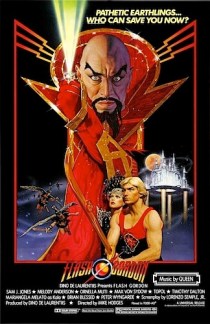
Flash Gordon (1980)

2009 #27a
Mike Hodges | 107 mins | DVD | PG / PG

Flash GordonI hadn’t been intending to review Flash Gordon — it’s not as if I don’t have enough new films to review — but though I have seen it before it was a long time ago and I was very young, so watching it again now I wasn’t quite prepared for just how good it is.
Flash often seems to be dismissed as an unintentionally campy load of nonsense, perhaps with some ironic appeal. What this assessment misses is how knowing it is. Yes, it’s ridiculously camp, the dialogue is cheesy, the performances equally so, and it’s brighter and more colourful than any under-5s TV show ever produced. But it knows it is, and because it does it with nary a nod nor a wink I think that passes some viewers by.

The sheer volume of things there are to love in this film makes them hard to list without watching it and pointing them out as they appear, but I’m sure I can manage a few. For one, there’s the design work — the sets, the costumes, the spaceships — all huge, vibrant, retro and often ridiculous, and all wonderful for it. The special effects are truly special, creating skies full of swirling rainbow colours, rainbow clouds for the spaceships to float through, platforms that tilt over a rainbow vortex… Do some of them look primitive? Well, a bit — but they have more charm than CGI ever will, and they don’t get in the way either.

The plot is ludicrous, built from B-movie elements and predicated on cliffhangers — which is exactly as it should be. The dialogue is packed with quotable lines, many so patently ridiculous that it can only have been deliberate. There’s not a single bad performance — everyone’s either in on the joke or playing the straight man to it. Of particular note are Max von Sydow’s properly villainous villain (who, to be quite honest, still has more depth than too many nemeses we see today); Peter Wyngarde as his scheming right-hand-man, granted a fantastic death; Mariangela Melato as his right-hand-woman, granted some of the very best ‘bad’ lines; Topol as a somewhat loopy Dr Zarkov; and, of course, Brian Blessed — no more need be said.

The fights and assorted other action scenes are exciting, frequently epic, and tinged — like so much of the film — with a perfectly judged level of humour. Arguably the best is a harem-set tussle between between Dale Arden and Princess Aura, watched by sniggering servants as they wrestle on a giant bed. It’s beyond knowingly handled by Hodges, the brief cutaways to the servants indicating the deliberate commentary on such voyeuristic lesbian-lite wrestling matches in other films.

Then there’s the score by Queen. As with Brian Blessed, what more needs to be said? (Incidentally, I got a big laugh when Blessed screams, “who wants to live forever anyway?”, forgetting that Highlander was still six years off when this was made.)

So, in all that, what’s wrong with Flash Gordon? When I noticed how much I was enjoying it — about five minutes in — I began keeping my eyes open for flaws, any niggling thing that detracted from the experience Hodges created. I couldn’t find a single thing. Not one.

Which means I can now become known far and wide as the blog that only awarded Star Wars four stars, but gave Flash Gordon a perfect

5 out of 5

Predator (1987)

2009 #16a
John McTiernan | 102 mins | DVD | 18 / R

PredatorLet’s not pretend here: although the series have become intrinsically linked, Predator is Alien’s poorer cousin. Not that it’s a bad film — it’s an entertaining war flick that turns into a sci-fi/action/horror skirmish thingy — but it doesn’t have the same finesse that imbues Alien and its sequel.

In the lead role, Arnie does his usual macho posturing. Around him, a crack team of special-operations soldiers are characterised enough to be distinguishable but little more. There’s a girl because there should be a girl, not that she does much. Mainly, there are a couple of big fights and one seriously ugly alien.

The main reason for Predator’s success may well be the Predator itself. It’s a fantastic bit of design and animatronics that easily stands up today, its disgusting mouth perhaps not as iconic as the Alien’s phallic extra one but arguably more gruesome to look at. It works differently too: a solo intelligent hunter that is picking off our human heroes and is always one step ahead. Much of the same could be said of Alien’s Alien, but that was like a beast stalking its prey, while the Predator is more like a man hunting some rats. Where Aliens felt like a natural evolution of the former franchise’s concept — more of them! — Predators seems like a rather ill-conceived idea.

Still, there’s plenty of visceral enjoyment to be had from Predator’s straightforward approach, which is more than can be said for its sequel

4 out of 5

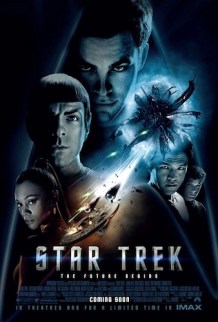
Star Trek (2009)

2009 #24
J.J. Abrams | 127 mins | cinema | 12A / PG-13

It’s Star Trek, Jim, but not as we know it.

Sorry, but as someone who isn’t actually much of a Trek fan I couldn’t resist that. I’ll try not to include any more. In which case, it’s set phasers to thrill (sorry) as the crew of the Starship Enterprise boldly go (sorry) back to the big screen, hoping to relaunch the ailing franchise to live longer and prosper (sorry). The crew look younger than ever and there’s a heavier dose of action to boot — why, it sounds like it might almost be fun! In which case, beam me up Scotty! (Done now.)

“Fun” is certainly the buzz-word for this incarnation of Trek: it’s all action, special effects and spectacle, without a single scene of uniformed elderly people sat debating ethics. Though some ethical issues circle the plot, they provide character motivation (or excuse) rather than any kind of debate. While the average blockbuster crowd won’t mind this — and nor will critics, apparently — the universal praise this reboot has received may become somewhat baffling. Clearly claims that it’s “great science fiction” are misattributed — it’s great action-adventure in a sci-fi setting. Perhaps an easy confusion to make, but an irritating one nonetheless.

But I digress. The emphasis is very much on spectacle throughout, with wide shots of future cities, starships, alien planets and battles, all shining and designed to be as awe-inspiring as possible. No element of the film remains untouched by this desire: the Good Guys and Bad Guys are clearly delineated — no shades of grey in this gleaming white Universe; the jokes are all entirely upfront, almost to the point of slapstick; everyone’s very young and pretty; and the majority of female characters (there aren’t many) are gratuitously in their underwear at some point too. It all makes for a huge contrast to the dark-as-we-can blockbusters that have been doing the rounds for the last few years (and will be as much as ever this summer) — it makes Iron Man look serious. This is completely appropriate for Trek as originally conceived: the original series was Kennedy-era optimism, all about equality, exploration and peace; perhaps then this is the first film of Obama-era optimism — lots of young people defeating overwhelming terrorist odds.

With all its bright, optimistic youthfulness, it has the feel of a PG-rated family-friendly blockbuster, which might lead one to wonder about the meaningfulness of the “12” certificate now that it has an “A” attached. The answer undoubtedly lies in the action sequences (not the underwear — there’s nothing worse than Princess Leia’s bikini, and that’s rated U. Not that it would be today.) It’s unfortunate that the opening U.S.S. Kelvin sequence is the film’s best, though the rest don’t suffer by comparison. While nothing else is as individually memorable — though parachuting onto the drill tries very hard to be — it’s all of a good enough quality and, crucially, moves by fast enough that you likely won’t notice.

There’s a plot too, believe it or not. It’s actually quite complex, but is pushed along in big chunks of exposition and those breezy action scenes, meaning most won’t notice the strain writers Roberto Orci and Alex Kurtzman are under to make it all work. Sadly they didn’t quite pull it off: there are some glaring plot holes, the worst being a huge blob of coincidence fuelled by convenience halfway through that barely makes any sense. This icy planet — or The Planet of Convenience, as I feel it should be called — features the giant red monster seen so prominently in the trailer. It will come as no surprise that it’s designed by the bloke who came up with Cloverfield’s beasty, not only because it looks almost as foul but because Abrams resolutely keeps the same crew around him at every level. But it’s an irritant to those looking for a cohesive story, starring in an unnecessary action sequence that stinks of both “oh, and a big nasty monster would be cool” and “no one will buy this coincidence, let’s hide it in an action sequence with a distractingly ugly monster!”

The plot does impress in one regard however: it is incredibly entrenched in the intricacies of Star Trek continuity and history, yet all this manages to slip by amiably and accessibly. It’s so at pains to explain why this new-look Trek is completely different from canon yet absolutely a part of it that it runs round the houses tying things together and explaining away inconsistencies that only knowledgeable Trekkies will care about. This is impressive because, in spite of it, it feels like a Fresh New Trek. Perhaps this is why the fans have embraced a film that looks like a multiplex-pleasing reboot: they feel catered for with Spock Prime (as the credits would have it), the complexities of time travel and the references back to the other Trek universe, offering up a whole load of new things to integrate into already-bursting continuity manuals, meaning the lighter action-adventure stuff is permissible too.

Technically speaking, the film is a mixed bag. The design work, for example, is great. While the Romulan ship is your typical Big Bad Semi-Organic Alien Vessel, seen a lot in every space opera TV series of the ’90s, the Enterprise is clean and bright and rather different. After years of Alien-inspired grime throughout sci-fi — even attempted in Star Trek with the submarine-like vessel at the heart of prequel series Enterprise — the new-look USS Enterprise is all bright white and vibrant colours. It’s custom made for plastic toy playsets in fact; or, to be slightly nicer, “these are the voyages of the Apple iEnterprise.”

On the other hand, the cinematography is frequently irritating. While many of the CG shots present a graceful view of the space spectacle, most of the time they need to put the damn camera down. It doesn’t need to be jiggling about all over the place during dialogue scenes — Kirk and Pike in the bar post-fight is an especially irritating example — and it would be nice to see what’s going on in the action scenes. Of course, they manage to provide a nice clear shot when the ladies are in their undies. Cynical? Never. DoP Daniel Mindel has confessed that he tried to get in as many lens flares as possible, and you can tell — it comes across like it was shot by someone who’s only ever worked on digital, then upon switching to film accidentally created a lens flare, thought it was pretty, and decided the film would be better if there was one at literally every opportunity. It wouldn’t.
The cast and handling of multiple characters are both less problematic. The way the young crew is brought together is more than a tad contrived, but with seven major characters to compile in a Very Young Crew origin story it’s not an easy task. Certainly, this way is much more exciting than if they were simply assigned the job at an appropriate age and bonded on their first mission — which would undoubtedly have been the plot of Old Trek’s origin movie. The focus is clearly on Kirk and Spock; mainly the former, but his character arc is little more than a standard genius-rebel-comes-good one, whereas Spock’s battle between two cultures and within himself allows Zachary Quinto a lot more to do. Chris Pine makes a good Dashing Hero, balancing the heroic action and broad humour with aplomb, but it’s Quinto whose acting chops come the closest to getting a test. Wisely, neither chooses to copy their original counterpart, which allows them to breathe as characters rather than impersonations.

Most of the leads follow the same strategy to good effect; while Anton Yelchin (as Chekov) and Karl Urban (as Dr ‘Bones’ McCoy) come closer to doing impressions than anyone else, they still make good their own versions. Winona Ryder is a piece of odd casting though, aging up for a tiny role as Spock’s mother. At least Jennifer Morrison’s equally tiny mothering role can be put down to the fact that, while she’s very recognisable to any House fans, she’s playing her own age and isn’t a movie star. Ryder is. Or, perhaps, was.

Unsurprisingly, Simon Pegg’s incarnation of Scotty is an awful a lot of fun. There’s nothing like enough of him, and a sequel will only benefit from an increased Scotty presence from the very start. Though Pegg gets the lion’s share of the best comedic bits — possibly due to his experience and talent in the field — he only turns up to add lightness at the point everyone else begins to get Very Serious About The Plot. Before that there are plenty of jokes flying around, including several that actually require memory — a rare thing in a film focused on spectacle — paying off earlier gags you didn’t expect would receive a payoff. The level to which the film is internally referential and interconnected is again to Orci and Kurtzman’s credit. As noted, the humour brings a nice lightness to proceedings, something missing from the darker-than-dark treatment most franchises offer these days.

The final scene is a bit of a cheesy moment, one of those “aww look the whole gang’s together and they’re all friends” bits — for an American film that relies on optimism, it’s something that they managed to have only one. But it does hold the promise of more adventures to come, and based on the critical and box office success of this outing we’re sure to get them. The need to introduce so many characters here both drives the plot forward and restrains it — the former provides a lot of material, including all the stuff tying it to main Trek continuity, while the latter means any independent narrative is primarily a facilitator for the rest. Hopefully a sequel will suggest the latter is true and it’s not a reliance on the former that has provided this entry’s quality. Or, to put it plainly, “next time they better come up with a good plot”.

For an independent viewer, the over-zealous critical reception is Star Trek’s biggest problem: while it is certainly satisfying in some areas it’s also lacking in others, but it seems most of the world’s critics are closet Trekkies, able to seize upon an above-average film and hail it as the Second Coming. It will come as no surprise when I say it isn’t. I’ve never really got on with Star Trek and its solar system of spin-offs — which, I admit, may be Doctor Who-fan bloody-mindedness — but this I enjoyed, a little in spite of myself and the disproportionate adulation it’s received elsewhere. Rebooting a franchise in a way that appeases fans and pulls in new viewers is no easy task, but it seems safe to say that Abrams has done almost as good a job as Russell T Davies, even if only one of them remembered to hide some brains among the entertainment.

This new incarnation of Trek is bright, light and fun in the face of insurmountable odds — both from the threat in the film and from public perception. Despite the claims, it is not the Second Coming, but it is very good at what it does. In all these respects, it really is just like Obama-era optimism. Does it mean Abrams can relaunch the ailing Trek franchise? Why, yes he CAAAAAAAAAAAAN.

(Really done now.)

4 out of 5

Star Trek placed 7th on my list of The Ten Best Films I Saw For the First Time in 2009, which can be read in full here.

X-Men Origins: Wolverine (2009)

2009 #23
Gavin Hood | 107 mins | cinema | 12A / PG-13

X-Men is a Great Big Action Movie Franchise — you know, the kind that sprawl on through increasingly lengthy films with the constant risk of diminishing quality. Well, at a relatively brisk 107 minutes, this fourth entry in the X-series is actually the second longest. Shocking I know. But while it counterintuitively conforms to the first rule, it fortunately doesn’t to the second, despite what others may say.

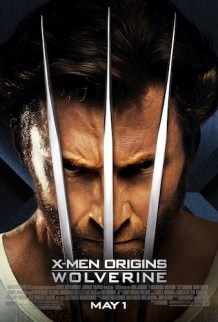
Wolverine, to put it simply — much as the film would — entertains. In this respect it may lack the depth of X-Men or X2, both of which played with subtexts of social exclusion and derision evoking especially the historical treatment of Jews and homosexuals; but, taken as a straightforward action-adventure movie about people with extraordinary abilities fighting each other, it more than satisfies. To this end the action sequences are mostly very good. Only one suffers notably from dark cinematography and choppy editing, both common faults these days, while others manage to exhibit the odd bout of originality — the climax atop a nuclear power station is brilliant, making good use of the characters’ superpowers while also delivering on the ol’ punching-and-kicking front. Some have criticised the action for being physically ludicrous, but perhaps they should be reminded that they’re watching a film about people with superpowers. With that in mind, Wolverine never goes beyond what’s plausible for the world that’s been created across all four films.

In fact, lack of subtext aside, this isn’t as distant from the other X-Men films as the single-character focus and prequel status may suggest. It’s mutant-packed, with numerous cameos from characters familiar to comics fans; it begins with the activities of a superhero team, ends with the rescue of a bunch of mutant kids, and the main plot revolves around some humans doing Bad Things to mutants — just like the first three. The most obvious difference is that Wolverine is now very much the central character, but even that isn’t a great change: he was in the first two, however much they tried to convince us otherwise, only neutered in the third because they knew this prequel was on the way. (For me, the abandonment of Wolverine’s backstory was The Last Stand’s biggest fault, the primary thing that made it feel truly separate from the first two films where it was the central — and unresolved — subplot.)

Elsewhere, the vaguely Watchmen-like opening titles are quite neat, conveying backstory and building up the Wolverine/Sabretooth relationship in an attractive fashion, while also slightly distancing this film from the rest of the series by being in a very different style. While the dialogue is rarely more than efficient, there is the odd good one-liner, my particular favourite being when a grossly overweight character mishears Wolverine’s trademark “bub” as “Blob”, a neat use of one familiar element to create another. Even with these moments, almost all the actors are above the script, especially Ryan Reynolds considering how briefly he appears. All do good work nonetheless, the standouts including Dominic Monaghan, whose character is so different from the violence-centric rest that you wish there was more of him, and Liev Schreiber, who is absolutely fine at what he has to do but would benefit from a few more dramatic scenes to get stuck into. Some of his scenes with Wolverine feel very much like a pair of good actors attempting to transcend the material they’re working from.

Around these weaker parts, Hugh Jackman unquestionably carries the film, and is occasionally granted more to do than just fight people. He even gets to attempt something we’ve not seen from Wolverine before: happiness. Even knowing where it’s all going to end — and there is sometimes a sense that we’re just being told a story we’ve either heard before or worked out for ourselves — there are bits like this that help flesh it out, that show us elements of Logan we might not have bothered to consider otherwise. There’s still the odd instance of box-ticking though, as the few pieces we know from the trilogy are strung together by this film’s plot. They’re not too awkwardly slotted in, but there is an awareness that someone was joining up dots.

While this can be ignored, the same can’t always be said for Wolverine’s noticeably silly hairstyle — one particularly bouffanty moment during the climax even provoked laughter from the audience I saw it with. Intriguingly, Jackman is the second of three Aussies with bloody silly hair this summer, following Russell Crowe’s L’Oréal locks in State of Play and preceding Eric Bana’s Picard pate in Star Trek. I’m sure there must be some deeper meaning to these bad barnets…

Unfortunately, a dodgy ’do isn’t the worst of Wolverine’s problems. There’s some very poor CGI, as if the effects guys thought claws were easy so didn’t worry about them too much. Clearly, this isn’t so. The much-criticised de-aging of another recognisable character is also weak, but, for my money, no weaker than what we saw in The Last Stand. Gambit is miscast and underused, and I’m told Deadpool is the latter also. Not being familiar with the character I had no real problem with his treatment here, but perhaps this is why fanboys dislike the film and some others won’t mind it: if you know what these two characters can be or are meant to be, their sidelining might feel like a betrayal; but if you don’t know them, there’s little wrong with them.

The biggest sin for others is that, at times, Wolverine merrily rolls out clichés. One might argue that it’s set in the ’70s and conforming to some kind of ’70s movie schtick, but that would be a pretty thin argument considering it’s not in evidence anywhere else. Personally, I was amused how some of these lines or moments are sped past, as if everyone involved knew they were shooting a bad cliché but felt they had to leave it in.

This year is surprisingly light on superhero movies, with only Watchmen and now Wolverine to satiate that particular fanbase. Of course, last year was exceptionally packed with them, and as the build to Marvel’s massive Avengers team-up kicks off next summer we’ve got a heavy few years ahead. A bit of a break is nice then, and while Watchmen dealt with the more intellectual front of superheroes (or, if you disliked it, tried to), Wolverine caters to the other side with its unashamed action-adventure entertainment. In fact, by being Actually Quite Good when almost everyone is laying into it, Wolverine manages to become the most underrated film of the year so far.

4 out of 5

Runaway Train (1985)

2009 #11
Andrei Konchalovsky | 106 mins | TV | 15 / R

This review contains major spoilers.

Runaway TrainRunaway Train bagged itself three Oscar nominations and one for the Palme d’Or back in 1986, which rather begs the question, how?

On the awards-worthy side, it’s based on an Akira Kurosawa script and features grittier-than-average direction and performances. On the other, the majority of its story and supporting characters feel closer to other ’80s actioners like Lethal Weapon or Die Hard. The focus on a high concept (the title says it all), emphasis on exciting action sequences, the way the plot is structured, the faintly pantomime villains, comical supporting characters, and occasional slips into fantasy (one character was welded into his cell, the state the prison has degraded to, the whole concept of the runaway train and its computer control centre) — none of these elements suggest your typical Oscar nominee, but instead a half-forgotten minor action flick.

The lead characters and their performances, by Jon Voight and Eric Roberts, are above average for the genre — this is where two of the Oscar nods come from — but they’re not notably superior to other outstanding examples (see Bruce Willis and Alan Rickman in Die Hard). Praising the acting can only cover the two leads, at best, because the villains and supporting roles are as one-dimensional and clichéd as you’d expect from the genre. The other Oscar nomination was for editing, one that’s more obviously deserved. Visually, the sequences of the train smashing through the countryside are fairly impressive. Perhaps the camerawork deserved a nod in this respect too, as it lends the film a gritty real-world feel that may be explain some’s distraction from the otherwise familiar values. It can’t mask them all though — for example, the occasionally brutal violence is still denied any real-world punch thanks to the fantastical sheen created by some plot points.

The notable exception to most of this is the ending, where Voight’s anti-hero stands atop a train engine we — and he — know to be doomed, his prison warden nemesis handcuffed inside, and rides it out of sight into the fog. It’s a classy finale that flirts with the downbeat ending, though doesn’t quite succumb to it because we also know the young sidekick and girl have survived. Nonetheless, there’s pleasingly no postscript, simply fading to black after the engine disappears into the mist. The titular train, one might theorise, is like some mythic beast — it arrives through snow-mist, leaves devastation in its wake, and then disappears back into it. But that might be getting a bit too pretentious…

In focusing on these lofty pretensions (which may have been forced on it by nominations and some reviews), one can become distracted from the fact that, taken as a straight-up high-concept action-adventure, Runaway Train has an awful lot going for it. And if you want to get pretentious about it, well, it might just support that too.

As a final aside: one of the film’s most memorable moments, in retrospect, is down to an accident of fate. Near the end a character looks at a space shuttle on TV and muses, “with all this high technology, why couldn’t we stop it?” Just 11 days after Runaway Train’s US release, Space Shuttle Challenger disintegrated 73 seconds after launch, killing its seven crew members. For anyone aware of this correlation, it’s an incredibly poignant moment.

4 out of 5

Though the Radio Times review I’ve linked to says Runaway Train is an 18, it was reclassified in 2008. [It has since been updated.]

Hellboy II: The Golden Army (2008)

2008 #93
Guillermo del Toro | 115 mins | DVD | 12 / PG-13

This review contains minor spoilers.

Hellboy II The Golden ArmyDespite enjoying the first live action Hellboy movie last year, I didn’t make it to the cinema for this sequel. Unfortunately neither did a lot of others, choosing to see The Dark Knight again and again instead. Of course these days the DVD release is almost as important… except Hellboy’s was on the same day as Dark Knight’s. I don’t have sales figures, but I expect it was thoroughly overshadowed again — which is a shame, because Hellboy II is actually a very different beast.

Despite shared roots in the pages of comic books, Hellboy II sits comfortably apart from last Summer’s other two big comic book adaptations, The Dark Knight and Iron Man. While the former was aiming for a real-world crime-epic feel and the latter a more humour-littered sci-fi, they both still dealt with billionaires investing in identity-hiding suits to fight crime of one kind or another. Hellboy exists in a completely different place. Of course there are still wise-cracking heroes (with requisite Issues) and scheming villains, action sequences and a liberal use of CGI (mixed with “we did it for real!” bits, thankfully the ‘in thing’ right now) — but it’s not Sci-Fi, it’s Fantasy.

Del Toro uses this to his advantage, allowing his incredibly fertile imagination to run riot over every frame. There are more creatures than the first Hellboy and Pan’s Labyrinth combined — in the Troll Market sequence, there’s probably more in each shot — and, in the vicious Tooth Fairies, a wonderfully gruesome twist on a familiar concept. Though couple these with certain other inventions, such as a baby-like talking tumor, and one might begin to wonder how this got passed as a 12 / PG-13; and you’d think a giant red demon getting a human girl pregnant might be enough to raise the classification. (I jest, of course — giant red demons are entitled to all the same rights as the rest of us.)

Imagination isn’t limited to creature design either. An attractively animated prologue manages to both bring back the ever-excellent John Hurt and find a way to convey the huge back story without making it tediously dull (it also has a Christmassy feel that was perfect for when I watched it). The action sequences have all the requisite coolness too, especially the closing duel on giant moving cogs. In fact, del Toro’s creation seems to overflow — the laying of plot threads for a further film is even more overt than it was in the first film — which makes it even more unfortunate that the director’s long term commitment to The Hobbit and its sequel, plus about half a dozen projects after that, makes a proposed trilogy-closer seem increasingly unlikely. This isn’t a major problem with the film, however, just an annoyance that we may never get a third entry.

One of the most amusingly idiotic criticisms I’ve encountered of Hellboy II was that it was “comic-book-ish” — not only does that make one think, “well, duh”, but also, “and why not?” When the other big comic book movies are aiming for real-world seriousness, it’s nice to have a more fantastical alternative. Hellboy II is more than up to the task.

4 out of 5

Hellboy II: The Golden Army placed 8th on my list of The Ten Best Films I Saw For the First Time in 2008, which can be read in full here. The brief comment there is probably more eloquent than this review, so please check that out too.

Die Hard 2 (1990)

aka Die Hard 2: Die Harder

2008 #95
Renny Harlin | 118 mins | DVD | 18 / R

Die Hard 2Good guides to how to write always advise that your hero is only as good as the villain. This is one of the reasons Die Hard is such an endlessly enjoyable film — as well as a great high-concept setup, excellent action sequences, and amusing one-liners, Alan Rickman’s villain, Hans Gruber, is one of the best ever committed to celluloid. Dry witted and clearly more educated than his opponent, Bruce Willis’ John McClane, he’s nonetheless defeated by that everyman spanner-in-the-works. Yippee-kay-aye indeed.

So how do you top that? Well, not like this. The generic Traitor General character offered here isn’t a patch on Gruber, meaning the hero/nemesis relationship between him and McClane never kicks off in quite the same way. The final act even tries to introduce a new villain, probably aware that the first one wasn’t quite working, though it’s to little avail. Their final duel — on the wing of a moving plane — is exciting enough, but doesn’t pack the same punch as the first film’s verbal sparring.

Arguably the other main reason Die Hard worked so well — the confined office block setting — is also discarded, giving McClane a whole airport to run around. We have to be grateful that this isn’t just a straightforward rehash of the first film — probably the advantage of being adapted from an unrelated novel, 58 Minutes, rather than a committee considering how to recycle the same idea — but it doesn’t have the same brilliant simplicity. That said, the line acknowledging similarities between the scenarios is a highlight, and good use is made of McClane’s fame following the events of the first film.

Die Hard 2 is by no means a bad action film — there are several sequences that are above par for the genre, an acceptable degree of silliness, and the odd spectacular explosion too — but the unavoidable comparison to one of the genre’s all-time classics is to its detriment. If only the villain was someone like Gruber’s brother…

4 out of 5

(Originally posted on 25th January 2009.)