Sky Captain and the World of Tomorrow (2004)

2009 #63
Kerry Conran | 102 mins | TV (HD) | PG / PG
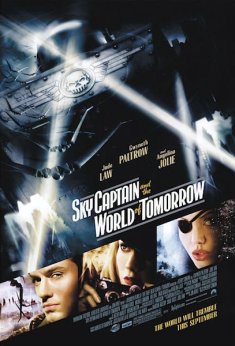
Sky Captain and the World of TomorrowIf the Indiana Jones series was a bit more sci-fi (even than Crystal Skull, that is), it might be rather like this. First time writer-director Kerry Conran evokes ’40s cinema serials more thoroughly than Lucas or Spielberg ever dared with a globe-hopping tale of a mad scientist’s giant robots doing all sorts of damage in a quest for… well, that would spoil the ending.

In the telling, Sky Captain is every inch a Boy’s Own adventure, packing every facet of that genre of storytelling into its brisk running time. There’s secret bases, ray guns, giant robots, flying aircraft carriers, snow-bound Himalayan treks, creature-infested secret jungle islands, huge underground bases, space rockets, planes that are also submarines, tree bridges over impossibly deep gorges… If it’s part of the genre, it’s probably here, and all finally executed with ’00s-level special effects. In some respects it does move between set pieces and locations in an episodic fashion, but then that’s more a trait of the films it emulates — i.e. episodic serials — than a flaw in Conran’s plotting.

Still, some might view Sky Captain as little more than an exercise in filmmaking — it was one of the first movies to be shot entirely on blue-screen, around the same time as Sin City and a couple of others. There’s more to it than that, but it’s also hard to ignore the style this creates. The shooting process is far from perfect if one were trying to recreate real life, but here the whole look is so stylised that it hardly matters. The period setting is nicely evoked, combining myriad influences into an intricately realised retro-future style, coupled with a lovely sepia sheen over everything. It’s beautifully lit, while individual shots and editing are frequently reminiscent of a style from the ’40s (and earlier). Again, Conran is being deliberately evocative of films of the period, rather than a modern film set then; more La Antena than Star Wars.

Another much-discussed feat of technology is the resurrection of Sir Laurence Olivier as the film’s villain. Unfortunately, his brief appearance is underwhelming. Perhaps we’ve become too accustomed to modern technology resurrecting deceased actors for ‘new’ performances (not that it happens that often); but then again, what was done with Oliver Reed for Gladiator — four years before this — seemed more impressive than the small amount of hologram we see here, even though the digitally created shots were equally brief. It’s a shame, because using Olivier for this key role is quite neat, certainly better than casting a glorified extra. In fairness, then, it’s a part so small that very few appropriately-big names would agree to it, which perhaps permisses resurrecting Olivier after all

Among the real performances, the acting is a bit flat. Perhaps this is deliberately in-keeping with the emulated style, though Jude Law is always this bad so maybe not. Similar comments could be made of the screenplay, if one were being unkind. What it does manage is a good amount of humour — an essential part of the genre, as any Indiana Jones fan will tell you, but it’s by no means guaranteed in these over-serious times (thankfully, the likes of Star Trek and Transformers are occasionally breaking down this barrier to fun).

Breaking free of any self-imposed period constraints, Conran also produces a few exciting action sequences, such as a plane chase through the streets of New York. It’s incredibly hard to create spectacle these days, but Sky Captain occasionally manages it. There are also lots of fun little references to other things for the keen viewer to pick out. 1138 crops up, inevitably, but my favourite is some dialogue lifted from Orson Welles’ War of the Worlds.

Sky Captain is a healthy dose of retro-styled fun. Perhaps that makes it an acquired taste, but there’s certainly nothing wrong with that.

4 out of 5

My review of the proof-of-concept short that inspired Sky Captain can be read here.
Transporter 3 (2008)

2009 #27
Olivier Megaton | 100 mins | DVD | 15 / PG-13

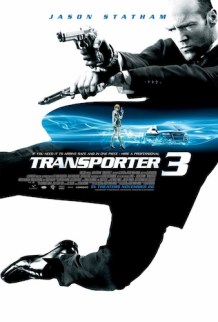
Transporter 3I very much enjoyed the first Transporter film. No, it wasn’t high art, but it did what it did very well — even managing a few outstanding moments — and in a pleasantly efficient running time too. 2005’s sequel kept the latter but sadly lost the former, pushing things too far into the realm of CG-aided silliness. With sequel director Louis Leterrier off bringing some of his much-needed CG silliness to the Hulk franchise, it falls to the amusingly-monikered Olivier Megaton to try to navigate this cars-and-kung-fu series back onto the right road.

Film credits sometimes baffle me. As you may guess, Transporter 3 has a perfect example: “Written by Luc Besson and Robert Mark Kamen. Based on characters created by Luc Besson and Robert Mark Kamen.” I honestly can’t comprehend the need for that second credit. Some may not even comprehend the need for the first one in a film like this, and usually they’d be right. Here, however, Besson and Kamen seem to have decided the presence of writers should be remembered and so stuck in an awful lot of character development. Not only is it not wanted — one of the best things about the first two films was their efficient 80-something minute running times, while this sprawls out to a full hundred — but it’s not very well done either.

Equally, the plot really makes very little sense for much of the film. Worse, when someone eventually explains it, it turns out to be no great shakes, especially as by that point the viewer’s just about pieced it together. I can’t compare it to the first two because, to be honest, I can’t really remember what their plots were, but I don’t remember thinking they were quite so ill conceived. It’s almost a shame, because it isn’t wholly a rehash of the first two — it’s still little more than an excuse to string together some fights and chases, but that doesn’t mean it can’t be different. There’s also a weak villain — never much of a threat, with an attempt at character development that is (of course) misplaced — who’s granted a logic-defying death (albeit with a nice surround sound mix). Overall, the film lacks both the humour and excitement of earlier instalments.

Megaton over-directs and over-edits the action (and a lot else besides) too often — it would be nice to tell what’s going on. Someone also needs to tell him that speeding up footage of two cars racing doesn’t make it more exciting, it just makes it look silly. And he misses apparently-obvious things that would improve sequences. For example, we know Frank’s bracelet flashes between yellow, orange and red as he gets too far away from the car — a conveniently visual warning system — so when someone takes the car and Frank has to run (and cycle) after it to avoid his wrist-bomb going off, we expect a fairly tense chase where the light on Frank’s bracelet-bomb constantly changes colour. But there’s just one half-glimpsed shot of the bracelet in the entire sequence. It’s a glaring omission that robs the setpiece of much of its ingenuity, rendering it a bog-standard chase.

After all the criticism of Transporter 2’s reliance on CGI, most of this sequel features no significant use of it — and that, of course, is a good thing. A car driving at high speed on two wheels between two articulated lorries is just silly if it’s all done with computers; done for real, as it is here, it’s somewhat impressive — exactly as it should be. (By ‘for real’ I mean a real car, real lorries, etc. I’m sure rigs of some kind must’ve been used to actually pull it off.) Unfortunately, after almost an hour and a half of keeping it real, Megaton mucks it all up again by resorting to CGI to pull off the ludicrous climax. Personally, I’d find it pleasantly ludicrous if they’d managed to film a real car doing that stuff on a real train, but the CGI just compounds the silliness.

When a film that exists solely to provide some nice action sequences can’t even do those well, you know you’re in trouble. Transporter 3 should be a mildly diverting piece of action fluff; just a bit of violent fun. I’m not sure if it’s trying to be something more with its added character development, or just generally failing in its primary aims. Either way, it’s still fluffy, but not actually much fun.

2 out of 5

Transformers: Revenge of the Fallen (2009)

2009 #80
Michael Bay | 150 mins | Blu-ray | 12 / PG-13

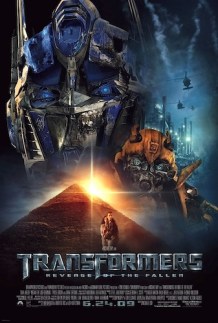
Transformers: Revenge of the FallenIf Transformers was “from the director of The Rock and Bad Boys”, then Revenge of the Fallen is “from the director of Pearl Harbor and Bad Boys II”. If you don’t get what I mean by that… well, let me explain…

The most striking thing about Transformers 2, as it inconveniently isn’t called, is that it’s over-long and indulgent. Has Bay never heard of an edit suite? The writers of a delete key? Anyone of quality control? There are too many ideas, when some should’ve been dropped for clarity and speed; the film could — nay, should — have been seriously trimmed down at every stage of production. By my reckoning, as much as an hour could be lost while still retaining all the best bits of action, humour and plot. Consequently, it’s simply not as much fun as the first film, exacerbating rather than fixing all its flaws and losing most of its charm (it didn’t have the last in spades, but it had enough).

There are good bits though. The humourous scenes highlight this contrast the most: some are genuinely amusing, others simply not, and typically go on too long. All the stuff with Sam at college — why? Especially his mum accidentally eating drugs. Or the jive-talking twins, who’d be this decade’s Jar Jar Binks if only they were as memorable. There are countless other examples — if you’ve read almost any other review you won’t need me to mention the robot balls. When the writers don’t try so hard, however, there are pleasurably funny scenes.

This applies to the action too. Some of it is exciting, but Bay has no genuine concept of rest or pause — sequence after sequence is thrown at the viewer with mind-numbing intensity. There are good beats liberally scattered throughout, but so many sequences means no stand-outs are left because there’s no time to properly process any of them. As in the first film, robot-on-robot fighting is hard to decipher. These Transformers are too realistic (as it were) — they’re all made up of thousands of gunmetal-grey parts; as soon as they come into contact you can’t tell which bit belongs to who and what exactly is hitting where. Even with the extended slow-mo shots — of which there are a lot more than in the first film — by the time you’ve actually worked out what you’re looking at, Bay cuts to the next confusing ShakyCam moment.

When things do slow it’s for brazen ‘character development’ or clunky plot exposition, both coming in great big tell-don’t-show info-dumps. At one point, one character literally urges another to “explain the plot”. The character scenes are equally forced, the dialogue functioning at a level of state-the-obvious inanity. Bay treats women with a similar absence of subtlety — every scene featuring a female is shot like a moving version of FHM, all skimpy clothes and slow-mo jiggling. The only exception is Sam’s mother.

Technically, the CGI is almost flawless, only the occasional brief shot failing to achieve little less than photo-real perfection. Bay’s typical tech fetish is also in evidence, suggesting he looked at a couple of car and military mags when he picked up that inspirational FHM. Bizarrely, however, the sound mix strikes me as a flawed technical element. I found it so odd that I had to download the digital copy and listen in plain old stereo to check there wasn’t something haywire in my surround setup. By the end it’s sounding as you’d expect (largely), but throughout there are unusually spartan patches, lacking in the music or hard-hitting explosive sound effects one expects. Perhaps we should be grateful that it’s less bombastic and wall-of-noise than you normally find in such action films, but it renders the soundtrack disconcerting at times.

On its cinema release, Revenge of the Fallen unsurprisingly jumped on the recent bandwagon of having an IMAX release, although at least some parts of the film were shot for the format — just like The Dark Knight, although with nothing like the same level of attention lavished on this in press coverage. According to the BBFC, the IMAX-exclusive version ran 91 seconds longer — 151:16 as opposed to 149:45. According to my player, the Blu-ray runs 149:53. It seems that, despite Bay’s promise of releasing the slightly-extended IMAX cut, complete with Dark Knight-style shifting aspect ratios, Paramount have been less faithful than Warner. Perhaps they considered the typical Transformers 2 fan incapable of grasping such a concept. Not that it really matters — if there’s one thing this film doesn’t need it’s to be any longer.

At times it’s like an uncomfortable amalgamation of Saturday morning cartoon and more adult-orientated action-comedy. On the one hand you’ve got a top-secret organisation with a semi-plausible acronym for a name (NEST) that sees soldiers and good giant robots travelling the world fighting bad giant robots, all without the public noticing. On the other, you’ve got whole sequences about drug use, almost brutal fight scenes, and lad’s mag-level slow-mo shots of girls running, changing and having their short dresses hiked up by robotic tails. (To be fair, there’s only one robotic tail.) In other words: if you’re an average 13-year-old boy, this is the Best. Movie. Ever.

For the rest of us, Revenge of the Fallen is, at best, the kind of blockbuster that might benefit from a second viewing, though probably after some time has passed. It’s not likely to create a better impression of the character development or comedy, but perhaps the MacGuffin-packed plot (there are at least three) would be easier to comprehend, the mythology-dumps easier to stomach, and the massive fights easier to follow. At worst, it’s a hurried production that would have benefitted greatly from some judicious editing from script level upwards. This is what happens when a studio allows someone like Bay an essentially limitless budget and less than two years to turn a blockbuster around.

3 out of 5

Transformers: Revenge of the Fallen is released on DVD and Blu-ray in the UK tomorrow.

Watchmen: Director’s Cut (2009)

2009 #79
Zack Snyder | 186 mins | Blu-ray | 18 / R

This review contains spoilers.

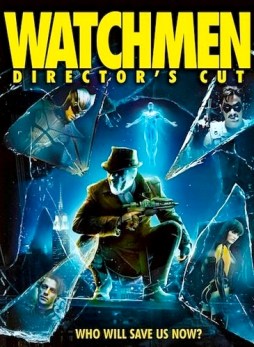
Hitting US Blu-ray so long ago that it’s shameful I haven’t watched it ’til now, and finally arriving in the UK next Monday, the Director’s Cut is Zack Snyder’s final vision of Watchmen: The Movie. The Ultimate Cut (currently available in the US but with no confirmed UK release), which integrates the animated Tales of the Black Freighter into the main feature, is, in Snyder’s words, “an experiment”. Maybe one day he’ll change his mind and say that’s actually his definitive version; I suppose these days — when it seems every major film has a proliferation of different cuts across theatrical release, home entertainment release, and home entertainment re-release — such a thing as a “definitive version” doesn’t necessarily exist. But that’s a debate for another day: for now, this — not The Ultimate Cut, and certainly not the theatrical cut — is Snyder’s Watchmen.

That said, I wouldn’t be inclined to say it’s vastly different to the previously seen version. There are some obvious new scenes and extensions, especially if you’re familiar with the original novel, but ultimately I didn’t find the additional 24 minutes created a vastly different experience. Most of the flaws still remain, from the unfixable — Malin Akerman is somewhat miscast; sometimes episodic storytelling (a largely unavoidable side effect of faithfully adapting a novel that is very much a story in 12 parts, as opposed to a story divided into 12 chunks) — to those that Snyder could potentially have rectified — the alley fight/Manhattan interview crosscutting still doesn’t quite work; Bubastis is inadequately explained; too little time is devoted to the large cast of secondary characters in New York to give Adrian’s plan the same emotional kick it has in the novel; and so on.

By the same token, none of the great bits are ruined, while some are enhanced. Although mostly faithful to the novel, the changes Snyder and co have made are almost all for the better: Rorschach’s “what do you see?” beats the fan-favourite landlady scene (goodness knows why it’s a fan favourite), and Matthew Goode’s slightly built, faintly Germanic Veidt seems a more natural fit for the character now than Gibbons’ more butch version (possibly only in my opinion, that one). Best of all is the modified climax, which retains all the significance of the original but, by changing the way in which it’s brought about, streamlines and tidies up the storytelling. The giant squid is a great comic book image, but this is superior plotting, especially in the abridged form a film adaptation must take.

As for the new bits themselves, some are slightly misguided — Rorschach’s escape from Blake’s apartment, for example, is wholly unnecessary; it shows him injuring a policeman, an incident now referred to over the next few scenes, but we don’t need to see it to follow the references, and showing it gets in the way of the previously perfect match-cut from the Minutemen photo in Blake’s apartment to the same one in Hollis Mason’s. By and large, however, the extensions add depth via little lines and moments. The most noticeable are a better building of Laurie’s backstory, and Hollis Mason’s death. The latter is a little ancillary to the main plot, its excision from the theatrical version easily justified to keep the running time down, but in itself is a well-played and tragic scene that adds further resonance to the end of Dan’s story.

Whatever you thought of Watchmen after the theatrical cut, this extended version is likely to change your opinion no more than any other re-viewing would. That said, with a little extra room to breathe and a few worthwhile extensions, and in spite of the odd tweak that doesn’t work, this is the superior cut of the film.

5 out of 5

Most of the comments in my lengthy review of the theatrical cut still stand, so I invite you to read it here.

Watchmen: Director’s Cut placed 3rd on my list of The Ten Best Films I Saw For the First Time in 2009, which can be read in full here.

Ashes of Time Redux (1994/2008)

aka Dung che sai duk redux / Dong xie xi du zhongji ban

2009 #71
Wong Kar-wai | 90 mins | TV | 15 / R

Ashes of Time ReduxA wandering man with magic wine and no memory; a clan prince who’s also his beloved sister; a master swordsman who’s almost blind; his wife, who loves his best friend; a persistent peasant girl after revenge for her little brother, with only eggs for payment; a young swordsman with no shoes and a camel; a large gang of bandits with a left-handed member; and a desert-dwelling problem solver who connects them all. Oh if only Ashes of Time were as simple as that sounds.

Despite apparently being an Eastern action movie — it’s in the wuxia genre, which, for the uninitiated, also covers the likes of Crouching Tiger, Hidden Dragon and House of Flying DaggersAshes of Time isn’t what one would typically expect from such a billing. Reviews talk about it being a confusingly-plotted art film — and those are the positive ones — which, coupled with my relative dislike of Chungking Express, meant I didn’t really expect to like it a great deal. But I found myself surprised, because I really enjoyed it.

For one thing, I followed the plot right to the end, though the final fifteen minutes throw up a series of twists to rival any thriller. I don’t claim to understand every nuance of every character, the meaning of every event, exactly how everything is connected (assuming it is), or what it’s really all about… but based on what I’ve read, even following it is an achievement on a first viewing. I felt more or less the same way at the end of The Big Sleep, and the trick here is the same: pay attention. Yes, this requires some effort on the part of the viewer — I was aware of myself paying close attention throughout in order to follow and comprehend the story, more so than in most films (even discounting easily-followed mainstream-aimed efforts). An awareness of this need for hyper-attentiveness from the get-go (which, as I say, I had thanks to perusing a couple of reviews) is likely to aid the viewer (which, as I say, it did me).

The story itself, then, is quite episodic. There’s some overlap, but in general characters come and go from the problem solver’s home in a parade, rarely interacting with one another. Each individual piece explores a different facet of a similar theme — “anecdotes about chivalric swordsmen”, as the Radio Times puts it — which serves to tie them together, alongside other plot elements and character points — several have wives in love with others, for example, while others have left their wives at home and one has been followed by his.

Wong (again, so I read) broke ground within the genre by prioritising emotion over action. Therefore potential viewers shouldn’t expect the abundant martial arts/swordplay the genre often provides. If Hero was too arty for you (as it was for me first time round), then this will almost certainly be beyond the pale. Despite the paucity of action — despite several stories concerning assassination and death, the actual act isn’t the point in the slightest — when it does turn up (the first significant sequence is halfway through) it’s excellent; effectively, if differently, done.

Indeed, the film is beautifully shot; perhaps not as obviously as Hero’s colour-coded vibrancy, but there are frequent moments that dazzle and I can’t recall a single weak visual. Wong mucked about with the colours as part of his reduxing, to the reported distaste of cinematography Christopher Doyle, but it still looks stunning throughout.

Wong’s 2008 redux included not only these tweaks to the visuals, but also modifications to the audio and losing seven minutes from the original cut. I’ve never seen it so can’t compare, though some reports claim the changes helped clarify the plot. For the curious, a catalogue of differences can be found here. Equally, those after better-informed reviews might like to read DVD Times’ coverage, with Noel Megahey on the DVD and John White on the BD, and Heroes of the East’s review of both cuts.

Having pointed you toward those wise reviewers, let me just say that Ashes of Time Redux is not your typical wuxia film and not for everyone. My enjoyment of it came as something of a surprise, which is always nice.

4 out of 5

Film4 are showing Ashes of Time Redux tonight at 1:05am.

Alone in the Dark (2005)

2009 #69
Uwe Boll | 94 mins | TV | 18 / R

Alone in the DarkI’ve never played an Alone in the Dark game. I wanted to, when I was young and they were a widely-known cutting-edge franchise, but it was deemed too scary or adult or something like that and I wasn’t allowed. (By the time someone’s nostalgia revived the series nearly a decade later, I didn’t care.) I’ve also never seen an Uwe Boll film, though his reputation obviously precedes him. Considering the latter, having no attachment to the former is probably a benefit to assessing this — I understand that, story-wise, it bears virtually no relation — but I can’t say it helps much.

Right from the off, things don’t look good: it opens with an essay’s worth of backstory in scrolling text… which, just to rub it in, is also read out. It takes about a minute and a half. There are any number of screenwriting rules this not so much breaks as slowly and methodically grinds into sand. Some rules can be bent or broken to good effect if the writer knows what they’re doing, but others exist for damn fine reasons and breaking them just results in a lesser film. This is unquestionably the latter. There’s an almost-excuse: the text was added after test audiences said they didn’t understand the plot. But it’s not much of one. The relevant information is all revealed later in the film too, and neither manage to explain what the hell is going on. It’s not the audience’s fault they couldn’t understand the plot, it just doesn’t make sense.

Quickly, the poor quality opening is cemented with the addition of a dire voiceover narration from Christian Slater’s lead character. He addresses the audience in a chatty style that’s both irritating and incongruous, and primarily exists to continuously dump more useless info. That it disappears without a trace fairly early on is a relief, but proves how pointless and cheap it was in the first place.

And then there’s an action sequence, which defies logic in every respect. The editing mucks up continuity, the good guys turn into a dead-end marketplace for no reason — other than it provides a handily enclosed location for the ensuing fist fight — the bad guy rams cars, scales buildings and jumps through windows, also for no reason, and the fight seems to consist of a punch followed by some slow motion standing around (yes, it’s the standing around that’s in slow motion) repeated too often, interspersed with the occasional ‘cool’ move or shot. On the bright side, there’s one sub-Matrix, Wanted-esque shot of a bullet-time close-up as Carnby fires at the bad guy through a block of ice, which in itself is passably entertaining. You’ll note, of course, that that’s one good shot. One. Shot.

I could go through every scene in the film describing what’s wrong in this way, but no one wants to suffer that. Suffice to say it only gets worse — none of the initial flaws improve, but are compounded by more weak performances (Tara Reid as some kind of scientist?) and the story entirely vacating proceedings. Before halfway I gave up following the plot — after all, why try to follow something that makes no sense in the first place — and just hoped it could pull out some interesting or exciting sequences. But the horror sequences have no tension and the fights no coherence. One action sequence, which begins entirely out of the blue, sees soldiers shooting at beast-thingies in the dark, lit only by muzzle flashes, set to a thumping metal soundtrack. It probably seemed innovative when conceived, but instead is laughable for all the wrong reasons. Like the rest of the film.

Sadly, none of it’s laughable in a charming way — this is not So Bad It’s Good territory. Take the moment where the good guys arrive at an abandoned gold mine that’s actually the villain’s Super Secret Lair. They bring a whole army’s worth of heavily armed marines. Commander blokey insists it’s nothing like enough men… and then proceeds to enter the mine with just half a dozen of them. If there was no budget for more it might be funny, but the rest stay up top to be slaughtered by some Primeval-quality CGI. Even the ending, supposed to be ambiguous apparently, is just a meaningless cop-out that makes absolutely no sense. Like the rest of the film.

Sometimes I feel sorry for Christian Slater. He always seems a nice guy in interviews, yet this kind of drivel is all the work he can get. At the time of writing it’s the 82nd worst film of all time on IMDb (according to its own page, though not that chart). While this is the kind of status that’s often an overreaction (the number of people on IMDb declaring various films are “the worst film ever” suggests most of them have been fortunate enough to never see a truly bad movie), for once it’s justified: Alone in the Dark is irredeemably atrocious.

1 out of 5

If you want to subject yourself to Alone in the Dark, ITV4 are showing it tonight at 11pm.

Alone in the Dark featured on my list of The Five Worst Films I Saw in 2009, which can be read in full here.

AVPR – Aliens vs Predator: Requiem (2007)

2009 #19
The Brothers Strause | 97 mins* | DVD | 15 / R

AVPRAliens vs Public Relations? Sadly not. And when a joke plot like that sounds more appealing than a rematch between two of sci-fi’s greatest monsters, you know you’re in trouble.
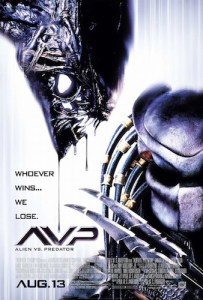
In my last Alien/Predator review, I made sure to attack director Paul W.S. Anderson a bit. As well as being renowned for making rubbish films, Anderson is also quite well known for being sequel-shy… and so it is with the AVP franchise, here handing the reins to the less-than-capable special effects-creating Brothers Strause. They supposedly set out with a fan-pleasing remit: primarily an R-rating, but they even make sure to use familiar fonts and sound effects right from the title card. Though said title card is blurry and unclear, obscuring the film’s very name — a sign of things to come, because their ability to please fans extends no further than some vague surface essentials.

To be fair, it can’t be easy to marshal all the familiar tropes of two different franchises into a single film that does something original with them. But that’s no excuse — things like facehuggers and skinned humans are present as if simply ticked off a list, having neither the surprise and mystery of the original appearance (obviously) nor anything new to make them worthwhile. They’re there because they ‘need’ to be, and while it makes some kind of sense to not play them as surprises, there’s nothing remotely new or different to hold our attention instead. Much of it is so poorly done that it’s not even set pieces strung together, it’s ideas for set pieces strung together.

If you thought AVP spent too much time focusing on the Predators rather than the humans (and I did), you’ll find AVPR even worse. It again tries to emulate the build-the-characters-first approach of the best Alien and Predator films, but intercuts their mundane lives with what the Predators and Aliens are up to. No, no, no. Part of the point of the character-based slow-build is to create tension — there’s none of that here. And by not withholding the monsters, the dull lives become even duller. One of the Alien series’ strengths was in making the extraordinary (space travel!) seem mundane (space truckers), but AVPR makes the ordinary seem mundane, and that’s no achievement at all; in fact, that’s a great big failure.

Even the action sequences are a mixed bag. There’s a nice line in harsh and surprising deaths — major characters are suddenly picked off, and with a cast so full of minor actors you can never be certain who’ll make it; and among them are a young boy, pregnant mums, and most of the town gets nuked by the army because the townsfolk trusted them. The final fight makes admirable use of suits and animatronics over CGI, but it’s so dark you can barely tell what’s happening. Similarly, the PredAlien may be great or it may be rubbish — you never see it well enough to tell. It’s not only the climax: over-dark cinematography and typically choppy editing obscure every action sequence. Why is it that in an age where special effects are so improved and there’s a preference for real actors over stunt doubles, action sequences have become harder to follow?

The overall feel is of a horror B-movie — a direct-to-DVD one. It may be a stock phrase for reviewers, but in this case it’s actually true: AVPR genuinely makes AVP look good. It’s a new low even for the Predator series, and it drags the Alien franchise from once lofty heights right down into the gutter with all the other too-long-running horror franchises. However permissable parts of AVPR might be (when judged on its own terms) (with a kindly eye), the inconceivably thorough degradation of a once-great franchise is its greatest crime.

Alien³ was a charming mess. This is just a mess. An irredeemable one.

1 out of 5

* AVPR on DVD is 7 minutes longer than in cinemas. This seems to be the only cut available (outside of Germany) and isn’t specially labelled, hence the lack of qualifying “Director’s Cut” or “Extended Cut” or “DVD Cut” in my title.

AVPR featured on my list of The Five Worst Films I Saw in 2009, which can be read in full here.

AVP: Alien vs. Predator – Extended Version (2004)

2009 #18
Paul W.S. Anderson | 98 mins | DVD | 15 / PG-13

This review contains minor spoilers.

AVPOnce upon a time — around the late ’90s, when he was only known for Event Horizon (and that video game thing no one wanted to mention) — director Paul W.S. Anderson was seriously and vocally attached to a film adaptation of Doctor Who. At the time it was such a good idea, a bright new hope for Who’s revival, with a Hollywood-level — yet, pleasingly, British — director at the helm. When it didn’t come together it was quite disappointing. In retrospect, I think we can breathe a collective sigh of relief.
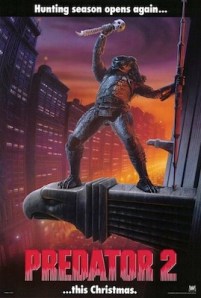
Anderson’s films always come in for a critical drubbing and AvP was no exception. Sadly, it was well deserved. The main problems are a weak script, including an abundance of prologues in place of genuine character development, and poor performances, not helped by what sounds like a regular use of bad ADR. Characters make leaps of logic that would be reasonable if they’d seen the preceding six films, but make no sense whatsoever given what they know in context. The story begins moderately well, even pushing to the slow build in the franchises’ best entries (though without as much tension), until just 13 minutes in, when there’s a pointless scene on a Predator ship. Of course we know they’re coming — they’re in the title — but it’s a reveal too soon and ruins any mood Anderson’s managed to create. Constant updates on their progress exacerbate the problem.

There are actually some very inventive ideas scattered throughout — like the captured, frozen Alien Queen — but, in storytelling terms, their reveals are poorly handled, occuring too early and too far from the protagonists. However much time Anderson wants to spend getting his humans into position (a lot, just like the other six filmmakers before him), he clearly doesn’t trust the audience to go along with it without some hints of the creatures (unlike the best of the filmmakers before him). It’s not his only directorial misstep. He makes the fatal mistake of letting his monsters out into the light too much, though the choppy editing almost obscures them again. While effects can now withstand this level of scrutiny, the effect of the creatures can’t — they belong half-hidden in shadow, especially the Alien.

Elsewhere, every facehugger is treated to a graphic slow-mo shot. Once might’ve been cool, but it quickly becomes overkill — especially when the first instance features three, immediately rendering every solo example that follows unremarkable. And then there’s the ending nabbed from Predator 2. And the final beat that, though the groundwork is laid earlier in the film, still doesn’t really make sense (considering how fast chestbursters came out of the humans, or how long the Predator had been dead by the time it popped). When the director doesn’t know how to handle the titular monsters correctly, you know you’re in trouble.

That said, Anderson certainly delivers on the title’s Aliens-fighting-Predators promise. Most of the film’s limited imagination is lavished on these battles, but as with most monster-on-monster bouts we have no stake in either side, leaving them mostly heartless and only engaging on the level of “cool!” The human characters are left by the wayside at these moments, disappearing out of the way — and taking what little plot there is with them — for a few minutes. When they do appear there are some attempts at character development (yes, beyond those prologues) which are well-intentioned but painful. All things considered, Anderson has taken two horror franchises with an action-adventure tinge and turned them into an action-adventure film with a horror tinge.

This ‘extended version’ is a whopping 79 seconds longer than the theatrical cut, adding a whaling station prologue. This exacerbates the issue of revealing the monsters too early, but it does go some way to justifying the otherwise random glimpses of the Predator ship. Nonetheless, to be truly effective we shouldn’t know more about what the aliens are up to than the human characters do and it’s all a mistake. (An unrated version of the film is also available in some territories. It runs eight minutes longer, but the additions seem to just be the deleted scenes included on other releases.)

Flash forward however many years since that mooted Who movie, and Anderson’s career has mostly reverted to video game adaptations and trashing as many franchises as he can. AvP is surely the culmination of his efforts: here he manages to amalgamate a popular and acclaimed film franchise, its almost-as-beloved stablemate, and an equally popular and acclaimed comics & video game series, and then decimate all three in one 85-minute (without credits) swoop. Well done Mr Anderson, your efficiency knows no bounds.

2 out of 5

Tomorrow, AVPR – Aliens vs Predator: Requiem.

Predator 2 (1990)

2009 #17
Stephen Hopkins | 104 mins | DVD | 15 / R

Predator 2I’ve been looking forward to Predator 2 for a number of years after a friend told me that, despite its poor critical standing, it’s actually a jolly good film. (“A number of years” is the average time it takes me to act on such a recommendation; and, knowing this particular friend, “jolly” was probably not the word he used.)
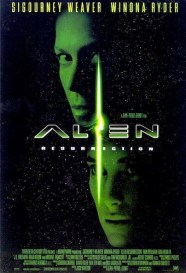
Here, action director extraordinaire John McTiernan hands the reigns over to Brit Stephen Hopkins (probably best to be remembered for helming half of 24’s phenomenal first season, though you can recall the Lost in Space film and A Nightmare on Elm Street 5 instead if you like) and the action is moved from a jungle to the concrete jungle (see what they did there?) of LA, in the near-future year of 1997. Made in 1990, Predator 2 is set in the future for no good reason — sure, there’s a big gang problem, but this is fiction, you can set it now and still make up things like a huge city-affecting change in the status quo; and that way you don’t have to have silly semi-sci-fi guns either. Not to mention the fact that before too long it seems like they’d rather forget this is the ‘future’ and just get on with things. In the end, all it does is seriously date the film: in almost every facet, from screenplay to costumes to direction, it feels more like 1987 than 1997.

Sadly, this isn’t where the problems end. Out of four Aliens and two Predators, this has to be the only one that doesn’t bother in the slightest with a slow build up of tension. Sure, Alien Resurrection gives us the actual aliens much earlier than the others, but they’re not really in force for a fair old while. Predator 2, on the other hand, opens in the middle of a gunfight that lasts for the next ten minutes, and there’s a second before the half hour. This isn’t necessarily a problem in itself but there’s nothing inspired about any of it, especially the gang drug war plot that provides most of the focus.

It’s a shame this fails so miserably, because the franchise re-location is actually a commendable thing. I’ve talked a few times about the Alien sequels dramatically switching genres, but Predator 2 leaves them looking as if they couldn’t be more alike. Where Predator is a behind-enemy-lines/covert mission/jungle/war actioner, Predator 2 is an urban drugs crime police, erm, actioner… though both with a sci-fi twist, obviously. But the vastly different settings and setups mean that, even with the involvement of the same sneaky alien hunter, the films have a vastly different feel too. It’s just a shame Predator 2’s “urban jungle” concept is so poorly executed… for a while anyway, because when it finally reaches the 30-minute climax things suddenly get quite good.

It’s a bit like all the time, effort and money went on creating a good lengthy climax, then any-old hour-long urban crime movie was bolted on the front to create something feature-length. In fairness there are some good bits earlier on, but the final half-hour (or so) feel like it’s from a slightly different, slightly better movie. The dialogue improves, suddenly filled with some decent lines, and it centres on a mano-a-mano (or mano-a-alien, really) fight that’s nicely reminiscent of the first film while being totally different, sprawling through locations and using lots of high technology. There are still flaws — it nicks the government agents’ motivation from Alien wholesale (they want to capture the alien for its weapons technology, which they admire it for) — but they’re largely forgivable.

Perhaps best of all is that throughout the climax it expands what we know of the Predator, rather than just rehashing what we learnt in the previous film, as in so many weaker sequels. There’s more of its weaponry and its medical kit, what amounts to a tour of its ship, hints of its society and culture, and it’s given a nice balance of fallibility — not so indestructible that it’s stupid when the hero wins, but not so weak as to be undramatic or inconsistent. There’s one especially good moment where the Predator discovers a character is pregnant and so spares her, a nice touch both in terms of how it reveals the previously-unknown pregnancy (through the Predator’s heat vision) and in revealing the creature’s morals. It’s this sense of honour and a heightened mental capacity that marks the Predator out from other such creature movies, especially the Aliens, who are essentially animals (it would seem), albeit cunning ones.

Predator 2 is a dire film rescued by an excellent finale. As well as a decent chase and fight, it also builds on the first film’s mythology, revealing a decent amount about the Predators and hinting at more, without going too far or spelling it out too bluntly. If only such qualities could have extended into the opening hour, this could have been a sequel on par with the original.

3 out of 5

Tomorrow, AVP: Alien vs. Predator.

Alien Resurrection (1997)

2009 #16
Jean-Pierre Jeunet | 104 mins | DVD | 18 / R

Alien Resurrection is much maligned, to the point that even screenwriter Joss Whedon has publicly disowned it. Which is interesting to me, because I really liked it.

While you clean up your beverage-of-choice that I’m sure you just spurted all over your monitor, let me reassure you that I’m not about to argue Resurrection is an undervalued classic on a par with the first two films; but, having heard nothing but bad things about it for over a decade, I found myself pleasantly surprised. As so many other reviews have sought to detail the film’s flaws I won’t dwell on them myself, but instead seek to explain why I liked it.

In my Alien³ review I applauded the franchise for taking each instalment in a new direction stylistically, and Resurrection doesn’t drop the baton on this. Structurally it’s the most straightforward of all four, slotting fairly neatly into a standard action-adventure/disaster movie template — especially once Ripley hooks up with the crew of the Betty — but this isn’t the most notable difference. No, that would be twofold: its black humour, where the tastes of both Whedon and director Jeunet make their mark; and how grotesque it is — almost two extremes walking hand-in-hand. The deformed, perverted Ripley clones; the Hybrid; the Ripley-Alien sex scene — there’s nothing like this in the other films, and that’s a grand thing. Even if you disapprove of most (or all) of that, the scene where two aliens kill a third so that its acid blood will burn through the floor, allowing them to escape, is a bit of genius that takes our existing knowledge about the species and does something gloriously new with it.

The Aliens themselves are very well realised. For fans who favour the first film to all others they undoubtedly spend too long in plain sight, but, while there is certainly some poor CGI (the underwater sequence being of particular note, though you can see how it seemed a good idea), the constantly slime-dripping practical creatures are excellent. The Aliens and the company (no longer Weyland-Yutani, for no good reason) are relatively revealed by the story too, which I’m sure is to its detriment for some. Personally, I considered it another sensible change: we’ve had three films of the company attempting to capture the Alien — what would happen when they succeeded? That the plot is still based around the company’s hunt for the Aliens (as significant chunks of the previous sequels were too) is also interesting — essentially, the whole franchise was launched because at some point during the first film someone decided Ash should be an android who wanted to capture this mysterious creature.

I can well imagine many hated all these additions and changes to the series’ mythology (especially the Hybrid — fans always hate things like that), but I found them to be an interesting attempt to further the franchise’s story rather than just rehash previous instalments. I won’t deny that some of it borders on the silly (or even crosses that line) and there are a few plot holes (which is disappointing, because many could have been explained away if someone had taken a bit of effort), but for the most part it’s fantastically creepy, grotesque, and more than a little weird… and all within the confines of a standard action-adventure plot! Plus, within that it also retains an unpredictability over who will die, something Alien³ managed to fudge. (That said, the top four names in the opening credits are the four survivors, so maybe I should just pay more attention.)

Resurrection marries the franchise’s most wonderfully grotesque imagery with a standard action-adventure plot, meaning anyone who comes to this looking for their average sci-fi action-adventure may walk away with their sensibilities shocked — or perhaps mutated beyond recognition. It’s certainly not the series’ best film, but I have a nagging feeling that it might turn into my secret favourite.

4 out of 5

Not so secret now I guess.

Alien Resurrection placed 9th on my list of The Ten Best Films I Saw For the First Time in 2009, which can be read in full here.