
Rob Marshall | 137 mins | cinema | 12A / PG-13
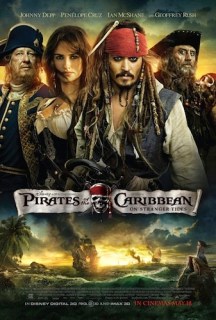 No one had high hopes for Pirates of the Caribbean when it set sail for the big screen (sorry) in 2003. It was based on a Disney theme park ride, for chrissake! But no, as it turned out: a witty and exciting screenplay, some properly photo-real CG from ILM, and an immediately-iconic Oscar-nominated performance from Johnny Depp were some of the ingredients that helped it become an instant blockbuster classic.
And then, drunk on success, they churned out two disappointing, overblown sequels. Picking up on elements left vaguely dangling from the first film, the filmmakers somehow fashioned it to look like a trilogy (not that the first film doesn’t work absolutely fine by itself), and given the lacklustre critical reception and conclusive nature of the story, I think everyone assumed that would be that.
But no. Not when you’re Disney and have a franchise capable of grossing over $1 billion per film. And so here we get Pirates 4, with high hopes: they seemed aware the two-part-ish sequels hadn’t gone down so well, promising a standalone adventure that returned to the quality of the first film; it’s adapted in part from a largely unknown but beloved by those that do novel (which also inspired the Monkey Island games, which in turn contributed a lot to Pirates 1 — it’s all very incestuous); plus Disney insisting on cuts for a tighter budget suggested there’d be less of the sequels’ excesses.
 It still cost $250m, mind, and the fact that’s what’s considered a cutback arguably shows.
Things start really well. The opening sequences in London are a hoot, Depp bringing some of the joy back to the character of Jack Sparrow that went awry during the last two films. We also get to see why he is actually a great hero, something occasionally lost under the drunken swaggering — look at his well-plotted escape from the King’s court, which initially looks like pure lunacy but turns out to be all clever set-up, for instance. The carriage chase through London streets that follows is good fun too, undoubtedly the film’s high point.
It’s pretty much downhill from there though. The film burns through ideas and plot points at a rate of knots. While I’m all for not stretching ideas thin — something that can happen too often in blockbuster movies these days — here the opposite is true, with not enough time devoted to explaining things, to characterisation, to making us give a damn about what’s going on or why it’s going on. They seem to think we’ll care about Sparrow, Barbossa and Kevin McNally’s character just because they were in the three previous films… and, in fairness, we do, to a point (well, the first two); but they also seem to think this will transfer to the new cast, and it doesn’t.
 The love story between a missionary and a mermaid barely factors. Word was this pair would be the series’ new Orlando Bloom and Keira Knightley, but whereas Elizabeth Swann and Will Turner were central to the plot of all the previous films (appearing before even Captain Jack in the first, if I recall), these two turn up late in the day and never have a chance to go anywhere. There’s also a surfeit of villains, meaning they either barely appear (the Spanish) or aren’t given close to enough screen time (Ian McShane’s Blackbeard). Every introduction is rushed, every subplot underdeveloped, every ending unsatisfactory. There’s too much, even for a movie that still runs over two hours.
There’s potential here, as there has been for all the Pirates films that followed in the wake of the first one, but as the quality continues to slip it’s becoming easy to believe that screenwriters Ted Elliott and Terry Rossio hit a fluke with the quality of the first film and haven’t been able to meet it again since. And I would say most of the fault lies with the screenplay, because there’s little fundamentally wrong with the rest of it.
Except the 3D, maybe. I have no idea if this was a post-conversion or shot for real, but it doesn’t matter — it’s dull. Either things are too dark to matter, or it just doesn’t pop in the way you’d like. A couple of sweeping scenery shots aside, it offers no benefit. 3D is a gimmick and all about spectacle — I believe anyone who thinks it’s a serious filmmaking tool for the future is deluding themselves, at least until someone can prove otherwise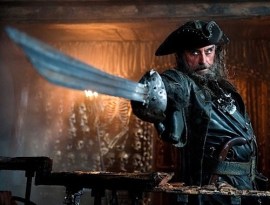 (much-heralded work like Avatar certainly hasn’t) — but it’s a gimmick On Stranger Tides doesn’t engage with, in the process showing it lacks spectacle. And considering dark scenes obviously don’t work well in the format, I dread to think what Ridley Scott’s Prometheus will look like. (I probably won’t see it ’til 2D Blu-ray anyway, so that might be a moot point.)
I’m certain some will think my score for On Stranger Tides is generous, but despite all the flaws it still has its moments. I just wish that instead of churning Pirates films out ASAP they’d put more effort into developing the screenplay. Perhaps hiring new writers would help. But with a fifth and possibly sixth film on the horizon, and no significant change of scribe imminent, any such hopes are already dashed. And as this poorly-reviewed effort still grossed a phenomenal amount (third highest of the year; eighth of all time), Disney will still get their money and keep pumping them out. The whole situation is not so much yo-ho, more ho-hum.

Pirates of the Caribbean: On Stranger Tides is out on DVD, Blu-ray and 3D Blu-ray in the UK from Monday, 12th September, and in the US from 18th October. Why can’t the Marvel releases from this summer be that way round, hm?
The UK TV premiere of Pirates of the Caribbean: On Stranger Tides is on BBC One tonight, 29th December 2013, at 8pm.
 Law Abiding Citizen is a revenge movie with a (slight) difference: wronged man Gerard Butler isn’t just going after the two criminals who invaded his home and murdered his wife and daughter — he’s going after the legal system that let one of the men walk free.
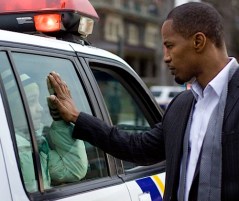 He attends the execution of the aforementioned criminal, but something goes wrong — instead of going to sleep with a lethal injection, the attacker suffers an agonising and horrific death. Someone must have swapped the chemicals. The prosecutors’ thoughts leap to the other criminal, but I’m sure we’ve all guessed who’s really behind this. And so Butler’s sprawling revenge mission begins…
 On the issue of who the film thinks is good and who it thinks is bad,
  It is a little far-fetched, granted, but it’s not so outside the rules the film sets up for itself that I find it unacceptable.
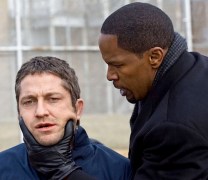 As an action-thriller that actually has something to think about wrapped up in it, I considered being a bit lenient in my score (much as I was to
 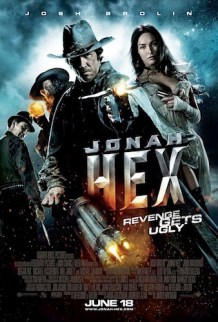 Jonah Hex is not a good film. Let’s just establish that, before I start being nice about it.
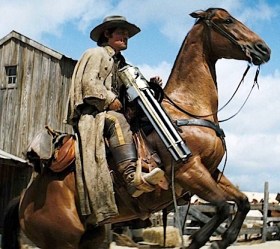 Much of the film rattles on in this way. And rattle it does: 73 minutes before credits. As blockbuster running times spiral out of control, such brevity is almost welcome. It doesn’t feel exceptionally short, mind, except for when the plot occasionally jumps forward.
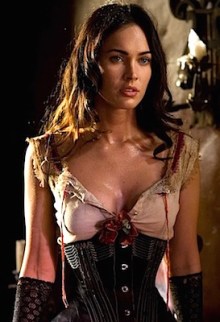 — usually improbably — or generally be a female. By “female” I mean “cleavage delivery device”. Considering her acting ability, her lack of presence is no real shame.
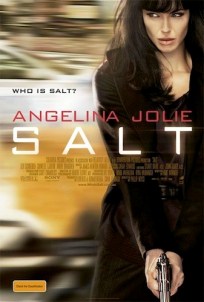 Angelina Jolie takes on a role originally earmarked for Tom Cruise in this Bourne-ish spy thriller from screenwriter Kurt Wimmer (
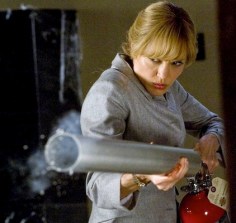 This is Salt’s mystery, and this is one of its strong points. The plot developments are well-paced throughout, developing and shifting our expectations rather than stretching it all for a glut of final act reveals. In this regard it goes places you might not expect from a mainstream Hollywood thriller. For starters, you expect the funeral-set assassination to eventually be the film’s climax, no doubt revealing our heroine isn’t a Russian spy as she unmasks the real killer. But that occurs at the halfway point, spinning the film off in new directions. To say more would spoil one of the film’s strongest elements: that, as I said, it has twists and follows storylines you wouldn’t expect in a Hollywood summer blockbuster.
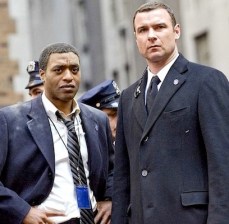 The three cuts, then, are: Theatrical (100 minutes — this was trimmed for the UK to make 12A, but is apparently uncut on disc); Director’s Cut (the one I viewed, this is 4 minutes 5 seconds longer); and an Extended Cut (1 minute 5 seconds longer than the Theatrical). The latter is based on the Director’s Cut and I’ll come to it in a minute. The differences between the Theatrical and Director’s cuts are numerous, but mainly amount to some extra character beats (including more flashbacks to Salt’s childhood) and violence — more blood; seeing people get hit rather than just seeing Salt firing; the President is killed rather than just knocked out; plus a very different death for Salt’s husband (again, more on this in a moment). Plus there’s a voiceover ending too, which in my opinion sets up the sequel even more than the Theatrical version does, with a blatant cliffhanger and suggested plot direction. My regular comparison site
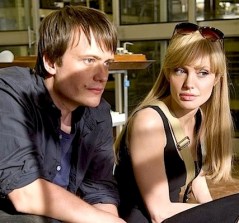 She has to control her emotions so as not to give herself away. In the other versions, however, she’s presented with him in a chamber and given a choice to save him — except trying to save him would give her away, so she’s forced to watch, blank-faced, as he slowly drowns. Salt sacrifices him for the greater good; he dies seeing her cold emotionless face. Ouch. By comparison, the theatrical cut’s blunt gunshot is much softer.
 if the filmmakers considered another option, now we can see it, and in cases like this choose our preference. Though it seems clear, by its inclusion in both the theatrical and director’s cuts, that Noyce preferred the instant-revenge option.
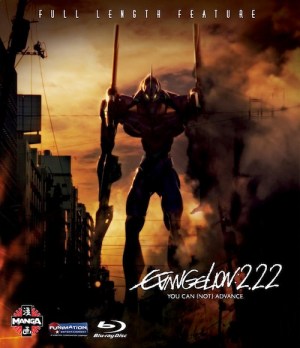 Just over a year since the
  For my money, the first 40 minutes or so of the film are (by and large) the best bits. It opens with a barnstorming action sequence, a great scene for newbies and fans alike as we’re introduced to Eva pilot Mari, who didn’t appear in the TV series. That she then disappears for most of the film, only to make a thoroughly mysterious return later, is one of those explanation-lacking flaws. I’m sure it won’t look so bad once the next two films provide us with answers. Well, I hope not.
 Then the gang take a trip to a scientific installation which is trying to preserve the oceans and their wildlife. It feels like animation shouldn’t be as effective for such a sequence as, say, the footage in a David Attenborough documentary, but nonetheless it feels extraordinary, in its own way. It also marks itself out with the interaction of the characters on a fun day out rather than their usual high-pressure monster-fighting world. And then it’s back to that world for another impressive three-on-one Angel attack.
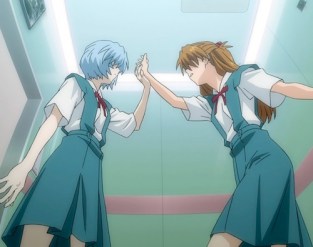 But it’s all building somewhere. For one, there’s another of the film’s best sequences — certainly, its most shocking, which readily earns the 15 certificate. I don’t want to spoil it for anyone yet to see the film, because it’s one of the plot points that differs from the TV series, but it involves the death of a main character in a brutal, deranged way. I say “death” — they pop up in the third film trailer that runs after the end credits, so there’s more to this yet…
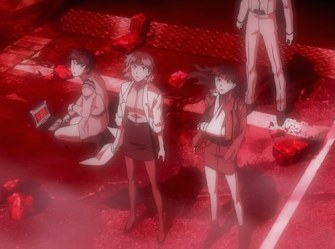 And then, after the end credits, there’s a brief scene that throws another spanner in the works! Double-cliffhanger-tastic… one might say…
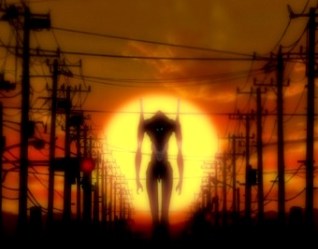 In short, if you’ve always liked Evangelion then you won’t be waiting for me to tell you this is a must-see reimagining; if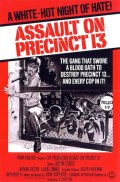
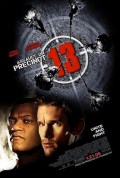
 John Carpenter’s rough-and-ready ’70s exploitation B-movie is remade as a slick ’00s action B-movie dressed up as an A-movie by director Jean-François Richet (who would go on to find far greater critical acclaim with his two-part French crime epic
 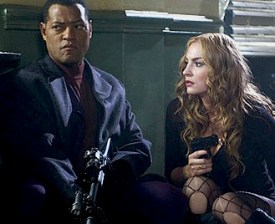 I don’t have hard timings to back this up, but I think the siege starts earlier and lasts longer here. It certainly felt that way, in part because the character of the father (whose act of revenge leads the gang to the precinct in the original) is gone. Of course, the film is about the titular assault on the titular station, so I think this refocussing is more than fair enough. It, naturally, emphasises the siege element of a film about a siege, something the original almost reneged on with its lengthy setup.
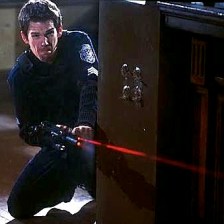 The only reason the prologue is necessary is if you want to begin your movie with an action sequence… so that’s why it there then. It’s also set in a sun-drenched summery atmosphere, totally at odds with the well-evoked wintery New Year that pervades post-titlecard. Consequently, looking back on the prologue, it feels even more out of place. I think it’s also designed to set a Gritty tone, with its rundown apartment and drugs deal and all that palaver; probably because the rest of the film is too far-fetched, if you were hoping viewers were going to be in mind of
  criminals inside the precinct are black or (in one case) hispanic. Ouch. You could try to argue we’ve developed past the need to force anti-stereotyping in casting; or you could argue this is a mainstream studio remake that felt the need to fall back on the familiar. It might not be a noticeable point were it not for it being so markedly different to the original.
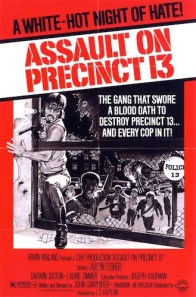 Assault on Precinct 13, it has always seemed to me, is an acclaimed cult classic of the action genre. I could probably find some references to support this — I know it’s on Tarantino’s list of the top seven exploitation movies, for starters — but for speed let’s just assume I’m right. Thing is, on initial impressions at least, I didn’t quite get that. It felt like an unexceptional low-budget ’70s exploitation B-picture to me.
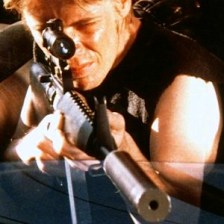 a huge gang who lay siege to the cut-off station. So the cops and the prisoners must work together to fend them off.
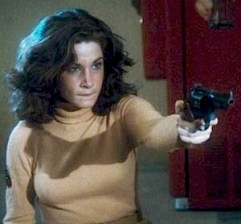 performing voodoo-esque rituals, coming and going as if by magic, doing things our heroes can’t necessarily explain, attacking in almost random waves… They feel almost supernatural; one might go so far as to say they play more like zombies than an organised criminal force. It’s no surprise that Carpenter would next helm
 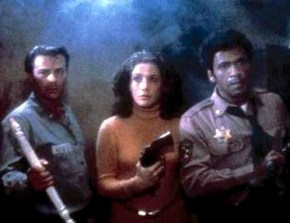 And another says that, “like
 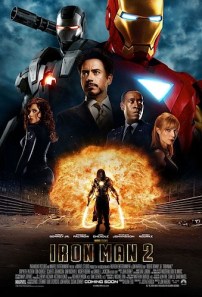 I’ve always contended that the first
  For starters, it relies on the story rather than the action. There are certainly some good sequences of the latter (more about those later), but there’s also a lot of story in between them — it’s not wall-to-wall explosions and punch-ups. Neither was the first, if you remember, and so it fits in that respect. It’s helped along by the ending of the first film, in which Tony Stark revealed he was Iron Man. That’s not something you do in superhero movies, which immediately lends this one a few new plot devices to play around with. Considering the burgeoning critical assessment that all superhero movies ever only tell the same two or three stories (an argument I think has a lot of validity), it’s nice to see anything to challenge the norm.
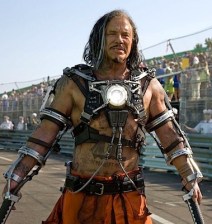 it’s the Penguin and whover-Christopher-Walken’s-character-was rather than Mr Freeze and Poison Ivy, if you will. They play to different sides of the hero: one is fighting Stark, one Iron Man (though there is naturally crossover); though they’re both intelligent, one functions as the brains and the other as the brawn. Mickey Rourke may go slightly underused, but it’s also part of the character, a quiet, thoughtful, intelligent hulk partnered with Sam Rockwell’s jabbering wannabe-Stark.
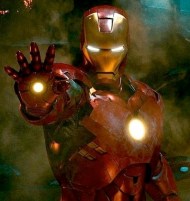 watched again later on Blu-ray, I enjoyed it a lot more. With Iron Man 2 I’m obviously distanced from trailers by a good year or so, and though one of their best moments is missing from the final cut, and the suitcase-suit is unavoidably spoilt by being so thoroughly screened during the promotion, watching now doesn’t have all the trailer-generated expectation to live up to. That famous Onion spoof about the first film’s trailer is, perhaps, even more applicable to the sequel.
 Aside from one unnecessary scene featuring Captain America’s shield and Agent Coulson leaving for New Mexico, and the fact that the film assumes everyone will know who Nick Fury is despite him being introduced fleetingly after the credits of the last film, the whole S.H.I.E.L.D./Avengers Initiative thing is worked into the plot well. If we didn’t know it was the beginning of the build-up to The Avengers, I think it would have sat much better with viewers. Even if it does end up blatantly laying the foundation for further stories, that’s hardly uncommon in franchise films of all kinds these days — at least we know this series will definitely pay it off, unlike so many franchise-wannabes that don’t make it past their first film. Plus, the film’s primary plot has its own villains and comes complete with a resolution; Fury, S.H.I.E.L.D. and co are a subplot that feed other subplots.
 100Films.co.uk