
Michael Bay | 165 mins | — | 2.35:1 | USA & China / English | 12 / PG-13
 As my Now TV Sky Movies subscription winds down, and I find myself with limited time left to watch the abundance of worthwhile films available there, I very nearly spent a little over two and a half of my precious hours watching the fourth Transformers movie (made available via Sky Movies on demand a week before its TV premiere, which is today).
And then I remembered that the last two Transformers films were rubbish, and that Age of Extinction had met with an even worse reception upon its theatrical debut last July, so why would I want to waste so much of my time on something I was sure to think was dross?
Maybe one day I will cave and check out this renowned piece of cinematic excrement, because I am a completist and having seen three of the films I feel compelled to watch every new entry that turns up, even if it takes me a while to get round to it. For now, though, I have better things to do. [Edit: I got round to it eventually. My review.]
Lest you came here hoping for some thoughts on Transformers 4 from someone who had actually endured it, here are some choice quotes from (and links to) other pieces that I have appreciated:
The loyal fans – and they are legion – will trot out clichés like, “Leave your brain at the door,” and defend Age Of Extinction’s right to be nothing but a succession of varoom! and kersmash! sequences. For those who aren’t still blindly faithful to something they liked when they were nine, despite the colossal scale, there’s little to see here.
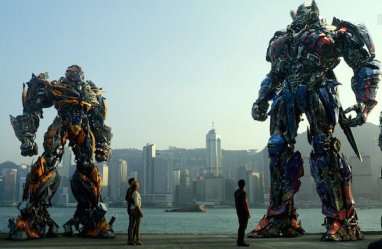
audiences love it. I saw this in a packed theatre. They CHEER when innocents were threatened/killed. I can loathe Bay for making it, but he’s…right? This crowd, they love hate. They love revenge. Selfishness. Cruelty. The sexism? They shrug it off. The nonsensical story and people? Ditto. But the cruelty is an active joy. They applaud. I’m not exaggerating. This (American) crowd applauded at the end of the film.

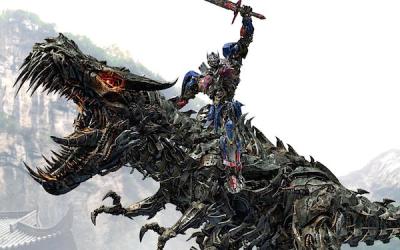
Oh man that Mike Bay fella must be the greatest moviemaker alive he even manages to throw in Robot-Dinosaurs too! And they’re on OUR SIDE! Well, to be honest I think they are actually Chinese, but fairs fair, they see Optimus in trouble and they step up, yes sir. Optimus rides in like John Wayne, bless him, sorting out the bad robots in this huge battle that’s so realistic I have to admit I lost track of what was going on, but that’s what war is like, man, its hell and you never know where the next bullet is coming from (or in this case flying robot lizard).
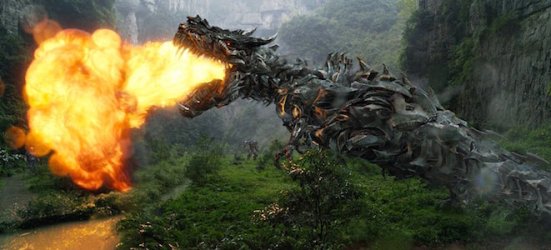
Where most movies have a beginning, middle and an end, Age of Extinction has a beginning, then AHHHHH! for another two hours or so. […] an adult-themed Transformers movie seemingly written by a thirteen-year old boy and directed by his walking erection

Bay keeps the movie in a state of perpetual climax. Everything is epic, even when it isn’t. […] Don’t ask questions, the movie insists. If you persist, the answer is always “because it looks cool.” Why is Mark Wahlberg carrying a sword that is also a gun? Because it looks cool. Why are that CIA team wearing heavy black outfits in what looks like a pretty scorching day in Texas? Because it looks cool. Why does Lockdown’s head transform into a gun rather than his arm or something? Because it looks cool. Why is Optimus Prime riding a dinosaur? Because it looks cool.
Bay is a film-making anomaly. Even the worst of his Hollywood peers are merely hacks. Bay is no hack. A hack is someone who understands their craft but fails to apply any artistry to it. Bay doesn’t even understand his craft.
There’s nothing wrong with filmmakers either lionizing or lampooning U.S. institutions. That’s what freedom of speech is all about. In Age of Extinction, though, satire ends at the water’s edge. As soon as the action shifts to Hong Kong, the outbreak of alien-engendered chaos is met by a sea captain ordering a call to “the central government” for help, and later China’s defense minister does a walk-and-talk, sternly and seriously vowing to defend Hong Kong. America’s government is portrayed either ridiculous or diabolical, but China’s is assured and effective.
Not coincidentally, Age of Extinction is considered an “officially assisted production” […] No such deal gets struck in China without the consent and approval of the Beijing government and the Chinese Communist Party, and in this case, Paramount is in business with the Beijing regime directly
(Though, much of Cohen’s piece is a little too “it should be pro-American! It’s unpatriotic!”)
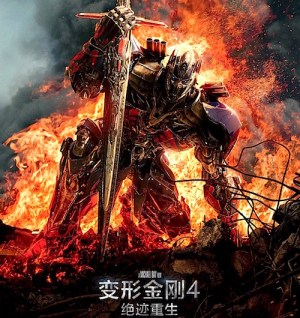
I can show you invention in all 3 past movies. Rich ideas, however dumbly incorporated. Not here. Everything is an echo or repeat, or else so offensive or boring as to negate any quality. But mostly it just SITS there. […] I want to be clear. Don’t see it. Ever.
Transformers: Age of Extinction debuts on Sky Movies Premiere today at 1:20pm and 8pm.

 #36 The Hobbit: The Battle of the Five Armies (2014)



























 Except, goodness, I couldn’t get it down to just five! From Connery alone you’ve got ‘Bond’ being bested in From Russia with Love, the iconic jetpack in Thunderball, and the trend-setting mini-adventure from Goldfinger. As the series rolls on there’s The Spy Who Loved Me and its parachute, Moonraker’s free-fall fistfight (you couldn’t do that today — everyone would assume it was CGI and it’d have no magic), and the perfectly staged training-exercise-gone-wrong from The Living Daylights. The Brosnan era really kicks in the action, first with another peerless mini-adventure in GoldenEye (and the bungee jump…!), then increasingly expansive and suitably witty openers to both Tomorrow Never Dies and The World is Not Enough. Finally, the Craig era tipped the whole shebang on its head with Casino Royale’s moody black-and-white quickie, and Quantum of Solace’s attention-demanding car battle. Skyfall may have moved back towards the Brosnan mould, but it’s an exceptionally well done one.
 a supporting character who’s come and gone over the years, initially seeming one-note but revealing more in more recent seasons — but here you get that kind of arc condensed into 90 minutes. Barr is every bit his equal, the pair forming a genuine if sometimes complicated bond. That it acknowledges but dodges the whole “mid-life-crisis man and teenage girl” iffiness is further to its credit.
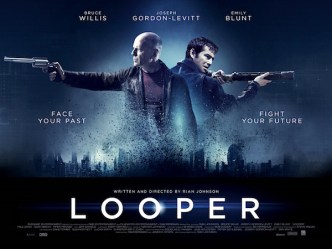 Writer-director Rian Johnson re-teams with the star of
 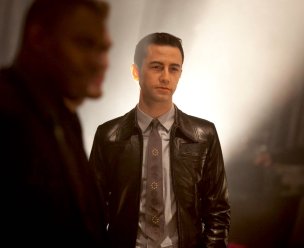 Firstly, the less you know the better. I pretty much knew the above before I went in, and that meant the film had surprises from the get-go. For instance, the near-future world most of the action takes place in has been well-realised by Johnson and his design and effects teams, and time travel is not the only SF concept or imagery employed here, which I wasn’t aware of. Their vision is
 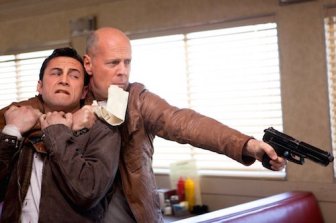 Heading up the cast, Gordon-Levitt does a good Bruce Willis impersonation — believable, but not a slavish impression. That was probably quite necessary, because I don’t imagine Willis has the thespian chops to emulate an older Gordon-Levitt. Notoriously, the younger actor does the whole thing under prosthetics designed to make it more plausible he’d age into Willis. They’re a bit weird: not badly done — far from it, in fact — but you’re always kind of aware they’re there. A highly able supporting cast flesh out the rest of the characters, though most memorable is young Pierce Gagnon as an imperilled child you wouldn’t necessarily mind getting killed. And I mean that in a nice way; about the film and his performance, if not the character.
 Even if there are some logic issues, it doesn’t fatally undermine the movie. Looper comes with the joys of a well-imagined future, a captivating storyline, engaging characters, and enough twists and turns along the way to keep you guessing at the outcome. The best genre movie of 2012? That was a year of stiff competition among SF/F pictures, but Looper may have the edge.
 At the start of their audio commentary on The Desolation of Smaug, co-screenwriters Peter Jackson and Philippa Boyens note that, when the decision was made to extend the already-shot Hobbit duology to a trilogy, it wasn’t a third movie that need to be created but a second. That is to say, it was the middle instalment that required the most extra material, including a new prologue and climax. The
  The extended cut amps him up even more, with an extra part in Mirkwood and a moment where he stands up for Thorin in Laketown. In fairness, he doesn’t have as much character development in this film as the first, while Thorin is on a definite arc and Gandalf is off on his own side-plot, but he’s undoubtedly a key character. I really don’t understand that complaint.
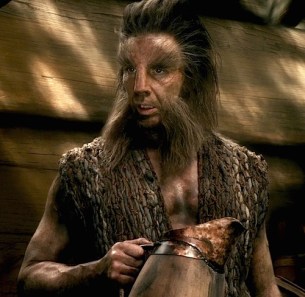 Even if some of the additions are worthless, on balance this is a better version of the film: more Beorn, more of the atmospheric Mirkwood, an additional character whose appearance will hopefully pay off in the extended
  The
The  Your enjoyment of the film will hinge on your tolerance for this level of filmmaking. War Zone isn’t a Marvel-derived adaptation to sit alongside their big-budget in-house productions, but one to rival other hard-R violence-focused flicks. It may be kind of nasty in places, but no more so than other movies of its ilk; and really, if you look at it from outside the confines of sometimes-simplistic comic book morality, the Punisher is quite a nasty character.
 When it comes to hitman movies, I’d’ve said there’s
  Between the mega-hits of
  The problem with the last point is that, in real life, Sam is still over there, still doing the same thing, while conflicts rage on. But this is a film — you need to find some kind of conclusion. The makers have tried, but its an incredibly half-arsed climax; less a resolution to the entire story and more Sam having learnt one lesson from something that went wrong a little earlier.
 mashed together with a polemical charity documentary about Africa, and then with some
 The second attempt at a US re-imagining of Godzilla received mixed reviews last summer, though there can be little doubt that it’s much more successful than the first,
  He’s denying us shots of it not to punish the viewer or to trick us, but literally to tease us, to build excitement and suspense and desire for the final battle. Too many people aren’t used to this — modern blockbusters have trained them for non-stop show-us-all-you’ve-got action from start to finish — and that’s a shame, and their loss, because Edwards’ method is superior to, and ultimately more entertaining than, 95% of other similar blockbusters.
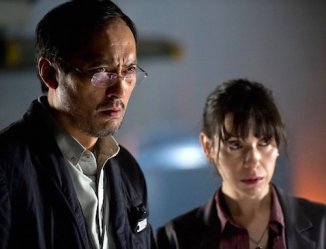 that simply aren’t present in the functional dialogue they have to work with, simply in the way they stand, the way they look at things… It’s not the focus of the film, it’ll pass many people by (indeed, it has), but I think there are some fine performances here. Not awards-winning ones, obviously, but in the hands of lesser actors, they would’ve been so much poorer.
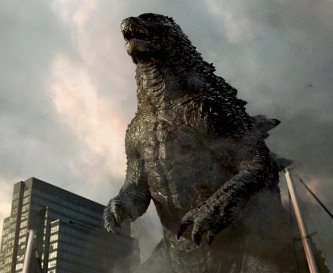 later, he slips quietly into the bay). Maybe, maybe not, but they always look big — more importantly, they feel big. There are various reasons for this, including Edwards’ shot choices: we often see them from a human perspective on the ground; when we do see wider shots, they’re from suitably far away, or high up, like a helicopter shot (if it were real…) Too many directors shoot their giant monsters with angles and perspectives as if they’re human-sized, which makes them come across as human-sized even when there’s a building next to them, never mind when they’re in places without reference points (coughatsea,PacifcRimcough). Edwards never does this, and it pays off. More than once I regretted that I can never be bothered to go to the cinema any more, because I bet this looked stunning on the big screen (I know I’m certainly
  most present big-budget summer tentpoles. That it got a little lost and under-appreciated in a summer of mega-hits is a real shame — it may not quite match summer 2014’s high points of
 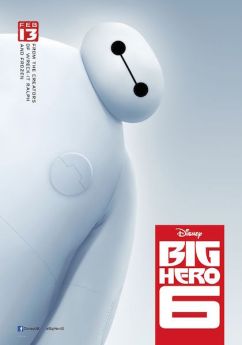 This year’s Best Animated Film Oscar winner is not this year’s best animated film. Not by a long stroke. What it is is one great character, one great emotional plot/subplot, and a lot of stuff that feels like every other big-budget action-orientated CGI animation of the past few years. Most succinctly, this is little more than (as
  The element that is an unequivocal success is Baymax. A soft robot — made of inflated vinyl so as to be genuinely huggable — he’s sweet, funny, and always entertaining. Memorable moments abound, in particular a sequence where his batteries run low, and his interpretation of a fist-bump (a recording booth improvisation by Adsit that was worked into the film). The movie truly comes alive whenever he’s on screen, but conversely loses some magic whenever he’s pushed into the background.
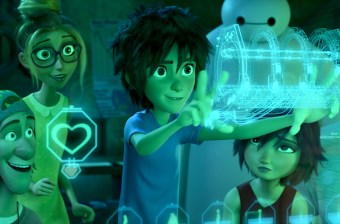 Big Hero 6 is by no means a bad film. It will certainly entertain its target age group, especially if they haven’t seen the other CG spectacles it nabs from. That aside, the entire thing is worth a look purely for Baymax and a few stand out moments — all of them involving the aforementioned vinyl robot, of course. Otherwise, it’s pretty by-the-book. The five-star-level praise it’s attracted in some quarters is completely unwarranted.
 100Films.co.uk