2015 #36
Peter Jackson | 144 mins | Blu-ray | 2.40:1 | USA & New Zealand / English | 12 / PG-13
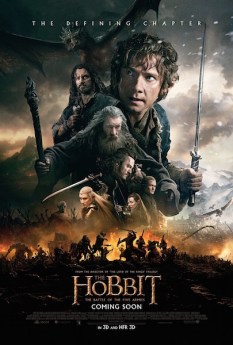 Peter Jackson’s epic Tolkien adaptation blunders its way to a conclusion with an instalment some have declared the trilogy’s best, presumably because they really enjoy watching someone else play video games. That’s what about half of this sextet-completing movie feels like, as it concludes the three-part Hobbit narrative with a CGI-riddled rendering of the titular battle. It’s the shortest film in Jackson’s Middle-earth magnum opus, though it comes to something when a film the best part of two-and-a-half hours long is described as “short”.
Before said battle, the movie finds itself with some business to attend to: we pick up immediately where the second part left off, with giant dragon Smaug flying towards Laketown with destruction on his mind. Kicking things off with a gigantic ten-minute action sequence isn’t a wholly bad decision pacing-wise, but this particular sequence is the wrong way to do it. Really, it’s the second film’s climax displaced — once Smaug is dealt with, a whole slew of new developments and subplots grow out of it, and that’s where the material that feels like it belongs in this film commences. Of course, that means there’s a lot of talking and manoeuvring, both politically and literally as people and troops shuffle about the board. Were it not for the big opening, there wouldn’t be an action sequence for about half the movie, and I guess that’s not considered acceptable in the modern blockbuster environment.
Now, if you were to watch all three films in one sitting, I suppose it wouldn’t matter precisely where the breaks fall. But how many people are actually going to do that? Not first-timers, that’s for sure. And then you’d get the problem of massive action sequences butting up against each other: the one that opens this film, right after the dwarfs-vs.-Smaug sequence invented during reshoots to take its place at the end of Film 2. Surely there were two other options available to Jackson when he made the decision to extend from a duology to a trilogy: he could have ended Film 2 before it even reached Smaug, 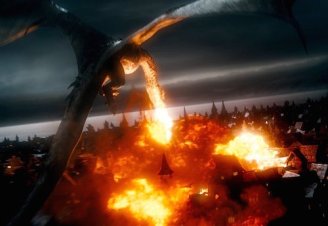 or he could have ended the second film with Smaug defeated and added more material to this third film to reach his desired running time. Or not even bothered adding stuff: if you lost the Smaug opener, The Battle of the Five Armies would still be over two hours long, which anywhere but Middle-earth is considered a decent length for a movie.
The rest of the film is a mixed bag for different reasons. For instance, Ryan Gage’s Alfrid is given a significant role — that’s the Mayor of Laketown’s assistant, if you’ve (understandably) forgotten who he is. Every minute that’s spent on his “comic relief” part is a minute wasted, and there are far too many minutes of it. Why that wasn’t left to the extended cut is anybody’s guess. It wouldn’t be particularly palatable there either — he’s just irritating, his actions predictable and unfunny — but longer versions are where there’s time for such indulgence. Conversely, Tauriel and Legolas are underused, wandering off on a completely aimless mission before wandering back for the battle.
Said battle feels a long time coming, but when it arrives… well, it’s a long time happening. It’s an epic by default, due to its sheer length. There are good bits, like the effort that has clearly been put into working out the armies’ tactics and the ebb and flow they would create. Wide aerial shots showing legions of troops swarming in formation, directed by generals with flags and horns mounted on high, are rather effective. 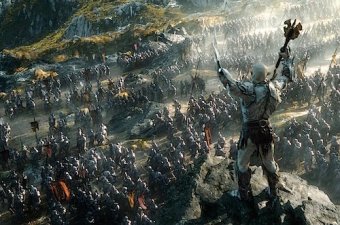 On the ground, the meat of the conflict only occurs when individual heroes are parcelled off into one-on-one duels. None of these particularly stand out, however, other than Legolas athletically jumping around a collapsing bridge that’s all so much CGI. This is where my earlier video game comparison really comes into play.
Some characters die. The impact is little-felt because of all the noise and bluster. That’s partly because there’s not really enough time for all the characters, of which there are more than ever. As with the second film, there’s been criticism that Martin Freeman’s eponymous Bilbo is barely featured, and, as with the second film, I disagree. Freeman’s not especially well-served in the acting stakes — Bilbo’s character development remains completed by the first part — but there’s still a focus on the actions of the little hero, some of which are pivotal.
Coming out of things best is Richard Armitage as Thorin, who succumbs to the paranoid madness that has afflicted generations of his family. Can he overcome it to do the right thing? The extent of this is sometimes laid on a little thick, but that’s the filmmakers’ fault (maybe this is another place that would benefit from a few trims) rather than Armitage’s performance. As the leaders of two of the titular armies, Lee Pace (elves) and Luke Evans (humans) also get a bit of a part to play, but the remaining dwarfs are given short shrift. That includes those played by James Nesbitt, Ken Stott and Aidan Turner, 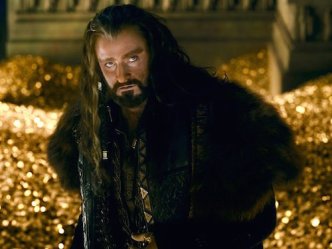 all of whom I’d thought would have more to do in the second and third parts of the trilogy. Turner, in particular, should have expected a bigger boost from Jackson’s decision to enrol him in an interracial romantic triangle, but it feels like they pulled back from that story thread a little after it proved unpopular in the previous film. It’s still obviously there, I just expected more of it.
On balance, The Battle of the Five Armies is probably the weakest of the three Hobbit films. Really, it’s just one big battle with a lengthy preamble. I can sort of see why Jackson felt like he could extend his original second film into a second and third — if you imagine them shorn of the reshoot-added bits, there’s still too much material for a single feature. The better solution, I suspect, would have been to accept splitting it into two shorter (i.e. regular-length) films, applying a bit of restraint in the process, rather than padding things further in an attempt to create two epics out of one ultra-epic.
As the credits begin, we’re treated to a sequence that emulates the one from Return of the King, with pencil sketches of the main cast alongside their names. On the Lord of the Rings concluder, it felt earnt; a special ending to a grand adventure. Here, it doesn’t. If anything, it feels like a reminder that the story we’ve just seen may have pushed to reach Lord of the Rings-level epicness, but is really just a tale of a small group going on an eventful hike, capped with a fairly large skirmish. A contemplative, momentous credit sequence does not feel warranted.
 I was something of a defender of Jackson’s version of The Hobbit at first. I enjoyed An Unexpected Journey and stand by my comment that, while it’s not The Lord of the Rings, it is the next best thing. As the trilogy has dragged on, however, it’s been dragged out, and the shine has gone off it. I still think there are elements to commend it, but I also think it could have been executed better. It’s hard to imagine an even longer version will improve much this time.
The Hobbit: The Battle of the Five Armies is released on DVD and Blu-ray in the UK on Monday.
My review of the Extended Edition can now be read here.

 The first of Summer 2013’s “Die Hard in the White House” movies, Olympus Has Fallen casts Gerard Butler as the top Secret Service agent who’s also super chummy with President Aaron Eckhart and his kid (Finley Jacobsen). However, after Something Goes Wrong™, Butler is moved to a desk job… but then, when the White House is attacked by terrorists, he’s the only good guy left standing inside. You know the rest, even if you haven’t seen White House Down.
 In fact, it takes itself very seriously indeed — Fuqua even puts characters’ names and jobs up on screen, as well as timecodes and locations, as if it’s a dramatisation of a real event. Obviously we all know it isn’t, making it feel incredibly odd. The CGI is just as bad as White House Down’s, though the exterior White House stuff looks more real than the obviously-greenscreen locales of the other film. Strikingly, this cost less than half as much ($70m vs. $150m).
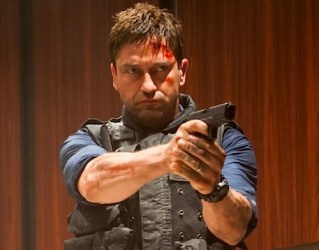 however, Olympus Has Fallen looks like a far lesser movie. It’s a shame it made it out of the gate first, and that some viewers are not blessed with enough of a sense of humour, because their comparative success has left some quarters with the impression this is the better movie and White House Down is just a clone. Hopefully that’s a wrong we can eventually right.
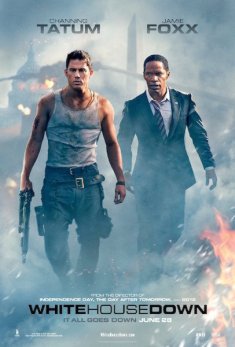 US Capitol policeman Channing Tatum is visiting the White House, trying and failing both to impress his estranged daughter and get a job in the Secret Service, when terrorists attack and try to take President Jamie Foxx hostage. Tatum rescues him from some of them, but with the rest occupying the building the stage is set for “
 If there’s a downside, it’s that this $150 million movie looks like it was made for closer to $15. There’s an overabundance of digital sets, ‘exteriors’ obviously shot on incorrectly-lit soundstages, and terrible CGI. Goodness only knows where all that money went — the actors’ salaries? Tatum and Foxx are good, but I’m not sure they’re worth that much. And here’s a good a time as any to say that this year I’ve become a bit of a Channing Tatum convert. I’d written him off because, to be honest, he looks a bit of a lug and I still think he’s woefully miscast as Gambit in
 Will Smith is the eponymous drunken vagrant, who also has the powers of Superman, in this under-appreciated superhero comedy-drama. Hated by the public for the destruction he causes while ‘helping’, and wanted by the authorities for the same — though they can’t catch him because, you know, superpowers — he gets an image makeover when he saves wannabe entrepreneur Jason Bateman. Bateman’s wife, Charlize Theron, is less sure of Hancock’s merits.
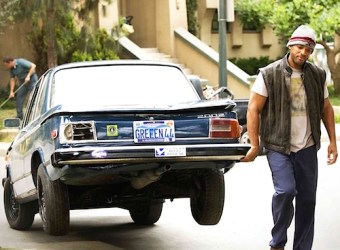 but it rubs against comedy stuff that feels like it’s from a Comedy. The extended cut includes an early sex/ejaculation joke/sequence that wasn’t in the theatrical cut because Berg thought it wasn’t funny and test audiences agreed. Goodness knows why it got put back, other than because of length — it accounts for over half of the extensions (more details
 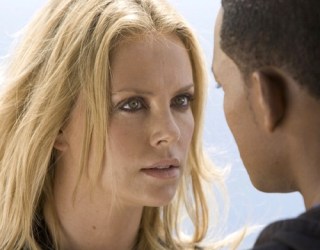 Why indeed, because a) she’s not a supervillain, and b) even if she were, why get changed?! It’s a kind of bait-and-switch: she’s made to look like a villain because we think that’s what she’s about to be revealed as, and a big hero-vs-villain fight follows too… but she isn’t. It’s not quite up there with the magically-changing Batsuits of
  The film would work a lot better on the whole if the tone had been settled on as definitively as Smith’s performance, rather than trying to have its cake and eat it by mining both the “what if this were real?” and “haha, an unlikeable drunk superhero!” versions concurrently. For my money, however, if you treat Hancock as a fairly seriously-intended movie that was forced to contain more (half-arsed) action and (misjudged) comedy for the sake of box office, it’s not a bad experience at all.
 After winning the Best Adapted Screenplay Oscar for
 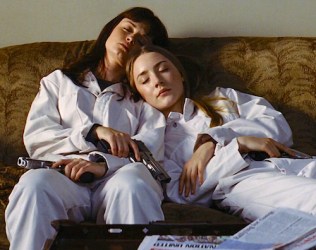 Here, Fletcher either needs to settle on one or the other, or clearly signal his intentions earlier.
 I had absolutely zero intention of ever watching this Sylvester Stallone vehicle (which is not to be confused with John Woo’s
  Said plot all comes down to a final fight, Stallone vs Jason Momoa (of
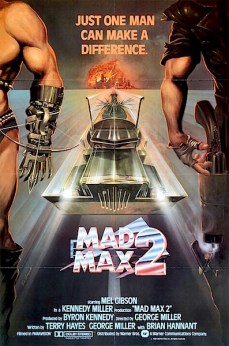 Roaming the outback of a gasoline-desperate post-apocalyptic Australia, “Mad” Max Rockatansky (Mel Gibson) comes across a commune-like oil refinery, whose inhabitants are under siege by a brutally violent gang. Max strikes a bargain: he’ll help them escape with their oil, in exchange for a tank full for himself.
 The most memorable part, however, is the climax. They escape the oil refinery, Max driving the tanker — fitted out with weaponry and defences — and the gang give chase. An almighty action sequence follows, a speeding battle through the outback. It feels wrong to just call it “an action sequence”, like that’s selling it short. You get the sense that this is why the movie exists; that co-writer/director George Miller’s goal with the entire rest of the film has been to get us to this point. It’s not just “the climax”, it’s “the third act”, and it’s stunning — the choreography of it, the editing, the stunts, as dozens of vehicles chase each other, people run around on top of them, jump between them… I don’t think it’s hyperbolic to say it must be one of the greatest action sequences ever committed to film. One of the reasons
 A bunch of obstreperous actors are too much to handle for the director of a Vietnam war movie, so he dumps them in the jungle to shoot it with hidden cameras. Things go awry; hilarity ensues.
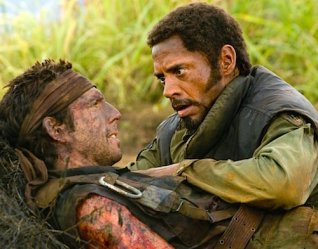 The film may run a little long in the middle, though I don’t think that’s the fault of this extended cut. It adds just over 17 minutes across many little changes and extensions
 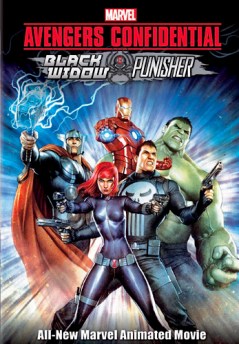 Anime take on Marvel properties. S.H.I.E.L.D. agent Black Widow teams up with vigilante Frank Castle, aka the Punisher, to investigate a threat to global security.
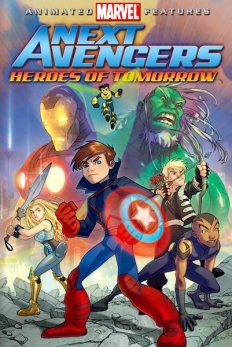 No, not the ’70s spy-fi series
  The rest of the new characters are largely fine, and while they’re clearly grounded in their parents’ personalities, they’re not just carbon copies — Cap’s son James is less worthy than his father, for instance; Black Panther’s son Azari is less elbows-out; and so on. Though Hawkeye Jr. is a little skeevy… Writer Christopher Yost has done a fair job of crafting realistic-enough kids, and in an era when superheroes seem to spend more time fighting amongst themselves than they do against villains, it’s nice that this team largely get on — though not in an overly-rosy “it’s all happy families” way, thankfully.
 Coupled with a good plot, which keeps moving and developing rather than setting up one threat and meandering along until a big fight, as well as a few cameos and maybe even surprises along the way, Next Avengers is the kind of movie you expect to be pretty awful kids-only dross, but turns out to actually be pretty darn good.
 100Films.co.uk