

Country: USA
Language: English, French, German & Czech
Runtime: 170 minutes
BBFC: 15
MPAA: R

Original Release: 24th July 1998 (USA)
UK Release: 11th September 1998
First Seen: TV, c.2001
Stars
Tom Hanks (Big, Cast Away)
Edward Burns (She’s the One, 15 Minutes)
Matt Damon (Good Will Hunting, Jason Bourne)
Tom Sizemore (Natural Born Killers, Black Hawk Down)
(The lead cast includes since-famous people like Vin Diesel, Barry Pepper, and Giovanni Ribisi, and the supporting cast even more recognisable faces, but, still, Edward Burns is second billed.)
Director
Steven Spielberg (Empire of the Sun, War Horse)
Screenwriter
Robert Rodat (Fly Away Home, The Patriot)
The Story
In the immediate aftermath of D-Day, a group of soldiers are tasked to locate and rescue just one man: Private Ryan, whose three brothers have been killed in action, earning him a free pass home. As the squad trek across France, mindful of the waste of resources, they encounter first-hand the early days of the Allied invasion of Europe.
Our Heroes
Just a regular bunch of soldiers, co-opted into a PR mission that isn’t that easy. They’re commanded by Captain Miller, their respected leader with a secretive past… a past which is actually thoroughly mundane, and just highlights the bizarre, heightened world of the war.
Our Villains
Nazis!
Best Supporting Character
Matt Damon was cast as the eponymous soldier because Spielberg wanted an unknown with an all-American look. Unfortunately for that plan, before Private Ryan came out Damon won an Oscar for Good Will Hunting and became famous overnight. It certainly changes the effect to have the team rescuing Movie Star Matt Damon rather than Some Unknown Actor, but, on the bright side, he’s good.
Memorable Quote
Reiben: “Hey, so, Captain, what about you? I mean, you don’t gripe at all?”
Miller: “I don’t gripe to you, Reiben. I’m a captain. There’s a chain of command. Gripes go up, not down. Always up. You gripe to me, I gripe to my superior officer, so on, so on, and so on. I don’t gripe to you. I don’t gripe in front of you. You should know that as a Ranger.”
Reiben: “I’m sorry, sir, but uh… let’s say you weren’t a captain, or maybe I was a major. What would you say then?”
Miller: “Well, in that case, I’d say, ‘This is an excellent mission, sir, with an extremely valuable objective, sir, worthy of my best efforts, sir. Moreover, I feel heartfelt sorrow for the mother of Private James Ryan and am willing to lay down my life and the lives of my men — especially you, Reiben — to ease her suffering.’”
Memorable Scene
The opening half-hour, which recreates the Normandy landings in shocking, brutal detail, and is supposedly very true to the actual experience. Surely the definitive modern combat sequence from any war movie.
Technical Wizardry
The heavily desaturated cinematography by Janusz Kaminski instantly lends the film a grim veracity, very appropriate to its tone. Such extreme colour palettes are commonplace nowadays, mainly thanks to digital grading, but when Private Ryan came to US TV providers had to deal with numerous complaints from viewers who thought there was a problem with their signal — which the broadcasters fixed by just upping the saturation of the film, of course.
Truly Special Effect
The involvement of ILM was downplayed so that the film didn’t come across as “an effects movie”, but they still had a key role — for instance, providing most of the bullet hits throughout the D-Day sequence. Not remarkable effects work in itself, maybe, but it’s appropriately invisible.
Making of
The D-Day sequence alone cost $11 million. It was filmed over four weeks (almost half the entire shoot), gradually moving up the beach to film the whole thing in chronological order. Spielberg personally operated the camera for many shots, none of which were storyboarded. The shoot involved up to 1,000 extras, 20 to 30 of whom were amputees fitted with prosthetic limbs to simulate them being blown off. Reportedly, many veterans have congratulated Spielberg on the sequence’s accuracy, including actor James Doohan, aka Star Trek’s Scotty, who participated in the Normandy landings.
Next time…
HBO’s Band of Brothers is basically Saving Private Ryan: The Series, taking the film’s visual style to tell the true story of a company of soldiers from their training, through the invasions of France and Germany, and right up to the end of the war. Often topping lists as the greatest TV series ever made, it certainly belongs in consideration.
Awards
5 Oscars (Director, Cinematography, Editing, Sound, Sound Effects Editing)
6 Oscar nominations (Picture, Actor (Tom Hanks), Original Screenplay, Score, Art Direction-Set Decoration, Makeup)
2 BAFTAs (Sound, Special Effects)
8 BAFTA nominations (Film, Actor (Tom Hanks), Director, Music, Cinematography, Editing, Production Design, Make Up/Hair)
1 Saturn Award (Action/Adventure/Thriller Film)
1 Saturn nomination (Special Effects)
3 MTV Movie Awards nominations (including Action Sequence for the Normandy landings. It lost to Armageddon.)
What the Critics Said
“hands-down the best film of 1998. Spielberg has clearly stated in recent interviews that he made the film as a monument to the brave men who fought and died in that terrible war (and on D-Day, in particular), but he’s also done something morally heroic in the process. Private Ryan clearly illustrates, once and for all, that war — the real, appalling thing, not the flag-waving glorification that you usually see at the movies — is hell on earth. Spielberg accomplishes these goals with a technical virtuosity that no other director, arguably in the history of the cinema, can even approach. […] He’s a director whose work has grown right before our eyes from that of a precocious whiz-kid to the complex, humanistic statements of a true artist. Whether or not you always appreciate how he utilizes his skills, the man is an undeniable genius.” — Paul Tatara, CNN
 Score:
 92%
92%What the Public Say
“the opening 25 minutes of Saving Private Ryan – where [Spielberg] thrusts us into the 1944 D-Day landings of Omaha Beach – is arguably his most impressive and certainly his most visceral work. It’s absolutely exhausting in its construction and sense of realism and the realisation soon sets in, that this cinematic auteur is not about to pull any punches in portraying a time in history that’s very close to his heart. The opening is so commanding that some have criticised the film for not living up this grand and devastating scale but Spielberg has many more up his sleeve. He’s just not able to deliver them too close together – otherwise, the film would be absolutely shattering and very difficult to get through. To bridge the gap between breathtaking battles scenes the film falls into a rather conventional storyline about men on a mission but its only purpose is to keep the film flowing and allows Spielberg the ability to make the brutality of war more personal.” — Mark Walker, Marked Movies

Is Saving Private Ryan the greatest war movie ever made? Maybe. The relatively simple story allows it to explore the mindset of the soldiers making the first forays into Europe after D-Day, both their camaraderie as a group of men and the actions they took to function through the experience. It’s certainly the most influential World War 2 movie of modern times — nearly 20 years later, its desaturated colour palette remains de rigueur for films set in the war. So too its realistic depiction of combat, which is more plausible than some of the Boy’s Own adventures that came before, though not so ridiculously gruelling as some that have come in its wake. Personally, the only superior WW2 ‘film’ I can think of is Band of Brothers, and considering that has ten hours to explore its characters and situations, it’s not really a fair comparison.

#80 will be… a very different Spielberg/WW2 story.
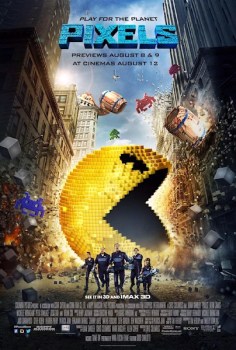 Adam Sandler, eh? He has his fans, though apparently not among people who can write because you rarely see a good word penned about him. The one exception is
 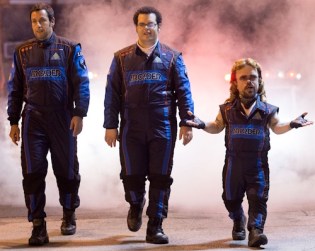 Pixels is the virtual definition of brain-off entertainment. The story has the plausibility of a kids’ daydream, the humour is frequently unimaginative, and the action sequences mostly coast on their basic concept rather than trying to elevate them. And Peter Dinklage is going to get a reputation for having terrible taste. I mean, I liked
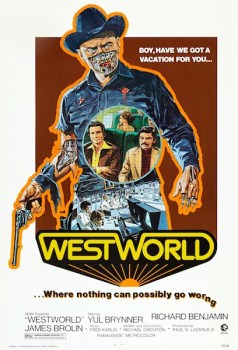 When writer-director Michael Crichton hit upon the notion of a theme park where the future-science star attractions broke free of their shackles and endangered the lives of the guests, it was so good it served him twice: he replaced the initial murderous AI-powered robot cowboys with rampaging genetically-engineered dinosaurs and sparked
 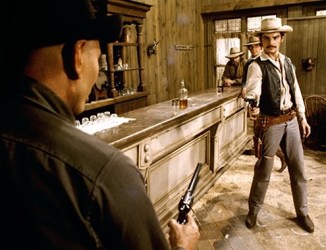 under $76,000, or about £58,200. The potential threat of the robots malfunctioning is built up gradually here and there, in asides from what our ostensible heroes are up to, and isn’t explained. There are nods to the fact the human staff don’t actually know how the robots work, but why should that be? Some of them were apparently designed by other robots, but how did the designing robots come about? Rather than explore any of its science fiction themes, the film just uses the basic idea to have the robots go on a killing spree right at the climax. This is something Crichton definitely turned around for
 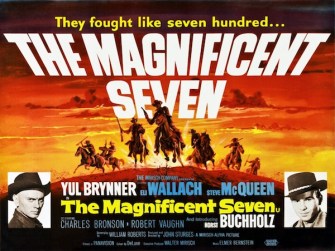 Described in the booklet accompanying the Ultimate Edition DVD release as “the last great American western before Sergio Leone reinvented the genre,” The Magnificent Seven doesn’t feel as dated as that might make it sound. Famously, it’s a remake of Akira Kurosawa’s
 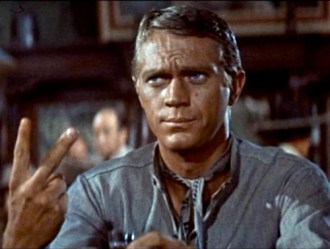 With even less screen time to go round than in Kurosawa’s original, the cast only get to provide thumbnail sketches of their characters. However, bearing that in mind, only Vaughn really feels shortchanged on time, while McQueen manages to steal every scene he’s in, even when he was supposed to just be in the background — much to Brynner’s annoyance. One reason this works is because the seven represent more or less the same things thematically, in some respects functioning as one hero character with seven parts. They are all unsettled drifters, good at killing but not at settling down; they have nothing to do but win and so be damned to go find another cause, or die trying. This is taken from Kurosawa’s film too, of course, but it fits just as well in its new setting, and the main scene where the seven discuss it is a definite highpoint of the movie.
 That’s not something that bothered me, but where I did find it suffering was in comparison to Kurosawa. While it has obviously been rejigged for its new setting, it’s not just borrowed the basic concept of seven violence-skilled loners defending a needy village, but rather retained all the bones of the samurai original. As with most remakes, it falters by not doing the same thing quite as well, for one reason or another. Still, if it is a faded copy then at least it’s of one of the greatest films ever made, which leaves it a mighty fine Western in its own right.
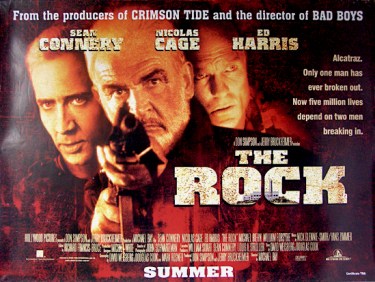
 Believing the mission lost, the military has launched its back-up plan: an airstrike that will destroy the poison gas but also kill everyone on the island. Naturally our heroes manage to complete their mission nonetheless, and as the jets streak across San Francisco Bay, Stanley attempts to signal abort with two green flares. In slow motion, of course.


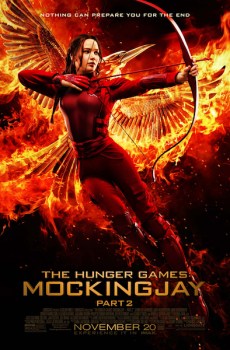 The artificially-extended Hunger Games trilogy-turned-tetralogy climaxes here. Presumably you’ve seen the first three and so know what you’re into by this point — either you’re invested or you’ve given up. Unless you want to know “does it end well?” before embarking on the whole thing, of course. While Mockingjay Part 2 is not the series’ finest instalment, it brings things to a decent head… eventually.
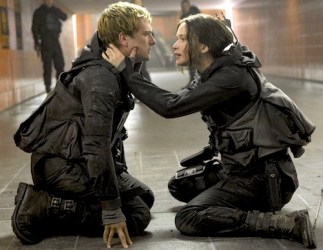 What follows isn’t perfect — in particular, the storyline could’ve done with tightening up — but it does have a lot going for it. There’s strong characterisation: Katniss is as confused, conflicted, and incapable of engaging with her emotions as ever, while Peeta’s PTSD is well-handled, with an effective device where he repeatedly makes a statement before asking, “real or not real?” There are other nicely developed thematic points too, like expanding further on the rebels not being perfect good guys (as initiated in Part 1), which plays a central role in the denouement. The action sequences are well staged and occasionally inventive, but best of all is that the climax doesn’t lean on being the biggest fight scene yet — it’s driven by the story, and the characters and their decisions, rather than being a ginormous shoot-out.
 Mockingjay Part 2 is not the best instalment of the Hunger Games, a series whose second half didn’t quite live up to the developed potential of the excellent
 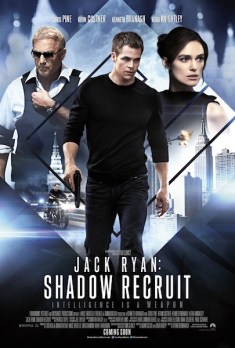 Kenneth Branagh, who once used to direct films based on Shakespeare and opera and that kind of thing, seems to have carved himself a place as a jobbing blockbuster director so far this decade: it started with a spot in Marvel’s then-burgeoning universe, adapting
 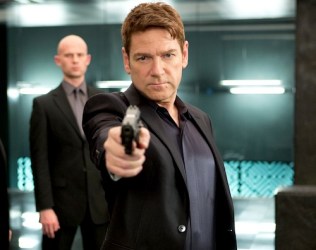 he comes up against oligarch Viktor Cherevin (Kenneth Branagh), the architect of the plan, which will be instigated by a massive terrorist attack on US soil. Unless Ryan can stop him, of course — with the help of his handler (Kevin Costner), and his fiancée Cathy (Keira Knightley), who’s followed him to Russia because she thinks he’s having an affair. I mean, he was sneaking around a lot…
 a little different to the action-thriller norm. Ryan has skills leftover from his military days, but he’s not a one-man army like Bond or Bourne — he needs help both on the ground and from tech guys behind the scenes, who play a vital role in… well, I was going to say “the climax”, but it’s “the bit just before the climax”. The climax is a chase around New York, because of course you have to end with a chase.

 Stoner comedies aren’t really my thing, but something about American Ultra — which is often pithily described as “
 really mean it’s funny (there are two or three laughs, tops), just that it has a less serious tone. Even if you want to claim the Bourne similarities are just one facet, the film as a whole feels generally reminiscent of any number of low/medium-budget action flicks. It’s not bad, it passes the time, but original or exceptional? No.
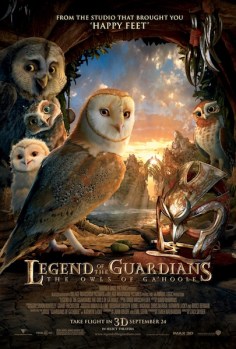 Legend of the Guardians is pretty odd.
 100Films.co.uk