The Hitman’s Bodyguard (2017)

2018 #61
Patrick Hughes | 118 mins | streaming (HD) | 2.39:1 | USA, Netherlands, China & Bulgaria / English, Russian & Spanish | 15 / R

The Hitman's Bodyguard

With a daft-ish title and promotional campaign that definitely amped up the comedy, you might be surprised to learn that The Hitman’s Bodyguard started life as a drama. Yep, apparently so. Then, a few weeks prior to filming, the script underwent a “frantic” two-week rewrite to be remixed into a comedy. The end result is kind of a mixed bag, which, all things considered, makes sense.

The hitman of the title is Darius Kincaid (Samuel L. Jackson), who agrees to testify against a dictator (Gary Oldman, underused) in exchange for the release of his wife from prison. While being transported through (of all places) Coventry, Kincaid and his escort are ambushed. The one surviving agent calls in Michael Bryce (Ryan Reynolds) to help. Bryce is a private bodyguard — formerly to elite clients, until Kincaid assassinated one of them. Suffice to say, the two don’t get along. Cue banter as the mismatched pair face more tribulations on their way to The Hague.

So, it’s a buddy action comedy, a well-worn genre, and The Hitman’s Bodyguard has nothing new to add to it. That said, while the antics may not be especially original, they’re not badly done. The film offers few big laughs, but there are one or two, and a couple of smiles. On the other hand, it’s a good 20 minutes too long (it needs to sacrifice some of the chatter, maybe some of the flashbacks, and definitely at least one action sequence) and some bits are inappropriately grim (random murder of parents? Photos of mass executions?) I guess those tonal inadequacies are the legacy of the last-minute rewrites, but, still, someone should’ve fixed that.

Explosion!

The action centrepiece is a rather good stunt-filled five-way chase between Jackson in a speedboat, Reynolds on a motorbike, Russian hit men, Interpol agents, and the Amsterdam police in cars. It’s not going to be challenging the John Wicks of this world for classic status, but it thrills enough. What seems like the climax is another pretty good one, as it intercuts a car chase with a hardware store fight that makes full use of the tools on hand. (I say “seems like” because it has another shoot-out after they finally make it to The Hague — like I said, it’s at least one action scene too long.)

Apparently The Hitman’s Bodyguard only cost $30 million, which is $5 million less than The Hurricane Heist (which I watched on the same evening, hence the comparison). But this film looks considerably more expensive than the other, and it has several considerably bigger-name stars too. I guess some people just know how to spend money better than others. This comparison is also relevant for my final score, because it again calls into question my non-use of half-stars on this blog. On Letterboxd I rated The Hurricane Heist as 2.5 and The Hitman’s Bodyguard as 3.5, a whole star different, but here they both get rounded to the same score. Well, no one said life was fair.

3 out of 5

Ryan Reynold’s latest law enforcement-adjacent role is as the voice of the eponymous character in Detective Pikachu, in cinemas now.

The Meg (2018)

2019 #77
Jon Turteltaub | 113 mins | download (HD+3D) | 2.39:1 | USA & China / English & Mandarin | 12 / PG-13

The Meg

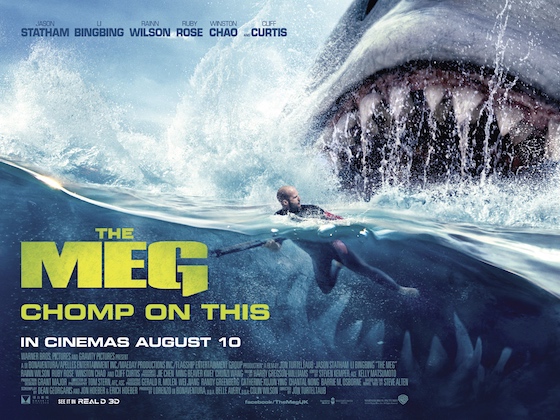
Jason Statham vs. a giant prehistoric shark — what more do you need to know?

Okay, well, despite the obvious pulp-blockbuster nature of this premise, it’s actually based on a novel, which was originally published in 1997 and so I guess arrived in a wave of post-Jurassic Park interest in man vs. prehistoric creatures thrillers. Well, Jurassic Park and the other obvious comparison, Jaws, were also both adapted from novels, so perhaps it’s not so weird after all. I’d never heard of the book before, but apparently it has a dedicated fanbase (there are multiple sequels), who were disappointed with this film because it makes some radical changes to the source material. Clearly, I’m not the right person to make that comparison.

Judged as a film in its own right, then, I thought it was a ton of fun. You know what you’re getting into with that pitch, and doubly so if you’ve watched the trailer. This isn’t some thought-provoking docu-drama about “what if we really discovered a prehistoric creature still lived?” This isn’t even Jaws, a relatively grounded adventure movie about normal people defeating a larger-than-average killer shark. This is a movie about a super-high-tech underwater research facility that accidentally unleashes a prehistoric monster and then all the scientists and submariners and whatnot on board have to track it down and stop it. This is a move about Jason Statham fighting a giant shark.

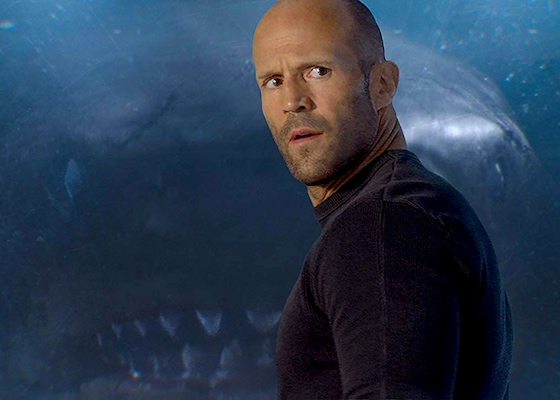
Stath vs shark

All of that said, some people have criticised the movie for not being quite as daft or out there as they wanted from a B-movie-inspired effects spectacular. I guess that’s a real “your mileage will vary” situation. Personally, I had a lot of fun with it. It keeps things more grounded than the utter batshit craziness of, say, Sharknado, but it’s clearly still allowing itself to have fun with the situations and concepts. It also doesn’t feel too samey, which considering there are only so many ways to interact with a giant shark is some kind of achievement.

Other criticisms I’ve read include that it’s too slow to get going, focusing on undersea rescues rather than getting straight to Stath-on-shark action. Again, this was something I actually liked about the film — that it allowed at least some time to build the Meg up as a mysterious unseen force (and, in the grand scheme of things, not that much time — this isn’t Jaws). It also gave the film a certain scope and scale. It’s not like this shark rocks up and they defeat it in an afternoon — the plot spread out over a couple of days, at least. I don’t know, there’s just something I like about that pacing.

Also, the film is a Chinese co-production, and so features many major and minor Chinese characters, and the climax is set in the vicinity of a Chinese beach. I’ve seen people criticise this aspect of the film because… um… Yeah, not liking that aspect smacks of racism, let’s be honest. I’m not saying everyone who dislikes The Meg is a racist — that would be stupid — but some reviews I’ve seen come with this slightly weird sense that part of the reason they dislike it is because it’s 50% (if that) a Chinese blockbuster.

Who fancies Chinese for dinner?

At the end of the day, I come back to what I said at the start: it’s a movie about a giant prehistoric shark being unleashed and attacking humans, and Jason Statham has to fight it. That’s all. It delivered on that in spades for me and I had a great time with it. And I guess tied to that pulpiness, if you have the option and enjoy the effect, I thought it looked fantastic in 3D.

4 out of 5

The Meg is available on Sky Cinema from today.

Die Hard with a Vengeance (1995)

2018 #63
John McTiernan | 128 mins | Blu-ray | 2.35:1 | USA / English & German | 15 / R

Die Hard with a Vengeance

Making a sequel to what’s regarded as one of, if not the, greatest action (and Christmas) movies of all time is basically a hiding to nothing — however good your work, if it’s not a stone-cold classic too then it’s a relative failure. Nonetheless, there are those who’d argue this second sequel to Die Hard is practically as good as the first one, and they’d practically be right.

After having to defend a skyscraper in the first film and an airport in the second, this time it’s an entire city that’s relying on John McClane (Bruce Willis): a terrorist known only as ‘Simon’ (Jeremy Irons) insists McClane engage in a series of outlandish games in a twisted version of Simon Says, with each successfully completed task preventing the detonation of bombs around New York City. But ‘Simon’ actually has a whole other plan, and there’s a reason he sought out the involvement of McClane…

I’m being coy about Simon’s true identity because the film plays it as a big reveal. I don’t know if it was a surprise twist back in ’95 — it’s not given away in the trailers, but I don’t know about other pre-release material. If it ever was a secret, well, I don’t think it is anymore. I’ve certainly known it almost as long as I can remember. It’s a shame, really, because while it doesn’t exactly ruin the film, it does somewhat undermine the first 45-or-so minutes where it’s played as a mystery.

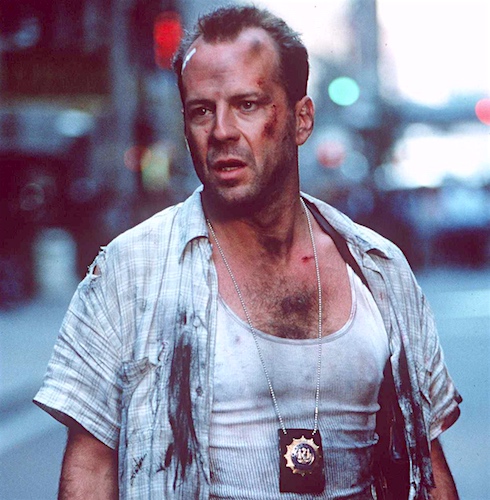
Dirty cop

That’s doubly disappointing because the the first half-or-so of the film is absolutely excellent: fast-paced (it hits the ground running and doesn’t let up), exciting, engaging. Willis is teamed up with Samuel L. Jackson, which makes for a fun double act. Jeremy Irons is reliably excellent as the villain. Okay, it’s not as classic a role as Alan Rickman in the first one, but then what is? But once Simon’s identity and plan are revealed, the pace and ingenuity begin to flag a little. It doesn’t get bad by any means, but it fails to maintain that early momentum throughout. It’s at least one action sequence too long — literally, because the finale is, pace-wise, an unnecessary addendum. Maybe something could’ve gone earlier to keep it tight, too.

Really, these are niggles; stuff that holds it back from absolute perfection. The inadequacy is only apparent becomes it comes after the first half, which is fantastic. Nonetheless, they niggled me enough to hold me back from giving With a Vengeance a full 5 stars, sadly. (However, I hasten to add that, although this is the same mark I gave Die Hard 2, With a Vengeance is a lot better — in retrospect, I’d probably give the first sequel a 3.)

But my biggest regret is that my insistence on watching film series in order, and my general tardiness about actually doing that watching (it feels like With a Vengeance has been on BBC One all the damn time throughout my life — I coulda watched it decades ago — but it took me a good few years to see Die Hard, and I didn’t watch Die Harder ’til after I started this blog), means I haven’t got round to seeing this until now. I mean, I should be on my third or fourth viewing already! Damn.

4 out of 5

Snowpiercer (2013)

2018 #251
Bong Joon Ho | 126 mins | Blu-ray | 16:9 | South Korea & Czech Republic / English & Korean | 15 / R

Snowpiercer

Before we knew about Harvey Weinstein’s real, vile crimes, his offences against cinema were already widely discussed. From manipulating the Oscars to re-editing foreign films himself before distribution, he’d managed to become powerful often at the expense of films themselves. Snowpiercer was another example: having acquired distribution rights while the movie was in production, Weinstein later insisted on severe cuts (reportedly 20 minutes) and changes (adding opening and closing monologues), but co-writer/director Bong Joon Ho refused. It was eventually released in the US uncut, but only on a limited number of screens, and the planned worldwide distribution either didn’t happen or was curtailed — I don’t know about other countries where Weinstein had the rights, but there was no UK release at all. But the downfall of Weinstein has seen the rights to various films shopped to other distributors, and so Snowpiercer finally made it onto Amazon Video in the UK last November, and as of this week is available to Netflix subscribers. For my part, I heard the good reviews back on its US release and, with no sign of it coming to the UK, imported the US Blu-ray when it came out in 2014; but, me being me, I only actually got round to watching it last year.

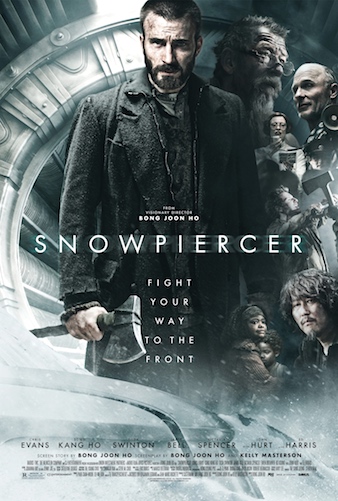
Based on the 1982 French graphic novel Le Transperceneige by Jacques Lob and Jean-Marc Rochette, Snowpiercer is set in the far future, after an apocalyptic event has left the world an arctic wasteland. What survives of humanity all live on the titular train, which constantly circles the planet. The rich people live in luxury at the front; the poor people live in squalor at the back. Numerous attempted uprisings by the lower class have failed, but, with nothing to lose but their shitty lives, they’re going to try again.

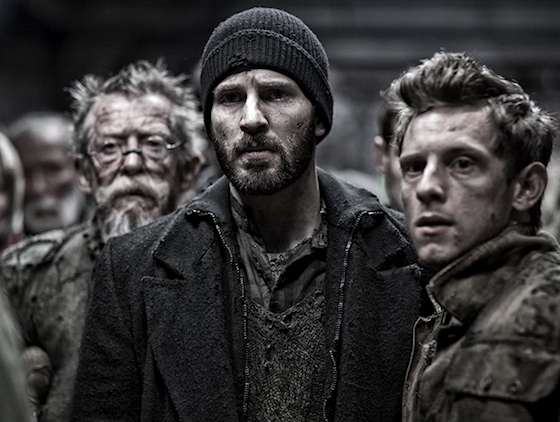
The War Doctor, Captain America, and Billy Elliot step aboard a train...

Yeah, it’s a pretty out-there, not-at-all-plausible premise, but just go with it and the film has rewards aplenty. If you want to get intellectual, the train’s societal structure and how it’s maintained offers an allegorical commentary about class divides and the interdependence of the oppressed and the oppressors. But if that sounds a bit heavy, the film wraps it up in a pulse-pounding action thriller, dressed up further with mysterious backstories ripe for exposing and an array of memorable performances, not least Tilda Swinton as a toothy commandant. So, it’s by turns seriously thought-provoking, outrageously hysterical, and wondrously exciting — there are several superbly staged action sequences as our heroes literally battle their way up the train.

It may’ve taken an unconscionably long time to reach our shores — but hey, what could be more British than a mega-train only turning up after a mega-delay? Unlike our shoddy rail service, however, Snowpiercer proves worth the wait

5 out of 5

Snowpiercer is available on Netflix UK now.

It placed 3rd on my list of The 26 Best Films I Saw For the First Time in 2018. I watched it as part of my Blindspot 2018 project.

Avengers: Endgame (2019)

2019 #67
Anthony & Joe Russo | 181 mins | cinema | 2.39:1 | USA / English & Japanese | 12A / PG-13

Avengers: Endgame

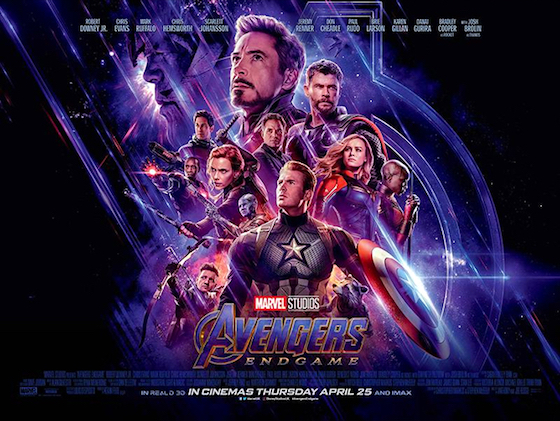
A trilogy each of Iron Mans, Captain Americas, and Thors; a pair of Ant-Mans and two volumes of Guardians of the Galaxy; an Incredible Hulk, a Doctor Strange, a Black Panther, a Spider-Man, and a Captain Marvel; plus, of course, a trio of previous Avengers — they’ve all been leading us here, the culmination of 11 years and 22 movies in the Marvel Cinematic Universe. It’s an unparalleled achievement in moviemaking; a combination of blockbuster scope with TV-esque serial storytelling that is so 21st century. Within its three hours and one minute running time, Endgame encompasses and represents almost all of the tendencies of other MCU movies — for both good and ill. This is not a perfect movie, and this will not be a 5-star review, which I’m saying upfront because massive spoilers may follow. There’s not much to discuss about the film if we limit ourselves to what’s been revealed in trailers and promos, because they’ve purposely kept almost the entire movie a secret, so I’m just going to talk freely.

If you’ve seen the movie then a plot recap is unnecessary. But in case you just don’t care and have decided to read on regardless: Endgame picks up days/weeks after the cliffhanger ending of Infinity War (maybe I missed or misunderstood something, but I swear one character said it had been 23 days then later someone said it had been two days). The surviving Avengers, plus newly-summoned addition Captain Marvel, manage to track down super-villain Thanos and set off to retrieve the Infinity Stones and use them to bring back the 50% of the universe’s population he turned to dust. Unfortunately, Thanos has destroyed the stones. All hope is lost. Cue title card: five years later.

Thanos no more

Okay, we’ll return to the plot in a minute, because this is the first structural oddity of the film. This opening salvo — made up of a pre-Marvel logo sequence in which we learn what happened to Hawkeye and his family, a pre-titles sequence which sets up the plan to beat Thanos, and the pre-timejump action I just described — is almost a self-contained unit dealing with the hangover from the last film. It wouldn’t fit as a closing act to Infinity War — that movie ended at the perfect point in the story — but nor does it really belong at the start of Endgame, which begins properly after the “five years later” card. I have mixed feelings about it, because I like that we see both the heroes’ immediate attempts to rectify the situation, but also that they can’t, so we get to see how they’ve coped (or failed to) over the ensuing years. But, structurally, it felt a little clunky to me; a bit of business from the previous movie that has to be wrapped up before this one can start. I’m not sure what the solution is. If movies still bothered with opening credits, something as simple as separating it all off as a pre-titles sequence might’ve been the answer.

Anyway, back to the plot. It’s five years later and the world is still coming to terms with the snap. There are too many characters in too many different places to recap what everyone’s up to — that’s part of why this film has a three-hour running time, because there’s simply so much to tackle. But in many ways this is the best part of the movie, especially if you’re invested in these characters rather than just here for action or spectacle. It’s a bit grim, obviously — no one’s going to be cheery about half the world being wiped out — but it digs into the differing reactions this would provoke in ways that are character-specific and mostly plausible. I say “mostly” because, when Hulk (or whatever he is now) turns up, I didn’t quite follow the logic of why he’d turned himself into this Banner/Hulk hybrid. Still, seeing how the characters come to terms with their new reality is an effectively thoughtful way to start off.

Crying Cap

But that’s not going to fuel a superhero blockbuster, is it? Here the little mid-credit scene from Ant-Man and the Wasp comes into play. Marvel have always used their credit stings to connect up the films, but has it ever been so vital as this? They’re normally little teases, basically trailers to remind you which film is next, but what happens in that Ant-Man 2 scene is vital to the plot of Endgame. Basically, Scott has been stuck in the Quantum Realm for the past five years, but this provides them with an opportunity: it might be possible to use it for time travel, allowing them to go back in time and undo Thanos’ actions. Or something. Endgame’s relationship with time travel is… variable. Time travel movies are always complicated, and because it’s not a thing that’s really possible they get to set their own rules for how it works. The problem is, Endgame isn’t very clear what those rules are. It makes a great show of saying “it’s not like in the movies” and reeling off a slew of pop culture references (Back to the Future is mentioned more than once), but then it struggles to clearly define how it does work in this movie. And once the characters set off into the past, any explanations it did give seem to go out the window.

It’s in this long middle act that Endgame was most often problematic for me. Act one is largely committed to being solemn, and act three is largely committed to being Epic, so it’s in the middle that the film shoots for the MCU’s trademark “light and breezy” tone. Unfortunately, sometimes this is so shoehorned in that it rubs against the serious stuff, resulting in a tonal mishmash. I’ve frequently advocated for movies that mix seriousness and comedy side-by-side, because real life often does the same, but there are points where Endgame undercuts its own stakes or undermines its characters for the sake of a one-liner or a comedy bit, rather than embracing the seriousness of the situation and letting comedy evolve naturally when it’s warranted.

There can be only one...

Conversely, some of the humour is accidental. One of the more egregious examples for me is when Black Widow and Hawkeye are faced with the Soul Stone dilemma: one of them has to die as a sacrifice for the stone to be released to the other. They both decide to sacrifice themselves, which leads to a protracted series of attempts to stop the other from committing suicide first. The constant back and forth of who had the upper hand gets almost to the point where it’s comical — I began to wonder if it was meant to be a comedy bit. But then, just as it was reaching the height of absurdity where I was about to conclude I should be laughing rather than just thinking “this is silly now”, it abruptly stops when one of them ‘wins’ and we get a Tragic Death Scene. It’s clearly meant to be a shocking, affecting moment of heroic sacrifice; instead, I found it a jumble of intentions that neutered any genuine feelings.

Another moment that’s well-meaning but fumbled comes during the big climax, when all the Lady Superheroes unite to do something. It’s a moment of such brazen, uncalled-for “feminism” that it feels like pandering, and that’s a bad thing. I’m searching for a better word to use in that last sentence, because overall feminism is a good thing, but this particular moment is so out-of-nowhere, so fundamentally meaningless (there’s no need for it to be just the women involved), that it’s egregious. When crybaby fanboy trolls scream about unnecessarily forcing political correctness onto genre movies, they’re unerringly wrong… except this time they’ll be right, because that’s exactly how this plays. There’s a broadly similar moment in Infinity War, when a couple of the female heroes defeat whichever of Thanos’ sidekicks is the female one, and I thought that worked, partly because no one made a big deal of it. Here, it’s clear they’re making a point. I’m not sure what the exact goal of it was — to say “women are as capable as men”; to say “look how many female heroes we have now”; or something else — but there are better, subtler ways to make that same point.

Nebulous plotting

Where Infinity War found room for almost all of the MCU’s ongoing franchises and characters (an impressive feat), Endgame cements its finale status by re-centring us on the original lineup from the initial Avengers team-up… er, plus a couple of other characters, who are important to varying degrees for various reasons. It’s that kind of “it’s almost this… but not quite” construction of content and/or theme that belies a certain lack of focus or forethought. If this is a last hurrah for the original team, why is Ant-Man vital to the story even being possible? Why does Nebula get one of the most significant subplots, intimately connected to her character arc from Guardians Vol.1 and 2? Why is brand-new (to the movies) character Captain Marvel repeatedly required to come in and save the day?

This extends to the time travel too: when they go back, it’s into the timelines of specific movies, but why those movies were chosen isn’t always clear. Avengers Assemble? Makes sense — it was where the crazy project of the MCU proved it was working, making that film both the end of the beginning and a beginning in itself. Guardians of the Galaxy? I mean, I guess — it’s where Marvel proved they could turn even the most obscure property into a massive, popular hit; plus it’s where a lot of the Thanos storyline really got going. Thor: The Dark World? …wait, what? Seriously?! Yes, perhaps the greatest trick Marvel have ever pulled is making Thor 2 — one of their least well regarded films — a moderately essential component of this finale. You need to have seen that movie to fully understand what’s going on here, and now you can’t really skip it in your rewatches either.

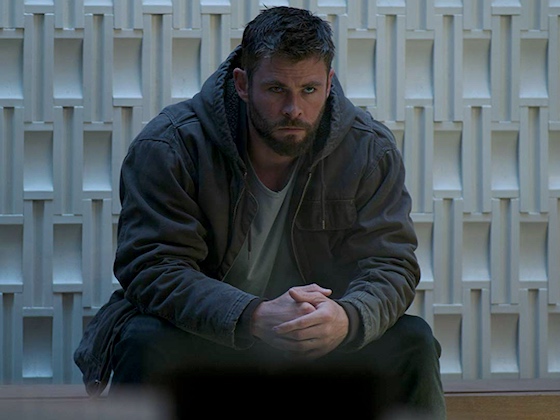
Thor after being told which movie he had to revisit

Talking of connectivity, Infinity War surprised by being a standalone movie, not just a Part 1. Okay, it was a standalone movie which ended with our heroes losing, which you could call a cliffhanger, but if you look at it from the other side — i.e. with Thanos as the main character — it’s a whole, completed, no-more-story-to-tell tale. Therefore it’s a fresh surprise (kinda) that Endgame is very much a Part 2 — and also, in fact, a Part 22 — freely nodding to and paying off stuff from previous movies on the assumption you’ll know what it’s referencing, more like the last instalment of a serial than a standalone film. Anyone who’s skipped a film or two (or three or four, etc) on the way to Endgame is likely to miss all the nuances, at the very least, and perhaps be left with more serious questions too. Newcomers definitely need not apply. But if there’s anyone who’s a fan of part of the MCU but not all of it, they’ll need to find their way into and through Endgame one way or another, because a whole bunch of stuff is wrapped up for good here; some heroes won’t be getting another standalone movie to put a button on their story.

I feel like this review has focused on the negatives and debatable drawbacks of Endgame, but that’s partly because a lot of the discussion right now seems unrelentingly praiseful. I mean, as I type this the film is ranked as the 5th best of all time on IMDb, a position it’s actually risen to over the past 24 hours (it debuted around 19th). I didn’t think it was perfect, or quite as good as that (for comparison: I thought Infinity War was more consistent and successful as a movie, and IMDb raters have currently ranked that 61st), but I did enjoy it overall. I don’t think it needed to be as long as it is (at times it meanders through scenes or comedic bits rather than getting on with things), but it doesn’t drag or bore. It’s a bit of an irreconcilable dichotomy that I think both it didn’t feel excruciatingly long and also that they should’ve tightened it up and brought the running time down.

The end for Tony?

Still, that runtime means they felt there was space for more than just action sequences. Allowing the film to focus on the emotions of the characters (at least some of the time) is suitable payoff for the investment people have in them. Indeed, as I said earlier, in many ways the first act is the film’s best stuff. This isn’t just an empty effects spectacle. But when it is a spectacle, it can be spectacular. Okay, the climax, where two sizeable armies rush at each other on a brown battlefield under a grey sky, degenerates into a massive free-for-all of whooshing pixels where it’s frequently hard to discern exactly what’s going on and who’s doing what to who (it actually reminded me of Aquaman, only with less colour. I’m sure such a comparison to a DC movie will be sacrilege to some Marvel fans, but it’s the truth). But within and around that there are still things that are a thrill, not least the big moment when the previously-dusted heroes turn up en masse in the nick of time. And when all is said and done, the end credits offer a special acknowledgement of the main Avengers who started it all, which was quite possibly my favourite bit of the whole movie.

There are no mid- or post-credit scenes, making this only the second MCU movie without them. (The first was The Incredible Hulk, which basically had its post-credit scene before the credits started. I’m sure they’d’ve placed that scene differently if they’d known it would become a trademark of the franchise.) It’s an appropriate decision: we know this isn’t the end (the next Spider-Man movie is out in a couple of months; many more officially-unannounced Marvel films are on the horizon after that), but this is supposed to serve as an ending nonetheless, and so letting it actually end, rather than attaching a tease for the future, is welcome. Though, really, how much of an ending is it? Yeah, it officially closes off the first era of MCU films, but a bunch of those characters are continuing into the future, and even some of the ones primarily associated with the first era — characters who died here — are coming back in prequels and the like.

Goodbye to MCU

However, the lack of credits scenes did allow me to enjoy some schadenfreude: I knew going in there were no scenes, but that there was a “meaningful sound effect” at the end of the credits. I had nowhere else to be, so I stayed to see what it was. Everyone else who stayed, however, was chattering about what the end credits scene might show. The credit roll came to an end, everyone went quiet in anticipation, that “meaningful sound effect” played, and I started getting ready to leave while all around me stared at a black screen while the cinema’s filler muzak played, thinking they were witnessing the beginning of another scene. It took them a good 30 seconds to twig. (Maybe I should’ve said something… maybe the usher stood at the front of the auditorium should’ve said something… maybe he and I are both just horrible people…)

That literally brings me to the end of Endgame. There’s much more that could be said about it, and will be said about it. For me, an interesting thing now will be to see what is its long-term reception. As I said, right now it’s riding high on a wave of audience euphoria, but it’s only just come out: most of the people who’ve seen it already are the really keen ones; the diehard fans. What will wider audiences think? What will the diehards think when they get a chance to revisit it, removed from the heat of initial emotion? Will the consensus remain that Avengers: Endgame ranks in the echelons of the very greatest movies of all time, or will cooler heads prevail?

4 out of 5

Avengers: Endgame is in cinemas everywhere (except Russia) now.

Baywatch: Extended Cut (2017)

2018 #62
Seth Gordon | 116 mins | streaming (HD) | 2.35:1 | USA, UK & China / English | 15

Baywatch

Once upon a time, I probably wouldn’t have given Baywatch a second thought. For one, I never paid the TV series any heed (its popularity was slightly before my time, but apparently it was knocking about until 2001, which I guess explains why I vaguely remember it being on), and although the theme song was inexplicably popular in clubs and the like while I was at uni, that wasn’t really my scene. As for this movie taken in its own right, I used to just write off modern American film comedy, and this cast wouldn’t have done anything to recommend it either. But, you know, some modern American comedies are actually funny, and I’ve warmed to The Rock a lot in recent years. So, despite the terrible reviews, I dove in.

“Dove in”, you see, because it’s a movie about lifeguards. That’s a pun.

Anyway, lifeguards. They protect people on the beach from things like drowning and, in this case, drugs. Yep, when a new street drug begins to flood (water pun! Anyway:) their beach, head lifeguard Mitch (Dwayne Johnson) and his team, including hot-headed new recruit Matt (Zac Efron), set out to investigate and stop the criminal enterprise behind it. Just like real lifeguards would, I’m sure. Or, as we all know, not. But, thank goodness, the film knows it too, and makes jokes about it, so that works, more or less.

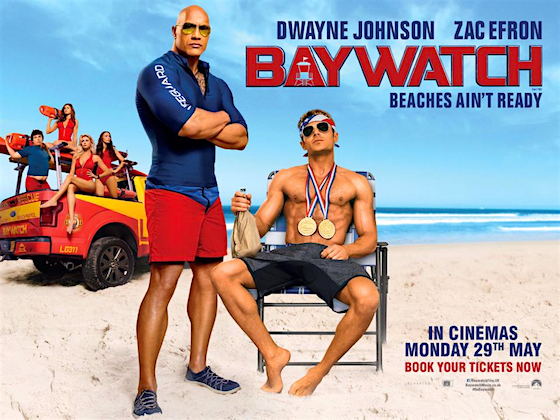
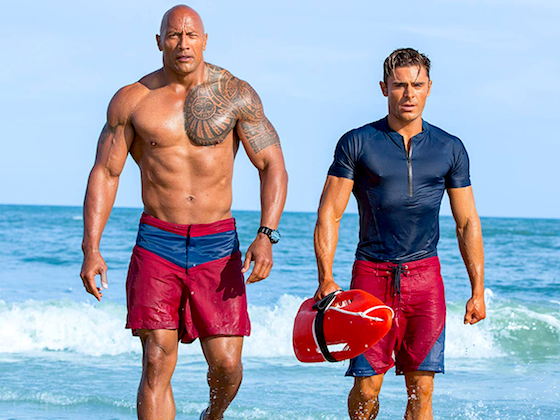
As I say, the stars of the film are Johnson and Efron.

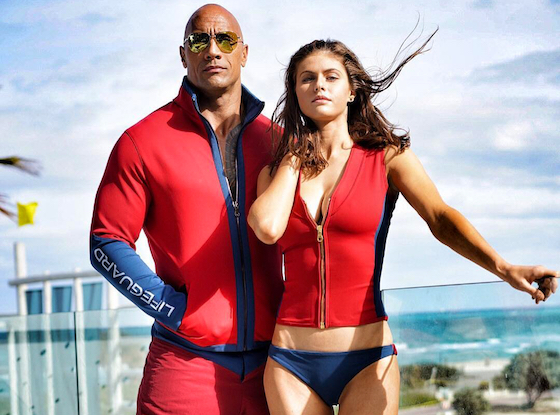
Dwayne Johnson and Alexandra Daddario

Oops, sorry, that’s Johnson with Alexandra Daddario. She’s also in the movie. Um, let’s… let’s try that again…

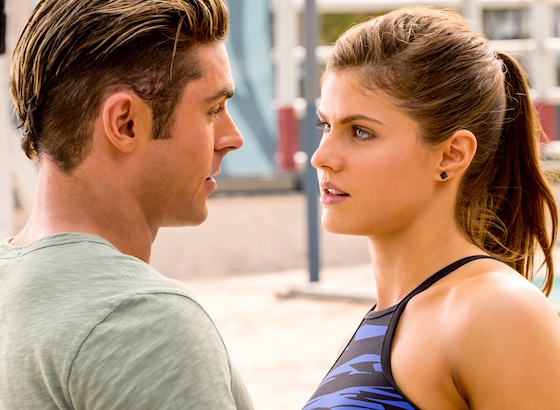
Zac Efron and Alexandra Daddario

Okay, so, now that’s Efron with Daddario. Third time lucky…

My God, just look at that pair of big, beautiful eyes…

No, that’s just Alexandra Daddario.

Keep your eyes on the eyes

Oops, there’s another one.

Oh, this is funny to you?

Yeah, I give up.

Okay, joke's over.

Okay, I’m done now.

As I was saying before, the film makes jokes at the expense of its own plot about lifeguards investigating crime. I presume that kind of plot line is something inherited from the original TV series. There are some more decent jokes at the expense of the original show’s reputation, too. Of course, most of those gags were in the trailer, so if you already saw them there then, well, that’s that. Similarly, someone involved should’ve been told that your big surprise cameos don’t really work as a surprise if the actors’ names are in the opening credits…

Other than that, if you’ve come to this review wondering what differentiates the extended cut (or “extended edition” if you buy it in the UK — why they made that insignificant change on the cover, God only knows), it adds less than five minutes of new material. There’s a full list of changes here if you’re interested in the details. It doesn’t add up to much, but it’s not egregious either. The main highlight is a bitchy line from the villainess when the girls arrive at the party (“You look amazing” “Someone has to”), and Daddario flashing her bra is, shall we say, a bonus. (Did I already mention that Alexandra Daddario is in this movie?) Technically the longer cut is unrated, but there’s nothing in it that wouldn’t pass at an R easily. Heck, ditch a couple of F words and it’d pass at PG-13.

Well that's just gratuitous

Hey, look, a photo that doesn’t feature Alexandra Daddario!

Surprise, it's Alexandra Daddario!

Dammit!

Anyway, as I mentioned in my intro, this got terrible reviews. Terrible, terrible reviews — it has 18% on Rotten Tomatoes, for chrissake! That should’ve warned me off… but… well, I actually thought it was fun. Big, dumb, daft fun. And that’s what I think it’s meant to be, so, really, what’s the problem? It’s not clever and it’s not subtle, but why would you expect it to be? Okay, fair enough: maybe you flat-out don’t enjoy this kind of movie. That’s fine. But for anyone who chooses to watch it with realistic expectations about the kind of film it will be, it delivers what you’d expect in reasonably good fashion.

3 out of 5

DaddarioWatch Baywatch is available on Netflix UK from today.

Teen Titans Go! To the Movies (2018)

2018 #246
Aaron Horvath & Peter Rida Michail | 84 mins | streaming (HD) | 16:9 | USA / English | PG / PG

Teen Titans Go! To the Movies

I don’t think I’d even heard of the Teen Titans Go! animated series until promotion for this big screen version started. Best I could tell, a lot of entitled fanboys hate it — it’s too childish and comical, whereas they’d prefer the ‘grown-up’ seriousness of cancelled animated series Teen Titans — and consequently weren’t at all impressed by it getting the honour of film adaptation. Whatever — I thought the trailer looked funny, and, fortunately, the end product lives up to it.

The Teen Titans are a superhero team made up of erstwhile Batman sidekick Robin, half-robot Cyborg (who, in other iterations, is a member of a certain major-league superhero team), shapeshifter Beast Boy, half-demon sorceress Raven, and alien princess Starfire. After they’re criticised for not having their own movie, the Titans set out to get one made. First step: get an arch-nemesis, for which they target Slade Wilson, aka Deathstroke.

Although ostensibly a children’s series, and therefore presumably a children’s movie, Teen Titans Go is actually full of gags and references aimed at older viewers, without resorting to cheap double entendres or the like designed to fly over kids’ heads, but instead focusing on the wider universe of superhero movies — it has less respect for the fourth wall than a Deadpool movie. It’s often genuinely witty, and burns through plot and jokes at a joyously fast pace (possibly a legacy of its short TV episodes). It also might be the first time I’ve ever seen a fart gag and thought, “that’s actually quite funny and kinda clever (for a fart gag).” That’s a special kind of achievement in itself.

4 out of 5

Teen Titans Go! To the Movies is available on Sky Cinema as of this weekend.

It placed 23rd on my list of The 26 Best Films I Saw For the First Time in 2018.

Samaritan Zatoichi (1968)

aka Zatôichi kenka-daiko

2019 #42
Kenji Misumi | 83 mins | Blu-ray | 2.35:1 | Japan / Japanese | 15

Samaritan Zatoichi

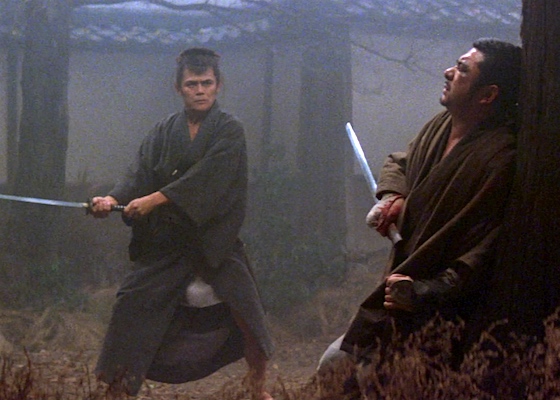
The 19th Zatoichi movie begins with our hero fulfilling some yakuza responsibilities: on the orders of a boss he’s been staying with, Ichi (Shintaro Katsu) is part of a group who try to collect overdue debts from a man. When he refuses to come peacefully, Ichi is forced to kill him. Only then does his sister, Osode (Yoshiko Mita), turn up, and Ichi learns what’s really going on: the debt was just a pretext for the boss to acquire Osode, who’s wanted by a local government official for, you know, the kind of thing corrupt officials want pretty young women for. Incensed, Ichi vows to protect Osode, although she’s not so keen on palling around with the guy who just murdered her brother…

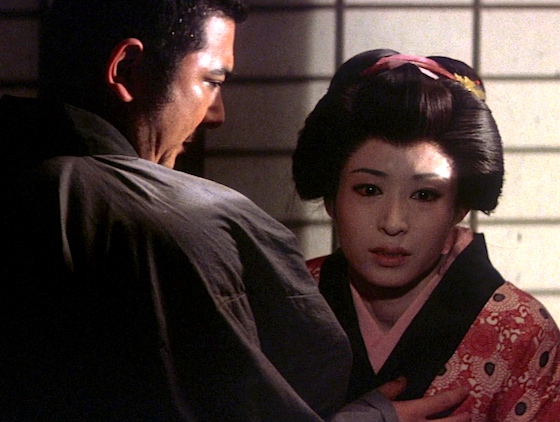
As opening acts go, it’s a strong setup. Okay, it’s similar to ones the series has played before (see Zatoichi’s Pilgrimage), but it finds its difference in the character of Osode. Where most characters quickly decide Ichi is the good guy and get on his side with no regrets, Osode struggles with her grief and her feelings towards the blind swordsman, swinging back and forth between acceptance and, well, not: at one point she gives serious consideration to murdering him and then committing suicide. It feels like a bit more psychological realism than we often get, especially from characters Ichi has wronged, and it’s realised on screen with some effectively different visuals. For example, when Ichi engages in a show of skill at a fairground ball game, Osode is initially as gleefully impressed as everyone, before she comes to realise it’s these skills that allowed him to murder her brother, an event she imagines in starkly-coloured purple/green ‘flashbacks’ as she looks at Ichi with new eyes. It’s a particularly striking departure from the series’ usual grounded visual style (one echoed when Osode has red/blue ‘flash forwards’ to killing Ichi), although the whole film is very nicely shot. Of course, Osode’s ambivalence can’t go on forever: eventually she forgives Ichi and falls in love with him, because she’s only a woman and, in the world of Zatoichi, nothing is more attractive than a blind, tubby, slovenly, rice-guzzling, depressed-by-his-own-conscience, roaming mass murderer.

Grief

Lest you think Samaritan Zatoichi is one of the series’ heavy instalments, fear not, because there’s some quite broad slapstick-ish comedy in counterbalance. The first half of that ball game, for instance, is definitely played for laughs. A later sequence sees Ichi wrapped in reeds to be dumped in the river, but fate gives him a chance to get to his feet, whereupon he engages in a fight with his would-be killers, stumbling around still wrapped up — despite which he still comes out victorious, of course. Ichi also ends up with a sidekick for part of the film, Shinsuke, played by Takuya Fujioka, who was a friend of Katsu and consequently pops up in a couple of Zatoichi films. Apparently he was mainly known for comic roles, which he brings a dash of here, but Shinsuke isn’t entirely useless, nor just played for comic relief, which makes a nice change for the sidekick role.

Other memorable sequences in this instalment include one where Ichi commandeers a horse to catch up with the villains, in which he takes to riding about as well as you’d expect for a blind man (i.e. not very); a dice gambling scene where, in an about turn from every other one featured thus far, it’s Ichi who’s doing the cheating; and a final one-on-one duel that is another classic in a series absolutely filled with them (I mean, how many times in these reviews have I referred to the climactic scene as “one of the best”? It must be a pretty long list at this point.) What’s different this time is how much of a challenge it is for our hero. According to IMDb trivia, it’s the longest one-on-one duel of the series, lasting 2 minutes 14 seconds, which feels like an eternity next to the mere seconds it usually takes Ichi to defeat a solo foe. It’s set as dawn breaks on a new year, and the drums at a nearby shrine begin to pound to mark the occasion, so loudly that they impair Ichi’s senses and, therefore, abilities. The film’s original title translates as something like Zatoichi Fighting Drums, and here we see why. Combining a duel that’s more protracted than usual with a thumping score courtesy of those drums, the finale feels like an epic confrontation… even if the fight’s happening for very little motivation.

Ichi struggles

And here we reach what’s wrong with Samaritan Zatoichi: despite an initial clean and clear setup, the plot gets a bit scrappy. Much of it is driven by the yakuza boss desperately pursuing Osode to please the government blokey, but it turns out he’s actually not that bothered about her. The boss doesn’t believe that, so he wastes time continuing to pursue Osode; but no, government blokey meant it, and it winds up with him not awarding a contract to the boss. Despite that, the boss continues to pursue Osode… Just Because, I think? Or maybe we’re supposed to take it he’s really after Ichi at that point? Other contrivances occur just to keep the plot rolling, too (at one point Osode sets off without Ichi — again, Just Because — which leads to a whole heap of trouble), and I wasn’t joking when I said the final ronin has little motivation: he seems to decide to pick a fight with Ichi just for shits and giggles.

But if you don’t worry about logical character behaviour too much, there’s an awful lot to enjoy in Samaritan Zatoichi. Such niggles hold it back from being amongst the series’ very best instalments, but there’s much else to recommend it, including likeable supporting characters, great fight scenes, and various other memorable set pieces.

4 out of 5

Resident Evil (2002)

The 100 Films Guide to…

Resident Evil

Survive the horror

Also Known As: Biohazard (in Japan — the film uses the original title of the game it’s based on in the country it originated from, appropriately enough.)

Country: Germany, UK, France & USA*
Language: English
Runtime: 100 minutes
BBFC: 15
MPAA: R
* The end credits call it “a German/British co-production”. IMDb adds the other two.

Original Release: 15th March 2002 (USA)
UK Release: 12th July 2002
Budget: $33 million
Worldwide Gross: $102.98 million

Stars
Milla Jovovich (The Fifth Element, Hellboy)
Michelle Rodriguez (The Fast and the Furious, Avatar)
Eric Mabius (Cruel Intentions, The Crow: Salvation)
James Purefoy (Mansfield Park, Solomon Kane)

Director
Paul W.S. Anderson (Event Horizon, AVP: Alien vs. Predator)

Screenwriter
Paul W.S. Anderson (Shopping, Death Race)

Based on
Resident Evil, a video game by Capcom, directed by Shinji Mikami.


The Story
After a virus kills all the employees at the underground research facility of Umbrella Corporation, a team of commandos are sent in to contain the outbreak. But to do that they’ll have to fight the facility’s megalomaniacal supercomputer, plus all the employees, who aren’t exactly dead after all…

Our Hero
Alice wakes up in her mansion with total amnesia… but soon a bunch of military operatives are whisking her along into a life-or-death situation, which it turns out she’s equally trained for herself.

Our Villains
The undead! Hordes of ’em, as always. Plus an evil supercomputer who controls the entire facility and speaks with the voice of a little girl, because why not. Oh, and we know someone deliberately released the virus — could they now be part of the team investigating the facility? Hmm, I wonder…

Best Supporting Character
Rain is just one of the commandos, but, as played by co-billed Michelle Rodriguez, she gets the lion’s share of the best lines. (I mean, the dialogue is hardly sparkling, but what good lines there are, she gets. Maybe it’s all in the delivery.)

Memorable Quote
Rain: “All the people that were working here are dead.”
Spence: “Well, that isn’t stopping them from walking around.”

Memorable Scene
With the team separated, Alice is exploring the facility alone and comes across some empty animal cages… and, shortly thereafter, the dogs that used to live in them… who are now zombie-dogs out to eat her, obviously. It’s mainly memorable for this bit:

Memorable Music
The score, co-credited to habitual genre composer Marco Beltrami and Goth rocker Marilyn Manson, was explicitly influenced by John Carpenter’s early electronic work, albeit given a very ’00s techno/rock spin by Manson.

Letting the Side Down
There’s so much stuff some would put in this category, but the main jarring point is some middling ’00s CGI. It’s not outright bad (like, say, the Rock-scorpion-thing in The Mummy Returns), but it definitely shows its age.

Previously on…
The first Resident Evil video game was released in 1996. The film is more “inspired by” than adapted from it. Multiple sequels to it came out before the movie finally hit the big screen, and even more have followed since, not to mention various spin-off novels, comics, animated films, and other stuff, like a themed restaurant in Tokyo.

Next time…
Five sequels followed over the next 14 years. Before the series-concluding final film had even made it to home media, a reboot was announced. That’s gotta be some kinda record, even for Hollywood.

Awards
2 Saturn Award nominations (Horror Film, Actress (Milla Jovovich))
3 Golden Schmoes nominations (Most Underrated Movie of the Year, Horror Movie of the Year, Best T&A of the Year — you might read that last category and think “only in the ’00s!”, but I checked and they still award it today)

Verdict

Writer-director Paul W.S. Anderson has managed to sustain a lasting career out of making movies no one seems to really like. With a CV full of video game movies (Mortal Kombat, multiple Resident Evils, the forthcoming Monster Hunter), and B-movie do-overs (Death Race) and emulations (AVP), he’s a bit like a bigger-budgeted, less-objectionable version of Uwe Boll (remember him?). Anyway, the first Resident Evil is actually one of his better efforts. I’ve never played any of the games so have no idea of its faithfulness (“not very” is my impression), but Anderson took inspiration from early John Carpenter movies to create a lean action/thriller/horror flick (again, leaning into those B-movies), which drives the viewer from set piece to set piece with quickly-sketched characterisation (or, in many cases, none at all) and a mysterious backstory to be uncovered. It’s no masterpiece, but it’s a solid 90-minutes-and-change genre fix.

Skyscraper (2018)

2019 #35
Rawson Marshall Thurber | 102 mins | download (HD+3D) | 2.40:1 | USA / English, Cantonese & Mandarin | 12 / PG-13

Skyscraper

If you were to describe a movie as “Die Hard in a building, from the director of Dodgeball”, you’d expect some kind of spoof. Not unreasonably: “Die Hard in an X” is (or was) a fairly common movie pitch, but the original is set in a building, so clearly someone’s making a joke (it’s me! And also everyone else who used this line to describe Skyscraper); and Dodgeball is, well, a comedy. Combine the two and you’ve definitely got a parody movie… right? Turns out, no.

That said, Skyscraper certainly owes a debt to its genre predecessors. It stars Dwayne Johnson as a security consultant employed to okay the world’s new tallest building for its imminent opening. When a group of terrorists break in and set the building on fire, endangering not only the rich dude behind the building’s construction but also Johnson’s family, it’s up to our guy — who used to be in the military or SWAT or something, I forget — to save the day. Plenty of running and jumping ensues, as you well know if you’ve seen that poster that went viral as people tried to work out if the angles add up. Unsurprisingly, they didn’t.

Beat THIS, Alex Honnold

That jumping scene does actually occur in the film, though. Does he make it? You guess. Does it make any more sense on screen? Eh, who knows? Frankly, who cares? Skyscraper is not a movie overly concerned with realism. Or originality. It’s not just the obvious stuff nabbed from Die Hard and/or The Towering Inferno (I’ve never seen the latter, but it’s been cited as an influence) — tropes and clichés abound. If you’re in a miserable mood, the endless parade of familiarity will likely frustrate any viewer. Conversely, if you’re in a forgiving frame of mind, it executes them at least as well as any other derivative action-adventure blockbuster.

The film doesn’t acknowledge or spoof these glaring rip-offs — as I said, it’s not actually a parody — but I think everyone involved was aware that it’s all a bit silly. Or maybe I’m being kind. Maybe I think the film is so obviously silly that I can’t believe they meant it to be read seriously. Either way, it’s at least as daft as you’d expect it to be, but that means it’s pretty fun if your expectations are right. It’s an undemanding 90-minutes-or-so of derring-do, where the scenarios are so extreme and OTT they can’t elicit much tension, but occasionally achieve a modicum of suspense nonetheless. And as so much of it is about doing things at great distances above the ground, it’s highly effective in 3D. One near-miss moment even made me gasp, so it was obviously doing something right with its sense of jeopardy.

3 out of 5

Skyscraper is available on Sky Cinema from today.