2025 Statistics!

Here we go, people! It’s happening! Iiiiiiit’s… the statistics! (People cheer, fireworks explode, dogs and cats live together, etc, etc.)

But… before the onslaught of numbers and graphs begin, a reminder that these stats cover my first-time feature film watches from 2025, as listed here. Shorts and rewatches are only factored in when expressly mentioned. Also, as a Letterboxd Patron member, I get a yearly stats page there too. The numbers will look different because I also log (some) TV, and it factors in shorts and rewatches more thoroughly — but that’s all part of what makes it worthwhile as an addition to this post. Plus, it includes some interesting things that I don’t, like my most-watched and highest-rated stars and directors. More stats are always good, right?

Speaking of which, for the first time since 2018, this post includes a new graph. Oooh! What could it be?! Well, it’s a special and unusual one — not necessarily one I’ll include every year going forward (though, hey, never say never), but something that speaks to this year in particular. It’s coming up relatively early on, so you won’t have to endure my crypticness for too long.

But I know you’re really champing at the bit to get started after that revelation, so let’s crack on…


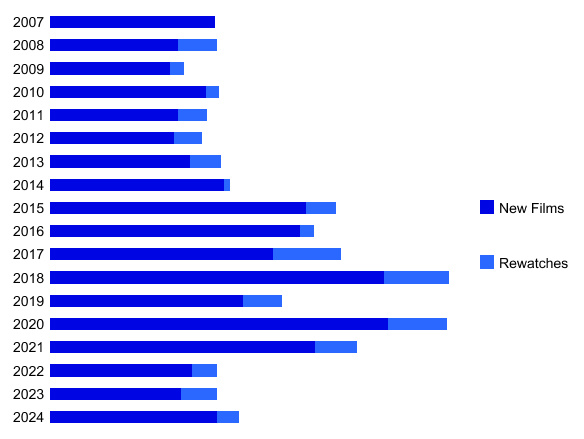
I watched 116 feature films for the first time in 2025. That’s down on 131 from last year, but up on every other year since my relaunch in 2022 (and it’s massively down on the years before that, hence treating the relaunch as some kind of cutoff). Overall, for size it ranks 12th out of all 19 years.

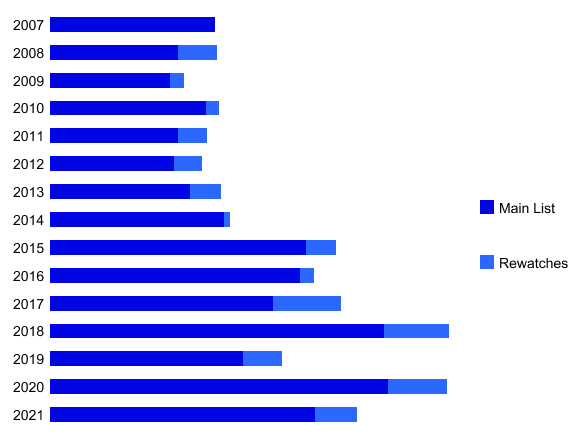
Of those 116, 88 counted towards my 100 Films in a Year Challenge. I did complete my Challenge this year (check out the Final Standing post and December review for more on that), with the remainder being 12 rewatches. That was all of my rewatches this year though, my lowest total in a decade — no wonder it was after that year (2016) that I started to make a conscious effort to rewatch stuff. Do I need to make even more of an effort, or is the 12 required by the Challenge an adequate amount? Something I’ll think on.
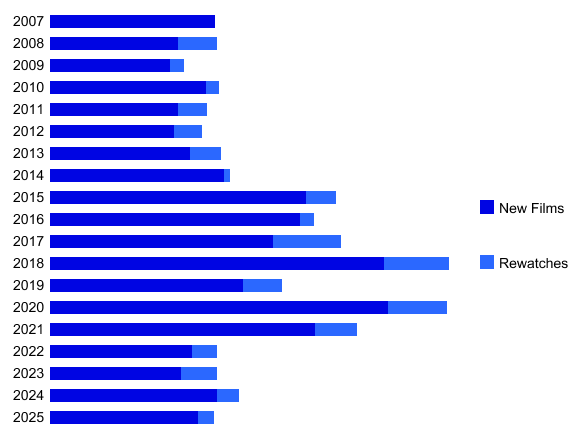

NB: I have no rewatch data for 2007 and incomplete numbers for 2008.

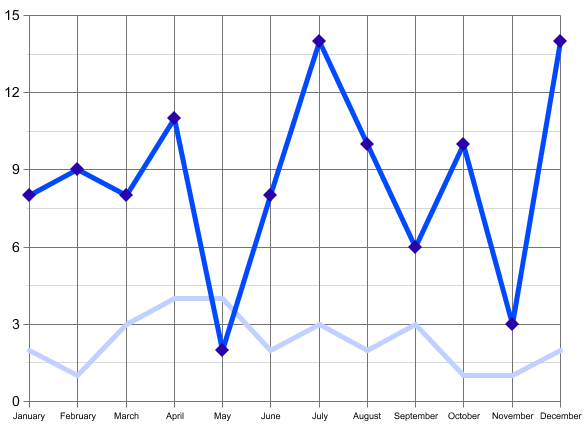
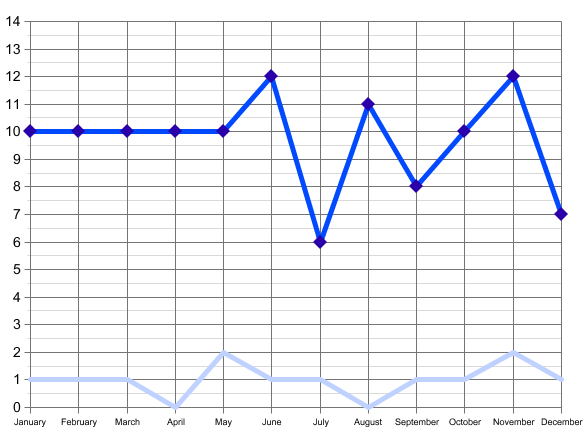
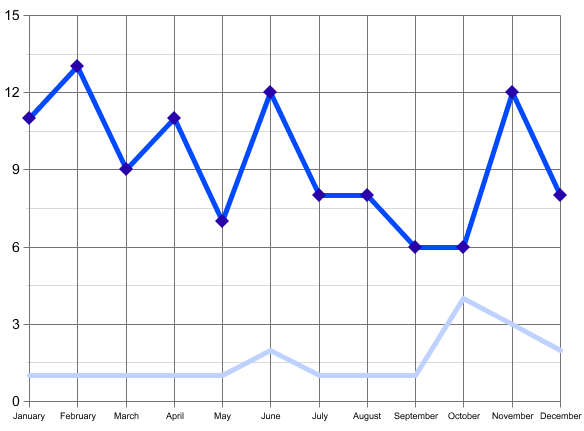
Here’s how that viewing played out across the year, month by month. The dark blue line is my first-time watches and the pale blue is rewatches. As you can see, things started out nice and flat, hitting my ten-films-per-month minimum goal consistently, but then it goes kinda crazy. I’m not sure there was a specific reason why. It would be nice to see no months dropping below that ten line, though, and more spiking above it wouldn’t hurt.
I also watched six short films. That’s thoroughly unexceptional: not my worst year; far from my best; down quite a lot (relatively) on the last two years. Of course, I don’t make a specific effort to watch shorts — if I did, I’m sure they’d be higher. Maybe I should? Maybe it’s not worth it?

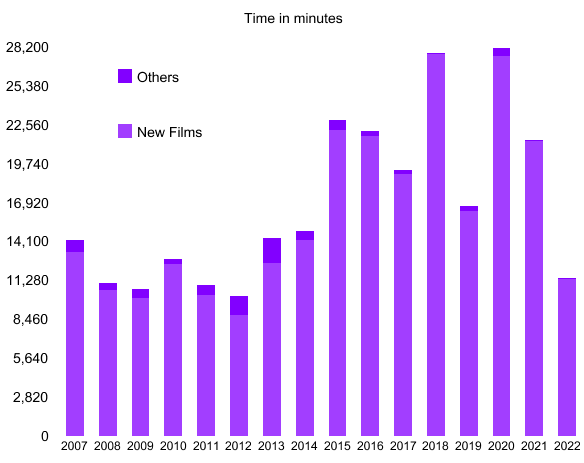
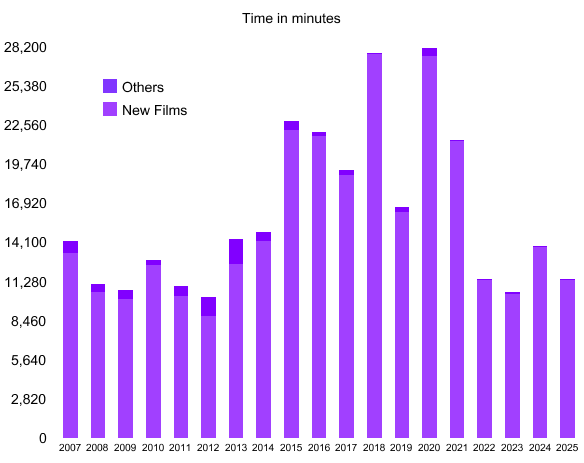
The total running time of my first-watch features was 189 hours and 35 minutes. That places the year 13th overall. It’s unusual for the running time position to not match the film total position, which suggests I overall watched shorter films this year. Thinking back over the kind of films I chose to watch and how I made decisions (a lot of “what can I squeeze in?”), that doesn’t really surprise me. If anything, it surprises me that it doesn’t happen more often… although, if I do that every year, it wouldn’t change anything in comparison, so maybe it’s not surprising. Add in the shorts and that rises by just under an hour-and-a-half, to 191 hours and 3 minutes. (The additional bit is labelled as “other” on the graph because it used to include alternate cuts of features that I watched for the first time but didn’t count towards the main tally. It’s been many years now since there were any, but I’d have to go back and recalculate most a dozen or more recorded years to make this shorts-only.)
One thing I’ve noted in a couple of monthly reviews throughout 2025 is how much time I’ve spent on specific non-film things — primarily, watching Critical Role (although that began, and was even more prevalent, in 2024) and playing Skyrim. So, I thought it would be fun to throw in a new graph for comparison purposes: how much time I spent watching films (for this graph I’ve also added in the 12 rewatches), how much time I spent watching Critical Role content (main campaign episodes, miniseries, one-shots, and chat shows like Talks Machina and Cooldown), and how much time I spent playing Skyrim (which, importantly, is just for two months, because I only started it in early November).
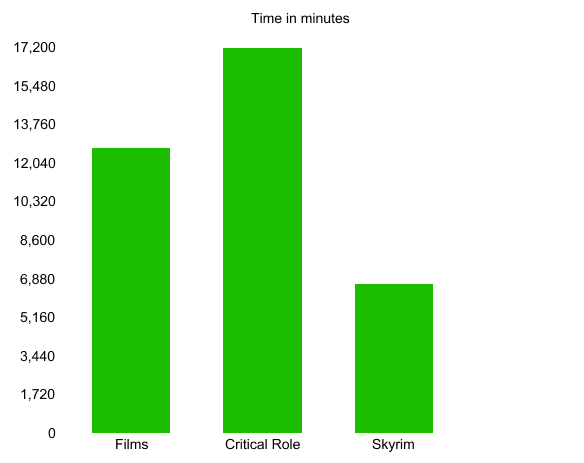
But what if those two months of Skyrim had been the same for the whole year? Well…
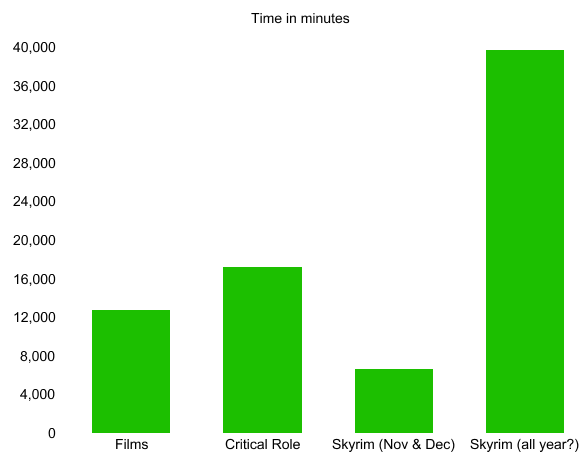
Well, crikey. Is that what 2026 will look like? Will I really play another 660+ hours of Skyrim? I doubt it… but you never know: there are reported playtimes that surpass 725 hours, and that’s just people who’ve bothered to log it on HowLongToBeat. And even if it’s not Skyrim, I feel like I’ve caught the bug of playing big open-world RPGs, of which I already own several more. It might seem silly to call a games console “life changing” but, well, getting a Steam Deck has certainly changed what I spend large chunks of my life doing.

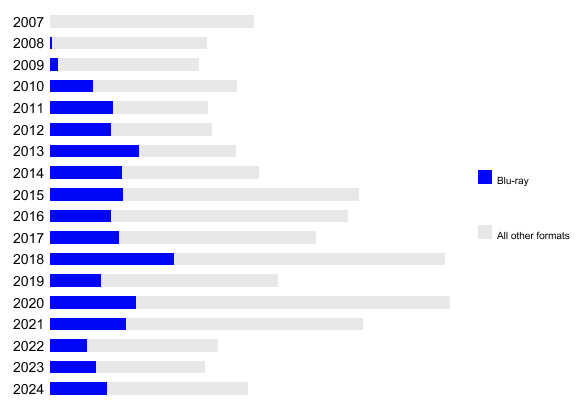
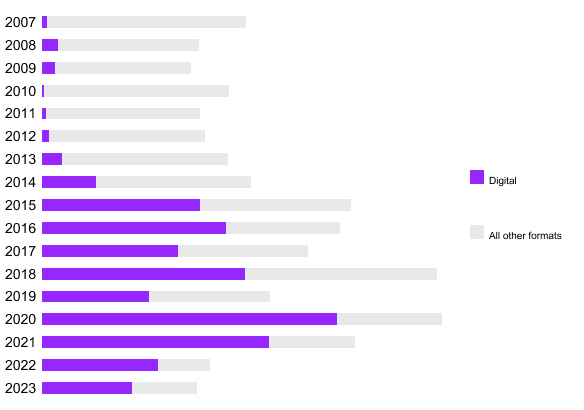
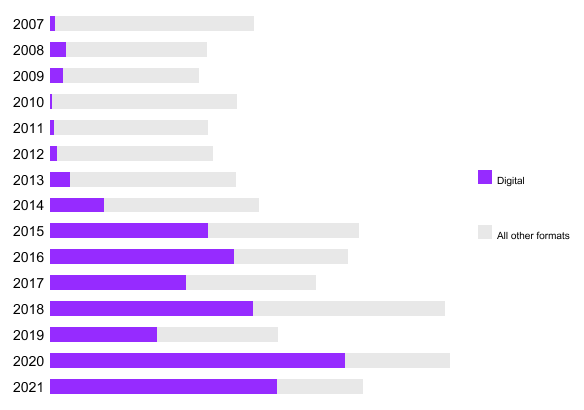
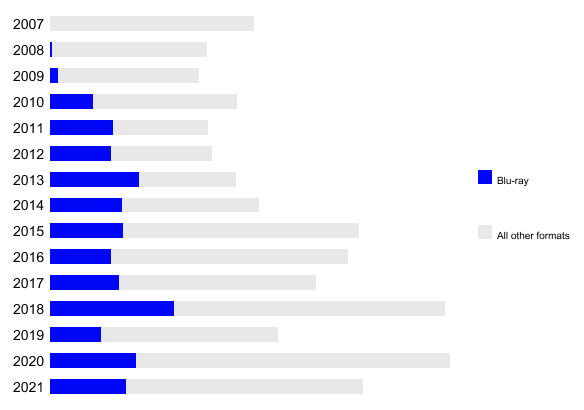
Alright, let’s shift the focus back to films, but sticking with technology: the ways in which I watched those films. For one brief, glorious moment I thought Blu-ray was finally the victor in this category (it last topped it in 2014)… then I counted streaming properly and it just had the edge. And then I remembered that nowadays I combine streams and downloads into digital, which wins easily with 60 films. I realise this is the end result of my own viewing choices, not some external fact I can’t control, but I watch what I want to watch where I can currently get it, and the convenience of streaming clearly wins out too often (not to mention streaming exclusives. I mean, if I waited for disc to watch Wake Up Dead Man, there’s a high chance I’d never ever see it). Anyway, digital sits at its lowest percentage (51.7%) since 2019, which was the last time it was below 50%, so maybe next year.
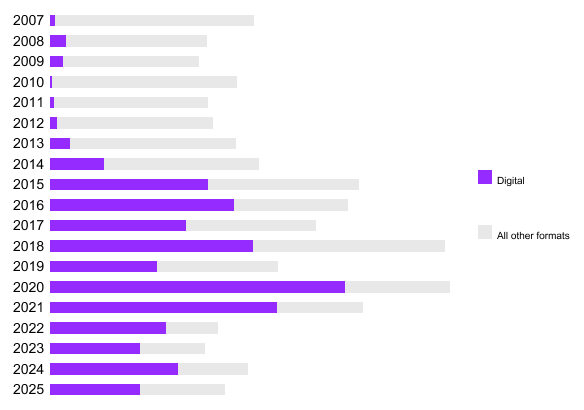
As noted, “digital” encompasses multiple different platforms and methods. The top one this year was Amazon Prime Video with 15 films (25% of digital), knocking downloads into a close second with 14 films (23.3%). That means the otherwise-ubiquitous Netflix charts third with 11 films (18.3% — or just 9.5% of all first-time watches), with NOW next on seven films (11.67%), and the numbers rounding out with Disney+ on four (6.67%), iPlayer and Tubi on 3 apiece (5%), YouTube on two (3.3%), and one from MUBI (1.67%).

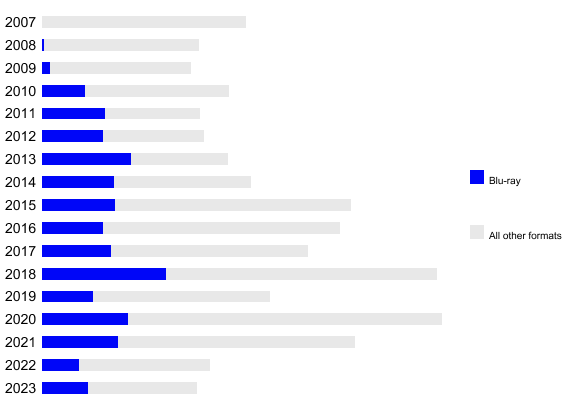
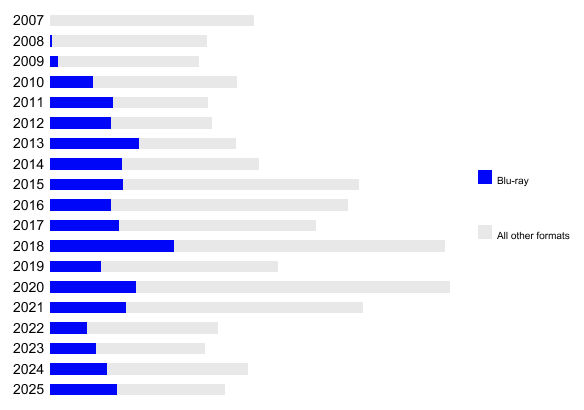
In overall second place was Blu-ray, with its 45 films (38.8%) representing the format’s highest number since 2021 and best percentage share since 2013. I’d say that’s something to build on, but I know from experience that what happens one year rarely has any bearing on the next.
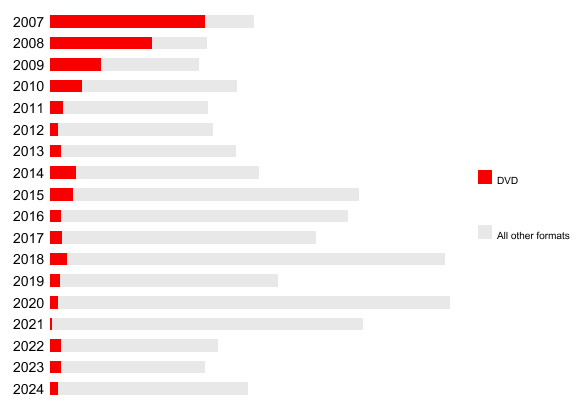
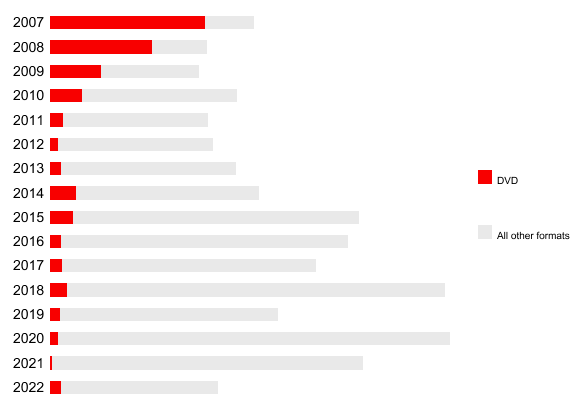
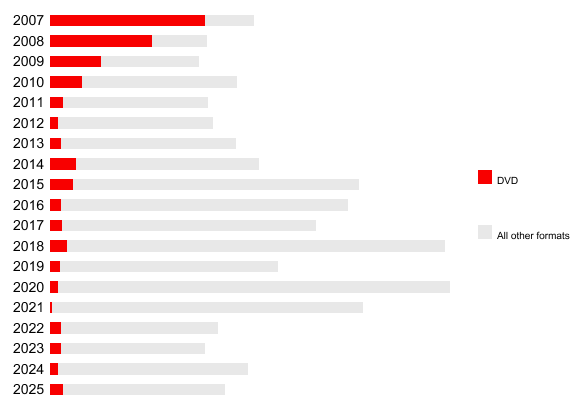
DVD saw a slight uptick this year, totalling nine films (7.8%), which is close to the figure from 2022 and 2023. It hasn’t been in double figures since 2018, and hasn’t been above 10% of my viewing since 2014, so the less I think about how many hundreds of them I have unwatched, the better.
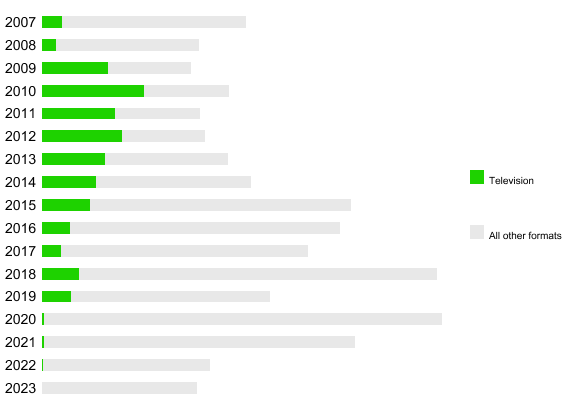
After popping back into contention with one film last year, TV’s disappeared again. I hardly watch anything on live TV fullstop nowadays — even when something’s on the BBC, I’m more likely to catch up with it on my own schedule via iPlayer — so no surprise I don’t watch any films that way anymore. If you’d still like to see a graph, there’s one in last year’s stats.

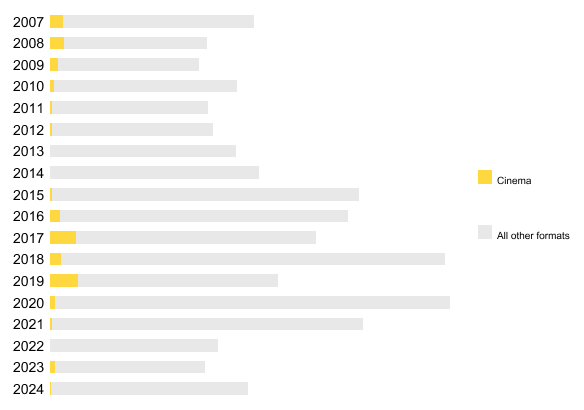
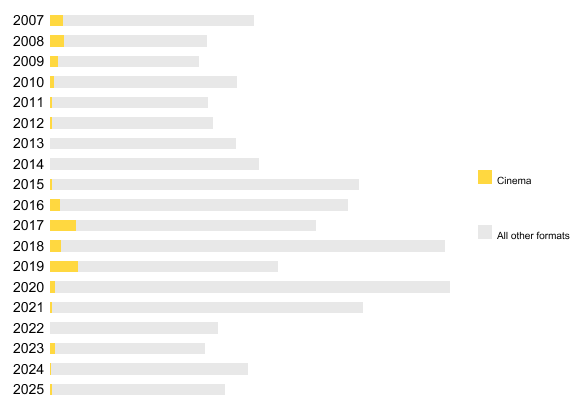
Instead, let’s move on to the final format left with something to actually record: cinema. I doubled my cinema trips this year… to two. Those would be a theatrical-only release of the filmed version of the stage production of Macbeth starring David Tennant, and the final Mission: Impossible movie. And, to be honest, very little else even tempted me to consider heading out to the cinema. Am I a bad film fan? Was everything this year that uninspiring? I’m not sure. Either way, I’m certainly not going to attempt any kind of commitment to improve that going forward.
Sticking with formats for a minute, first the disappointing news that I only watched 2 films in 3D. We can debate the death and decline of the format all you want (no one’s trying to claim it’s not well past its zeitgeist, but a lot of big movies still seem to get 3D versions theatrically), but I have plenty of discs unwatched, so I ought to make an effort to pump those numbers up.

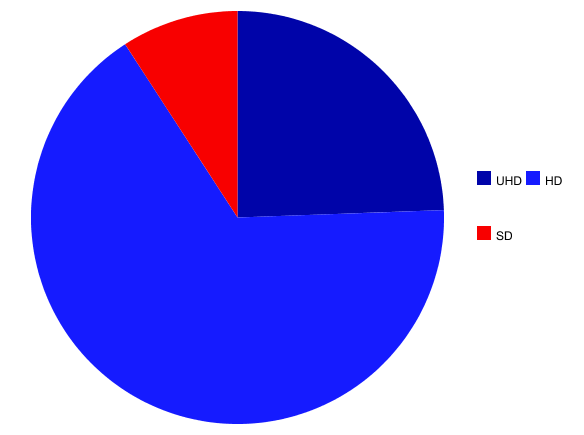
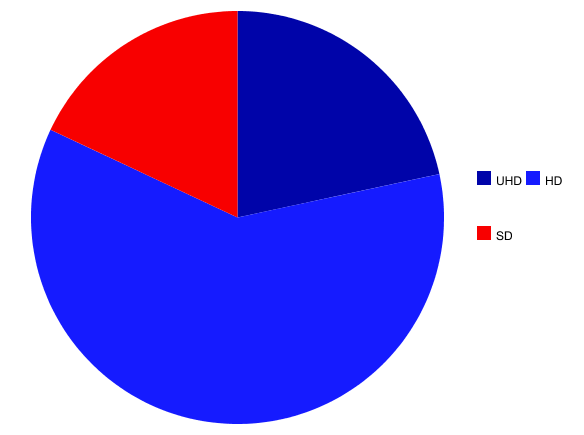
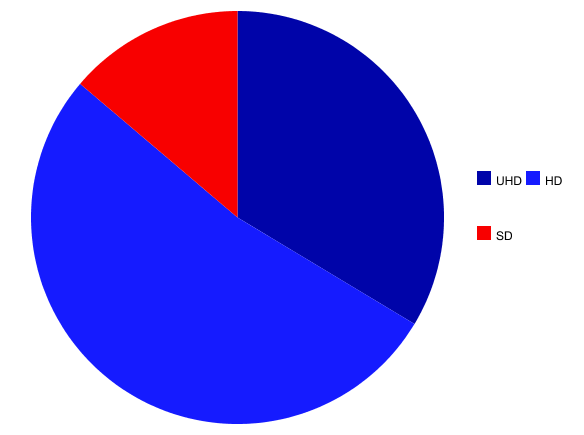
A different ‘future of home viewing’ format is having opposite fortunes: this year, 39 of the new films I watched were in 4K Ultra HD. At just over a third of my total viewing — 33.6% to be precise — it’s its strongest year yet. Still, 1080p HD remains the standard, at 61 films (52.6%), while SD somehow clings in there with 16 films (13.8%). As much as it might seem like “everything’s HD nowadays”, DVD was a far bigger and more diverse format than anything else (bigger than Blu-ray, certainly, and more diverse than streaming offerings, certainly), so — despite all the random stuff that gets 4K upgrades nowadays — of course there’s a lot out there stuck in SD quality, and perhaps always will be. Unless you exclusively watch new releases, SD’s going to be a fact of viewing for a long time yet; perhaps forever.
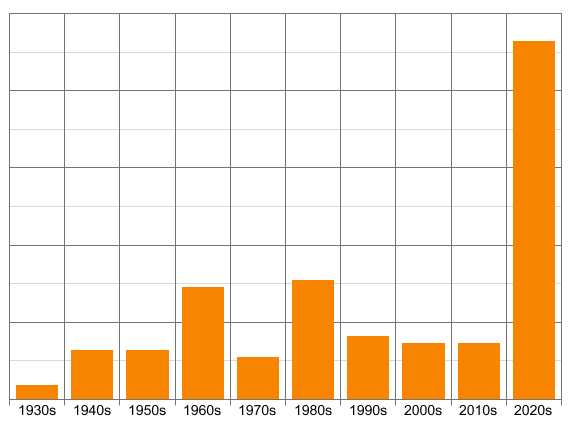
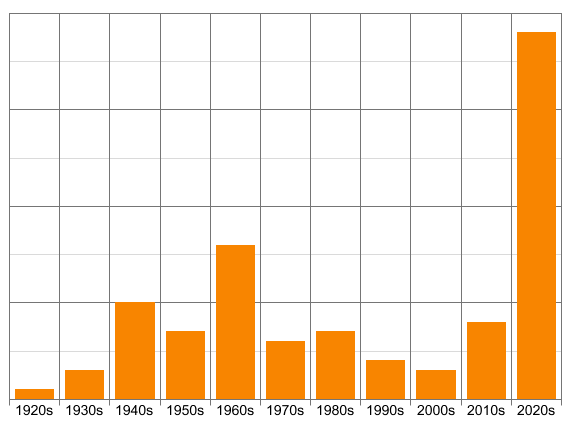
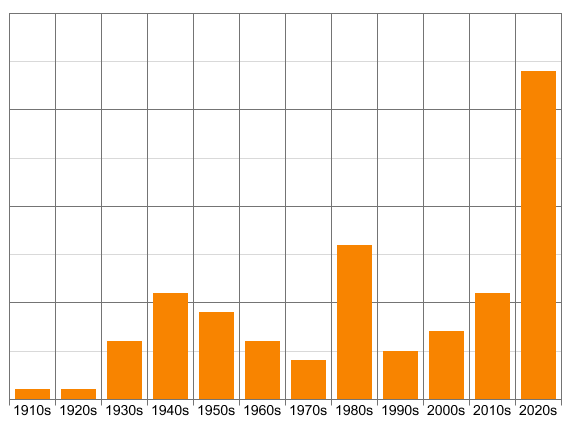
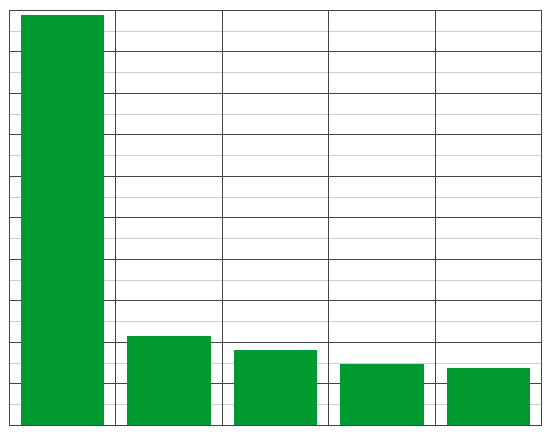
Moving on to time now, and in 2025 I watched something from every decade since 1900 for the first time since 2022. Okay, the 1900s were only represented by a single short film, but there weren’t any features that decade anyway. At the other end of the spectrum, the top decade was — as usual — the current one, i.e. the 2020s, with 33 films (28.45%). That’s actually the lowest percentage for the current decade since 2021, when they were still beaten by the 2010s (which also had a lower percentage — they kind of split the ‘recency’ that year).

Rather than a single other period coming close, it seems my viewing has been spread around, because second-place the 1970s had under half as many films, 16 (13.8%). Right on its tail is the ’60s with 15 (12.9%), and not far behind that is the ’80s on 13 (11.2%).

Only then, in fifth place, do we finally find the 2010s, with 10 films (8.62%), while sixth place is a three-way tie between the 1920s, 1990s, and 2000s, each with (appropriately enough) six films (5.2%). Rounding things out are the 1950s on five (4.3%), the 1940s on three (2.6%), the 1930s on two (1.7%), and the 1910s on one (0.9%).
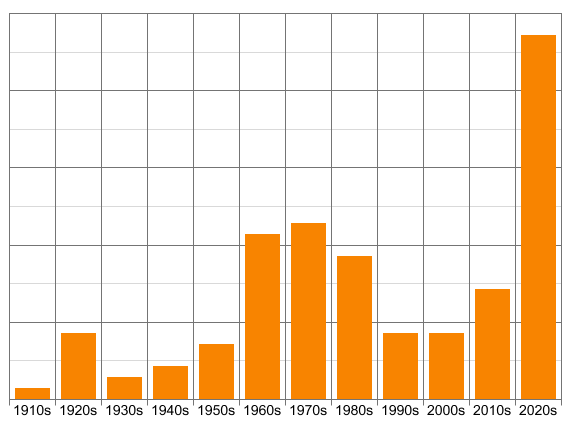
Honestly, I’m almost surprised the 2020s remain so high, considering how few new films it feels like I’m watching; although, as it’s less than a third overall, I guess that still makes sense.

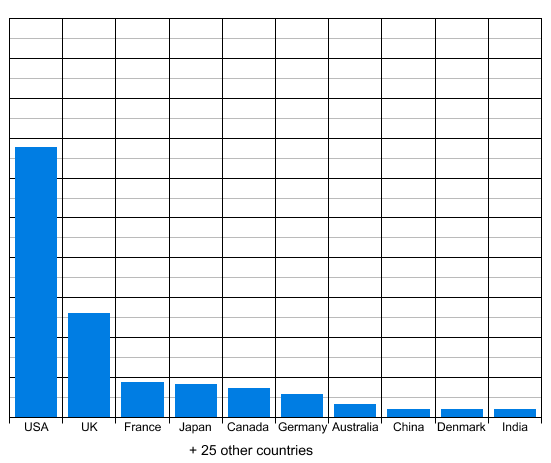
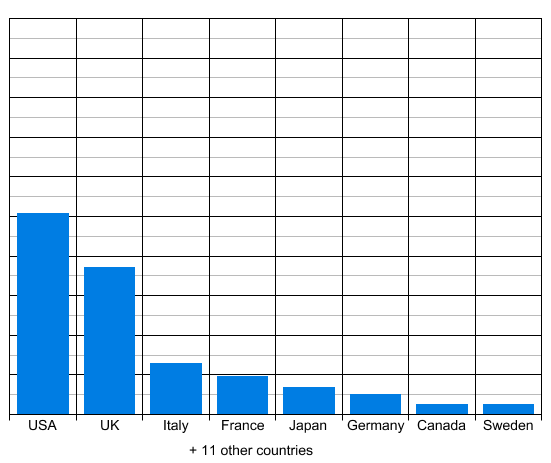
Unfortunately, such upending of norms (okay, maybe that wasn’t an “upending”, but tweaking) doesn’t extend to countries of production, where the USA dominates as always with 59 films, aka 50.9%, which sees it slip back above 50% after dropping below it for the first time last year. Still, that’s its second-lowest percentage since I began recording this, so that’s something… although, on the other hand, the total of 19 countries is down from 31 last year. You win some, you lose some.

Another for the former camp was good old Blighty, with the UK hitting its highest percentage yet at 37.1% from 43 films. All those poliziotteschi I watched for the Challenge helped Italy overleap France for third place, with a total of 15 films (12.9%), although our Gallic cousins still came fourth, with 11 films (9.5%). Continuing down the chart we find Japan on eight (6.9%), Germany on six (5.2%), Canada and Sweden each with three (2.6%), and Australia, Hong Kong, and Spain on two (1.7%) apiece, before eight further countries each have one film (0.9%), the sole total newcomer to my viewing history being Uganda.
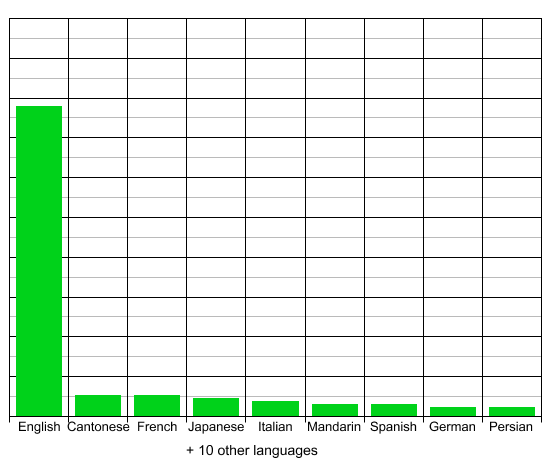
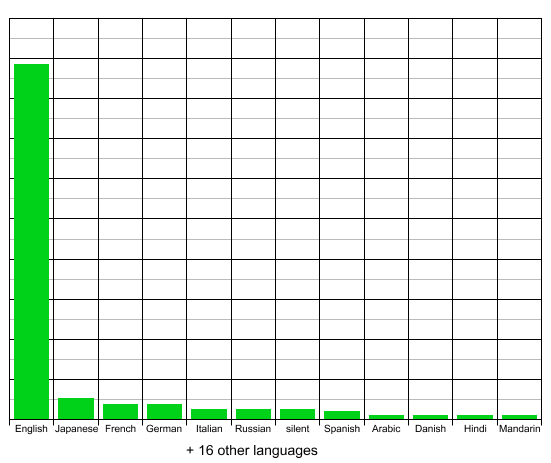
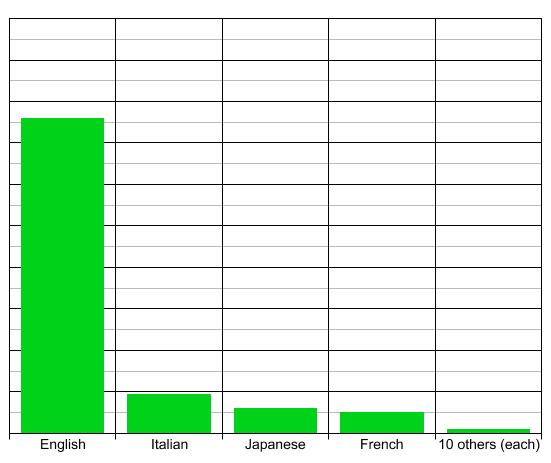
Unsurprisingly, English remains unassailably dominant for languages, featuring significantly in 88 films (75.9%) — although, as it’s only ever dipped below three-quarters once before, getting almost that low isn’t a bad result. A distant second was Italian with 11 (9.5%), those poliziotteschi once again helping to rearrange the usual rankings. The only other languages represented in multiple films were Japanese in seven (6%) and French in six (5.2%). There were 10 other languages in one film each, with uncommon ones for my viewing including Finnish, Irish Gaelic, Luganda, Norse, and Welsh.
A total of 101 directors and seven directing partnerships helmed the feature films I watched in 2025, plus one film with no credited director of any kind. For the first time in three years, two of those directors helmed more than two films: top was Fernando Di Leo with four (all poliziotteschi), followed by Tatsuya Oishi with three (the Kizumonogatari trilogy). The other directors with multiples (two apiece) were Alfred Hitchcock and (for the second year in a row) Robert Tronson (both being entries in the Edgar Wallace Mysteries series, same as last year).

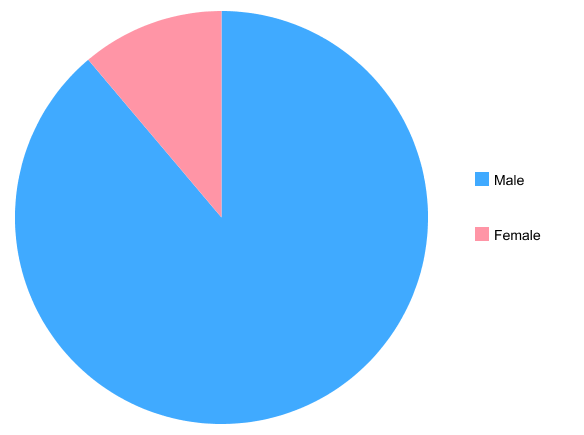
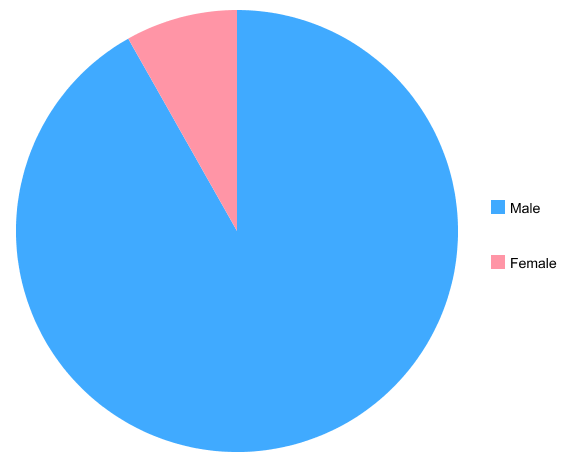
As for women, this year I watched 11 films with a female director, which, when you adjust for those co-directed with a man, comes to merely 8.2% of my viewing — up from last year, and a lot better than it was when I started tracking this in the mid-2010s, but still not great. Indeed, on a percentage basis, it’s my third best year (2020 and 2023 managed to nudge above 11%). I’ve said it before, but it bears repeating every year: I neither avoid nor seek out female directors; I just watch the films I watch and see what number comes out at the end. The industry, undoubtedly, still needs to do more. I hope this graph will continue to improve in the future; but you can’t change the past, so as someone who watches a lot of older films, I can’t imagine it will ever reach 50/50.
Last year, I made furthering my progress with the IMDb Top 250 part of my Challenge. I did make solid progress, but not enough to get it completed: by the beginning of January 2025, I still had ten films left. Sadly, I can’t say I kept up that momentum, as only one film from my 2025 viewing appears on the chart at time of writing — The Wild Robot at 181st. And because that list is ever-changing, the number I have left to see has actually gone up, and now sits at 15. It’s kind of frustrating, but also indicative of the fact that the list of ‘great movies’ is never truly set in stone.

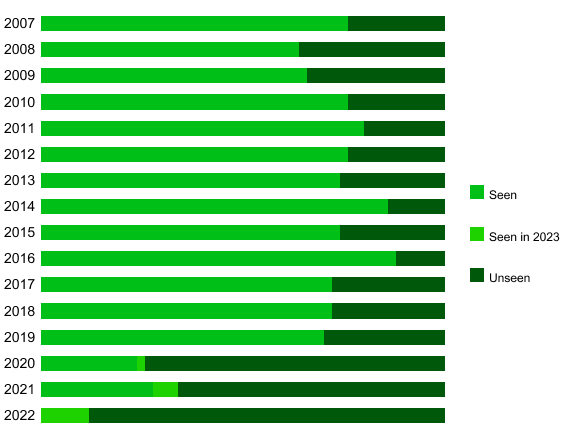
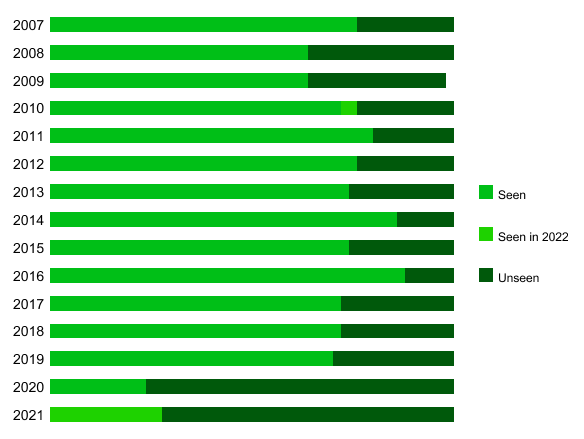
Another mediocre effort at progressing lists comes as we turn our attention to the “50 Unseen”, the list I publish each year of 50 notable films I missed from that year’s new releases. I’ve continued to track my progress with all of those lists as the years have passed, and in 2025 I watched 14 films across all 18 lists. That’s up from 10 last year, but doesn’t match the 20 from the year before, which was already one of my weaker years (I didn’t have the heart to see how this year compared further back). Those 14 were quite spread around amongst the various years, with the single largest being six from 2024’s 50, i.e. last year’s list. That means 2025 ties with 2023 as the second-worst ‘first year’ ever, the one time I’ve done worse being the pitiful four I watched in 2009 from 2008’s list.
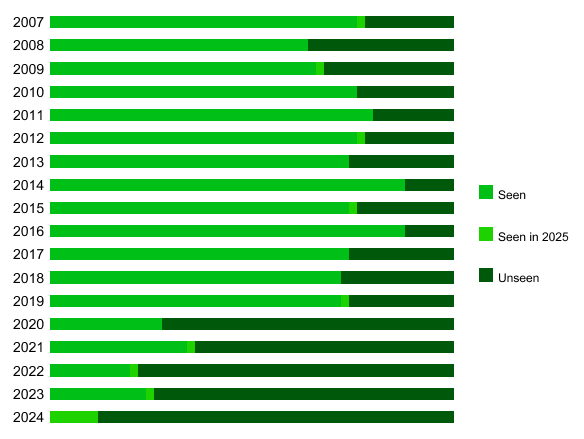
In total, I’ve now seen 557 out of 900 ‘missed’ movies. That’s 61.9%, continuing the decline this has been experiencing since 2022 — it’s one negative side effect of my new Challenge, because I used to pay a fair amount of attention to these, whereas now my focus is on Challenge-qualifying films, where “50 Unseen” titles make up only one ten-film category. The ability to switch around what’s included in the Challenge is within my power, of course, but to get these back above 70% (where it sat from 2018 to 2021) I’d have to watch 108 of them, so even if I wanted to let it take over my entire 100-film Challenge (which I don’t, really) it still wouldn’t do the job. Oh well. (As usual, the 50 for 2025 will be listed in my “best of” post.)

And, before you know it, we’ve reached the end! Well, the climax, at any rate — the final set of stats. I’m talking, of course, about the scores.

As you may have noticed, I didn’t post a single film review in 2025, but I scored every new film I watched nonetheless. That does mean my precise ratings are flexible until I lock them in by posting a review. Most will still say the same, but there are plenty of films I awarded a half-star on Letterboxd, and as I insist on rounding to a whole star for the blog, some of those have the potential to shift in the other direction (because a half-star doesn’t mean it should automatically round up. I mean, it might’ve already been rounded from, say, 3.3 to 3.5, right? But I really don’t want to start getting that granular with my ratings). Anyway, for the sake of completing these stats, I’ve assigned a whole-star rating to every film, and while it’s theoretically possible I’ll change my mind when I eventually post a review, I’m sure this section will remain broadly accurate.

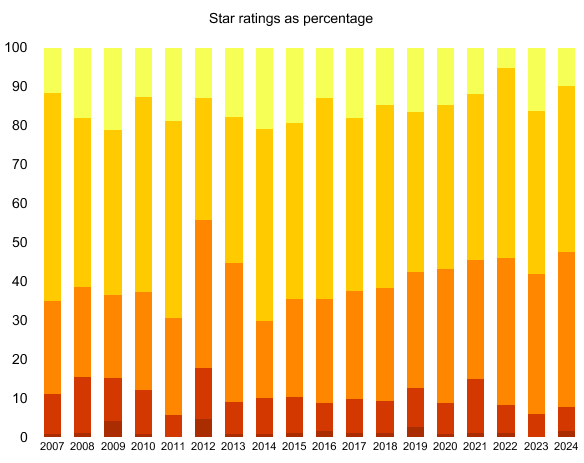
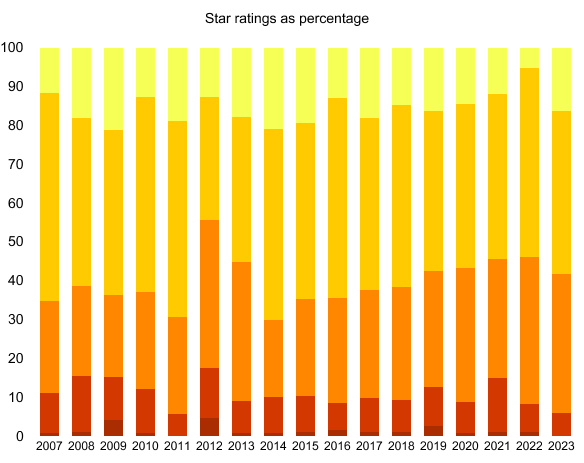
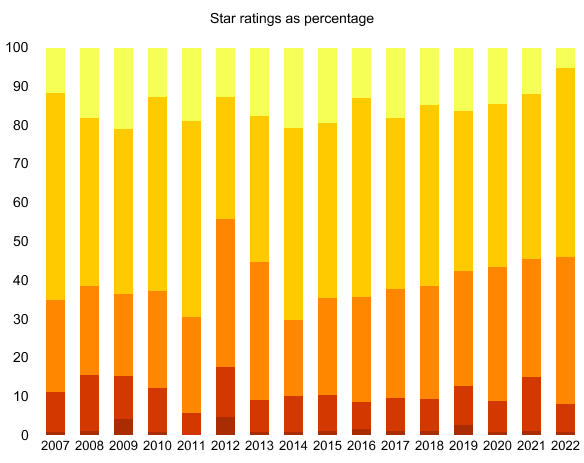
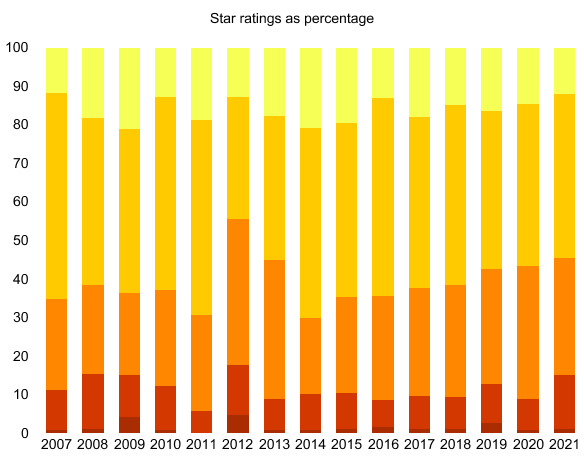
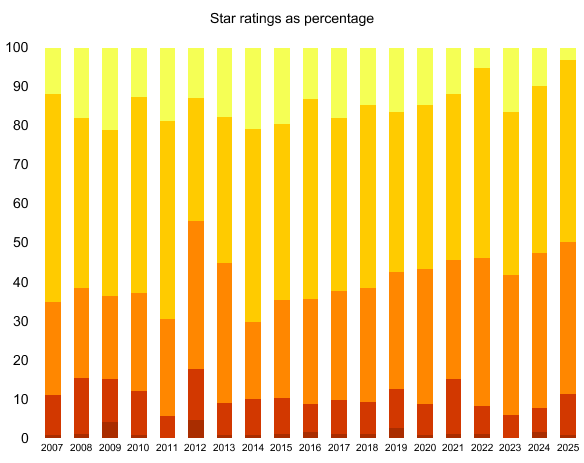
Beginning with the cream of the crop, in 2025 I awarded just four five-star ratings (3.45% of my viewing), the lowest number ever. Raw numbers and percentages can paint very different pictures (four from 116 films is statistically pretty different than if it were from the 264 films I watched in 2020), but even then it’s well below where this figure sits on average, which is above 15%. Well, it is what it is — I don’t grade with the intention of hitting the same curve every year, so my 2025 viewing was simply lacking in this regard.

That said, other scores remain typically healthy. The most common score was four stars, which I handed out to 54 films (46.6%). That’s marginally above the historical average of 44.8%, but is also lower than seven previous years, so sits in the upper-middle overall. Not too far behind were the 45 three-star films (38.8%). Only once have the three-stars overtaken four-stars to be the dominant rating (in 2012), although they have been within a few percentage points of each other sometimes. This year, the difference of 7.8% is towards the closer end (five years were even closer), so while it’s not the greatest year, it’s not the most mediocre either.

As for the actually ‘bad’ ratings, there were 12 two-star films (10.34%) and only a single one-star film (0.9%). In fact, I almost didn’t give out any one-star ratings this year, which would have made 2025 just the third year where that happened; but then I decided Ice Age: Collision Course really was terrible enough that two stars would be too generous, so here we are.
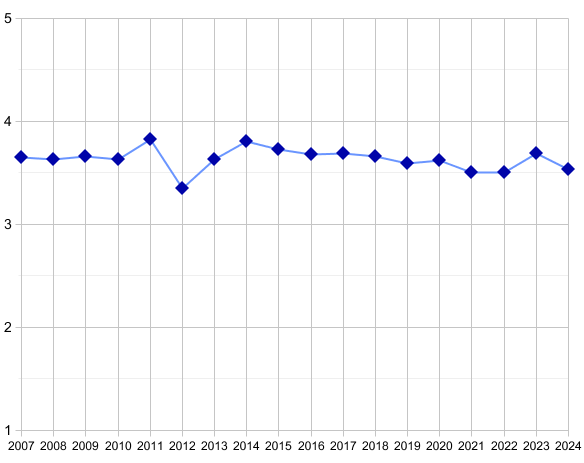
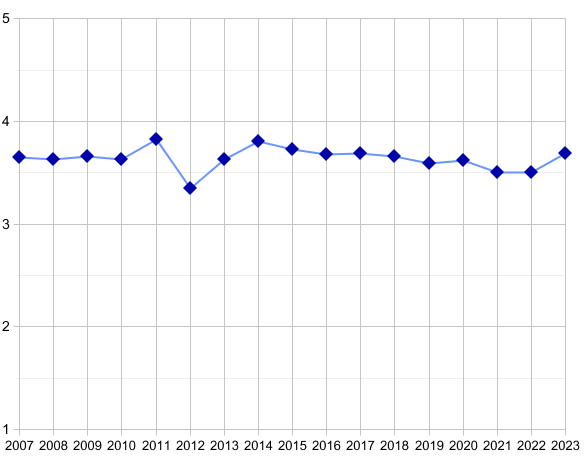
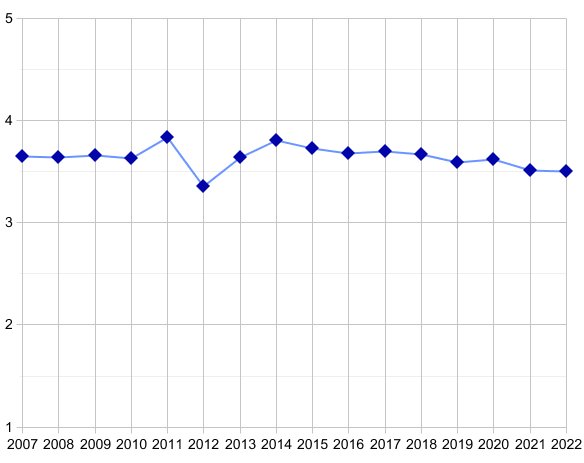
That brings us the average score — a single figure to quantify 2025’s quality compared to other years. The short version is 3.4 out of 5. That might not sound terrible — it’s still above the halfway point of 2.5 or the notional average of 3.0 — but it’s actually only the second time my annual average has been below 3.5. Being one of the two weakest years of the past almost-two-decades is, well, not good. It’s not the lowest of all, though: if we add a few more decimal places, we see 2025 averaged 3.414, which is still notably high than 2012, which at 3.352 was a smidgen off rounding to 3.3. Still, it represents a further tick down for the line.
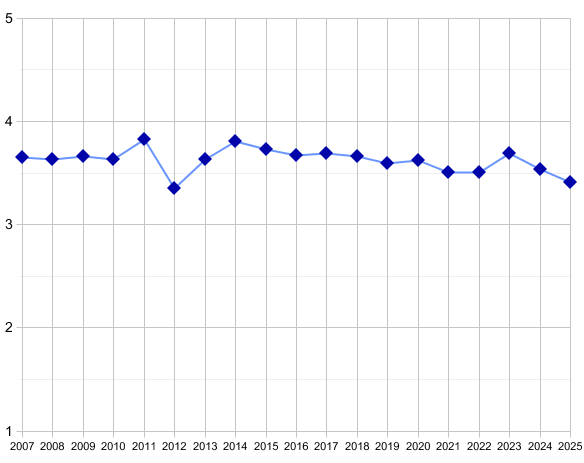
Honestly, I’m not surprised: it’s felt like a very “decent but not great” year throughout, a perception which is supported by the still-solid number of 4-star films but almost total absence of 5-stars. That’s the way it goes sometimes, although 2025 has demonstrably been worse for it than normal. It does make me wonder if next year I should put more energy into seeking out better-regarded films. Not that that’s a guarantee of success (I’ve bounced off plenty of highly-acclaimed classics and, conversely, loved my fair share of less-beloved cult classics and other people’s write-offs), but it improves the odds. Either way, we’ll see what 2026 brings this time next year.


More quantifying of quality as I distil those 116 first-time watches to my favourite 10%.
2024 Statistics!

When Andy Williams sang “it’s the most wonderful time of the year”, he was on about Christmastime; but ’round these parts, the real most wonderful time of the year comes a little later: in early January, with the annual statistics post. And, friends, that time is here again.

Before the onslaught of numbers and graphs begin, a couple of quick reminders. Primarily: these stats cover my first-time feature film watches from 2024, as listed here. Shorts and rewatches are only factored in when expressly mentioned.

Secondly, and finally: as a Letterboxd Patron member, I get a yearly stats page there too, which can be found here. The numbers will look a bit different, because I also log whatever TV I can, plus it factors in shorts and rewatches more thoroughly, but that’s part of what makes it interesting as an addition/alternative to this post. It also breaks down some interesting things not covered here, like my most-watched and highest-rated stars and directors.

Now, without further ado, here’s what you came for…


I watched 131 feature films for the first time in 2024. That puts it right in the middle of the history of 100 Films: out of 18 years, it ranks ninth largest (or tenth smallest).

Of those 131 films, 85 counted towards my 100 Films in a Year Challenge. Alongside 15 rewatches, that means I finally reached all 100 films for my Challenge for the first time in its new form. More thoughts about that in the Final Standing and December review posts.

Outside of the Challenge, I rewatched only two further films for a total of 17 rewatches. That’s my lowest number since 2016, which was the last year before I started to make a concerted effort to up my rewatches (first with the Rewatchathon from 2017 to 2020, then by including them as a category in my Challenge). Any number going down is a shame, but there are always going to be compromises somewhere — if I’d rewatched more, I likely would’ve watched fewer new films.


NB: I have no rewatch data for 2007 and only incomplete numbers for 2008.

Here’s how that viewing played out across the year, month by month. The dark blue line is my first-time watches and the pale blue is rewatches. Both lines are much flatter than normal (I mean, look at 2023’s), which is because I was consistently hitting my “ten films per month minimum” goal but rarely managing to exceed it (the spikes in April and December being notable exceptions).

I also watched 16 short films. That might not sound like a lot, but it’s actually my third highest total ever, behind only 2019’s 20 and 2020’s 65 (which was so high thanks to watching many for film festivals I was working on), and just ahead of last year’s 15. On the other hand, only 11 were ones I’d never seen before, down marginally from 12 last year. (For some reason I didn’t make that distinction in last year’s stats, but it does affect the total running time, because only the new ones count.)

The total running time of my first-watch features was 229 hours and 3 minutes. That’s my highest since I revamped the site for 2022, but only ninth overall. The same ranking as for the film count? It’s almost as if there’s a correlation! I jest, but what it does suggest is that I rarely, if ever, watch a disproportionate number of especially-short or especially-long films. Talking of short things, add in the (new) short films and that total rises by only just over an hour to 230 hours and 14 minutes. (The additional bit is labelled as “other” on the graph because it would also include any alternate cuts of features that I watched for the first time, but there weren’t any this year. In fact, it’s been five years since there were.)

Formats next, and after disappearing last year, TV is back! Okay, it’s only got one film to its name (thanks to the BBC for premiering a new Wallace & Gromit feature on Christmas Day), but it’s something, I guess. Unless there’s another similar must-watch-live event in 2025 (doubtful), I imagine it will drop off again next year.

It will come as no surprise that the year’s most prolific viewing format was digital with 85 films. At 64.9% of my viewing, it’s an increase on last year, though still below the peak of 2020–2022. It was below 50% in 2019, and I’d like to get it back down there in favour of Blu-rays.

“Digital” encompasses a multitude of different platforms and viewing methods, and this year it was downloads that topped them with 20 films (23.5% of digital). Of the streamers, it was actually NOW that emerged victorious for the first time, with 18 films (21.2%), knocking Netflix and Amazon Prime into shared third place with 16 films (18.8%) each. Surging slightly ahead of the “also ran”s, iPlayer accounted for eight films (9.4%), while bringing up the rear were Apple TV+ on three (3.5), Disney+ and MUBI each on two (2.4%), and newcomer Crunchyroll with one (1.2%). Crunchyroll is all about TV and has hardly any films (I think I found a grand total of four), so don’t expect to see them return (although it’s not an impossibility).

Back to the main ranking, Blu-ray did come second with 38 films (29.0%), a raise in number but drop in percentage from last year.

Last year I noted that the addition of a Physical Media category to my Challenge hadn’t actually done much to boost the number of DVDs I watched. This year I took that category away, and DVD did drop slightly, down to six (4.6%); but, considered over a longer timescale, it’s held pretty steady — just look at the graph:

Finally, I made just one trip to the cinema this year (for Dune: Part Two). Other things piqued my interest, but nothing else panned out. Will 2025 fare any better? Well, I’ll be sure to catch the next Mission: Impossible, at least. Hey, one is still better than I managed some years (2013, 2014, and 2022, I’m looking at you).

Looking at formats from a different angle, now. First: in 2024, I watched as many new films in 3D as I did in 2021–2023 combined. Okay, that was still only four, but it’s an improvement. Looking at my Blu-ray collection, I own 63 films in 3D that I’ve never seen (plus about the same again that I’ve seen but not in 3D), so this number should be significantly higher. Maybe I’ll finally boost it up in 2025. (The first number to beat is 2020’s 13. The best ever is 2018’s 18.)

Next, the format du jour, 4K Ultra HD (it still feels pretty new to me, though 4K discs are about to hit their 9th anniversary). I watched 32 films in UHD in 2024, which is a numerical increase from 2023’s 27, but a percentage drop: 24.4% vs last year’s 26.2%. Still, it’s my second best percentage ever, so that’s not nothing. 1080p HD remains the standard, of course, representing a sliver under two-thirds of my viewing at 66.4%. Meanwhile, SD lingers on with 12 films — a hold from last year, but a percentage drop to 9.2%, only the second year it’s been under 10%. Will it ever go away entirely? It would be nice, but there remain plenty of films without even a DVD-quality SD copy out there, never mind all the DVDs that have never received an HD release.

Some people would think that the fact I’m watching so many films in high quality means I’m mostly watching new stuff, but those people are misinformed. Okay, so the the 2020s remains my top decade with 51 films (38.9%), its highest total yet; but other recent decades fare less well, with the 2000s and the 2010s in joint fifth with just eight films (6.1%) each. That’s the third year in a row that my top two decades haven’t been the most recent two; before that, it only happened in 2010 (understandably) and 2019.

The decade that actually landed second place was the 1980s with 17 films (12.98%), closely followed by the ’60s on 16 (12.2%), while the ’90s took fourth with on nine (6.9%). After the first two decades of this century, we come to another tie: the ’40s and the ’50s on seven (5.3%) each. Things are rounded out by the ’70s on six (4.6%) and the ’30s on two (1.5%). No features from before 1932 this year, although I did watch two shorts from the 1920s, five from the 1900s, and even one from the 1890s.

You might think no films from before 1932 would mean no silent films, but there was actually one. At this point I think we’re all aware they still make technically-silent films sometimes, and this year the qualifier was Robot Dreams. I still need to watch more genuine silents from the actual era though, and (minor spoiler alert!) some are almost guaranteed to feature in 2025.

As for spoken languages, English dominated as always, with 102 films wholly or significantly in my mother tongue. At 77.9%, it’s a couple of points up on last year, but still below any previous year. Nonetheless, second place is a distant tie between French and Cantonese in seven films (5.3%) each. They’re closely followed by Japanese in six (4.6%), Italian in five (3.8%), Mandarin and Spanish each in four (3.1%) each, and German and Persian in three (2.3%) apiece. In total, 19 languages were spoken in 2024’s viewing, including Czech and Telugu for the first time on record, and Swedish for the first time since 2020. That tally is better than 2022 or 2023, but still below 2015–2021.

In terms of countries of production, the USA drops below 50% for the first time ever, its 64 films accounting for just 48.85%. Meanwhile, the UK reaches a new percentage high, with 43 films coming out at 32.8%. Lest you think I’m going to brag about being worldly, I’ll note that only 29.0% of films didn’t feature either the US or UK among their listed production countries. Still, there were 31 countries in total in 2024, which is among the better years since I started recording this stat (the highest is 2020’s 40). France were third for the fourth year in a row with 17 films (12.98%), followed by Japan with 11 (8.4%), Hong Kong with nine (6.9%), Italy with eight (6.1%), then a three-way tie between Australia, Canada, and Germany each with five (3.8%).
A total of 114 directors plus eight directing partnerships helmed the feature films I watched in 2024, with a further six directors and four partnerships behind my short film viewing. For the second year in a row, no one was responsible for more than two features, but those with a duo on the list were Abbas Kiarostami, Denis Villeneuve, Joseph Kuo, Joseph L. Mankiewicz, Oliver Parker (not to be confused with Ol Parker, who also had one), Robert Tronson, Sammo Hung, W.S. Van Dyke, and Wellson Chin. Plus I watched three shorts credited to British cinema pioneer Cecil Hepworth.

This is my tenth year charting the number of female directors whose work I’ve watched each year. I’d love to say the number and percentage of women-directed films I watch has steadily grown in that time, but it’s actually fluctuated wildly. The low point was 2016, at just 1.66%; the high was 2020, at a still-measly 11.4%; last year, it was 11.2%. In 2024, I watched 10 films with a female director, though two of those were a shared credit (one as part of a duo, one a trio). Counting those shared credits as the appropriate fractions means those 10 films represent 6.74% of my viewing. As terrible as that sounds, it’s still my third best year — so, even worse, then. As I’ve said before, I neither avoid nor especially seek out female directors — arguably I should do more of the latter, but the fact I just watch what I watch and this is how low the percentage is suggests that it’s the industry who really need to do more. That said, as revealed earlier, I watch a relatively high percentage of older films, and you can’t change the past. I hope this graph will improve further in the future, but I doubt it will ever come close to 50/50.

Every year, I track my progress at completing the IMDb Top 250, but this year it’s a bit special because I made it a whole category in my 2024 Challenge. When I made that decision, it wasn’t guaranteed I’d finish the Top 250: the category only required 12 films to complete it and I had a few more than that left on the list. My thinking was: at the very least it will be significant progress; at best, maybe I’d watch a couple more than the prescribed 12 and get the list close to done. Well, I didn’t specifically watch any ‘extra’ films, but titles do come and go (Godzilla Minus One was on the list when I announced my plans in January, but was gone by the time I watched it in September) so maaaybe… but no, I’m still 10 films away from completing it. Goddammit. Comings and goings aside, at the time of writing this article there were 13 films from my 2024 viewing still on the Top 250 — the 12 I watched for the Challenge (listed here) plus Dune: Part Two. Their current positions range from 41st (Spider-Man: Across the Spider-Verse) to 237th (My Father and My Son). Well, there’s always next year…

As I’m sure you’re aware, at the end of every year I publish a list of 50 notable films I missed from that year’s new releases, which I call my “50 Unseen”. I’ve tracked my progress at watching those ‘misses’ down the years — progress that has been very variable: I didn’t watch too many of them at the start, then went through a period of several years where I made serious inroads, but recently I’ve dropped off again. Put in more practical terms: I hit a high of 68 watched from all previous lists during 2018, but only watched 10 during 2023. There’s a nice bounce in 2024, doubling to 20 films across all 17 lists, although it’s still one of my weaker years (only four were worse). That’s dominated by 12 from 2023’s 50 — a big improvement on the six from 2022 I watched last year, but still my fourth-worst ‘first year’ (historically, I’ve watched the most from any given list in its first year of existence).

In total, I’ve now seen 543 out of 850 ‘missed’ movies. That’s 63.9%, a further drop from last year, though still a little above 2017 (2018 was the first year I got it above 70%). I’d like to get it above 70% again, but to do it by the end of 2025 I’d have to watch 87 films, which is almost double the number I watched in 2022 to 2024 combined. To even hold the percentage steady I’d have to watch 32 films, which is still more than 2023 and 2024 combined, so it’s not looking great. (As usual, 2024’s 50 will be listed in my “best of” post.)

And so we reach the finale of every review; a fitting climax to these statistics: the scores.

For the avoidance of doubt, this stat factors in every new film I watched in 2024, including those I’ve not yet reviewed (this year, that’s 92% of them — an improvement on last year’s 95%, albeit not by much). That does mean there are some where I’m still flexible on my final score; usually films I’ve awarded 3.5 or 4.5 on Letterboxd, but which I insist on rounding to a whole star here. For the sake of completing these stats, I’ve assigned a whole-star rating to every film, but I reserve the right to change my mind when I eventually post a review (it’s happened before). It only applies to a small handful of films, so hopefully this section will remain broadly accurate.

At the top end of the scale, in 2024 I awarded 13 five-star ratings (9.92% of my viewing). That’s down slightly from last year, though not close to as low as 2022. (I’d make comparisons to all other years, but that’s only down fairly as a percentage and I don’t have that to hand. I should compile a list of them, really.) At the scale’s other end, I gave two one-star ratings (1.53%), which is more or less normal for me — indeed, my all-time average is 1.94 per year. Even when I watch more films, it doesn’t change much, because I avoid giving it to all but the most terrible rubbish, and I try to avoid watching such things, on the whole.

The largest group this year was four-stars, given to 56 films (42.75%). Three-stars has only been the majority awarded once (in 2012), but it came pretty close this year, as there were 52 three-star films (39.69%). Finally, there were only eight two-star films (6.11%), which is roughly in-keeping with the last couple of years (before that there were a lot more, but then I watched a lot more in general. I really ought to get those percentages ready for comparison…)

And so to the big final number: the average score for 2024. Oo-ooh! The short version is 3.5 out of 5 — down from last year, but the same as the two years before that. To get more precise (for the sake of comparison, as all of my years fall within a spread of 0.4), at three decimal places the score is 3.534 — that’s above 2021 and 2022, then, but the only other year it bests is 2012 (a real outlier, as you can see on the below chart). As my fourth lowest-scoring year, it’s almost the antithesis to last year, which was fifth highest.

What can we conclude from all that? Nothing much, really. The fact that line is pretty flat (a few oddities aside) suggests both my film choosing and my scoring have remained consistent over the years, for good or ill. Should I choose better films? Should I score more leniently? Or more harshly? To be honest, I don’t really think about such questions. I take these stats as an indication of what’s happened, not as a learning exercise in what I should or shouldn’t change.


Talking of scores and finales, next up is the finale of the 2024 review: my pick of the best from my 131 first-time watches.

2023 Statistics!

Here we are again: the best bit of the year — the statistics!

As was the case last year (and will surely remain so going forward), these haven’t been fiddled with to fit with my new-format Challenge, but instead continue to encompass all of my first-time watches from the past year (as listed here). That’s just the way I like it (in part because it means I can compare across the years, whereas switching to a Challenge focus would basically be starting again).

Before the onslaught of numbers and graphs, I’ll just mention that, because I’m a Letterboxd Patron member, I get a yearly stats page over there too, which can be found here. In some places that’ll look a bit different to this one, because I also log whatever TV I’m allowed there; but it does have some interesting additional and alternative stats, like my most-watched and highest-rated stars and directors. So, if you love this stuff as much as I do, be sure to check out the extra goodies there at some point.

And with that said, it’s on to the main event…


I watched 103 feature films for the first time in 2023, which is my lowest final tally in over a decade (you have to go back to 2012’s 97 for less). It snuggles in between the handful of years in which I reached exactly 100 and 2013’s 110 as my all-time 5th lowest year (out of 17).

Of those 103 films, 67 counted towards my 100 Films in a Year Challenge. Alongside 25 rewatches, that means I totalled 92 films for my Challenge — sadly falling short of the goal of 100 for the second year running.

Outside of the Challenge, I rewatched a further three films, for a total of 28 rewatches. That’s somewhere in the middle of the pack — my 7th best year ever for rewatches, which also makes it my 10th worst.


NB: I have no rewatch data for 2007 and only incomplete numbers for 2008.

Here’s how that viewing played out across the year, month by month. The dark blue line is my first-time watches and the pale blue is rewatches. As is usually the case, my viewing month to month is wildly unpredictable.

I also watched 15 short films in 2023. (Those don’t count in any statistics, with the sole exception of the version of the total running time that expressly mentions them.) That’s only the third time my shorts count has been in double figures, sitting behind 2019’s 20 and 2020’s festivals-driven whopper of 65.

The total running time of my first-watch features was 173 hours and 11 minutes. That’s my lowest since 2012, which makes sense when you remember the stat from the first paragraph. Add in the shorts and the figure rises almost 2½ hours to 175 hours and 33 minutes, though you still won’t find lower since 2012. (In the graph, I would also include any alternate cuts I watched for the first time in that “others” block, but there weren’t any this year.)

On to formats now, and the big news (if you can call it that) isn’t what’s #1, but what isn’t here: I didn’t watch a single film on TV in 2023, the first time that’s happened in the history of the blog. TV was once my dominant format, making up over half my viewing in 2010, and the largest portion in 2009, 2011, and 2012, but tailed off thanks to the rise in streaming. It’s also a personal thing: its number of films was still in the 20s as recently as 2019, but then I got rid of Virgin Media and its easy recordability, and the number went off a cliff. But I won’t lament it too much, because there’s always a chance it’ll return — unlike, say, VHS, which still accounted for five films back in 2007 and two in 2008 before disappearing entirely.

As for what is #1, that’s not really news at all: it’s digital again, with 60 films — though at 58.25% of my viewing, that’s its lowest percentage since 2019. My streaming viewing had been hovering around 50% from 2015 to 2019, but then suddenly darted up to almost 74% in 2020. I know most would blame the pandemic for that kind of thing, but during lockdown I still had all my many, many Blu-rays, so I don’t really know why that happened. It dropped marginally to 72.5% in 2021, then a little more to 69.4% last year, but a fall of over 10% is… well, I approve. Maybe it’s silly to look at it that way — I mean, this is my own viewing: I could ban myself from streaming anything if I wanted to — but I kind of just watch what I want to or feel like, then look at these numbers in retrospect. With that in mind, I continue to want to see Blu-ray do better, and this is a step in the right direction.

Of course, “digital” is actually made up of multiple streamers, plus downloads. This year was a tight one, with Netflix’s 16 films (26.7% of digital) narrowly claiming the crown from Amazon Prime on 15 (25%). Next were downloads on 13 (21.7%), before a small handful of other streamers filled out the rest: Disney+ with six (10%), MUBI with five (8.3%), Now on three (5%), and Apple TV+ on two (3.3%). That’s right, nothing in 2023 for iPlayer, nor ITVX, nor Channel 4, nor YouTube, nor any of the multitudinous other streamers that are available nowadays.

Overall second went, also as usual, to Blu-ray, with 31 films (30.1%). That’s up on last year, though doesn’t by itself totally cover the drop in digital.

So where else have those lost digital percentage points gone? Well, DVD held steady on eight films. With my overall viewing down, that means it accounts for a slightly higher percentage — 7.8% in 2023 vs 7.2% in 2022. Hardly making the world of difference, that, is it? DVD has theoretically enjoyed a boost these last couple of years thanks to the Physical Media category of my Challenge, although in fact it hasn’t made that much of a difference (looking at the graph, the two Challenge years aren’t notably different to pre-Challenge years like 2016, 2017, 2019, and 2020). Spoilers: the Physical Media category is going away in 2024, so it’ll be interesting to see how DVD charts next year.

Our search for those lost digital percentage points finds perhaps its biggest culprit in cinema. I went four times this year — less than I’d hoped, but tied with 2020. It’s only 3.9% of my viewing, but if we’re talking about how percentage points have moved around, I guess those are all nabbed from digital. (For those who want the full maths: add cinema’s 3.9% to DVD’s 0.6% increase for 4.5% of streaming’s lost 11.1%. That leaves 6.6%, and Blu-ray went up by 8.6%, so… um, wait, what? Oh, I’m just confused now. Let’s abandon the pretence I know what I’m talking about, have a graph, and then on to something else.)

In 2022 I only watched one new film in 3D. I’d hoped to improve on that in 2023 (the general public may think 3D is dead, but it still has its fans — like me — and I’ve still got a 3D TV and plenty of unwatched discs), but I didn’t — in fact, I watched no films in 3D. Oh. Well, at least that’s an easy figure to improve upon… (In overall terms, I did watch two 3D titles this year, both Doctor Who ones. That too is the same as 2022, when my one new 3D film was supplemented by a 3D rewatch.)

As for the new high PQ standard, 4K Ultra HD, that fared significantly better, with 27 films in 2023 — up from 24 in 2022, even though I watched fewer films overall. Indeed, at 26.2% of my viewing, you could argue it’s 4K’s strongest year yet. (I watched 40 back in 2020, but that was only 15.2%.) Still, 1080p HD remains the standard overall, accounting for 62.1% of my viewing. Of course, sometimes the only option is lower quality, and so I still watched 12 films in SD. That’s my lowest raw number yet, and even as a percentage — 11.65% — it’s down on the last two years.

In terms of the age of films watched, it’s normally the present decade that tops the chart, although it typically takes a couple of years to assert that position. The 2020s got there for the first time last year, matching the 2010s record of doing it in the decade’s third year. No surprise, then, to find the 2020s in first place again, with 38 films (36.9%). Normally you’d then find the preceding decade in second place, but — for the second time in a row, and only the fifth time ever — that’s not the case. In fact, two decades bested it: for no immediately obvious reason, the ’60s are second with 15 films (15.5%); and, boosted by my noir-focused WDYMYHS selection, the ’40s are third with 10 films (9.7%). That leaves the 2010s in fourth place with just eight films (7.8%).

Every decade since the 1920s cropped up in my feature film viewing this year. That means the 1910s miss out for the first time since 2019, but the 1900s & earlier were represented by shorts, as they have been every year since 2020. I specify “and earlier” because one even came from the 1890s. Counting down the remaining decades, in joint fifth place we have last year’s #2, the ’80s, tied with the ’50s on seven films (6.8%) apiece. From there we’ve got the ’70s with six (5.8%), the ’90s with four (3.9%), the ’30s and 2000s each with three (2.9%), and finally the 1920s with just one (0.97%).

As well as watching older films, I’ve also tried to watch more films from around the world — in a relatively “hands off” way, that is. By which I mean, it’s not like I’ve disqualified US/UK productions from my Challenge, nor anything else particularly radical or concerted; I’ve just tried to, y’know, vary things. That approach means that, while the USA remains clearly the dominant country of production, with 60 films this year, its percentage has dropped significantly, to 58.3% — down from almost 73% last year, and well below the previous low, 67.6% in 2021. Meanwhile, the UK has actually gone up, with 33 films equating to 32.04%, its highest ever, over 2013’s 29.3%.

In total, there were 23 production countries in 2023 — up from 17 in 2022, which is good considering I watched roughly the same number of films. It’s fewer than in any year from 2014 to 2021, but I did watch a lot more films in that period. France came third for the third year in a row with 12 films (11.7%), Germany were fourth with 10 films (9.7%), Italy were fifth with nine films (8.7%), and Mexico had an uncommonly strong showing to reach sixth place with five films (4.9%). There were three each for Canada and Hong Kong, and two apiece for China, Cuba, Ireland, and Sweden. That leaves eleven other countries with one film each, including Japan, who I mention because they built up to a huge spike a few years ago, culminating in third place in 2018, but have tailed off again since, for no readily discernible reason.

Unsurprisingly, it’s a similar story with languages — although the UK and US combine here (along with various other countries, including foreign films where it’s spoken a significant amount) to leave me with 77 films in English. It remains by far the highest single language, but features in less than three-quarters of films in 2023 — 74.8%, to be precise — which is far down on last year’s obscene 92.8%, and well below the previous low, 2020’s 84.5%. Nonetheless, it’s a long drop to second placed French, featured in nine films (8.7%), which is only just ahead of Italian in eight films (7.8%) and Spanish in seven films (6.8%). In all, 16 languages were spoken in 2023’s viewing, slightly up from last year, but you’d have to go back to 2014 to find lower again. But, as I’ve said, I watched far more films per year in those years, so of course the number of countries and languages represented was higher.

A total of 89 directors plus seven directing partnerships helmed the feature films I watched in 2023, with a further seven directors and one partnership added by my short film viewing (one feature director also directed a short, as we shall see in a moment). No director had more than two features to their name this year, but those with two were Allan Davis (both from the Edgar Wallace Mysteries series), Dario Argento (if things had gone as planned, he would’ve had at least four), Eric Appel, Joselito Rodríguez, Kenneth Branagh (if rewatches counted, he’d have more), Mario Bava, and Roger Michell. It was Danny Boyle who was behind one feature and one short, while Dean Fleischer Camp helmed three shorts (the original Marcel the Shell with Shoes On trio) and George Albert Smith is credited with two.

For a few years now I’ve been charting the number of female directors whose work I’ve watched each year. This had been steadily improving, but fell back considerably in 2022, unfortunately. In 2023, I watched 12 films with a female director (11 with a woman directing solo, one where she was part of a duo with a man). Counting the shared credit as half a film, that comes out as 11.17% of my viewing. That’s actually my second highest percentage since I started monitoring this, but remains shockingly low considering that women make up a little over 50% of the population. I say that’s an industry problem, primarily — if more women were allowed to direct movies as a matter of course, I’d see more movies directed by women.

At the time of writing, just one film from my 2023 viewing appears on the IMDb Top 250 — that would be Oppenheimer at 68th. However, because that list is ever-changing, the number I have left to see has actually gone up, from 18 at the end of 2022 to 19 now — the first time that’s happened since I started tracking this a decade ago. One of those 19 films has only just inserted itself into the list though, so I presume it will speedily drop off (that tends to be what happens to new entrants). Still, even that would leave me with a net change of zero. Maybe my 2024 viewing will have more of an impact…

Talking of minimal impact, let’s move on to the disaster zone that is my progress with my “50 Unseen” lists — you know, the list I publish at the end of every year of 50 notable new films I missed that year, which I’ve continued to track my progress watching down the years. I went through a period where they helped to decide a lot of my viewing, and consequently I was constantly chipping away at every old list. Not so much nowadays. In fact, “not at all” might be more accurate: in 2023, I only watched 10 films across all 16 lists. I haven’t even watched that few from just the previous year (i.e. in this case, 2022) since I only watched eight from 2009’s list in 2010. To be precise, I watched six from 2022’s 50. That’s my second-worst ‘first year’ ever, beating only the four from 2008’s list that I watched in 2009. Eesh. The only reasoning I can offer for such a drop off is that I’m watching far fewer films than I used to, and more of them are older.

In total, I’ve now seen 523 out of 800 ‘missed’ movies. That’s 65.4%, the lowest it’s been since 2017. I was pleased to get it above 70% for the first time in 2018 and my aim had been to keep it up there, which I managed for the next few years. I’d like to get back there, but it’s unlikely to happen in 2024: I’d have to watch 72 films (from across all 17 years), which would be a new record. Considering I watch at least 100 (ish) films every year, hitting 72 seems theoretically possible, but only if I were to devote most of my viewing to only films from these lists. I won’t be doing that. Maybe I can achieve 70% in 2025… or 2026… Of course, the goal posts keep moving because the list increases by 50 titles every year (speaking of which, 2023’s 50 will be listed in my forthcoming “best of” post).

And so we reach the finale of every review, and thus a fitting climax to these statistics: the scores.

For the avoidance of doubt, this stat factors in every new film I watched in 2023, even those for which I’ve yet to publish a review (this year, that’s a ludicrous 95% of them — it was just 27% last year, although it was 98% in 2021). That means there are some where I’m still flexible on my precise score; usually films I’ve awarded 3.5 or 4.5 on Letterboxd, but which I insist on rounding to a whole star here. For the sake of completing these stats, I’ve assigned a whole-star rating to every film, but it’s possible I’ll change my mind when I eventually post a review (it’s happened before). Still, hopefully this section will remain broadly accurate (because I’m not going to come back to modify it!)

At the top end of the spectrum, in 2023 I awarded 17 five-star ratings (16.5% of my viewing) — a massive increase on 2022’s six (5.4%). Having last year asserted that my marking has become harsher as I’ve got older / more experienced, this year suggests that, eh, maybe not; although, historically, 16.5% is slap bang in the middle of the board (by which I mean: eight years had a higher percentage and eight years had a lower percentage). I’ve always been a relatively lenient grader and, to be honest, I see no reason why that should change — I just like films, ok?

At the other end of the spectrum, though perhaps indicative of the same thing, I gave zero one-star ratings — only the second time that’s ever happened, after 2011. I’m always stingy with them, feeling that the lowest-of-the-low should be reserved for things that are truly execrable, so in many respects it’s nice to have gone a whole year without watching anything so meritless.

My most commonly awarded rating was, as usual, four stars, which I gave to 43 films (41.7%). That’s down from last year, although together the top two ratings add up to 60 films in both 2022 and 2023 (and, remember, I only watched slightly more films last year, so it’s broadly equal). Slightly behind were the 37 three-star films (35.9%), while only having six two-star films means their percentage — 5.8% — is the lowest since 2011 (a year you may remember for its similar lack of one-star films).

So, from all that we can calculate the final stat of the year: the average score for 2023. The short version is 3.7 out of 5 — the highest it’s been since 2018, which was the fourth year in a run of 3.7s. It bucks the trend, too, as 2019 and 2020 both averaged 3.6 before 2021 and 2022 hit 3.5. If we want to get more precise (and we do), we can add a few more decimal places and see the score comes out at 3.689. That makes 2023 the fifth highest scoring year ever — again, quite the turnaround from the last two years, which were both my second-lowest year ever at the time.

All of which said, as you can see from the graph above, my average score has remained pretty consistent across the years. There are no truly bad years, just weaker ones — or, in 2023’s case, stronger ones. Hurrah.


All that remains now for my review of 2023: which of those 103 films were my favourites?

My Most-Read Posts of 2023

Normally I’d post my December “failures” today, but they’re not ready yet (it takes a surprisingly long time to write that column, you know), so I thought I’d crack on with my 2023 reviews instead.

According to my WordPress stats page, I published just 38 posts during 2023. In some respects, I’m surprised it’s so many, considering for most of the year each month consisted of just my monthly review and my list of failures.

Because I knew there were so few posts to work with, I considered not bothering with this post this year. I only started it (seven years ago) because 2016’s #1 baffled me so much. It’s part of the furniture now, but I’m always trying to question ‘the furniture’ so things don’t become staid for the sake of it (becoming staid because of the quality of my writing or whatever, that’s fiiiine).

In the end, I decided to stick with it (you probably guessed that, given that you’re reading it). Not because the results are anything special or interesting, but because… well, they’re not terribly uninteresting, as these things go. If nothing else, I had the idea to add the year’s most-read post overall to the below graph (in purple), for a sense of scale. That post is from just last year, my summation of the 2022 edition of Sight & Sound’s The 100 Greatest Films of All Time. It’s followed in the chart by a bunch of old TV columns, plus my post on the 2012 Sight & Sound list, before you finally find 2023’s #1 post at #14 overall. The other four are so far down the list, I couldn’t be bothered to count that far.

As for what those posts actually were…


My Top 5 Most-Viewed New Posts in 2023

5) Blindspot 2023

In the absence of actual film reviews, other posts have been able to sneak into this list — an unusual occurrence. Although, there were reviews published in 2023 that didn’t make this list, so… Perhaps it’s because of name recognition, perhaps it’s just a random fluke, but Blindspot beats out the similarly-themed “What Do You Mean You Haven’t Seen…?” by two spots (i.e. WDYMYHS came 7th).

4) Silent Shorts Summary

Shorts don’t normally get a look in here either, but reviews are reviews, I guess. This roundup covered eight shorts made between 1900 and 1926, including the first-ever Sherlock Holmes “film”, the first adaptation of Frankenstein, some Georges Méliès trick photography, and a dancing pig. A really, really freaky dancing pig.

3) Archive 5, Vol.6

Remember Archive 5? It was supposed to be a regular feature, but in the last two years I’ve only managed six of them. This one — 2023’s only addition to the strand — featured reviews of 7500, Carefree, The Lie, Paris When It Sizzles, and The Rhythm Section.

2) The All-New 100 Films in a Year Challenge, Mk.II

The post in which I outlined the categories and rules of my Challenge for 2023. Considering this is linked to in all my monthly updates, plus on my Challenge Tracker page, it feels like it shouldn’t come as a surprise to see it being much visited. Well, “much” is a relative term: it came 84th overall, below even the same post about 2022 (who was so interested in 2022 during 2023?! He says, as he begins 2024 with a bunch of posts about 2023…)

1) 2023 | Weeks 3–4

Far and away my most-viewed new post of the year (something I could also say last year — is there always one “break out hit”? I can’t be bothered to go back to find out, to be honest). Feel free to guess which of the five included reviews was the culprit: 1926’s The Magician, 2022’s Glass Onion, Oscar-nominated short My Year of Dicks, then-recent release Shotgun Wedding, or The Banshees of Inisherin, another Oscar nominee. Maybe it was just that particular combination.


2022 Statistics!

It’s time once again for the highlight of the year (my highlight, at least) — the statistics! And because I love them so much, I’ve not really messed around with them. That’s to say, these are still based on my first-time watches from 2022 (as listed here), not only films I watched for the new-style Challenge.

Before the onslaught of numbers and graphs begin, I’ll just mention that, because I’m a Letterboxd Pro member, I get a yearly stats page over there too, which can be found here. In some places that’ll look a bit different to this one, because I also log whatever TV I’m allowed there; but it does have some interesting additional and alternative stats, like my most watched and highest rated stars and directors.

With that plugged, it’s time for the main event…


I watched 111 feature films for the first time in 2022. That’s my lowest total since 2013, when I watched 110, and my 6th lowest ever (out of 16 years).

Previously that still would’ve been “a success”, because my goal was to simply watch 100 new films. But this year I changed things up a bit. Unfortunately, as I’ve already discussed (a couple of times), I failed. Nonetheless, I watched 89 films towards my Challenge, including 71 of those new feature films, 17 rewatches, and one short film.

Outside of the strictures of the Challenge, I rewatched three further films, for a total of 20 rewatches. That, too, ranks as my 6th weakest year. Not ideal, but — in a very literal sense — it could be worse.


NB: I have no rewatch data for 2007 and only incomplete numbers for 2008.

I also watched seven short films, which may not sound like many but is still my 5th best year for the form. These won’t be counted in most of the stats that follow, except where they’re noted alongside the features’ running time.

The total running time of my first-watch features was 189 hours and 21 minutes. Add in the shorts and that rises by over an hour to 190 hours and 33 minutes. (I would also factor any alternate cuts I watched for the first time into that “others” block, but there weren’t any this year.) Unsurprisingly, that lines up with the lesser number of films watched to be one of my lowest totals ever.

Here’s how that viewing played out across the year, month by month. The dark blue line is my first-time watches and the pale blue is rewatches. This is the fifth year I’ve been including this particular graph, and when you look back over them all, the main thing you can learn is that I really have no consistency. The only common factor I can spot is a relative drop in the September/October region each year, often dragging August or November in with it.

Next, the ways in which I watched those films. Despite including a specific DVDs category in my Challenge, I couldn’t turn things round for physical media: digital is once again the year’s most prolific viewing format, with 77 films, or 69.37% of my viewing. That’s actually down on the last two years (both over 72%), but still up on every year before that. One day I’ll do the right thing and get this down below Blu-ray… or so I keep telling myself…

Digital does have a slight advantage in that several different formats and services contribute to it, though the reason I lump them together is that there’s fundamentally no difference quality-wise between downloading and streaming a film nowadays (most of the time). This year, downloads beat any of the individual streamers, accounting for 26 films (33.8% of the digital total). A number of factors contribute to my wanton piracy, primarily getting hold of specific films in a reliably-accessible format for the sake of my Challenge, as well as acquiring various obscurities. Following on, the top streamer was Netflix, unseating regular victor Amazon Prime, with 14 films (18.2%). Amazon was close behind, though, with 12 films (15.6%). Both are lower than last year, unsurprisingly, but Disney+ actually saw a slight gain in raw numbers, from seven to nine films, which more than doubled its percentage, from 4.7% to 11.7%. Not too far behind was Now on seven (9.1%), with the category rounded out by half-a-dozen others: iPlayer and All 4 each with three (3.9%), MUBI with two (2.6%), and one each (1.3%) for Apple TV+, Talking Pictures TV Encore, and YouTube.

As usual, it was a distant second place for Blu-ray with 25 films (22.5%) — half of last year’s total in raw numbers, and a slight drop in percentage too.

That’s slightly tempered by an increase in my DVD viewing, the result of forcing my hand by making it a category in my Challenge. It should’ve resulted in at least 12 DVDs watched, but I ended up bending the rules and counting some rewatches. Anyway, the format still rallied to eight films — four times as many as last year, and increasing its representation from 0.97% to 7.2%. I imagine the DVD category will remain for 2023’s Challenge.

There was just one other format represented in 2022’s viewing: TV, with only one film (0.9%). The bigger news there is that, in the end, I didn’t make it to the cinema in the whole of 2022, the first time that’s happened since 2014. Funny kind of film fan I am, eh? I imagine it’ll be back in 2023: I’m still hoping to make time to see Avatar 2, and there are multiple big-screen-benefitting films out later in the year (not least a new Mission: Impossible). For now, here’s TV’s graph, showing how the once-mighty (look at it in 2010) have fallen…

Looking at formats from a different angle, I only watched one film in 3D in the whole of 2022. That might sound natural — 3D TVs have been phased out; disc releases in the format are almost nonexistent — but I’ve still got my 3D TV, and the releases are still coming, and I’ve got a large backlog of them to get through, anyway. So, I really should’ve watched more than one! Well, it would’ve been two, if I’d been able to find a genuine copy of Jackass 3D. I’ve managed to source most of the recent Marvel films in 3D (even though they only get a disc release in Japan nowadays), so if I finally catch up on those in 2023, the figure might be healthier next year.

As for the cutting-edge format du jour, 4K Ultra HD, that fared better, with 24 films — the exact same figure as last year, which in percentage terms is almost a doubling, from 11.6% to 21.6%. At the other end of the spectrum, the increase in DVDs, plus some harder-to-find SD downloads and streams, meant I watched 20 films in SD — the lowest raw number since 2017, but the highest percentage (18.0%) since 2015. Watching a lot in SD is nothing to be proud of (HD is usually so much nicer), but some stuff is simply only available in that format. Better than not being viewable at all. Meanwhile, ‘regular’ HD has been decreasing as a share of my viewing since UHD came along in 2017, but this year it tumbles to its lowest figure yet, just 60.4%

Unsurprisingly, it’s mostly older films that are only available in SD, and so an increase in one reflects an increase in the other. To wit, when it comes to the age of films I watched, the two most recent decades are not my two most-watched, for only the second time ever. Number 1 belies this fact: the 2020s top the chart for the first time, with 34 films (30.6%). But where you’d expect to find the 2010s in second place (having been the #1 decade from 2012 to 2021), it was actually the 1980s with 16 films (14.4%). That’s another side effect of my Challenge, where one category required me to watch 12 films from 1986 (even though I only got through ten of them in the end). It’s in joint third that we find the 2010s, sharing a place with the the 1940s (no doubt boosted by my Challenge’s noir category), each with 11 films (9.9%).

Every decade since the 1900s was represented in my viewing this year, as they were in 2020 and 2021; although, as with those years, the 1900s themselves only feature via shorts, so don’t ‘count’ here. Counting down the years in size order, in fifth place was the 1950s with nine films (8.1%), followed by the 2000s on seven (6.3%), the ’30s and ’60s both on six (5.4%), the ’90s on five (4.5%), the ’70s on four (3.6%), and one (0.9%) each for the 1910s and 1920s.

In recent years, I’ve been pleased to see an increasing variety in the production countries and languages of the films I’ve been watching. Unfortunately, watching so many fewer this year has wiped out some of those gains. So, while the USA has always been the dominant country of production, the 81 films it had a hand in this year represent 72.97% of my viewing, up from the sub-70% figures of the last two years. That said, I’ve been counting this figure since 2012, and that percentage is still the fourth lowest ever, so things could certainly be worse.

On the other hand, there were only 17 production countries this year, half of last year’s 35, and the lowest number since 2012. As ever, second place went to the UK with 26 films (23.4%). France was third for the second year in a row (and the seventh time in eleven years), with 11 films (9.9%). Tied for fourth were Canada and Japan with four apiece (3.6%), while Germany had three (2.7%), and on two (1.8%) each were Australia, Belgium, Israel, Italy, and Russia (provided the latter also includes the Soviet Union). That leaves six other countries with one film apiece. Countries that often feature but didn’t this year included China, India, Ireland, New Zealand, Spain, and Sweden.

It’s a similar story with languages, naturally: there were only 12 spoken languages (plus American Sign Language and some silent films), my lowest total since 2013. Top of the pile by an obscene amount was English, featuring in 103 films (92.8%). For context, in second place was French, spoken in just five films (4.5%). Normally I’d list more uncommonly-heard languages here, but there weren’t really any this year… except, for the second year in a row, Klingon.

A total of 99 directors plus eight directing partnerships helmed the feature films I watched in 2022, with a further three directors and two partnerships making my short film viewing. Only three directors were behind multiple features, the lowest number of repeat offenders ever (tied with 2012). The most came from Jeff Tremaine with three (the first three Jackass movies), while the other two were Stanley Kubrick (his pair of early-career noirs) and Alfred Werker (another couple of noirs). Additionally, two of the shorts I watched were masterminded by the great Georges Méliès.

For a while now I’ve been specifically charting the number of female directors whose work I’ve watched each year. This was steadily improving, but 2022 has seen an about-face in fortunes, dropping to my lowest level since 2017. My viewing this year included four films with a female director — three credited solo (Siân Heder’s CODA, Maggie Gyllenhaal’s The Lost Daughter, and Carrie Cracknell’s Persuasion), and one as part of a duo with a chap (Vanessa Yuille co-directing Doctor Who Am I). Counting the latter as half a film, that works out as just 3.15% of my viewing, which is sandwiched between 2017’s 2.84% and 2018’s 3.26%, but a long way off 2020’s high of 11.44%. As I’ve said before, I neither avoid nor seek out female directors — maybe I should do more of the latter, but I generally just watch the films I watch and see what comes out in the wash. The industry, undoubtedly, still needs to do more. As ever, I hope this graph will improve again in the future, though I doubt it will ever reach 50/50.

Before I dig into 2022’s star ratings, let’s take a look at a couple of viewing projects I always have on the go. First, the IMDb Top 250, which I’ve been vaguely working on since before this blog even began. At the time of writing, five films from my 2022 viewing appear on the list. However, because it’s ever-changing, the number I have left to see has actually gone down this year by 10, to 18 films. I’m so close to the end now, before long I may end up making it part of my Challenge to help finish it off. The current positions of the ones I saw this year range from 87th (High and Low) to 227th (To Be or Not to Be).

Next, my “50 Unseen” — the list I publish at the end of every year of 50 notable new films I missed that year. I’ve continued to track those ‘misses’ down the years, and went through a period where they helped decide a lot of my viewing. Recently, though, not so much. Last year was weak for continuing to complete these, and 2022 has been even weaker: in 2021, I watched a measly 21 films across all 14 lists; in 2022, I watched just 16 films across all 15 lists. Nearly all of those — 14 — were from 2021’s 50. That’s a better ‘first year’ than last year (when I only watched 12 from 2020’s 50), but is otherwise poor. Randomly, the other two both came from 2010’s list.

In total, I’ve now seen 513 out of 750 ‘missed’ movies. That’s 68.4%, a big drop from recent years — the last time my completion rate was below 70% was back in 2017. It’s not as if there aren’t still plenty of movies I want to see on those lists (and there’ll be 50 more from 2022 added soon), so I need to pull my finger out there.

And so, we reach the finale of every review, and thus the climax of 2022’s statistics: the scores.

Before we begin, I’m going to repeat the caveat I gave last year: this stat factors in every new film I watched in 2022, even those for which I’ve yet to publish a review (this year, that’s 27% of them — it was 98% last year). That means there are some where I’m still flexible on my precise score — usually films I’ve awarded 3.5 or 4.5 on Letterboxd, but which I insist on rounding to a whole star here. For the sake of completing these stats, I’ve assigned a whole-star rating to every film, but it’s possible I’ll change my mind when I eventually post a review (it’s happened before). Still, this section should remain broadly accurate.

The headline fact here is that I award a mere six five-star ratings in 2022. At just 5.4% of my first-time watches, that’s by far my lowest ever — the next worst was 2012, when I gave more than double (14 films, 13%). Was it that bad a year? Well, yes and no — I do feel like I didn’t watch many great films this year, but I did watch a lot of very good ones. Has my marking got harsher as I’ve got older / more experienced? I think it has, which is probably only right. But I’m still a relatively lenient grader overall.

For example, the most prolific rating I handed out remained four stars, which in 2022 I gave to 54 films (48.7%). That’s the highest percentage of four-star ratings I’ve given since 2016. Maybe a couple more would’ve found their way up into the five-star bracket in the past, but — as I said — I think I generally watched films that were good-but-not-great in 2022.

Continuing down the chart, there were 42 three-star films (37.8%). These three “good” ratings therefore make up 91.9% of my first-time watches in 2022, showing it certainly wasn’t a bad year. Well, it never is, really — but more on that in a minute, when I get to the overall average score.

In the negative pile, then, we find eight two-star films (7.2%) and just one one-star film (0.9%). As I said, I’m still a lenient marker overall — films have to be truly bad to receive a negative rating from me, and absolutely dreadful to sink to the depths of a single-star rating — in the entire history of 100 Films, just 1.32% of films have received that ignominy.

So, finally, the average score for 2022. The short version is 3.5 out of 5 — the same as last year, and only the third time the average has been below 3.6. I refer you to my earlier comments about how, if 2022 is “not a bad year”, then no year has ever really been bad. To get a few decimal places deeper (and thus provide a more accurate comparison), 2022 scored 3.505. That’s slightly down on 2021’s 3.507, meaning 2022 takes its place as my second-lowest scoring year ever, ahead of 2012’s egregiously poor 3.352. They’re all clearly above 3.0, though, so — I reiterate — no truly bad years, just weaker ones.

And that’s a good thing. Who wants to deliberately watch more bad films to get a ‘truer’ average? Or you could start hating on films to adjust your ratings curve down, but that’s self-defeating — just accept that, if you like films, you will like more films. I get annoyed with people who claim to be “film fans” but give most of their viewing low scores — are you sure you actually like films? At the other end of the scale, maybe it would be nice to watch even more even better films and pull my average up. It certainly wouldn’t hurt. But I think it’s simply the luck of the draw — I’ve seen many an acclaimed film that didn’t work for me, as well as plenty of stuff that’s been widely dismissed that I love. As long as the majority of my viewing is at least “good”, that’s good enough for me.


Talking of good and great films, next I’ll be finishing off my review of the year with my pick of the top 10% of films I watched for the first time in 2022.

My Most-Read Posts of 2022

I published 84 posts here in 2022 — that’s up from the 55 in 2021, which is good because that was a major part of the point of my relaunch; but it’s still down from the 120+ I posted in 2020 and 2019, and over 200 each in 2018 and 2017. That said, it’s partly because I’ve been lumping most reviews together into “weeks” rather than posting them individually.

One thing it hasn’t done is reverse the slide in my traffic. I guess people are reading blogs less and less nowadays, maybe? Or perhaps it’s just that I’ve stopped posting my TV columns, which were my big hitters hits-wise. It was insulting IMDb voters’ response to the Game of Thrones finale that gave me my biggest year ever, after all. Whatever the reason, in 2022 my views were the lowest since I started sharing my reviews via IMDb’s External Reviews section in 2017 (IMDb devaluing links to reviews offsite is another possible explanation here). They’re still at more than double where they were in 2016, though, so… um, there’s still further to fall?

Anyway, here are the five posts that attracted the most of those paltry views. #1 stood out in particular, as this graph of the posts’ relative success shows:

Now, you might like to know exactly which those posts are…


My Top 5 Most-Viewed New Posts in 2022

5) Weeks 1–3

Featuring reviews of Carry on Spying, Penny Serenade, The Navigator, In the Line of Fire, Barbie as The Princess and the Pauper, and Free Guy. This is most noteworthy for nearly being a three-way tie: Weeks 1–3 had just a single hit more than each of the posts tied for 6th place, Archive 5 Vol.1 and Vol.5.

4) Ghostbusters: Afterlife

Who ya gonna call? No idea why this one charted so high (my posting wasn’t especially timely to any of its release dates, I don’t think), other than the perennial popularity of its franchise. Plus, like the posts in 5th and 2nd, the fact it was posted in February means it had most of the year to rack up hits.

3) Prey

Another popular franchise with a much-anticipated new instalment. This one I posted on the weekend it came out, which likely helped it gain views.

2) Weeks 4–6

Featuring reviews of Voyage of Time: An IMAX Documentary, L’avventura, She’s Gotta Have It, Don’t Look Up, Jackass: The Movie, and Jackass Number Two. Again, I can’t see anything particularly special about this that would elevate it to second place, except perhaps that reviews of streaming titles often seem to do better — Don’t Look Up is, of course, a Netflix film, while Voyage of Time has been on MUBI. Perhaps the release of Jackass Forever had people looking at writing on the previous films, too.

1) Sight & Sound’s The 100 Greatest Films of All Time (2022 edition)

Far and away my most-viewed post of the year, with 4.6 times as many hits as #2. As I speculated in my December review, the success of this post is likely due to it being both timely (even if it was posted 24 hours after the news broke, people were still discussing it on social media) and newsworthy (being a once-in-a-decade occasion deemed to be important to all cinephiles). There’s no reason my particular piece on it should receive more hits than anyone else’s, so I can only assume bigger sites saw even more traffic from it.


The Screaming Monthly Review of October 2022

Alright, Halloween’s over — but, later on, there are a few statistics about how far off-track I am in completing my 100 Films Challenge this year, and that gave me the heebie-jeebies, at least.


This month’s viewing towards my yearly challenge

#61 The Sign of Four: Sherlock Holmes’ Greatest Case (1932) — Series Progression #4
#62 The Two Faces of January (2014) — Rewatch #10
#63 Walk the Line (2005) — DVD #7
#64 The Thrill of It All (1963) — Wildcard #3
#65 Scream 3 (2000) — Series Progression #5
#66 Scre4m (2011) — Series Progression #6
#67 The Guilty (1947) — Genre #6
#68 The Mission (1986) — WDYMYHS #8
#69 Scream (2022) — New Film #10
#70 La Grande Illusion (1937) — Blindspot #8


  • I watched six feature films I’d never seen before in October.
  • All of them counted towards my 100 Films in a Year Challenge, along with four rewatches.

The rest of this week’s observations fall into a few different categories. First, some thoughts on the films themselves and the Challenge categories they qualify under…

  • I had drafted a rather long bit here about the first of those rewatches, because originally I counted a rewatch of Encanto — but I’d already counted Encanto earlier this year, the first time I saw it. Technically my rules state that “a film can only count once”, but what I really meant was “a viewing can only count once”. I rarely watch the same film twice within a year, so it didn’t cross my mind to anticipate that in my rules. Nonetheless, I was torn about whether counting the same film twice, albeit on different viewings, was ‘legal’. Then I happened to rewatch The Two Faces of January, which didn’t qualify under any other category, so I thought I may as well count that instead. Quandary solved! But I might need to rethink and be more specific for 2023.
  • The next rewatch is also a little contentious for me. The point of the DVD category was to make me watch more of my DVDs, and I watched someone else’s copy of Walk the Line (because I was at their house; meaning my copy still sits unplayed, 15+ years after I bought it). But, referring to the rules again, I didn’t make it hard-and-fast that it had to be my DVD that was watched (it’s just heavily intimated). If I was closer to my target, I might let this go uncounted; but with things looking tight, I feel like I have to exploit my own unintended loophole.
  • The Thrill of It All was also a DVD, also owned by someone else, but I dodged the issue this time by counting it as the Wildcard for the Decades category. That’s a funny one, because basically any film can count — it’s just got to have been released in, er, a decade. Daft, maybe, but them’s the rules. And so, as the first new film I watched (that didn’t qualify for another category) since I completed Decades last month, The Thrill of It All just happened to be in the right place at the right time to be a Decades wildcard.
  • This month’s Blindspot film was Jean Renoir’s anti-war prisoner-of-war classic, La Grande Illusion.
  • This month’s WDYMYHS film was The Mission. Arguably I should’ve left that until last, as it was a stand-in for another film, but eh, I fancied watching it, so I did.
  • I didn’t watch anything from last month’s “failures”.

Now, statistical stuff…

  • With just six new films watched, October ties with September for the weakest month of the year so far. But there were an uncommonly high number of rewatches, so in that respect it’s not so bad.
  • Indeed, thanks to those rewatches — and that all the new films I watched qualified for the challenge — this is actually the most successful month for 2022’s 100 Films Challenge since January!
  • I also watched three short films this month, which doesn’t get mentioned anywhere (until their reviews turn up, eventually), but is the most for a single month this year. So, despite how it looks at first glance, October wasn’t so bad after all.
  • That said, it doesn’t sit well statistically, lowering every average you care to mention: my average new films in October (from 13.2 to 12.7), the average new films for 2022 to date (from 9.4 to 9.1), and the rolling average of new films for the last 12 months (from 10.2 to 9.9).
  • It’s also the sixth month this year that’s failed to reach my minimum target of 10 new films, which makes 2022 the least successful year in this regard since 2013.
  • Such a poor run means that, with 83% of the year gone, I’ve only completed 70% of my 100 Films Challenge.
  • The only other occasions on which I’ve been in comparably poor shape heading into the final two months of the year were 2008 (when I ended October at #73) and 2009 (when I was at #66). In 2008, a last-minute push saw me just reach #100 after watching 11 films in six days. In 2009, if I’d pulled off the same feat again I could’ve made it… but I didn’t, and ended on #94.

There’s more about what all this means for the last two months of 2022’s 100 Films Challenge in the “Next Time” section at the end of this post.


The 89th Monthly Arbitrary Awards

Favourite Film of the Month
This month’s viewing included a highly-acclaimed anti-war classic and a Palme d’Or-winning multi-Oscar- and BAFTA-nominee — very worthy films no doubt, but often they’d be usurped by something more populist that I just enjoyed more. Scream (2022 version) comes closest, but not quite close enough. As for the other two, I think I give the edge to The Mission.

Least Favourite Film of the Month

I guess, on balance, this goes to B-league film noir The Guilty. I didn’t dislike it at all — it’s a perfectly respectable slightly-above-run-of-the-mill B-noir — but the other new films I watched were just that bit better, overall. (I was going to deliberately watch a bad film last night to stop this from happening, but I ran out of time.)

Best Scream of the Month
In typical me fashion, I started my rewatch of the Scream films back in June, aiming to space them out up until Halloween, but ended up not watching the second until the end of September and the rest this month. Oh well. But of the three I watched this month, which is the best? I say Scre4m. The 2022 one is good, but the 2011 film got to the “legacy sequel” thing first and did it near-perfectly. Still, whichever way you cut it, I think the good Scream films now outnumbered the bad (or, at least, lesser) ones, so that’s nice.

Best Early-Cinema Short Film of the Month
As I mentioned earlier, I watched a few short films this month, all from the early days of cinema — titles like The Sick Kitten, which is basically the world’s first cat video (it’s little more than a 30-second close-up of a kitten. I won’t be reviewing it). There was also Life of an American Fireman, which was once hailed as the first example of crosscutting (between action inside and outside a burning building), until it was discovered that was a re-edit decades later, and the original cut actually played the action in full twice. Oops. Of higher quality were two films by the great Georges Méliès: The Infernal Cauldron, in which some devilish business sees people thrown in a burning cauldron; and The One-Man Band, which uses trick photography to have multiple Méliès play in a band together. Maybe nowadays we can see the seams a bit in how it was done, but the filmmaker’s sense of fun and experimentation for the sake of it radiates off the screen.

The Audience Award for Most-Viewed New Post of the Month
No posts particularly shone in October (y’all weren’t interested in my Scream coverage, huh?), with the victor being the monthly review of September. Previously it’s been a rarity for a monthly review to win here (this may be only the third time it’s happened), but that’s now two months in a row. On the one hand, weird. On the other, I do like my monthly reviews — to me, they’re the backbone of the blog, with their regularity and their neat little summaries of things. So, if y’all want to start treating them that way too, that’s cool by me.


Every review posted this month, including new titles and the Archive 5


As we head into the final two months of the year, the number of films I have left to watch for my 100 Films Challenge are, frankly, a lot higher than I’d like — they should average 8.3 per month, but for November and December it’ll need to be 15.0.

On the bright side, those numbers break down neatly across most of the remaining incomplete categories: each month should have three film noirs, three films that progress a series, two Blindspot films, two WDYMYHS films, one new film, and one rewatch; plus, there are five DVDs to split between them, and a single wildcard to go somewhere, which may well end up being a 13th DVD, or perhaps another film noir, or another series entry. I’m not sure things will pan out quite so neatly, but maybe they will — it’s something concrete to aim for in each category, after all.

More importantly, is that doable? My averages across 2022 so far suggest not. But I’ve pulled things out of the bag in December before now (see the last bullet point under “Viewing Notes”), so only time will tell…

The Halfway Monthly Review of June 2022

Another month gone, and suddenly we’re halfway through 2022. Whaaaat?!

To mark the occasion, the Viewing Notes section is a little longer than usual, taking a look at how the rest of the year might shape up — or might need to shape up, considering my new 100 Films Challenge is currently running behind schedule…


This month’s viewing towards my yearly challenge

#36 Top Gun 3D (1986) — Rewatch #6
#37 Scream (1996) — Wildcard #2
#38 Escape in the Fog (1945) — Genre #1
#39 Pretty in Pink (1986) — WDYMYHS #5
#40 Paris, Texas (1984) — Blindspot #6
#41 The Flying Deuces (1939) — DVD #3
#42 Apollo 10½: A Space Age Childhood (2022) — New Film #6
#43 My Name Is Julia Ross (1945) — Genre #2


  • I watched 12 feature films I’d never seen before in June.
  • Six of them counted towards my 100 Films in a Year Challenge, along with two rewatches.
  • Wait, two rewatches? Yep, because I’ve deployed my second wildcard of the year to count Scream as a second rewatch for June. That means I can’t count two rewatches in a single month again this year; but, as it marks the beginning of a rewatch of the Scream series, it does open up the rest of those films to counting under Series Progression. Nifty.
  • Genre was the only category I hadn’t started when June began. Escape in the Fog changed that, meaning all 11 categories are officially underway — and all still ‘in play’, with none completed — as I reach the halfway point.
  • This month’s Blindspot film was Wim Wenders’ Paris, Texas, starring Harry Dean Stanton as a dad trying to bond with his kid.
  • This month’s WDYMYHS film was the John Hughes-penned Pretty in Pink, co-starring Harry Dean Stanton as a dad who’s really good with his kid. I remain one behind here, but there’s still plenty of time to catch that up.
  • From last month’s “failures” I only watched The Contender.
  • I also watched a short film this month — my first this year! I often feel like I should watch more shorts, especially as I own hundreds on disc (a handful of dedicated collections, and then loads included as special features here and there). Maybe I should make it some sort of official goal. 100 Short Films in a Year? Sounds doable — but in addition to what I already aim for? Maybe not.

As I was saying, now that we’re halfway through the year, here’s how things are shaping up overall…

  • I should be at #49 now (not #50, thanks to the first six months of the year being slightly shorter than the second six). Although I’m short of that, at least I’m not a whole month’s worth short (the target for the end of May is #41), so that’s something. Nonetheless, I need to push a bit harder for the rest of the year: the monthly average to reach 100 in 12 months exactly is 8.3 films per month, but for the rest of the year I need it to be 9.5.
  • As a point of comparison, so far this year I’ve averaged 7.2 Challenge films per month, so it’s a bit of a step up.
  • But I’ve averaged 10.5 films per month overall, so if I just make more of them Challenge-compliant going forward then I should be fine.
  • Were I still doing my old-style 100 Films Challenge (just watching any new-to-me 100 films in a year), I’d currently be at #63 — which would be my poorest performance at this point since 2014.
  • All of which sounds fine and dandy, until you remember this: I typically watch fewer films in the back half of the year.
  • That’s not just a casual observation: I have numbers on this. For example, I can tell you that, out of 15 years of running this blog, I did actually watch more films in the back half of the year five times. And on a further three occasions, the second half was within 10% of the first half’s tally. So, it’s not as if the two halves are often wildly different. Which is funny, when you think about it, considering my overall annual tallies can be so very different — historically, anywhere from 94 to 264 films in a year.
  • Anyway, what do the stats foretell for this year? Based on my all-time average first-half-to-second-half ratio, I would watch 122 films this year. Narrowing that to just the last five years, I would make it to 108. And if we look at just years where I’d made comparable progress by the end of June — which happen to be 2010 to 2014, when I’d reached between #55 to #64 by this point — they too reckon I’d make it to 122.
  • Which is all well and good for my old target, but what about the New 100 Films Challenge? Well, so far my ratio of new films to films that count is roughly 1.47:1. If that holds, then watching 122 new films would mean I watch only 83 that count towards my Challenge. So, as I said earlier, I need to up the number of compliant films. Or, of course, just watch more films.
  • As to that final point, the last time I watched more films in the second half of the year than the first was in 2015, driven by pushing myself to make it to #200. But such a goal isn’t always necessary: in 2014, I did an even greater percentage of my viewing in the back half, but only to make it to #136. And goals aren’t a guarantee of anything: in 2016, I watched more in the first half of the year than I had in 2015, but so much less in the second half that I only made it to #195.

All of which goes to prove one thing: when it comes to my film watching, statistics may be fun, but they’re useless at predicting the future.


The 85th Monthly Arbitrary Awards

Favourite Film of the Month

Quite a few more-than-solid films this month, but the one that comes closest to jumping out at me is also one I’ve been meaning to see ever since it came out, 12 years ago now. That would be political thriller The Ghost Writer (originally released as The Ghost here in the UK, but now under its international title on Netflix). Why does it sometimes take me so damn long to get round to things I was actually quite keen to watch? Goodness only knows. And it’s things like this — where, as I expected, I enjoy them a lot — that prove I shouldn’t let such delays happen.

Least Favourite Film of the Month
Apologies to any Laurel and Hardy fans reading this, but my first real experience of their work didn’t really make me laugh, and a comedy that doesn’t make you laugh isn’t much of a success, so The Flying Deuces takes this (dis)honour.

Most Timely Viewing of the Month
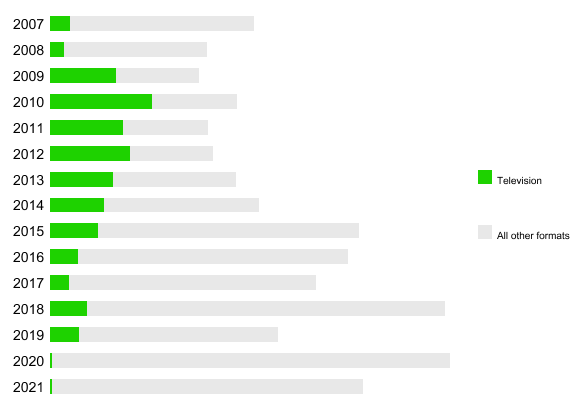
Here in the UK, we got a bonus Bank Holiday if June, to celebrate Queenie’s Platinum Jubilee… and, on the first of them, I watched the fairly-obscure (I’d certainly never heard of it before) 1938 film Bank Holiday. The film and modern real-life event aren’t really connected in any way (no Jubilee going on in the film), but hey-ho.

Best Accent of the Month
Accents in films are a funny business. Sometimes, people don’t even bother: witness My Name Is Julia Ross, a Hollywood production set entirely in London and Cornwall, where half the cast don’t even bother to attempt English accents. Sometimes, you wonder if people needed to: take The Ghost Writer, where it feels like everyone’s doing one accent or another, be it Scots and Americans doing English, or Brits doing American. And then there’s films that are a wonder unto themselves, like House of Gucci, where the entirely-English-speaking cast are doing ‘Italian’ as if they’re in a Dolmio advert. “I cooka da pasta” indeed.

The Audience Award for Most-Viewed New Post of the Month
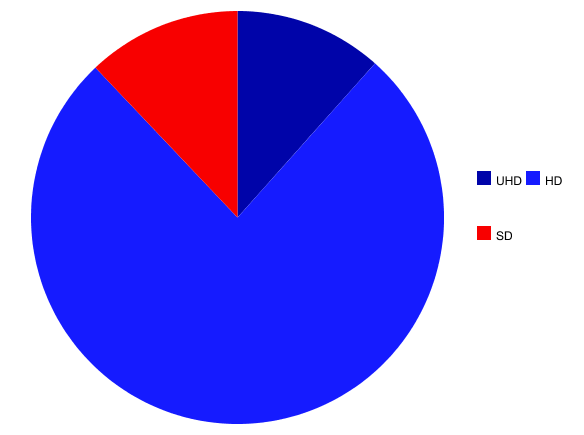
For the second month in a row, my monthly failures roundup — namely, May’s Failures — has topped the chart. I say “topped”: it was the highest new post, but 29th overall. I guess my new reviews just haven’t been that interesting. (My ‘mistake’ has been stopping TV reviews: 24 of the 28 posts above May’s Failures were old TV columns.)


Every review posted this month, including new titles and the Archive 5


Y’know, I still haven’t been to the cinema yet this year. I keep meaning to see Top Gun: Maverick, but things keep getting in the way. But, as of today, my local cinema have put it back on to their biggest screen for the weekend, so maybe I’ll finally pull my finger out and get there in the next couple of days.

As for the rest of the month… oh, who knows!

2021 Statistics

Enough about my shiny new look (although, if you missed all that, you can read about it here) — let’s go back to digging through the remains of 2021. And we begin (or, rather, resume) with one of my personal highlights of the entire year: the statistics. Regular readers will know what this is all about, but if you’re new to these parts and enjoy things like percentages and graphs… oh boy, you’re in for a treat!

Before we begin, a quick word that, because I’m a Letterboxd Pro member, I also get a yearly stats page over there. My 2021 stats can be found here. I don’t only log new watches on Letterboxd, so any overlapping statistics will be slightly different, but they mainly have different categories (like repeat cast & crew members — so you can, for example, find out which actor appeared in the most films I watched last year).

And now…


I watched 207 new feature films in 2021. That means it ranks 3rd all-time, passing 2015’s 200 by a solid seven films, but coming far shy of the top two: 2018’s 261 and last year’s 264.

I also ran my Rewatchathon for the fifth year in 2021. I’ve spent all of that time thinking I ought to include it in the statistics properly, and all of that time not getting round to deciding how exactly to incorporate it, and now it’s over — I’m doing something slightly different next year. Well, maybe that will finally compel me to square the circle. Anyway, I rewatched 33 films — short of my target of 50, but not that bad else wise. That makes a combined total of 240 films, which is another distant 3rd place finish, behind last year’s 310 and 2018’s 311.


NB: I have no rewatch data for 2007 and only incomplete numbers for 2008.

I also watched four short films last year, which is my lowest total for those since 2016. A shame after the past two years saw me set new records each year, but then I’ve never made a concerted effort to watch shorts. Maybe I should. As always, the only stat they count towards is the total running time, and they barely make a dent there. To wit: the total running time of new features was 357 hours and 12 minutes, while adding the shorts bumps it to 357 hours and 58 minutes — just a 46-minute increase. That’s my smallest “others” total ever, barely even visible on the graph below (it’s 1 pixel high).

Here’s how that viewing played out across the year, month by month. The dark blue line is new feature films and the pale blue line is my Rewatchathon. Last year I included a pale green line for shorts, but that seemed a bit pointless this year. Last year I noted that, while the precise values of the graph changed each year I’d been running it (since 2018), the rough shape stayed the same: quickly climbing to a peak in April or May, then lower and bumpier to the end of the year. 2021 bucks that trend entirely, with the high point coming in February, before it almost tapers off, but spikes up dramatically in August and December, traditionally two of my weaker months. What does this tell us? Maybe not to rely too much on precedent.

Next up, the formats on which I watched those films. Despite my continued advocacy (and purchasing of) physical media, it’s digital that once again romps away with the crown here, accounting for 150 films, or 72.46% of my viewing. That’s down slightly from last year’s 73.9%, but is still above the 2015–2021 average, which is 58.5%. I’d definitely like to get it down closer to 50%; or, even better, to see Blu-ray beating it, considering I buy so many of the darn things.

Of course, a lot of individual formats and services contribute to that digital total. The top spot therein is a tie between Amazon, topping the list for the fourth time in five years, and downloads, each with 35 films (23.3% of digital). Downloading was second last year, so that isn’t actually a huge change. The same could be said of the next few places on the chart: last year Netflix and Now tied for third, while this year Netflix is there by itself, with 26 films (17.3%), and Now is just behind, on 22 (14.7%); and iPlayer comes fifth, with 16 (10.7%). Last year there were three other services to mention: AMPLIFY!, which didn’t occur this year; YouTube, which I didn’t watch anything on this year; and Disney+, which retains that position kinda by default, with seven films (4.7%). Rounding out the digital services were MUBI on five (3.3%), All 4 on three (2%), and Apple TV+ managing a solitary one (0.7%). Most of their original content seems to be TV, although they did have a couple of other films that interested me, so that really should’ve been higher — but then I could say that about all the streamers (I mean, just look at my failures list each month).

A very distant second place in the format war goes to Blu-ray with 51 films (24.6%) — just a third of digital’s tally, I’m ashamed to point out. It’s the format’s 14th year on this list and its 4th highest total, which doesn’t sound too bad, but as a percentage it pales besides the 40% I was hitting a decade ago.

Between them, digital and Blu-ray accounted for a staggering 97.1% of my viewing in 2021, up on the 95.5% they represented last year. To be precise, that’s 201 out of 207 films. The remaining six were split equally between three other formats — again, to be precise, that means DVD, TV, and cinema each clocked just two films (0.97% each). Here’s a graph showing how much DVD has fallen — something that should improve next year, at least a bit. (If you want an idea of how much it might grow, 2018 had exactly 12 DVD watches.)

A similar “once mighty, now not” slump has befallen TV across the decades, its place in my viewing schedule now definitively overtaken by streaming.

And finally, the cinema, brought low by Covid for the second year in a row. More films that I was interested in were screening, but is it worth the risk? And we’re all hoping 2022 will be better, but how much is still a question mark. We’ll see in a year’s time…

In amongst all that, I watched 24 films in 4K — a drop from last year’s 40, but still above any year before that (2019’s total was 15, for example). On the other hand, I watched just three in 3D, my lowest total there since I got my 3D TV back in 2017. New releases on the format are dwindling (even Disney, who were previously reliable with Marvel and Pixar titles, now only release the former on 3D BD in Japan, with no sign of the latter), but I’ve still got a not-insignificant pile of 3D discs I’ve bought and not watched yet. It’s somewhat ironic, then, that all of my 2021 3D watches were films I don’t own or can’t get on disc, so were downloaded by other means (wink wink, nudge nudge).

Topping both of those this year was the number of films I watched in SD. Yep, really. Between some downloads, some streams, and those couple of DVDs, I watched 25 films in SD in 2021. At 12.1% of my total viewing, that’s actually the second highest percentage since 2016. What’s more interesting is that, although it means the percentage fluctuates somewhat, the actual number of SD titles I’ve watched has been pretty consistent for years: the average for the past six years is 23.6, most falling in the 23–25 range. While it’s nice to watch as much in HD (or even UHD) as possible, there are some titles that are just so hard-to-come-by that one has to settle for lower quality. While “SD” might make many of us think of DVD-level quality, several of this year’s SD titles were more “recorded off TV to VHS then ripped to digital”-level. Yeah, they looked and sounded awful, but when that’s the only way to see the film at all…

Of course, it tends to be older films that only exist in such low quality, and my viewing on the whole skews newer (though don’t get me started on the fact some brand-new productions still receive DVD-only releases). But as the new decade continues to get underway, the question is: how new? It took the 2010s until 2012 to usurp the 2000s at the top of my decade chart. Could the 2020s manage it a year earlier? In short, no — but it’s close! The 2010s are still in first place, but with only 46 films — that’s their lowest since 2012, coincidentally. It represents 22.2% of my viewing this year, the lowest-ever percentage for a top decade (at the same point, i.e. in 2011, the 2000s still had 35.2%). And the 2020s are snapping at their heels, just three films behind on 43 (20.8%). The margin between these two decades was 33% last year, but this year it’s just 1.45%.

In third place comes the ’90s with 22 films (10.6% — exactly double their percentage in the last two years). That’s their best total ever, their highest placing since 2017, and their best percentage since 2010. Why did they do so well? Oh, don’t ask silly questions (i.e. I have no idea. Chance, I guess). There’s an even bigger surprise in fourth place, though: the 1930s with 18 films (8.7%). Their previous best showing was last year, with just six films (2.3%), and their previous best percentage was way back in 2008, at 3.8%. And with the 1940s coming in fifth with 16 films (7.7%), also their best-ever result, could this be a preview of years to come? Well, I have set myself the task of watching at least 12 films noir next year…

Things continue to ping back and forth in time as we move down the chart. Next is the ’80s on 15 (7.2%), followed closely by the 2000s on 13 (6.3%), followed even more closely by the ’70s on 12 (5.8%), and right behind them are the the ’50s on 11 (5.3%) — far down the chart though it may be, it’s still their highest ever total. Indeed, never before have so many decades reached double-figure tallies in a single year.

Rounding out the list, the ’60s have an uncommonly low five (2.4%), while bringing up the rear are the 1920s on four (1.9%) and the 1910s on two (0.97%) — not their best result (2007 and 2010 were both higher), but only the sixth time they’ve featured at all in 15 years. Finally, no features for the 1900s & earlier, but they were represented by a single short film, for only the third time ever (the previous occasions being 2013 and 2020).

There’s somewhat less variety in where films came from, with the USA once again dominating countries of production, having a hand in producing 140 films. However, at just 67.6% of my total viewing, it’s their lowest percentage ever (down from last year’s 68.6%, the first time it had been below 70%). There’s nothing wrong with US movies, but there’s a whole world out there and it’s nice to spread one’s viewing around a bit. To wit: there were a total of 35 production countries represented in my viewing this year, the second best ever (behind last year’s 40, when there were almost 28% more films, so, y’know, fair enough). Some of the more unusual ones (in terms of my own viewing) included Latvia, Estonia, Ethiopia, Lebanon, Peru, and Romania.

Back at the top end of the chart, the UK took its usual second place, with 54 films (26.1%). France returned to third place, a position it’s held for six of the ten years I’ve been monitoring this stat, with 18 films (8.7%). Hot on their tail was Japan on 17 (8.2%). Also in double figures were Canada (15, 7.2%) and Germany (12, 5.8%), and coming seventh with seven was Australia (3.4%). China, Denmark, and India were tied on four (1.9%) each, while four countries each had three, eight countries had two apiece, and the remaining 13 had one film each.

All those US and UK films mean that English was the most dominant language, as always. It was spoken to at least some degree in 183 films, or 88.4% of my viewing, a percentage that’s up from the last three years. As I say, this count includes all films where it was spoken enough to merit listing, even if it wasn’t the primary language. Perhaps I should start making a note of just the main spoken tongue for the sake of the statistic… Also as usual, the language in second was a long way off. This year it was Japanese in just 11 films (5.3%). No others made double figures. But overall there were 27 spoken languages (plus five silent films), which isn’t bad. Some more rarely-heard languages this year included Amharic, Estonian, Kiowa, Somali, Tupi… and Klingon.

A total of 178 directors and eight directing partnerships were responsible for the films on 2021’s main list. 16 of them helmed multiple films, led by Leo McCarey with five. Second place is shared, with three apiece from David Hare (the Worricker trilogy) and Reginald Le Borg (all among the Inner Sanctum Mysteries series), while Ishirô Honda helmed two plus one film in a ‘partnership’ (that would be the US cut of King Kong vs. Godzilla, where Honda’s original work was supplemented with US material by Thomas Montgomery). The remaining 12 had two films each, and they were: Jack Bernhard, Bob Clark, Cameron Crowe, George Cukor, Joe Dante, Paul Greengrass, Tom Hooper, Ben Lewin, Anthony Minghella, Mike Nichols, George Stevens, and James Whale.

For a few years now I’ve specifically charted the number of female directors whose work I’ve watched. 2020 saw a new high reached, but sadly 2021 sees it slip back again — although it’s still above 2019, just, so there’s that. My viewing this year included 13 films with a female director (12 solo; one as part of a trio with two men), which comes out as a measly 5.94% of my viewing. As I put it last year, it’s debatable whether the onus should be on me to seek out more films directed by women or on the industry to give more directing gigs to women, but ultimately it’s a bit of both — though I’d argue with more weight on the latter, because I just watch the films I watch; I neither avoid nor seek out female directors especially. Anyway, I do hope this graph will continue to improve in the future, though I’m not sure it will ever approach 50/50 (considering all the older films I watch, which are predominantly directed by men to a farcical degree).

We’re approaching the end now — broadly speaking, because before I dig into 2021’s star ratings, it’s time for an update on a couple of viewing projects I vaguely have on the go. First, the IMDb Top 250: at the time of writing, seven films from my 2021 viewing appear on that famed list. However, because that list is ever-changing, the number I have left to see has only gone down by two, to 28. That’s my poorest showing since 2012. I feel so close to the end now (just 11.2% to go) that I really would like to get it finished off. Of course, new releases ping on all the time (there are currently four 2021 releases on there), but that’s life — if I finish the rest of the list, I can bop them on the head as and when they pop up. Anyway, the current positions of the seven I saw this year range from 52nd (Cinema Paradiso) to 222nd (La Haine).

My next viewing project is the one I call my “50 Unseen”. As regular readers will know, at the end of my annual “top ten” post I always include a list of 50 notable films I missed from that year’s releases. I’ve continued to track my progress at watching those ‘misses’ down the years — which is how I know that 2021 was a particularly poor year for this particular mission. Where previously I would watch at least one film from every list, this year I only managed to hit eight of the 14; and from most I only watched one film, leaving my with a total of 21 films across all 14 lists. That’s the lowest since 2010 (when I only had three lists to work from!) In fact, the last time I watched that few films from even just the newest list was in 2014. And speaking of the newest list, in the first year of watching 2020’s 50, I watched 12 of them — the lowest ‘first year’ since 2010 (again), when I only watched eight films from 2009’s list. You might think this is because 2020 was a poor year for new films, thanks to the pandemic, but there are plenty in that 50 I very much want to see, I just… haven’t. Maybe I’ll finally catch up on them in 2022.

For what it’s worth, the other nine I watched came from 2007, 2009, 2011, 2012, 2013, 2019 (all one film each), and 2015 (three films — why so many more, I don’t know).

All of which means that, in total, I’ve now seen 497 out of 700 of those ‘missed’ movies. That’s exactly 71%, the first time this percentage has dropped year-on-year since 2009 (it was 73.2% last year). On the bright side, that’s still above where it was the year before last (70.3%), so it’s not a total disaster. (As usual, my new list of 50 misses from 2021 will be in my “top ten” post, sometime soon.)

And so, to conclude the statistics for 2021, it’s the climax of every review: the scores.

Now, I need to provide a similar caveat to last year: this stat factors in every new film I watched in 2021, even those for which I’ve yet to publish a review — which, this year, is 98% of them. That means there are some where I’m still flexible on my precise score — those films I’d award, say, 3.5 or 4.5 on Letterboxd, but which I insist on rounding to a whole star on here. For the sake of completing these stats, I’ve assigned a whole-star rating to every film, but it’s possible I’ll change my mind when I eventually post a review (it’s happened before). Still, this section should remain broadly accurate.

Starting at the top end, then, in 2021 I awarded 25 five-star ratings, which means 12.1% of the films I watched got full marks. That’s at the lower end of my range, which historically spans from 11.9% to 21.2%. I’d put that down to harsher marking rather than poor quality: there were quite a few 4.5-type films where I eventually erred towards the lower score.

As usual, the most prolific rating was four stars, which I gave to 88 films. At 42.5%, that’s a sliver up on last year’s percentage (which was 42.1%), which rather suggests the lower number of five-star films wasn’t all that much due to those 4.5s after all… unless a lot of 3.5s got the rounded-down treatment too, of course.

Well, there were 63 three-star films, which is the third highest tally ever, behind 2018 and 2020 — both years in which I watched more films. So, really, that’s only appropriate. The historic range of my three-star ratings spans all the way from 19.6% up to 38.0%, so 2021 coming in at 30.4% actually puts it somewhere in the middle.

Indeed, the real gains are to be found among the two-star films, which number 29 — the highest-ever for one year, and the first time there I’ve given out more two-stars than five-stars (although they did draw back in 2012). It comes to 14.01%, which isn’t actually the highest ever… but it is close, because 2008 reached 14.4%. Again, this brings up the usual debate: was this a weak year, or is my scoring getting harsher? I think, at this point in my life, the latter is definitely a factor.

Last, and most definitely least, I handed out just two one-star ratings, which is only 0.97% of my viewing. That’s very typical: I’ve awarded two or fewer single-star scores in 10 out of 15 years, and only three years have pushed its percentage above 1.5%

Finally, the average score for the year — a single figure with which to judge 2021 against other years, for good or ill. The short version is 3.5 out of 5 — that’s the first time it’s dropped below 3.6 since 2012, when it was an anomalous 3.4. Indeed, that’s the first 3.5 score in 15 years (there are five 3.6s, six 3.7s, and two 3.8s). To go to a few more decimal places, it’s 3.507 — still my second-lowest scoring year ever, but it doesn’t stick out quite as egregiously as 2012’s 3.352. Still, it’s only the third time the score’s been below 3.600 (2019 was the other, on 3.589), so it is a low one, whichever way you cut it. Again we ask: was it a weak year, or is my scoring getting harsher? As I said before, I am beginning to feel it’s the latter.

All of which said, let’s not forget: it’s still a pretty good average overall. I mean, it’s well above 3.0, and 3 is a positive score. A ‘true average’ might be 2.5, but then I’d have to watch a lot more bad movies, and who wants to do that? Maybe I could try to watch even more very good / great films, and then maybe the average would rise again… or maybe I’d just worry I was being too lenient. No, at this point I feel I’ve demonstrated a degree of consistency in my marking — so long as the average is in the 3.5–3.7 range, I feel like I’m getting things about right.

And so, I’m sorry to say, the stats are over for another year. I know I’m changing things up from 2022, so will this post look significantly different next year? Y’know, probably not: I love this stuff too much to stop working it all out.


My picks for the best and worst films I saw in 2021. And then my review of 2021 will be over, and you’ll have seen these blue-ish stripey mid-post graphics for the last time!

My Most-Read Posts of 2021

2021 was a relatively quiet year for me, review-wise — I made just 55 posts, vs. over 120 in each of 2019 and 2020, and over 200 in 2018 and 2017. Nonetheless, that’s still enough from which to draw a Top 5, right?

Normally I do a “TV Top 5” and “Film Top 5”, but, as I only posted three TV columns last year, that seems a little pointless. Instead, here’s an overall Top 8 — because of course all the TV posts made the very top of the list, and this means you can deduce the film-only Top 5 if you want to.

Also, the graph in the header image was made with accurate figures, if you want an idea of the posts’ success relative to one another. (A less balloon-obscured version is available here. If you think the two on the left, 7th and 8th, look the same height, they’re not — but they are very, very close: the difference between them has come out as just 1 pixel.)

My Top 8 Most-Viewed New Posts in 2021

8) Psycho Goreman
One of just four reviews I posted in 2021 of new films I watched in 2021. Two of the other three are also in this top eight, while the fourth (Muse: Simulation Theory) came 12th overall. Also worth mentioning (as much as any of this is): Psycho Goreman beat the post in 9th place by just one hit. That was the 100-Week Roundup XXII, for what it’s worth.

7) The Man Who Reviewed Some Films
A four-film compilation, including The Man Who Knew Infinity, The Man Who Knew Too Much, The Man Who Shot Liberty Valance, and The Man Who Sleeps. Was one of those responsible for its popularity? Or is it a unique combo of four fairly-popular films? Who can say. Maybe people were just intrigued by the title.

6) Nomadland
The 2020 Oscar Best Picture winner finally made it to a wide UK release in April 2021, occasioning my review. The mix of awards season success and “new release” status likely explains its success here.

5) The Past Christmas on TV
The 2020 edition of my Christmas TV overview, including Cinderella: A Comic Relief Pantomime for Christmas, Doctor Who: Revolution of the Daleks, Roald & Beatrix: The Tail of the Curious Mouse; a roundup of comedy specials, including Ghosts, The Goes Wrong Show, Not Going Out, and Upstart Crow; plus brief words on Blankety Blank and Have I Got 30 Years for You.

4) No Time to Die
A new James Bond film was too significant to miss — especially one as long-awaited as this — and so it broke my (inadvertent) long run of not posting reviews, and proved unsurprisingly popular with readers, too.

3) Death to 2020
Now, normally this wouldn’t count, because I posted it last year. But I posted it at 11pm on December 31st, and in that first hour it only gained 11 hits, so — under those unique circumstances — it seemed unfair to leave it out entirely. More than unfair, it would be inaccurate: a highly successful post, that could’ve been missed off both the 2020 and 2021 lists due to a technicality of posting time. Anyway, I expect it did well because reviews of Netflix content often do… and because it’s probably more a TV special than a true film, and, as we know, TV reviews usually do best of all. To wit:

2) The Past Month on TV #67
including Dial M for Middlesbrough, It’s a Sin, more of The Twilight Zone, WandaVision episodes 5–8, and A West Wing Special to Benefit When We All Vote. I expect the combo of It’s a Sin (one of the best-received TV series of the year) and WandaVision (the much discussed debut Marvel Disney+ series) is responsible for this.

1) The Past Month on TV #66
including Cobra Kai season 2, Mark Kermode’s Secrets of Cinema series 3, Staged series 2, more of The Twilight Zone, and WandaVision episodes 1–4. All very popular shows, so it figures they would add up to the #1 spot.