
2012, eh? What a year: the Jubilee, the Olympics (I still call it the Jubilympics); the Paralympics; the highest-grossing film in Britain ever; the most-watched video on YouTube ever; the world not ending… it was certainly a year to remember.
Not so much for 100 Films, unfortunately: as we know, I fell just a trilogy box set short of reaching my titular goal. Not the first time, and as we’ll see later it may even have been predictable (except not really). Nonetheless, there are lists to be reeled off and statistics to be over-analysed. And this year there are more statistics than ever! If you’re like me, you’ll be excited by that; regular folk may just skip to the end.
Before those, there’s The List itself. After two years (is that all?) of presenting it in numbered order, I’m switching back to alphabetical. Why? Well, as you’ll see just before said full list, there’s my monthly updates. They cover the year in order, as it happens, and now that I’m linking to them from this post there’s no real need for a numbered list here too. Indeed, for those who like to cut up facts and statistics and lists in multiple different ways (as I do), this means that a year of 100 Films is presented as both numbered and alphabetical lists for the first time — exciting!
And as this post is now longer than ever, here’s a quick contents list, so you can just skip straight to the stuff you prefer…
- As It Happened, being the monthly updates for 2012, containing the numbered list;
- The List, being an alphabetical list of everything I watched;
- Alternate Cuts, Other Reviews, and Shorts, being lists of those;
- The Statistics, being the best bit of the post;
- Coming Next, being a quick reminder that I’m not done yet.
So without further ado…
Below is a graphical representation of my viewing, month by month. More importantly, each of the twelve images links to the relevant monthly update — as noted (three times now?), this is where you’ll find the numbered list of everything I watched this year.








- 102 Dalmatians (2000)
- 16 Blocks (2006)
- 2 Fast 2 Furious (2003)
- 2000 AD, aka Gong yuan 2000 AD (2000)
- Avengers Assemble, aka Marvel’s The Avengers (2012)
- Bad Day at Black Rock (1955)
- Batman: Mask of the Phantasm (1993)
- Batman: The Dark Knight Returns, Part I (2012)
- The Beast Stalker, aka Ching yan (2008)
- Bill Cunningham New York (2010)
- Birth (2004)
- The Book of Eli (2010)
- Burke & Hare (2010)
- The Call of Cthulhu (2005)
- Captain America: The First Avenger (2011)
- Cars 2 (2011)
- Chatroom (2010)
- Conan the Barbarian (2011)
- The Court Jester (1956)
- Cowboys & Aliens: Extended Director’s Cut (2011)
- The Dark Knight Rises (2012)
- A Date with the Falcon (1942)

- Despicable Me (2010)
- Detective Dee and the Mystery of the Phantom Flame, aka Di Renjie (2010)
- Devil (2010)
- Drive Angry (2011)
- The Expendables (2010)
- The Falcon in Danger (1943)

- The Falcon Strikes Back (1943)
- The Falcon Takes Over (1942)
- The Falcon’s Brother (1942)
- Fantastic Four (2005)
- The Final Destination (2009)
- The Gay Falcon (1941)
- Gnomeo & Juliet (2011)
- Green Lantern: Extended Cut (2011)
- Harry Potter and the Deathly Hallows: Part 2 (2011)
- The Hunger Games (2012)
- Ip Man 2, aka Yip Man 2 (2010)
- Iron Sky (2012)
- Ironclad (2011)
- The Keep (1983)
- Knight and Day (2010)

- Kung Fu Panda 2 (2011)
- The Lady Eve (1941)
- The Last Airbender (2010)
- Legion (2010)
- The Lincoln Lawyer (2011)
- The Lost Weekend (1945)
- Love and Other Impossible Pursuits, aka The Other Woman (2009)

- Master and Commander: The Far Side of the World (2003)
- Megamind (2010)
- Moonfleet (1955)
- The Negotiator (1998)
- The Other Guys (2010)
- Outland (1981)
- Passchendaele (2008)

- The Plank (1967)
- Predators (2010)
- Priest (2011)
- Prometheus (2012)
- Rango: Extended Cut (2011)
- Repo Chick (2009)
- The Return of the Musketeers (1989)
- Rise of the Planet of the Apes (2011)
- RoboCop (1987)
- RoboCop 2 (1990)
- Rules of Engagement (2000)
- Rush Hour 3 (2007)
- The Saint in London (1939)
- The Saint in New York (1938)

- The Saint in Palm Springs (1941)
- The Saint Meets the Tiger (1943)
- The Saint Strikes Back (1939)
- The Saint Takes Over (1940)
- The Saint’s Double Trouble (1940)
- The Saint’s Vacation (1941)
- The Scarlet Claw (1944)

- Scre4m (2011)
- Serpico (1973)
- Sherlock Holmes: A Game of Shadows (2011)
- Skyfall (2012)
- Special (2006)
- The Spiral Staircase (2000)
- Stepping Out (1991)

- Stiff Upper Lips (1998)
- The Sum of All Fears (2002)
- Thor (2011)
- Tinker Tailor Soldier Spy (2011)
- Tiny Furniture (2010)
- Tombstone (1993)
- Unauthorized: The Harvey Weinstein Project (2011)

- Underworld: Rise of the Lycans (2009)
- Unknown (2011)
- Unstoppable (2010)
- War Horse (2011)
- With Great Power: The Stan Lee Story (2010)
- M (British version) (1931/1932)
- Batman (1989)
- Batman Returns (1992)
- Batman Forever (1995)
- Batman & Robin (1997)
- Batman Begins (2005)
- The Dark Knight (2008)
- Dr. No (1962)
- From Russia With Love (1963)
- Goldfinger (1964)
- Thunderball (1965)
- Dirty Laundry (2012)
- Marvel One-Shot: The Consultant (2011)
- Marvel One-Shot: A Funny Thing Happened on the Way to Thor’s Hammer (2011)
- Room on the Broom (2012)
- Toy Story Toons: Hawaiian Vacation (2011)
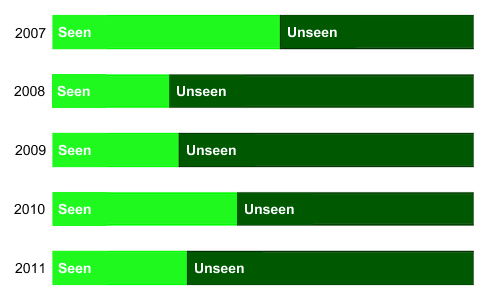
For only the second time ever I fell short of my goal, watching just 97 new feature films in 2012. (All are included in the stats that follow, even if there’s no review yet.) What’s perhaps more interesting is the pattern that I’m forming: in the six years I’ve been doing this blog, I’ve repeated a run of 120-something (2007, 2010), 100-exactly (2008, 2011), and under-100 (2009, 2012). Weird.
I also watched one feature I’d seen before that was extended or altered in some way, as well as reviewing 10 others that I’d seen before (easily the most ever). All 108 films are included in the statistics that follow, unless otherwise indicated. (Despite not making it to 100 on the main list, that’s more films in the stats than either of the two years I made it to 100.)
I also watched five shorts (none of which shall be counted in any statistics). As noted last year, I own quite a few DVDs of shorts (my database informs me that it’s nearly 400 individual short films), so I really should make more of an effort in this area.
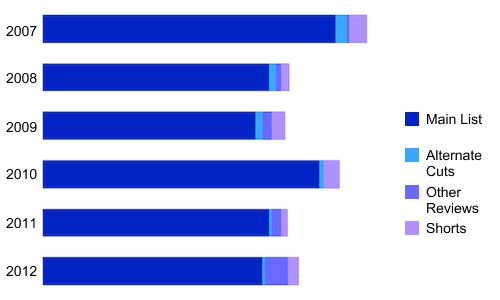
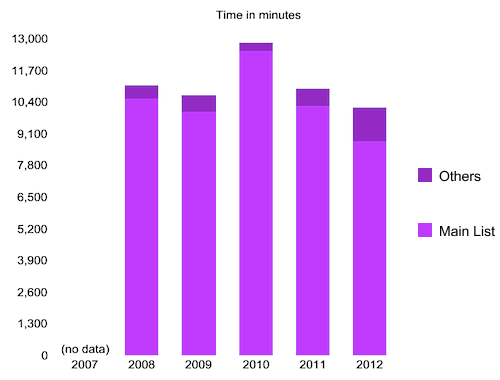
The total running time of new features was 146 hours and 17 minutes. That’s the lowest ever, in part thanks to a lot of Saint and Falcon films that only run around an hour each. The total running time of all films (including, for this stat only, shorts) was 169 hours and 35 minutes. That means that the shorts, alternate cuts and other reviews run nearly 24 hours — over double the next nearest (which was last year, at nearly 12 hours). You may like to compare the following graph to the number-of-features one above — does the total number watched tarry with their total length? (As it turns out, yes, yes it does.)
I saw two films at the cinema this year. That’s the same as last year, and so the joint lowest-ever. Cinemas are so pricey and time-consuming these days. Still, there were near misses for The Avengers and The Hobbit, which would have made it my best year at the box office since 2009. But alas, no.
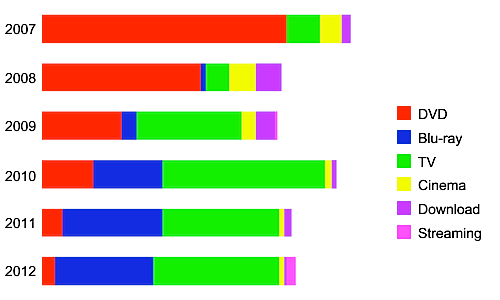
The highest format is once again TV, this year totalling 53 films. After accounting for hardly any of my viewing in the first two years, TV surged to dominance in 2009 and has remained there ever since. Considering the size of my unwatched disc collection, that really shouldn’t be the case. Second place this year again went to Blu-ray (third year running). With 41 films it’s about the same as last year. DVD, however, sinks further into the doldrums: just six SD discs graced my player this year. Again, considering I have literally hundreds of the things I’ve not got round to, that’s a disgrace. There was also a single download (one of the Falcon films that I missed on TV and had to retrieve from iPlayer, as will be the case with all of them when I get on with the rest of the series).
Much to everyone’s surprise, streaming has undergone a resurgence and so makes a moderately significant appearance on the list this year. Whoever thought (even in the comparatively-recent early days of dedicated services like YouTube) that streaming would be a viable way to watch films in a reasonable quality? But that’s where we’re at now, thanks to increasingly fast broadband and a preponderance of rental services looking to make it easy to view films for those punters not all that concerned with image quality. All my streaming films this year were watched on a Wii, via either Netflix or LOVEFiLM. The former seemed to provide DVD-like quality; the latter looks more like an over-compressed downloaded pirate copy. In spite of that, I’m not going with Netflix — I have LOVEFiLM for DVDs/BDs by post, and my package comes with free unlimited streaming (it’s an old one that’s no longer available, haha!) If only they could step up the picture quality… Anyway, four films came down the pipes to me this year — it may not sound like much, but the previous average was 0.2. At this point I wouldn’t like to predict if that will be higher or lower next year.
This year the most popular decade was the 2010s, with 46 films (42.6%). That’s the first time it’s topped the list, just losing out to the ’00s last year. It’s a solid victory: though the first decade of the new millennium still comes in second, it’s with just 21 films (19.4%). It would be an even wider percentage gap were it not for the other reviews (adding a pair of Batmans to the ’00s) — indeed, looking at the main list alone, the three years of this decade account for over 47%. Clearly I err towards the modern.
That said, third place this year goes to the ’40s: buoyed by the Saint and Falcon films, it totals 14 (13%). Of the rest, the ’90s managed a respectable nine (up on last year’s low of five); both the ’80s and the ’60s reached five; the ’30s achieved four; the ’50s made it to three; and the ’70s had just one. That’s every decade since the 1930s covered, the same as last year — oops! I have a moderate collection of silent films that I really should get stuck into. (I’d do a graph for this section, but with all those decades to factor in it’d just be a mess.)
This is also the first full year to feature my new top information line (I say “new” — I was surprised to find this was the first whole year of it, so I guess I started in mid-2011). That means lots of opportunities for new statistics, and so that opportunity shall be seized! The main area this can be applied are the countries and languages info, which reveal I watched 106 films that were either wholly or significantly in English. 106, out of 108. Diverse. Some of those did share languages — Iron Sky, for instance, has a lot of German; and there were a couple of Hong Kong films that also rated English as a listed language. Cantonese and Mandarin chalked up three films apiece, one way or another. And that’s it.
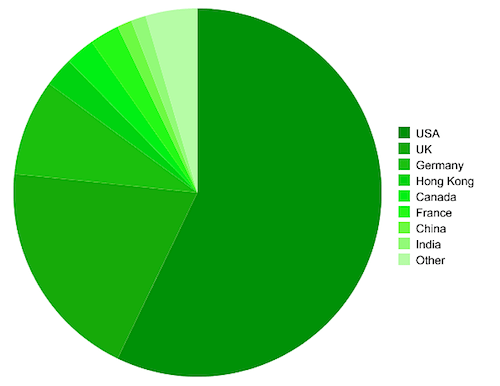
Country-wise, the USA dominate with a massive 88 films (81.5%). No surprise really. Second goes to jolly old Blighty with 30 (27.8%), a mixture of co-productions and… not co-productions. Indeed, it’s the former that gives third place to Germany (13) and accounts for many others, which I’ll list in a minute. Some films could easily be narrowed down to a specific country of origin (several of those German films are definitely US productions with co-funding), but others are truly multi-national — how do you decide where to draw the line? I’ve taken to just listing every country IMDb offers. So some of the following ‘genuinely’ produced films I watched — Hong Kong, Canada (both 4) — while many others were just somehow in on it — France (4), China (2), India (2), and one each for Australia, Finland, Italy, Japan, New Zealand, Singapore, and Spain.
A minuscule three films from the main list appear on IMDb’s Top 250 Films as of New Year’s Day 2013. To put that in perspective, the previous low was seven, and that was half of some years’ total, and a third of the first’s. It’s not as if I’ve seen most of the IMDb Top 250 either — I’m missing about 119. To rub it in, the three I did see are all from the past 18 months. Main lesson: try to watch more classics next year. Nonetheless, the positions of those present range from 38th (The Dark Knight Rises) to 220th (Harry Potter and the Deathly Hallows: Part 2), via 130th (Avengers Assemble). I know, Skyfall isn’t on there! Positively shocking.
As ever, there are too many other similar lists to consider checking them all. And based on those results, I wouldn’t be able to tick much off any of them anyway.
I’ve yet to re-watch any of the films from this list, only the second time that’s happened — and the last was the other year I failed to make 100. Weird coincidence. Not a surprise when one doesn’t see much at the cinema, really — I’ve got more than enough to catch for the first time without re-watching things in under 12 months. That said, a good few of the remaining reviews (especially the lower numbers) will likely require a re-watch before I cover them. Films like Tinker Tailor deserve thought in their review, not a quick dashed-off-from-11-month-old-memories comment or two.
At the end of all five previous years’ summaries I’ve included a list of 50 notable films I’d missed from that year’s releases. With 2012 over, I’ve managed to see (deep breath) one more from 2007 (bringing the total for that 50 to 27), no more from 2008’s list (leaving it at 14), two more from 2009’s (bringing that to 15), and six more from 2010’s (bringing it to 22). Finally, in the year since listing 2011’s 50, I’ve managed to see 16 of them. As that beats all I’ve seen in four years of 2008’s list and three years of 2009’s, it’s not a bad start. Still a lot of viewing to do, mind, and I’ll be adding another 50 from 2012 in my next post.
A total of 85 solo directors and seven directing partnerships appear on the main list. A record low have multiple films on the main list, with just Jack Hively and Irving Reis scoring three (all Saint and Falcon films, respectively) and Scott Stewart claiming a risible pair (Priest and Legion). However, Tim Burton, Joel Schumacher and Christopher Nolan each put in two appearances thanks to my retrospective on the Batman series — which actually makes three for Nolan, as I also saw The Dark Knight Rises. Matching that is Terence Young, director of three of the first four Bond films; and, like Nolan, Fritz Lang features in both the main list and the ‘other’ list, making two for him too. Numbers are rounded out by Guy Hamilton, director of Goldfinger, bringing the overall total of feature directors to 96. (I should also mention Leythum, director of the first two Marvel One-Shot shorts.)
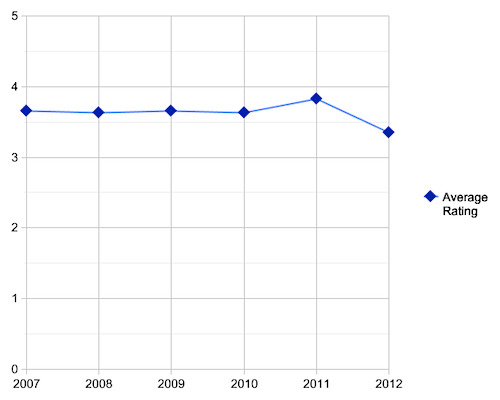
This year’s star ratings kick off with 14 five-star films — the lowest ever (and five of those weren’t in the main list). Conversely, there were five one-star films — the highest ever. Oh dear. Plus, for the first time ever, the majority of films (41 of them) scored three stars. That’s well above average, and the most ever by nine. Consequently, four-star films were well below average, just 34 of them, the lowest ever by eight. Normally they account for around 50% of my scores, but this year it’s just 32%. The only bit of sanity came from the two-star films, back to their regular ballpark with 14 after last year’s record-low-by-half.

That gives an average score of 3.4 — easily the lowest ever. No surprise, considering the low 5s, high 1s, and uncommonly dominant 3s. The first four years’ average score alternated between 3.6 and 3.7, but they were all actually even closer, ranging just 3.63 to 3.66. Last year saw an extraordinary leap up to 3.83, while this year it sinks to 3.35 — a whole half mark lower. No wonder it’s been awkward compiling my top ten (but more on that next time).
Finally, a record-low 26 of the films (plus three of the shorts and all the other reviews) are currently in my DVD/Blu-ray collection.
Nearly done! Later this weekend I’ll look back over the 97 new films I saw to pick out my worst five and best ten, and remind you of 50 new releases from the past 12 months that I’ve yet to see.























 Talking of Halloween, you may have noticed that I’ve been re-posting all of my Saw reviews. Now seemed as good a time as any. To accompany that, I wrote some new words on my opinion of the franchise as a whole. If you missed it, you can read those
  #81a Dr. No (1962)
 #83 Prometheus (2012)





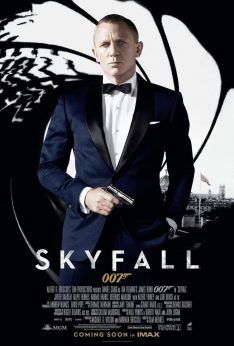 Bond is back, and you’ve surely seen the torrent of 4- and 5-star reviews (and the insignificant handful of dissenting voices). I’m pleased to report that the consensus is correct: Skyfall is Bond at his best.
 Technically speaking, the film looks gorgeous thanks to Roger Deakins’ cinematography. Best looking Bond ever? There’s little I can think of to dispute that. Obviously it could be said to lack some of that ’60s glamour, but from a purely photographic perspective, it shines. (Incidentally, this shot isn’t actually in the film.) I’m less sold on Thomas Newman’s score. While in no way bad, and with undoubted sparing but precise use of the Bond theme, it didn’t always click for me. The fact I at times felt like I was listening to cues from
  honestly, there perhaps aren’t as many twists as you might expect in that department, but the ways they’ve nodded to the franchise’s history are sublime.
 #78 Avengers Assemble, aka Marvel’s The Avengers (2012)