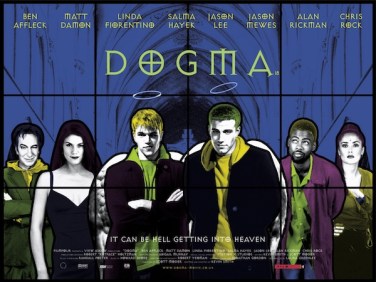
Dogma (1999)

100 Films’ 100 Favourites #24

It can be Hell getting into Heaven.

Country: USA
Language: English
Runtime: 128 minutes
BBFC: 15
MPAA: R

Original Release: 12th November 1999 (USA)
UK Release: 26th December 1999
First Seen: DVD, c.2004

Stars
Ben Affleck (Armageddon, Daredevil)
Matt Damon (The Rainmaker, The Bourne Identity)
Linda Fiorentino (The Last Seduction, Men in Black)
Salma Hayek (Desperado, Frida)
Alan Rickman (Die Hard, Galaxy Quest)

Director
Kevin Smith (Clerks, Red State)

Screenwriter
Kevin Smith (Chasing Amy, Zack and Miri Make a Porno)

The Story
When two fallen angels discover a loophole that might allow them back into Heaven, a normal woman is charged with stopping them before they bring about the apocalypse. Hilarity ensues.

Our Heroes
Abortion clinic worker Bethany has greatness heaped upon her when the voice of God gives her a mission (“I don’t want this, it’s too big.” “That’s what Jesus said.”). She ends up collecting a motley crew of followers and helpers, including 13th apostle Rufus, Serendipity herself, and idiot-prophets Jay and Silent Bob.

Our Villains
Banished angels Loki and Bartleby are fed up with living on Earth, but that’s okay because they’ve found a loophole that will get them back into Heaven. It might destroy the world or something, but, y’know, collateral damage ‘n’ all that.

Best Supporting Character
Alan Rickman again (see also: last time), this time as Metatron — not an anime hero or Power Rangers villain, but the dry-witted, genital-less Voice of God.

Memorable Quote
“Any moron with a pack of matches can set a fire. Raining down sulphur is like an endurance trial, man. Mass genocide is the most exhausting activity one can engage in, next to soccer.” — Loki

Memorable Scene
Whiling away time until they can execute their plan, Bartleby and Loki invade a company’s board meeting and expose the members’ secrets. (Any scene that features Bartleby + Loki + dialogue is among the film’s best bits.)

Truly Special Effect
I suppose it’s a relatively simple one really, but I’ve always thought the various characters’ wings look magnificently ‘real’. That’s the beauty of practical effects for you.

Letting the Side Down
This isn’t about the film itself, but they made a behind-the-scenes documentary, called Judge Not: In Defense of Dogma, which wasn’t actually ready for the film’s DVD release. Instead, it was included on the later DVD of Vulgar (not heard of it? Me either.) Eight years later, when Dogma made its way to Blu-ray, the making-of… still wasn’t included. I mean, how hard is it to pay attention when creating a new release and do more than just “copy and paste” the DVD’s contents?!

Making of
Even before the film opened it was picketed by Christian protestors. Unbeknownst to that mob, the film’s writer-director Kevin Smith joined them… and, unrecognised, got interviewed on TV. Sounds kinda implausible, but it happened.

Awards
1 Razzie nomination (Worst Supporting Actress (Salma Hayek, also for Wild Wild West))

What the Critics Said
“those who would call it sacrilegious (and there will be many) should look beyond the foul language and crude humor, to see more deeply into Smith’s intentions to give the dusty doctrines of the ancient faith a fresh new perspective. Foul language aside, the film has some interesting things to say about human nature, and about the nature of those non-humans we have come to know and love, and hate, and pray to, and obsess about, over the last few millennia.” — John R. McEwen, Film Quips

Score: 67%

What the Public Say
“The beginning of the movie has a few disclaimers pleading with a sensitive audience to not hate this movie because of its seemingly antireligious rhetoric. To be honest, I thought the message of ultimate religious tolerance was fairly clear. […] I don’t think Dogma will make you examine your faith any more than before you watched it. Instead it will let you turn a more satirical eye to the absurdities of the modern church bureaucracy and hopefully make you laugh a little bit about how ridiculous some of this shit is. It’s okay to have faith in a higher power, but getting too extreme with your ideals can make you an asshole.” — ThomFiles

Verdict

Not nearly as disrespectful to Christianity as the Bible-bashing protestors would like you to think, Kevin Smith’s religious comedy can be a bit of a mixed bag — the story is occasionally a tad baggy and the toilet humour sometimes goes too far for my taste, but there are plenty of amusing scenes, lines and performances. Irreverent and crude, to be sure, but sometimes surprisingly clever, and consistently funny.

#25 will be… setless.
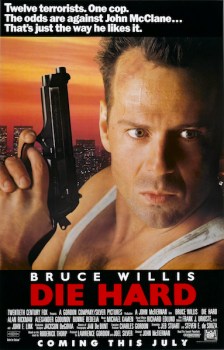
Die Hard (1988)

100 Films’ 100 Favourites #23

Twelve terrorists. One cop.
The odds are against John McClane…
That’s just the way he likes it.

Country: USA
Language: English
Runtime: 132 minutes
BBFC: 18 (1988) | 15 (2007)
MPAA: R

Original Release: 15th July 1988
UK Release: 3rd February 1989
First Seen: DVD, 2003

Stars
Bruce Willis (Twelve Monkeys, The Sixth Sense)
Alan Rickman (Robin Hood: Prince of Thieves, Sense and Sensibility)
Reginald VelJohnson (Turner & Hooch, Die Hard 2)
Bonnie Bedelia (Die Hard 2, Presumed Innocent)

Director
John McTiernan (Predator, The Hunt for Red October)

Screenwriters
Jeb Stuart (Another 48 Hrs., The Fugitive)
Steven E. de Souza (The Running Man, Beverly Hills Cop III)

Based on
Nothing Lasts Forever, a novel by Roderick Thorp.

The Story
While off-duty cop John McClane is visiting his estranged wife at her office Christmas party, a gang of terrorists enter the building and take the guests hostage. McClane avoids capture, making him their only hope of rescue…

Our Hero
One of New York’s finest unfortunately caught in the wrong place at the wrong time… or, as it turns out, the right place at the right time. They’re currently working on an “origin story” movie for cop John McClane, which is daft because Die Hard is his origin story — he may’ve become an action hero in later movies (I wouldn’t know, I still haven’t got beyond the second), but here McClane is just an ordinary cop. Well, a very committed ordinary cop, anyway.

Our Villain
Smart, witty, and thoroughly ruthless, Alan Rickman’s big-screen debut is a flawless turn that defined thriller villains (British-accented terrorists with a secret plan) for at least the next half-decade. No one does it better, though.

Best Supporting Character
McClane’s only real friend, Sgt. Al Powell is a beat cop on the outside who just happens to pick up his signal. Fortunately, he’s much smarter and more helpful than a team of FBI agents. Well, aren’t we all?

Memorable Quote
Hans Gruber: “Do you really think you have a chance against us, Mr. Cowboy?”
John McClane: “Yippee-ki-yay, motherfucker.”

Quote Most Likely To Be Used in Everyday Conversation
See above.

Memorable Scene
As Gruber lectures the collected hostages on how the terrorists have planned for every eventuality, a nearby elevator door pings open. One of the hostages screams, Gruber and co rush over, to find one of their compatriots dead with a message scrawled on his sweatshirt: “Now I have a machine gun, ho-ho-ho.”

Truly Special Effect
When the bomb in the elevator shaft blows out the side of the building, the effect was accomplished by collecting virtually every camera flashbulb of a particularly powerful type and wiring them to the outside of the actual building to simulate the flash, then superimposing a shot of an actual explosive blowing a hole in an all-black miniature of the building.

Making of
The filmmakers struggled to find a way for McClane and Gruber to meet prior to the movie’s climax. The scene in which they do, where Gruber pretends to be one of the hostages, was dreamt up after it was discovered Alan Rickman could do a good American accent.

Previously on…
Die Hard is adapted from a novel, which is a sequel to one called The Detective, which was filmed in 1968 starring Frank Sinatra as the lead cop (called Joe Leland rather than John McClane). When production began on Die Hard, Fox were obligated to offer the lead to Sinatra. Fortunately for them, he turned it down.

Next time…
Lightning struck twice for unlucky John McClane when he got embroiled in another Christmastime terrorist incident in Die Hard 2, aka Die Harder; then Gruber’s brother sought revenge in trilogy-forming Die Hard with a Vengeance. Years later, someone realised there was money to be made, leading to poorly-received cash-in sequels Live Free or Die Hard, aka Die Hard 4.0, and A Good Day to Die Hard. A sixth is in development.

Awards
4 Oscar nominations (Editing, Sound, Sound Effects Editing, Visual Effects — or, to put it another way: Sound, Effects, Editing, Sound Effects Editing)

What the Critics Said
“From its trailer, Die Hard looks like a typical action movie of the ’80s: a sweaty, bare-chested, all-American hero battles swarthy, heavily accented terrorist villains, accompanied by lots of high-tech explosions, vast sheets of breaking glass and enough sophisticated weaponry to account for the Pentagon’s budget overrun. As directed by John McTiernan, it turns out to be something more — the archetypical action movie of the ’80s, the perfection of the form. Sleekly engineered, impeccably staged and shrewdly dosed with humor and sentiment, Die Hard has everything but a personality.” — Dave Kehr, Chicago Tribune

Score: 92%

What the Public Say
“Vulnerable but witty, McClane is a very well realised action hero who has set precedence as far as similar roles are concerned. […] Unlike Schwarzenegger and Stallone, Willis’ McClane is not the archetypal heroic figure that is invincible and untouchable. He gets his butt handed to him regularly and often finds himself panicking with frequent looks of nervousness and even fear.” — Billy’s Film Reviews

Verdict

The action movie to end all action movies… or, y’know, spawn endless sequels and rip-offs. But Die Hard really did perfect the mix: a capable but not superhuman hero, a genuinely threatening but enjoyable-to-watch villain, plenty of thrills and tension, but also humour and eminently quotable dialogue. And it’s set at Christmas (though originally released in July — what?!), which makes it ideal for seasonal counter-programming. What more could you ask for?

Prepare thyself… for #24.

Cube (1997)

100 Films’ 100 Favourites #21

Don’t look for a reason.
Look for a way out.

Country: Canada
Language: English
Runtime: 90 minutes
BBFC: 15
MPAA: R

Original Release: 11th July 1998 (Netherlands)
UK Release: 25th September 1998
First Seen: TV, c.2000

Stars
Maurice Dean Wint (Rude, Nothing)
David Hewlett (Scanners II: The New Order, Cypher)
Nicole de Boer (Star Trek: Deep Space Nine, Corrupt)
Nicky Guadagni (Crash, Lars and the Real Girl)
Wayne Robson (Interstate 60: Episodes of the Road, Survival of the Dead)

Director
Vincenzo Natali (Cypher, Splice)

Screenwriters
Andre Bijelic
Vincenzo Natali (Splice, In the Tall Grass)
Graeme Manson (Rupert’s Land, Orphan Black)

The Story
Six strangers wake up inside a mysterious 14-foot cube, its walls covered with circuit-like designs and each wall containing a door… which leads to another cube, identical but for the colour scheme. They soon realise that some of these rooms are boobytrapped with death-dealing devices. If they combine their different backgrounds and strengths, perhaps they can find a way out…

Our Heroes
The six individuals we follow are a fractious bunch. You may side with one or two, but at any given moment something might happen to make you rethink who should or should not be trusted.

Our Villain
The Cube itself is the enemy here… although with the amount our group fight amongst themselves, maybe it’s not the only problem…

Best Supporting Character
Part way through the film, our gang come across Kazan, who clearly has some kind of mental problem. I thought Andrew Miller’s performance was decent, but pretty much every other review of the film criticises all of the acting, and I’ve never seen Rain Man (a regular point of comparison), so who knows?

Memorable Quote
Holloway: “What does it want? What is it thinking?”
Worth: “‘One down, four to go.'”

Memorable Scene
The opening scene, which quickly establishes the danger of the environment so succinctly and memorably that Resident Evil ripped it off a few years later.

Technical Wizardry
The characters move through many rooms in the cube, a challenge for a low-budget production… unless, of course, all the rooms are nearly identical: there was only one cube set, with coloured panels changed to suggest the different spaces.

Making of
All of the characters are named after famous prisons around the world. Not only that, but their personalities reflect the characteristics of those prisons. To say too much might spoil parts of the film for those who’ve not seen it, but the curious can find a fuller explanation here.

Next time…
There are two sequels to Cube, Hypercube and Cube Zero, each worse than the last. Don’t waste your time.

Awards
1 Saturn nomination (Home Video Release)
Toronto International Film Festival — Best Canadian First Feature Film

What the Critics Said
“They don’t agree on the best course of action, and might one of them be a spy for whomever is in charge? The grating mechanical noises that echo through the Cube all around them seem to be the manifestation of the stress they’re under, stress they act out on one another. Holloway estimates they have only a few days without food and water before they’re too weak to continue, and yet they slow themselves down with their virulent bickering. […] As Rennes says, “Ya gotta save yourselves from yourselves,” and they’re not doing a terribly good job of that.” — MaryAnn Johanson, flickfilosopher

Score: 62%

What the Public Say
“you can’t make [the plot] sound interesting — “for 90 minutes, people move through largely identical cubic rooms that want to kill them”. But it is interesting, mainly, and here’s where the Twilight Zone comparison is useful. […] the cast ends up filling somewhat allegorical roles: the Teacher, the Authoritarian, the Intellect, the Survivalist. And Cube, in finest Rod Serling fashion, plays out as a series of conundrums in which the audience is invited to think about how these different types, that is to say, these different worldviews and moral codes, interact with each other in a patently allegorical environment” — Tim Brayton, Antagony & Ecstasy

Elsewhere on 100 Films
I offered some thoughts on Cube when I watched the two sequels back in 2008: “In its series of careful, measured, necessary reveals, the film strikes a perfect balance between what it lets the viewer know — and the revelations are expertly paced throughout — and what it keeps hidden, either for the viewer to deduce or interpret for themselves, or simply because one doesn’t need to know. […] everyone interested in the more intelligent end of the sci-fi spectrum should see Cube.”

Verdict

Regular readers will know of my fondness for the single-location thriller. A lot of that likely stems back to Cube, which I think pioneered the form as a popular one for new filmmakers making low-budget genre pictures, and is the yardstick all others must measure up to, at least for me. Throw a mismatched group of characters into a confined, mysterious setting and, hey presto, instant drama. Cube remains one of the best because of both the mysteries of its location, and the pure tension director Vincenzo Natali creates as the cast try to avoid or evade the deadly traps.

Next… yippee-ki-yay, #23 !

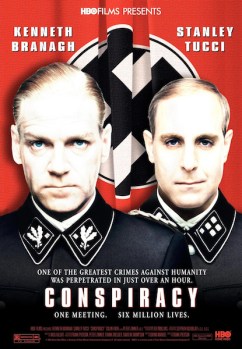
Conspiracy (2001)

100 Films’ 100 Favourites #20

One meeting. Six million lives.

Country: UK & USA
Language: English & German
Runtime: 96 minutes
BBFC: 15
MPAA: R

Original Release: 19th May 2001 (USA)
UK Release: 25th January 2002
First Seen: TV, 25th January 2002

Stars
Kenneth Branagh (Henry V, Valkyrie)
Stanley Tucci (The Terminal, The Hunger Games)
Colin Firth (Bridget Jones’s Diary, The King’s Speech)
David Threlfall (Scum, Nowhere Boy)
Kevin McNally (Pirates of the Caribbean: The Curse of the Black Pearl, Valkyrie)

Director
Frank Pierson (The Looking Glass War, A Star is Born)

Screenwriter
Loring Mandel (Countdown, The Little Drummer Girl)

The Story
1942, Berlin: a group of high-ranking Nazis gather for the Wannsee Conference, its purpose being to determine the method by which they will implement Hitler’s policy of making Germany free of Jews. Put another way, this is the meeting that created the Final Solution.

Our Heroes
I mean, they’re all Nazis, plotting the Final Solution — heroes are in short supply. That said, some object… just not very many, and not for long.

Our Villains
I mean, they’re all Nazis, plotting the Final Solution — there are plenty of villains. Chief amongst them, however, is SS-Obergruppenführer Reinhard Heydrich (Branagh), whose calm and charming demeanour hides a will of steel and a sure belief in their terrible purpose.

Best Supporting Character
There’s a strong cast of British character actors (as well as those mentioned above, we have Ian McNeice, Ben Daniels, Brendan Coyle, Owen Teale, Peter Sullivan, Nicholas Woodeson, and Jonathan Coy — you might not know all the names, but you’ll likely know the faces), so it’s hard to name just one stand-out. However, Dr. Wilhelm Stuckart (Colin Firth) is particularly memorable: he’s a nice guy because he only wants to sterilise the Jews. He’s also one of the few men in the room who’s aware of how the rest of the world will judge them if they proceed down a path of extermination.

Memorable Quote
Hofmann: “Evacuation to where?”
Heydrich: “Let us postpone that question for a while.”
Klopfer: “To hell, one hopes.”
Lange: “Many already have.”
Luther: “Do they even have a hell?”
Heydrich: “They do now. We provide it.”

Memorable Scene
Although it’s bookended by arrivals and departures, and occasionally broken up in the middle with pauses for food, etc, the film is essentially one long meeting. Which sounds incredibly dull, but of course isn’t.

Making of
Pierson chose to shoot the film’s meeting sequences in long takes, sometimes getting through 20 or more pages at a time. A highly unusual method for a screen production, so the fact most of the cast had a stage background must’ve been a boon. It was shot on Super 16 film for similar reasons: it has longer film magazines and smaller cameras, allowing the cameramen to get closer to the actors.

Awards
1 Golden Globe (TV Supporting Actor (Stanley Tucci))
2 Golden Globe nominations (Best Miniseries or TV Movie, Best Actor in a Miniseries or TV Movie (Kenneth Branagh))
2 Emmys (Actor in a Miniseries or Movie (Kenneth Branagh), Writing for a Miniseries or Movie)
8 Emmy nominations (Outstanding TV Movie, Supporting Actor (both Colin Firth and Stanley Tucci), Directing, Cinematography, Editing, Sound Editing, Sound Mixing)
1 BAFTA TV Award (Single Drama)
1 BAFTA TV nomination (Actor (Kenneth Branagh))
Peabody Award

What the Critics Said
“What a week for thoroughly exceptional, audaciously gripping fact-based dramas. We had Bloody Sunday on Sunday and now here’s Conspiracy. […] The performances are uniformly outstanding, but out of all of them it will be images of Kenneth Branagh as Heydrich you will take away with you. They may even haunt your nightmares. Branagh, who won an Emmy for the role, is flawless, and in Heydrich this fine actor has re-created a monster. Just watch the iron come into his eyes when he is contradicted or questioned. Watch that smooth charm slip as he calmly threatens those who are not completely on his side.” — Alison Graham, Radio Times

Score: 100%
(Sort of.)

What the Public Say
“to see the planning of the Final Solution played out is chilling, to say the least. Obviously, it’s not an easy watch, but it’s an important film. If you’re at all interested in how scary and terrible things happen in this world, and how the death of millions can be plotted the same way your company runs a board meeting, this is definitely a movie to see.” — Dan Bergstrom @ Letterboxd

Verdict

“A group of men have an administrative meeting” is possibly the least exciting logline for a movie you could ever read, but when those men are Nazis, at the height of the Third Reich’s pomp and opulence, and the businesslike meeting is to plot one of the greatest atrocities ever committed by mankind, it becomes horrendously fascinating. For that we can also thank Loring Mandel’s precise screenplay, and perfectly calibrated performances from a magnificent cast of seasoned actors.

#21 will be… nothing to do with Phillip Schofield.

The Past Month on TV #2

This month, another ragtag selection of programmes I’m not watching at the same speed as anybody else.

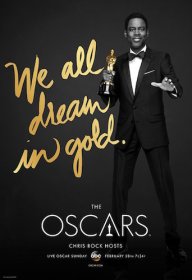
The 88th Academy AwardsThe Oscars
They feel so long ago already, don’t they? But no, the Oscars were just a couple of weeks back. I thought it was a pretty good show this year. Chris Rock ended up belabouring the race point a bit by the end, including a few gags that went very wrong, but his opening monologue was good, as were some of the skits on the way. That there were a few surprise winners also helped keep things ticking along nicely, though (without having seen it) I think Spotlight is already destined to be an obscure answer to “name a film that won Best Picture” within a couple of years.

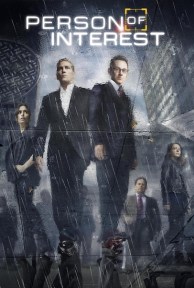
Person of Interest (Season 4 Episodes 1-3)
Person of InterestI have very mixed feelings about Person of Interest, whose fourth season has only made it to UK TV in the past few weeks (the belated fifth starts in the US in May, they announced yesterday). When it works, it’s a good quality vigilante/procedural action show; but its array of arc plots are as unrewarding as they are never-ending, and are consequently unsatisfying to a fault (literally). However, now that I’m so deep into it, and with cancellation finally confirmed (the foreshortened and delayed fifth season will indeed be its last, as was also finally announced yesterday), I feel like I’m in ’til the bitter end. The makers just bloody better have had the notice to get a proper ending into that now-final episode…
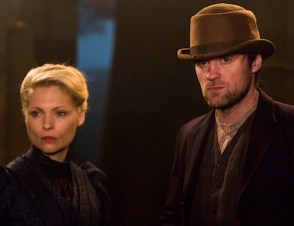
Ripper Street (Series 4 Episodes 5-6)
Ripper StreetWhen Amazon picked up Ripper Street after the success of the third series, it was for a fourth and fifth season totalling 13 episodes. The show’s writers seem to have taken the double recommission to heart and crafted an arc plot to last throughout those two seasons, meaning this first half ends on a big surprise and with all sorts of things left up in the air. And now we have to wait. Still, it’ll be fascinating to see how there are six or seven more episodes left, considering the predicament they’ve put the characters in.

Shetland (Series 3 Episodes 3-6)
ShetlandI think I sounded a little more dismissive of Shetland than I’d intended in last month’s review. The remainder of the season stepped outside the programme’s usual wheelhouse, heading down to Glasgow and into the world of organised crime, which perhaps lost some of the series’ unique spark. However, it chose to tackle some very heavy issues in the last couple of episodes; the kind of thing that has too often been dumped into dramas as a plot twist without exploring the actual ramifications. Kudos to the writers for dealing with it intelligently and sympathetically, then, and to the cast — particularly Alison O’Donnell — for their incredible performances.

The X Files (Season 10 Episodes 3-6)
The X FilesThe quality of this revival has certainly been all over the place. I was wary of episode three, Mulder & Scully Meet the Were-Monster, because comedy always seems at odds with The X Files’ grand conspiracy storylines, but I thought it was hilarious and deserving of its acclaim as the best episode of the season. Home Again felt like solid standard X Files fodder, and Babylon was clearly trying to be zeitgeisty but perhaps wasn’t fully thought-through. As for the much-maligned finale, My Struggle II… well, it was a mess, and over-ambitious, and a stupid idea to end it on a cliffhanger when no one knew how well the revival would go down. Let’s hope Chris Carter is right that there’ll definitely be more.

Also watched…
  • Dickensian Series 1 Episodes 13-20 — please BBC, can we have some more?
  • Elementary Season 4 Episodes 9-13 — you can adapt the wordplay mystery from A Study in Scarlet all you want, it still doesn’t make you actually similar to Sherlock Holmes.
  • The Flash Season 2 Episode 10 / Arrow Season 4 Episode 10 / DC’s Legends of Tomorrow Season 1 Episode 1 — I can’t be the only person who thinks of these like one show that’s on three times a week.
  • Gilmore Girls Season 3 Episode 11-Season 4 Episode 17 — 71 to go.
  • Grantchester Series 2 Episodes 1-2 — remember when I said I was going to watch fewer crime dramas? Because I didn’t, clearly.
  • The People v. OJ Simpson: American Crime Story Season 1 Episode 2 — who thought this was going to be a comedy?

    Things to Catch Up On
    The Night ManagerThis month, I have mostly been missing The Night Manager. The critically-acclaimed ratings hit is, as you likely know, a spy thriller adapted from a John le Carré novel, which not only means it has pedigree, but that its star — Tumblr-beloved Marvel villain Tom Hiddleston — is now being tipped to take over as Bond. I wouldn’t know, I’ve not seen it yet.


    Next month… Daredevil season 2.

  • Daredevil (2003)

    100 Films’ 100 Favourites #22

    Take the dare

    Country: USA
    Language: English
    Runtime: 103 minutes | 133 minutes (director’s cut)
    BBFC: 15
    MPAA: PG-13 (theatrical cut) | R (director’s cut)

    Original Release: 14th February 2003 (USA, UK & others)
    First Seen: cinema, February 2003

    Stars
    Ben Affleck (Pearl Harbor, Batman v Superman: Dawn of Justice)
    Jennifer Garner (13 Going on 30, The Invention of Lying)
    Michael Clarke Duncan (The Green Mile, Sin City)
    Colin Farrell (Minority Report, Alexander)

    Director
    Mark Steven Johnson (Ghost Rider, When in Rome)

    Screenwriter
    Mark Steven Johnson (Grumpy Old Men, Ghost Rider)

    Based on
    Daredevil, a Marvel Comics superhero created by Stan Lee and Bill Everett.

    The Story
    Blind New York lawyer Matt Murdock defends the innocent by day, and by night uses his special abilities to bring the guilty to justice as costumed vigilante Daredevil. When crime boss Wilson Fisk, aka Kingpin, hires Bullseye to take out a business associate, the assassin frames Daredevil for the crime, which brings him into conflict with the businessman’s combat-trained daughter, Elektra.

    Our Hero
    Blinded as a child, Matt Murdock found his other senses heightened. Following the murder of his father, he trained in the law. Now by day he’s a defender of the innocent, and by night hunts the guilty as superhero Daredevil. Even though the film mixes in his origin story, it doesn’t take a “Year One” approach to his crimefighting, which makes a change of pace even now. (In recent years a lot of the blame for the film’s failure has been laid at Ben Affleck’s door, because it’s popular to bash ’00s-era Affleck. Rotten Tomatoes’ short summary of contemporary reviews tells a different story, stating “Ben Affleck fits the role” as one of the film’s key qualities.)

    Our Villains
    Coming off the back of The Green Mile, Michael Clarke Duncan was the obvious chap to step into the giant shoes of Hell’s Kitchen’s crime lord, Wilson Fisk, aka Kingpin. The real fun comes courtesy of Colin Farrell’s crazy, campy killer, Bullseye, who enlivens the film any time he’s on screen.

    Best Supporting Character
    Jennifer Garner is terribly miscast as Elektra, really, but she makes a fair fist of it nonetheless, and the film doesn’t shy away from the outcome of that storyline.

    Memorable Quote
    “Hey, that light, at the end of the tunnel? Guess what? That’s not heaven… that’s the C train.” — Daredevil

    Memorable Scene
    Matt and Elektra spar in a children’s playground. It’s a scene some people despise, probably because of what it thinks passes for dialogue, but you can’t say it doesn’t stick in the mind.

    Memorable Music
    If you were of the right age and disposition back in the early ’00s, the Daredevil soundtrack was more influential than the film itself. It was partly responsible for launching gothy rock group Evanescence, who you may remember for Bring Me to Life, which was on the film’s soundtrack and was their biggest hit (it was #1 here for four weeks). I think they’re still going, despite numerous changes of line-up, though they release albums once in a blue moon.

    Letting the Side Down
    “All of it!” Oh, hush, you.

    Making of
    Originally greenlit as a relatively low-budget film, at roughly $50 million, during shooting Sam Raimi’s Spider-Man was released and became a huge hit (it was the first film to gross over $100 million in one weekend). Consequently, Fox upped Daredevil’s budget to $80 million, specifically to “enhance the film’s visuals”. I guess that’s where all the Spider-Man-esque CGI tumbling came from, then.

    Previously on…
    Although this is the first full-blown adaptation of Daredevil to actually make it to the screen, he’s turned up in other characters’ series down the years, including both live-acton (1989 TV movie The Trial of the Incredible Hulk, which starred John Rhys-Davies as Kingpin) and animation (episodes of the ’90s Spider-Man and Fantastic Four series).

    Next time…
    Although no sequel was forthcoming, Jennifer Garner starred in spin-off Elektra. Whatever you think of the 2003 Daredevil, Elektra is much, much worse. Numerous attempts at a reboot movie faltered, until the rights reverted to Marvel Studios, who used the property to kick off the Netflix arm of the MCU. As much as I like the movie, the TV series is much better. Season two is released this Friday, so if you’ve not seen any then you’ll soon have 26 episodes to catch up on, you lucky thing you.

    Awards
    1 Razzie (Worst Actor (Ben Affleck, also for Gigli and Paycheck))
    1 Razzie nomination (Worst Actor of the Decade (Ben Affleck, also for everything else he did in the ’00s))
    1 Kids’ Choice Award nomination (Best Female Butt Kicker)
    2 MTV Movie Awards Mexico nominations (including Best Colin Farrell in a Movie (it lost to S.W.A.T.))

    What the Critics Said
    “This is the Unforgiven of superhero films. Conventions are turned on their head, twisted, questioned. […] In almost every superhero film, there’s another conventional scene where the villain has the hero cornered and helpless. Yet the villain never unmasks the hero. That scene drove me nuts in Spider-Man. […] In Daredevil, no one ever hesitates to unmask DD. That’s what I mean by this being a film grounded in reality. People act real, do real things. Even if they are wearing silly costumes.” — “Dr. Michael Hfuhruhurr”, Ain’t It Cool News

    Score: 44%

    What the Public Say
    “Colin Farrell is deliciously hammy and steals every scene he’s in, showing he’s having a total blast (and to be honest, the hamminess suits Bullseye). Michael Clarke Duncan is PERFECT casting for Kingpin, for his size, stature, overall menacing feel. And honestly, I like Ben Affleck in this, too. He makes me believe he’s blind. He makes me believe that he’s a broken, tortured character who tries to put on a brave face in front of his friends.” — Nick Piers

    Verdict

    The runt of the litter when it comes to the (first) modern explosion of superhero movies, Daredevil has, believe it or not, always had its fans. The darker tone than contemporary X-Men or Spider-Man films works in its favour in that respect, though I know not everyone feels that way. Ben Affleck actually does a solid job as the titular hero, while Michael Clarke Duncan was perfectly cast as hulking villain Kingpin. Most enjoyable, though, is Colin Farrell’s finely-judged camp craziness as henchman Bullseye. Okay, the Netflix series has now easily surpassed it, but the Daredevil movie is still a moderately underrated film for its era. (The Director’s Cut is apparently much better, too, though I’ve still not made the time for it.)

    Season two of Marvel’s Daredevil is available on Netflix from Friday.

    #20 will be next… with character actors planning genocide.

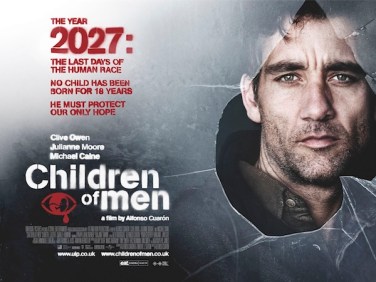
    Children of Men (2006)

    100 Films’ 100 Favourites #19

    The year 2027:
    The last days of the human race.
    No child has been born for 18 years.
    He must protect our only hope.

    Country: USA & UK
    Language: English… and German, Italian, Romanian, Spanish, Arabic, Georgian & Russian, apparently.
    Runtime: 109 minutes
    BBFC: 15
    MPAA: R

    Original Release: 22nd September 2006 (UK)
    First Seen: cinema, October 2006

    Stars
    Clive Owen (Inside Man, Shoot ‘Em Up)
    Julianne Moore (The Hours, Still Alice)
    Michael Caine (The Italian Job, Batman Begins)
    Chiwetel Ejiofor (Serenity, 12 Years a Slave)
    Danny Huston (The Proposition, X-Men Origins: Wolverine)

    Director
    Alfonso Cuarón (Harry Potter and the Prisoner of Azkaban, Gravity)

    Screenwriters
    Alfonso Cuarón (Y Tu Mamá También, Gravity)
    Timothy J. Sexton (Live from Baghdad, The Liberator)
    David Arata (Brokedown Palace, Spy Game)
    Mark Fergus (First Snow, Iron Man)
    Hawk Ostby (First Snow, Cowboys & Aliens)

    Based on
    The Children of Men, a novel by P.D. James.

    The Story
    In the near future, mankind has become infertile, and no child has been born for 18 years. The world has gone to hell, with Britain one of the few countries that still has a functioning government, albeit a controlling, totalitarian one. In this world, government drone Theo is persuaded by his ex-wife, now head of an activist group, to escort a friend out of the country. Turns out that friend is a young woman… who’s pregnant — a situation that interests a lot of dangerous people…

    Our Hero
    Theo, disillusioned former activist, who’s roped back in, initially by kidnap, later with the promise of a hefty payday. Before long it turns out he’s actually a good guy at heart, of course.

    Our Villains
    “The rest of humanity” wouldn’t be a wholly bad answer here, as Theo and co keep bumping up against people violently concerned with their own interests. Within that, there’s the issue of if the activist group’s motives can be trusted…

    Best Supporting Character
    Theo’s friend Jasper, a former political cartoonist turned pot dealer, played by Michael Caine as a John Lennon-inspired old hippy.

    Memorable Quote
    “As the sound of the playgrounds faded, the despair set in. Very odd, what happens in a world without children’s voices.” — Miriam

    Memorable Scene
    Any of the (faked-)single-take action sequences is a worthy pick here. Alternatively, fans of a certain rock group will appreciate the inflatable pig floating over Battersea Power Station.

    Technical Wizardry
    As our heroes escape in a little Fiat, they’re attacked on a country road, the camera moving around the small person-filled vehicle in a single take. They used a special camera rig, along with a car modified to allow the windscreen to tilt out of the camera’s path, and seats that tilted to lower the actors out of the way too. The “single” shot took six takes in four locations, transition effects to seamlessly join shots, and CGI to create the motorbike, windscreen, blood, roof, and more.

    Making of
    The other most memorable single take is near the end, a running street battle during which Clive Owen’s layperson does his best to not get killed. It took 14 days to prepare the shot, with a delay of five hours every time it had to be reset. It was filmed over the course of two days, but only one complete take was actually captured. In the middle of one take, some blood spattered on the camera lens; Cuarón shouted “cut”, but was drowned out by the sound of tank and gunfire. Cinematographer Emmanuel Lubezki persuaded the director to leave it in, and that’s the shot in the final film. Pay attention during the sequence and you can see the liquid and dirt that gets splattered on the lens disappear during one of the ‘seamless’ cuts.

    Awards
    3 Oscar nominations (Adapted Screenplay, Cinematography, Editing)
    2 BAFTAs (Cinematography, Production Design)
    1 BAFTA nomination (Visual Effects)
    1 Saturn Award (Science Fiction Film)
    2 Saturn nominations (Actor (Clive Owen), Director)
    Nominated for the Hugo for Best Dramatic Presentation, Long Form.

    What the Critics Said
    “[Cuarón] increasingly shoots the film’s set pieces in virtuoso long takes — gliding tracking shots that evoke Tarkovsky and handheld work that suggests Kathryn Bigelow. What makes these scenes stunning is not only mind-boggling choreography and timing, with Emmanuel Lubezki’s camera somehow capturing multiple planes of action even while continuously changing position, but also their ability to realistically evoke the frightening chaos and simultaneous madness of war. […] Such overwhelming studio work might be too arty for those who like their genre served sans showiness. But Cuarón is implementing a verisimilitude that both matches the film’s edge-of-your-seat escalations and demonstrates a new understanding of blockbuster realism.” — Michael Joshua Rowin, Stop Smiling

    Score: 92%

    What the Public Say
    “Cuarón uses sequences evocative of Holocaust imagery and detention camps to implicitly communicate a world rife with injustice and pain. In designing the look of the film, Cuarón told his art department that he did not want inventiveness, but reference, so that an audience would be able to adequately recognize a distorted form of their own reality. For the reader and viewer who encounter this uncanny world, it feels all the more real because of its familiar elements.” — Mariel Calloway

    Verdict

    I saw Children of Men on a whim back in 2006. I can’t even remember why — I don’t think I’d seen any trailers or reviews, and it had been open for a good few weeks already. It was a time when I went to see loads at the cinema, though (in those days I paid good money to see Fun with Dick and Jane — does anyone even remember that?), and I think it may’ve been the only thing still on. Anyway, it meant I actually got in a little ahead of the hype that has gradually (and justifiably) grown around the film since, and still loved it. Cuarón mixes intelligent near-future sci-fi with exciting, and excitingly-realised, action sequences to create an action-thriller of a movie that stimulates both the mind and the adrenal glands. A fantastic film in every respect.

    #22 will be next… to give the Devil his due.

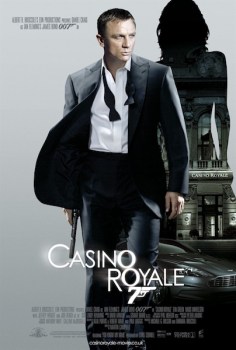
    Casino Royale (2006)

    100 Films’ 100 Favourites #18

    Everyone has a past.
    Every legend has its beginning.

    Country: UK, USA, Czech Republic & Germany
    Language: English
    Runtime: 144 minutes
    BBFC: 12A (cut, 2006) | 15 (uncut, 2012)
    MPAA: PG-13 (cut)

    Original Release: 14th November 2006 (Kuwait)
    UK Release: 16th November 2006
    US Release: 17th November 2006
    First Seen: cinema, 16th November 2006

    Stars
    Daniel Craig (Layer Cake, The Girl with the Dragon Tattoo)
    Eva Green (The Dreamers, Sin City: A Dame to Kill For)
    Mads Mikkelsen (Valhalla Rising, The Hunt)
    Judi Dench (Iris, Philomena)
    Jeffrey Wright (Shaft, The Hunger Games: Catching Fire)

    Director
    Martin Campbell (GoldenEye, Green Lantern)

    Screenwriters
    Paul Haggis (Crash, The Next Three Days)
    Neal Purvis (Die Another Day, Johnny English)
    Robert Wade (Stoned, Skyfall)

    Based on
    Casino Royale, the first James Bond novel by Ian Fleming.

    The Story
    British agent James Bond, newly promoted to exclusive double-oh status, investigates a terrorist plot that leads him to Le Chiffre. Banker to the world’s terrorists, Le Chiffre has managed to lose a lot of his clients’ money, and intends to win it back in a high-stakes poker game at the eponymous establishment. Bond is charged with joining the game and bankrupting the banker, with treasury employee Vesper Lynd along to keep an eye on the money and off Bond’s perfectly-formed arse.

    Our Hero
    “James before he was Bond,” as the awful US tagline went. Daniel Craig instantly disproved the not-that-numerous-but-certainly-vocal critics (remember all the “Bond isn’t blond” rubbish?) by being perhaps the most convincing actually-is-a-highly-trained-agent Bond since Connery.

    Our Villain
    Le Chiffre, a total banker. Fond of poker, bleeds from his eye, brilliantly played by Mads Mikkelsen, who has deservedly gone on to many other things, no doubt some wholly due to this.

    Best Supporting Character
    Eva Green is Vesper Lynd, a woman so remarkable that Bond names his personal Martini recipe after her. He also falls in love with her. Considering the rest of the Bond canon, that’s not likely to end well.

    Memorable Quote
    “I’m afraid your friend Mathis is really… my friend Mathis.” — Le Chiffre

    Memorable Scene
    At dinner on the train to Montenegro, Bond meets Vesper for the first time. They verbally size each other up. She wins. “How was your lamb?” “Skewered. One sympathises.”

    Write the Theme Tune…
    Easily the best Bond theme of the Craig era (though I like the QoS one more than most, and my main objection to Adele’s is that it’s about a flying baby horse and its receptacle for bread waste), You Know My Name was co-written by the series’ regular composer since the mid ’90s, David Arnold. That meant he could integrate the tune into his score, which was a Good Thing.

    Sing the Theme Tune…
    Far removed from Bond’s Bassey-imitating default style, the slightly gravelly sound of Soundgarden’s Chris Cornell (the first male vocalist on a Bond theme for nearly 20 years) helped indicate the series’ harder, manlier new direction.

    Technical Wizardry
    After four films of honing the Maurice Binder “naked silhouettes” style, title designer Daniel Kleinman cuts loose with an array of inventive playing card-based imagery. The most original Bond title sequence since at least Thunderball and, by being so atypical, the most unique of them all.

    Truly Special Effect
    Chasing after a kidnapped Vesper in the middle of the night, Bond suddenly sees her in his headlights, tied up in the middle of the road. He swerves, his Aston Martin crashes, and barrel rolls… seven times. The stunt team set a world record with that, which (despite Fury Road’s best efforts) is still unbeaten a decade later.

    Making of
    James Ferguson, a doctor from Aberdeen, came up with the idea for the scene in which Bond is poisoned and then remotely diagnosed by experts at MI6 HQ in London. Ferguson, a Bond fan, was retained as medical adviser for future Bond films.

    Previously on…
    Casino Royale was adapted for TV in 1954, starring the great Peter Lorre as Le Chiffre, and its title (and little else) was used for the awful 1967 Bond spoof. This version is the 21st in the canonical James Bond film series, and the first time that series has performed a reboot: the film opens with Bond attaining his famed double-oh status, something we’ve never seen before.

    Next time…
    Daniel Craig’s second outing, the somewhat misunderstood and underrated Quantum of Solace, was the first direct sequel in the Bond canon, picking up on various plot threads from Casino Royale and even resolving a few of them. After Craig’s third, Skyfall, went off on its own, last year’s Spectre tried to tie together the entirety of Craig’s era, with mixed success. Beyond that, James Bond will return indefinitely, though Craig may not.

    Awards
    1 BAFTA (Sound)
    8 BAFTA nominations (British Film, Actor (Daniel Craig), Adapted Screenplay, Music, Cinematography, Editing, Production Design, Visual Effects)
    1 Saturn Award (Action/Adventure/Thriller Film)
    4 Saturn nominations (Actor (Daniel Craig), Supporting Actress (Eva Green), Writing, Music)
    2 World Stunt Awards (Best High Work, Best Stunt Coordination and/or 2nd Unit Director)
    1 World Stunt Awards nomination (Best Fight)

    What the Critics Said
    “I never thought I would see a Bond movie where I cared, actually cared, about the people. But I care about Bond, and about Vesper Lynd, even though I know that (here it comes) a Martini Vesper is shaken, not stirred. Vesper Lynd, however, is definitely stirring, as she was in Bertolucci’s wonderful The Dreamers. Sometimes shaken, too. Vesper and James have a shower scene that answers, at last, why nobody in a Bond movie ever seems to have any real emotions.” — Roger Ebert

    Score: 95%

    What the Public Say
    “While there is very much a dramatic and sensitive undercurrent to this Bond film, Casino Royale doesn’t shortchange the audience on action. From Bond chasing a skilled free runner enemy to a brutal staircase battle, Casino Royale delivers a harsher and bleaker sense of violence that had been missing from some of the predecessors and not seen since Timothy Dalton’s dark turn in Licence to Kill.” — vinnieh

    Elsewhere on 100 Films
    Just before Quantum of Solace was released in 2008, I wrote that Casino Royale was “a damn fine Bond film, returning to Fleming and resetting the character without losing anything truly essential about the franchise. […] this one’s up there with the very best, not just of Bond but of action-spy-thrillers in general.”

    Verdict

    In the early ’00s, it didn’t feel like the Bond series was in need of a reboot. Die Another Day had been a huge hit at the box office and gone down pretty well with critics (no, really, it did), and Brosnan was all set to do a fifth (though, considering his age, likely final) film as Britain’s top secret agent. Then Bourne happened, shifting the playing field of the spy-action genre, at the same time as Bond’s producers finally regained the rights to Fleming’s very first Bond novel. For the first time in the series’ 40-year history, they decided to reboot.

    What Casino Royale does skilfully is acknowledge the changes brought by Bourne, but adapt them to Bond’s slightly more classical style (something Quantum of Solace fumbled). At the same time, it acknowledges and frequently subverts that Bond formula (“Shaken or stirred?” “Do I look like I give a damn.”), the antithesis of DAD’s uber-referentiality. In itself, it took Fleming’s relatively slight novel, with its lack of action by modern blockbuster standards, and expanded and modernised it effectively to fit current tastes. The result is arguably the best Bond movie ever made.

    #19 will be… the last days of the human race.

    Casablanca (1942)

    100 Films’ 100 Favourites #17

    They had a date with fate in Casablanca.

    Country: USA
    Language: English
    Runtime: 102 minutes
    BBFC: U
    MPAA: PG (1992)

    Original Release: 7th December 1942 (Brazil)
    US Release: 23rd January 1943
    UK Release: December 1942 (BBFC)
    First Seen: DVD, 2006

    Stars
    Humphrey Bogart (The Maltese Falcon, The Big Sleep)
    Ingrid Bergman (Notorious, Autumn Sonata)
    Paul Henreid (Now, Voyager, Deception)
    Claude Rains (The Invisible Man, Notorious)
    Conrad Veidt (The Cabinet of Dr. Caligari, The Thief of Bagdad)

    Director
    Michael Curtiz (The Adventures of Robin Hood, Mildred Pierce)

    Screenwriters
    Julius J. Epstein (Arsenic and Old Lace, Cross of Iron)
    Philip G. Epstein (Arsenic and Old Lace, The Last Time I Saw Paris)
    Howard Koch (The Letter, Letter from an Unknown Woman)

    Based on
    Everybody Comes to Rick’s, an unproduced play by Murray Burnett and Joan Alison. (Despite the film’s popularity, a legal dispute between the playwrights and Warner Bros meant it wasn’t staged until 1991.)

    The Story
    Controlled by the German-subservient French government, Morocco in 1941 is a congregation point for German officials, collaborating French, and refugees attempting to get to neutral America. When letters of transit allowing that passage come into the possession of nightclub owner Rick Blaine at the same time as the love of his life, Ilsa Lund, walks into his joint with her husband, Resistance leader Victor Laszlo, Rick has some tough decisions to make — and quickly, with corrupt police captain Renault hunting for the letters and German Major Strasser gunning for Laszlo…

    Our Hero
    Of all the gin joints in all the towns in all the world, everybody comes to Rick’s. That’s because Rick is Humphrey Bogart. You’d go to a bar run by Humphrey Bogart, wouldn’t you?

    Our Heroine
    The most beautiful woman to ever visit Casablanca (a gross understatement), here’s looking at you, Ingrid Bergman. (Yes, I added this section pretty much just to say that.)

    Our Villains
    It’s set during World War 2 so, I mean, who do you think?

    Best Supporting Character
    Claude Rains was the Invisible Man, but here he’s Captain Louis Renault, a corrupt copper who — despite being fourth-billed in a film packed with memorable dialogue — still gets a good many of the best lines.

    Memorable Quote
    “Of all the gin joints in all the towns in all the world, she walks into mine.” — Rick

    Quote Most Likely To Be Used in Everyday Conversation
    “Louie, I think this is the beginning of a beautiful friendship.” — Rick

    The Most Famous Misquote in Movie History
    “Play it again, Sam.” — Rick
    (Ilsa says “Play it once, Sam,” and “Play it, Sam.” Rick says, “You played it for her, you can play it for me. If she can take it, I can take it, so play it!”)

    Memorable Scene
    As Laszlo boards the plane out of Casablanca, Ilsa thinks she’s staying with Rick… until he convinces her to go. Standing in the doorway of an aircraft hanger, it’s probably the film’s most iconic scene — if you’ve not seen it, you’ve certainly seen it parodied.

    Memorable Song
    You must remember this: a kiss is just a kiss, a sigh is just a sigh. The fundamental things apply, As Time Goes By. Play it again, Sam!

    Making of
    Casey Robinson re-wrote the film’s romantic scenes and was offered a credit, but turned it down because he only took credit for screenplays he wrote entirely himself. Of course, with that decision he missed out on winning an Oscar.

    Awards
    3 Oscars (Picture, Director, Screenplay)
    5 Oscar nominations (Actor (Humphrey Bogart), Supporting Actor (Claude Rains), Black-and-White Cinematography, Editing, Score)

    What the Critics Said
    “bear in mind that it goes heavy on the love theme. Although the title and Humphrey Bogart’s name convey the impression of high adventure rather than romance, there’s plenty of the latter for the femme trade. Adventure is there, too, but it’s more as exciting background to the Bogart-Bergman heart department. Bogart, incidentally, as a tender lover (in addition to being a cold-as-ice nitery operator) is a novel characterization” — Variety

    Score: 97%

    What the Public Say
    “the script’s greatest strength is not quotability. It’s character development. Rick, Ilsa, Renault and Laszlo are complex individuals, about whom we care, no matter their flaws. Sam (Dooley Wilson), an African American pianist, is layered by loyalty to Rick and emotional acuity, while Major Strasser, the antagonist, is not a comic book villain. Because he’s a Nazi, we do not like the Major, but director Michael Curtiz and his writers are smart enough not to make him stereotypically evil, instead opting to develop him as determined and efficient. Because all of the characters are so genuine, the filmmakers earn our emotional investment” — Josh, Cinema Parrot Disco

    Verdict

    Casablanca is remembered now as much for its selection of ever-quotable lines as for anything else — you don’t have to have seen the film to know that if you go walking into all the gin joints in all the towns in all the world and someone’s looking at you, kid, then maybe not today, maybe not tomorrow, but soon you should round up all the usual suspects again, Sam, for the beginning of a beautiful friendship. Or something. It’s much more than that, though: an engaging romantic drama, with enough overtones of noir to keep it snappy, set in perhaps a ’40s equivalent of the Wild West. It may be three-quarters of a century old next year, but it still merits playing again.

    #18 will see… Bond begin.

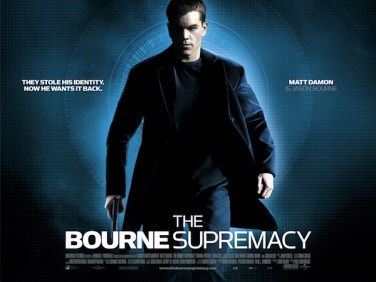
    The Bourne Supremacy (2004)

    100 Films’ 100 Favourites #16

    They should have left him alone.

    Country: USA & Germany
    Language: English, Russian, German & Italian
    Runtime: 108 minutes
    BBFC: 12A
    MPAA: PG-13

    Original Release: 23rd July 2004 (USA)
    UK Release: 13th August 2004
    First Seen: cinema, August 2004

    Stars
    Matt Damon (The Talented Mr. Ripley, The Departed)
    Franka Potente (Blow, Romulus, My Father)
    Brian Cox (Manhunter, X2)
    Joan Allen (The Ice Storm, Death Race)
    Karl Urban (The Lord of the Rings: The Two Towers, Dredd)

    Director
    Paul Greengrass (The Bourne Ultimatum, Green Zone)

    Screenwriter
    Tony Gilroy (Proof of Life, The Bourne Legacy)

    Based on
    The character of Jason Bourne, created by Robert Ludlum. Not so much based on The Bourne Supremacy, the novel by Robert Ludlum.

    The Story
    Bourne and Marie are living a quiet life in India, until he’s framed for the murder of two CIA agents and the theft of files they were acquiring. After the actual culprit tries to kill Bourne, he believes the CIA have tracked him down, and makes good on his promise to bring the fight to them…

    Our Hero
    Living a life of seclusion with Marie, but still struggling with resurfacing memories from his time as a CIA operative, Jason Bourne has no intention of going anywhere near his former life… until they come for him, and the gloves are off. Bryan Mills ain’t got nothing on Bourne’s particular set of skills.

    Our Villains
    A whole host of interests are aligned against Bourne this time. From within the CIA, corrupt director Ward Abbott is still trying to cover his ass. A more physical threat comes in the form of Russian operative Kirill, referred to in early drafts of the screenplay as “Mock-Bourne” because he, a) frames our hero, and b) is his equal — well, almost.

    Best Supporting Character
    Pamela Landy brings some complication to the CIA side of the story: she’s out to get Bourne, same as the fellas from the first film, but that’s because she’s been conned too. Will she see the light and side with our hero?

    Memorable Quote
    Nicky: “It’s not a mistake. They don’t make mistakes. They don’t do random. There’s always an objective. Always a target.”
    Landy: “The objectives and targets always came from us. Who’s giving them to him now?”
    Nicky: “Scary version? He is.”

    Memorable Scene
    In Munich, Bourne visits the one remaining Treadstone operative. They fight, using household items as weapons (see “making of”, below). Then a team of soldiers arrive. Bourne turns on the gas, shoves a magazine in the toaster, and… well, the result was disproved by MythBusters, but it’s still cool.

    Technical Wizardry
    The cinematography and editing, according to some.

    Letting the Side Down
    The cinematography and editing, according to some.

    Making of
    The film famously features Bourne using a rolled-up magazine as a weapon in a fight with another Treadstone operative. Fight coordinator Jeff Imada looked over the set after it had been dressed to get an idea of what would be lying around that could be used as a weapon, and had the idea of a rolled up magazine. He had to demonstrate to sceptical crew members that it would indeed be a functional weapon, but was helped by actors Matt Damon and Marton Csokas giving each other bruises from practising with it.

    Previously on…
    The Bourne Identity left enough hanging to help fuel this movie.

    Next time…
    Although Supremacy was designed to wrap up the mysteries left dangling from Identity, they found plenty to drive a third film, which completes the trilogy by answering those remaining questions. A fourth film was essentially a spin-off. This summer’s fifth film will be about… something…

    Awards
    2 Saturn nominations (Action/Adventure/Thriller Film, Actor (Matt Damon))
    2 World Stunt Awards (Best Work with a Vehicle, Best Stunt Coordinator and/or 2nd Unit Director)
    1 World Stunt Award nomination (Best Fight)
    2 MTV Movie Awards nominations (including Best Action Sequence (the Moscow car chase))

    What the Critics Said
    “Greengrass keeps you off-balance throughout. When the fight scenes and car chases arrive, there’s no telling, from shot to shot, what we will see next or how we’ll see it. […] Working with cinematographer Oliver Wood, Greengrass shoots the fight scenes and chases so close in that we see some moments almost as a blur. The editors, Richard Pearson and Christopher Rouse, break those sequences up into quick jagged shots that key us up and keep us hyper-alert. The world is being broken into bits of information, and we look hard at the screen to take it in. The approach could have resulted in the usual visual gibberish that defines contemporary action moviemaking [but] you can always tell what’s going on” — Charles Taylor, Salon

    Score: 81%

    What the Public Say
    “I thought the movie was shot well, though at times I felt that the shaky cam effect was overused, as instead of pulling you into the action, it just gives you a headache and a dizzy spell” — Zoë, The Sporadic Chronicles of a Beginner Blogger

    Verdict

    Debate used to rage about whether Identity or Supremacy was the better film, centred on their very differing directorial styles. Fans of Greengrass’ sequel seem to have settled on Ultimatum as their preferred Bourne instalment now, though, leaving Supremacy to be generally regarded as the least-best of the first three Bournes. That does it something of a disservice: it’s an exciting, twisty, complicated thriller, and its groundbreaking visuals can’t be ignored for their contribution to the action genre — for good or ill.

    #17 will… always have Paris.