
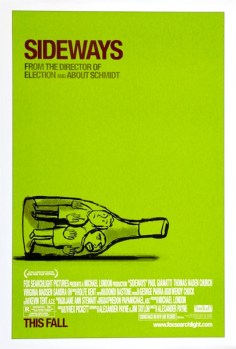
In search of women.
In search of themselves.
Country: USA & Hungary
Language: English
Runtime: 127 minutes
BBFC: 15
MPAA: R

Original Release: 22nd October 2004 (USA)
UK Release: 28th January 2005
First Seen: cinema, 2005
Stars
Paul Giamatti (Big Fat Liar, Shoot ‘Em Up)
Thomas Haden Church (George of the Jungle, Spider-Man 3)
Virginia Madsen (Candyman, The Number 23)
Sandra Oh (Under the Tuscan Sun, Hard Candy)
Director
Alexander Payne (About Schmidt, Nebraska)
Screenwriters
Alexander Payne (Jurassic Park III, The Descendants)
Jim Taylor (Election, I Now Pronounce You Chuck & Larry)
Based on
Sideways, a novel by Rex Pickett.
The Story
Middle-aged wine lover Miles takes his friend, groom-to-be Jack, up to California wine country for a more mature kind of bachelor trip, but Jack’s lascivious ways lead them to become involved with a pair of women — while keeping Jack’s impending nuptials a secret…
Our Hero
Miles Raymond is a divorcee, a teacher, and an unpublished novelist, depressed at the state of his life. His one love is wine appreciation, though when Jack goads him into getting closer to a waitress he casually knows, Maya, things begin to look up.
Our Villain
Jack, a has-been actor and Miles’ college roommate. Not really interested in wine; very interested in women — even though he’s engaged, he hooks up with Maya’s friend Stephanie, not telling her about his imminent marriage. Not strictly a villain, but his antics bring Miles little but misery.
Best Supporting Character
Maya is a waitress at Miles’ favourite restaurant, and they bond over a shared appreciation of wine. Unfortunately, her friendship with Stephanie and the secret of Jack’s engagement poses a threat to her burgeoning relationship with Miles…
Memorable Quote
“If anyone orders Merlot, I’m leaving. I am not drinking any fucking Merlot!” — Miles
Quote Most Likely To Be Used in Everyday Conversation
See above.
Memorable Scene
Jack hooks up with a random waitress but has to flee when her husband comes home, leaving his wallet behind with the wedding rings inside. He gets Miles to take him back to her house, where Jack convinces his friend to sneak in to find the wallet. Inside, the waitress and her hubby are having sex, but they spot Miles grabbing the wallet — so he’s chased back to the car by a very angry naked man. (It’s not exactly the film’s cleverest bit, but it is memorable.)
Making of
Sideways was so popular, it actually had an effect on the wine market. Miles is famously critical of Merlot (see above), which actually caused its sales to drop in the US and UK. However, there was a bigger impact on Pinot Noir, which he expresses a love for. After the film’s release, sales of Pinot Noir wines increased by over 20% compared to the year before. The effect lasted, too: a 2009 study found that sales volume of Merlot had slowed and its price had dropped, while sales and prices of Pinot Noir were still up.
Next time…
Author Rex Pickett has penned two sequel novels, Vertical and Sideways 3 Chile, but Alexander Payne has said he has no interest in adapting them and, though Fox owns the rights to the characters, they have no interest in making sequels without Payne. Of gossipy interest, however, is that Pickett deliberately wrote Sandra Oh’s character out of the sequels, because the actress made script changes he disliked and he didn’t want to work with her if they did make a sequel.
Awards
1 Oscar (Adapted Screenplay)
4 Oscar nominations (Picture, Supporting Actor (Thomas Haden Church), Supporting Actress (Virginia Madsen), Director)
1 BAFTA (Adapted Screenplay)
What the Critics Said
“how different these two characters are: the crass actor and the sensitive writer, linked by being roommates at college, but by little else these days. Viewers will probably identify with one or the other, but the beauty of the script is that these are rounded, believable people with recognisable failings and strengths — one is not superior than the other. So, while Jack is a bit dim, crude, and thinks largely with his crotch, he’s also enthusiastic, loyal and embraces life. And while Miles is funny, clever, and knowledgeable, he is also timid, drink-dependent, and crippled by insecurity” — Nev Pierce, BBC Movies
 Score:
 96%
96%What the Public Say
“This performance made [Thomas Haden Church] a star, earning him roles in everything from Spider-Man 3 to Easy A. By turns charming and crass, his laconic man-child is a perfect foil to the tightly-wound Miles, and their chalk-and cheese riffing is minded to fine comedic effect at times, most notably in Miles’ horrified discovery that Jack has been chewing gum throughout his detailed tutorial into wine tasting. It’s Giamatti’s picture though. He makes Miles vulnerable, sarcastic, grouchy and tender – sometimes all at the same time. He’s capable of expressing a depth of emotion with nothing more than a flicker in his eyes or furrowing of his brow. It’s a performance he’s never bettered.” — Rob D, Random Movie Guy

Do you ever watch a film, like it well enough, but then find that, without re-watching or consciously re-evaluating, it sneakily grows in your estimation? That was Sideways for me, after I saw it on its original release. I’ve watched it a few more times since which have cemented my opinion. It’s a pretty perfect example of the comedy-drama, being both very funny but with a core story based in characters going through emotional crises, whether they know it or not. It’s a deceptively gentle film, the kind of movie where it can seem like nothing’s happening, but the cumulative effect builds to a nice, complicated aftertaste. Like a fine wine, then.

I see #85… walking around like regular movies.


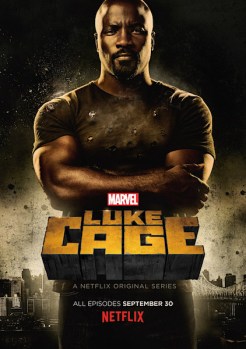 The third series in the Marvel/Netflix stable wins points for boldness, much as Jessica Jones did this time last year. Where Daredevil is a well-done but ‘standard’ superhero show, leading to it being somewhat demeaned by the Cool Kids of the critical world (but much higher-rated by us plebs on the likes of IMDb), Jessica pushed into dark psychological territory, and now Luke Cage brings black culture and life into the fold.
 It feels like only yesterday I was writing here about season four (it was, in fact,
  Well, it’s only taken me 3½ years to get round to this (seriously, where does time go?!) This bunch really represents the series’ highs and lows. On the one hand, Be Right Back — in which Hayley Atwell signs up for a company who create a virtual version of her deceased partner using his contributions to social media — is an exploration of broadly-plausible near-future-tech with a focus on its potential emotional effect. That’s what Black Mirror does best, I’d argue: look at stuff that may, perhaps, be in the pipeline, and how that would actually play out for us. On the other, there’s The Waldo Moment, which is also sickeningly plausible — as Charlie Brooker himself has said, it’s more or less come true, though with the likes of Boris Johnson and Donald Trump instead of a blue cartoon bear — but as an episode it doesn’t quite seem to know where to go with its concept or what it might ultimately signify. The episode just stops rather than ends, until a flash-forward coda that’s a bit silly in its extremity. Even Brooker, while doing press for the third season (released tomorrow), has said he’d go back and re-do that episode if he could. Still, full marks for effort.
 This latest series of Red Dwarf (which airs its fifth episode tonight, with the sixth available on demand from tomorrow) seems to have gone down rather well, with some reviews even hailing it as a “return to form” — that form being “the good old days” of Red Dwarf VI (or thereabouts), over 20 years ago. Personally, I didn’t dislike Red Dwarf VII or Back to Earth, and I even have a soft spot for Red Dwarf VIII, so what do I know? Nonetheless, I would concur that this Dwarf represents a fine vintage, hitting the series’ unique mix of accessible mainstream-ish comedy and proper science-fiction concepts. Red Dwarf XII is already in the can for 2017, and I wouldn’t be surprised to see Dave commission more episodes beyond that.
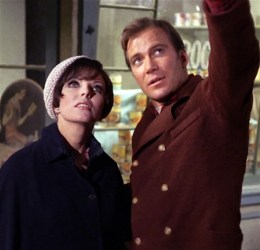 The entirety of TV Star Trek is available on Netflix, so I took the chance to watch the most acclaimed episodes of both The Original Series and The Animated Series — which happen to be connected, something I didn’t realise until afterwards. Er, I mean, which I totally planned. Both are pretty fine uses of science-fiction to explore relatable issues. Well, not many of us have to deal with disruptions to reality caused by time travel, or knowledge of the future creating dilemmas about what we do next, but they work the relatable stuff in around the surface plots. And they both still seem pretty bold for network TV episodes even today, almost half a century later, as (spoilers!) Kirk lets a good woman die to retain the correct timeline, and a kids’ cartoon deals with the subject of euthanasia.
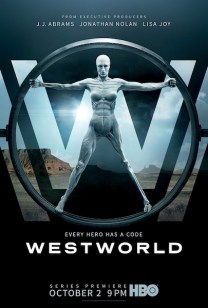 This month, I have mostly been missing loads of stuff. Probably the most talked about is HBO’s adaptation of Westworld, which has apparently pulled in even bigger ratings than Game of Thrones. Over here there’s the second series of The Missing, which if it’s half as good as the first will be a real must-see. Then there’s Woody Allen’s first (and last) TV series for Amazon, Crisis in Six Scenes. Reviews have been mixed to poor but I still intend to get round to it. And finally Hooten & the Lady, which may be the worst title for anything in the history of ever, but a globetrotting adventure series inspired by the likes of Indiana Jones and Romancing the Stone sounds right up my alley.












 Favourite Film of the Month

























 100Films.co.uk