Ghost in the Shell (1995)

100 Films’ 100 Favourites #36

It’s found its voice…
now it needs a body.

Original Title: Kôkaku Kidôtai
Also Known As: Mobile Armored Riot Police: Ghost in the Shell (Japan)

Country: Japan
Language: Japanese
Runtime: 83 minutes
BBFC: 15

Original Release: 18th November 1995 (Japan)
UK Release: 8th December 1995
First Seen: DVD, 2000

Stars
Atsuko Tanaka (Ghost in the Shell 2: Innocence, Bayonetta: Bloody Fate)
Akio Ôtsuka (Black Jack, Paprika)
Kôichi Yamadera (Ninja Scroll, Cowboy Bebop: The Movie)
Yutaka Nakano (Cowboy Bebop: The Movie, Ghost in the Shell 2: Innocence)
Tamio Ôki (Journey to Agartha, Wolf Children)

Director
Mamoru Oshii (Patlabor: The Movie, Ghost in the Shell 2: Innocence)

Screenwriter
Kazunori Itō (Patlabor: The Movie, .hack//SIGN)

Based on
The Ghost in the Shell (攻殻機動隊 Kōkaku Kidōtai, literally Mobile Armoured Riot Police), a manga by Masamune Shirow.

The Story
Japan, 2029: Public Security officer Major Motoko Kusanagi and her team are assigned to track down and capture a dangerous hacker known as the Puppet Master, but they soon find themselves embroiled in a far-reaching conspiracy…

Our Hero
In a future world where humans can undergo varying degrees of cyberisation, Major Motoko Kusanagi is a “full-body prosthesis augmented-cybernetic human” — only her brain is organic. Her body is a generic mass production model, so she can blend in while being a kick-ass law enforcement officer.

Our Villain
The Puppet Master, a cyber criminal who hacks into people’s brains and gives them false memories. But is there something even worse going on behind the hacker?

Best Supporting Character
Kusanagi’s second-in-command Batou is stoic to the point of brusqueness — apparently quite a different characterisation to his portrayal in other Ghost in the Shell media.

Memorable Quote
“If we all reacted the same way, we’d be predictable, and there’s always more than one way to view a situation. What’s true for the group is also true for the individual. It’s simple: overspecialise, and you breed in weakness. It’s slow death.” — Major Kusanagi

Memorable Scene
Pursuing the Puppet Master, Kusanagi comes face to face with a six-legged tank. After a blazing gun battle, she tries to physically rip it open, her cybernetic body straining to breaking point — and beyond…

Technical Wizardry
Ghost in the Shell was groundbreaking in its skilful combination of traditional 2D animation with CGI additions. It used a process called “digitally generated animation” (DGA), which combined cel animation with computer graphics to create lens effects that simulated depth, motion, and unusual lightning techniques, as well as mixing in 3D CGI and digital audio.

Letting the Side Down
In 2008, Oshii revisited the film to create Ghost in the Shell 2.0, which regraded the colour, replaced some of the original animation with new CGI, omitted several scenes, and featured a remixed and re-recorded soundtrack. (More details here.) As is almost always the case when directors fiddle with their creations decades later, it wasn’t well received by fans.

Next time…
As befalls many a popular anime franchise, Ghost in the Shell has spawned a raft of sequels and reboots. The only direct sequel, Innocence, was released in 2004. TV series Ghost in the Shell: Stand Alone Complex ran for two seasons between 2002 and 2005, with the first run compiled into movie The Laughing Man and the second into Individual Eleven, all of which were followed by a final film, Solid State Society. Another reboot came in 2013 with direct-to-video series Ghost in the Shell: Arise, which so far totals five episodes and, last year, continuation film Ghost in the Shell: The New Movie. (Only four episodes have so far been released in the West, but the movie — which continues the story from the fifth episode — came out on Monday in the UK. Just to make things more complicated.) A live-action American remake is currently shooting for release in March 2017 — you’ve probably heard about it.

Awards
5 Annie Awards nominations (Animated Feature, Directing, Producing, Writing, Production Design)

What the Critics Said
“When Akira first blasted out of Japan back in 1991 it looked like the Western concept of widescreen animation would be changed forever. […] Unfortunately, it was not to be. Sure, on video, the Manga scene has gone from strength to strength, but as far as theatrical releases are concerned, nothing has really come along to match Akira’s sheer retina-scalding magnificence. Until now. […] From its baddie-eviscerating opening sequence through innumerable car chases, shoot outs and tongue-in-cheek dialogue exchanges, this is exactly the kind of film that James Cameron would make if they ever let him through the Disney front gates.” — Clark Collis, Empire

Score: 95%

What the Public Say
“both the film and Oshii have fallen into a kind of disrepute among the anime community. The common line on GITS is that it’s wordy, masturbatory, and pretentious with nothing going on intellectually and that the (plainly inferior but more easily accessible) GITS: SAC is a better alternative. I wanted to write this article to respond to that notion. GITS is a highly thoughtful film and worthy of comparison to virtually any scifi feature you could name. ” — tamerlane, too long for twitlonger

Verdict

Ghost in the Shell was the first anime I consciously saw, which maybe helps it earn a place here. It’s an initially accessible movie that’s also very complicated — there are pulse-pounding action scenes and a thriller storyline to keep things exciting, but also a lot of deep philosophical discussions, touching on themes of gender and identity. I think for some viewers the latter are a negative, while for others they’re the entire point. (I imagine the forthcoming Hollywood remake will either ditch or seriously curtail them, but you never know.) The combination makes for a stimulating (in multiple senses) sci-fi actioner.

Next… who ya gonna call? #37 !

Gangs of New York (2002)

100 Films’ 100 Favourites #35

America was born in the streets

Country: USA & Italy
Language: English
Runtime: 168 minutes
BBFC: 18
MPAA: R

Original Release: 20th December 2002
UK Release: 9th January 2003
First Seen: cinema, 2003

Stars
Leonardo DiCaprio (Titanic, The Revenant)
Daniel Day-Lewis (My Left Foot, Lincoln)
Cameron Diaz (There’s Something About Mary, My Sister’s Keeper)
Jim Broadbent (Moulin Rouge!, Another Year)
Liam Neeson (Schindler’s List, Kingdom of Heaven)

Director
Martin Scorsese (Goodfellas, The Departed)

Screenwriters
Jay Cocks (The Age of Innocence, Silence)
Steven Zaillian (Schindler’s List, The Girl with the Dragon Tattoo)
Kenneth Lonergan (The Adventures of Rocky & Bullwinkle, Margaret)

Story by
Jay Cocks (Strange Days, De-Lovely)

Inspired by
The Gangs of New York: An Informal History of the Underworld, a non-fiction book written in 1927 by Herbert Asbury.

The Story
New York City, 1846: after his father is murdered in a fight by fellow gang leader Bill ‘the Butcher’, young Amsterdam Vallon is dumped in an orphanage. Sixteen years later, he returns to the Five Points district. With revenge in mind, he tries to establish himself with the ruling gang and get close to their leader — Bill.

Our Hero
In the first of his five (to date) collaborations with Scorsese (or six if you count that advertising short they were paid an insane amount for), Leonardo DiCaprio is Amsterdam Vallon, son of a murdered gang leader who, decades later, plots his revenge. His nemesis is a cunning so-and-so, however…

Our Villain
Although he’s a ruthless killer, and the unquestionable villain from the outset, Daniel Day-Lewis manages to render Bill a perversely charming creation, who unavoidably captivates your attention whenever he’s on screen.

Best Supporting Character
Priest Vallon, Amsterdam’s father, only appears in the opening sequence, but his influence and death hangs over the rest of the movie. That’s why you need an actor of Liam Neeson’s calibre for the part, and of course such casting pays off.

Memorable Quote
“I’m 47. 47 years old. You know how I stayed alive this long? All these years? Fear. The spectacle of fearsome acts. Somebody steals from me, I cut off his hands. He offends me, I cut out his tongue. He rises against me, I cut off his head, stick it on a pike, raise it high up so all on the streets can see. That’s what preserves the order of things. Fear.” — Bill

Memorable Scene
Scorsese captures an entire lifecycle in New York’s Five Points within a single tracking shot, which begins with immigrants arriving fresh off the boat and ends with coffins lined up on the quay.

Memorable Music
I have mixed feelings about U2 (because, y’know, Bono), but the theme they crafted for GangsThe Hands That Built America — is a pretty good track, and sits very appropriately at the end of the movie. It was Oscar-nominated, but lost to Eminem’s Lose Yourself from 8 Mile.

Letting the Side Down
Scorsese tried to make Gangs of New York for ages. At one point, he wanted Meryl Streep for the lead female role. He ended up with Cameron Diaz. Say no more, eh.

Making of
Unable to film in New York, which no longer looked like it did back in the mid-1800s, the production was mounted on a large set at Rome’s Cinecittà Studio. According to Wikipedia, production designer Dante Ferretti constructed “over a mile of mid-nineteenth century buildings, consisting of a five-block area of Lower Manhattan, including the Five Points slum, a section of the East River waterfront and two full-sized sailing ships, a thirty-building stretch of lower Broadway, a patrician mansion, and replicas of Tammany Hall, a church, a saloon, a Chinese theater, and a gambling casino.” Now that is a set!

Awards
10 Oscar nominations (Picture, Director, Actor (Daniel Day-Lewis), Original Screenplay, Cinematography, Art Direction-Set Decoration, Costume Design, Film Editing, Sound, Original Song)
1 BAFTA (Actor (Daniel Day-Lewis))
11 BAFTA nominations (Film, Director, Original Screenplay, Cinematography, Music, Production Design, Costume Design, Editing, Sound, Visual Effects, Make Up/Hair)
2 World Stunt Award nominations (Best Fight (the opening), Best Stunt Coordinator and/or 2nd Unit Director)
1 Teen Choice Award nomination (Choice Movie Liplock)

What the Critics Said
“The ambition is immense. This is Scorsese’s version of D.W. Griffith’s Birth of a Nation and Michael Cimino’s Heaven’s Gate and there are echoes of Kurosawa, Eisenstein and Visconti, as well as the nod to Welles […] As with Heaven’s Gate, judgment on this film must await Scorsese’s longer version. Nevertheless, this remains an astonishing achievement, a film with a passionate sense of life, by one of the greatest filmmakers at work today.” — Philip French, The Observer

Score: 75%

What the Public Say
“This movie, even if it ended with Amsterdam’s degradation rather than his triumph, would be fabulous, probably only inferior to Raging Bull and Goodfellas among Scorsese’s oeuvre. The problem is that the movie is nearly three hours long, and that the movie continues after Amsterdam’s maiming. There is a marvelous story to be told about American tyranny, about the immigrant experience, about just how firmly entrenched the powerful are. Do you choose bellicose racism as Bill does, or do you throw your lot in with benevolent corruption as Tweed does? It hardly seems to matter; you will be expunged and forgotten in the slop and grime of the Five Points all the same while someone else wears a tall hat and eats well.” — speakerformediocrities, Seeing Things Secondhand

Verdict

Gangs of New York ended up with a bit of a mixed reception when it finally came out in 2002, which is only to be expected after Scorsese had been intending to make it for over 20 years, and the version he had shot was stuck in editing for a year (considering all the Director’s Cuts we get nowadays, why have we never had Scorsese’s original 48-minutes-longer cut?) It’s undoubtedly a compromised film, then, but one that retains a rich atmosphere, engaging performances (even if it suffers from two of the leads, DiCaprio and Diaz, being two of the least accomplished), and an impressive sense of scale. It may have a relatively simplistic revenge-tale throughline, but class swirls around it.

#36 will be… 攻殻機動隊.

The Game (1997)

100 Films’ 100 Favourites #34

Players Wanted

Country: USA
Language: English
Runtime: 128 minutes
BBFC: 15
MPAA: R

Original Release: 12th September 1997 (USA)
UK Release: 10th October 1997
First Seen: TV, c.2000

Stars
Michael Douglas (Wall Street, Basic Instinct)
Sean Penn (Dead Man Walking, Milk)
Deborah Kara Unger (Crash, Stander)

Director
David Fincher (Panic Room, Gone Girl)

Screenwriters
John Brancato (The Net, Terminator 3: Rise of the Machines)
Michael Ferris (Terminator Salvation, Surrogates)

The Story
What do you buy the man who has everything? After high-flying businessman Nicholas Van Orton is enrolled in a mysterious alternate reality game by his estranged brother, it’s no surprise that unusual things start to happen. But as those happenings begin to take on a sinister edge, it may be Nicholas has been targeted by something more serious, and potentially life-threatening.

Our Hero
Nicholas Van Orton is an immensely successful financier, but so low on friends that he even spends his birthday completely alone. He could do with fun in his life, or so believes his brother… or does he?

Our Villains
The game is run by a company called Consumer Recreation Services, or CRS. But they just run games… or do they?

Best Supporting Character
Early on in his experience, Nicholas runs into waitress Christine, who has also been affected by the game… or is she actually a part of it? Just who can he trust?!

Memorable Quote
“You know, I envy you. I wish I could go back and do it for the first time, all over again. Here’s to new experiences.” — Ted

Memorable Scene
On the run and tired, Nicholas hops in a cab. He doesn’t notice the doors lock, until the maniacal cab driver begins to speed down the hill. As Nicholas desperately tries to escape, the driver leaps out — and the cab soars into the river, with Nicholas trapped inside…

Awards
1 Saturn nomination (Action/Adventure/Thriller Film)

What the Critics Said
“Crafted with a commanding, aloof precision by David Fincher in his first outing since hitting the jackpot with Seven, this unusual dive into the ambiguous world of an undefined pastime without apparent rules generates a chilly intellectual intrigue that will arouse buffs, trendies and techies more than it will mainstream [audiences. It] projects the same sense of suffocating enclosure and mounting despair in a style that will inevitably be compared to that of Stanley Kubrick in its steely technical mastery and remote, disenchanted worldview, all in the service of a story that resembles a highbrow puzzle as much as it does an involving narrative.” — Todd McCarthy, Variety

Score: 72%

What the Public Say
“just when we’ve finally come to a part of the story we can accept and trust, it turns out that we’ve once again been led astray. In this cinematic game, Fincher’s directorial ability wins out; his ability to pace his films; to completely draw the audience’s attention in whichever direction he requires, as well as keeping them emotionally attached to the protagonists is a balancing act which Fincher has mastered time and again over his career, and The Game is no exception.” — jyapp8715, Through the 4th Wall

Elsewhere on 100 Films
I reviewed The Game as part of a retrospective on Fincher’s films back in 2011, saying it “is by far at its best on your first viewing, when you don’t know how it will end and it’s stuffed with mysteries and twists. That’s not to say it doesn’t bear repeat viewings — as with most twist-ending-ed films, there’s naturally some interest in seeing it again knowing what’s going on — but a lot of the film’s enjoyment comes from being played with, the back-and-forth of what the truth is.”

Verdict

In fairness, The Game probably comes near the bottom of my top 100, because I remain a little dubious about its re-watch value — not because it’s poorly made (far from it), but because the twists and reveals are such a big part of its appeal, and once you know them, you know them. Also, arguments continue between its fans and its haters about whether the plot makes sense or not, and how much that actually matters — personally, I think it makes enough sense (maybe for some parts you have to switch on your “it’s a movie” filter, however). The reason it makes my list nonetheless is the quality of a first viewing, especially if you do buy into its conceit and just go with it. Few other films have kept me guessing from the start up to the very closing moments, and consequently on the edge of my seat throughout. That experience may be unrepeatable, but as one-time deals go, it was immeasurably memorable and effective.

#35 will be… the hands that built America.

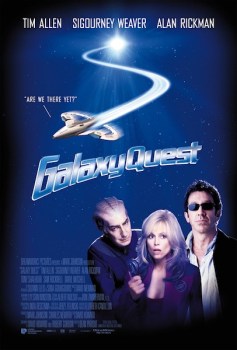
Galaxy Quest (1999)

100 Films’ 100 Favourites #33

The show was cancelled…
but the adventure has only begun.

Country: USA
Language: English
Runtime: 102 minutes
BBFC: PG
MPAA: PG

Original Release: 25th December 1999 (USA)
UK Release: 28th April 2000
First Seen: DVD, c.2001

Stars
Tim Allen (The Santa Clause, Christmas with the Kranks)
Sigourney Weaver (Alien, Avatar)
Alan Rickman (Dogma, Harry Potter and the Philosopher’s Stone)
Tony Shaloub (Men in Black, Pain & Gain)
Sam Rockwell (Confessions of a Dangerous Mind, Moon)

Director
Dean Parisot (Fun with Dick and Jane, RED 2)

Screenwriters
David Howard
Robert Gordon (Addicted to Love, Lemony Snicket’s A Series of Unfortunate Events)

Story by
David Howard

The Story
The cast of ’70s sci-fi series Galaxy Quest have been reduced to convention appearances and mall openings since their show was cancelled; but when a group of aliens, who believe the series was an historical document and have built the show’s spaceship for real, ask for the crew’s help to defeat a genocidal general, the actors must endeavour to become their characters for real.

Our Heroes
A ragtag gang of washed-up actors who used to star on a space opera TV series, now co-opted into being real heroes. They’re all based on the cast and characters of Star Trek, of course: Tim Allen’s Jason Nesmith, the ship’s captain, is obviously William Shatner/James T. Kirk; Sigourney Weaver’s Gwen Demarco, the token female, is Nichelle Nichols/Uhuru; Alan Rickman’s Alexander Dane, the classically-trained actor playing an alien science officer, is a combination of Leonard Nimoy/Spock and Patrick Stewart; Tony Shaloub’s Fred Kwan, a fake-foreign engineer, is a mixture of James Doohan/Scotty and Walter Koenig/Chekov; and Daryl Mitchell’s Tommy Webber, a young helmsman from an ethnic minority, is a mixture of George Takei/Sulu and Wil Wheaton/Wesley Crusher.

Our Villain
General Sarris, a reptilian warlord waging war against the kindly Thermians. No discredit to Robin “Ethan Rayne off Buffy” Sachs, but he’s kind of beside the point, really.

Best Supporting Character
Enrico Colantoni (Veronica Mars, Person of Interest) plays the leader of the friendly aliens, Mathesar, a naïve soul who speaks in a sing-song monotone.

Memorable Quote
“By Grabthar’s hammer, by the suns of Worvan, you shall be avenged.” — Sir Alexander Dane

Memorable Scene
Our heroes arrive in the bowels of their screen-faithful ship to find “a bunch of chompy, crushy things” impeding their path — for absolutely no reason. “We shouldn’t have to do this, it makes no logical sense, why is it here?… This episode was badly written!”

Making of
In cinemas, the film began with a 4:3 aspect ratio for clips from the old TV series, then widened to 1.85:1 for the Earth-based scenes, before widening again to a highly cinematic 2.35:1 once Tim Allen’s character realises he’s on a real spaceship. It was decided to ditch the middle stage for the home video releases, which I suppose makes sense, but is a lot less fun.

Previously on…
Galaxy Quest is an original creation, but it’s heavily inspired by the Star Trek franchise and its fans.

Next time…
A reboot TV series was supposedly in the works at Amazon, though comments made by co-star Sam Rockwell just last month suggest the project had developed into a direct sequel, which was then sadly scuppered by the untimely death of Alan Rickman.

Awards
1 Saturn Award (Actor (Tim Allen))
9 Saturn nominations (Science Fiction Film, Actress (Sigourney Weaver), Supporting Actor (Alan Rickman), Performance by a Younger Actor/Actress (Justin Long), Director, Music, Costumes, Make-Up, Special Effects)
Won the Hugo Award for Best Dramatic Presentation

What the Critics Said
“Whether you love Star Trek or laugh at it, your starship is about to come in, docking in the form of Galaxy Quest, an amiable comedy that simultaneously manages to spoof these popular futuristic space adventures and replicate the very elements that have made them so durable. […] If Galaxy Quest never attains consistently giddy heights as it plays out its combination of knowing satire and heroic adventure, it nevertheless keeps its tongue firmly in its cheek, offers a few genuine laughs, moves swiftly, if not at warp speed, and is led by a talented cast.” — Lawrence Van Gelder, The New York Times

Score: 90%

What the Public Say
“As a fan of the various science fiction classic series, like Star Trek and Star Wars, I’ve met most of the people parodied in Galaxy Quest – from the overzealous fans to the has-been and bitter celebrities making a living off a series’ memories. A movie like Galaxy Quest manages to poke fun at a wide range of people but still be loveable and sympathetic at the same time.” — Kevin Carr, 7M Pictures

What the Trekkies Say
In 2013, just after Star Trek Into Darkness came out, a massive convention of Trekkies decided to vote on the best Trek movies. Galaxy Quest muscled its way in to 7th place, besting six real Trek flicks. (Infamously, Into Darkness came dead last.)

Verdict

Managing to satirise both classic sci-fi TV shows and their (shall we say) enthusiastic fanbase, while remaining relatively respectful to both, is quite a feat, and is surely one reason Galaxy Quest has proven so popular. Another is its accessibility: you don’t need to be a Trekkie to get all the gags. Combine those two and you have a film for fans and non-fans alike. To really cement the issue, it’s a solid adventure movie as well as a funny comedy.

#34 will be… what you get for the man who has everything.

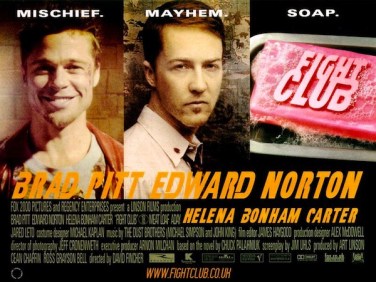
Fight Club (1999)

100 Films’ 100 Favourites #29

Mischief. Mayhem. Soap.

Country: USA & Germany
Language: English
Runtime: 139 minutes
BBFC: 18 (cut, 1999) | 18 (uncut, 2005)
MPAA: R

Original Release: 15th October 1999 (USA)
UK Release: 12th November 1999
First Seen: TV, c.2001

Stars
Edward Norton (American History X, 25th Hour)
Brad Pitt (Interview with the Vampire, World War Z)
Helena Bonham Carter (Room with a View, The King’s Speech)
Meat Loaf (The Rocky Horror Picture Show, Tenacious D in The Pick of Destiny)

Director
David Fincher (Se7en, The Social Network)

Screenwriter
Jim Urls (Sweet Talk, Jumper)

Based on
Fight Club, a novel by Chuck Palahniuk.

The Story
The film’s nameless narrator is growing increasingly disillusioned with his mundane consumerist lifestyle, when he bumps into Tyler Durden. A free-spirited soap salesman, the pair have a fight for the heck of it. Finally experiencing some kind of genuine feeling, they set up an underground club for fighting, but it gradually becomes clear that Tyler may have bigger ideas…

Our Heroes
I am Jack’s nameless narrator. I am also Jack’s friend, Tyler Durden. Yes, just his friend…

Our Villains
The establishment! Capitalism! What’ve you got?

Best Supporting Character
Helena Bonham Carter hasn’t been fucked like that since grade school.

Memorable Quote
“The first rule of Fight Club is: you do not talk about Fight Club. The second rule of Fight Club is: you do not talk about Fight Club! ” — Tyler Durden

Quote Most Likely To Be Used in Everyday Conversation
“You are not special. You are not a beautiful or unique snowflake. You’re the same decaying organic matter as everything else.” — Tyler Durden

Memorable Scene
Called into his manager’s office to discuss his bad behaviour, the Narrator decides the best method of getting his own way is by enacting physical violence… on himself.

Technical Wizardry / Truly Special Effect
For what’s essentially a drama, Fight Club is overloaded with special effects and visual trickery. I don’t know if any are particularly groundbreaking in and of themselves, but several are particularly striking. A personal favourite, thanks to the perfect execution of the idea, is the shot where the Narrator’s condo is transformed into a living IKEA catalogue.

Making of
Marla’s original post-coital line was, “I want to have your abortion.” The studio objected to such an offensive line, so Fincher agreed to change it on the condition that the new line had to be used. The studio agreed, apparently unaware that such an agreement was never going to end well. Fincher wrote the replacement line, “I haven’t been fucked like that since grade school.” The studio asked for the original line back; Fincher refused. (It must say something about American values that abortion is considered more shocking than underage sex.)

Next time…
Nothing from the film, but Chuck Palahniuk has continued his novel in 10-issue comic book series Fight Club 2. A second comic series, Fight Club 3, is planned.

Awards
1 Oscar nomination (Sound Effects Editing)
1 MTV Movie Awards nominations (Best Fight for Edward Norton fighting himself)
1 BRIT Award nomination (Best Soundtrack — it lost to Notting Hill)

What the Critics Said
“Three factors elevate Fincher’s apocalyptic stew to something approaching art. First is Norton’s performance, as sneaky and shocking as that in his film debut Primal Fear. Second is Palahniuk’s story, which dances on a razor’s edge between life and death, expression and repression, ecstasy and agony. Third is Fincher’s dedication to making a film that looks and sound likes no other, one that powerfully illustrates what dementia looks like from inside and out.” — Carrie Rickey, Philadelphia Inquirer

Score: 79%

What the Public Say
“it’s hard to believe Fight Club is now 15 years old. As I was watching the film last night I found it hard to review because it is so ingrained in pop culture now it would be almost sacrilegious to say something bad about it. […] The first time I saw Fight Club I did not see the twist of [REDACTED] coming. I remember being surprised, but also very confused. I didn’t really understand how it worked then. On the second viewing it is easy to see a million clues pointing to this from the very beginning. Director David Fincher is very clever in how he orchestrates the film by giving you all these hints. He’s very good at walking that tight rope of not giving away too much. The twist is definitely one of the highlights of the film and why it is so memorable. It doesn’t feel cheap to me as some of these things normally do.” — Sherise, The Girl that Loved to Review

Elsewhere on 100 Films
I reviewed Fight Club as part of a retrospective on Fincher’s films back in 2011, saying “Fincher’s films often look great, but Fight Club is surely the most visually inventive. A list of exciting spectacles could be endless […] To top it off, the ‘regular’ cinematography is grounded in Fincher’s trademark darkness, as if every shot was conceived as just black and he added only what light was necessary.”

Verdict

A controversial film to this day, Fight Club is a violent, explicit exploration of the turn-of-the-millennium Western male psyche, which hasn’t necessarily lost its relevance in the ensuing decade-and-a-half. Criticised by some for endorsing the anarchic lifestyle it depicts, praised by others for satirising that mode of thinking, and criticised by other others for not satirising it well enough, the film can certainly provoke a spread of views. There’s little doubt that David Fincher’s direction is memorably slick and inspired, however, and it has one of the most talked-about twists in movie history.

#33 will… boldly go where no comedy has gone before.

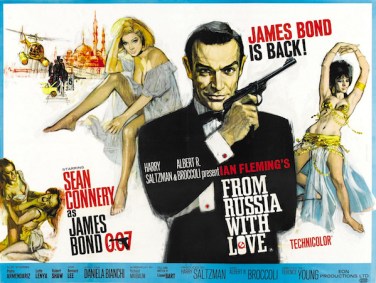
From Russia with Love (1963)

100 Films’ 100 Favourites #32

James Bond is back!
His new incredible women!
His new incredible enemies!
His new incredible adventures!

Country: UK
Language: English, Russian, Turkish & Romany
Runtime: 115 minutes
BBFC: A (1963) | PG (1987)
MPAA: GP (1971) | PG (1994)

Original Release: 11th October 1963 (UK)
US Release: 8th April 1964
First Seen: TV, c.1995

Stars
Sean Connery (Darby O’Gill and the Little People, Zardoz)
Daniela Bianchi (Special Mission Lady Chaplin, Operation Kid Brother)
Pedro Armendariz (Fort Apache, 3 Godfathers)
Lotte Lenya (The Threepenny Opera, The Roman Spring of Mrs. Stone)
Robert Shaw (A Man for All Seasons, Jaws)

Director
Terence Young (Dr. No, Wait Until Dark)

Screenwriter
Richard Maibaum (Bigger Than Life, Licence to Kill)

Adapted by
Johanna Harwood (Dr. No, Call Me Bwana)

Based on
From Russia with Love, the fifth James Bond novel by Ian Fleming — one of John F. Kennedy’s favourite novels.

The Story
When Soviet consulate clerk Tatiana Romanova offers to defect, she has one condition: that she is extracted by James Bond. Although M smells a trap, as collateral Tatiana offers a Lektor, a decoding machine MI6 have wanted for years. Bond travels to Istanbul to steal the Lektor, unaware he’s being manipulated by the criminal organisation SPECTRE…

Our Hero
The name’s Bond, James Bond. In only his second big-screen outing, so Connery is still establishing the character here — considering all the ‘fun’ antics that came since, Bond is quite a hard bastard in Dr. No and From Russia with Love (which is only appropriate for a government-sponsored killer, of course).

Our Villains
They may not be as grandiose as the volcano-dwelling types that came later in the series, but From Russia with Love has two of Bond’s most memorable adversaries: the hard former KGB officer Rosa Klebb, with her deadly shoe (well, it sounds silly when you put it like that), and assassin Red Grant, who may not know what wine to have with fish but could certainly gut you like one. A fish, that is. Not wine. You can’t gut wine.

Best Supporting Character
Kerim Bey, British Intelligence’s man in Turkey. An affable, witty soul, he’s also an invaluable ally during Bond’s time in Istanbul.

Memorable Quote
Tatiana: “I think my mouth is too big.”
Bond: “I think it’s a very lovely mouth. It’s just the right size… for me, anyway.”

Memorable Scene
On the Orient Express, SPECTRE assassin Red Grant manages to corner Bond in his compartment. Although he has Bond at gunpoint, Grant is distracted by the offer of gold coins hidden in Bond’s case. Bond tricks Grant into setting off the case’s booby trap, allowing Bond to tackle him. A rough close-quarters fight ensues.

Write the Theme Tune…
Having arranged and performed Monty Norman’s James Bond Theme for Dr. No (for which he didn’t receive a credit), John Barry was the main composer for Bond’s second adventure. However, the producers tapped Lionel Bart — then popular from Oliver! — to write the title song. Barry didn’t like that Bart’s lyrics had nothing to do with the film’s story, a point he set out to rectify when given full control of the soundtrack to Goldfinger.

Sing the Theme Tune…
A good answer if you’re ever faced with a trivia question about James Bond theme singers, Matt Monro was — so Wikipedia tells me — known as “The Man With The Golden Voice” and “became one of the most popular entertainers on the international music scene during the 1960s and 1970s.” With the Bond formula not yet fully established, a snippet of his song is heard on a radio early in the film, but not played in full until the end credits. (The title credits are scored with an instrumental version of the song, plus the James Bond Theme.)

Technical Wizardry
Projecting the title credits on writhing half-naked girls? It’ll never catch on.

Making of
Although Red Grant is presented as a physically-imposing male specimen, including showing off his half-naked physique the first time he appears, in reality actor Robert Shaw had to stand on a box when opposite Sean Connery because he was so much shorter than the Scot. (4 inches shorter, according to CelebHeights.com. Yes, that’s a real website.)

Previously on…
This is the second film about the adventures of James Bond, after the previous year’s Dr. No.

Next time…
The next film, Goldfinger, set the template for much of the rest of the Bond series. To date, that has encompassed a further 22 canonical movies, with the series’ 25th already in development. From Russia with Love was adapted for radio in 2012, the third of (to date) five Bond radio adaptations starring Toby Stephens as 007.

Awards
1 BAFTA nomination (British Cinematography (Colour))

What the Critics Said
“Don’t miss it! This is to say, don’t miss it if you can still get the least bit of fun out of lurid adventure fiction and pseudo-realistic fantasy. For this mad melodramatization of a desperate adventure of Bond with sinister characters in Istanbul and on the Orient Express is fictional exaggeration on a grand scale and in a dashing style, thoroughly illogical and improbable, but with tongue blithely wedged in cheek.” — Bosley Crowther, The New York Times

Score: 96%

What the Public Say
From Russia with Love turned out to be amongst the best of the Bonds. Distinctly low key, and relying on the strength of its cast over the spectacular thrills and gadgetry that would come to define the series, it’s a great couple of hours’ cinema that may delight viewers who come to it expecting the same old nonsense from 007.” — Mike, Films on the Box

Elsewhere on 100 Films
I reviewed From Russia with Love as part of a retrospective on Connery’s Bond back in 2012, when I noted it was “a very faithful rendition of the book. That makes it a Cold War spy thriller, albeit one with fantastical touches […] Mostly, though, it feels remarkably plausible. Sequences like the theft of a decoding machine from the Russian consulate, or the famous confined train carriage fight with Red Grant, have real-world heft rather than typical Bond action sequence fantasticism.”

Verdict

It’s only the second Bond movie, so there’s no template yet, but in retrospect From Russia with Love is an oddity among the Bond flicks of the ’60s and ’70s. Although it has many of the series’ regular trappings — exciting action, exotic locations, beautiful women, grotesque villains, nifty gadgets — it also functions as a straight-up ’60s Cold War spy thriller, with few of the fantastical touches the Bond films would become known for. Such atypicality means anyone looking for a “Bond formula” movie will be disappointed, but otherwise it’s an accomplished thriller, and one of the series’ finest instalments.

The first rule of #29 is… don’t talk about #29.

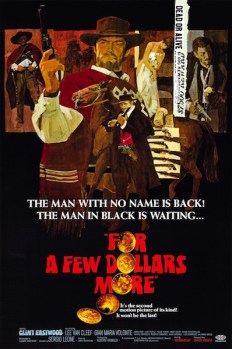
For a Few Dollars More (1965)

100 Films’ 100 Favourites #31

The man with no name is back!
The man in black is waiting…

Original Title: Per qualche dollaro in più

Country: Italy, Spain & West Germany
Language: English and/or Italian
Runtime: 132 minutes
BBFC: X (cut, 1967) | 15 (1986)
MPAA: M (1969) | R (1989)

Original Release: 18th December 1965
UK Release: January 1967 (BBFC)
First Seen: DVD, 2003

Stars
Clint Eastwood (Dirty Harry, Unforgiven)
Lee Van Cleef (High Noon, Escape from New York)
Gian Maria Volontè (Investigation of a Citizen Above Suspicion, Le Cercle Rouge)
Klaus Kinski (Aguirre, Wrath of God, Fitzcarraldo)

Director
Sergio Leone (The Good, the Bad and the Ugly, Once Upon a Time in the West)

Screenwriters
Luciano Vincenzoni (Death Rides a Horse, The Good, the Bad and the Ugly)
Sergio Leone (A Fistful of Dollars, Once Upon a Time in America)

Scenario by
Sergio Leone (The Colossus of Rhodes, A Fistful of Dynamite)
Fulvio Morsella (My Name is Nobody, A Genius, Two Friends, and an Idiot)

The Story
A pair of bounty hunters team up, in spite of their mutual distrust, to capture the most wanted fugitive in the Wild West. That’s the short of it — the ins and outs get complicated.

Our Heroes
The Man With No Name (who this time is called Monco) is played as coolly as ever by Clint Eastwood. This time he teams up with The Man In Black — not Johnny Cash, but Colonel Douglas Mortimer. Much older than Monco, but played with equal amounts of cool by Lee Van Cleef.

Our Villain
El Indio, a murdering, raping, bank-robbing outlaw. Has his own gang; has greater loyalty to money. May also be the first character to smoke marijuana in a major film production.

Best Supporting Character
Klaus Kinski plays a hunchback. I mean, what more do you need to know?

Memorable Quote
“Where life had no value, death, sometimes, had its price. That is why the bounty killers appeared.” — title card

Memorable Scene
It’s a Leone film; there’s a tense climactic pistol duel — surely that’s all the recommendation you need.

Memorable Music
The score is by Ennio Morricone, of course, so of course it’s fantastic. His main theme for The Good, the Bad and the Ugly may be more famous, but personally I prefer this one.

Letting the Side Down
I suppose I should mention the dubbing, which is always skew-whiff in these movies. But it is what it is.

Making of
Leone felt that Gian Maria Volontè’s performance was too theatrical, so he often subjected the actor to multiple takes in an attempt to tire him out. Volontè eventually stormed off the set… but, unable to get a ride out of the desert, returned to filming.

Previously on…
A Fistful of Dollars, also starring Clint Eastwood and directed by Sergio Leone, started both the Man With No Name Trilogy (aka the Dollars Trilogy) and the entire Spaghetti Western subgenre.

Next time…
The Good, the Bad and the Ugly completes the trilogy — not that it was intended as such by Leone: US distributor United Artists invented the “Man with No Name” concept as a way to sell the three films together. Eastwood’s character actually has a name, and a different one in each film at that.

What the Critics Said
For a Few Dollars More, like all of the grand and corny Westerns Hollywood used to make, is composed of situations and not plots [but] on a larger, more melodramatic scale, if that’s possible. […] The rest of the film is one great old Western cliché after another. They aren’t done well, but they’re over-done well, and every situation is drawn out so that you can savor it.” — Roger Ebert

Score: 94%

The Joys of Putting Different Reviews Right Next to Each Other

What the Public Say
“It’s a wacky and irreverent film, exactly the type of cheeky genre fare that you’d expect as the follow-up to a blatant act of plagiarism […] This irreverence is what makes the film fun, but it also never stops it from being intelligent. Like its predecessor was to a slightly lesser extent, For a Few Dollars More is a film about the value of life (often literally and monetarily) and the cost of our connections with other human beings (specifically men in this predominantly male society).” — Wes, Screening Notes

Verdict

Sergio Leone defined the Spaghetti Western subgenre with A Fistful of Dollars, and some would argue perfected it with The Good, the Bad the Ugly, but in between those two he made this, my favourite of the trilogy. Leone’s trademark style tells a story whose scope is in the sweet spot between the first film’s one-town tale and the third’s epic narrative, with a pair of sparky heroes going up against a ruthless villain, and a nice twist in the tail.

#31 will be… Бонд зовут. Джеймс Бонд.

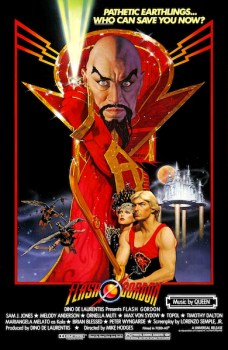
Flash Gordon (1980)

100 Films’ 100 Favourites #30

Pathetic earthlings…
Who can save you now?

Country: UK & USA
Language: English
Runtime: 115 minutes
BBFC: A (1980) | PG (1987)
MPAA: PG

Original Release: 5th December 1980 (USA)
UK Release: 11th December 1980
First Seen: c.1995

Stars
Sam J. Jones (10, Ted)
Melody Anderson (Dead & Buried, Firewalker)
Max von Sydow (The Seventh Seal, The Exorcist)
Topol (Fiddler on the Roof, For Your Eyes Only)
Ornella Muti (The Last Woman, Tales of Ordinary Madness)

Director
Mike Hodges (Get Carter, Croupier)

Screenwriter
Lorenzo Semple Jr. (Batman: The Movie, Three Days of the Condor)

Adaptation by
Michael Allin (Enter the Dragon, I’ll Be Home for Christmas)

Based on
Flash Gordon, a newspaper comic strip created by Alex Raymond.

The Story
American football player Flash Gordon and journalist Dale Arden accidentally end up on the spaceship of scientist Dr Zarkov, which transports them to the planet Mongo. There, they learn the planet’s evil Emperor, Ming the Merciless, is subjecting Earth to natural disasters in a bid to destroy it. Flash must unite the warring factions on Mongo to defeat Ming and save the Earth.

Our Hero
He’s a miracle, king of the impossible. Just a man, with a man’s courage, but he can never fail. He’ll save every one of us. Flash! Ah-ah!

Our Villains
Max von Sydow is deliciously villainous as evil emperor Ming the Merciless. There’s a handful of similarly entertaining underlings, too, like scheming right-hand-man Klytus, who gets a great death, and right-hand-woman Kala, who gets some of the very best lines.

Best Supporting Character
Prince Vultan may be culturally iconic for one two-word exclamation, but it kind of encapsulates the presence he brings throughout the film.

Memorable Quote
Zogi: “Do you, Ming the Merciless, Ruler of the Universe, take this Earthling Dale Arden, to be your Empress of the Hour?”
Ming: “Of the hour, yes.”
Zogi: “Do you promise to use her as you will?”
Ming: “Certainly!”
Zogi: “Not to blast her into space? …uh, until such time as you grow weary of her.”
Ming: “I do.”

Quote Most Likely To Be Used in Everyday Conversation
“Gordon’s alive?!” — Prince Vultan
(Not that it’s likely to be appropriate in everyday conversation, but you’re still going to hear it said — especially if you’re ever around Brian Blessed.)

Memorable Scene
In Ming’s harem, Flash’s love interest Dale and Ming’s rebellious daughter Aura end up wrestling on a giant bed. Kinky! But it’s knowingly directed, with cutaways to sniggering servants indicating a deliberate commentary on such gratuitous girl-on-girl spectacles in other films.

Write the Theme Tune…
“Dum dum dum dum dum dum dum dum FLASH! Ah-ah! Saviour of the universe!” Rock group Queen composed the entire score for Flash Gordon, and their unmistakeable sound is a significant part of the film. Best of all is that main theme, surely one of the most memorable and hummable pop themes for a movie ever recorded. If you’re interested in the making of the soundtrack, there’s a detailed article on Queen’s official site.

Technical Wizardry
The design work is great. The sets, costumes, and spaceships are all huge, vibrant, retro, often ridiculous, and wonderful.

Truly Special Effect
Skies full of swirling rainbow colours, rainbow clouds for the spaceships to float through, platforms that tilt over a rainbow vortex… OK, there’s a lot of rainbows, but it’s unique and looks great.

Letting the Side Down
There is so little that’s bad about Flash Gordon that I’ve left this section in just to point out that there is nothing bad about Flash Gordon.

Previously on…
The most famous earlier version of Flash Gordon must be the three cinema serials starring Buster Crabbe that were produced between 1936 and 1940. They’re great fun (I nearly made space for one of them on this list, but… not quite). There was also a live-action TV series in the ’50s and an animated one in 1979.

Next time…
An animated TV movie followed that last TV series in 1982. Flash was part of the Defenders of the Earth animated series in the mid ’80s, alongside other heroes such as the Phantom. Another animated series came along in 1996, while a live-action reboot was attempted in 2007. It looked terrible, and I’ve heard it’s one of the worst TV shows ever made. Reports of a new film being in development come along now and then, with Kingsman’s Matthew Vaughn being the most recently attached director. Until that rolls around, Flash’s main claim to current pop culture relevance comes courtesy of Ted and its sequel.

Awards
3 BAFTA nominations (Music (because Queen), Costume Design, Production Design/Art Direction)
3 Saturn nominations (Science Fiction Film, Supporting Actor (Max von Sydow), Costumes)
1 Razzie nomination (Worst Actor (Sam J. Jones))
Nominated for the Hugo for Best Dramatic Presentation

What the Critics Said
Flash Gordon is played for laughs, and wisely so. It is no more sophisticated than the comic strip it’s based on, and that takes the curse off of material that was old before it was born. This is space opera, a genre invented by Edgar Rice Burroughs and Hugo Gernsback and other men of unlimited imagination harnessed to definitely limited skills. It’s fun to see it done with energy and love and without the pseudo-meaningful apparatus of the Force and Trekkie Power.” — Roger Ebert

Score: 82%

What the Public Say
Star Wars was squarely heterosexual, but Flash Gordon could only have emerged from the same pop-culture closet that birthed David Bowie, Elton John, Mick Jagger, and Freddie Mercury […] As for the empty-headed dialogue and the puerile plot, isn’t it obvious those are both part of the point? Everyone involved (well, except maybe Sam J. Jones) knows precisely what this is and performs accordingly, with a straight face but with a small gleam in the eye. […] I don’t know if I’d want to know anyone who couldn’t love this movie, or at least enjoy it on some level.” — Rob Gonsalves, eFilmCritic.com

Elsewhere on 100 Films
In 2009 I said that Flash Gordon was better than Star Wars. Well, I mean, I don’t know if I exactly stand by that, but I’m also not going to contradict it — Flash Gordon is awesome.

Verdict

Once reviled for being a laughably silly Star Wars cash in, the world has gradually begun to realise the truth: that Flash Gordon was always in on the joke. And it’s so obviously in on the joke, it makes a lot of the old reviews criticising it look embarrassingly tin-eared. It’s not meant to be a serious sci-fi adventure, like its big-screen Trek and Wars contemporaries. It’s designed to be camp, colourful, over-the-top, driven by cliffhangers and wackiness. It’s funny, it’s fun — it’s Flash! Ah-ah!

#31 will be… slightly more expensive.

Face/Off (1997)

100 Films’ 100 Favourites #28

It’s like looking in a mirror — only not

Country: USA
Language: English
Runtime: 139 minutes
BBFC: 18 (cut)
MPAA: R

Original Release: 27th June 1997
UK Release: 7th November 1997
First Seen: TV, 22nd September 2002 (probably)

Stars
John Travolta (Saturday Night Fever, Hairspray)
Nicolas Cage (The Rock, Ghost Rider)
Joan Allen (Nixon, The Bourne Supremacy)
Alessandro Nivola (Mansfield Park, Jurassic Park III)
Gina Gershon (Bound, P.S. I Love You)

Director
John Woo (Hard Boiled, Mission: Impossible II)

Screenwriters
Mike Werb (The Mask, Firehouse Dog)
Michael Colleary (Darkman III: Die Darkman Die, Firehouse Dog)

The Story
FBI agent Sean Archer finally corners his nemesis, Castor Troy, knocking him into a coma in the process. Unfortunately, Troy has planted a bomb that will destroy Los Angeles, and the only other person who knows its location is his brother — and he ain’t talking. So Archer comes up with the perfectly sane and utterly foolproof plan to secretly have a face transplant and assume Troy’s identity. Unfortunately, the real Troy wakes up, takes Archer’s face, and kills everyone who knows the truth. Hilarity ensues! No, wait, it’s not that kind of movie — violent bloody action ensues.

Our Hero
Sean Archer, super cop. Looks like John Travolta, until he looks like Nicolas Cage. Don’t overthink it, it works just fine when you’re watching the film.

Our Villain
Castor Troy, super villain. Looks like Nicolas Cage, until he looks like John Travolta. Don’t overthink it, it works just fine when— wait, I did that bit.

Best Supporting Character
Castor’s brother, Pollux. Yes, that’s his name. Looks like Alessandro Nivola throughout.

Memorable Quote
Castor Troy: “Sean Archer here, who’s calling?”
Sean Archer: “Well if you’re Sean Archer, I guess I’m Castor Troy.”

Memorable Scene
The good guy’s teenage daughter — played by Dominique “Lolita” Swain, as if to ram the point home — is hanging out in her bedroom wearing next to nothing, when in walks the villain, who starts perving over her… oh, and he’s got her dad’s face at the time. This is the kind of scene you can have when your body-swap movie is rated 18, I guess.

Making of
According to IMDb, the studio wanted John Woo to take the slash out of the title, but he kept it so people wouldn’t think it was a hockey movie. I don’t know why you’d think it was a hockey movie without the slash, or why adding a slash magically stops it being a hockey movie, but that’s what it says.

Awards
1 Oscar nomination (Sound Effects Editing)
2 Saturn Awards (Director, Writer)
7 Saturn nominations (Action/Adventure/Thriller Film, Actor (both Nicolas Cage and John Travolta), Supporting Actress (Joan Allen), Younger Actor/Actress (Dominique Swain), Music, Make-Up)
2 MTV Movie Awards (including Action Sequence for the speedboat chase)
4 MTV Movie Award nominations (including Best Villain, shared between Nicolas Cage and John Travolta)
1 Golden Trailer Awards nomination (Best of the Decade)

What the Critics Said
“Travolta and Cage make superb adversaries, flip-flopping roles, first as hero, then as villain. What titilating fun to observe Cage seethe with venom and Travolta meet danger head-on, then see Cage become Travolta, as the latter adopts the unmistakable characteristics of the fiend. […] Face/Off is a masterpiece equal to the action classics Seven Samurai, The Wild Bunch and The Good, the Bad, and the Ugly.” — Roger Hurlburt, Sun Sentinel

Score: 92%

What the Public Say
“Gorgeously shot with lots of Ol’ West style close up on the eyes while silence is only interrupted by the sounds of gun magazines falling to the ground. Woo’s directorial vision and the clever exchange of snark and built up bitterness displayed in the dialogue are just two of the beautiful components displayed in the first 30 minutes of this film that set the tone of the fucking masterpiece that it is.” — Amy Seidman, This Film Is Better Than You, Deal With It

Verdict

After making his name as an “heroic bloodshed” director par excellence with films like A Better Tomorrow, The Killer and Hard Boiled, John Woo headed for Hollywood… and made Van Damme vehicle Hard Target and nuclear-warhead-theft thriller Broken Arrow. But after those he made this, surely one of the best action movies of the ’90s. Its sci-fi high-concept allows Travolta and Cage to have a whale of a time in each other’s bodies, and Woo’s trademark OTT action is as exciting as ever.

Next: #30, ah-ah! Saviour of the universe!

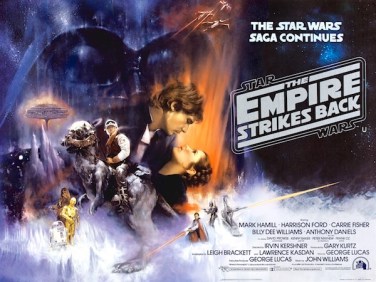
The Empire Strikes Back (1980)

100 Films’ 100 Favourites #27

The Star Wars Saga Continues

Also Known As: Star Wars: Episode V – The Empire Strikes Back

(I may be a young whippersnapper, but I’m old enough that, when I was a kid, we still called it just The Empire Strikes Back. I thought that would be a nicer place for it among my 100 Favourites, therefore.)

Country: USA
Language: English
Runtime: 124 minutes | 127 minutes (special edition)
BBFC: U
MPAA: PG

Original Release: 21st May 1980 (UK)
US Release: 20th June 1980
First Seen: VHS, c.1990

Stars
Mark Hamill (Star Wars, The Big Red One)
Harrison Ford (Raiders of the Lost Ark, Air Force One)
Carrie Fisher (Star Wars, Hannah and Her Sisters)
Billy Dee Williams (Mahogany, Batman)
Frank Oz (The Muppet Movie, Monsters, Inc.)

Director
Irvin Kershner (Never Say Never Again, RoboCop 2)

Screenwriters
Leigh Brackett (The Big Sleep, The Long Goodbye)
Lawrence Kasdan (Raiders of the Lost Ark, Wyatt Earp)

Story by
George Lucas (Raiders of the Lost Ark, Willow)

The Story
After the evil Galactic Empire uncovers the Rebel Alliance base on Hoth, our heroes flee for the stars. Guided by a message from beyond the grave, Luke heads to meet an old Jedi master. Meanwhile, Han, Leia, Chewie, and the droids hide for a bit, then go to meet the only black man in the galaxy…

Our Heroes
Luke Skywalker: ace pilot; Jedi in training.
Han Solo: reformed criminal.
Princess Leia: wait, hold on, her planet was destroyed — surely now she’s either Queen Leia or, y’know, nothing?

Our Villain
Darth Vader: daddy issues personified.

Best Supporting Character
R2-D2 is the best supporting character in every Star Wars film, but in this one we are introduced to Yoda. Looks like a Muppet, as cheeky as a Muppet, much wiser than a Muppet. Probably. It’s hard to be certain.

Memorable Quote
“Try not. Do, or do not. There is no try.” — Yoda

Quote Most Likely To Be Used in Everyday Conversation
Leia: “I love you.”
Han: “I know.”

Memorable Scene
After a dramatic lightsaber duel, Darth Vader lops off Luke’s hand, his weapon disappearing with it. As Luke dangles over an endless fall to Certain Death, Vader decides this is the perfect moment to impart a big secret…

Memorable Music
The Star Wars Main Theme is all well and good, but here regular composer John Williams introduces us to arguably an even more iconic tune — it certainly gets played outside of the films more often, as a universal signifier of evil. That’s right, it’s the Imperial March! All together now: dum dum dum dum-duhdum dum-duhdum…

Truly Special Effect
To animate the tauntauns, Phil Tippett and ILM pioneered the use of go motion, a version of stop-motion animation that moves the puppet while the frame is being exposed so as to create motion blur, thereby making the effects more realistic. (It purposefully wasn’t used for the AT-AT walkers, to emphasise their mechanical movement by keeping it slightly jerky.) Go motion would go on to be used on films including Dragonslayer, E.T., RoboCop, and Willow. It was going to be used for the dinosaurs in Jurassic Park, but then someone had another idea…

Letting the Side Down
Lucas’ Special Edition fiddling isn’t as prevalent in Empire as in its original trilogy compatriots. If anything, the big windows in Cloud City are a nice touch.

Making of
The crew took crates of simulated snow from the Hoth set to the shoot in Norway, in case there wasn’t enough real snow on location. Somewhat ironic, then, that the location was hit by a snowstorm, coating the region so thoroughly that some of the scenes set in Hoth’s wilderness were filmed right outside the crew’s hotel.

Previously on…
The story begins, of course, in Star Wars. There’s tonnes of other material set before Empire, not least the infamous prequel trilogy.

Next time…
The Star Wars universe is immense, so don’t expect me to even attempt a summation of it. At the most essential, Return of the Jedi picks up the dangling threads of Empire and completes the trilogy, while last year’s The Force Awakens continues the narrative decades later, with more instalments to come in 2017 and 2019.

Awards
2 Oscars (Sound, Special Achievement in Visual Effects)
2 Oscar nominations (Score, Art Direction-Set Decoration)
1 BAFTA (Music)
2 BAFTA nominations (Production Design, Sound)
4 Saturn Awards (Science Fiction Film, Actor (Mark Hamill), Director, Special Effects)
4 Saturn nominations (Supporting Actor (Billy Dee Williams), Writing, Music, Costumes)
Won the Hugo for Best Dramatic Presentation
1 WGA Award nomination (Best Comedy Adapted from Another Medium — yes, really)

What the Critics Said
“It’s almost too much to expect that a sequel can ever top the success of the original, and I suspect that this will prove the case with The Empire Strikes Back […] While Empire doesn’t quite measure up to Star Wars in the freshness and originality of its script, and the plethora of space operas that has been jamming the screens ever since Star Wars has somewhat lessened the novelty of city-sized ships sailing the stratosphere, nevertheless this 20th Century-Fox release remains a rattling good entertainment, a worthy successor to the original — and far and away the best of its kind since Star Wars itself.” — Arthur Knight, The Hollywood Reporter (This original 1980 review also mixes up Yoda and Boba Fett. Fun.)

Score: 94%

What the Public Say
“the movie suffers from as uneven a vibe as its forebear, with, especially, the midsection lacking in elements designed to wholeheartedly sustain one’s interest. This proves to be especially true of Luke Skywalker’s ongoing (and less-than-captivating) training at the hands of Frank Oz’s Yoda, as such interludes suffer from a lack of momentum that bring the proceedings to a dead stop at each and every turn. […] an erratically-paced yet consistently entertaining installment in a not-quite-great sci-fi series.” — David Nusair, Reel Film Reviews (This site gives Episodes III, IV, V and VI a rating of 3/4, but Force Awakens a full 4/4. Just so you know.)

Elsewhere on 100 Films
I’ve written about the original Star Wars trilogy twice before, both times back in 2007. Of The Empire Strikes Back’s modified DVD version, I said that “the big change comes in dubbing both Boba Fett and the Emperor with appropriate actors from the prequel trilogy […] Other than shunning the poor original actors in such a way, Empire is much the same as ever.” Then, treating the film as the fifth part of the saga, I wrote that “a variety of elements […] have a very different impact in light of what we’ve experienced in the first trilogy. The most obvious is the revelation that Vader is Luke’s father: it’s no longer a twist, of course, but the emotional impact on Luke still makes it an important moment. Yoda […] seems to have gone a little loopy after several decades alone on Dagobah”.

Verdict

What more is there to say about The Empire Strikes Back, really? According to some polls, it’s the greatest movie of all time; even if you don’t go that far, it’s a masterpiece of blockbuster science-fantasy adventure. Every moment is tuned to tickle the thrill-glands; every special effect a labour of love that, with their inventiveness and genuine physicality, remains largely impressive today. And it’s so well paced that most people completely overlook that the storyline is chronologically challenged (Luke travels to Dagobah, meets Yoda, learns a bunch of tricky Jedi skills, and heads off to Cloud City, all while the rest of the characters hide in an asteroid field and are locked up for about five minutes). Plus it has the audacity to end on an almighty cliffhanger/revelation double-header! And in that spirit: it’s not even my favourite Star Wars movie. But I’ll tell you about that another time.

#28 will star… Travolta/Cage.